Category Archives: Chemistry

Gold Refining with Borax

According to the GEUS, the Geological Survey Office of Denmark and Greenland, it is possible to concentrate and isolate gold from the ore using borax and charcoal. This method has the immediate benefit of making mercury “redundant” in gold isolation.

Extraction of gold by amalgamation with mercury is a simple means of producing metallic gold in the field.  After contact with gold enriched ore, mercury is evaporated into the air by direct application of a torch flame to the puddle of metal leaving purified gold metal.

It is thought that there are millions of miners who scratch out a subsistance living working a small patch of ground for gold. It’s called small scale mining. In the course of this activity, environmental contamination can accrue to the immediate area as well as the watershed at large. Sadly, the toxicological insult to the miners from exposure to mercury vapor can be severe.

This method is an inexpensive and simple alternative to the mercury process. Perhaps the chemistry community has something to contribute by way of education or improved methods of extraction.

8/25/10  Update.  I have revisited this post and am compelled to comment further.  While I am unable to offer a good chemical explanation for the effect of borax on gold ore, I can say that the use of borax as a flux  for smelting goes back to the 19th century during the American gold rush period.  The process described in the link appears to be a smelting process for enriched ore containing elemental gold, as opposed to sulfide, or sulphuretted ore. The function of a flux is to modify the flow and phase separation properties of host rock so as to partition away from the gold phase or layer.  In other words, a flux modifieds the slag to help the gold to separate cleanly from the rock.

Lipid Rafts

This morning I found out what a “lipid raft” is. All of these years I’ve been in the dark about order and disorder in cell membranes. I didn’t learn about this through any sort of noble quest; I was merely curious about a movie.

Molecular Movies is a website containing links to a marvelous set of animations about cells and molecules. I enthusiastically recommend that the reader visit this site. The movie mentioning lipid rafts is in “The Inner Life of the Cell“.

Make or Buy? Gaussling’s 11th Epistle to the Bohemians.

The most important reaction in chemistry is the one in which you transform chemicals into money. Some chemicals convert into a lot of money per kg, others not so much. The kind of money you want to focus on is profit. Just turning cash over at cost wears thin rapidly and is hazardous to your career. At the end of the day, after you’ve paid the raw mat vendors, payroll, and the feds, you want to have a steaming heap of luchre left over as profit.

At some point in the game, everyone in fine chemical manufacturing realizes that you can’t make everything in-house. There are good reasons to consider making as many intermediates as you can. When you buy an intermediate, the vendors price (cost + profit) becomes the cost you plug into the economics. Optimally, you might be able to make the material cheaper than buying it … eventually. But some raw materials are deceptively simple looking. A company can rack up a lot of brain damage and wasted time trying to make certain kinds of materials outside of your skill set.

We used to joke that at some point in process development, you have to shoot the chemist and get on with scale-up. Often, the decision to make-or-buy an intermediate gets to the table only after you try to make it. In process development, it is important to identify the make-or-buy decisions as early as possible. This can save valuable time. While you may end up spending more per unit mass for the material, not having to make it is equivalent to opening up extra capacity in your facility. Ideally, your want precious reactor/equipment hours spent on the highest value added steps. With each successive step, the value of the intermediate becomes greater.

If your make-or-buy decision revolves around a known item of commerce, then the economics and scheduling is relatively easy. You will have to settle on specifications, delivery schedule, shipment details, and pricing. If the material is not TSCA listed, then you will have to get the vendor moving early on a filing with the EPA, if they are in the USA. If you intend to import a non-TSCA listed fine chemical, not for pharma, ag, food, or other covered use, then the importer of record is responsible for the TSCA paperwork. This can take a few months of lead time.

But if the compound is novel and/or proprietary, then it is instantly much more complex. Not only do you have  to deal with the EPA on TSCA filing, but you have to find a vendor who is willing and able to ramp up a new process. They will need specs, projected delivery information, an agreeable price, and quite possibly a lined-out process and analytical methods. If the vendor has available capacity, this might happen as quickly as 3-4 months. More likely than not, this can take 6-9 months.

If your raw material is part of a critical technology or major account, then you may have to consider dual sourcing. If one plant goes down or the quality or delivery drifts beyond what is acceptable, then you still have one facility that can deliver. And, if you have two vendors, you can start a dandy little bidding war between them for your business. Many companies require their purchasing managers to qualify two vendors for crucial materials. You can argue that you should always have two vendors, but many times the amount of business the material feeds into is too small to bother with.

Chemical manufacturing is much more than reaction chemistry. A chemist in manufacturing can find him/herself involved in many kinds of work.   Regulations, chemistry, process safety, engineering, packaging issues, IP, marketing, and process economics add up to the knowledge set that a chemist needs to acquire while heading up the career ladder.

Bye Bye JOC

I’ve decided that I’m going to let my subscription to Journal of Organic Chemistry lapse. It’s getting too expensive and they’re accumulating in my house at an alarming rate. The spouse unit is beginning to dig in her heels. My kid thinks it’s normal to have chemistry journals and molecular models all over the house.

Instead, I’ve subscribed to Journal of Loss Prevention in the Process Industries. Much of my time is taken up with process safety and reactive hazards these days, so I may as well accept the transition. I’ll probably subscribe to OPR&D as well. It feels strange, though. I’ve had a JOC subscription since  my junior year in college in ’82/’83.  Carrying around stacks of journals is like carrying around blocks of wood. And, after a while the collection gets a little … odd.

Reactivity and Risk. Gaussling’s 10th Epistle to the Bohemians.

A chemical plant performing synthesis is a place where the materials in use are purposely selected for certain attributes of instability. Chemical stability refers to the tendancy of a substance to remain unchanged when exposed to some kind of stimulus. That stimulus may be exposure to heat energy, mechanical shock, or a more precise chemical attack on particular functional groups. Unstable substances have a low threshold to change. Stable substances require more stimulus to cause a change in composition.

Substances that are extremely stable are often not very useful in near-ambient temperature chemical synthesis, i.e., saturated hydrocarbons, metal sulfates, silica, etc.  The lack of lower temperature reactivity (say, up to 200 C) can be compensated for by application of high temperatures. Petroleum refineries take full advantage of high temperature reaction chemistry to alter the composition of otherwise stable hydrocarbons.

We choose stable substances for duty as solvents, diluents, carriers, etc., precisely because of their non-changeability or stability. “Inert” solvents allow chemists to bring molecules into solution for selective transformations. Of course, we all know that most solvents have some influence on the course of a transformation, the point is that we can transform solute materials without the fuss of altering the solvent too.

Chemical synthesis requires the manipulation of reactivity (and therefore stability) to perform useful transformations. Without well placed instability on a molecule, there cannot be efficient, directed synthesis. It is the job of the synthesis chemist to apply the knowledge of reactivity.

Because of the inherent instability of reactive and flammable materials, chemical plants must require that certain behaviors, procedures, and knowledge be set into a formal structure. Actions and conditions must give predictable consequences. This structure is comprised of a set of standard- operating procedures, equipment, test methods, and safety requirements.

It seems silly to go to the trouble of detailing the merits of running a safe plant, but it is worth pointing out the layers of requirements on an operating plant. 

  1. Preservation of life, health, and the environment
  2. Compliance with federal, state, and local regulations
  3. To provide for the uninterrupted flow of goods and services in the conduct of business
  4. To qualify for affordable business insurance
  5. To be a good neighbor and stable source of gainful employment for all concerned

A company in the business of manufacture is exposed to many kinds of liability. A chemical manufacturing plant is subject to modes of failure and liability that set it apart somewhat. 

One result of chemical manufacture that sets it apart from other forms of industry is the combination of unknown risk and dread fear. For communities in the vicinity of chemical operations, fear comes from the combination of the unknown as new risks, unknown effects, or delayed effects with the dreaded possibility of catastrophic or fatal consequences, inequitable consequences, involuntary effects, and high risk to future generations (see: Perilous Progress: Managing the Hazards of Technology, Edited by Kates, Hohenemser, and Kasperson, 1985, Westview Press, Boulder, Colorado, p 108. ISBN 0-8133-7025-6).

While the neighbors of a furniture factory may be annoyed by the presence of a nearby woodworking shop, it is unlikely that the neighbors will be stirred into existential dread by its presence. The hazards of a woodworking plant are easy to imagine and therefore, easier to rank into the grand list of life’s dangers.

Chemical and nuclear risk perception score at the extreme ranges of risk perception. Both domains involve an agent of potential harm that is poorly understood by most people. Ionizing radiation is inherently destructive to tissues, but the exact relationship between quality and dose to risk is fuzzy at low level exposure. And because it cannot be sensed directly, fear of it’s presence can induce disturbing excursions of imagination and dread.

Fear of chemicals is widespread in the industrialized world. The downside to chemical operations has been immortalized by numerous well known industrial calamities like Love Canal (Hooker Chemical), Bhopal, numerous dioxin fiascos, PCB’s, or occupational exposure to asbestos or chromium (VI). There are a great many chemical items of commerce that are unavoidably hazardous to health.

Because of the risks associated with toxicity or exposure to hazardous energy from machines, chemicals, radiation, heat, noise, gravity, sharp implements, etc., the many layers of government have established agencies and a regulatory structure to diminish risk exposure to workers specifically and citizens generally.

The purpose of the chemical industry is to produce goods and services for people who want or need the value of it’s output. Like the ad says- “We don’t make the surfboard, we make it better”. Well, making the surfboard better inevitably requires that certain kinds of hazards be unleashed and managed. The expectation that hazardous materials can be eliminated in manufacturing is a fantasy. The manipulation of instability is inherent to chemical transformation. Zeroing out hazards has to come from the demand side of the market.

Martian Swamp Gas

According to recent reports, space scientists using infrared spectrometers at observatories in Hawaii and Chile have detected low levels of methane in the Martian atmosphere. This finding is consistent with results from as far back as 2003 when several studies reported methane at approximately 45 ppb.  Observers performing the latest work conclude that the observed methane must be of recent origin, given the short half-life of atmospheric methane due to photodegradation. 

The connection of these findings with the possibility of past or present life on Mars has proven irresistable. I’m sure there are group leaders beavering away at mission proposals this very moment based upon these findings.

An explanation that is much less exciting and much more challenging in regard to grant proposals is the abiotic explanation. Here on earth there we have a lesser known and widely overlooked abiotic theory of hydrocarbon origin. Abiotic hydrocarbons are often referred to as primordial and are known to exist in planetary atmospheres elsewhere.

According to John S. Lewis, Physics and Chemistry of the Solar System, 2nd edition, 2004, Elsevier, Inc.,  p. 159, the mole fraction of methane in the atmosphere of Jupiter is 0.001 and for Saturn it is 0.002.  The mole fractions of water are 0.001 and 0.002 respectively. Among heavy atom species, only ammonia, hydrogen sulfide, neon, and argon approach these levels within a factor of 0.5 to 0.1.

Oxygen and carbon are two of the most highly abundant heavy atoms and to see them richly represented as their respective hydrogen compounds isn’t so surprising.

At some point in the formation of the solar system, atomic carbon and atomic hydrogen were cool enough to collide and form molecular methane.  Hydrogen with its larger mole fraction would be expected to dominate bond forming interactions with carbon atoms, forming H-saturated methane.

Given the abundance of methane in the gas giants (and don’t forget the methane atmosphere of Titan)  it is hard to discount that Mars has trapped methane in the vast interstitial spaces of the interior of the planet. Methane is known to form clathrate structures with water, so perhaps the proposed underground reservoir of Martian water is comingled with methane.

I believe we should be exploring Mars. But I am increasingly uncomfortable with this stream of “Entertainment Tonight” titillation coming from NASA in regard to the possibility of life on Mars.  Perhaps our culture isn’t as advanced as we assume. Space exploration has always had a large political prestige component to it. Contractors need new contracts and politicians are always keen to bring funding to their districts.  If it takes our lesser angels to make it work, then so be it.

Chemist Alert! NFPA 400 to be posted in May 2009.

The National Fire Protection Association (NFPA) is an international nonprofit organization dedicated to the prevention of fire related incidents. The have recently pitched a set of regulations as NFPA 400 pertaining to the storage of hazardous materials. The comment period is long over and soon the rules will be issued as a published document.  While the NFPA is not a regulating body, their rules are widely adopted by government organizations and promulgated.

If you have not taken the chance to review some of these documents, it is well worth your time as a chemical professional to do so. Why? Because the practice of chemistry is being dramatically necked-down in terms of the kinds of chemistry that can be practiced and the manner in which materials are stored. Not only is your local fire marshal packing a stack of NFPA based fire codes, but a whole host of federal regulators are armed with regulations from Homeland Security, EPA (i.e., TSCA), DOT, REACH, and an alphabet soup of regulatory coverage aimed at every conceivable substance.

Organizations that oversee chemical operations include the chemical industry, hospitals, agriculture, mining, and academia. All organizations are under the obligation to provide a safe workplace for the employees. It makes sense to minimize employee exposure to risk. But the web of applicable regulations for any given chemical operation is expanding by the day.

Not only is an organization obliged to conduct business in compliance, but quite often there is the requirement of self-reporting of noncompliance. An organization finding itself out of compliance is an organization in need of legal representation. The nuances relating to most any kind of regulation are such that your average company president will generally be unwilling to settle the malfeasance with the regulatory agency without the help of an attorney. This is the point where a jet of cash starts flying out of the company coffers.

So, the question of the effect on academic chemistry arises.  Academic chemistry departments are seeing increased coverage under the regulatory umbrella as well. Should academic research labs have some sort of dispensation given the nature of the activity? Given that OSHA regulations may not be applicable to students, academic labs are already under somewhat less scrutiny. More to the point, how much government intrusion should researchers accept in relation to the kinds of chemicals they work with and store and the kinds of risks that are taken during research?

This is important for a very good reason. The issuance of proposed rules by organizations like NFPA results in regulatory pressures that eventually find their way to individual researchers. But the researchers don’t hear about it directly from NFPA. The University Health and Safety department hears about the regulations (or guidelines) and they apply requirements on chemistry departments. Faculty being faculty, they’ll perform a gritching ritual and eventually comply.

Generally, the arrival of new regulations results in new constraints. The end result is that the department has to spend more to operate the labs and students receive less experience with interesting chemistry. This whole unfortunate trend of increasing government oversight of all things chemical will eventually neuter US chemical education and industry leaving a bland and uncompetitive culture averse to risk.

I hate to be critical of fire safety people. But I also hate to see chemical education and research hamstrung by well intended parties who have devised highly detailed and extensive rules that will seep into every aspect of the chemical sciences. I am aware of absolutely no pushback of any kind when it comes to this matter.

Flux-O-Links

The US Nuclear Regulatory Commission website offers a downloadable set of documents pertaining to Fire Dynamics along with a few spreadsheets and loads of worked problems. The set of documents is quite well done in my estimation and is entirely suitable for we industrial chemists. My operating principle is that it never hurts to keep learning about fire phenomena when you work around flammable materials.

Gotten a little rusty in your welding theory?

An affordable spectrum analyzer is just what a fellow needs for the radio observatory.

Need pure Astatine, see p 19.  Light up the accelerator and dial up the proton current.

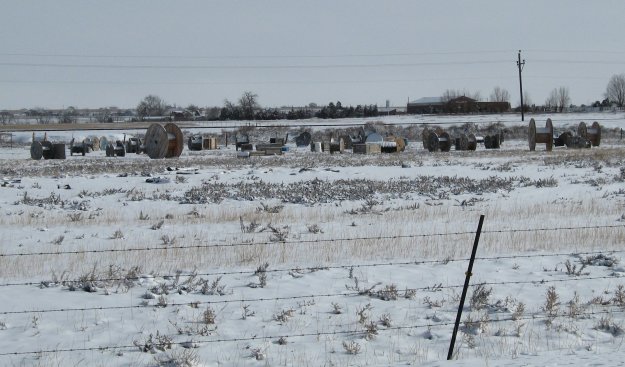
Spoolhenge

Unlike many of my colleagues in the Chemical Industry, say in New Jersey for instance, Th’ Gaussling is able to enjoy a pleasant country drive to and from work every day. Among the many sights to enjoy is Spoolhenge. This curious archeological artifact is thought to have been constructed by ancient electricians in the early Cupracene Age of the Sparkezoic Era.

Who were these people? What strange rituals did they perform in this maze of paleospools? Only a few crude wirenuts fashioned out of elk antler remain in the soil surrounding these ruins.

Writer and amateur paleophrenologist Anders van der Klopp suggests the ruins may have been part of a temple built by ancient astronauts who crash landed on earth in the distant past. Van der Klopp’s panspermia theory is not taken seriously by mainstream paleophrenologists who balk at the idea of electricians in space. Perhaps one day we will solve the mystery.

Spoolhenge

Spoolhenge

Chemical Art in the Public Domain

For the last few years I have been attempting to work with a full professor of chemistry who holds a named chair. He is fast approaching emeritus status and in addition to the other maladies of aging, he tends toward spontaneously bureaucratic demands and is rather hard of listening. His secretary types his correspondence which is written in the officious, pseudo-legalese tone remniscent of a 19th century divorce decree.

Recently, while discussing chemistry with the “judge” by email, I suggested that he look at the patent literature for clues to synthetic procedure. Procedures found in patents may have a general utility and are not automatically claimed. Minimally, a dip in the patent literature broadens ones knowledge of the prior art. Certainly, art found in expired patents has a high likelihood of being up for grabs.

My clumsy and sophomoric attempt at helpfulness sparked a multiparagraph recitation in reply on the anticipatory nature of content in patents and how “such material” is unacceptable for “we in academe”.

Suit yourself, says I. But like any prospector knows, gold is where you find it. And this brings me to a point.

Every week some number of US patents expire or lapse. This continuous stream of expiration represents a situation much like the periodic deposit of placer gold after the spring runoff.  Gold veins in the walls of the canyon spall and fracture allowing gold nuggets and dust to tumble into the creek.  Prospectors who know what to look for can pick up the occasional nugget of art that has fallen into the public domain.

Granted, expired art may be 17 years out of date, but many kinds of compositions and transformations in chemistry are not subject to the expiration of utility. Many kinds of oxidations, reductions, alkylations, halogenations, functional group transformations, etc., remain quite useful over time. What changes over time are the economic and regulatory compliance issues. It is possible to make C-C bonds without a platinum group metal, triflate, and boron.

The value of expired patent art is well known by the pharmaceutical industry. Pharma companies will fight like wounded bears to get extra days added to their patents or otherwise attempt to extend claimed art as far into the future as possible with formulation or other schemes. They know that the day after a cash cow drug goes off patent, there will be generic versions on sale by opportunistic producers.

Prior to June 8, 1995, utility and plant patents were allowed for a period of 17 years with the 17 year clock starting from the application date and the period of enforceability beginning on the issuance date. From June 8, 1995 onward, utility and plant patents are valid for 20 years.

It is in the nature of scientifically minded folk to be forward looking and lavish extra attention on the latest techniques.  In our enthusiasm for the new and exciting, we may forget the vast storehouse of knowledge accumulated over the last 100 years of chemical research.

There is an ever increasing store of public domain art at the patent office waiting to be extracted by those who have the interest to do so. If you do decide to adopt some expired art, it is worth paying attorneys fees to make sure your judgement is sound and to look for related patents that may be problematic. Due diligence is money well spent.

It is true that patents are written by lawyers with little interest in providing too much enablement to the public. But these lawyers also know that playing games with enablement is contrary to the intent of the sworn statements in the application and may ultimately weaken a patent during litigation. A patent isn’t a peer reviewed paper. But, to Phosita, it can be a rich source of clues on how to perform some particular expired art that may serve as the basis of a product or process.