Category Archives: Chemistry

The Most Important Reaction

The most important reaction in industry is the one in which you transform chemicals into money.  It’s about adding value to feedstocks in some way.  A chemical is valued because of some property.  For instance, heptane might be valued because of it’s hydrophobicity, it’s inertness, it’s moderately high boiling point, the solubility (or lack therein) of some material in it, or all of these attributes.  

Heptane is a useful example because it is often used as a substitute for hexane. It has a higher boiling point than does hexane, which raises an interesting point.  The art of synthetic chemistry is in managing reactivity.  In R&D work, when faced with sluggish reactivity, we might be tempted to find more reactive components.  For instance, if sodium tert-butoxide isn’t basic enough, try n-BuLi.  If that isn’t basic enough, try t-BuLi. This series of bases from NaOtBu to n-BuLi to t-BuLi increases in basicity, but it also increases in cost on a $/mol basis.  The hazards also increase.  

But another way to increase reactivity is to increase the reaction temperature.  It is probably the easiest and cheapest way to do it, in fact. Of course, petroleum chemists have known this for quite some time.  Hydrocarbons that are normally inert in the ordinary range of temerpatures, say -78 C to 200 C, become reactive to HF or H2SO4 or zeolites at 300 to 400 C.

A reaction that is sluggish in refluxing hexane may perk up in refluxing heptane, xylenes, or mineral oil.  Most people seem to have an aversion to running a reaction at elevated pressure. This is unfortunate and may be due in some small way to lab culture.  If monies haven’t been provided for a Parr reactor in the past, then there is an “activation barrier” to trying reactions at elevated pressure.  Also, high pressure processing in scale-up is hampered by the requirement for bigger pots & pans with higher pressure ratings.  The practical limit for high pressure in a common metal reactor vessel might be 70 or 90 psi.  general purpose production reactors have mechanical limitations that bench chemists may not have considered.  The agitator shaft has a mechanical seal that is prone to leakage.  The pot will have numerous ports with valves that can can be weak points. General purpose reactors have heating/cooling jackets on them that can leak. All reactors have pressure relief devices called rupture disks that are set to predetermined relief pressures.  Glass lined reactors may have pressure limitations due to the brittle glass that lines the interior surface of a metal pot.

It turns out that in the chemical processing industry, high pressure capability is a capacity that relatively few company’s have.  High pressure capacity is niche work and is nice to have.  Most of us have to manipulate reactivity by other means. 
Some Sunny Day

This link shows the closing scene of Dr. Strangelove.  Why are atomic bomb blasts so fascinating to watch? Of course, the movie was a satire.

But when you see the next one, it becomes much more sobering.  It is a clip from a BBC documentary with CGI enhancement on Hiroshima. Part of the responsibility of having civilian control over military forces in the USA entails that at least some fraction of the civilian population retain a bit of knowledge of topics like this.

I think that when queried, most people will think of an atomic bomb blast as primarily a nuclear radiation calamity. To be sure, there is a healthy gamma pulse and the dispersal of a large variety of troublesome radionuclides, with long lasting contamination issues.  But much of the prompt destructive effect is from the immense heat pulse followed by the blast wave. 

Mutual assured destruction (MAD) as a nuclear strategy was arguably successful because parties on both the NATO and Soviet blocks were more desirous of long life than of the need for the delivery of nuclear hellfire at any cost.  The cold war was a time of opposing political and economic doctrines. MAD was essentially a secular concept.

In the present era of religious theatre, movements citing supernatural endorsement of earthly doctrines are in ascendancy.  The calculus of MAD fails when parties practice nuclear policy under the influence of supernatural euphoria.

Lotsa TSCA

One of the banes of life for a scientist in fabulous industry is having to deal with regulatory compliance.  And, in my opinion, one of the thorniest to contend with is TSCA– Toxic Substances Control Act. Now, for those people who make the same thing day-in and day-out, TSCA is practically invisible. In this mode, your product is either on the list and therefore approved for manufacture, or management has applied for and received some exemption from the EPA.  But for those intrepid characters who are in the business of making new stuff or just lots of different stuff on a regular basis, the question of TSCA compliance is an ongoing minefield concern. 

TSCA is promulgated by the EPA.  Basically, TSCA regulates what isn’t already covered by food, drug, agrochemical, cosmetic, and nuclear material regulations.  TSCA covers chemicals and formulations used in R&D and in general manufacturing.  The TSCA inventory is maintained by Chemical Abstracts Service. With certain exceptions, what is on the TSCA list can be manufactured freely and in any quantity.  The TSCA inventory has a group of listings for public viewing and a confidential group of listings. The balance of chemicals in the universe are those that are not on the TSCA inventory. These are problematic for manufacturers.

One important complication for chemicals that are on the inventory is the SNUR– Significant New Use Rule.  Even though a chemical may be on the list, certain uses may be restricted. So if you plan on manufacturing a product that is on the TSCA inventory, you really should look for SNUR’s.

A chemical product that is not on the public or confidential TSCA inventory cannot be sold for commercial use in the USA. Perversely, you can manufacture for export only.  Products that are not on the inventory can be sold at any scale for R&D use only, however. 

Let’s say that something is on the confidential inventory.  Unless you know this, you would conclude that a chemical is not on the inventory. Well, guess what? You can’t just call the EPA to find out if a chemical is on the confidential inventory. You have to submit an application as if you were going to file for real. If it is confidential, then the EPA will notify you on the normal application timeline.

In order to manufacture something for commercial use that is not on the TSCA inventory, you either have to get it listed by filing a PMN (Premanufacturing Notice) or you file for an LVE (Low Volume Exemption).  Also, any raw materials and isolated intermediates in the process have to be listed. If not, you have to file for those as well. So, initiating the manufacture of new chemicals is complicated by the requirement of performing numerous filings.

LVE’s have a 30 day evaluation period. If you screw up the application, you have to resubmit it and the clock restarts at zero again. The EPA folks look at the chemical process and all of the chemicals and evaluate the potential for harmful exposure to people and the environment.  They use numerous modeling programs to estimate toxicity and potential environmental insult.

In parts of the physical world like the lab or a production area, it is possible to have a physical disaster like a spill, fire, or explosion. In the regulatory world, you have administrative disasters.  And these administrative- or compliance- calamities can be just as costly and career threatening as an actual disaster in the plant. Fortunately, in an administrative disaster the body parts lying around are just metaphors.

[Note: I am not a regulatory specialist.  I acknowledge that I am a mere laboratory wretch and therefore deeply marbled with imperfections and inhomogeneities.  As god dog is my witness, I am prostate prostrate in supplication before those with superior understanding of this topic. I welcome- nay, beg- corrections, comments, and lashings from those with superluminal understanding of this most sacred codex.]

Processing on Demand as a Business Strategy

Process development is one of the jobs I do.  Take an existing process and find ways to make a compound faster, better, and cheaper. The matter of condensing multiple steps into fewer steps is called “telescoping”.  One of the most desired outcomes of process development is to find a way to execute a reaction with fewer labor hours and maybe even higher yield.

My comments are in the context of specialty chemical manufacture. In this domain of industrial activity, it is not unusual for a specialty chemical to be campaigned for production on demand (POD).  That is to say, instead of building an inventory and letting it sit for some time period, it might be more desirable to make material when an order comes in.  This is a valid strategy for products that have a poor shelf life or for compounds whose demand is sporadic. 

But, there are economic arguments for and against POD. On the negative side, the lack of inventory can cause customers to go elsewhere for orders that have to ship immediately. Not every customer can wait until the next hole in the production schedule for a shipment.  Also, unless one has confidence in projected demand patterns and has made a successful business case to management for excess production, POD esentially dooms one to a perpetual cycle of smaller scale production runs with the concommittant smaller economies of scale. 

On the vendor side, getting an accurate picture of demand can be very difficult. The reason is that the manufacturer of a specialty chemical is not often connected to the “final” end use of the product, so timely and accurate market data might be considered proprietary information that the direct customer is not willing to share.

On the positive side, POD assures that the dollars invested in inventory are kept to a minimum.  Management has to be watchful of inventory levels.  It is possible to accumulate large dollar investments in inventory.  Having a million dollars of slow moving inventory is equivalent to having a milllion dollars of working capital sitting on pallets that you can’t use for other applications.  But for POD to work well, the plant must have some excess capacity. And one of the reasons we have sales people is to fill up that excess capacity. So, POD may not be a strategy that works all of the time.

A fair question might be the following- why should an opportunity for process development even exist on an current process? In other words, why wasn’t it done to begin with?  Fair question.  There are a few answers. 1) In the race to get a product to market on schedule, there usually isn’t time to explore all of parameter space. Often, to meet obligations that our friends in the sales force have made, the development timeline can accomodate only a certain amount of R&D activity before something has to go to the pilot plant for scaleup.  2) The reality is that any given R&D group is likely to chose certain favored synthetic approaches from their particular tool bag.  The solution to a scaleup problem is not automatically a global solution to the problem.  A great many syntheses have alternative approaches that may find favor in a particular group. Especially if the literature search was truncated in some way.

In science it is always good to reevaluate your fundamental assumptions, and in manufacturing it is the same.  No process is perfect and every one can be tweaked in some way to optimize the economics.  Some companies have special staff to do just this thing.

Many of us have joked that it is possible to make anything in a single step if only you had the right starting materials.  True enough.  But manufacturing as a profit generating activity requires that value be added to raw materials to produce profitable finished goods. This forces manufacturers to vertically integrate a process to some extent so as to allow for sufficient added value in the finished good. In other words, the more art you can apply to the manufacture of a product, the greater the chance that several of the steps may be highly profitable. 

One way to think about high $ per kg boutique products is as follows.  A product that requires considerable art (skill) is likely to be one that has a mfg cost driven by labor costs.  Products whose costs are driven by labor are products whose costs can be driven down more readily than those driven by raw material costs. A labor intensive product stands a better chance of cost improvements than does a raw material cost intensive product.  The reason? Improved throughput in units per hour already cuts unit labor costs.  You get the picture.

Pomegranate Juice UV-Vis Spectrum

Odwalla Pomegranate Juice

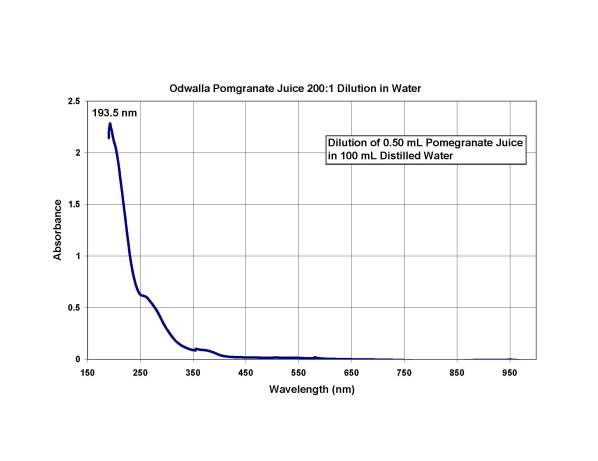
I’ve been really curious about the UV/Vis Spectrum of Pomegranate juice, so I finally broke down and ran the spectrum.  I bought commercially available Odwalla Pomegranate Juice from Safeway and diluted 0.50 mL of this juice in 100 mL (+/- 1 mL) of distilled H2O.  It is approximately 200 to 1 dilution. This commercial juice is also mixed with Chokecherry, Elderberry, Blueberry, Black Currant, and Apple juices, as well as a bit of citric acid. I’m going to try to get plain pomegranate juice for comparison.

I took a bit of the diluted soln and added some metals to it to see if there were any shifts in peak wavelength.  The two shoulders (~250 and ~350 nm) were unchanged in wavelength and extinction, but the extinction of the peak at 193 nm was increased. The metals were SnCl2, ZnCl2, FeCl3, and MnOAc2.  The Mn(II) Acetate has a fair extinction at ~195 nm but drops sharply at ca 200 nm. In all cases the shoulders remained. I would have to run a control to see if the consistent uptick in extinction at 193 nm is due to the metal ions.

When the dilute juice soln was treated with a few grains of NaIO4, the shoulders disappeared and the soln promptly took a clear yellow color. So it should be possible to follow the oxidative degradation of these solutions by UV/Vis.  Since the juice is a complex mix of chromaphores, there is no telling what species are involved and what exactly is being oxidized.  I’m sure that someone has sorted out what is in pomegranate juice. 

This is what I did with a saturday afternoon.

Market Pull and Technology Push

The chemical business is, after all, a business.  You have to make something that somebody wants. Brilliant ideas are a dime a dozen. Getting a new product to market is harder than you might expect, even if you have a purchase order in hand. The transition from bench to 1000 gallon reactor is often full of unanticipated problems.  The process of forcing a new product or technology on a market that didn’t exactly ask for might be called “Technology Push”.  The process of responding directly to a clear market demand is called “Market Pull”.

Market pull is a force that business types, especially the MBA’s, feel best about.  It is easy to justify the allocation of resources to launch into a product development cycle that addresses a clear and quantifiable demand.  Duh. It’s a no-brainer. That is, if there are no bottlenecks to get through. The merits of market pull are only valid if the proposed technology has been shown to work to specifications. Beware of the inventor who cannot produce a prototype to back his/her patent.

Technology push is a circumstance wherein a company has a product or technology that might stimulate demand if it were marketed properly.  Now, an economist might say that there is no such thing as stimulating demand. They’ll patiently explain that this only stimulates an underlying demand that may not have been articulated. Whatever formalism you prefer, it is possible to dazzle potential customers with a new capability.  Clever people can dream up applications that the original inventors could have never anticipated. Look at Symyx with their fantastic technology package for high throughput experimentation.

It is a bit easier to write a business plan based on market pull because the job of forecasting revenue flows should be based on measurable market conditions. Again, the assumption is that the proposed response to the market pull is a technology that works.

A business plan based on technology push has to incorporate estimates of acceptance of change. You see, technology push is the realm of the paradigm shift.  Predicting outcomes from the early side of the timeline is very tricky.  Customers for paradigm shift technologies may be scarce.  Not all companies are interested in being an early adopter or a buyer of first generation technology. 

Market pull is the domain of orthodoxy, of the rightous and proper company president who is also a CPA and who worked his way up the ladder from the accounts receivable department. Technology push is the domain of the engineers and scientists.  These are the dreamers who know in their hearts that if you build it, they will come.

Successful technology companies are somehow able to give a voice to the technology people in the allocation of resources.  Very often, these companies are managed by chemical engineers. While ChemE’s may not be trained in advanced synthesis R&D, they are involved in the scale up and economics of new processes.  Chemists live in a 2-dimensional world of space and time.  Chemical engineers live in the 3-dimensional world of space, time, and money.  Their knowledge of economics is what causes them to rise to the top of the corporate ladder more frequently than chemists.

It seems to me that companies that thrive today are those who do both market pull and technology push. Market pull is the cash cow.  Technology push is the seed corn for next years crop.

The 80/20 Rule

Having done my tour of duty in chemical sales and having travelled over a good bit of the northern hemisphere buying & selling, I’ve picked up a few insights into the B2B and “retail” chemical business.   Everyone has the major chemical catalogs on their desk. You know, the thick tomes from Aldrich, Spectrum, TCI, Matrix, Strem, GFS, Gelest, Fisher, etc.  There is considerable overlap in content, though some specialize in their chosen niches. While Aldrich makes no bones about total world domination, others are pleased just to dominate certain cul de sacs of chemistry. 

SAF is clearly the colossus of international catalog companies.  The Aldrich wing was started by Alfred Bader, now a retired art collector. To hear him tell it, Bader was frustrated by the limited availability of reagent chemicals and spotty service (by Eastman Chemical, if I am not mistaken).   Anyway, Bader was the right character at the right time.  He had a single-minded drive to give chemists what they needed and make a few bucks doing so. The slogan “Chemists Helping Chemists” was a the result of a sincere calling.  Bader visited university chemistry departments and asked professors what they needed.  Over time the Aldrich catalog collection grew and so did the company. Eventually, Bader was quietly forced out of the organization.  Founders can become “problematic” evidently.

Today SAF offers a vast collection of products and makes a sizeable fraction of what they offer.  Most professors don’t know it, but interesting materials from the lab might be saleable to a catalog company. If a prof has developed a new reagent or some useful fragment or pharmacophore, for instance, it might be worth contacting a catalog company to see if they want to stock it. You never know until you ask.

But we business types know that dealing with professors can be sticky, so Herr Doktor Professor, don’t get too high handed or greedy!  Academics are often missing the merchant gene and as a result badly price their wares.  The typical mistake is to over-estimate the demand and hike the price up to the astronomical numbers that you see in the catalogs. 

Here are the problems. Catalog companies do not pay the prices that you see in the catalogs. Buying material for inventory is equivalent to putting a stack of money on the shelf.  They have to pay lots of money up front before the first purchase order for your wonder product is faxed in. They have to pay for those damned fat catalogs, the inventory, salaries, the facility, regulatory compliance, certification, labeling, packaging, the time value of money, taxes, and they have to make a profit for the shareholders. So if the catalog price of something is $10 per gram, figure that they’re likely to keep their costs to $2 to $3 per gram for it, tops.  Obviously, this is subject to variation due the type of material or special negotiated deals.  But a 3x to 5x markup is not uncommon and is necessary to stay in business.

Then, after you ship the product to the catalog house and they put it into the collection, it might not sell.  It could be a dog.  The rule of thumb is that 20 % of your inventory will do 80 % of the business.  So, one of the ways to grow is to increase the number of products. Their interest in your product may be of a statistical nature rather than a firm belief in it’s viability.

I’ve heard many people go off about high catalog prices. I don’t like to pay the high prices either. But it is the cost of convenience.  If you need some obscure material, chances are that you can order it and have it in a few days. That is worth something and the catalog companies know it.  Hell, I’d do the same thing.

UV/Vis Spectrum of Bromine in Water

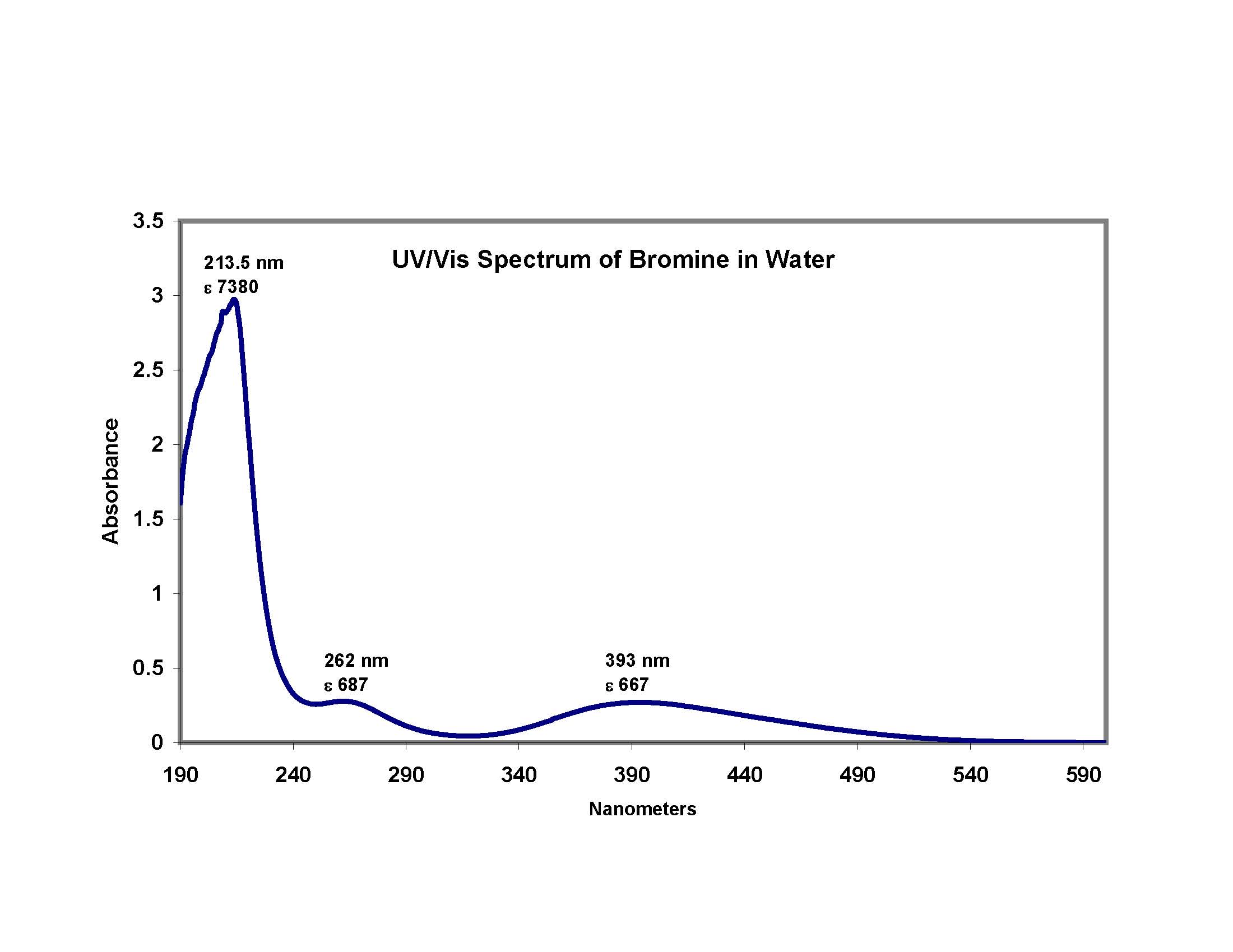
We have a Cecil CE 2041 UV/Vis spectrometer.  Data is collected by the DataStream CE2000 software package. The instrument has 4 nm of resolution, not the best, but still quite usable. To quote the famous British philosopher- “You can’t always get what you want!” (M. Jagger).

This posting is an experiment on how to upload data to the web. The graphic below is a jpeg conversion of a pdf conversion of an Excel chart. Seems like an awkward way to do this. Undoubtedly someone out there can offer a suggestion of how to upload an Excel graphic to the blogosphere.

 uv-vis-of-br2-in-water-rev-2.jpg

It looks like prior to an upload the graphic has to be beefed up a bit.   I’m gonna have to monkey with it some more. Maybe someone has a suggestion.

Organic Qualitative Analysis. RIP.

One of the chemistry classes I took as an undergrad continues to assist me in my synthetic endeavors mid-career.  The class was organic qual.  It was designed to take the student through the determination of an unknown organic compound , or mixture, with the aid of qualitative tests and derivitization to figure out the compound. We did small visual tests to guage acidity, basicity, water solubility, etc. We did sodium fusions to look for halides, 2,4-DNP hydrazones for carbonyls, picrates of amines, and flame tests to make a guess at saturation. We were given just so many grams of unknown and we had to perform several tests to support a claim of identity. It was an excellent experience because an organic prof taught the actual lab section.  We had access to the lab during the week to work on the unknowns. 

We used derivitization to determine some of the more difficult unknowns. CRC Press had a book of physical properties of a large range of known compounds that were derivatized, so you’d compare mp’s, color, bp, solubility, etc., to make a case for identity.

I would be interested to hear if this is still in the curriculum out there. I fear that it has passed along into history in the face of the hyphenated cryptozoology of todays analytical instruments.  That’s a pity.  Organic qual gave me the chance to handle chemicals, perform reactions, deal with ambiguity,  and do tests that might be hard to work into the rest of the curriculum.   Part of being a good organic chemist is racking up lots of time in the lab doing stuff, polishing up the physical intuition and mechanical skills.

I am embarrassed to admit that at one time I embraced the idea that the organic microlab experience was good pedagogy.  I now see it as more of a phenomenon meant to stretch department budgets. The idea of giving students barely enough reagents to make 100 mg of something is pretty dubious.  If the student goofs and spills something or makes a mismeasure, they might end up with 25 mg of product. The isolation of this amount of mass is problematic for fresh learners.  I miss the days when the organic lab kit had 25, 50, 100, and 250 mL flasks in it (19/22 ST joints, of course). 

The argument goes something like this: Our conversion to microlab equipment is justified because of the cost saving gained by going to a lower scale. We buy fewer grams of expensive reagents and we lower waste generation for the department. Well, this is a bunch of self-serving crap. I can just see the department chair’s pointed head nodding in agreement as some tenured Poindexter drones on about minimizing the negative impact on the environment.  

For Christ’s sake, we’re talking about chemistry, not church camp.  Minimally, chem majors should not be cheated by limiting them to the microscale experiments.

If you want to save the environment, stop driving your SUV down to 7-11 to get cigarettes.  Or, don’t bring home so much cheap plastic crap from Big Box Mart.

Colleges should be giving their chemistry majors more synthesis experience, not less.  In industry it can be a real problem finding fresh BS/BA graduates that have lab experience beyond sophomore organic lab.  Schools that promote lab-based synthesis research for undergrads (as opposed to computation) are doing their students a bigger favor than they may realize.