Category Archives: Climate and Weather

Incinerating plastics for electric power

Abstract: I’m going to make a pitch for incinerating plastic. Yes, it will indeed produce CO2. But as we go merrily down the reduced carbon footprint path, I think it is reasonable to exempt certain activities from stringent reduction. One of them is incineration of waste. It can be done efficiently while generating electrical power and can be put to use in getting rid of BTU-laden waste combustibles like plastic.

Synthetic polymers, i.e. plastics, long ago rose to a high level of production due to demand. In particular, plastics like polyethylene (PE), polypropylene (PP), polystyrene (PS), polyethylene terephthalate (PET), polyvinyl chloride (PVC), polyvinyl acetate (PVA), polyurethanes, polymethylmethacrylate (PMMA), various polyamides and adhesives are produced at incomprehensible scale. Within several of these major polymer varieties are their copolymers. LDPE is a good example. Low density polyethylene is a copolymer of ethylene and alpha-olefins like 1-butene, 1-hexene, and 1-octene. Placing the olefin group (C=C) exclusively at the 1-position requires some large-scale wizardry as internal olefins are thermodynamically more stable. Generally, commodity scale alpha-olefins have the terminal olefin put in place as they are made, not afterwards. These comonomers interfere with crystal formation within the bulk polymer. This has a large effect on many things including melt temperature, melt strength, stiffness, glass transition temperature, puncture resistance, tensile strength and lower density.

||| Side Note: Alpha olefins have other uses besides polymer manufacture. They are a crucial raw material for plasticisers, soaps/detergents, lubricants and oilfield chemicals. Interestingly, ethylene is a ripening hormone used by fruit.

The low unit price of plastic products like films, food packaging and medical packaging along with steady marketing has conditioned the consumer to expect such goods as disposable. And the plastics industry is happy to fill that expectation. Single use applications fill homes, businesses, hospitals … everywhere. Single use plastic waste also fills landfills, the countryside, waterways, and increasingly the oceans.

Recycling of plastic waste is complicated. Plastics may be made of just the pure homopolymer with only a single repeat monomer or along with a copolymer. A blend of mixed polymer waste may also contain a dog’s lunch of pigments, soot, intumescent additives, plasticizers, glue residues or labels, multiple layers of different polymers and UV blockers- components that you are unlikely to want to transfer into the final product. Even if you neglect the additive problem, there is always the immiscibility of different polymers. Yes, mixed polymers do not always form a homogeneous melt. This is a problem for everyone down the value chain.

Making polymers

While the end-use consumer is the final customer of the producer’s polymer, it is the converters who order the resin pellets directly from the polymer producers or wholesalers. Those who design the plastic article may or may not do a deep dive into the exact brand and grade of plastic to be used. Certainly there many articles (toys) that can be made from a variety of plastic brands and specifications where buyer input may be unknowledgeable or minimal. For many buyers of finished plastic goods, like everything price is likely to be the major parameter.

Users of performance polymers for demanding applications requiring particular polymer specifications will be more specific in their requirements.

The converters blow continuous films or do the injection or blow molding for those who set the final product specs. The converters buy their raw polymer on the basis of specified properties. One measure of the suitability of a particular polymer grade relates to the torque required to produce the maximum number of widgets per hour from the extruder. The converter’s business economics depend on throughput. A polymer that is otherwise wondrous to behold but its melt is too viscous will be problematic for the converter if it requires considerable torque from the extrusion equipment.

Make no mistake, retailers like Home Depot or Menard’s neither know or care about polymer specifications, nor do the end users. The companies who distribute wholesale products are specialists in warehousing and shipping and are unlikely to know polyurethane from HDPE because they don’t need to. The engineers who design and specify properties for the manufacturer are the key decision makers in the value chain.

The plastic manufacturer produces a polymer to give a set of particular physical properties. The converter takes the polymer pellets and combines them with additives, if any, to meet particular specifications. Polymer properties depend to a large extent on their thermal history. Once melted and cooled a polymer’s physical properties can change. Heating and cooling can lead to new phase transitions not present in the pellets. One change could be the glass transition temperature where the rigidity of a polymer changes from glassy to rubbery. Imagine a plastic coffee cup with a glass transition temperature of 75 oC trying to hold 87 oC coffee. Such a cup sags when the coffee is poured in. This is no good. The phase changes like glass transition temperature or melting temperatures can be identified with Differential Scanning Calorimetry (DSC).

Synthetic polymers such as PE are everywhere in our lives. These polymers are made from crude oil or, especially in the US, natural gas feedstocks. Collectively we consume and throw away massive amounts of polymer waste. The effort to recycle plastic in the US has largely been a failure due in part to insufficient segregation and cleaning. Closing the loop with a strong demand for recycled plastics has also faltered. Apart from recycling, what else can be done with it?

Plastics as fuel

Sending a metric ton of polyethylene plastic to the landfill produced the same energy as sending a ton of gasoline or diesel to the landfill in terms of potential energy. Synthetic polymers are either entirely hydrocarbon in composition or mostly so with some oxygen, nitrogen or chlorine thrown in. The fundamental fact is that these polymers are high in BTU content. The downside is that they ignite poorly due to the lack of volatiles. The polymers have to be thermally “cracked” or depolymerized to form volatile components that have a lower flash point. This cracking requires higher ignition temperatures than liquid or gas fuels.

Specific energy density refers to the amount of chemical energy per kilogram of material. In the table below the top three listings are pure hydrocarbons. Coal contains hydrocarbons but also minerals that do not contribute to overall combustion energy.

SubstanceSpecific Energy (MJ/kg)
Diesel Fuel45.6
Methane55.6
Polyethylene (PE)46.3
Coal, Bituminous24 – 35
Specific Energy. Source: Wikipedia.

In liquid combustion, it is the vapor above the liquid that burns. All liquids have a certain fraction of substance in gas phase at equilibrium above it at a given temperature. The flash point is the temperature in which the vapor can sustain combustion. Here is the official definition-

Source: Wikipedia.

In normal use, flashpoint (Fp) is used to gauge the ease of ignition of a substance when exposed to air. The Fp allows us to partition high hazard from lower hazard combustible materials high flashpoint liquids like motor oil pose less of a fire risk than does gasoline or propane. In the Globally Harmonized System (GHS) of Classification and Labeling of Chemicals,-

Flammable liquids are categorized by flammability, from Category 1 with a flash point < 23 °C and initial boiling point < 35 °C to Category 4 with flash point > 60 °C and < 93 °C.

Naturally, in the US we do it a bit differently with categories Flammable and Combustible

Flammable– Flash point < 100 oF (38 oC), e.g. gasoline, methanol, acetone, natural gas

Combustible– Flash point > 100 oF (38 oC), e.g., paper, organic dusts, cooking oils

The US system is easier to remember than is the GHS but is perhaps a bit imprecise.

Plastic combustion

Why all of this vapor pressure stuff? It turns out that most plastics like polyethylene or polyethylene terephthalate (PET) have insignificant vapor pressures at room temperature. This is due to the extremely long chain lengths of the polymer and its subsequent high molecular weight. Considerable energy is needed to loosen these polymers from the liquid phase into the gas phase. So, the trick is the use pyrolysis to crack the long chains into shorter and more volatile pieces. This can be called destructive distillation like the process used for making coal gas. But this requires an input of energy to raise the temperature high enough to do the cracking.
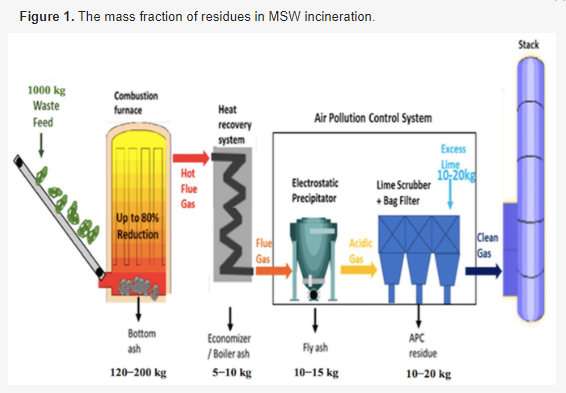
Source: Kanhar, A.H.; Chen, S.; Wang, F. Incineration Fly Ash and Its Treatment to Possible Utilization: A Review. Energies 202013, 6681. https://doi.org/10.3390/en13246681

Plastic pyrolysis is conducted at temperatures between 300 oC and 1000 oC with residence times between 0.5 seconds to 100 minutes, depending on the temperature. YouTube has videos of people using homemade pyrolysis reactors to produce a diesel-like composition. The thermally cracked polymer produces vapors that are condensed and recovered. There are a few examples of homebrew crackers that vent the exhaust subsurface into water to condense the vapors. Seems clever until you realize that when the cracker begins to cool, the fluid in the condenser tank will siphon back into the still hot cracker and flash explosively into vapor. An inline trap could easily prevent this.

Columbia Climate School

In addition to heat for steam production to drive electrical generators, pyrolysis of plastics will indeed produce CO2, hydrochloric acid (from PVC) as well as ash and char. Properly done, the ash, char and hydrochloric acid can be effectively scrubbed. Some thought will have to be given to the ultimate disposition of solid residues which will contain what remains of the mineral additives found in some plastics. Some may not be friendly.

By merely existing on Earth, humans will continue to produce air, water and soil pollution. We’ll continue to burn fossil fuels to some extent and continue to belch combustion gases into the air. I think this is a given. Humans will continue to collect raw materials for manufacturing. A mass movement to live a more modest, low consumption zero carbon footprint life is unlikely to occur. But, how about just a lower carbon footprint?

The point of this little pyrolysis excursion is that plastics are a potential energy resource that we wantonly toss into the landfill or in the street. Pyrolysis always produces solid waste residues which must be disposed of, so waste is still being produced, but a smaller volume than the plastic waste. As usual, the costs and benefits of the process depend on the balance of input costs vs output value.

As of March 2024, the CO2 level is a 425 ppm. We should remember that we do not have to drop the atmospheric CO2 to the level of the year 1800, just below some value like 350 ppm according to Columbia University. What we can do now is to begin living a somewhat lower consumption life. Instead of driving 5 miles to 7-Eleven in your F-150 to buy Miller Lite, cigarettes and lottery tickets, consider making all of your purchases next time you gas up. Consider backing off just a bit on plastic consumption.

Oh, and shut off the damned lights when you vacate a room. Unplug “wall-wart” device chargers that are not in use. They draw a trickle charge even when not in use. Have an “instant-on” TV or stereo not in use? Unplug it. The instant-on feature uses electricity to stay instantly ready for you. If it doesn’t “click” or it switches on/off by remote, it is likely an instant-on device. There. I’m finished now.
Zombie Oil & Gas Wells in Texas

Much has been written about the gas & oil industry in the US. My aim only is to highlight the leaking, not actively producing, oil & gas wells.

Many states have a problem with orphaned and zombie wells. Big ole Texas has a problem with orphaned and “zombie” oil wells also. Over time, oil and gas companies have been abandoning uncapped oil and gas wells in their eternal haste to produce “Black Gold, Texas Tea.” Inactive or non-compliant wells with delinquent organizational reports (Form P-5) for more than 12 months are called “orphan” wells in Texas. The state of Texas does have procedures for the disposition of orphan wells. Wells may be abandoned because of low output or the owners going bankrupt. It is possible to take over an orphaned well, though why would someone takeover a depleted orphan well or a low output well?

What’s worse, even the capped wells have begun to leak because of the corrosion and decay of well casings and plug material. The leak may be far down the hole or near the surface. These abandoned wells that are now leaking are called “zombie” wells. The zombie wells push up brackish water along with hydrocarbon liquids and vapors into the atmosphere and the surface soil as well as underground into the water table. Some underground flows are large enough that sinkholes form and fill up with polluted water.

The Oil & Gas division of the Texas Railroad Commission is responsible for “Regulating the exploration, production, & transportation of oil and natural gas in Texas.”

In a September 14, 2022, article in the Houston Chronicle, James Osborne writes

Source: Houston Chronicle

Following up, Amanda Drane writes in her July 17, 2023, article in the Houston Chronicle

Source: Houston Chronicle

The Texas Oil & Gas Association has stated-

Source: The Houston Chronicle.

As can be seen, the Texas Oil & Gas Association seems to feel that it has done its job with orphaned wells. The Teflon-coated Texas Oil & Gas trade association did what trade groups are supposed to do- shield their members from public blame and immense liability.

One component of crude oil & gas is hydrogen sulfide (H2S) which resides in both the liquid and vapor phases. This component is capable of both oxidation in the air to form a series of variously oxidized sulfur products as well as elemental sulfur itself. Hydrogen sulfide is extremely toxic and prone to cause olfactory fatigue in humans. The odor threshold is extremely low which could lead one to safely vacate the area, but the “nose numbing” effect on the sense of smell can lead to a false sense of security and continued exposure. Most cases of intoxication occur in confined spaces, however.

In a way, drilling for and striking oil & gas is like opening Pandora’s box. The well can produce valuable oil & gas, but along with it comes produced water with undesired dissolved minerals, petroleum and drilling residues. It seems clear that the State has a compelling interest in the final disposition of the well. The driller or party who owns the drilling rights to the well should be financially responsible for its clean shutdown. Bankruptcy should not absolve a company from responsibility for trouble the well brings.

This post is limited to the issue in Texas but it can exist anywhere oil & gas drilling has occurred. Obviously, the oil & gas industry represents a massive amount of economic activity and consequently it has enjoyed a privileged position in American industry in terms of regulations. It is doubtful this will change but that doesn’t mean that the beady eye of scrutiny should blink.

Even if hydrocarbon vapors and other gaseous substances blowing out of wells were not greenhouse gases, can’t a case be made for capping-off wells just to prevent pollution? There is a mentality out there that holds that if some pollution action is not mandatory, then it is not necessary. Their response to a problem is often that they “met regulatory standards.” That is, they would have done less if they could have.

The Eclipse Viewed from Lagrange Point L1

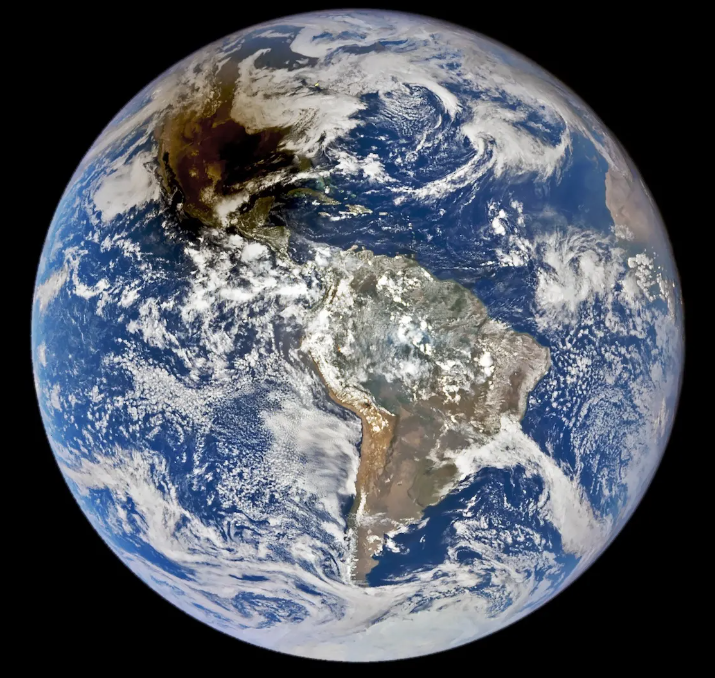
Here in Colorado, we were located north of the totality band in the partial annular eclipse region that swept across the US last week. I’ve seen annular eclipses previously so it was a been-there-done-that event for me. Below is a great photograph from NASA showing the eclipse from the DSCOVR (Deep Space Climate Observatory), a satellite jointly operated by USAF, NASA and NOAA. This satellite is in a non-repeating Lissajous orbit at the Lagrange point L1 about 1.6 million kilometers from Earth. It has also been called a looping halo orbit. At this location, it has a perpetual fully illuminated view of the Earth which rotates below it. The exception would be when the moon is in this part of its orbit.

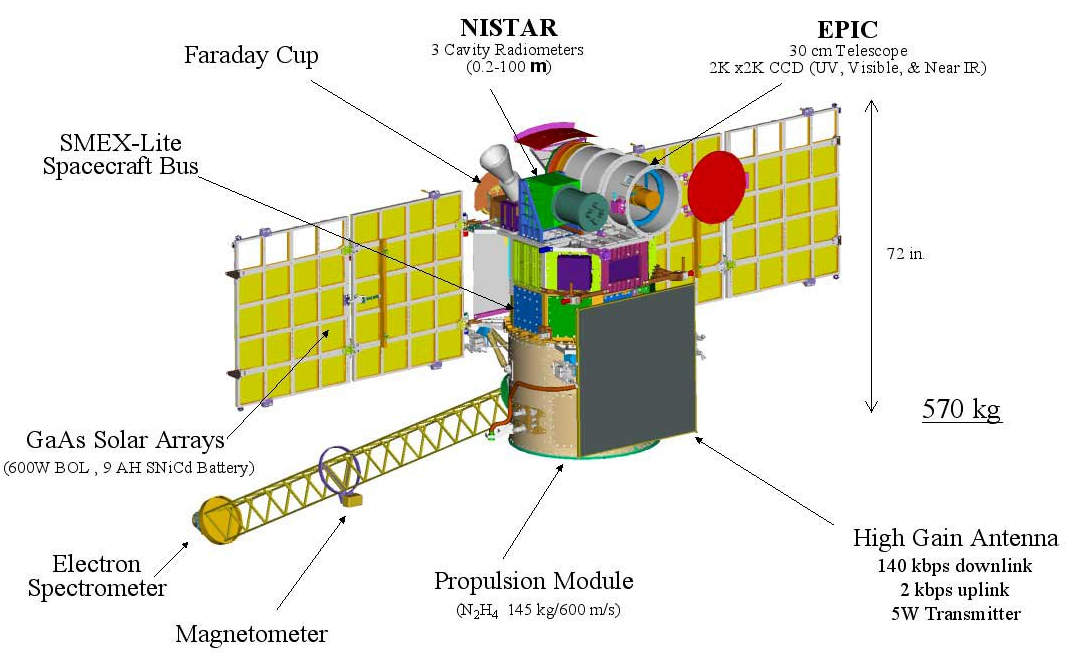
The probe carries numerous sensors to allow measurements of the earth and space environments.

Source: NASA October 14, 2023 Annular eclipse. It is the dark spot on North America.

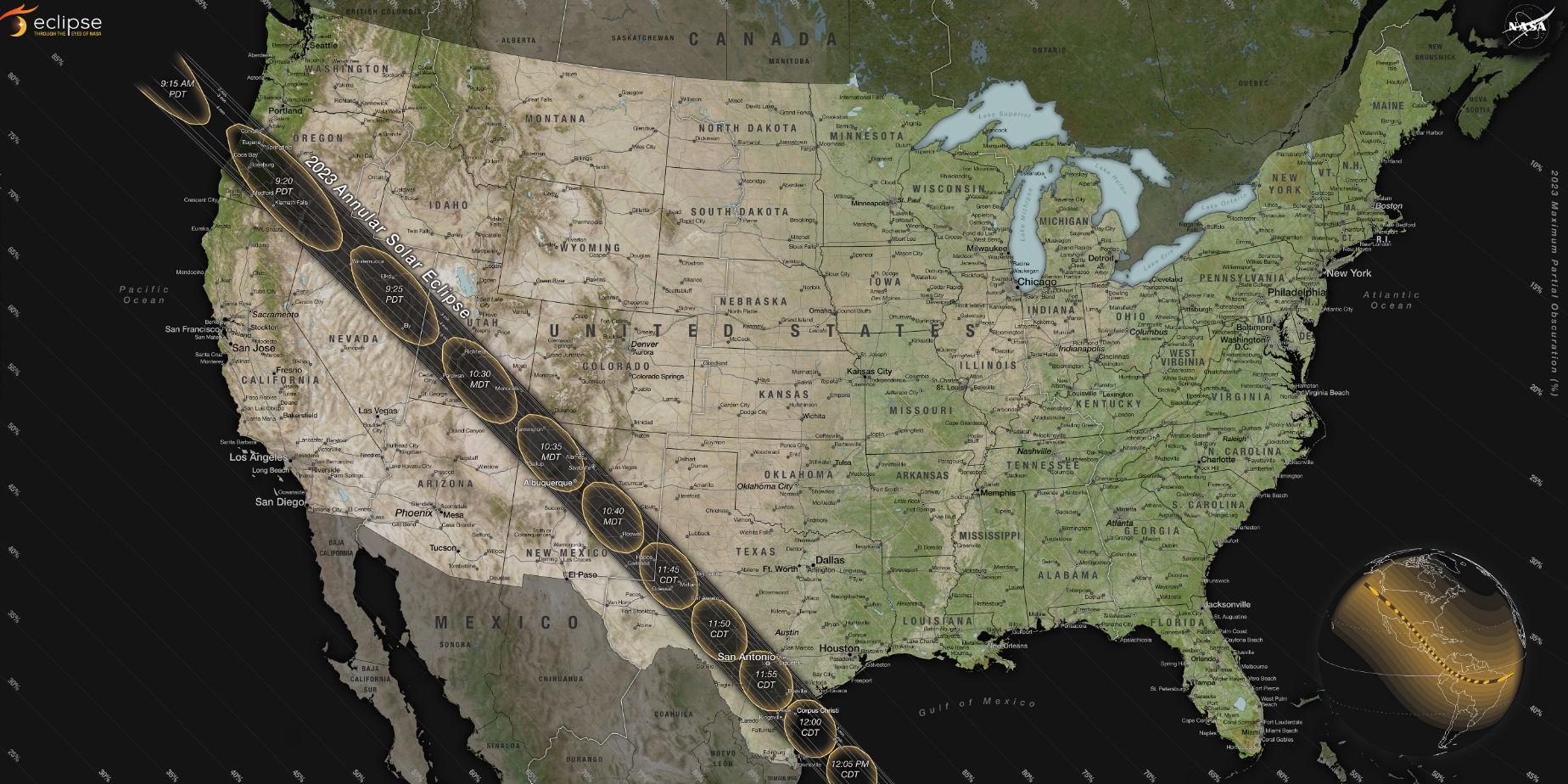
The band of totality stretched across the southwestern states October 14, 2023.

Source: NASA. Path of the annular eclipse totality.

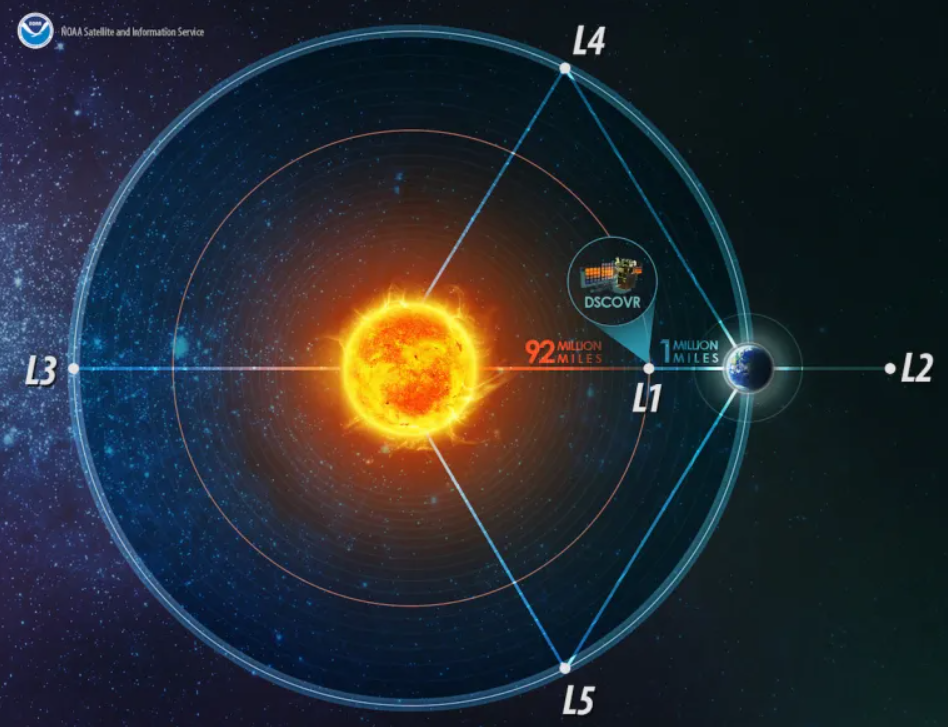
Lagrange points arise from two large masses in gravitational proximity, in this case the sun and the Earth. Relative to the two large masses the 5 Lagrange points allow for stable “parking orbits” for small objects like a satellite. Objects are placed in orbit around the Lagrange points to remain roughly stationary in relation to the Earth-Sun system.

Source: NASA. Lagrange Points.
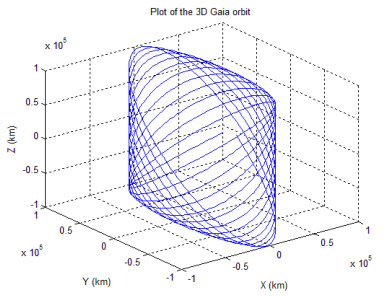
Source: Jordi Carlos, GarcĂ­a GarcĂ­a, Universitat Politecnica Catalunya, 2009. A three-dimensional view of the simulated Lissajous-type orbit of the Gaia probe about L2.

According to Wikipedia, a Lissajous orbit differs from a halo orbit in that it is quasi-periodic and dynamically unstable, needing occasional station-keeping actions by the probe. A halo orbit about a Lagrange point is described as a periodic, 3-dimensional orbit.

The history of the probe is a bit odd.  It was launched by SpaceX on a Falcon 9 v1.1 launch vehicle on 11 February 2015, from Cape Canaveral. DSCOVR, initially called Triana after Rodrigo de Triana, the first European explorer to see the Americas. The mission began as a proposal by Vice President Al Gore in 1998 as a whole earth observatory at the L1 point. The probe’s mission was put on hold by the Bush Administration in January 2001 and officially terminated by NASA in 2005. The probe was placed in nitrogen blanketed storage until it was again funded, then removed and tested for viability in November 2008. The Obama Administration funded it for refurbishment in 2009 and the mission was fully funded by 2012. The Air Force allocated funds in 2012 for its launch and awarded SpaceX the contract. On February 11, 2015, the probe was finally launched from Cape Canaveral, FL. Management of DSCOVR is provided by NASA’s Goddard Spaceflight Center.

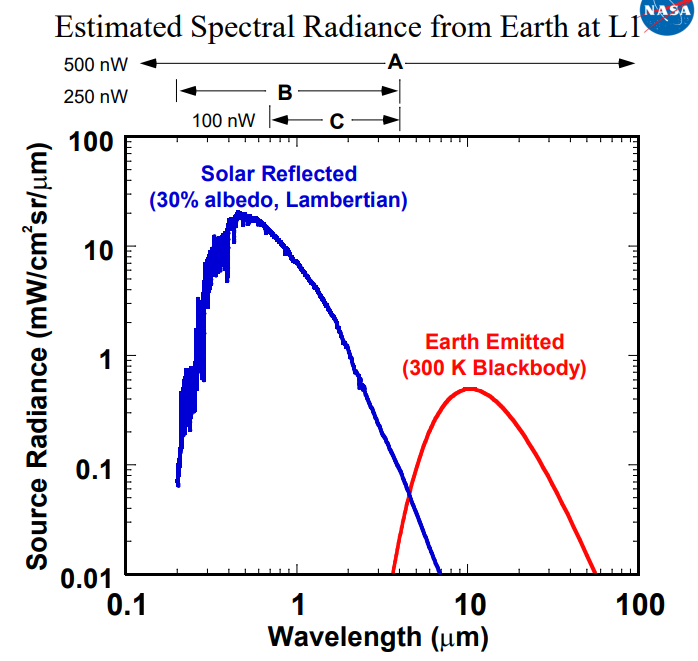
The NISTAR instrument on board the DSCOVR probe was provided by the National Institute of Standards and Technology, NIST. NISTAR is a 4-band cavity radiometer and is located as shown below in orange. It measures reflected and emitted light in the infrared, visible and ultraviolet parts of the spectrum. The instrument is able to separate reflected light from Earth’s radiant emissions.

Source: Wikipedia. The DSCOVR probe.
Source: NASA, Steve Lorentz, Allan Smith, Yinan Yu, L1 Standards and Technology, Inc. Graph showing the parts of the spectrum where reflected and emitted radiation from Earth is to be found.

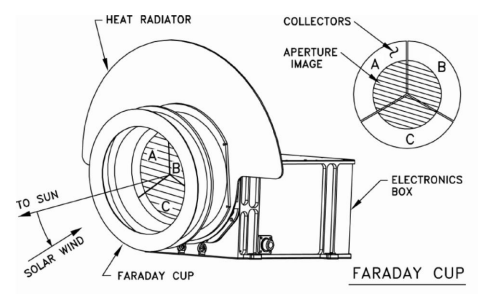
The Faraday Cup (FC) is a sensor that collects and quantifies the flux of positively charged particles in the solar wind, i.e., protons and helium nuclei. Variations in the solar wind speed are observed. In the course of operation they discovered that the solar wind is “colder” than was previously thought in terms of what is referred to as “thermal speed.” The researchers presented thermal speed numbers on the order of 300 to 500 km/sec.

Source: NASA. The faraday cup on board DSCOVR.
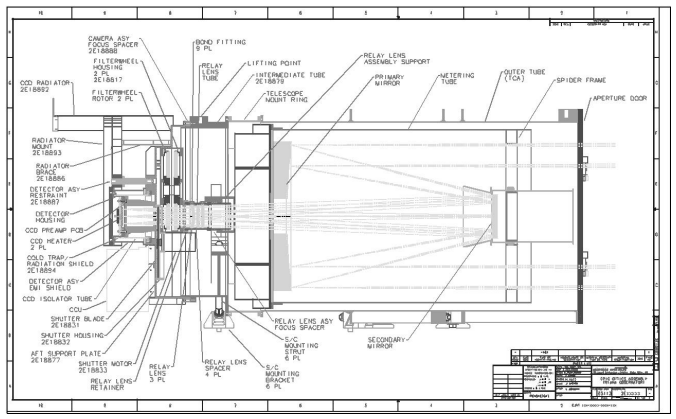
Source: NASA. The imaging camera- Earth Polychromatic Imaging Camera (EPIC). Sorry about the tiny print size.

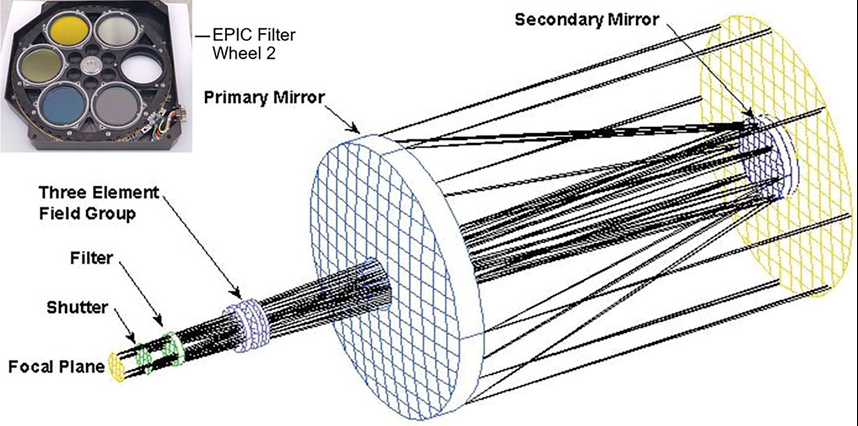
Schematic of optical system of EPIC.

Source: Alexander Cede1,2,3*, Liang Kang Huang2,4, Gavin McCauley1, Jay Herman2,5, Karin Blank2, Matthew Kowalewski2, Alexander Marshak2, Front. Remote Sens., 09 July 2021, Sec. Satellite Missions, Volume 2 – 2021 | https://doi.org/10.3389/frsen.2021.702275. Copyright Â© 2021 Cede, Kang Huang, McCauley, Herman, Blank, Kowalewski and Marshak. The optics of the EPIC camera are that of a Cassegrainian style telescope.
  • 1SciGlob Instruments & Services LLC, Elkridge, MD, United States
  • 2Goddard Space Flight Center, NASA, Greenbelt, MD, United States
  • 3LuftBlick, Innsbruck, Austria
  • 4Science Systems and Applications, Inc., Lanham, MD, United States
  • 5Joint Center for Earth Systems Technology, Baltimore, MD, United States

The probe has a 420 kg dry mass and its solar panels provided an initial 600 watts at 28 volts. The probe attitude and translational motion is managed with a set of 4 reaction wheels and 10 hydrazine thrusters. The hydrazine, N2H4, monopropellant is decomposed over a bed of catalyst prior to ejection. This decomposition yields hot N2, H2 and NH3 gases.

Like many satellites, DSCOVR uses reaction wheels for attitude control. Of the 4 reaction wheels, 3 are for axis-control and the 4th is used as a spare. Each wheel is driven by an electric motor. When the angular velocity of a single reaction wheel changes, there is a proportional counter rotation, resulting in a change in attitude about that 1 axis. Since the wheel velocity can be precisely controlled by the electric motor, fine adjustments in attitude can be attained.

Low Water Slows Traffic Through the Panama Canal

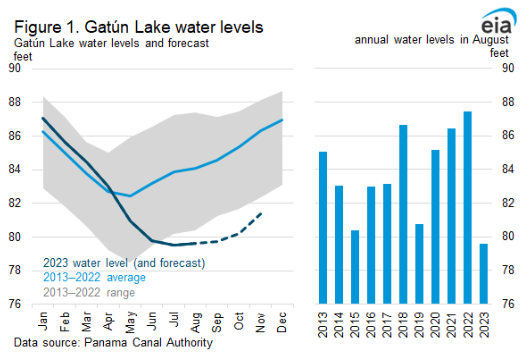
The US Energy Information Agency, EIA, released a notice about low water levels from a historic drought in the Panama Canal region is slowing the passage of large ships. In particular, the Very Large Gas Carrier (VLGC) vessels are restricted which affects the transport and price of Liquified Petroleum Gas (LPG). According to the Panama Canal Authority (APC), water levels in the canal are at their lowest levels since 1995 and are expected to stay low if the drought is prolonged.

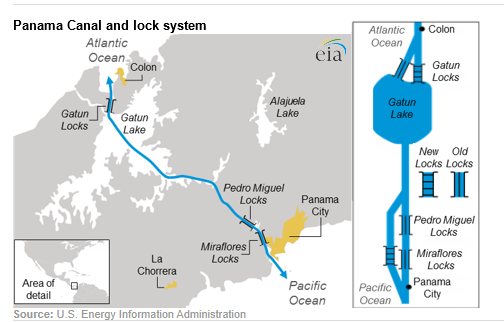
The core of the problem is low water levels at Gatun Lake. This lake is a key part of the system. It is an artificial reservoir that sits between the Atlantic and Pacific oceans providing water and power for the lock system. Due to a prolonged dry season and below normal precipitation, the APC has enacted water saving regulations.

Source: Charts from EIA

The largest fraction of US-provided hydrocarbons carried through the canal by VLGC vessels is propane which is used for petrochemical applications and highly seasonal heating demand. Increased demand for US propane in East Asia has put pressure on the canal due to increased vessel demand.

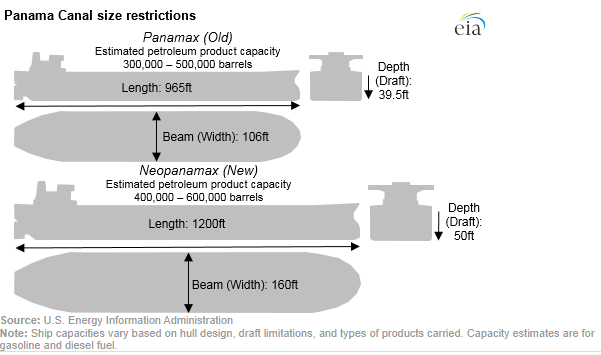
The canal has two types of locks- Panamax and Neopanamax. Ships are rated according to their size and draft as seen in the EIA graphic below.

Source: Graphic from EIA.

The base cost of transit for Panamax VLGC vessels is $300,000. A smaller gas or chemical carrier using the Panamax locks has a base cost of $60.000. The low water problem has restricted the flow of traffic through the canal to just 32 transits per day- 10 for the Neopanamax and 22 for the Panamax. Other routes to Asia are around the Cape of Good Hope or through the Suez Canal.

Source: Graphic from EIA.

Due to low water, restrictions have led to a waiting time of 13 to 17 days to transit the canal during August. According to Reuters 8/22/23, 125 booked and non-booked vessels were waiting to pass. As of this date, restrictions allow vessels with a maximum 44 foot draft. According to EIA a 6 foot decrease in draft can lead to a 40 % reduction in cargo.

How much CO2 reduction do we actually need?

I am asking this question because the transition away from fossil fuels will have a serious knock-on effect on a very large sector of the global economy. Of the total liquid hydrocarbon production, 14 % goes to the petrochemical markets. Of natural gas production, 8 % goes to petrochemicals.

There is a serious complication connected with the idea of shutting down the combustion of hydrocarbon fuels. The elimination of oil and gas combustion activity means that crude oil production drops precipitously and therefore so would refining. Oil refineries are designed to maximize the volume of their most profitable products while minimizing their cost to manufacture. I refer to gasoline, diesel and aviation fuel. Petrochemicals come from oil and gas. Their economics ride on the coattails of fuel production to some extent in terms of scale. Refineries are physically large operations so as to operate with the maximum economy of scale. Maximum economy of manufacturing scale drives consumer prices downward.

Refineries produce much more than fuels. They produce asphalt, lubricating oil, polymer raw materials, petrochemicals for pharmaceuticals and other raw materials for thousands of products we take for granted. There are countless uses for petrochemicals beyond throw-away plastic bottles and bags. Just look around where you are sitting this very moment. Unless you are in Tierra del Fuego or Antarctica, you can’t help but see examples of hydrocarbon applications.

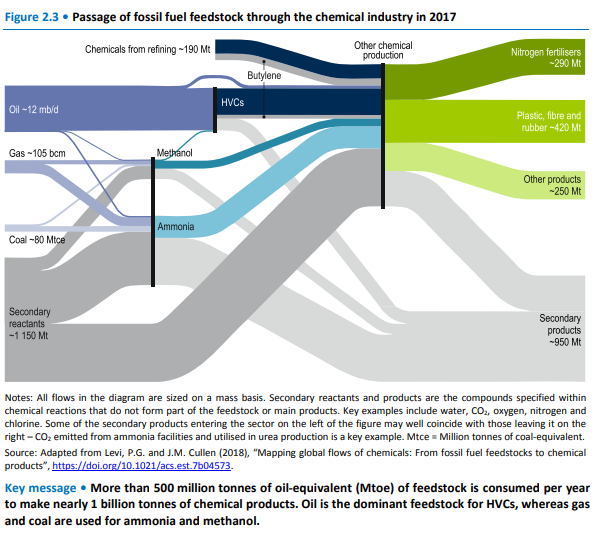
The Future of Petrochemicals, IEA
Flow of oil and gas streams to chemical product production. Source: The Future of Petrochemicals, IEA.

Could refineries adapt to the loss of a large fraction of their fuels production and still produce petrochemicals? Engineering-wise, I’d say yes. But as far as economics go, that is a harder question to answer. Company officers have a fiduciary responsibility to the stockholders. This is a baked-in feature of corporate business. The promise of ever-increasing margins and volumes is part of that. Switching gears towards sustaining the petrochemical sector in the face of declining fuel sales is natural in one sense, but if it involves declining EBITDA over time, it could be disastrous for the stock market. Petrochemical prices might have to climb drastically to sustain earnings. Players in the global oil & gas market are extremely twitchy. The mere suggestion of a potential problem is enough to send prices soaring or diving. Luckily, a wind-down of fuel production will take some time during which the players might be able to compensate.

Look around you. How many consumer goods come in plastic containers or plastic film-coated paper? All of our electronic devices are built into casings of some sort, most of which have plastic or fiberglass (resin impregnated glass fiber) components. The list is endless. For many or most of these things to stay on the market, a substitute material will be needed to replace the hydrocarbon-based materials. Wooden casings for computer monitors and iPhones? What about paint? Paint is loaded with hydrocarbon components.

A vast number of products we take for granted use hydrocarbon materials in some way. Perhaps renewable plastics will scale to meet certain demands. Recycling applies only to those plastics that can be melted- the thermoplastics. Thermoset plastics like melamine cannot be melted and so cannot be recycled. Recycling only works if consumers close the recycling loop. Plastics must be carefully sorted in the recycle process. When a mixture of plastics is melted, the blend can separate like oil and water producing inferior product. National Geographic has a good web page describing recycling.

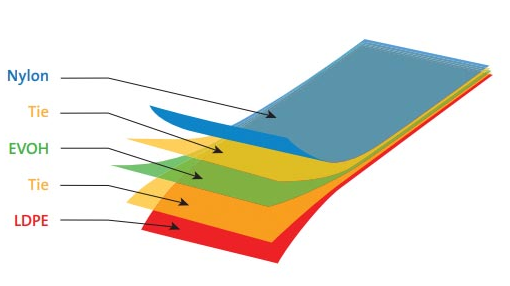
Some plastics such as clear, colorless polyethylene films are usually pure polymer. Most synthetic polymers are colorless. In general, any synthetic polymer that is colored has pigments in it. Black plastic is loaded with soot for instance. Many polymer films for packaging are multilayered with different types of polymer layered together.

Waste thermoplastic with food residues is very problematic, especially those with oil residues. Waste plastic for recycle must be clean. Multilayer plastic films are not suitable for recycling either.

Source: Technical Bulletin, Saint Gobain. Multilayer film structure with 3 different films and two tie layers between them. The Nylon layer provides toughness and tear resistance. The polyethylenevinyl alcohol (ethylene-vinyl chloride copolymer) layer (EVOH) blocks the transmission of oxygen and carbon dioxide. Low density polyethylene (LDPE) layer provides broad chemical compatibility along with biocompatibility for safe handling of biopharmaceuticals. Not all polymers are compatible with melt bonding. The tie-layer is a melt-bondable adhesive polymer film that hold the layers of polymer into a single film. The tie layer polymer is often a polyethylene film that has a surface layer of organic acid or anhydride groups that can bind to other polymers by melt bonding.

Other additives such as plasticizers are present in flexible plastics like polyvinyl chloride (PVC) or other compositions where suppleness is important. Pure PVC is rigid. Additives are an industry unto its own. The varieties and grades in the plastics business is mind boggling. The variety of plastic compositions is too diverse to allow recycling of all plastics.

Polymer manufacturing is likely to continue indefinitely. There is simply too much money at stake for the big oil & gas and petrochemical players to deconstruct themselves to a large extent. They will, however, follow the consumer, but how far?

So, the question is this- for the sake of keeping a viable petrochemical stream in place while hydrocarbon fuel consumption declines, how much hydrocarbon fuel can we burn per year without exceeding the capacity of the earth to absorb the CO2 produced? We want to lower the slope of the atmospheric CO2 curve enough to achieve a reasonable steady state. The global economy depends very much on the production and use of petrochemicals. People will generally avoid economic suicide.

Where is the balance point for a sustainable production of necessary petrochemicals and the decommissioning of hydrocarbon fuel production? I certainly don’t know.

Late Night Thoughts on Twisters, Replay.

Now that we are well into tornado season in North America, I thought I’d dredge this old 2007 post up out of the cobwebs in the dungeon. As Uncle Al pointed out in the comments, Middle Easterners did have dust devils so a vortex of wind was not unknown there. These, however, are no match for a full-blown F4 tornado.

==========

One has to wonder what the original inhabitants of North America thought of the tornado (how do you say “WTF” in Lakota?). Without a doubt, Native Americans were visited by tornadoes. The experience must have certainly left an impression. It would be interesting to hear any stories that may be out there.  This topic has been the subject of scholarly study.

Little record of native American lore remains regarding their experiences with the tornado.

“The Cheyenne language has several words for tornadoes and their related storms: hevovetaso (tornado), ma’xehevovetaso (big whirlwind), ehohaatamano’e (threatening weather). For the Cheyenne, the tornado is not some kind of evil predatory force or a random assault from a blind and dumb atmospheric soup with no concern for human life. A tornado has a job, Yellowman told me, and that is to restore balance to the environment. The tornado speaks to the native people, in their respective tribal languages, in a voice that sounds like fire. Before it reaches the tribal land, the tornado tells the elders how big it’s going to be, not in the technical language of the EF scale but in colloquial terms: small, medium, big, huge.

From the Tapistry Institite and links within.

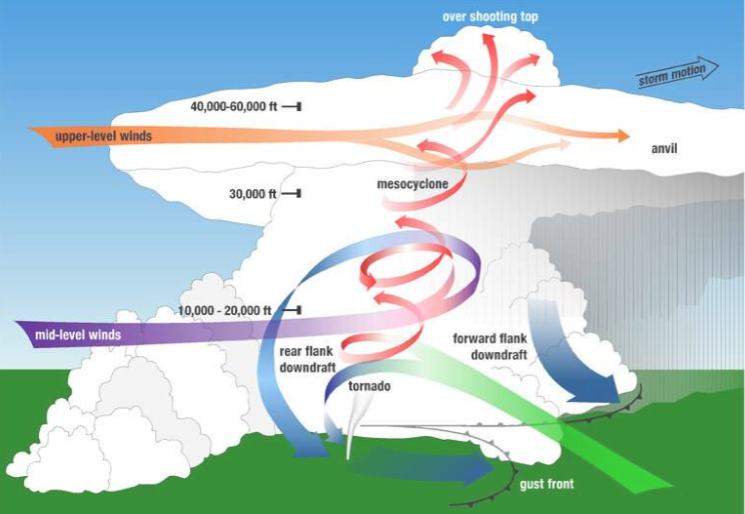
North America is geographically privileged in that there is the possibility that overland southerly flows of cold dry air from the north can readily contact flows of warm moist air from the Pacific, Gulf of Mexico, or the Atlantic.   Vertical mixing of unstable humid air results in convection cells that are further driven by the latent heat of condensation.  These humid flows are spun up by the Coriolis effect and wind shear to afford monster anvil storm cells that can tower to 50,000 ft or higher.

Diagram of an anvil cloud. Source: NOAA

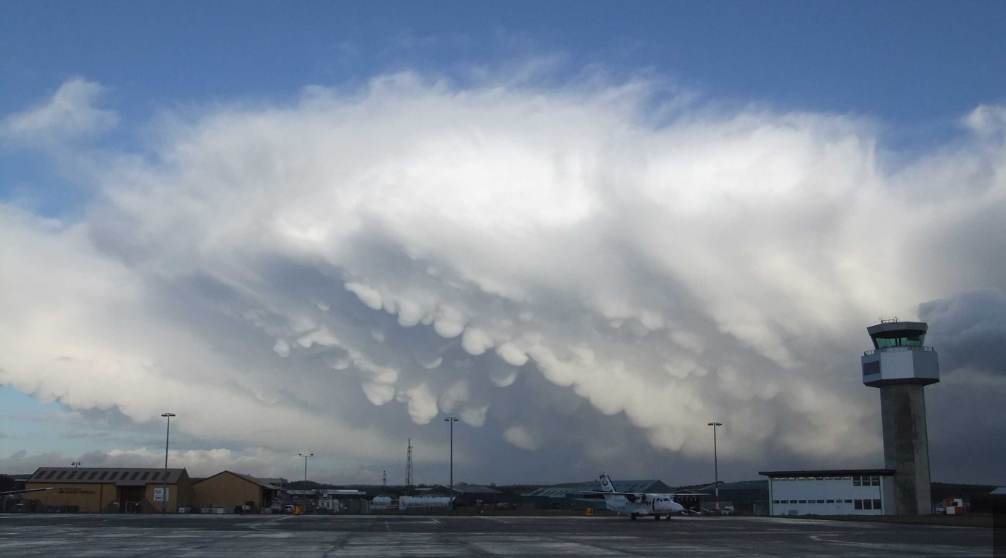
Like many places, here in Colorado we often see isolated storm cells in the early evenings of summer, red in color at low altitude changing to a billowy yellow-white at altitude near sunset. Very often you can see mammatocumulous features signifying violent mixing activity. It’s no place for an airplane.

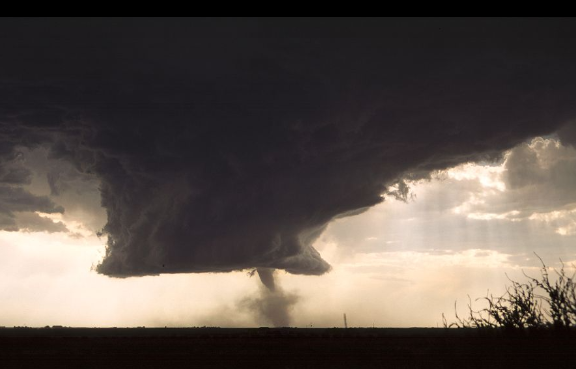
A murus, or wall cloud forms at the bottom interface where cold, water-saturated downdraft air is pulled into the adjacent column of rising air. The moisture condenses quickly and at low altitude to form the wall cloud. On occasion a tornado will drop out of a wall cloud.

Wall cloud with a funnel. Source: https://opensky.ucar.edu/islandora/object/imagegallery%3A2389

It is interesting to speculate as to how our modern mythologies and iconographies might have been different if the tornado phenomenon had been common in the Mediterranean and the middle east.  Would Charleton Heston have summoned a tornado to smite Yule Brynner’s Egyptians rather than parting the Red Sea and drowning the buggers?  Perhaps the Pharaohs might have built great stone helices rather than obelisks.  Aristotle might have written a treatise on the handedness of helical flows or whether the air flowed radially into or out of a tornado.

If the tornado had been a common phenomenon in the middle east during the iron age would the “Big Three” Abrahamic religions today feature tornadic themes in their texts and monuments? If so, perhaps the great cathedrals of Europe might today have relief sculptures or stained glass windows portraying the Israelites or Philistines being driven hither and thither by the swirling wrath of the Almighty’s cyclone. 

Well, that’s enough of that.

Lamar, my boy, show ’em how it’s done.

Dear Rep. Lamar Smith,

Yer a smart feller there, Lamar. Ya have a BA from Yale and that JD from SMU. Ya passed the bar exam and started private practice in San Antone. In 11 years ya worked yer way up ta national ‘lected office.  It’s an accomplishment no matter how’ya look at it. And that America Invents Act piled on some mighty fine improvements ta the patentin’ process. That was good work there boy.

As chair of the House Committee on Science, Space and Tech-nology, ya been perty skeptical ’bout them snooty climate science boys with their jar-gon and their uppity attitudes actin’ all high’n mighty-like ’bout climate n’such. A good ole’ boy from the Hill Country ought ta be able to pick up on that fancy c’mputer modelin’, right?

I think that ya ought ta throw some of yer many talents inta climate modelin’ yerself. You’d be doin’ the scientific folks a favor. You’d roll up yer sleeves an’ dig in ta clean’n up that po-litically correct climate data. Darn tootin’ you would. I’m sure the folks at NOAA would give ya a desk er somethin’ ta do yer cipherin’.

Give it some thought, Lamar. Shouldn’t take more’n a few Saturday afternoons ta make a big dent innit. Don’tcha think? Keep yer head on a swivel.

Th’ Gausslin’


(Texican language services provided by Elroy)


Climate Drift

More than a few people in my meager sphere of coworkers, family, and acquaintances are of a decidedly conservative bent and apparently bathe in the fetid wellspring of the Fox network for their daily ablutions. I recognize this because more than a few use substantially the same phraseology as they express the similar contentions on politics or of some duplicitous liberal miscreant. Most are admitted non-sciency folk and have heard that the current dust-up about AGW, Anthropogenic Global Warming, derives from assertions of a self-serving conspiracy by unscrupulous scientists angling for grants or in service of some deeper, darker purpose.

Like many people I’m trying to follow and comprehend the topic of climate change and AGW. Having taken no more than an undergraduate semester of meteorology and oceanography as well as flight training, I can grasp basic concepts and use some of the vocabulary in a sentence. So, when I’m asked for my opinion I usually just shrug my shoulders and offer a scenario for consideration.

Forget CO2 for a minute. What happens to surface water if the atmosphere and oceans get a bit warmer? It’s safe to say that, generally, there will be more moisture entering the air. It’s a fact that water vapor is a greenhouse gas. Water vapor absorbs infrared energy from the sun. Any influence that manages to cause the atmosphere to hold more water is an influence that will cause the atmosphere to capture more thermal energy and result in warming. Being more buoyant that dry air, moist air can convect to produce clouds.

The change from liquid water to gas is an endothermic process. Energy is absorbed to produce water vapor from surface water. During cloud formation, upwelling air naturally cools and condenses to aerosols and droplets. These may freeze to ice and liberate the latent heat of fusion. This is an exothermic process, liberating latent heat which warms the air causing further convection. So, a parcel of moist air convecting upwards will result in an inrushing of surface air which is drawn upwards to sustain a column of rising moist air. The early cloud building phase of a thunderstorm (cumulonimbus) is characterized by strong updrafts from convection.

So, one might expect storm behavior to change as the relative humidity increases. As the average air temperature rises, the higher latitudes (north and south) might be expected to see some change as well.

In the northern hemisphere one of those changes could be the melting of higher latitude snowpack and glacial ice. Ice and snow pack consists of fresh water. Fresh water is less dense than salty ocean water. As fresh surface water runs onto briny oceanic water, it will tend to stratify according to density with lower density, less briny water tending towards the surface.

The thermohaline circulation, also referred to the Atlantic conveyor, is responsible for the gulf stream current that flows in a northeasterly direction along the Atlantic coast of North America and into the north Atlantic. This current is responsible for delivery of relatively warm water to the north Atlantic. These warm waters are partially responsible for the temperate climate of the UK and northern Europe. One of the most important concepts of climate science is that one cannot separate the oceans from climate. Due to the considerable heat capacity and latent heats of water (relative to air), the oceans are a substantial reservoir of energy capacity in direct thermal contact with the atmosphere.

The gulf stream’s arrival to the cooler north Atlantic where the water increases its salinity and density due to low temperature and evaporation to form a region of sinking water that forms a subsurface current. This current circulates to the Pacific and Indian oceans and eventually back to the north Atlantic in a loop of circulating water. For the north Atlantic, this loop is at the surface and transfers heat back to the north Atlantic in the form of warm surface gulf current water.

The gulf stream submerges between the coast of Norway and Greenland. In doing so, warm water is transferred to the north Atlantic. Should Greenland undergo a sudden warming with subsequent release of melted fresh water, it would be expected that the process of sinking of briny surface water would be suppressed due to the presence of less dense surface melt water from Greenland. The effect would be to suppress the potential energy of descending cold briny water feeding the Atlantic conveyor as well as oxygen transport to the ocean depths. Upwelling water from the deep transports vital minerals to support the food chain. The loss of this upwelling will have a distinct affect on the fisheries.

If it transpires that the loss of heat transport to the north Atlantic results in a general cooling of that body of water to form ice, how is the overall heat balance of the earth affected? Could it trigger another ice age?

The point of this is to offer that a rise in air temperature can lead to consequences that are not intuitively obvious. Talking about global warming should not end with just “warming”. The ramp up to global warming is a disturbance that may have surprising results.

Global warming talk

Our local ACS section meeting tonight featured two speakers with opposite views on anthropogenic global warming (AGW).  One was a senior scientist from CIRES and the other was a retired physics prof from UCONN. 

The physicist did what physics profs like to do which is to say, reduce the problem to constituent elements. To make a long story short, the physicist tried to demonstrate that CO2 levels are the result of warming, not the cause.  He applied Henry’s law and did a lot of handwaving and criticism of climate science and modeling as well as some old fashioned back of the envelope calculations. It was a rather good demonstration of the climate deniers art.

The CIRES guy’s talk was really quite comprehensive and tied in observations from a wide variety of types of experiments to support the notion that CO2 has rapidly ramped up coincident with the industrial revolution- say the last 200 years or so. What was most persuasive to me were the isotopic data showing the deficit of C13 in the recent CO2 buildup. This data suggests that the accumulated atmospheric CO2 levels are measurably tipped towards biomass or fossil fuel origin rather than of inorganic origin.

As near as I can tell, much of the audience of chemists seemed to incline towards the climate denier. A vocal few were certainly skeptical of the data in the sense that the limits of the instrumentation had to be accounted for. But this was the normal skepticism one sees chemists display everywhere. I’ve done it myself.

Obviously, I’m not a climate scientist and would never be confused with one. I’ve been on the fence about AGW until tonight. I think I’m tipping slightly towards AGW now based on the isotopic findings. 

What I saw tonight was more like the parable of the three blind men and the elephant. The AGW denying physicist and more than a few in the audience understood at least part of the data and concepts. And from the area of expertise they held, felt they had a unique perspective on the problem. I gathered this from the nature of the questions asked.  

This is emblematic of the situation and in a similar vein to creationist “science”.  Creationism has all kinds of problems as a model of reality.  But what I often observe in its adherents is a limited knowledge of the theory they are trying to defeat.  In fact, I would offer that creationists comprise a kind of scholarly archtype. Creationists have the answer already and spend their time collecting data in support of it. This is characteristic of people who read devotionally rather than analytically.

I think learned people can fall into a kind of intellectual cul-de-sac from which many never escape. A lot of AGW deniers spend their time trying to debunk the IPCC data rather than performing experiments to achieve greater clarity.  AGW deniers are certainly well represented with conservative affiliation.

I was accosted by a coworker the other day who was so disgusted by my liberal ways and neutral attitude towards AGW that he couldn’t be bothered to expend the energy to fully dress me down for it. It just wasn’t worth the effort, apparently. Thanks friend. Where are all of these liberals the conservatives keep bitching about? I’m not seeing them.