Category Archives: CounterCurrent

Fulminating Belief and the Drake Equation

It seems to me that the character(s) who produced the YouTube video that has caused so much religious fulmination in the sandy parts of the world ought to be parachuted into Cairo to answer for their actions. Surely they can give the best explanation of what their movie represents.

Another thing has occured to me. Perhaps we should make a minor adjustment to the Drake Equation which describes the number of civilizations in our galaxy with which communication might be possible. The equation can be found at this link.  The L factor defines the length of time a civilization releases detectable [radio] signals into space. Given the self destructive behaviours of beings capable of generating radio signals on at least one planet, maybe it is time to define L*.

L* = L(1 – P*/P) where P = average number of intelligent inhabitants of a planet and P* = average number of intelligent inhabitants willing to die/kill for their magical or political beliefs.

Perhaps the reader has a better modification.  Here is the Drake equation copied straight from Wikipedia:

N = R^{\ast} \cdot f_p \cdot n_e \cdot f_{\ell} \cdot f_i \cdot f_c \cdot L

where:

N = the number of civilizations in our galaxy with which communication might be possible;

and

R* = the average rate of star formation per year in our galaxy
fp = the fraction of those stars that have planets
ne = the average number of planets that can potentially support life per star that has planets
f = the fraction of the above that actually go on to develop life at some point
fi = the fraction of the above that actually go on to develop intelligent life
fc = the fraction of civilizations that develop a technology that releases detectable signs of their existence into space
L = the length of time for which such civilizations release detectable signals into space

General remarks

I wish to make a few remarks on current news items of interest.

Country singer Randy Travis was found in a ditch in north Texas allegedly drunk, naked, and belligerent following an apparent one car accident.  Crimony! It’s that awful Nashville music that he sings. If I sang that twangy, mornful, depressing stuff all the time, I guess I’d be sloppy drunk in a ditch too. He should dry out and switch to show tunes or something a bit more cheerful.

It seems that while the televisions and internets of the world are busily dulling enchanting us into the delusion that our ever accelerating consumption of resources and expansion into wild spaces are having no effect on the “natural world”, the global ecosystems are actually in trouble. I emphasize natural world only because so many of us are preoccupied with the on-line world. In fact, many are worried about a “state change” in the global ecosystems.

In Approaching a state-shift in Earth’s biosphere, a paper just published in Nature, the authors, whose expertise spans a multitude of disciplines, suggest our planet’s ecosystems are careening towards an imminent, irreversible collapse.

Earth’s accelerating loss of biodiversity, its climate’s increasingly extreme fluctuations, its ecosystems’ growing connectedness and its radically changing total energy budget are precursors to reaching a planetary state threshold or tipping point. [ The Automatic Earth, August 6, 2012. ]

I know, I know. Sounds like Chicken Little. But we should pay more attention to our small planet. The atmosphere is thinner than most people think, the fisheries are stressed, desertification is happening in Africa, and human population pressures are mounting in many locations.  We can’t keep the extractive industries going forever. We need to find an economic model or culture that allows us to do with less mass. Reduced consumption per capita. Look, it’ll happen anyway as key resources dwindle.

We should be aggressively recycling lithium, gallium, tellurium, indium, and the rare earth elements in particular.  These are key elements in our much beloved electronic devices. There are other materials to watch, including hydrocarbons in general.  A society with infrastructure causing one to hop in the SUV and drive 5 miles from their isolated subdivision to buy cigarettes and beer is a society that is on a rendezvous with destiny.

Thoughts on crystals, symmetry, and perfection

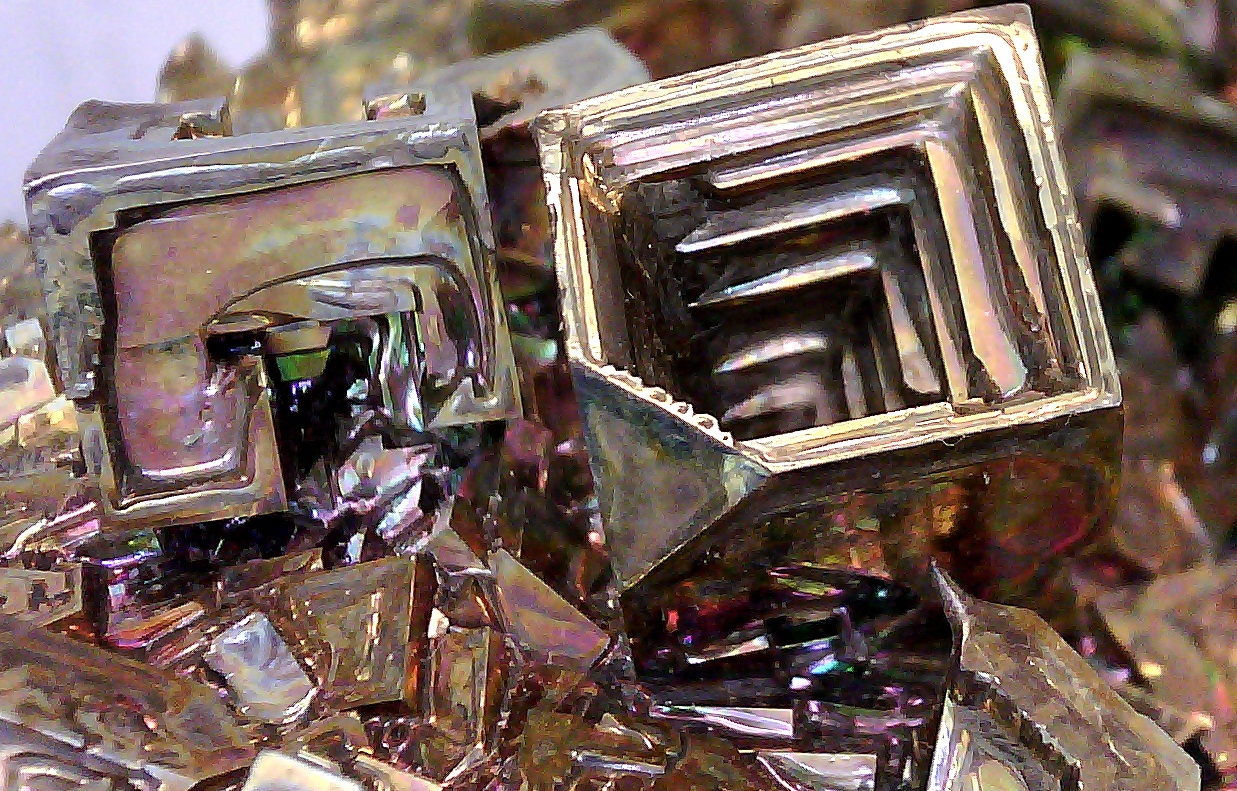
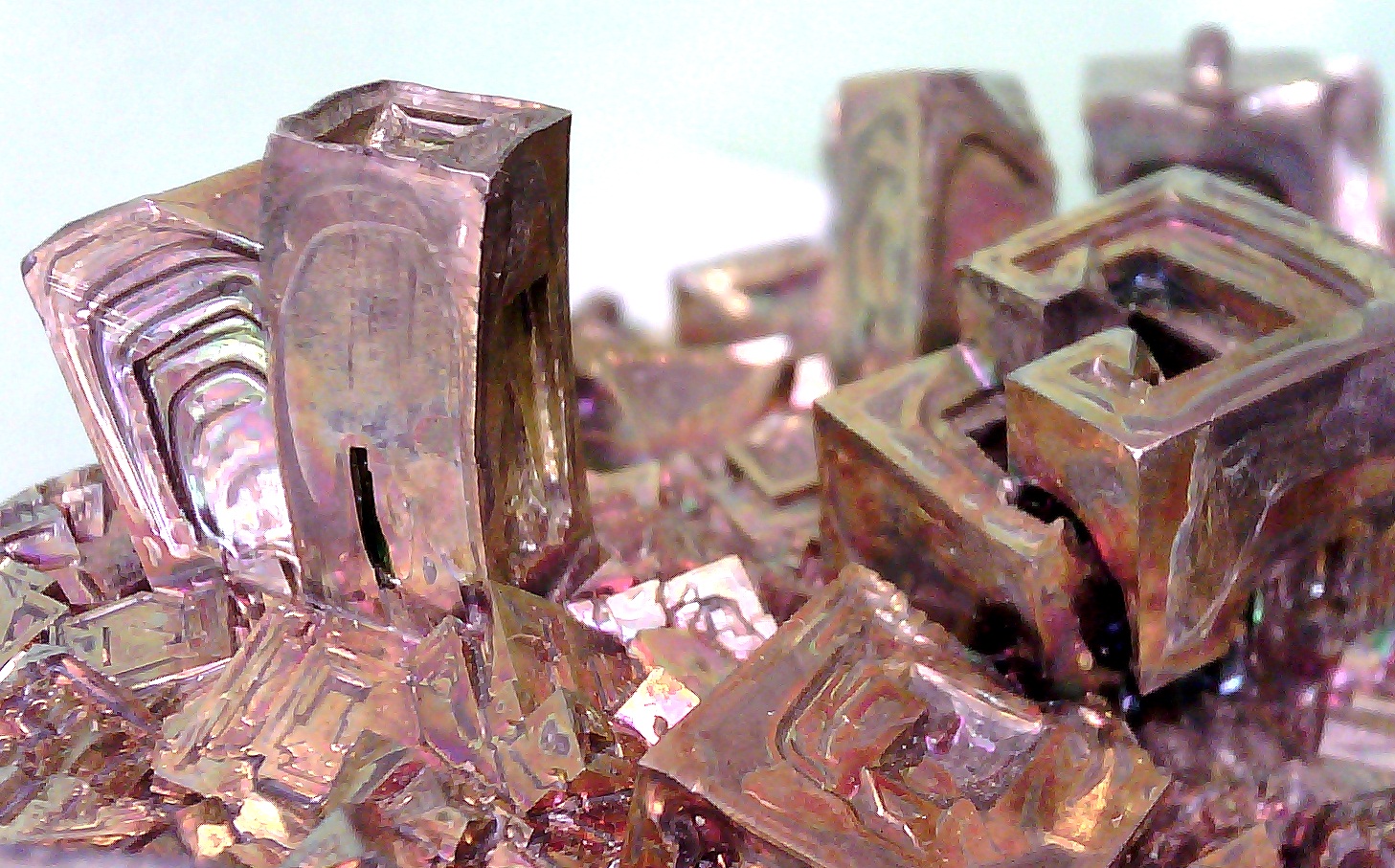
Bismuth crystals on my desk

Nothing too unusual here. Just some bismuth crystals sitting on my desk. A metallurgist friend died recently and his family passed along some of his samples to me. Virg was a great guy. He knew how to conduct himself with decorum like a civilized human being. I don’t confer this praise on everyone.

Bismuth City

I think many people find some kind of solace in the orderliness of crystals. Nature has seemingly betrayed the prevalent trend of disorderliness to produce a latticework of pristine stuff in appealing shapes. Crystals appeal to our innate desire for symmetry and rectilinearity. We subconsciously associate symmetry with goodness and calm. Properly stacked goods in your basement suggest orderliness. Shoes lined up in the closet or socks neatly arranged in the drawer provide a reassurance that something in life is at least predictable.

Crystallinity infers a repetitive array of subunits asssembled under the austere constraints of efficient stacking. It represents subunits held in confinement and subject to limits on motion.

Crystallinity is in a sense sterile and lacking in diversity. Living things are not crystalline for the most part. Crystallinity is static and devoid of the many necessary degrees of freedom needed for life.  Living things often have superficial symmetries, though on closer inspection something inevitably cracks the symmetry. Humans have a bilateral symmetry across a line taken from the head to between the feet, as do butterflies and hippos. Internally, though, the symmetry is less than obvious.  Our genetic polymers of DNA have a gross secondary helical symmetry as do some peptides, but even that yields to partial symmetry when the monomeric units are accounted for.  Sure, there are instances of crystallinity in living things. But living things require a fluid internal environment to allow molecules to collide and react.

If you take crystallinity as an allegory of perfection in the sense of a way of being- that is, orderliness and freedom from defects- then you might conclude that a perfect being would be constrained by symmetry or the attributes of perfection.  It would seem that the attribution of perfection in a being might pose the possibility of limitation.

Instead of getting wrapped around the axel philosophically, perhaps we should gladly rejoice in the lack of perfection in ourselves and the ultimate absurdity of perfection in the fanciful dieties whom we imagine control the vibration of every molecule in the fleas that ride on the tailfeathers of every sparrow.

Thoughts on Academia

The blog post by Terran Lane of the University of New Mexico provides a good example of the frustrations in academics today. Much of this is well plowed soil. I link to it because I think he is spot on about more than a few things.

The availability of external funding for the last 30 years has equipped American colleges and universities with a great deal of equipment and facilities. The availability of funding for grad students and post-docs has energized a vast educational complex that has come to depend on external grant money to maintain built up infrastructure. Naturally when an institution expands in good times, it finds itself top heavy in overhead when the good times end.

Ambitious people step forward when presented with the opportunity to grow programs and institutions when times are cash rich.  But when the cash influx begins to taper off, these same people find themselves in the position of having to decomission or dismantle parts of the very organization they helped to build.  It is hard for people in any circumstance to feel like they are moving forward when they have to make do with less.

One response to restricted university resources is to increase competition for teaching positions and tenure. Candidates with the best potential for winning grants are highly prized in any candidate search. The result of this is that professors today are burdened by administrative expectations in the hunt for resources in order to maintain close to what they already have.

Friends at PUI institutions are also feeling the heat, possibly due in part to the rise in undergraduate research programs that took off in the 1980’s.  Undergraduate research in chemistry, at least, has grown into an expectation rather than a plus. This brought the buzz saw of the grant machine into the grassy quads of many quiet institutions.

Certainly no untenured prof is going to throttle down their scholarly activity for the greater good of science funding.  Faculty will continue to struggle with this as long as grants are a major metric in rank and tenure.

Which brings me to my final point. Scientific knowledge as national treasure.  I am sifting through Chemical Abstracts Service data bases searching for something nearly every day. This resource of ours, scholarly and pragmatic knowledge, is one of the crown jewels of human civilization. It is the collective contribution of people and institutions going into the distant past and across the curved surface of our world.  We should cherish it for what it is- an archive of achievement, a repository of knowledge for application to future challenges, and a representation of the best of what we are capable of.

The notion that academia is the apex of the life intellectual has never been entirely true. You do not have to be in industry for very long before it becomes quite clear that there are a great many smart and creative people outside of academia. People who become professors are people who are in love with the very idea of the university and of higher education. We must find a way to allow research active faculty to throttle down the grant cycle just a bit so they may throw their energies into serving their institutions in the traditional manner. By service to  their students, to scholarship, and to the advance of civilization.

That said, it seems embarrassingly obvious to say that our academic institutions are a critical part of our civilization past, present, and future. But today our institutions are in peril of substantial decay if left to antagonistic legislators and fulminating demagogues bent on terminating programs in the name of social reconstruction.

We know how to operate our university/research complex. Absent some of the mania in the horse race for grants, perhaps we can offer a bit more student contact with professors. A BA/BS degree must be understood to mean that a graduate has absorbed knowledge, sharpened reasoning ability, accrued some judgement, and has developed a professional demeanor that can only come from the personal interaction between people. We should expect from our institutions that a professor is a professor, not a shift supervisor.

Gluten harvest underway

The annual gluten harvest is underway in northern Colorado.  Winter wheat planted last autumn has pushed through the soil, grown to produce a head of grains on every stalk, and finally, transitioned from a sea of lush green grass to the now dessicated amber waves of grain. Giant harvesting machines are cutting the short-statured hybrid crop and somehow rattling it into chaff and grain.

Now that we are avoiding gluten in our household, I view the wheat harvest a little differently. It is somebody else’s harvest.  It’s odd way to look at it I suppose.

Microscopic Printing on Aldrich Chemical Labels

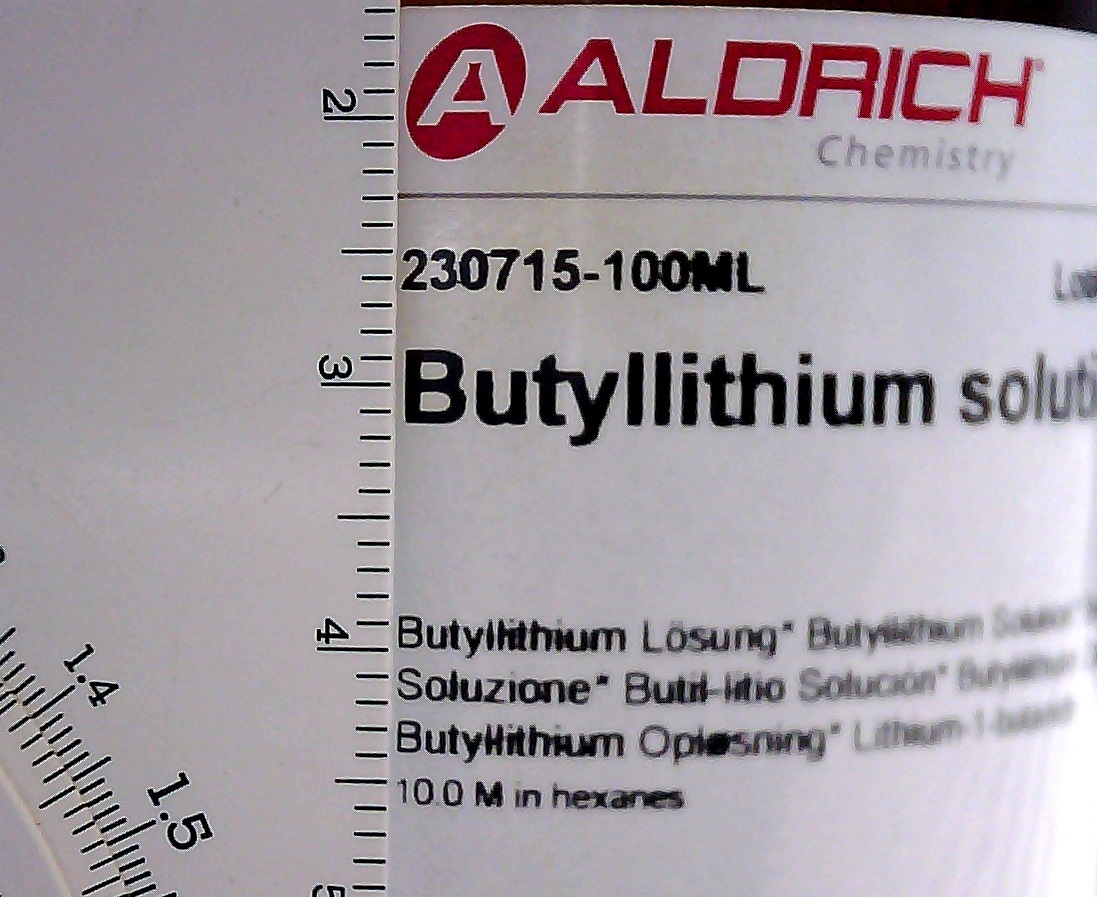
OK. I’m going to have to be the bad guy and take Aldrich (SAFC) to task on their labeling. I recently received a 100 mL bottle of 10.0 M BuLi in hexanes.  As I looked around for the concentration, I found it written in tiny print away from the name and part number which were written in larger print.  I have placed a ruler next to the label in the photo below to show the size of the print. It is the same size as the date on a penny.

Labels do not “just happen”. Someone has to design a label. This involves arranging content on a limited space while meeting internal and external requirments for safety statements and other content.  Labels do not fall from the sky in great sticky sheafs. Someone prints them. And that someone assigns font sizes and space for the information. So, someone has caused the font size to be tiny irrespective of the print content. I have numerous bottles with microscopic printing and vast expanses of white space. This smells of automation.

I’ll wager that there is an automated label generator that takes product label data and prints it onto the label irrespective of the actual need for microscopic font size. I can envisage a giant warehouse with automated shelf pickers whizzing about pulling bottles off the milti-tiered stacks and placing them into plastic tubs which course their way to shipping. Elsewhere in this voluminous interior is a widget that prints the labels and sticks them onto the bottle after they are filled.  Somewhere a human is pushing a broom.

C’mon Aldrich! Make your labels more legible. Good gravy. What would Bader say? I’m sure your accounting office has no trouble reading the print on the checks that arrive to pay for these products.  Consider that you’ve been put on notice.

Fine print on Aldrich reagent bottle. Molarity is printed in 1.0 mm font size.

Adrift in Cheminformatics Space. CHETAH 9.0 Fails with Some ChemSketch SMILES Strings.

The ASTM software Chemical Thermodynamic and Energy Release version 9.0, CHETAH 9.0, has many useful features for calculating thermodynamic values of substances.  My interest is in the (gas phase) calculation of ΔHf, limiting oxygen concentration, lower flammability level, Cp, entropy, ΔG, maximum heat of decomposition, net plosive density, ΔHc, and minimum ignition energy. The package claims to have the largest known database of Bensen group values at 965 entries.

I would have supplied links but the WordPress Editor is on the fritz. One more bloody software “issue”. – ‘th Gaussling

I recently upgraded from CHETAH 8.0 to 9.0 because 8.0 is incompatible with Windows 7.  These upgrades are a kilobuck a pop so they can be a budgetary surprise. After I upgraded I noted that 9.0 is not compatible with Windows 7 either!! Luckily I have a couple of lab computers that are still XP systems and therefore compatible with 9.0.  The folks at the University of South Alabama write and support CHETAH.

I understand from private communication that CHETAH 10.0 is in the works in anticipation of the release of Windows 8. Oh joy. I hope that some effort will be put into the user interface and general robustness. My question is this- what about those of us who will be using Windows 7 for the next few years? Will rev 10.0 be compatible? Will it have click and drag features or more of a DOS accent like the current rev?

One of the features that is nice about CHETAH is that it accepts SMILES strings as data input.  It parses the string into known Benson groups and flags unknown groups.  Previously I had been entering smiles strings from ChemDraw 7.0, an ancient but still useful version. Lately I have been evaluating ChemSketch freeware.  And lucky for me, I found another hole to stumble into.

SMILES is not inflexible in its syntax, apparently.  ChemDraw will convert a structure to a SMILES string that is different in its sequence from the identical structure drawn by ChemSketch.  I have found that CHETAH 9.0 will consistently accept SMILEs string entries from ChemDraw, but with only some ChemSketch SMILES strings.

Consider the following SMILES strings of the same structure-  5-Bromo-7-tert-butoxy-3-methyl-3H-isobenzofuran-1-one. The nomenclature is from Chemdraw. I do not use this compound- I dreamed it up as an example.

ChemDraw 7.0–  O=C2OC(C)C1=CC(Br)=CC(OC(C)(C)C)=C12

ChemSketch 12–  CC(C)(C)Oc1cc(Br)cc2c1C(=O)OC2C

The ChemDraw SMILES string is accepted by CHETAH 9.0 and parsed into Benson groups, but when you attempt to process the data it gives a “Run-time error 9” warning and then closes the program. From what I can tell, CHETAH 9.0 will only accept 9 Benson groups because when you clip off functional groups, it will accept the string for the next step. However, it still shuts down and indicates another error saying “subscript out of range”. I don’t know why this happens and the handbook does bnot seem to list errors. The programmer put the error routines in the program, but I guess was too busy to tell anyone what they mean.

The ChemSketch SMILES string above is not accepted at all.

I cannot justify switching to ChemSketch for several reasons and this is one of them.  The ChemSketch editor is generally balky compared to the smooth operation of ChemDraw. However, I must say that ChemSketch is very feature rich and has gotten much better. If I wasn’t already committed to ChemDraw (and Chem3D) I’d strongly consider it.

CHETAH seems to have limitations on the number of Benson groups it will accept for a molecule. It seems to require a particular edition of SMILES syntax. And, the user interface is is balky and antiquated.  I’ll try to uninstall CHETAH and reinstall it. That said, it still seems … brittle.

From what I can piece together by googling SMILES, the system has been evolving. Apparently, chemical graphics software out there has captured particular editions of SMILES at the time when their revision is released.  It would be nice if some international standard were in place to devise an enduring syntactical structure. Seems like something CAS could help with.


CT Scans. Who is monitoring a patient’s radiation dose?

The matter of medical x-radiation dosing is surfacing again. I wrote a post about this in 2009.

Let’s get to the core of the matter. Physicians need to take charge of this since only they have any real control. It’s a pretty goddamned simple concept. Doc’s who are calling for x-ray’s need to begin recording calculated dosing from this hazardous energy. If it is too troublesome for them, then the x-ray techs should record the information.

CT scanning seems to be problematic. There is no business incentive to hold back on CT use in for-profit settings. I suppose that documentation would only reveal the extent and magnitude of x-ray use. It would be fodder for malpractice law firms.

I can just see the billboards- Have you or a loved one ever gotten a tan from x-rays? If you have, call Dooleysquat, Schwartz and Schmuck for a free consultation. Do it Now!

Kansas tries harder to drown the beast.

I know there are a lot of smart people in Kansas. It’s just that they tend not to end up in elective office there. The latest examples of Kansas-being-Kansas are staggering. Take for example the matter of Gov. Brownback’s massive tax cut on business profits.  From what I understand by reading news material from the corporate controlled news media, Kansas, under Brownback and the GOP controlled legislature, have managed to end taxes on business income.  The fact that Koch Industries is based in Wichita is more than a little coincidental, I’m guessing.

Evidently the GOP “leaders” in the KS legislature have been dueling it out with Missouri, awarding tax incentives for companies to move across the border to the Kansas side. This kind of fratricidal fiduciary hijinks is not uncommon. All states are eager to raid other states for businesses.  Tax concessions are the pieces-of-eight in this interstate piracy. Our states are in a race to the bottom in their pursuit of business transplants.

Of interest relating to Kansas is this little nugget.  AMC Entertainment Inc. announced that it is moving to Leawood, KS, from the Missouri side. But, about the same time it was announced that the Dalian Wanda Group would buy AMC Entertainment. Dalian Wanda Group is about to reap the benefits of Brownback’s tax policy by operating in KS.  A Chinese company makes one of the largest buyouts of a US company and lands just in time in the Kansas tax haven.

Let me speak plainly. A Chinese company owns a largish US company headquartered in Kansas will be taking advantage of infrastructure put in place over generations by hard working Kansans and US citizen taxpayers. All have contributed in many ways to Kansas infrastructure by way of grants for electrification, roads & highways, universities, military bases, as well as protection by all of the branches of the US military.  This Chinese company will enjoy greatly reduced tax liabilities by operating in Kansas. The controlling stockholders are Chinese and will benefit from operation within US borders at the expense of Kansans as a result of the Kansas GOP. These foreign owners will instead allow their employees to contribute to the public coffers.

The burden for expenses related to responsibilites previously administered by the state will be unpooled and relocalized.  The purpose and benefit of taxation has been that pooling funds can bring the benefits of civilization to the state without having to rely on the Darwinistic forces of the market. It is ironic that a state so rabidly against evolution has embraced such a Darwinistic approach to social policy.

The stated intent of GOP leaders (like Dick Army, etc.) cloaked  behind the curtain has been to “drown the beast”. That is, kill federal and state government by unfunding it. You do that by electing serial government haters like Gov. Brownback and possibly by having the Koch boys behind the scenes pulling strings. Not only has Kansas stuffed a dagger in the chest of civic administration of government services, they have opened the pipeline for profits to stream out of the US from a state tax haven from the operation of a corporation by a Chinese conglomerate.

The Kansas GOP has accelerated the transition of power from a constitutionally backed system with structural transparency to the private concentration of power with no transparency and no civic obligation.  Way to go boys. The full import of this should be evident in a generation when most of the GOP legislators who enacted this shit sandwich will be long gone.

Make no mistake. The GOP euphamism of “drowning the beast” is really about the transfer of power from the many to the few. The slogans about liberty and freedom are a plush teddy bear for the masses of low information voters to embrace. Power is in the ability to allocate resources. As the public loses its ability to allocate resources, it loses power. As private or corporate interests accumulate resources, their ability to exercise power rises.  There is nothing new here. Power always concentrates.

[Note:  A copy of this essay appears in the Daily Kos.]

Facebook IPO- Not a banner day

The IPO of Facebook stock on friday was a bad business day on two accounts.  Most obviously, the anticipated share price “pop” didn’t happen by the end of the trading day. FB shares opened at $38.00 per share and ended the day at $38.23 per share.  According to Andrew Bary at Barron’s, early investors paid an average of $1 per share. With lockup provisions on 1.8 billion shares expiring in the August to November time-frame, large scale selling could drive down share prices later in the year.

The Barron’s article quoted a tech trader who said

“Like most IPOs in tech land, Facebook is geared toward enriching early investors and employees while sticking public investors with shares burdened with poor voting rights and high growth expectations.”

There is nothing new in this statement of condition. Cashing in one’s shares in a risky investment of time and money in a startup is a commonly executed means of capturing reward. Risk takers are entitled to a payoff when a venture achieves success.

But this trader’s sentiment reveals something deeper about business and it’s role in our culture. This was a public offering of fractional ownership whose sole means of income is advertising. It is clearly designed to transfer future risk to public investors who have precious little voice in corporate governance.

Facebook has offered public investors a kind of sh*t sandwich: A chance to buy into a public corporation that is structurally configured to retain controlling interest by one of the founders.

Has Facebook created wealth or is it just capturing the market share of other advertisers? Facebook, like Google, is a creature of advertising. And, like Google, it is a magic version of the Yellow Pages that automatially anticipates or finds the listings you may want. But it is more than that. It is a directory that supplies the listings it wants you to have. Instead of the full page ads of the advertising print period where trees were actually pulped to provide something called “paper”, today’s ads are hot links to the advertisers website.

Facebook and Google are really just newer versions of the old circus of broadcasting. Broadcasters supply eyeballs and ears to adverisers who then have tens of seconds to mesmerize viewers and listeners with their magic. It is like rattling a stick in a bucket of swill. Facebook supplies amusement as a so-called social network and Google supplies entertainment as well as utilitarian services.

It was also a bad business day for broadcasters covering the FB IPO.  All of the cable television business progamming was set on this blessed and much anticipated initial public offering. Regrettably, the event was delayed for technical reasons until mid day EDT. When the stock was finally released, “experts” were standing by to render their opinion on the last 20 seconds of market activity.  Like all stock market data, it is marked by a jittery, noisy curve, sometimes trending upwards and then downwards.  Over one minute anything looks like a trend.

Faced with the possibility of hours of air time to fill before something exciting happens, the CNBC talking heads natter on and on with a variety of experts who natter on and on. All-the-while stock footage of the NYSE floor and the post-pubescent hoodie-boy CEO of FB loop cycles endlessly. For this we allocate broadcast spectrum?

In the end, there was no excitement. FB closed the day pennies above to where it started. I like to think this is because investors aren’t as foolish as the cynical people who are behind the offering believe on the opening day, at least.

An excellent analysis of Facebook valuation has been posted by Aswath Damodaran, Professor of Finance at NYU.