Category Archives: CounterCurrent

Things to notice about the disasters in Japan

Everyone is rightfully concerned about Japan and what is to become of the region around the Fukushima Dai’ichi generating station. The quality of information by the various broadcast outlets is improving somewhat in my estimation. What the rest of the world should take note of is the stoic and highly admirable manner in which the Japanese have responded to the earthquake*tsunami*nuclear-disaster trifecta that has fallen upon them. In a US city there’d be looting and widespread felonious mischief as local criminal entrepreneurs rose to the occasion.

Another thing that I hope is noticed is the manner in which the failures initiated and propagated at the power station.  The unfortunate low elevation of the emergency generators is the obvious one.  But there is something else that is dramatically affecting how the incident propagates.  If you look at the cutaway diagrams of the plant you will see the highly compact nature of the facility.  The footprint of the buildings are quite small given the amount of equipment and processing that occurs there. In particular, the location of the cooling pools for the spent fuel assemblies is at the upper level of the structure, above the reactor spaces. 

The upper level with the cooling pools has an overhead crane that can move along the length of the facility. The fuel elements can be pulled up and out of the reactor and moved laterally into the pool.   The General Electric design is quite efficient in the use of acreage. But in the event of a major upset with fire, explosions, major radioactive material release, and structural damage, the compactness of the facility and the elevation of the spent fuel cooling pools works for prolonged incident propagation and against termination. 

The very altitude of the cooling pool spaces presents a major hurdle to taking control of the situation.  Having this problem at ground level where you could directly apply resources to the event would be bad enough. But to have it many stories above ground places huge constraints on the responders.  Designers of power plants should be thinking about where hazardous energy can be released and how responders will deal with it. Problem- all facilities design projects are constrained by severe cost considerations. Designers prefer to think about the most efficient designs, not how their brain child is going to fail.

Credible Information on Fukushima

It is difficult to find truly informed opinion on the Fukushima reactor disaster in Japan.  The Daily Kos Community site by Richard Blair seems very credible from what I can discern.  The writer claims to be a Nuclear Power Operations-certified systems engineer in GE Boiling Water Reactors (BWRs). I have no reason to disbelieve it.

Actually, Rachel Maddow (and writers) did a very even handed presentation this evening of the basics of reactors, radiation, and nuclear power generation on her show. 

Blair (writing under the pseudonym Richard Cranium) shares some interesting insights on the Fukushima boiling water reactors. It’s worth a look.  It is part of a larger effort at information aggregation called the Japan Nuclear Disaster: Mothership.

Bug Hunt: Los Angeles

Big, angry, armored termite soldiers from the Planet “O” land off the coast of SoCal and make an amphibious assault. Luckily for humanity they land near Camp Pendelton. Thus begins Battle: Los Angeles

Filmed in a documentary style, this movie follows the travails of a platoon of Marines on a mission to pick up civilians at a police station in Malibu and take them to a forward operating base (FOB) before heavy bombardment of the coast begins. The aliens take and keep the initiative early in the invasion.

The invaders aren’t misunderstood ET’s with big blue cow eyes.  These bipedal and possibly cyborgish critters are loaded with high velocity rounds and are fiendishly single-minded in their attempt to secure the planet. Aaron Eckhart plays the lead character, Staff Sergeant Michael Nantz.  Along the way the platoon picks up USAF staff sergeant Elena Santos played by Michelle Rodriguez. The casting of Rodriguez was particularly smart from the marketing perspective. Hotties with automatic weapons are irresistable to the male moviegoer. I’m thinking of Ripley making her escape from the Nostromo.

OK, guys, this is not a chick flick. It’s not especially bloody, but it is filled to the brim with male bravado and long satisfying bursts of full automatic gun fire. Wives and girl friends may be unmoved by the machinegun aesthetic. Just thought I’d mention it.

It’s not Academy Award stuff, but it is worth seeing on the big screen.

On a separate topic, for the fans of Dune, there is this link.

China Syndrome in Japan

The China Syndrome is a fanciful “theory” that postulates that when a nuclear reactor undergoes a meltdown, the hot core material melts through the pressure vessel and through the concrete containment flooring below into the ground. All the way to China. 

Well, this really can”t happen because the core, hot as it is and dense as it is, could only go to whatever depth matches it’s density. I don’t think many people really understand what happens to core material when it breaches the containment and encounters the subsurface. Further, it’s hard to say if the core material will remain intact as a single unit long enough to retain a critical condition as it spills outside of the reactor vessel assembly. 

The fuel elements are, I believe, ceramic in nature, making them refractory. Refractory materials have quite high melting points. A reaction mass that has some fluidity might well split off isolated blebs which could then take the whole mass away from a critical condition.  This would tend to dampen the reaction rate and allow the reaction mass to cool below the melting point of the mass.  

Quite apart from the dispersion of the core material is the loss of moderator around the reaction mass.  This would occur as the primary coolant water flashes to steam as the pressure vessel is breached. Loss of moderator reduces the number of neutrons in the resonant range and the power should drop accordingly.  The decay heat from the fission products should be fierce.

As a molten parcel of reactor core heats up the surface material below it, the molten flooring, soil, or bedrock must be fluid enough to allow the core to displace it downward. It could be that the blob gets elongated and increases the surface to volume ratio enough to allow the loss of neutron flux to cause the blob to cool below the melting point of the ground.   How a self-heating blob of core material behaves under the pull of gravity in a variable and possibly refractory rocky matrix is not an easy problem.

Ground water would be problematic for the neighborhood because eruptions of contaminated steam would be expected to issue from the crater.

I hope these poor fellows are able to get their reactors under control before the area gets too hot.  If the reactor spaces and control rooms get too hot it is going to complicate the remediation.

It is worth reading the updates from NISA.

Some Comments on Public Schools

I know public school teachers very well. There is much talk about the kind of job public school teachers are doing these days. Much of the discussion is very negative.  A lot of people seem to think that American public school education is in some kind of decline.  Conservatives in particular seem to have a good deal of criticism to direct at public school teachers.

While I suspect that this grumbling on the right has more to do with vengeful, angry little boys who have grown to be vengeful, angry men, I’ll set this hypothesis on the shelf for some more aging.

In Coloado we have an annual test battery for public school students called the CSAP’s.  It was an initiative set forth by conservative legislators who have a very negative view of public education in general and of teachers unions in particular.  The CSAP’s start tomorrow in fact.  My 9th grade kid will spend the next week taking them. 

It is funny. No matter how tight the legislation is, people will always find a way to game the system.  I know of one principal who was selected to open a brand new elementary school nearby.  While at his previous elementary school in a poor neighborhood, he had access to the students CSAP scores. Prior to his departure he contacted the parents of the top 70 or so students and invited them to come to his new school in a more affluent neighborhood. Nearly all of them did, leaving the previous school in the lurch.  Test scores plummeted at his previous school last year because of this. The parents of the recruited students had a good many volunteers among them. The level of volunteerism dropped substantially as well, adding to the workload in a school already depleted of hourly teachers aids.

Yes, the aforementioned principal seems guilty of some kind of malfeasance or corruption. He’s gaming the system. But he fell out of the sky into a system begging for gamesmanship.  He did it to pave his way into a superintendant slot someday and I’ve no doubt that he’ll get it.

The great fallacy of this issue in the public forum is that it is up to teachers alone to keep kids on track.  Having been married to a special education teacher I can say that there are a great many parents producing kids that are improperly wired, emotionally disturbed, sociopathic, and/or neglected or abused.  Many kids go to school hungry and go home to high stress environments where there is rampant drug abuse, alcohol, and family violence. 

It is not uncommon for some elementary students to be the only family members who can speak English.  Parents in such homes are not able to help with home work. They are not able to communicate with the schools owing to cultural aversion to such contact or because they are undocumented.

I believe that our culture has changed considerably since my age cohort was in public school.  College was a distant aspiration for many of us.  College was not needed to work in the trades. We could get on-the-job training or attend some kind of trade school.  Or, join the military.  These were the options. We had been to the moon, tamed the atom, and built massive industrial capacity for manufacturing an ever growing array of widgets and medicines.  Arguably, something was working well if industrial output is the measure.

But over time, with greater affluence in the US and abroad, the technology gap between the US and other nations began to shrink. Other cultures were developing their own magic dust and secret sauce.  The advantages of the US system began to diminish relative to other cultures. But the one thing that didn’t change is the bell curve.  As a population we still produce offspring who populate the bell curve of abilities and interests. 

I suspect that we have begun to intepret the “below 50th percentile” population in the various bell curves in a most disturbing way. Could it be that we are interpreting the very existance of the low academic achieving population as some sort of educational or societal failure?  Are we expecting modern education to skew the curve toward the high end against the natural spread of abilities and aptitudes in our culture?   Is the notion of excellence skewed towards academic achievement rather than the myriad other activities that make a productive life? Is high academic achievement the only acceptable result of education of our population? 

Not everyone needs to be a scientist or an engineer or astronaut.  We need to continue to identify youth who have such interests and aptitudes and carefully cultivate them toward such opportunities.  But we also must pay attention to those who have more ground based aspirations and abilities and value them just as highly.  It is like a food web.

The notion that we should engineer our schools to produce more super achievers is faulty and unfair to the 99 % who won’t become scientists or astronauts.   Even if we could multiply the population of scientists, engineers, and astronauts, the economy cannot accomodate them. Such professions are near the apex of the career pyramid.

I have come to believe that US culture has failed a large number of its youth.  Just look at the rates of incarceration in the USA.  A culture truly concerned about the wellbeing of its individuals wouldn’t have a few million of them in jail.  Could it be that the conditions in which we imprison citizens reflects what we truly think about individuals?  I think the current malaise in public school education manifested as high dropout rates and low achievement  and the epidemic of convicted felons may be connected as part of a larger failing of our society.

Extractive Metallurgy as Inorganic Chemistry

I am involved in an extractive metallurgy project 1 day per week give or take.  So I have been trying to take apart undesirable minerals in an ore to concentrate the desired metal. It’s called beneficiation- a word introduced by Agricola in his book De Re Metallica published in 1556.  I can’t disclose what the desired metal is.  Suffice it to say that it is rather scarce though not a coinage metal. 

What really amazes me is the disconnect between what many of us think of as the field of inorganic chemistry and the field of extractive metallurgy.  In my training as an organikker, I had never been exposed to extractive metallurgy, nor did I even know what it was.  Turns out that it is a field of applied inorganic chemistry. In this field, a metallurgist is the person who figures out how to extract desired metals from ore.  Nobody seems to call them a chemist, at least to their face. They’re the metallurgist.  No doubt there are exceptions.

Well, that clears things up quite a bit. I feel better getting that off my chest.  I’m sure any wayward metallurgist who happens upon this site has already begun to laugh. Extractive metallurgists do synthetic inorganic chemistry. It’s just that they prefer to keep company with a gangue of engineers and geologists rather than those who don’t work with minerals.  I can relate.

Chemistry jobs

Last fall I was invited to speak to some chemistry students at a local university. Being an industry guy, I was perceived as having some “special” insights into getting a job after college.  While I might have been a successful job hunter when I was less than 40, the odds got much longer after that transition to middle age. More on that in another post.

While I cannot outline the exact path to employment- you really can’t do that- I was able to talk about some of the lesser known jobs that  a chemistry degree will enable.  They are not sexy R&D jobs nor are they upper level executive jobs either. I’m not a pharma guy, thankfully, so my comments do not pertain to that bizarre and brutal world of pharmaceuticals.

The jobs I pointed out are critical to the conduct of manufacturing. They are jobs that one might not necessarily get at the entry level either.

So here are some of the jobs I mentioned.  Environmental health and safety- EH&S. Industry needs people who understand the regulatory situation relating to worker safety and to the environment.  EH&S is also concerned with hazardous waste management.  Expertise in this area is critical to the daily operation of any chemical plant.  This is a good place for an entry level and an experienced chemist to enter because the position typically requires a BS degree and greater than high school knowledge of chemicals and hazards.

Purchasing is an area where a chemist can play an important role in the operation of a plant.  Somebody has to source and buy the chemical raw materials. In general, there is spot buying and contract buying. Spot purchasing offers freedom on the upside but possible instability and higher pricing on the down side.  Purchasing under contract offers a better footing for negotiation and long term stability, but may lock the buyer into minimum volume and a firm price schedule. If demand for your product wavers, being locked into a supply agreement can be a problem if you have agreed to take a set volume.

There are various levels of purchasing positions.  At one end is the purchasing of non-chemical products.  Don’t need a chemist to do this.

On the other end is what is called the supply chain (or procurement) manager. Here is where you need to have a chemist.  This person is charged with assuring that there is an uninterrupted supply of feedstocks to the production facility. They are also tasked with assuring that the vendors meet some basic level of QA/QC and are able to document the whole spectrum of quality assurance. That is, does the vendor have the mechanisms in their business structure to assure not only the flow of product out the door, but also that the process is stable and produces material of the proper quality? Here,  management of change is is very important. A supply chain manager also makes site visits and conducts quality audits of vendors.

Business development and sales is an arena that makes good use of chemists and engineers. The most highly prized type of sales and business development person is the fabled “rainmaker”.  Business development is an activity where a manufacturer makes a connection with a customer who needs some particular material manufactured.  The goal in business development is, not uncommonly, to bring a new product into being.

In the chemical world (outside of pharma) there are commodity chemcials and there are custom and fine chemicals.  Commodity chemicals are those for which there are more than one manufacturer and the difference is mostly in the pricing and availability.  A chemical that is commoditized is one in which the volumes are often high and the margins are thin. Think ethylene, sulfuric acid, BTX, etc.

Commodity chemical producers need sales people too, but their job description is more related to account management and sales. If you dig being a sales rep, go for it.

A business development manager is someone who tries to match technological capability to the needs of the customer for more specialized products. This is teh person who looks at the chemistry and SWAGs a price based on paper chemistry and a spreadsheet.  This is often high pressure work. A bad quote may spell trouble for you. Too high and the customer balks. Too low and you may be faced with the wrong expectations by the customer.  Above all, a good business development person manages expectations.

Quality control/assurance is another position for a chemist. This is for someone who is highly organized and is fond of recordkeeping. This is the world of specifications and certificates of analysis, or certs. The QC person is responsible for making sure the company does what it says it will do in regard to product quality. It is a gatekeeper position and it can be a real hot seat. QA/QC can hold up a shipment or it can prevent the plant from using a raw material. It is a powerful post and those who hold it are not universally loved.

Process safety- what I presently do- is a job description wherein chemists are charged with determining whether or not a process is safe to execute. It is a hybrid job- part synthesis, analysis,and P-chem. It requires quite a bit of imagination in that you have to try to imagine possible failure modes and often obscure ways of testing materials for the potential to release hazardous energy.

Inventory management is central to the operation of any manufacturing unit. It is critical to receive raw materials both physically and in the accounting system. Materials have to be stored in designated locations and have to be staged for use according to a master schedule. While is is less common to find chemists here, I suppose it is possible. Often this position is filled by someone who is familiar with the manufacturing environment.

Related to inventory management is shipping and receiving. In order to load hazardous material onto a truck for transport, one must have training in the regulations pertaining to the transport of hazardous goods. In addition to the regs, there is training in operating in a hazardous environment and emergency response. Again, not a lot of chemists will end up here, but it is a job description in the chemical industry.

Finally, there is the possibility of working as a plant operator. You can find a large variety of people operating in a chemical plant. I know ex-firefighters, ex-military, biologists, farm boys, heavy equipment operators, construction contractors, and people who have worked in chemical plants all their adult lives. It is hard work. You have to work on the plant floor wearing PPE that is often uncomfortable, or perhaps sit at a terminal in a control room monitoring a process train.  But if you like working with your hands on machines and electronics in manufacturing, it may be job for you.

If your desire is to be a captain of industry- a CEO or President, then you should forget lab work and go into business development or sales, or even accounting. Anything related to the accumulation of sales dollars, customer service, plant startup, and deep finance is crucial to someone handing you the keys to the corporation.

Yes, I know that there are a few scientists who have ascended to the top, but they are the exception. You must be fluent with the ways of money and show a record of rainmaking.

The other possibility for a chemist is to join a startup venture. But this is hard to find since most startups are begun with a core group of people who know each other. At some point, however, they will begin to recruit skilled people to fit particular slots. I have no real advice to offer here except that startups are very risky. At some point you may be asked to invest more than just time.

Geysers of Enceladus

My day job requires that I can practice the art of calorimetry with some reasonable extent of expertise, so in that vein I have been cracking open some of my dusty p-chem texts and revisiting basic thermo.

The other day while on an excursion to a bricks and mortar bookstore to pick up some of my favorite periodicals (Kitplanes and Vanity Fair), I happened upon a copy Elements of Chemical Thermodynamics by Leonard K. Nash (1970, Dover, $12.95). Feeling bad for Borders and their current run of poor luck, I bought the book as though it would make some difference.

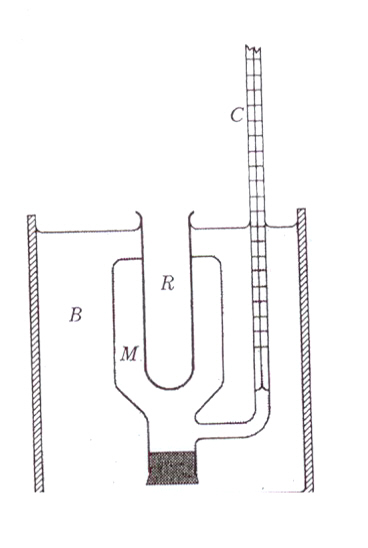
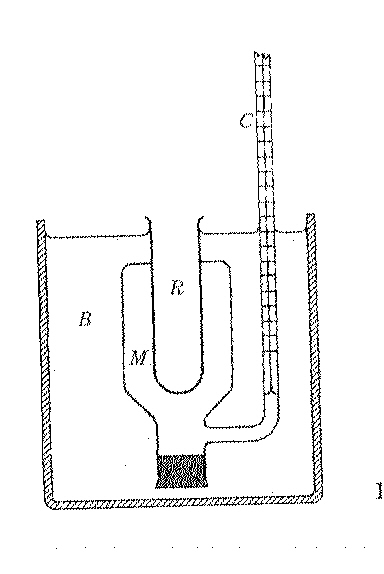
Figure 2 on p 5 (below) shows a schematic of a ice calorimeter.  An ice calorimeter uses a thermally isolated enclosed space M completely filled with liquid and solid water immersed in an insulated tank of ice and water B. The internal, thermally isolated, working volume of water has two important features- it has a small volume sample container R protruding into it and it has a calibrated small inside-diameter expansion capillary C. 

A sample in container R is in thermal contact with reservoir M.  Heat absorbed in M melts some ice and results in the loss of low density ice and the formation of higher density liquid water. The net volume of the contents then decreases and is registered as a column height change in capillary C.

Given the volume change and knowing the density and heat of fusion of water at 0 C, one can calculate the heat absorbed by the reservoir.

So, what about Saturn’s moon Enceladus? The moon is thought to be covered by water ice with liquid water underneath. It’s reasonable to assume that if some volume of water below the ice transitions to the solid phase then the collective volume for liquid water is decreased resulting in an uptick in pressure.

If this happens, it could provide a mechanism for the geyser phenomenon witnessed by the Cassini probe. The geyers could simply be a result of PV work energized by gravity and radiative cooling of the surface and subsequent thickening of the surface ice into the underlying liquid phase.

I’m sure the boys and girls at Cassini have thought of this, but since I’m not tied into the literature I have not heard anybody express it.

Watson, open the pod bay door please

Now that Watson has mopped up in Jeopardy, can we assume that contestants will finally be able to enjoy their free time doing leisurely activities like strolling through the glade instead of enduring the drudgery of game shows?  Finally, technology has freed humans from the shame and humiliation of standing there under the piercing stare of Alex Trebek. 

IBM’s website states that humans win in this new age battle between John Henry and the steam engine.  Yeah, right. IBM wins. One more thing reduces to a tedious, value added algorithm.

Budget Hand Waving

It is interesting to watch how the various factions of our culture interact on the matter of governmental budgets.  It is though a budget is an end in itself. It is though a budget is the final product of government.  Many apply a puritanical spin on budget and debt concepts. This country produces Cotton Mather characters every generation.

What is important about a budget item is what it does out in the field. OK, elected officials pushed the funding for a particular program or acquisition.  It seems to me that what is of interest is the result of the funding, not the protracted battle for funding.  The headline should be the funded project and the politicians can take their credit in the Congressional Quarterly.

The contrived acrimony over budgets is a battle over abstraction.  People make wild claims as to the market or social imperatives and morality of various magnitudes of spending. Spastic gesticulations and flying spittle get air time on the tube.  But perhaps we should go to the actual object of the budget item and have a look? Who knows what we’ll find?

What the republicans bring to the proceedings is a plan for nothing less than social reconstruction. They plan to wrest control over government so they can kill it.  The Teahadist wing and their antebellum jive appeals to a subset of the electorate more at ease with the Luddite ideals of the John Birch Society than to the social ideals of the 20th century. 

I can’t believe that history will look favorably on the conservatives and their irretrievably antisocial doctrines. People who have benefitted in more ways than they understand from the massive civil infrastructure of the USA now want to stop contributing  to it.

It’s too bad there isn’t a  libertarian confederate homeland for them to go to.  They could spend their days privatizing themselves silly while sitting there in the shade, counting their Krugerrands and sipping Mint Julips. Wait a minute, that sounds pretty relaxing …

I wish I was in the land of cotton, old times there are not forgotten,
Look away, look away, look away, Dixie Land.