Category Archives: CounterCurrent

The American gold rush and relativistic electrons

Exactly why do people value gold? Is all of the allure of gold due to its color? What if gold metal did not have the golden color? Instead, what if it had a silver luster like its neighbors on the periodic table of elements? Would we find it quite so appealing?

There are many reasons why people might desire gold.  The motivation to possess gold would surely vary based upon where in the value chain the metal was encountered.  Gold prospectors might value gold because it was an item of trade. Artisans would value gold for more pragmatic reasons relating workability.  Rulers would value gold because it was an asset that could be put in the treasury and later used to buy influence or fund military adventures. Thieves and plunderers valued gold owing its high value per unit volume  and the ability to offer it in trade virtually anywhere.  

Here is what we can say for sure about gold.  It’s high degree of inertness means that it can retain its golden luster indefinitely and bestow an everlasting aspect. Its malleability and ductility means that metalsmithing with fairly primitive tools was feasible. Gold could be hammered into thin sheets that could be cut, punctured, and otherwise worked by artisans to produce impressive art objects. Gold could be worked to produce all manner of ornamentation for the sake of religiosity, as an ostentatious display of wealth and power, or for coinage. Whatever the context, gold leaves an impression on people, aesthetic or otherwise.

Here is where it all gets interesting. You see, one of the consequences of Einstein’s theory of relativity is that as an object approaches the speed of light, c, its mass increases by an amount defined by a fairly simple mathematical relationship. An object’s rest mass is less than its mass appreciably near lightspeed.  The term “relativistic” refers to effects relating to objects traveling near lightspeed.

It turns out that some of the outer electrons around heavy atoms like gold and mercury are moving at an appreciable fraction of the speed of light- they are relativistic electrons.  If these relativistic electrons are at the outer, valence level, then aspects or behaviors affected by relativity may become apparent by how the atom interacts with light or other atoms. 

Chemistry is about the behavior of electrons confined to the space in the immediate vicinity of nuclei, or bound electrons. In particular, the electrons outer, valence, electrons. This is the realm of chemistry.  Chemists go about their business manipulating these electrons for fun and profit. Virtually our entire material experience of life is dictated by the manner in which these electrons interact.

In the case of gold, the 6s electrons are moving at a significant fraction of the speed of light. The magnitude is 58 % of c, according to one internet reference. At this velocity, the electron mass has increased by a factor of 1.22 times its rest mass. This being the case, the Bohr radius of the orbital is contracted by 22 %. 

The implication of this perturbation in orbital size is that an electronic transition between the 5d and 6s orbitals shifts out of the UV range and into the visible band. The molar extinction from the UV cutoff to about 500 nm is high enough that metallic gold takes on its characteristic golden hue from the reflected light.

Gold is not the only element to be affected at the valence level by relativistic effects. Mercury is also affected. The contraction of the 6s orbital results in relative inertness of the 6s^2 lone pair and poor interatomic (metallic) bonding, resulting in the unusually low melting point of mercury.  Indeed it is likely that most of the interatomic attraction is due to van der Waals forces, which is notably weak.

The inertness of the 6s lone pair reveals itself in the oxidation states of bismuth, which has stable oxidation states at +3 and +5. Like other pnictogens, bismuth (III) compounds have a lone pair. But unlike nitrogen and phosphorus lone pairs which are reactive and an important part of their ordinary chemistry, bismuth’s 6s lone pair is rather inert and not significantly hybridized. Triarylbismuth (III) compounds are trigonal planar with the lone pair taking spherical s-orbital symmetry.  UV-Vis experiments will show that for some simple BiAr3 compounds, the n->pi* transition has a very low extinction coefficient, unlike the analogous Ph3P.  Exposure to Pd(II), for instance, will show scant indication of coordination in the UV spectrum, again unlike Ph3P.

This is quantum chemistry stuff that the reader can run down later. What is of interest to me in this post is the fact that, without knowing it, gold prospectors, miners, and mill operators of the 19th century took full advantage of certain relativistic effects in their search for gold.

The first relativistic effect the early miners took advantage of was the simple fact that gold is a colored and relatively inert metal. It could be spotted by simple inspection in streams and quartz veins. The color of gold made it impossible to confuse with other metals. Ofcourse, iron pyrite was always a problem, but there were simple ways to test for pyrite.

The other relativistic tool used by miners was amalgamation of gold (and silver). Mercury, being a metallic liquid by virtue of relativistic valence electrons, could be intimately contacted with gold dust or larger particles to form a solution that would remain liquid up to some modest fraction of gold. Mercury, being quite dense, would naturally seek the low points where the gold would also be found. This dissolution could be affected by simple sloshing or by grinding the mercury with the ore in an arrastra or an amalgamation pan.  After agitation, the mercury would pool and could be easily collected.

Later amalgamation techniques would combine aqueous cyanidation of the ore in the presence of mercury in hopes of better gold and silver  recovery. Reduction of gold or silver chloride occured in-situ to provide amalgam.  Amalgamation of ore that had been chlorinated by roasting in the presence of NaCl was a common solution to the serious problem of sulphuretted auriferous or argentiferous ore.

The miners of the 19th century American gold rush certainly didn’t know that their task of extracting gold would be aided by the effects of high velocity electrons. Most people walking around today don’t know or even care about this more than 55 years after the passing of Albert Einstein.  But it goes to show how subtle effects of nature can affect our lives in unexpected ways. And this is just one of many such nuances of physics.
Some Questions

What do farmers think of crop circles? Isn’t it just … vandalism? Is there such a thing as crop circle insurance?

Many of the fellows who boarded the three ships at Griffins Wharf and pulled off the Boston Tea Party were disguised as Mohawk Indians. How patriotic or heroic is it to destroy property and attempt to blame others for the deed?

When Rand Paul implodes alone in the forest, will he make a sound?

An involuntary grunting reflex

Make magazine is one of my very favorite publications. It’s made for hillbilly engineers and aspirants like myself.  Their Maker Shed Store offers kits as well as plans for making all sorts of cool gadgets. Check out this Berliner Gramophone kit and this vacuum tube radio kit.  

Kit building and garage engineering are important activites for aspiring young scientists. We senior scientist types should be on the ready to mentor local high school students in their bid to learn about technology from the ground upwards.

Electronic experience is invaluable to all experimentalists- physicists, chemists, geologists, biologists, etc- and is a subject of lifelong utility. Many students do not have peer groups or family members who can help them get into this subject.

As a junior high school kid, I worked on TV sets (tube electronics) and acquired some electrical and mechanical ability in doing so. I actually fixed a few problems, surprisingly. A family friend had a TV repair shop (remember those?) and as a result I had a steady supply of TV chassis to take apart for my collection of parts like potentiometers and variable capacitors.

Like most kids rippin’ stuff apart and eyeing the construction methods I gained valuable electrical insights and personal experience with electrical current.  Like the time I discharged a picture tube through my hand while trying to remove a flyback transformer from my grandparents color TV. It was great lesson in capacitance and isolated static charge. As my grandparents sat on the Davenport and watched, they heard a sudden and involuntary grunting noise burst from my mouth as I hurled myself from a squatting position by the opened console TV set and backwards across the room. I probably absorbed more joules of energy from landing on my backside than the joules absorbed by my hand. Luckily I was not burned. The next day I learned how to properly discharge the aquadag in the picture tube.

It is nothing at all like tangling with an vicious animal who might stand there after the altercation spent and panting, wondering in its little badger brain how to tear an even bigger chunk out of your leg. A discharged electrical appliance bears the same silent affect before as afterwards. It’s wicked electrons are inanimate and unparticular in their singular drive to find ground. An unexpected jolt from a device is much like a magical experience. It comes from nowhere and everywhere and is over in the blink of an eye. Afterwards you stand there in shock and awe of the effect of even modest amounts of energy.

The impulse to do science is also the impulse to find boundary conditions of phenomena. Where are the edges? How does it switch on or off? You have to be willing to leave some skin in the game to find out about things.

Obstreperous Theocracy

So it appears that the US is quietly building up military forces within striking distance of Iran. The island of Diego Garcia (UK) has served as a staging area for standoff weapons. The military-political establishment has been busy with threat analysis and is evidently staging forces to some extent based on their conclusions and evolving policy.

I think there are many credible arguments that rightly assert that Iran is an active threat to what passes for stability in that region. Or at least at the first-order level of political analysis. Iran is plainly an obstreperous theocracy with a particular zeal for the export of its orthodoxy.

As always, the drums begin to beat for war and the business of manufacturing public consent begins in earnest. I’ll go out on a limb and make a gross generalization. All human populations seem to have a fraction, say 1/4 , who are particularly fearful by nature. These are the folks who susbscribe to concrete notions of nationalism, righteousness, and the associated keenness for adherence to orthodox doctrine. These were key proclivities of the US/Soviet cold war era. It is part of a collective consciousness that is especially adept at finding patterns that validate its fundamental fear.

It would seem that we may be in yet another run up to the projection of force on the far side of the world. A good question would be this: Are we addressing the fundamental cause of World-vs-Iran conflict? At minimum we trying to shore up the result of a century of bad western foreign policy.  This region is at the overlap of profound social forces associated with abrupt infusions of petrodollars, reflexive militarism, ethnic antipathy, and religious orthodoxy.

I think that Chomsky has some valid points about the origin of these conflicts. Iran and other groups have used the Israeli-Palestinian conflict as a bully pulpit for their own regional ambitions. Obviously there is sincere religious and ethnic outrage over the the Palestinian issue. But a state like Iran is sure to use this conflict to their own political advantage to exercise the projection of power.

The US and other western states have chronically miscalculated the magnitude and direction of regional conflicts.  For instance, would a military strike against Iran be viewed as just an attack on the government of Iran, or as an attack by infidels on Shi ‘ism? Are we prepared for what would follow? I think I can guess the answer.

Andy Grove on Scaleup

Andrew Grove is the former CEO of Intel who was responsible for its transition from memory chip producer to microprocessor producer. According to Wikipedia, Grove is responsible for an increase of 4500 % in Intel’s market capitalization. In his youth he and his family escaped from Budapest, Hungary during the Soviet invasion of 1956. Groves holds a PhD in chemical engineering from UC Berkeley. Grove is now retired and is a senior advisor to Intel.

Grove recently wrote an article for Bloomberg that is quite insightful in its analysis of certain aspects of American corporate culture. In particular, Grove notes the disconnect between US technology startups and the subsequent expansion of business activity leading to job growth. He also notes that startups are failing to scaleup their business activity in the USA. The Silicon Valley job creation machine is powering down.

Grove makes an interesting point here,

A new industry needs an effective ecosystem in which technology knowhow accumulates, experience builds on experience, and close relationships develop between supplier and customer. The U.S. lost its lead in batteries 30 years ago when it stopped making consumer-electronics devices. Whoever made batteries then gained the exposure and relationships needed to learn to supply batteries for the more demanding laptop PC market, and after that, for the even more demanding automobile market. U.S. companies didn’t participate in the first phase and consequently weren’t in the running for all that followed. I doubt they will ever catch up.  Andrew Groves, 2010, Bloomberg.

To build on what Grove is saying, I’ll embellish a bit and add that an industry is actually a network of manufacturers, suppliers, job shops, labor pools, insurers, bankers, and distributors. When deindustrialization occurs, the network of resources collapses. The middle class takes a big hit when a commodity network moves offshore. In the end, the intended market for commodity goods and services- ie., the middle class- is weakened by the very move that was supposed to keep prices down and profits up.

Grove is most concerned with the matter of scaleup. This is the business growth phase that occurs after the entrepreneurship proves its worth in the marketplace. Investors pour money ino large scale operations and staff to get product onto the market. Grove suggests that investment in domestic startups who do not follow on with domestic scaleup are not participating in keeping the magic alive.

Offshore scaleup negatively counteracts the benefit of domestic innovation. In a sense, it is an abdication of the trust given to the entrepreneurs by the citizens who provided the infrastructure to make the innovation possible.

Grove makes a good point in his editorial and I think that the rest of us need to take an active stance to question the facile analysis so often uttered by business leaders when it comes to relocation of business units offshore.  Citizens paid for the infrastructure and a large part of the education that makes our innovative technology possible. There needs to be more public pushback on business leaders and government officials about this topic.

Russia being Russia

It was reported that the Russian Parliament has approved a draft of a law to increase the powers of its FSB, or the remnant of its Soviet era KGB.

The final version is somewhat weakened from its earlier form, which prescribed punishment for individuals who ignored such warnings from the F.S.B. In remarks posted on his party’s Web site this week, Vladimir Vasiliyev, the chairman of the State Duma’s Committee on Security, described the new power as “a preventive conversation” with “someone who is beginning to move toward committing a crime.” (New York Times, July 16, 2010)

Imagine that. A Future Crimes Division.

When asked about the bill by a German reporter during a meeting with German Chancellor Angela Merkel on Thursday, President Dmitri A. Medvedev said, “what is going on now is the result of my direct instructions,” and that foreign commentators should not concern themselves with it. (New York Times, July 16, 2010)

The police state is back. The Russian gov’t is moving (back) towards policing perceived intent. What a sad day for Russian civilization and the world.  Queen to E5, check.

Viewpoints on American Business

Over at the Robert Reich blog there is a recent commentary on Chinese currency policy. Reich makes some interesting comments on the Chinese approach to industrialization.

But most fundamentally, China is oriented to production, not consumption. It wants to become the world’s preeminent producer nation. While keeping the yuan artificially low is costly to China — it pushes up the prices of everything China imports — China is willing to bear these costs because its currency policy is really an industrial policy.

We think the basic purpose of an economy is to consume, not to produce. So we only grudgingly support industrial policy. We think of government efforts to rebuild our infrastructure as a “stimulus.” We approve of government investments in basic research and development mainly to make America more secure through advanced military technologies. And we give American companies tax credits for R&D wherever they do it around the world.

Don’t be fooled into thinking that US companies will continue to make big profits from sales in China. China allows big U.S. and foreign companies to sell in China on condition that production takes place in China – often in joint ventures with Chinese companies. It wasn’t American know-how, so it can eventually replace the US firms with China firms.  [Italics by Gaussling]

It seems to me that American policy leaders have no clue whatsoever on how to coexist or compete with China economically. Because of the authoritarianism in contemoporary Chinese culture, they are able to focus their resources on long term goals while we in the USA rely on a kind of economic Darwinism. It seems that we are waiting for the rational forces of the marketplace to take us forward in the economic struggle with China.  In reality, American businesses have no nationality. Their obligation is only to achieve maximum shareholder value, irrespective of parochial concepts of national interest.

Americans like to put on a show of maintaining an orthodox capitalistic stance against a nation state like China. One with a centrally controlled economy.  Unfair currency policy is a foreign policy that China is using to leverage the flow of export dollars their way.  Somehow we are content to play cards with an opponent who has stacked the deck.

It is worth remembering that much of the technology that economically emergent states use to energize their manfacuring sectors was paid for by US citizens over the last 100 years. Electronics , metallurgy, chemistry, aerospace, transportation, automation. The US has made substantial contributions to technologies that are now ubiquitous.

These emergent states have not funded generations of successive invention and improvement to achieve their semiconductor FAB or petrochemical complex. Corporate investors dropped it out of the sky.  This technology that we have been busy exporting has been dearly paid for by generations of hard working citizens here. Yet, through the exercise of advanced business philosophies, this magic of ours has been transplanted off shore to the benefit of a few.

I think there is an assumption that our American democracy is somehow a uniquely robust form of democracy. It is hard to make that argument anymore. A culture that equates money with speech and validates it in the Supreme Court is a culture that accepts the notion that the congress is part of the marketplace of goods and services.

In the face of a shift in the global economic center of gravity, Americans are busy in an orgy of fratricidal disassembly of its institutions. Journalism and independent media come to mind.  The former watchdogs of democracy are now quasi-analytical entertainment divisions of a few major comglomerates.

The market is like a stomach. It has no brain. It only knows that it wants more. I think nations like China know this about us and take full advantage of the fact that we like to wear the badge of orthodox capitalist on our sleeves. In a way we are just country bumpkins who have never traveled out of the county. We’ll be true to our doctrine as we run aground.

I think that, in the end, publically owned corporations will be the death of our economic vitality. Blind reverence for CEO’s who maneuver a dividend no matter what the economic climate force this species of organization to abdicate any sense of national affiliation. It’s been happening for many years. Legions of B-school students study the strategy of Jack Welch and similar ethically agnostic characters who serve the greater good of the corporation.

Instead, legions of B-school students should be trying to figure out how to sustain American manufacturing rather than how to outsource it. These people should not confuse M&A with progress. Making things and offering services that people want is how progress happens. If taxes are too high to sustain business within these borders, then an open effort to bring corporate taxes into line based on mathematically defensable arguments should be made. To work for progress is to be progressive. We need more progressive business people, not more financial wizards. The grownups of America need to step up.

NatGeo King Tut Exhibit- Ho Humtep of the Ballyhoo Dynasty

Th’ Gaussling went on a minor field trip recently to the local art museum in Denvertown to see the marvels of King Tut. And what a marvel it was … of marketing. It is hard to say that the exhibit met expectations. To be sure, there are some fine artifacts on display.  And it is a splendid example of museum-craft. Notable is the exquisite goldsmithing and scuplture on display. There are decorative articles that resemble a form of gold filigree that are quite impressive for the era. My northern European ancestors were sleeping in hollow logs and howeling at the moon when the Egyptians were doing the work on display.

But at the end of the day, the exhibit is yet another recasting of history in a theatrical form suitable for the attention deficit masses. Case in point:  a video short subject portrays DNA work on a mummy where the scientist assures us that such research is a part of the larger effort to cure disease.  Golly, sounds urgent.

Well, maybe there will be useful findings that contribute to the betterment of human health. But if it doesn’t , is the knowledge useless? I think not. This is the same sort of lame apologia used for jusifying space exploration or studying the frogs of Amazonia. If you are not looking around, you are not going to find new things.

Scientists should stand firm with the conviction that exploration is a net benefit for mankind. We should be more careful that claims of a breakthrough are tempered bya realistic warning about the speed of progress.  We should stop leading people along with false expectations about the fabulous things just around the corner. All progress is the result of prolonged hard work by many people.

A chemist’s encounter with boneheads and the disreputable

One of the things that happens to a chemist in the sales department is the business of taking odd phone calls. Someone out there will scan the internets for information on some particular substance or product and find the number of your company switchboard. The person at the front desk  will spend a moment with the caller and then connect them with someone like myself.

During my business development time I have been amused, surprised, pestered, annoyed, and yes, a little frightened.  I have fielded calls from a prisoner wanting expert witnessing (his planned appeal was based on a false premise), illicit drug makers wanting bulk intermediates sent to their motorcycle or chrome shops, and crooked characters wanting items on the MCA list sent to their garage operations.

I am not a member of the law enforcement fraternity. God knows these characters have never asked for my help.  There is precious little I can personally do in the fight against drug crime. But foiling those who would profit from poisoning the nervous systems of our citizens is something that can be done by chemists.

I have spoken with misguided people on the dark side of chemistry who are on the fast track to prison. And, I have taken calls from parents of K-12 students wanting energetic or otherwise hazardous materials for their science fair project. In this case, we’ll have a polite discussion about safety and I’ll offer some alternatives.

I have been yelled at by frustrated foreign nationals for my refusal to quote on items on the munitions list or the State Department’s official shit list of bad actors. Some were persistant buggers, but I extracted satisfaction in interfering with their sourcing plans. The front lines in illegal technology transfer or illegal synthetic drugs is not in the offices of the authorities. It is on the phones and emails messages of companies who sell materials or devices that facilitate the activity.

It turns out that knowingly selling substances to suspicious characters is not only morally wrong or makes you an accessory, but it is just plain bad business. Long term stability for you and your company requires compliance with the code. Selling materials that may be used for illicit purposes by unqualified buyers is only an open invitation for trouble.

Trolling for organizational weaknesses happens all of the time and all over the business world. Industrial espionage, attempts at illegal export/import of controlled materials, and raw material sourcing attempts for illicit or controlled substances. You have to keep your head on a swivel and qualify your customers.  

Trade shows are particularly bad for spying and competitive intelligence gathering. Companies who can afford large trade show booths will have an enclosed room to meet privately with potential customers. That way watchful eyes will have a harder time figuring out what they’re up to.

Few experienced business development people are shy about asking questions, especially yukking it up over a business dinner and drinks. When in doubt about giving information, just shut your yap, shrug your shoulders, and grin.

Always be up front and honest when it comes to withholding confidential information. Even, or perhaps especially, when you have an NDA in place.  You do not want to get in the habit of discussing sensitive topics in social settings. Leave that for meetings in the conference room where your cohorts can participate and everyone can hear what was disclosed. Savvy business people on either side will halt conversation on the spot if they believe that proprietary information is being divulged inappropriately.

As to the matter of gaming the system, I’ll offer that it’s always better in the long run to avoid planting misinformation. It is better to be regarded as uninformed or unhelpful rather than as a liar in the sales world. You can eventually slough off the reputation of being a bit uninformed or rude. But once branded as a liar, even in a field of liars, it is a stink that will follow you for the rest of your career in sales.

The Black Hills- Of Chiselers and the Chiseled.

The Black Hills are a mountain range that stand in the southwest corner of South Dakota and extend a bit into northeastern Wyoming. The area is known for the natural beauty of its forested mountains and green meadows. The relatively low population density along with the dramatic monuments and natural wonders make this a satisfying destination. In rather stark contrast to the panoramic beauty of the area, however, is a geopolitical history that is quite a bit less than pristine.  

After decades of expansive settlement from the US in the east and the corresponding conflicts, a treaty was forged in 1868 between a confederation of northern plains Native tribes and the US government. This treaty deeded the Black Hills region to the Native confederation.

Within a few years the Native American confederation lost possession of the land granted to them by the Treaty of Ft Laramie. It seems to have happened not so much by the US government backing out of its obligations, but by lack of decisive government enforcement of the terms of the treaty.

The discovery of gold in 1874 by the Custer expedition and the prompt announcement of this discovery lead to an irreversible economic migration to the area by gold seekers and those who would follow them. Many of the gold seekers were miners and entrepreneurs from other gold fields seeking new opportunity. Custer met his end in battle, hopelessly outnumbered by Indian forces.

Today the Black Hills of South Dakota are a locus of tourism, gambling, and recently, neutrino physics. Native Americans reside on a handful of reservations scattered throughout the eastern plains.

It is a curious contrast to behold. Today automobiles and tour buses disgorge well fed tourists by the hundreds of thousands each year to marvel at the spectacle of Mt Rushmore, buy souvenirs, and to rejoice in nationalistic self satisfaction.

Bikers make the annual sojourn-in-leather to nearby Sturgis in part to celebrate the freedom of motorcycling. All of this celebration of freedom in an area where the lust for gold has trumped the freedom of a hunter-gatherer society by those who had mastery of explosives, metallurgy, and steam energy. I suppose it was inevitable.

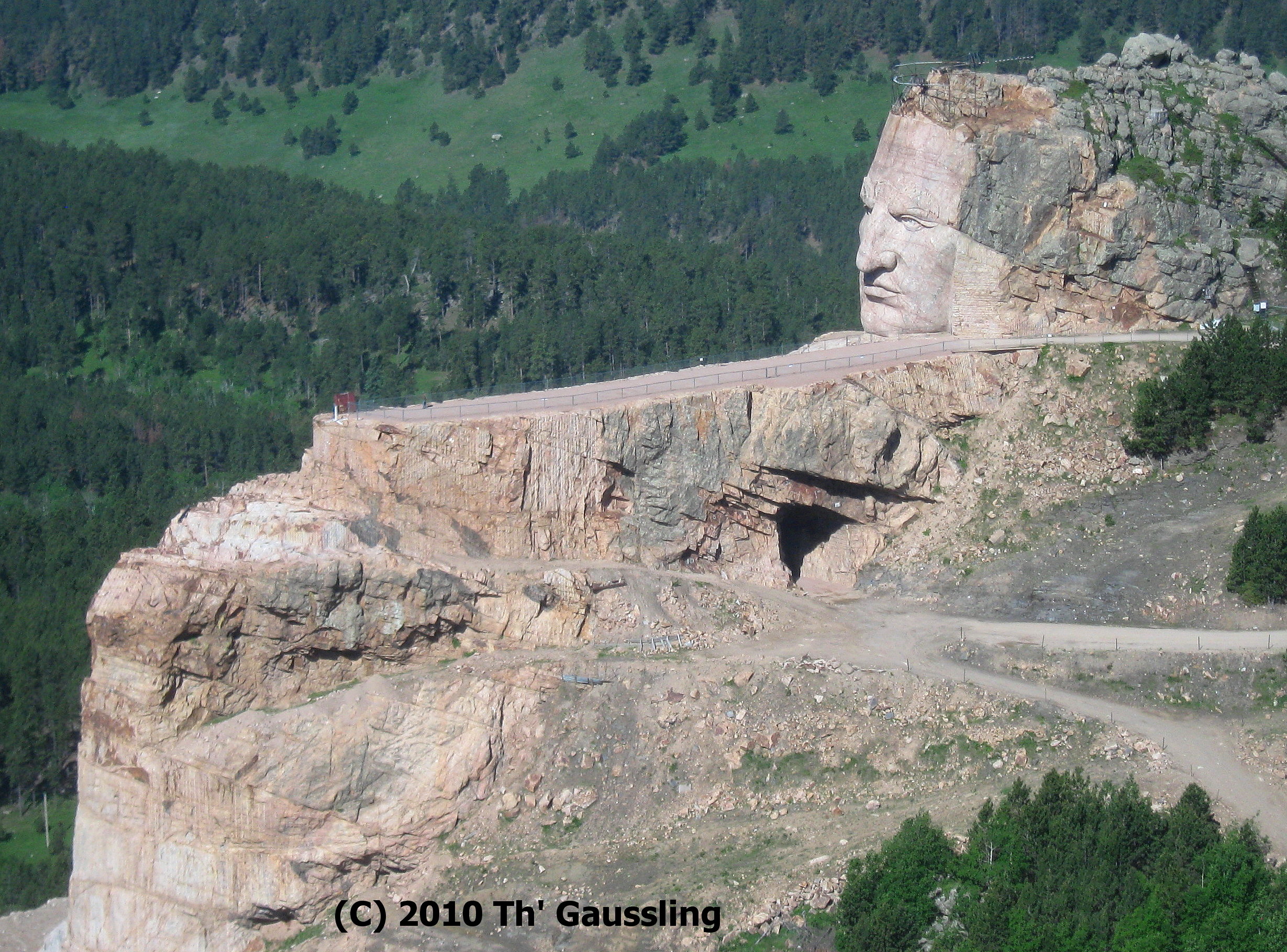
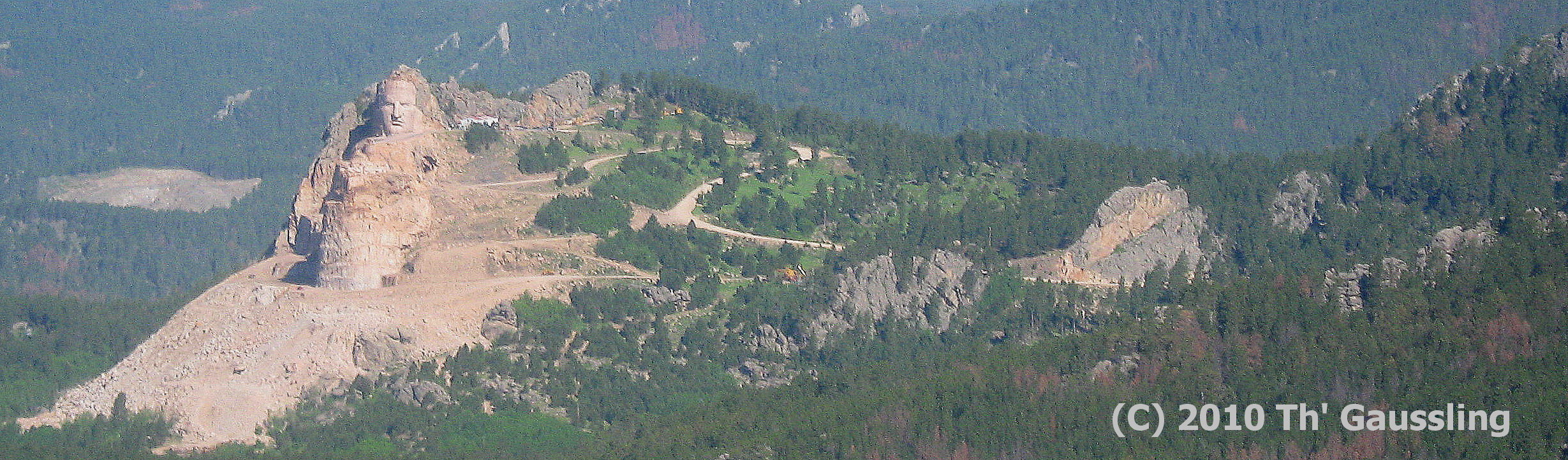
View of Crazy Horse Monument from Helicopter

Th’ Gaussling and family splurged (Yoww!!) on a helicopter tour of the Mt Rushmore and Crazy Horse area. It was just spectacular. The heliport was a mile from the Crazy Horse Monument so we were treated to two visits to the site.

Crazy Horse in Context

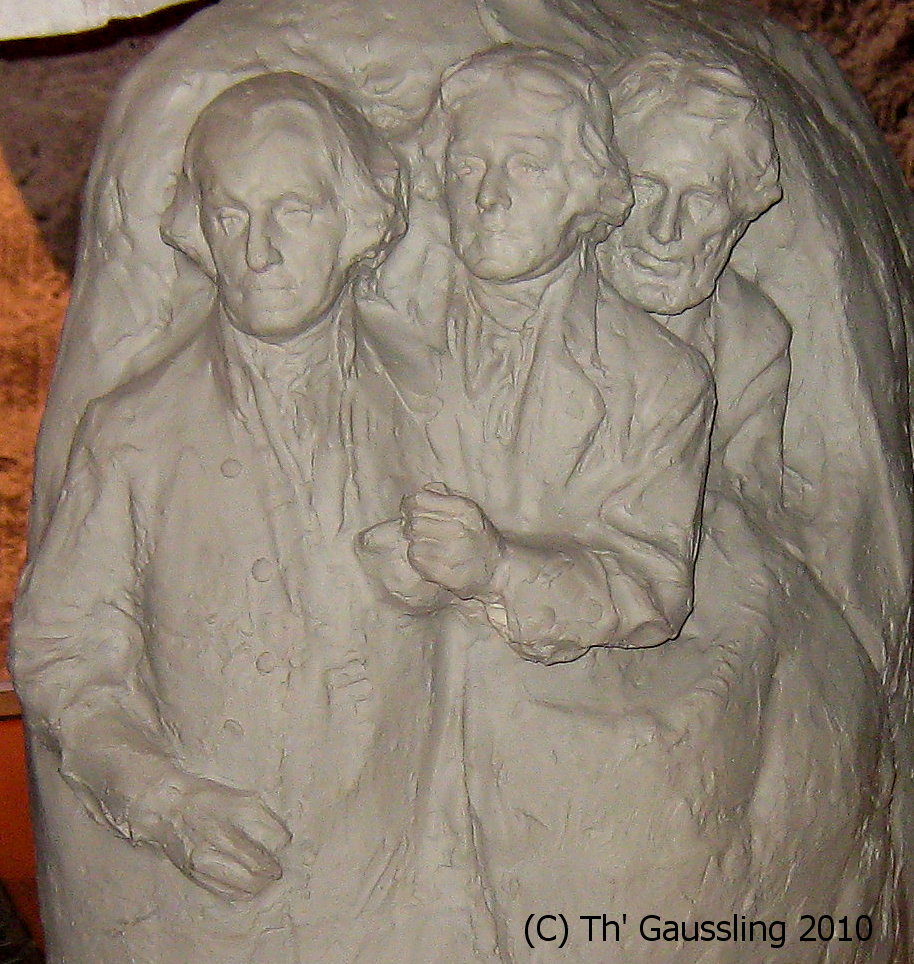
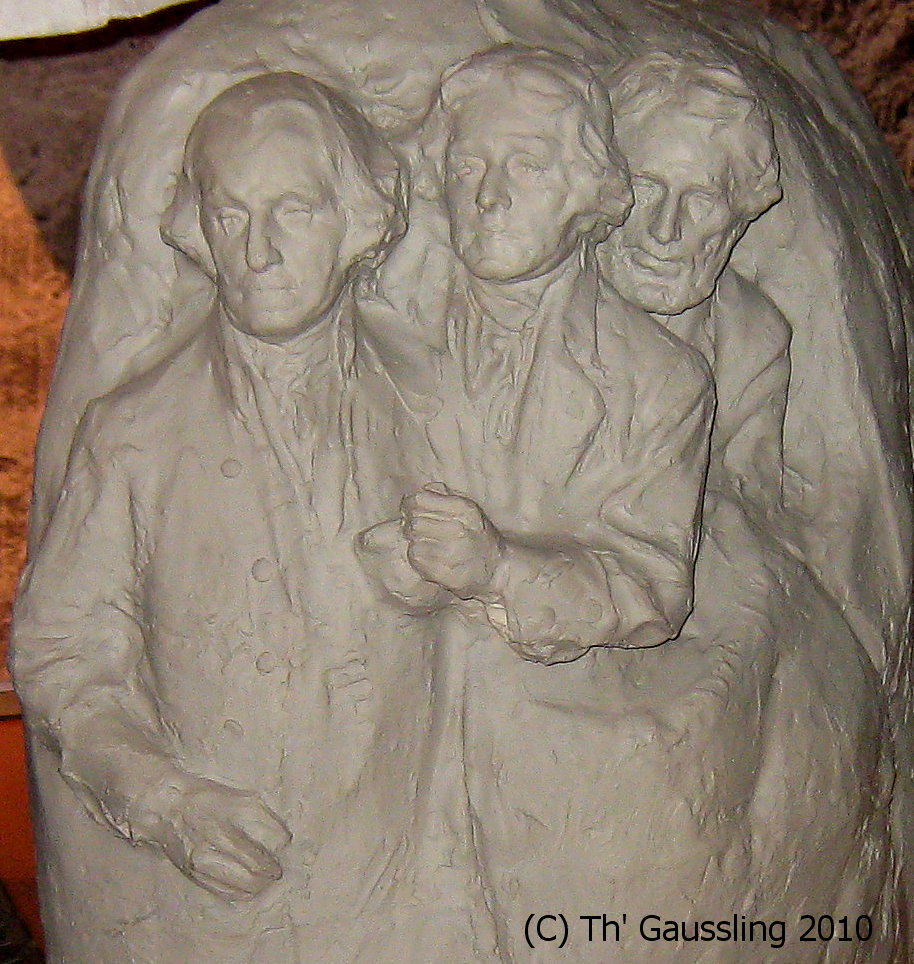
Gutzon Borglum launched his ambitious monument project on a mountain the locals called Mt Rushmore. The final form differed somewhat from early models.

A great deal of resources and effort went into the Mt Rushmore monument. It features a parking garage, gift shops, museum, two indoor theaters, an amphitheatre, cafe, and Borglums studio. The visior is free to simply sit and ponder the monument or dive into the historical details of its construction.

Mt Rushmore Profile View

Borglum fabricated scale models of the subject faces in his workshop below the site and used a geometric device to transfer the dimensions to the mountain. A plumb bob hung below a protractor-style device mounted on the model. A rudimentary coordinate system would provide a basis for scale-up.

Scale Model Faces of Mt Rushmore

Borglum died of complications from surgery in March of 1941. Gutzon’s son Lincoln Borglum carried on with the project after his death. However, Lincoln left the project substantially in the form left by his father. The project was officially halted later in 1941 owing to a lack of funding.

Mt Rushmore

Mt Rushmore is a spectacular thing and everyone should see it. All of the fellows captured in stone had attributes worthy of meditation. The timeline between them and we of the present day is jam packed with fantastic events that they had a hand in initiating. I’m certain that they would say that our technology is different but human nature is the same.