Category Archives: CounterCurrent

It’s a hip hop hippity hop

I was standing in a light rain this afternoon watching a hip hop dancing exhibition. A lawyer friend standing next to me commented that it was so cold he had to keep his hands in his own pockets. I thought that was funny.

Since the kid has been studying hip hop dancing, I’ve been to one hip hop concert and a few dancing exhibitions. I have to say that I rather like it. 

I’ve noticed something over the years at school functions where parents gather to watch their kids. Strangely, the parents are almost universally uncomfortable around the parents of other kids. When they (we) walk into the school they automatically become shy. Their social skills seem to be left outside. Even the elementary quantum unit of civility, an introduction and a handshake, is offered only after awkward minutes elapse and it becomes apparent that anonymity cannot be maintained. The notion that the parents of your kids friends are also your friends is not an axiom.

In fact, this whole business of adult friendship is a puzzlement to me. I can’t tell you how many times a discussion with another adult escalates into “that’s bullshit, this is how ya do it …” or terminates as “well, we don’t do that…”.  Many adults I know are seemingly unable to enter into a discussion where ideas are tossed around and back and forth analysis ocurs with mutual curiosity and interest.

So many people I know will take any given comment as an invitation to render approval or disapproval. There is rarely any interest to build on a concept or flesh out possibilities. One coworker is unable to discuss any topic I bring up. The reply to my sentence is invariably to throw out onto the table the activity or thing they do in a superior way than implied by my comment. There is never any back and forth- their participation is just a series of reflections off a mirror back to themselves.  Some of these folks are very brittle emotionally and intellectually.

Then there are the people who only participate in a discussion when they can dominate it. If they cannot dominate the proceedings, they leave. I have taken to the bad habit of preempting them by leaving when they arrive to dominate the discussion. Who is the bigger fool? I am not sure.

Somebody (William James?) once said that for most people, thinking consists in the rearranging of their prejudices. There is a lot of truth in this.

Note to Larry King

Note:  The rest of you please go about your business. This is a private letter  to Larry King.

Hey old buddy,

I heard that you was getting ready for yer, what, eighth deevorce? Dude, you really need to think about puttin’ that horse out to pasture. I can understand one or two. Hell, I been deevorced myself. But eight? Sssshoot! It only takes two points to make a straight line. Ain’t it gettin’ a might pricey? Don’cha ever wanna retire from that damned station in Alanta?

Here is what ya do. Ya go into yer back yard and dig up some of that money ya got buried back there and ya git yerself a condo and a dog.  A fella like you prob’ly needs a mastiff or some other big dog. Whatever. The dog will love ya no matter who else you may be fooling around with that month. Catch my drift? Git my meanin’?

Okay then. ‘Nuff said.

Your pal,

Th’ Gaussling

Drill baby dr … what was the question?

I keep seeing video footage of citizens who have been asked to comment on the recent plan to open up offshore oil exploration. President Obama and his crew have read the tea leaves and have concluded that, in addition to advancing alternative fuel technologies and markets, it would be useful to open up offshore drilling, at least a bit. Invariably the people who appear on air seem to concur that we need to find and tap the petroleum resources under the sea floor.

Rarely one hears an interviewee who will openly say that we should reduce petroleum consumption, or at the very least, its growth rate.

Here is my question. Why are we so anxious to tap all of our resources as soon as possible?  Isn’t oil in the ground a little like money in the bank? Oh, I forgot. We are not a savings culture.

Obviously, the new exploration emphasis is to support a decent growth rate in consumption. A high throughput of fossil carbon and energy is needed to sustain the profitability of certain large public corporations.

As I see it, the problem with public corporations is that they are run on behalf of what are essentially absentee landlords. The stockholders demand a good return on their investment or they’ll bail. Can’t blame someone for that. So, management runs the corporation in a way that affords maximum profit rather than maximum sustainability. As a result, in the same manner as absentee landlords, management drifts into the mindset that they can justifiably milk the resource to depletion for fast cash. If cash is king, fast cash is divine.

The market is very much like a stomach. It cannot plan. It only knows that its hungry or not hungry. It seems to me that an organ with a bit more wiring should be in charge of energy resources.

Phosphate the Wonder Anion

I thought it would be good to start the week by highlighting a particularly praiseworthy anion. That anion is phosphate, sometimes called orthophosphate, (PO4)3-.

So, you ask, what is so bloody interesting about phosphate? Isn’t every atom, ion, and molecule special in some way?  Well, yes, but phosphate is uniquely constituted to provide services in the critical area of genetic information keeping and functional group transformation (without Pd and boronic acids).

Here is the curious thing: Biochemical systems use phosphorylation and hydrolysis as a means of executing molecular transformation. Remember oxidative phosphorylation?  So, how is it that a phosphate moiety that is so useful as a leaving group or activator is also able to hold together DNA with such high fidelity?

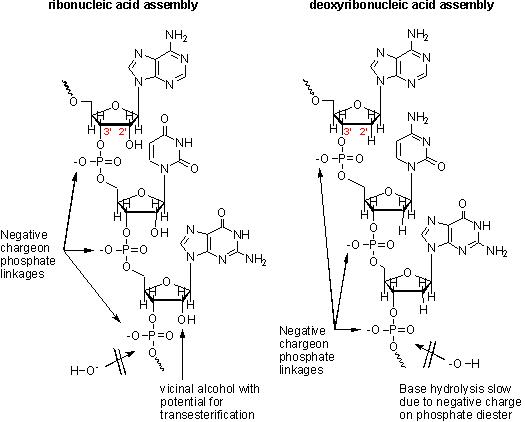
Phosphate Backbone on RNA and DNA

In his much-referenced 1987 paper entitled “Why Nature Chose Phosphates” (1), Frank Westheimer observed that phosphate diesters have a very useful property as a linking group for nucleic acids. The charged oxygen on (RO)2P(=O)O- serves several purposes.  The presence of a charged linker renders DNA and RNA compatible with the hydrophilic environment inside the cell. The charge prevents the nucleic acid polymers from migrating to more hydrophobic environments found inside of cell membranes. And equally important, the monobasic anion serves as a kinetic barrier protecting the millions of phosphate linkages in a DNA strand from cleavage under neutral or basic hydrolytic conditions over the lifetime of the organism.

The hydrolytic stability of phosphate diesters is not to be underestimated. Westheimer points out that dimethylphosphate anion has a half-life of 1 day at 110 C in 1 N base. He cites the rate constants at 35 C for the saponification of (CH3O)2PO2- is 2.0 E-9 (1/mol sec);  (CH3O)3P=O is 3.4 E-4 (1/mol sec); and for ethyl acetate 1.0 E-2 (1/mol sec).

However, the very simplicity and current prevalence of phosphate ion in the environment does not go far in explaining how phosphate might have found its way into metabolic and structural use.  In prebiotic times, the occurence of phosphate is in doubt (2).  But not just the occurrence of phosphate is in doubt. The relative abiotic inertness of phosphate towards esterification and the formation of other metabolically useful species raises the question of the original oxidation state of phosphorus during the onset of early life.

While phosphate is found in certain meteorites, Pasek suggests that a more ubiquitous meteoric phosphide mineral species such as schreibersite, (Fe, Ni)3P, found in iron meteorites may have provided the necessary reactive precursors for metabolic evolution (2). Pasek cites growing evidence of a late meteoric bombardment period at 3.8-3.9 GA.

Schreibersite hydrolyzes to a variety of oxidized species including phosphite. Phosphite has the advantage of being substantially more water soluble than phosphate, providing a larger molar concentration in seawater.  Schreibersite reacts with acetate to form acetylphosphonate. In fact, a variety of organophosphorus compounds may be formed on exposure of schreibersite and its hydrolysis products with organic materials.

Lowly phosphate isn’t sexy like the newer anions triflate and BArF. But its seemingly mundane properties are key to the function of metabolism and genetics.

(1)  F.H. Westheimer, Science, 1987, 235(4793), 1173-1178.  (2) Pasek, M.A. PNAS, January 22, 2008, vol 105, no. 3, 853-858.

Zoning and Hard Times

Many have written about the essential fragility of the economic situation of most American workers. We save too little and accumulate too much high interest debt.  Our consumption in every context seems unsustainable. The fragility of the monetary system with its lack of dependence on gold and the cosmic-scale debt that our country has racked up has many people worked into an existential lather.

The hard reality is that a worker can lose his/her job and all of the forms of stability that comes with it. We have become absolutely dependent on the economic system of the “employment” by people and organizations. We exchange our labor for payment on an hourly or salary basis and hope to sustain a stable and predictable lifestyle therefrom.

When a person loses their job, the reality of maintaining shelter and keeping everyone fed and clothed pops straight up into view. Because we have structured our culture and economic system on sustenance by employment, our ability to improvise is weak. Our ability to get another cashflow stream going is limited and most people pursue solutions that consist of finding other employment.

What workers in America lack is something that is available in much poorer countries. When an American worker loses their job, either they must find another job or start a business to sustain a living income. But if an American worker wants to start a business making something or retailing, chances are that local zoning codes will bar them from operating out of their home.

There are certain kinds of business activity that people can do out of their residence. Many people do office type work like accounting, consulting, writing, and other information intensive services out of a home office. Baby sitting, daycare, sewing, and small scale construction contracting are commonly based in a residence.

But if you want to repair cars, retail specialty parts of all kinds, or manufacture widgets at the microscale, chances are that your activity will be banned either by municipal ordinance or by a home owners association.

If you visit a city in a poorer country- say, Thailand- what you will see are large sections of housing where people combine their occupation with their residence. I recall being lost on foot somewhere in Bangkok a few years ago, wandering through neighborhoods where families lived in small shops that had a metal overhead door for street access by potential customers. At sundown, the shop activity ceased and the stove came out and a pot of soup was put on the heat. Fans, televisions, and music would blare into the sweltering streets along with the aroma of food.

Poor as these folks might be, they have something that American city dwellers absolutely lack. They have the ability to consolidate their resources to provide shelter and an income. By day a family might sell parts for small gas engines or some particular range of plumbing fittings. By night they repair to the back room for supper and relaxation.

An American facing the prospects of no job and left with only industrial skills is in a bit of a pickle.  While they might have very valuable skills, chances are that these skills are not readily transferable to common home-based activities. Someone with retail experience, on the other hand, might be able to put together a small shop.

What would stop an American city dweller from starting a home retail business is the issue of zoning and code compliance.  If an unemplyed person wanted to sell articles of clothing in a converted garage shop, there would be a long list of problems with the town board and the neighborhood. There would be applications and appeals, neighborhood input, and public hearings for a variance to the code. Zoning, parking, fire codes, and handicap access are just the start.

Then there is the matter of neighbors and their firm theories on property value. US culture has long been aloft on an arc of gentrification. People invest heavily in their homes and view their shelter not just as something that keeps out the weather. We festoon them from a vast array of manufactured decorative goods. We slather them with paint and adorn them with “accessories”.  

We have come to rely on our homes as repositories of personal wealth. And this notion, evolved from countless proposals before countless town boards, has become a complex web of building codes and ordinances controlling seemingly every degree of freedom to act that you can imagine.

Go to a town board meeting anywhere and look for those who seek to influence the board. Much of the time they are people related to real estate and development. Much of the gentrification we see has its roots with developers seeking to provide a sense of exclusivity. 

The result is that wealth creation by the appreciation of residential property value has been given a privileged position over wealth creation by the productive use of that property.

Our ability to sustain ourselves through hard times is constrained by rules to meant to protect property value and provide a basis for notions of the residential ideal. Americans are poorly prepared to be poor. We have an infrastructure that is not well adapted to allowing the unfortunate unemployed the option to scratch out a living from their homes. So pervasive is the residential ideal that the options for shelter are few in gentrified areas of the country. We have zoned ourselves into a corner based on bourgeois notions of aesthetic tidiness.

Alien Fasteners. Wingnuts from space.

Imagine that you and a companion are out for an evening stroll after a big dinner, say in a park somewhere. You hear a curious whining sound and look up to see an alien spaceship on a landing approach to the park. The craft lands and the crew scuttles off to perform some tedious abduction or organ harvest in the neighborhood.

Your companion exclaims “Golly! There is something you don’t see every day!”. But you’re unmoved by your companions incisive commentary. Because you see this as a long sought opportunity to examine an alien craft up close.

What would you look at? The propulsion system? Or perhaps the weapons array or guidance system? Pffft.

I would look at something much more mundane. I think it would be very enlightening to see what kind of fasteners they use. That’s right. Fasteners. Nuts, bolts, latches, bungees, straps, nails, hinges, hooks & loops, and rivets. How do these confounded exo-buggers hold things together? What’s the deal?

Fasteners are mechanical contrivances used to restrain objects into a desired configuration, often by the application and fixing of tension or compression through some structural element.  Think of all of the fasteners we encounter before we set foot out the door every morning.

Elastic articles of clothing perform a fastening function through the application of tension about numerous body parts through the miracle of Spandex/Lycra.  Shoe laces are fastening devices that apply and hold tension on opposing shoe upper elements wrapped over the arch of the foot.

Moving upwards, the zipper is a fastener that works in concert with a trouser/skirt button or snap fastener.  The belt and buckle are a fastener ensemble that together apply and hold tension about the circumference of the waist to keep ones trousers from succumbing to the pull of gravity.

Other fasteners include shirt buttons, brassiere connectors (damn those things!), earring wires, eyeglass frames (they connect to your face), cell phone belt attachments, the deadbolt on the front door, all manner of electrical connectors, and the list goes on and on. Electrical connectors are  especially interesting because they combine the functions of electrical continuity and fastener. All are a compromise between the competing interests of biomechanics, convenience, safety, regulatory standards, and custom.

So, back to the space ship. How would space faring beings approach the problem of fastening materials and components. Would they use individual components fastened together or would they use integrated component assemblies that support multiple functions? Perhaps the mechanical fastener question is moot because components would be cast, glued, or welded.

Integrated components have a certain appeal, but, by their integrated  nature could serve as a node from which to initiate failure propagation to multiple systems. For instance, if a battery was built to serve as a structural element for the craft, could a battery failure of some sort serve to initiate a structural failure mode? At what point is it foolish to integrate systems rather than leave them distributed? As always, it depends.

I think an alien spacecraft would have at least a few kinds of obvious fasteners. Surely alien technologies are subject to component failures and would require occasional repair.  Of interest would be the concessions to alien biomechanics.

Humans occasionally use wingnuts to fasten objects that need not be permanently affixed. The wingnut is simply a style of threaded nut that has two modest protuberances that allow for torsion and compression to be applied by the fingers and wrist. The wingnut is not functional for beings who lack the sort of articulated digits that we have. Perhaps an alien being would have a latch or other contrivance to accommodate its appendages.

Of course, all of this alien talk is just a device with which to cast the matter of fasteners into a more interesting light. Fasteners are part of our collective technological heritage and are rather under-appreciated. But, if you are unfortunate enough to be abducted by aliens, I suspect that the matter of alien fasteners might be of immediate interest.

Schneier on Security

Over at CNN.com there is an excellent post by the security expert Bruce Schneier. Finally, somebody has spoken what must be said. Schneier, by the way, was the one who invented the Blowfish encryption algorithm.

“Security theater” refers to security measures that make people feel more secure without doing anything to actually improve their security. An example: the photo ID checks that have sprung up in office buildings. No one has ever explained why verifying that someone has a photo ID provides any actual security, but it looks like security to have a uniformed guard-for-hire looking at ID cards …

Despite fearful rhetoric to the contrary, terrorism is not a transcendent threat. A terrorist attack cannot possibly destroy a country’s way of life; it’s only our reaction to that attack that can do that kind of damage. The more we undermine our own laws, the more we convert our buildings into fortresses, the more we reduce the freedoms and liberties at the foundation of our societies, the more we’re doing the terrorists’ job for them. –Bruce Schneier

My take on Schneier’s thesis is that the public, i.e., the teeming masses, must not allow the many arms of government to further tighten its grip on our liberties. Liberties once taken are hard to recover. The combination of media sensationalism, advanced information gathering, and authoritarian reflex is driving the USA into a permanent security state. A mature and thinking public must buffer the exaggerations and sensationalism that is broadcast into our homes every minute of every day.

Counterterrorism is also hard, especially when we’re psychologically prone to muck it up. Since 9/11, we’ve embarked on strategies of defending specific targets against specific tactics, overreacting to every terrorist video, stoking fear, demonizing ethnic groups, and treating the terrorists as if they were legitimate military opponents who could actually destroy a country or a way of life — all of this plays into the hands of terrorists. –Bruce Schneier

By closely following the exploits of a handful of radicals as though they could bring down our civilization, we legitimize their efforts as being worthy of our sustained attention. These are low frequency high visibility events.  Unfortunately, lingering and repeated gawking at sensational events against a constant buzz of soaring narrative is what television does best.

PETN in his BVD’s

History will record an underwear bomber and a shoe bomber. Luckily for the passengers of one transatlantic flight, the anonymous martyr on board was incompetent. Like the shoe bomber before him, this murderous buffoon failed to plan for a reliable means of triggering his bomb.

PETN, or pentaerythritoltetranitrate, was found to be the explosive agent used in the attempted inflight bombing of  Northwest Flight 253. This is a relatively common and powerful explosive in the category of aliphatic nitrate esters. It is a colorless powder that can be used in mixed and cast explosives or as the pure material. Like many detonable materials, it does not need to be placed in confinement to produce an explosion. PETN becomes unstable above 71 C, a fact that limits its suitability for some applications. My references do not clarify what is meant by unstable, but the material could be prone to chemical degradation above this temperature which would adversely affect its quality.

Other aliphatic nitrate esters include nitroglycerin, BTTN or 1,2,4-butanetriol trinitrate, EGDN or ethylene glycol dinitrate, and PETRIN, the trinitrate analog of PETN. A nitrate ester has a C-O-NO2 linkage and differs from aliphatic or aromatic nitro compounds which have C-NO2 linkages instead.

Nitrate esters are made from an alcohol or polyol and nitric acid. Nitro aromatics like TNT are made by acid catalyzed nitration of reasonably electron rich aromatic compounds like toluene or phenolics. The oxygen in the C-O-NO2 ester linkage confers some extra measure of instability to the molecule.

PETN is commonly used in Primacord, an explosive cord comprised of a PETN core inside a thin fabric or plastic sleeve. Primacord can be used as a blasting agent itself or it can be used as a fuse or delay line to trigger other explosives from a central point.

PETN is an explosive with a high brisance value. That is, it produces a shock that has a shattering effect on materials. In fact, brisance is quantified by the “sand test” which measures the production of fines from the shattering of 200 g of 30 mesh Ottawa sand. After the test, the sand is re-screened and the finer material that later passes through the screen is weighed. The greater the mass of fines, the greater the brisance.

Explosive         Sand Crush (g)   Heat of Explosion (cal/g) 
Black powder         8                                    684
Lead Azide            19                                  367
Comp C-4             55.7                            1590
TNT                      48                                1080
RDX                  60.2                        1280
Nitroglycerin         51.5                           1600
AN                               nil                                346
Picric Acid              48.5                           1000
PETN                         62.7                            1385
Source:  Cooper & Kurowski, Introduction to the Technology of Explosives, 1996, Wiley-VCH, p76-77. ISBN 0-471-18635-X

Pentolite is a composition prepared from a 50/50 blend of trinitrotoluene (TNT) and PETN with wax as a bonding agent and plasticizer. There are many blends of explosive materials. The composition is adjusted for the application.

The job of an explosive is to do PV work on objects. It does this by generating an abrupt pulse of heat and a large number of small gas molecules like N2 and CO2. The detonation velocity of PETN is ~ 8 km/s, so that a relatively small number of PETN molecules in a small volume are converted rapidly into a larger number of  gas phase molecules, all seeking to occupy the molar volume of 22.4 L/mol. 

The prompt generation of many moles of hot, small molecules results in the expansion of decomposition gases which forcefully press against the surroundings. The gases resulting from the 8 km/s detonation wave in the bulk solid explosive expand and compress the nearby air into a shock front that expands approximately spherically. As it does this the gases cool and the shock dissipates.

Explosive Power is a measure of an explosives ability to do work. Explosive power = Q x V,  Q = heat of explosion and V = volume of gas generated. The Power Index of a material is the ratio of explosive power to that of picric acid times 100 %. The power index of PETN is 167, TNT is 119, and RDX is 169.

CT scan abuses. Who is actually in charge of the use of X-rays?

The latest news  about CT scan abuse and the subsequent excessive radiation exposure to the public is very disturbing. A recent issue of the Archives of Internal Medicine features 2 articles describing their findings in regard to the use and possible misuse of CT x-rays. There is no point in my regurgitating the details of the two articles. The reader can study the articles without my noisy input.

What I would like to point out is that this is a case of faulty administrative control over the exposure of patients to hazardous energy. Who is the gatekeeper for access to a CT scan-  the primary care doc or a consulting radiologist? If it is the primary care doc, is he/she up to speed on the exposure/dose details? Does the primary care doc know the dose and variability in radiation exposure for a given workup? Does the dose vary with the model of CT scanner? How much resolution is really necessary, anyway? Does half the dose give half the resolution, or is there some other law relating transmitted energy to resolution?

Maybe the gatekeeper should be the radiologist. The radiologist should be able to calculate a radiation dose and speak knowledgeably about the details of the risk. But should the radiologist be in a position to second guess the primary care doc? Does anybody provide feedback to the primary care doc as to the wisdom of a given CT scan? Doesn’t sound like that would work very well.

So, who is really the gatekeeper in regard to the merits of any given CT scan given to the patient? But more importantly, how the hell can it transpire that radiation exposures are far higher than anybody apparently realized??? Radiation technology and radiation biology are mature sciences now. And presumably, radiologists are trained to pay attention to these kinds of details.

Where the HELL were the radiologists when these instances of excessive exposure were accumulating?? Isn’t that why we train them … to provide expertise in the use of ionizing radiation in medicine??  Were they busy? Did they have something else to do besides monitoring the use of radiation on actual patients?

Could it be that people in the CT business are more captivated by the industrial light and magic of imagery and special effects rather than the grubby details of dosimetry?

Heads on a Stick

As one of those poindexters who actually likes to watch Book TV on C-SPAN-2, I blundered into an interview of Naomi Prins. The host was Senator Bernie Sanders (I-VT). Prins is presently a Senior Fellow at Demos and has had careers at Goldman Sachs and Bear Stearns.

Prins has a good deal of interesting insight into how securities are engineered from subprime loans and stamped with ratings. What stands out is how artificial securities are as an asset. It’s like putting a step ladder on a canoe. The view is good, but evenually you’re going to get wet.

Securities are synthesized from dung and straw, drenched in investment sauce, and then nestled in decorative tins by white gloved MBA castrati to afford a “product”. Naturally, banks and ratings agencies assure us that the rating on the security is meaningful. After all, who is more sober and conservative than a banker?

Perhaps investment banking as it is now practiced should be regarded as a pathological condition- a form of predatory, sociopathic behavior worthy of a psychiatric profile? Investment banking is a profession dedicated to the proposition that the mere repackaging and skimming of the wealth of others is the desired outcome. It is a bubble industry specializing in puffery and deception.

My libertarian friends assure me that the free market place is the most natural and efficient form of economic intercourse. Of course, the problem is that there isn’t a substantially free market anywhere. We have regulated markets because some people invariably game the system at the expense of others, resulting in a convulsive discharge of legislation.

One could take a Darwinistic view and say that the victims of investment shenanigans are to blame for being greedy and uninformed. There is truth in caveat emptor, but one of the reasons we have civilization is to buffer out the harshness of life. How do you protect the greedy and uninformed from the greedy and deceitful? It is the eternal problem.

The most despicable part of the 2008-9 financial collapse is the lack of accountability on the part of the skunks who invented and promulgated the unstable investment devices.  Their heads should be impaled on sticks and planted in the financial districts for all to see. Figuratively, I suppose.