Category Archives: CounterCurrent

Federal regulations. Death by 1000 cuts.

Tea baggers whose lily white faces flare deep red when discussing government regulations should put down their Hitler signs, unstrap their firearms in the garage, and tune into C-Span. What they will witness is a real time picture of how the Code of Federal Regulations (CFR) got so thick.

The House of Representatives has been calling witnesses from the firms involved with the Deepwater Horizon accident to give testimony before congress.  What is presently occuring is the fact finding phase of what will no doubt turn into a series of bills and enforcement actions. Representatives are interested in whether or not regulations were ignored and what kinds of gaps there may be in the regs.

The BP-Transocean oil spill just off the mouth of the Mississippi River has fouled public fisheries and threatened to leave a splash of hydrocarbon “heavies” on vast stretches of beach and estuaries along the Gulf coast. The economic harm to the public and the material insult to the environment is still evolving.

In all likelihood, statutes relating to oil production at sea will be modified as a result of this incident. Good men perished horribly in the fire and sinking of a drilling vessel which was registered in the Marshall Islands and operated by an “American” company based in Switzerland. Changes in safety requirements, if not implemented by the industry, will certainly be mandated by federal law.

This is how most government regulation seems to accumulate. It is by stimulus and response. A bad event happens or somebody games the system for their own gain and people are harmed. Elected representatives respond by writing statutes that cover the circumstance and anticipate related problems.  Eventually, the new regs will be published in the Federal Review and some agency will be required to promulgate the changes.

Federal law accumulates like rime ice on the leading edge of an airplane wing in a storm.  Eventually the accumulation becomes so onerous that the airplane can no longer fly. It’s like death by a thousand cuts.  Unfortunately, the constitution does not mandate a sunset feature or the periodic review and streamlining of regulations. 

I suppose it is more titillating for teabaggers to imagine a cabal of preening liberals sipping Pinot Grigio and pulling the strings of their liberal agenda. You know, manditory spanish language and gay studies in the elementary schools. But for now, everyone is working on this oil problem.

Deepdoodoo Horizon

It has transpired that Transocean, Ltd., owner of the Deepwater Horizon semisubmersible drilling rig that recently sank off the coast of Lousiana, has petitioned  in federal court to limit the damages relating to the incident to $27 MM in total damages.

According to an interview on NPR today, the company is interested in limiting the payout with the stated goal of maintaining a more orderly court action.  I’m sure they really are interested in a slow and orderly litigation.  They protest that they were required by their insurer to file this petition. Probably true as well.

Only a team of oil industry lawyers under the enchantment of serious groupthink could have come up with this kind of a ploy. Of course, their insurers are keen to limit the payout. Gotta stretch the action out over as long a period as possible and issue as many office actions as possible to try to make the other side bleed out. Gettin’ lawyered up is expensive.

Insurance companies are a major employer of lawyers. Many people are unaware that no small amount of the litigation that consumes our courts is on behalf of insurance companies acting against any deep pocket within reach to recoup their losses.  Had to pay a claim on an industrial accident? Well, surely somebody or their equipment is at fault.

The conservatives would have you believe that the courts are choked with liberals litigatin’ against god fearin’ lumbermen and McDonalds coffee makers. There may well be some truth there. But there is a constant buzz of legal action happening against manufacturers of nearly everything by insurance underwriters anxious to recoup their losses. The insurers do a simple calculation. Is it likely that the award from a suit will exceed the litigation costs? If you have a stable of lawyers on staff, you might be able to keep the costs down.

If I were an equipment maker of anything relating to the drilling string on the Deepwater Horizon, I’d be plenty worried.

The people most outraged are the lawyers who represent the families and those injured by the explosion and fire. If the dollar pool for all settlements is limited, then the fees for the law firms is likewise limited. Sorta takes the fun out of it for all of the litigators.

Depth of knowledge

It’s funny how you can deceive yourself into thinking that you understand a reaction. Then you do that last experiment and get a result that shows unexpected sensitivity to one thing or other.  Depth of knowledge comes from doing a lot of experiments, not hand waving. It is important to try to learn something from every experiment. If the rxn went south, what happened?  Can you do a mass balance?  What happens to the mass that doesn’t convert to product?  Consider every “poor” result as an opportunity to extend your understanding of the reaction.

If you want to claim true expertise in a process, you have to know what the reaction system is broadly sensitive to and what it may be insensitive to. In short, you need to know what affects the velocity of the reaction or what steers it to side product formation. Exactly what are the boundaries of “normal”? 

Running the same reaction a hundred times successfully by carefully following the directions confers proficiency, not expertise.  It is fine for most workers to have proficiency. But someone should take the trouble to acquire broad expertise for the inevitable off-normal event somewhere down the timeline.

An upset condition can stem from an off-normal engineering input or from some reactivity issue. How many watts per liter will your reaction generate?  How will your reaction mass behave if there is a solvent boil-off? Does the solvent boiling point fall below the maximum temperature of the reaction in an off-normal condition? In other words, can the reaction mass self-heat in a manner leading to a runaway condition?  If so, what layers of protection are in place to prevent this kind of event?

The ability to push electrons in a mechanism or facility with named reactions is not enough skill for process scale-up. A chemist has to walk over the entire acreage to thoroughly map out the hills and valleys of the process. The people who operate the big pots and pans, and their families, are depending on your thorough knowledge to keep them safe.

Acquiring expertise is going to annoy people. It necessarily slows things down. It will make you a colossal boor at parties. But never confuse motion for progress or data for knowledge. Over time, people will come to you for advice on things. Be patient.

Adolescent Phillies fan receives Joules from constable

Have you seen the footage of the police officer who tasered some 17 year old  kid who ran onto the ball field at a Phillies game the other day? What kind of world do we live in when cops feel they’re required to electrically stun a kid who stupidly ran onto the field? Why is this a stunnable offense? Welcome to the city of brotherly shove.

It wasn’t a meeting of the United Nations or a drunken brawl at a biker party. It was just a ball game- entertainment for the idle- where a fun lovin’ kid was trying to outrun the baseball authorities. We have become so intolerant of unstructured behavior that we allow our police to partially electrocute citizens.

This is only the latest incident where a law officer seems to use his stun gun when he’s merely inconvenienced. Maybe if Philadelphia had skinnier cops, they could catch more of their suspects rather than having to zap them like livestock.

Naturally, the police chief stated that it appeared that the officer was within department guidelines.  This kind of answer from a chief of police is really disturbing. The fool didn’t have the wits to say it was under study or some other delay tactic.  Yeah, the kid was a bonehead for running onto the field. But when the state feels justified in using this kind of force on some goofy kid, it has gone too far.

It’s a hip hop hippity hop

I was standing in a light rain this afternoon watching a hip hop dancing exhibition. A lawyer friend standing next to me commented that it was so cold he had to keep his hands in his own pockets. I thought that was funny.

Since the kid has been studying hip hop dancing, I’ve been to one hip hop concert and a few dancing exhibitions. I have to say that I rather like it. 

I’ve noticed something over the years at school functions where parents gather to watch their kids. Strangely, the parents are almost universally uncomfortable around the parents of other kids. When they (we) walk into the school they automatically become shy. Their social skills seem to be left outside. Even the elementary quantum unit of civility, an introduction and a handshake, is offered only after awkward minutes elapse and it becomes apparent that anonymity cannot be maintained. The notion that the parents of your kids friends are also your friends is not an axiom.

In fact, this whole business of adult friendship is a puzzlement to me. I can’t tell you how many times a discussion with another adult escalates into “that’s bullshit, this is how ya do it …” or terminates as “well, we don’t do that…”.  Many adults I know are seemingly unable to enter into a discussion where ideas are tossed around and back and forth analysis ocurs with mutual curiosity and interest.

So many people I know will take any given comment as an invitation to render approval or disapproval. There is rarely any interest to build on a concept or flesh out possibilities. One coworker is unable to discuss any topic I bring up. The reply to my sentence is invariably to throw out onto the table the activity or thing they do in a superior way than implied by my comment. There is never any back and forth- their participation is just a series of reflections off a mirror back to themselves.  Some of these folks are very brittle emotionally and intellectually.

Then there are the people who only participate in a discussion when they can dominate it. If they cannot dominate the proceedings, they leave. I have taken to the bad habit of preempting them by leaving when they arrive to dominate the discussion. Who is the bigger fool? I am not sure.

Somebody (William James?) once said that for most people, thinking consists in the rearranging of their prejudices. There is a lot of truth in this.

Note to Larry King

Note:  The rest of you please go about your business. This is a private letter  to Larry King.

Hey old buddy,

I heard that you was getting ready for yer, what, eighth deevorce? Dude, you really need to think about puttin’ that horse out to pasture. I can understand one or two. Hell, I been deevorced myself. But eight? Sssshoot! It only takes two points to make a straight line. Ain’t it gettin’ a might pricey? Don’cha ever wanna retire from that damned station in Alanta?

Here is what ya do. Ya go into yer back yard and dig up some of that money ya got buried back there and ya git yerself a condo and a dog.  A fella like you prob’ly needs a mastiff or some other big dog. Whatever. The dog will love ya no matter who else you may be fooling around with that month. Catch my drift? Git my meanin’?

Okay then. ‘Nuff said.

Your pal,

Th’ Gaussling

Drill baby dr … what was the question?

I keep seeing video footage of citizens who have been asked to comment on the recent plan to open up offshore oil exploration. President Obama and his crew have read the tea leaves and have concluded that, in addition to advancing alternative fuel technologies and markets, it would be useful to open up offshore drilling, at least a bit. Invariably the people who appear on air seem to concur that we need to find and tap the petroleum resources under the sea floor.

Rarely one hears an interviewee who will openly say that we should reduce petroleum consumption, or at the very least, its growth rate.

Here is my question. Why are we so anxious to tap all of our resources as soon as possible?  Isn’t oil in the ground a little like money in the bank? Oh, I forgot. We are not a savings culture.

Obviously, the new exploration emphasis is to support a decent growth rate in consumption. A high throughput of fossil carbon and energy is needed to sustain the profitability of certain large public corporations.

As I see it, the problem with public corporations is that they are run on behalf of what are essentially absentee landlords. The stockholders demand a good return on their investment or they’ll bail. Can’t blame someone for that. So, management runs the corporation in a way that affords maximum profit rather than maximum sustainability. As a result, in the same manner as absentee landlords, management drifts into the mindset that they can justifiably milk the resource to depletion for fast cash. If cash is king, fast cash is divine.

The market is very much like a stomach. It cannot plan. It only knows that its hungry or not hungry. It seems to me that an organ with a bit more wiring should be in charge of energy resources.

Phosphate the Wonder Anion

I thought it would be good to start the week by highlighting a particularly praiseworthy anion. That anion is phosphate, sometimes called orthophosphate, (PO4)3-.

So, you ask, what is so bloody interesting about phosphate? Isn’t every atom, ion, and molecule special in some way?  Well, yes, but phosphate is uniquely constituted to provide services in the critical area of genetic information keeping and functional group transformation (without Pd and boronic acids).

Here is the curious thing: Biochemical systems use phosphorylation and hydrolysis as a means of executing molecular transformation. Remember oxidative phosphorylation?  So, how is it that a phosphate moiety that is so useful as a leaving group or activator is also able to hold together DNA with such high fidelity?

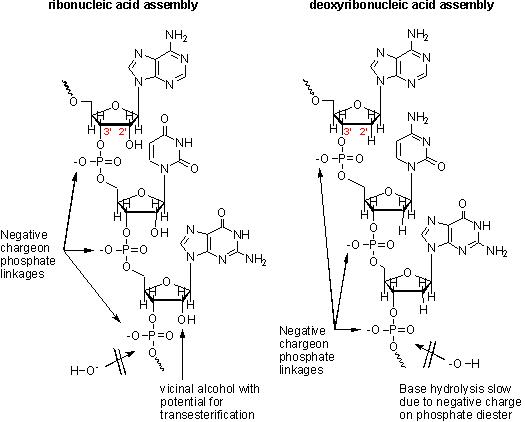
Phosphate Backbone on RNA and DNA

In his much-referenced 1987 paper entitled “Why Nature Chose Phosphates” (1), Frank Westheimer observed that phosphate diesters have a very useful property as a linking group for nucleic acids. The charged oxygen on (RO)2P(=O)O- serves several purposes.  The presence of a charged linker renders DNA and RNA compatible with the hydrophilic environment inside the cell. The charge prevents the nucleic acid polymers from migrating to more hydrophobic environments found inside of cell membranes. And equally important, the monobasic anion serves as a kinetic barrier protecting the millions of phosphate linkages in a DNA strand from cleavage under neutral or basic hydrolytic conditions over the lifetime of the organism.

The hydrolytic stability of phosphate diesters is not to be underestimated. Westheimer points out that dimethylphosphate anion has a half-life of 1 day at 110 C in 1 N base. He cites the rate constants at 35 C for the saponification of (CH3O)2PO2- is 2.0 E-9 (1/mol sec);  (CH3O)3P=O is 3.4 E-4 (1/mol sec); and for ethyl acetate 1.0 E-2 (1/mol sec).

However, the very simplicity and current prevalence of phosphate ion in the environment does not go far in explaining how phosphate might have found its way into metabolic and structural use.  In prebiotic times, the occurence of phosphate is in doubt (2).  But not just the occurrence of phosphate is in doubt. The relative abiotic inertness of phosphate towards esterification and the formation of other metabolically useful species raises the question of the original oxidation state of phosphorus during the onset of early life.

While phosphate is found in certain meteorites, Pasek suggests that a more ubiquitous meteoric phosphide mineral species such as schreibersite, (Fe, Ni)3P, found in iron meteorites may have provided the necessary reactive precursors for metabolic evolution (2). Pasek cites growing evidence of a late meteoric bombardment period at 3.8-3.9 GA.

Schreibersite hydrolyzes to a variety of oxidized species including phosphite. Phosphite has the advantage of being substantially more water soluble than phosphate, providing a larger molar concentration in seawater.  Schreibersite reacts with acetate to form acetylphosphonate. In fact, a variety of organophosphorus compounds may be formed on exposure of schreibersite and its hydrolysis products with organic materials.

Lowly phosphate isn’t sexy like the newer anions triflate and BArF. But its seemingly mundane properties are key to the function of metabolism and genetics.

(1)  F.H. Westheimer, Science, 1987, 235(4793), 1173-1178.  (2) Pasek, M.A. PNAS, January 22, 2008, vol 105, no. 3, 853-858.

Zoning and Hard Times

Many have written about the essential fragility of the economic situation of most American workers. We save too little and accumulate too much high interest debt.  Our consumption in every context seems unsustainable. The fragility of the monetary system with its lack of dependence on gold and the cosmic-scale debt that our country has racked up has many people worked into an existential lather.

The hard reality is that a worker can lose his/her job and all of the forms of stability that comes with it. We have become absolutely dependent on the economic system of the “employment” by people and organizations. We exchange our labor for payment on an hourly or salary basis and hope to sustain a stable and predictable lifestyle therefrom.

When a person loses their job, the reality of maintaining shelter and keeping everyone fed and clothed pops straight up into view. Because we have structured our culture and economic system on sustenance by employment, our ability to improvise is weak. Our ability to get another cashflow stream going is limited and most people pursue solutions that consist of finding other employment.

What workers in America lack is something that is available in much poorer countries. When an American worker loses their job, either they must find another job or start a business to sustain a living income. But if an American worker wants to start a business making something or retailing, chances are that local zoning codes will bar them from operating out of their home.

There are certain kinds of business activity that people can do out of their residence. Many people do office type work like accounting, consulting, writing, and other information intensive services out of a home office. Baby sitting, daycare, sewing, and small scale construction contracting are commonly based in a residence.

But if you want to repair cars, retail specialty parts of all kinds, or manufacture widgets at the microscale, chances are that your activity will be banned either by municipal ordinance or by a home owners association.

If you visit a city in a poorer country- say, Thailand- what you will see are large sections of housing where people combine their occupation with their residence. I recall being lost on foot somewhere in Bangkok a few years ago, wandering through neighborhoods where families lived in small shops that had a metal overhead door for street access by potential customers. At sundown, the shop activity ceased and the stove came out and a pot of soup was put on the heat. Fans, televisions, and music would blare into the sweltering streets along with the aroma of food.

Poor as these folks might be, they have something that American city dwellers absolutely lack. They have the ability to consolidate their resources to provide shelter and an income. By day a family might sell parts for small gas engines or some particular range of plumbing fittings. By night they repair to the back room for supper and relaxation.

An American facing the prospects of no job and left with only industrial skills is in a bit of a pickle.  While they might have very valuable skills, chances are that these skills are not readily transferable to common home-based activities. Someone with retail experience, on the other hand, might be able to put together a small shop.

What would stop an American city dweller from starting a home retail business is the issue of zoning and code compliance.  If an unemplyed person wanted to sell articles of clothing in a converted garage shop, there would be a long list of problems with the town board and the neighborhood. There would be applications and appeals, neighborhood input, and public hearings for a variance to the code. Zoning, parking, fire codes, and handicap access are just the start.

Then there is the matter of neighbors and their firm theories on property value. US culture has long been aloft on an arc of gentrification. People invest heavily in their homes and view their shelter not just as something that keeps out the weather. We festoon them from a vast array of manufactured decorative goods. We slather them with paint and adorn them with “accessories”.  

We have come to rely on our homes as repositories of personal wealth. And this notion, evolved from countless proposals before countless town boards, has become a complex web of building codes and ordinances controlling seemingly every degree of freedom to act that you can imagine.

Go to a town board meeting anywhere and look for those who seek to influence the board. Much of the time they are people related to real estate and development. Much of the gentrification we see has its roots with developers seeking to provide a sense of exclusivity. 

The result is that wealth creation by the appreciation of residential property value has been given a privileged position over wealth creation by the productive use of that property.

Our ability to sustain ourselves through hard times is constrained by rules to meant to protect property value and provide a basis for notions of the residential ideal. Americans are poorly prepared to be poor. We have an infrastructure that is not well adapted to allowing the unfortunate unemployed the option to scratch out a living from their homes. So pervasive is the residential ideal that the options for shelter are few in gentrified areas of the country. We have zoned ourselves into a corner based on bourgeois notions of aesthetic tidiness.

Alien Fasteners. Wingnuts from space.

Imagine that you and a companion are out for an evening stroll after a big dinner, say in a park somewhere. You hear a curious whining sound and look up to see an alien spaceship on a landing approach to the park. The craft lands and the crew scuttles off to perform some tedious abduction or organ harvest in the neighborhood.

Your companion exclaims “Golly! There is something you don’t see every day!”. But you’re unmoved by your companions incisive commentary. Because you see this as a long sought opportunity to examine an alien craft up close.

What would you look at? The propulsion system? Or perhaps the weapons array or guidance system? Pffft.

I would look at something much more mundane. I think it would be very enlightening to see what kind of fasteners they use. That’s right. Fasteners. Nuts, bolts, latches, bungees, straps, nails, hinges, hooks & loops, and rivets. How do these confounded exo-buggers hold things together? What’s the deal?

Fasteners are mechanical contrivances used to restrain objects into a desired configuration, often by the application and fixing of tension or compression through some structural element.  Think of all of the fasteners we encounter before we set foot out the door every morning.

Elastic articles of clothing perform a fastening function through the application of tension about numerous body parts through the miracle of Spandex/Lycra.  Shoe laces are fastening devices that apply and hold tension on opposing shoe upper elements wrapped over the arch of the foot.

Moving upwards, the zipper is a fastener that works in concert with a trouser/skirt button or snap fastener.  The belt and buckle are a fastener ensemble that together apply and hold tension about the circumference of the waist to keep ones trousers from succumbing to the pull of gravity.

Other fasteners include shirt buttons, brassiere connectors (damn those things!), earring wires, eyeglass frames (they connect to your face), cell phone belt attachments, the deadbolt on the front door, all manner of electrical connectors, and the list goes on and on. Electrical connectors are  especially interesting because they combine the functions of electrical continuity and fastener. All are a compromise between the competing interests of biomechanics, convenience, safety, regulatory standards, and custom.

So, back to the space ship. How would space faring beings approach the problem of fastening materials and components. Would they use individual components fastened together or would they use integrated component assemblies that support multiple functions? Perhaps the mechanical fastener question is moot because components would be cast, glued, or welded.

Integrated components have a certain appeal, but, by their integrated  nature could serve as a node from which to initiate failure propagation to multiple systems. For instance, if a battery was built to serve as a structural element for the craft, could a battery failure of some sort serve to initiate a structural failure mode? At what point is it foolish to integrate systems rather than leave them distributed? As always, it depends.

I think an alien spacecraft would have at least a few kinds of obvious fasteners. Surely alien technologies are subject to component failures and would require occasional repair.  Of interest would be the concessions to alien biomechanics.

Humans occasionally use wingnuts to fasten objects that need not be permanently affixed. The wingnut is simply a style of threaded nut that has two modest protuberances that allow for torsion and compression to be applied by the fingers and wrist. The wingnut is not functional for beings who lack the sort of articulated digits that we have. Perhaps an alien being would have a latch or other contrivance to accommodate its appendages.

Of course, all of this alien talk is just a device with which to cast the matter of fasteners into a more interesting light. Fasteners are part of our collective technological heritage and are rather under-appreciated. But, if you are unfortunate enough to be abducted by aliens, I suspect that the matter of alien fasteners might be of immediate interest.