Category Archives: CounterCurrent

Technological Triumphalism

“Technological triumphalism” is a term that surfaces infrequently, encapsulating the belief in our capacity to resolve almost any issue through the innovative use of technology. While technological progress has led to countless pivotal breakthroughs, such as antibiotics and the transistor, it has also given rise to means that magnify age-old human tendencies towards negative behaviors. As our tools and methods evolve with technological advancements, so too do our desires and avarice, often intensified by the fresh opportunities new technologies present.

As an example of technology bursting on the scene producing both good and bad consequences, consider the Haber-Bosch process for the industrial manufacture of ammonia. An industrial feedstock like ammonia can split into several streams. On the plus side, cheap and available liquid or gaseous ammonia for fertilizing crops was a boon for mankind in terms of increased food production. Also, the combination of ammonia and nitric acid leads to the production of the solid fertilizer ammonium nitrate.

Another and wholly different product stream involving the oxidation of ammonia (Ostwald Process) is nitric acid production, HNO3. It is required for the manufacture of industrial intermediates, high explosive nitroaromatics like TNT, picric acid, nitroesters like nitroglycerine and even more powerful explosives. Explosives are neither inherently good or bad, their merits depend on how they are used. When used for construction or mining, explosives are a positive force in civilization. However, they cast a long dark shadow when used to destroy and kill.

Fritz Haber

A good example of unanticipated consequences of a technology uptick is found in the story of the German chemist Fritz Haber. Haber won the 1918 Nobel Prize for Chemistry for the invention of the Haber-Bosch synthesis of ammonia. It is estimated the 1/3 of present global food production relies on the use of ammonia from the Haber-Bosch or similar processes. Haber has been widely praised for his part in the invention of catalytic ammonia production using atmospheric nitrogen. These are important developments, but … [Wikipedia]

As a German nationalist, Haber was also known for his considerable contributions to German chemical warfare through WWII. Haber was responsible for the production of Zyklon A and Zyklon B.

It is claimed that neither Fritz Haber nor Carl Bosch were fans of National Socialism in Germany in the 1930’s. Haber claims to have done his WWI gas warfare work for Kaiser Wilhelm as a German patriot. Intimidated by German laws aimed at Jews and Jewish colleagues, Haber (a Jew converted to Catholicism) left Germany in late 1933 for a position as director of what is now the Weizman Institute in what was at that time Mandatory Palestine. He died while enroute in the city of Basel, Switzerland, at age 65.

Chemical warfare in WWI began with an idea from volunteer driver and physical chemist Walther Nernst who suggested in 1914 the release of tear gas at the front. This was observed by Haber who later suggested chlorine gas be used instead because of its density. Haber personally supervised Germany’s first release of chlorine gas at the Second Battle of Ypres in WWI. Supervising the installation of the 5730 tanks of chlorine were chemist Fritz Haber, chemist Otto Hahn, physicist James Franck and physicist Gustav Herz. Of the 5 scientists mentioned above, Nernst included, all would receive a Nobel Prize in their lifetimes.

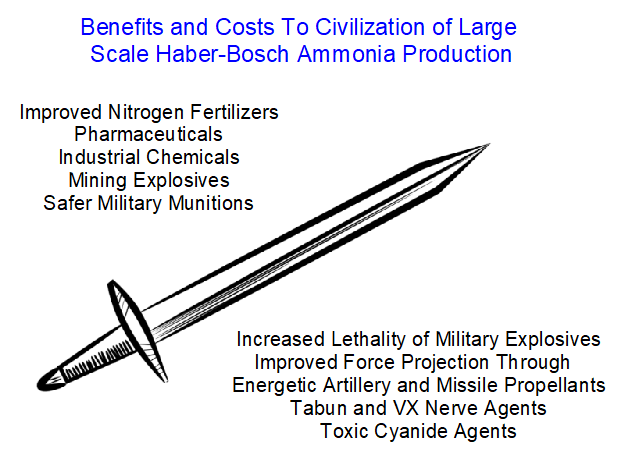
The double-edged sword of ammonia. The military benefits apply to both offensive and defensive use. Graphics by Arnold Ziffel.

The Future

Ask yourself this- will your descendants in the year 2124 share in the creature comforts coming from the extravagant use of resources as we have? Doesn’t the word “sustainability” include the needs of 4-5 generations down the line?

There are wants and there are needs. For many of us in the 21st century, most our needs in the US are more than satisfied along with surplus income to satisfy many of our wants. Will our descendants a century from now even have enough resources to meet their needs after our continuing wanton and extravagant consumption of resources of the last 150 years?

What will descendants in 100 or 200 years require to fend off the harshness of nature and our fellow man? Pharmaceuticals? Medical science? Fuels for heat and transportation? Will citizens in the 22nd century have enough helium for the operation of magnetic resonance imagers or quantum computers? Will there be enough economic raw materials for batteries? Will there be operable infrastructure for electric power generation and distribution? Lots of questions that are easy to ask but hard to answer.

Come to think about it, does anyone worry this far in advance? The tiny piece of the future called “next year” is as much as most of us can handle. Is the world a much smaller place than it used to be or is the scale just better understood?

A plug for climate change

Even the sky is smaller than we think. At 18,000 feet the atmospheric pressure drops to half that at sea level. This means that half of the molecules in the atmosphere are at or below 18,000 feet. This altitude, the 500 millibar line, isn’t so far away from the surface. From the 58 Fourteeners in Colorado, it is only 4000 ft up. Not that far. The breathable, inhabitable atmosphere is actually quite thin. The Earth’s atmosphere tapers off into the vacuum of space over say 100 km, the Kármán line. While this is more of an arbitrary designation than a physical boundary between the atmosphere and space, the bulk of the atmosphere is well below this altitude. With this in mind, perhaps it seems more plausible that humans could adversely affect the atmosphere.

The lowest distinct layer of the atmosphere is the troposphere beginning as the planetary boundary layer. This is where most weather happens. In the troposphere, the atmospheric temperature begins to drop by 9.8 Â°C per kilometer or 5.8 oF per 1000 ft of altitude. This is called the dry adiabatic lapse rate.

With increasing altitude, the atmospheric temperature gradient decreases to about 2 oC per kilometer at ~30,000 ft in the mid-latitudes where the tropopause is found. The tropopause is where the lapse rate reaches a minimum then the temperature remains relatively constant with altitude. This is the stratosphere.

Over the last 200 years in the West at least, advances in medicine, electrical devices, motor vehicles, aerospace, nuclear energy, agriculture and warfare have contributed to what we both enjoy and despise in contemporary civilization. The evolving mastery of energy, chemistry and machines has replaced a great deal of sudden death, suffering and drudgery that was “normal” with a longer, healthier life free of many of the harmful and selective pressures of nature. Let’s be clear though, relieving people of drudgery can also mean that they may be involuntarily removed from their livelihoods. It is quintessentially American to sing high praises to capitalism. It is even regarded as an essential element of patriotism by some. On the interwebs capitalism is defined as below-

Capitalism is an economic system based on the private ownership of the means of production and their operation for profit.

As I began this post I was going to cynically suggest that capitalism is like a penis- it has no brain. It only knows that it wants more. Well, wanting and acquiring more are brain functions, after all. Many questions stand out, but I’m asking this one today. How fully should essential resources be subject to raw capital markets? It has been said half in jest that capitalism is the worst economic system around, except for all of the others.

I begin with the assumption that it is wise that certain resources should be conserved. Should it necessarily be that a laissez faire approach be the highest and only path available? Must it necessarily be that, for the greater good, access to essential resources be controlled by those with the greatest wealth? And, who says that “the greater good” is everybody’s problem? People are naturally acquisitive, some much more than others. People naturally seek control of what they perceive as valuable. These attributes are part of what makes up greed.

Obvious stuff, right?

The narrow point I’d like to suggest is that laissez faire may not be fundamentally equipped to plan for the conservation and wise allocation of certain resources, at least as it is currently practiced in the US. Businesses can conserve scarce resources if they want by choosing and staying with high prices, thereby reducing consumption. However, this is not in the DNA of business leaders. The long-held metrics of good business leadership rest on the pillar of growth in market share and margins. Profitable growth is an important indicator of successful management and a key performance indicator for management.

Firstly, a broader adoption of resource conservation ideals is necessary. Previous generations have indeed practiced it, with the U.S. national park system serving as a notable example. However, the scarcity of elements like Helium, Neodymium, Dysprosium, and Indium, which are vital to industry and modern life, raises concerns. The reliance of Magnetic Resonance Imaging (MRI) operators on liquid helium for their superconducting magnets poses the question of whether such critical resources should be subject to the whims of unregulated laissez-faire capitalism. While some MRI operators utilize helium recovery systems, not all do, leading to further debate on whether the use of helium for party balloons should be permitted to continue, given its wasteful nature.

Ever since the European settlement of North America began, people have been staking off claims for all sorts of natural resources. Crop farmland, minerals, land for grazing, rights to water, oil and gas, patents, etc. Farmers in America as a rule care about conserving the viability of their topsoil and have in the past acted as a group to maintain it in good condition. But, agribusiness keeps making products available to maximize crop yields, forcing farmers to walk a narrower line with soil conservation. Soil amendments can be precisely engineered with micronutrients, nitrogen and phosphate fertilizers to reconstitute the soil to compensate for higher yields. Herbicides and pesticides are designed to control a wide variety of weeds, insect and nematode pests. Equipment manufacturers have pitched in with efficient, though expensive, machinery to help extract the last possible dollars’ worth of yield. Still other improvements are in the form of genetically modified organism (GMO) crops that have desirable traits allowing them to withstand herbicides (e.g., Roundup), drought or a variety of insect, bacterial, or fungal blights. The wrench in the gears here is that the merits of GMO have not been universally accepted.

Livestock production is an advanced technology using detailed knowledge of animal biology. It includes animal husbandry, nutrition, medicines, meat production, wool, dairy, gelatin, fats and oils, and pet food production. There has been no small amount of pushback on GMO-based foods in these areas, though. I don’t watch this in detail so I won’t comment on GMO.

The point of the above paragraphs is to highlight a particular trait of modern humans- we are demons for maximizing profits. It comes to us as naturally as falling down. And maximizing profits usually means that we maximize throughput and sales with ever greater economies of scale. Industry not only scales to meet current demand, but scales to meet greater future demand.

Essentially everyone will likely have descendants living 100 years from now. Won’t they want the rich spread of comforts and consumer goods that we enjoy today? Today we are producing consumer goods that are not made for efficient economic resource recovery. Batteries of all sorts are complex in their construction and composition. Spent batteries may have residual charge left in them and have chemically hazardous components like lithium metal. New sources of lithium are opening up in various places in the world, but it is still a nonrenewable and scarce resource. This applies to cobalt as well.

Helium is another nonrenewable and scarce resource that in the US comes from a select few enriched natural gas wells. At present we have an ever-increasing volume of liquid helium consumption in superconducting magnets across the country that need to remain topped off. This helium is used in all of the many superconducting magnetic resonance imagers (MRI) and nuclear magnetic resonance (NMR) spectrometers in operation worldwide. Quantum computing will also consume considerable liquid helium as it scales up since temperatures below the helium boiling point of 4.22 Kelvin are required.

As suggested above, today’s MR imagers can be equipped with helium boil off prevention recovery devices that recondense helium venting out of the cryostat and direct it back into a reservoir. One company claims that their cold head condensers are so efficient that users do not even have to top off with helium for 7-10 years. That is a good thing. Hopefully it is affordable for most consumers of MRI liquid helium.

In the history of mining in the US and elsewhere, it has been the practice of mine owners to maximize the “recovery” of ore when prices are high. Recovery always proceeds to the exhaustion of the economical ore or the exhaustion of financial backing of the mining company. Uneconomical ore will remain in the ground, possibly for recovery when prices are more favorable. It is much the same for oil and gas. As with everything, investors want to get in and get out quickly with the maximum return and minimum risk. They don’t want their investment dollars to sit in the ground waiting for the distant future in order to satisfy some pointy headed futurist and their concern for future generations.

What is needed in today’s world is the ability to conserve resources for our descendants. It requires caring for the future along with a good deal of self-control. Conservation means recycling and reduced consumption of goods. But it also means tempering expectations of wealth generation, especially for those who aim for large scale production. While large scale production yields the economies of scale, it nevertheless means large scale consumption as well, In reality, this is contrary to the way most capitalism is currently practiced around the world.

Sustainability

The libertarian ideal of applying market control to everything is alleged to be sustainable because in appealing to everyone’s self-interest, future economic security is in everyone’s interest. If high consumption of scarce resources is not in our self-interest, then will the market find a way to temper it? As prices rise in response to scarcity, consumption will drop. ECON-101 right? Well, what isn’t mentioned is that it’s today’s self-interest. What about the availability of scarce resources for future generations? Will the market provide for that? What does “sustainability” really mean? Does it mean that today’s high consumption is sustained, or does it mean resource conservation?

Is the goal of energy sustainability to maintain the present cost of consumption but through alternative means? Reduced consumption will occur when prices get high enough. As the cost of necessities rises, the cash available for the discretionary articles will dry up. How much of the economy is built on non-essential, discretionary goods and services? The question is, does diminished consumption have to be an economic hard landing or can it be softened a bit?

Some chemical elements

Here is where we transition into some chemistry. Our transition into a more electric world requires the use of certain chemical elements that may be unfamiliar to many. Certain elements are critical such as copper, aluminum, steel, silicon, germanium, gallium, neodymium, lithium, indium, boron and some others. And each element requires industrial plants and mining to produce them. Mining and refining generally use large quantities of electric power and water. Most all of the equipment in the mines and industry rely on steel machinery which itself requires a cascade of resources to produce.

As of the date of this writing, we are already down the timeline by many decades as far as the R&D into alternative electrification. What we are faced with is the need for a rapid and very large scaling-up of renewable electric power generation, transmission and storage for the anticipated growth in power consumption for electric vehicles.

Price elasticity is where an increase in price fails to result in a drop in demand. Necessary or highly desirable goods and services may not drop in demand if the price increases at least to some level. As with the price of gasoline, people will grumble endlessly about gas prices as they stand there filling their tanks with expensive gasoline or diesel. Conservation of resources has to overcome the phenomenon of price elasticity in order to make a dent without shortages.

A meaningful and greater conservation of resources will require that people be satisfied with lesser quantities of many things. In history, people have faced a greatly diminished supply of many things, but not by choice. Economic depression, war and famine have imposed reduced consumption on whole populations and often for many years. When the cause is released, people naturally return to consumption as high as they can afford.

The technological triumphalism reflex of civilization has allowed us to paint ourselves into a resource scarcity corner. We are reliant on new technology that itself is reliant on more mature technology.

Added 10/30/24.

The habit of relying on future technological breakthroughs to solve current problems is universally seen as a positive expression except for those culturally disconnected from modernism such as the Amish, etc. The problem arises when we blunder forward, oblivious to consequences of the technology. Unforeseen consequences are notably difficult to visualize early in development and may be interpreted by some as negativism.

In chemical manufacturing we are accustomed to a performing PHA- Process Hazard Analysis -when starting up a new process. In a PHA meeting we list all of the potential points of failure in the process equipment and then brainstorm every possible failure mode and possible links to other equipment. It usually takes most of a shift and it is essential that engineers and plant operators are present to lend their expertise. As potential failures are identified they are rated according to their likelihood and seriousness. Each entry that calls for a dated action item by persons responsible for solving the problem.

What the PHA also does is to alert those involved in designing processes of problems that may be general in nature and worth remembering for the next process.

Social Media- An invention gone bad?

Did the persons who introduced the various social media platforms in the early days consider the possible malevolent use and consequences of their online products? Was anything other than the rapid development of their platform and getting online as fast as possible even considered? Was there a devil’s advocate in the building at the time? Once money is invested in a business plan or invention, the desire to go to market becomes insurmountable.

If the question is “could trolls and other online troublemakers have been avoided from the beginning?”, then perhaps the early social media developers should have some accountability to those who download the app. If not, what should be the developer’s role in solving the problem of online trolling or fraud?

As with so many useful things in the marketplace that have a dark side, weapons for instance, doesn’t the user have some responsibility for proper use? Well, yes and no. Someone who knows about guns should have the responsibility for its use, that’s yes. Going very dark, what about leaving a loaded and chambered pistol on a playground. Is it reasonable to expose children to the danger from mishandling? Should they be expected to know what the loaded pistol could do? Clearly not.

The core of the issue seems to be the matter of when a seemingly innocuous invention is released for global use and is unexpectedly misused by some users. Is the developer responsible for damages resulting from the misuse? Can the developer be forced to harden their product to attenuate the abuse?

Could it be that clamping down on trolls on a given app will involve a reduction of clicks or eyeballs? Would advertisers overlook this or negotiate a lower price?

It is doubtful that anyone in 1975 was begging for a Facebook to come on the market. Dot matrix printers were a marvel then. Eventually, when available, Facebook would take the world by storm. Demand appeared when people became aware of it. Is it a triumphal bit of technology? Both were built to exploit existing telecommunications technology and data collection systems. Facebook is a system that converts views and clicks into money over the internet. Facebook is a product that delivers our eyeballs and data to advertisers. Similar to a newspaper or television. Fb is triumphal to advertisers and Meta.

Conclusion-

Is there really such a thing as general Technological Triumphalism? I’m beginning to think that it might exist only as squinted at from 50,000 feet. In the very early 20th century, physicians longed for a magic bullet to cure infections apart from the toxic mercurials then in use. They needed a Technological Triumph, and it arrived in pieces through experiments over time. Along came sulfa drugs, then penicillin and both of these were explored for more potent analogs. As medicinal chemistry advanced, entirely new classes of antibiotics were discovered. The lesson of penicillin coming from mold led to the exploration of microbial and fungal sources from all over the world, producing antibiotics affecting a variety of systems in gram (+) and gram (-) bacteria. Once an active candidate is discovered, it’s structure and stereochemistry are determined. Once the composition is known, modifications can be prepared to explore the efficacy of analogs and sort out the mechanism of its antibiotic properties.

Technological Triumphalism can be a philosophy that in its hazardous form can lead people to believe that if a technology goes surprisingly bad, certainly something can be invented to make it better. Fix one technology with another. The discovery of antibiotics was the result of answering a question that begged for a solution.

An example is the problem of CO2 in global climate change. Should we compensate for rising CO2 emissions by scrubbing the atmosphere or should we find a way to reduce emissions by driving fewer miles? The first is a technological solution and the other is more of a lifestyle change.

Limitations of Quantum Computing

Note: First, let me make clear that I am not a computer scientist and while I’ve learned FORTRAN, BASIC and PASCAL in the early 1980’s followed by coursework in quantum chemistry in grad school- and somehow passed– the question of how quantum computation actually computes with qubits remains a mystery to me. Honestly, I’m weary of hearing about it. That said, I do continue to worry about the ever-increasing pressure on the liquid helium tit which quantum computing will definitely lock on to.

An interesting article came out in the current issue of Quantum Magazine giving some straight talk about how quantum computers might actually be used. All of us have been bombarded by breathless predictions of a wondrous future where we can find prime factors of stupidly large numbers and crack very secure cryptography.

Quantum chemistry is about orbiting electrons confined to particular regions of oddly shaped space around a positively charged nucleus, depending on their energy. That is a lifetime of study right there for me. I think I’ll stick to atoms and molecules.

Oh yes, in the early 80’s we used an IBM 360 and submitted our batch jobs as a stack of punch cards. Eventually we were allowed to use the DEC writer for BASIC programming. One sunshiny day an Apple 2 appeared in the chemistry department office. It had 16 K of memory, a green monitor and an external floppy disk drive. There were whispers that 32 and maybe even 64 K were on the horizon. Heady stuff.

The IT guys were surly then too.

Amassing Cannon Fodder is an Old Soviet Tactic

After reading a biography of the Russian Marshal of the Soviet Union, Georgy Zhukov, it becomes apparent that there are parallels between Soviet tactics in WWII and those used in the Putin-Ukraine conflict. Beyond the deployment of similarly vintaged tanks and weaponry, General Zhukov was notorious for committing his forces to battle with little regard for casualties. Similarly, Putin’s military has been characterized by the use of inadequately trained and equipped conscripts. Additionally, it has been reported that Putin’s forces have positioned troops behind the front lines to prevent or even target any deserting or retreating frontline soldiers. Zhukov’s approach often involved rapidly advancing battalions and armor to the front with minimal planning, depending on the attrition of Nazi forces. This tactic was typically executed under Stalin’s direct orders, though sometimes initiated by Zhukov independently.

The conflict between Putin and Ukraine has evolved into a war of attrition. Initially, Putin thought he could swiftly deploy tanks and troops as he did in southern Ukraine in 2014, seizing territory through sheer intimidation. However, he miscalculated the armaments, determination and tenacity of the Ukrainian forces. Since 2014, tens of thousands of Ukrainian soldiers have received training from Western nations. By February 2022, they were significantly better prepared and less intimidated by Putin’s military. In conventional warfare, the Russian military turned out to be a paper tiger, at least with its conventional non-nuclear forces, that is. The Putin-Ukraine war is still unfolding but Russia will come out of it severely stunted win or lose and possibly with new leadership. Whatever the outcome, the winner will have a great deal of de-mining to do. The conflict continues to unfold, but regardless of the outcome, Russia is likely to emerge greatly weakened, potentially with a change in leadership.

Putin is a smart guy. Certainly he knows the consequences of releasing as much as a single low yield tactical nuclear weapon, even if it’s limited to a demonstration. Pandora’s box would swing wide open and out would slink an ever-expanding series of repeats of above ground nuclear blasts until a city would be hit. Then all out nuclear war could happen in the old eye-for-an-eye fashion. Dark days would follow indeed.

Putin surely realizes the dangerous situation his county is in with mounting military losses, the brain-drain of skilled workers leaving the country and a crumbling oil and minerals-based economy. Yet he wears the neutral expression of the Sphinx in public because he must. He has painted himself and his nation into a corner. He even resorted to making nice with the plump North Korean dictator which must have been a nauseating demotion for him.

A bit of history

The Magna Carta was an agreement signed in England on June 10th, 1215, at Runnymede along the River Thames. This agreement had the unique provision of the enforcement of limitations on the sovereign. Rather than a simple recitation of grievances by the barons, the Magna Carta contained ‘security clause 61’ which provided for the barons the authority to seize the castles and lands of King John and hold them until such time as he held to his responsibilities as agreed upon in the signed document.

The Magna Carta was not just a contract between wealthy barons and King John, rather it was a step change towards political reform that provided for enforcement on the King. From Wikipedia

Unfortunately, the distrust between the barons and the Crown, compounded by the annulment from Pope Innocent III, led to its swift failure. Just a few months after the agreement fell apart, the First Baron’s War erupted. However, this was not the final chapter. The document was reissued in successive versions, with the more radical language removed, in 1217, 1225, and finally in 1297, when its remaining elements were incorporated into England’s statute law. It was not unique in its attempt to limit the power of the Crown; similar efforts were seen elsewhere. Over time, the Parliament of England enacted laws that overshadowed the original document, diminishing its significance.

Back to Russia

The point of highlighting the Magna Carta, despite its failure, is that nothing of this type of significance happened in the history of Russia, at least until the Bolshevik Revolution. Perhaps this comparison is too facile, causing real historians to choke on their Starbuck’s latte. But allow me to finish. The Magna Carta was not entirely unique for its era. However, it was notable for including a provision that enforced the good faith by the King. It represented a collective bargaining effort by the 25 barons with King John to alleviate some of the monarchy’s oppression and, in doing so, progress the political atmosphere for a short time with fits and starts. As kings often do, King John protested to the Pope, who then exerted his authority in a manner only a Pope could. The Pope excommunicated the Barons and nullified the agreement, having been persuaded by King John that it undermined the Church’s authority.

Russia seems not to have a tradition of producing successful popular uprisings to the power of the Tsar. of course, the Bolshevik revolution is the shining counterexample. Not in the sense of overthrow so much, but as an enforceable agreement to relieve a measure of oppression by the monarchy at all levels. In contradiction to this sweeping generalization is the case of Tsars Alexander I and II. Alexander I introduced minor social reforms but he was a strict Russian nationalist and Slavophile. Many of the reforms he instituted early in his career were retracted later.

Tsar Alexander II , however, instituted many liberal reforms but is possibly most revered for his Emancipation of the Serfs in 1861. In the US, he is remembered as the Tsar who sold us Alaska. He was a supporter of the Union in the American Civil War and even sent ships to New York Harbor and San Francisco Bay to deter Confederate warships. Eventually he was assassinated in Saint Petersburg on March 13, 1881. The first assassin’s bomb thrown under his armored carriage left him dazed but uninjured. The second assassin’s bomb thrown shortly thereafter delivered the fatal injuries as he stepped out to investigate. The third assassin’s bomb was unused.

Zooming forward to the present, what actions can the Russian populace take regarding Tsar Putin? After centuries of political oppression aided by new thinking, modern technology, and nuclear weapons the current Tsar has built a deep and wide moat around himself and his allies within the Kremlin establishment. Beyond this moat stands a population conditioned to obedience by fear, a legacy of decades of Soviet rule. I believe that national pride will deter them from emulating Western forms of civil society and governance. And why can’t they develop an authentically Russian something-something ‘democracy’, or whatever? Russia has deep foundation of cultural, artistic and scientific achievements to take pride in, despite its history of authoritarian governance. Whatever Russia eventually does, it will be heavily Slavic and Eastern Orthodox.

Russians are just as pleasant and smart as everyone else in the world, obviously. Russian hospitality is first rate as I have personally experienced. They just have the heavy blanket of oppressive leadership over them that continues to drag through the generations. Even if Putin falls out of power, there is a line of replacements cut from the same cloth. Perhaps a leader of a reform movement could rebuild Russia? It could happen but just as likely it could revert into a system that is better at prosecuting a war of aggression and suppression of the population. The replacement of Putin could be good for the world, or it could go sour. The world has to wait it out and see. In the meantime, it is critical to keep Putin out of Ukraine, Poland and the Baltic states.

The Putin government is like a toxic gas- it will expand into all of the space available. After the decades-long stand down in tension since the collapse of the Soviet Union, the problem of an aggressive Russia arises again. The West must remain the sturdy counter example to the authoritarian culture of Putin’s Russia. We in the USA, especially, need to do a better job as the shining city on the hill. Lately the shine is wearing off.

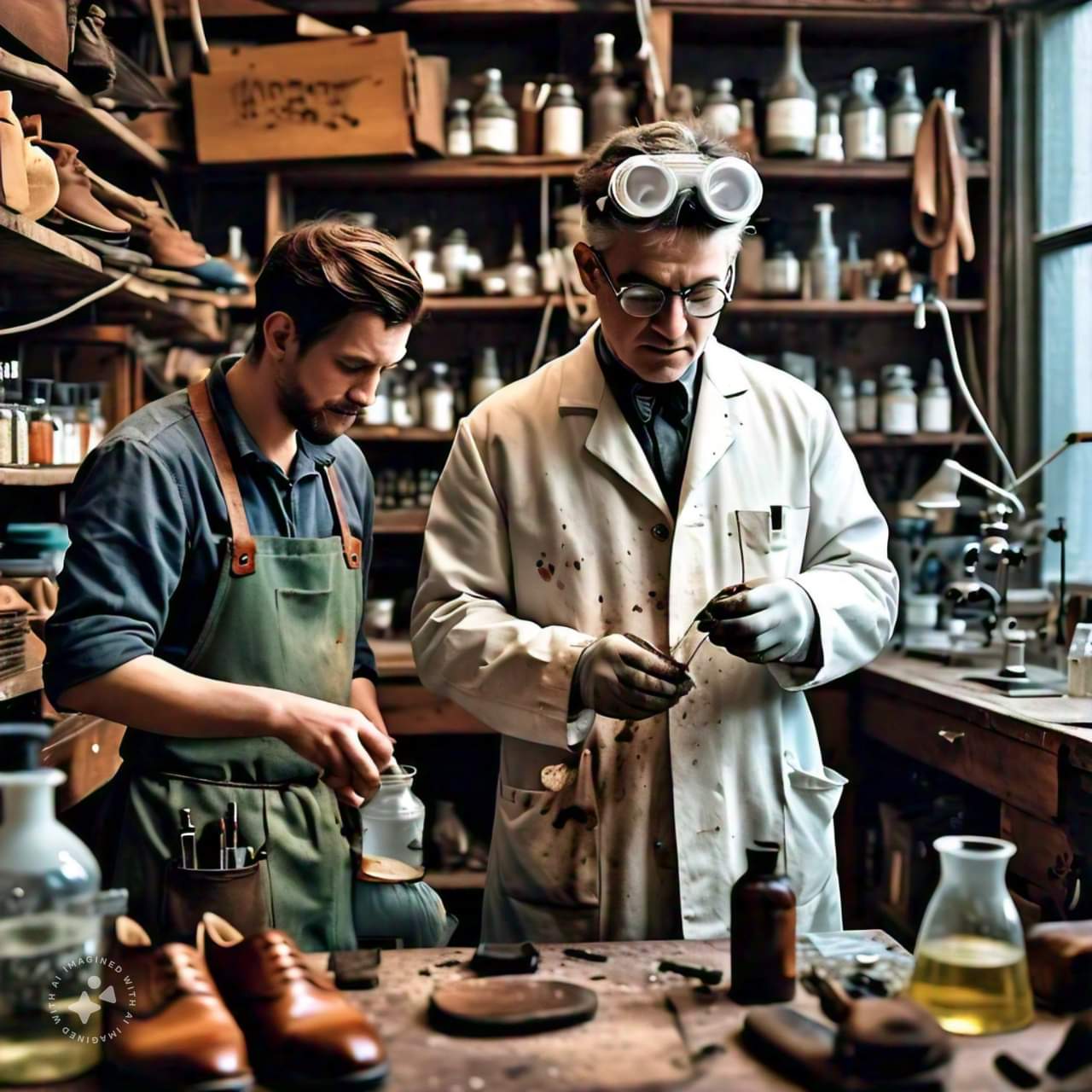
Chemistry Fun with AI

Yet ANOTHER chemist bowling the wrong direction. Dammit, Jim!
Multi-tasking in the lab with shoe repair.
Chemist riding a goat. I can think of a few reasons not to do this. But, he DOES have his safety glasses on.
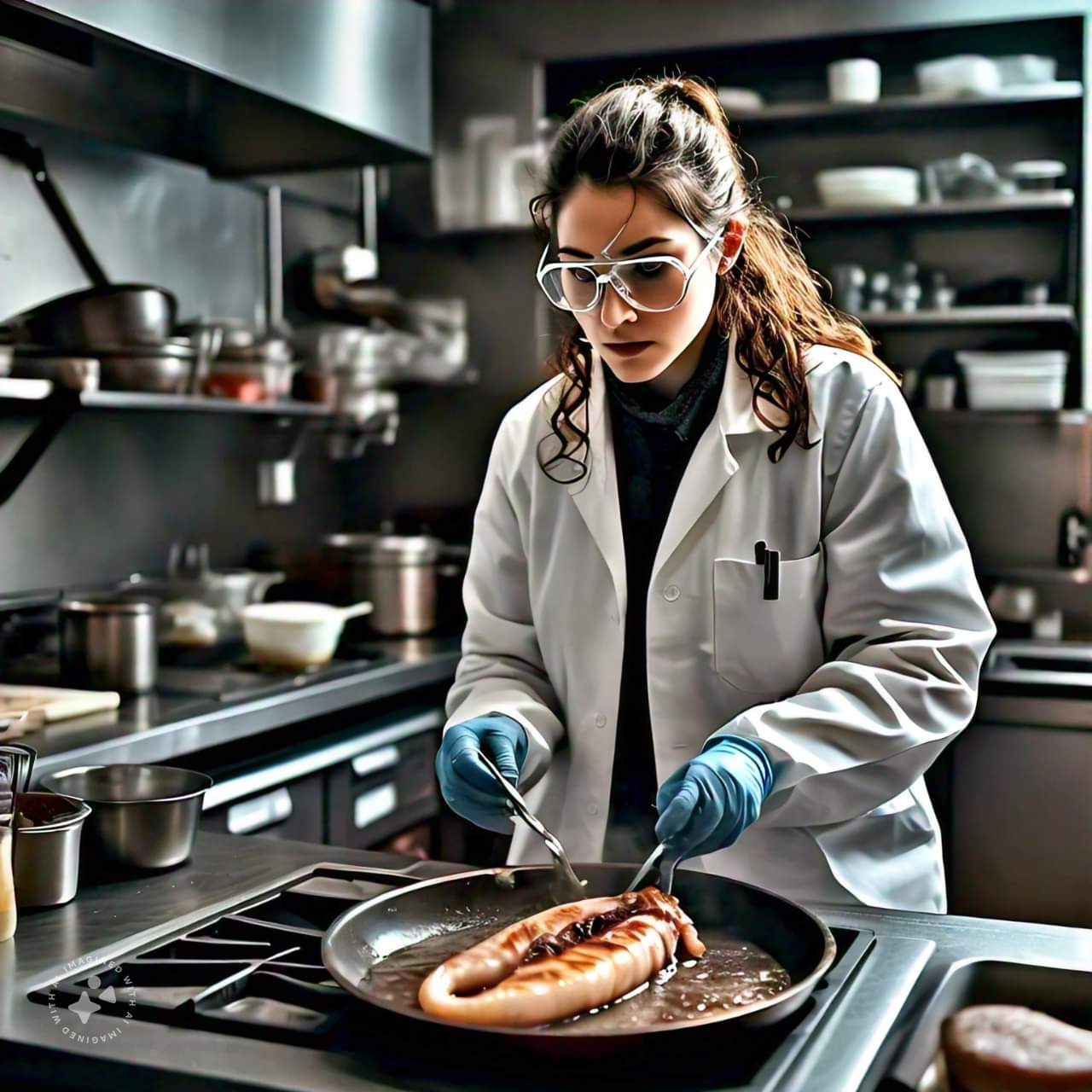
Chemist frying a kielbasa (I think?). At least one thing in the lab smells good.

And finally, a non-chemistry image.

Relaxing after locating a rare Colorado Alpine Cabbage on the way up a 14-er.

Reconstruction of the USA

Writing about theology is outside my comfort zone. As a non-theist, I lean heavily towards a mechanistic, secular explanation of the universe where observation, measurement and theory are the pillars which support our understanding of the universe. Crediting a deity with creating the universe only begs the question: who created the deity? Why would a universe created by a deity be more likely than one that exists independently? Along this line of thinking, Occam’s Razor would suggest that a deity is an unnecessary step in the reduction to the truth. Occam’s Razor isn’t just philosophical tidiness. It reflects a physics that is cut from the cloth of reductionism.

Occam’s Razor is neither a natural law nor a formal scientific method; it serves more as a heuristic guideline. When multiple explanations yield the same conclusion, the simplest one is usually deemed more likely. Supernatural or magical explanations find no refuge in Occam’s Razor. It’s not about resorting to a simple magic trick. Any explanation favored by Occam’s Razor must still withstand subsequent observation, measurement, and theoretical scrutiny—the core of scientific inquiry.

The point of this essay

I am writing to highlight that the United States of America, despite its chaos and noise, errors and blunders, has developed an impressive economic growth engine, formidable military capabilities, expanded civil rights, enhanced public health, and a wide-ranging scientific and technological foundation that surpasses anything previously witnessed in history. Numerous sources support this claim.

A significant portion of the American experiment including its economic system, directly stems from the European Enlightenment of the 17th and 18th centuries. It must be emphasized that there is an emerging movement aiming to regress various facets of our culture to a period before the Enlightenment—a time characterized by extensive church authority and a government in alliance with it.

I will state plainly that I am deeply opposed to the forces currently working to regress our civilization. Since my earliest memories which began at the time of the Kennedy assassination in 1963, there has been a continuous lament over the state of our nation. People have consistently shaken their heads, openly questioning how the USA could continue to progress amidst the prevailing turmoil. This sentiment has persisted over the years. Nevertheless, not only have we persisted, but we’ve also made continuous progress in improving the quality of life.

The nostalgia for the “good old days” of America’s supposed greatness is often lamented by those who find current times challenging. A closer examination of American history reveals a complex tapestry of both distressing events and prosperous periods. In any given year, one can uncover instances of both success and sorrow. It seems that a certain level of disorder is inherent in our pluralistic democratic republic. The population typically follows a statistical distribution, with a majority of average individuals at the center and fewer at the extremes, represented by the virtuous and the villainous. While disorder is a constant, its nature fluctuates with the changing eras.

Considering the unfathomable expanse of the universe, it is difficult to comprehend the significance of distant galaxies, which remained invisible until recently, within the cosmological framework of the Old Testament as depicted in Genesis. The Abrahamic faiths inherently present a cosmological theory complete with an origin narrative and are replete with Bronze and Iron Age prescriptions for social structure, upheld by a deity who is portrayed as both loving and wrathful- curiously human attributes.

Bronze age religious sentiments

The foundations of these religions originate from an era that is far removed and largely outdated in the context of today’s social norms. The holy scriptures were written at a time when life-changing phenomena were commonly attributed to witchcraft, demons, or benevolent gods. Historically, the struggle to understand cause and effect in life meant attributing disease, illness, and death to dark and unseen forces. The advent of microscopes, along with advancements in medication and surgical procedures, has dramatically altered this perspective.

A persistent and detrimental remnant from the Bronze Age Abrahamic religions is the belief that humans have dominion over Earth and its creatures. This belief manifests in various ways today, notably hindering necessary conservation, environmental and public health efforts out of concern for humanity and the biosphere. The Earth’s biosphere has been under significant strain for many decades. Unfortunately, this broad dominion has historically held over women, who have suffered tremendously under a patriarchy endorsed by these religious doctrines.

Undoubtedly, religion provides numerous benefits to individuals in various significant aspects. However, it can also serve as a personal and collective obstacle. The issue arises when it becomes a foundation for mystical thinking, offering black and white solutions to the complex spectrum of issues we encounter, rather than acknowledging the continuous shades of grey that characterize our reality.

The coming storm

I posted an article on Theocratic Dominionism back on October 25, 2006. Today Dominionism, Christian Nationalism, Christian Reconstructionism, or the New Apostolic Reformation, NAR, are gaining much ground in politics. It is apparent now that the old Republican party has transmogrified into the MAGA party whose devout members are being led to a Christian Nationalism model. The endgame sought is certainly consistent with the goals of Project 2025. This is in the direction of what has been called “illiberal democracy” as the President of Hungary, Victor Orban, puts it.

The father of Christian reconstructionism is credited to the son of Armenian immigrants Rousas John Rushdoony (1916-2001). He was an orthodox Calvinist minister, philosopher, historian and theologian. Michael J. McVicar, associate professor of Religion at Florida State University wrote of Rushdoony –

According to McVicar, Rushdoony had no interest in the world of the enlightenment. The orthodox Calvinist Rushdoony saw people as “religious creatures bound to God, not as rational autonomous thinkers”. Rushdoony advocated under the theonomic perspective, meaning a Christian form of government where individuals and society are ruled by divine law, especially under judicial laws in the Old Testament of the Christian bible.

Rushdoony opposed democracy which he claimed opposed the will of God and favored the republic which represented a better form of civic government. He said to Bill Moyers in an interview “… a republic avoided mob rule and the rule of the “51%” of society; in other words “might does not make right” in a republic.”

Distilled down to a sticky residue, Dominionism is the belief that Christians should take moral, spiritual, and ecclesiastical control over society. Romans 13:1-5 says in so many words that God has ordained the state as a delegated authority; it is not autonomous. Secular authority is not sanctioned. It is upon this authority that Dominionism rests.

Implementing an ecclesiastical governing hierarchy to operate various government entities will be complex. Individuals identify as Atheist, Catholic, Jewish, Muslim, Mormon, etc., for numerous reasons, including family history or personal choice. Are these individuals considering that sectarianism might not pose an issue? Have they examined the impact of sectarianism in the Middle East and other regions closely?

Even if the sectarian issue is resolved, consider the extensive scope of the law in all its forms. Discussions about biblical law often seem to focus on the Ten Commandments, the law outlined in Deuteronomy and biblical punishments like stoning. Punishing criminals is one aspect, but what about civil laws? The Bible doesn’t explicitly detail regulations for commerce, transportation, safety, torts and numerous other areas governed by secular laws.

An example of religious authority gone bad

The Spanish Inquisition, officially the “Tribunal of the Holy Office of the Inquisition,” began in 1478 by the Catholic monarchs King Ferdinand II of Aragon and Queen Isabella I of Castile. They sought and obtained independent inquisitorial authority separate from the Vatican and its own inquisition. Lasting from 1478 to 1834, this judicial institution aimed to eliminate heresy. However, it often forced Jews and Muslims to convert to Christianity or expelled them from the kingdom when they resisted conversion.

Unfortunately for the people of the New World, the Spanish conquistadores carried their Inquisitional evangelism with them to root out heresy. Along with it they spread smallpox, influenza and other diseases wiping out whole populations. This has been extensively covered by historians. The conquests of Cortes and his second cousin Pizzaro starting around 1519 in what is now Mexico and to the south visited death upon the Aztecs, Incas and many others.

The Catholic church in medieval times carried great authority and the monarchies of the time knew it. They sought to find favor with the Vatican and share in its power and wealth over the population. It manifested as the notion that to be against the ruling class was to be against God. It has never been documented that God had stepped in personally to referee these power games, you know, like he spoke to Noah or Moses, but the church was only too happy step in and be the arbiter of matters for the silent supernatural.

In theocracy, who is in charge?

The Biblical Law scenario wouldn’t involve a deity directly governing society, but rather sectarian politicians and religious leaders would act in the place of the mysterious, invisible and silent Deity. Over time, laws such as those from the Mosaic tradition would need to be codified for widespread dissemination, uniform interpretation and adaptation to law school curriculum. Considering the limited details provided by religious texts on prohibitions and punishments, extensive interpretation would be necessary to address the countless scenarios that could emerge within a society. The question then arises: In cases of uncertainty, what should be the recourse?

The long and short of it

What this burgeoning theocratic movement is about is political power. In short, a subset of the American people believe they have a solution to the woes of society and they have supernatural backing to make it happen. They claim that their authority is not of this world and not subject to Earthly constraints. The laws of man are inherently subservient primarily to the laws of God as issued thousands of years ago to tribal desert goat herders.

Reconstructionism is a quiet movement. It’s purpose is to implement a reconstruction of American values to suit the world view of a minority of religious extremists. It is a movement that seeks nothing less than the establishment of a theocratic form of government in America.  It is also called Theocratic Dominionism or Christian Reconstructionism.  But don’t believe me, see for yourself.  Google these terms and browse the online resources. 

For myself, I have been watching Christian fundamentalism since the early 1970’s.  I recall stopping at a booth at the county fair as a high school student and talking to members of the John Birch Society. I thought at the time that they were Looney Toons, or just an obscure Christian libertarian group.  I guessed that they were mostly harmless.   Well, I was wrong.

Frederick Clarkson at PublicEye.org writes- “Reconstructionist leaders seem to have two consistent characteristics: a background in conservative Presbyterianism, and connections to the John Birch Society (JBS).”

But what is reconstructionism about? Again, Clarkson puts it succinctly-

Risk and Regulations: An Epistle to the Bohemians, Redux.

Attached is an updated reprint of an essay I posted 10/28/07. Since then I have shifted into EPA regulatory compliance within the chemical industry. My views have changed a little, it turns out.

==========

“We live in an age of miracle and wonder” is the refrain from Paul Simon’s album Graceland. All around us and through us are engineered materials devised for their specific physical and chemical properties. Time-released magic bullet drugs that inhibit specific enzymes. Flavors & fragrances, colorants, rheology modifiers, UV absorbers, emollients, preservatives, food irradiation and manufactured food additives are engineered and marketed to satisfy our lizard brain’s willingness to shell out cash-for-fun and stimulate our limbic system’s emotive triggers. 

It is hard to avoid contact with manufactured goods that aren’t affected by chemistry. A century and a half of tinkering with substances at the molecular scale has given us the ability to optimize the composition and performance of products that make our lives easier and safer.  Microprocessors and Lycra, Hastelloy and Lipitor- the chemical industry has evolved to produce the raw materials and finished goods needed for the performance we have come to expect.

Industry has a Spotty Record of Safety

Along with the considerable list of positive contributions, history provides a detailed record of the problems associated with the exuberant but uncritical acceptance of the flood of manufactured goods.  From radium poisoning of watch dial painters to chromium VI to asbestos, there is a long list of accidents, ignorance, negligence and environmental insult. The trail blazing of our chemical industry leaves behind it a chronicle of tragedy as well as benefits.

The result of the checkered past of industry is a growing (some would say “metastasizing”) and intertwined web of state, federal, and international regulatory oversight and requirements. And with it- arguably as a result of it- has come greater institutional risk aversion

Risk Aversion

In a general way, risk aversion is a type of survival trait and is likely hardwired into our ape brains. It is hard to blame people for being wary or fearful of risks, especially those they do not understand. Over time risk aversion is useful survival trait. But on the other hand, risk aversion is also a type of inertia. Or, it can be a fulcrum from which policy and imaginary justifications are leveraged.  The fear of risk may be firmly grounded on experience or it might be imagined or a mixture of the two. The hard part of risk management is identifying real hazards and the probability and magnitude of a bad outcome for managing safety day-to-day. Basically, the hard part is the whole part.

Corporate officers have a fiduciary responsibility to the stockholders. They’re purpose is to maximize profits without undue risk to the organization. Most respond to the regulatory environment by perhaps heaving a sigh and relenting to the requirements. Regulatory compliance can have costs associated with it like animal testing of chemical products and intermediates, or engineering upgrades and these costs need to be built into annual budgetary calculations.

How Granular Does Safety Have to Be?

Can safety practices be excessive? I would say that if some specific activity is based on imaginary risks, risks identified by the untrained or massively overestimated risks, the cold eyes of an industry consultant may be needed. Who knows, you may have actually underestimated a risk.

Safety has a large psychological component to it. How do you compel people to behave consistently in a way that keeps everyone safe? Not just immediately, but in the twentieth or five hundredth time they perform a task with associated hazards? Complacency is a normal human weakness where a misstep can lead to casualties.

The amount and type of safety measures in chemical processing required greatly depends on the chemical substance. Some company’s batch records give very detailed instructions to maintain constant safety. Others are less so on the assumption that the operations staff know what they are doing. Too much detail can lead to operator impatience and freelancing.

It is possible for organizations to be dominated by confident voices that are quite risk averse but not very knowledgeable about the technology. Leaders will state that “safety-first is our policy”.  A paper storm of SOPs will issue, dragging out the most elementary actions into numerous steps and check boxes. There is great merit to SOPs, but enlightened and proactive interpersonal management of hazardous operations is just as important. Management by walking around works.

Organizations can find themselves spiraling into micromanagement of even the smallest details for fear that the regulatory and liability hammer could fall at any moment. Indeed, if one studies many regulations in detail, it is easy to fall into habit of overreacting. Risk aversion isn’t just a personality issue, it is statutory under numerous regulatory umbrellas.

Being a baby boomer, the chemical safety practices I have been exposed to and have practiced is rather out of date. My education occurred during a time when running chemical reactions on an unventilated bench top was normal. We used Tirrill burners to flame dry our glassware on the sophomore organic lab benchtop and set the hot glass on a Transite square, an asbestos product from Johns Manville. I still would have no problem using Transite. In fact, I have done many things since summer of 1980 that would be frowned upon today. My grad school and post doc time went way into the weeds on using hazardous materials with minimal oversight.

Today I am a senior chemist involved in chemical safety in industry. Until recently, I was involved in finding the thermal safety boundaries of chemical reactions through calorimetry. But with the past experience that I have, I know a bit more about the boundary conditions of handling chemicals than the younger chemists may get to acquire. In order to know how to work with hazardous chemicals you must have worked previously with hazardous chemicals and perhaps seen for yourself what can happen with sloppy technique.

This is nothing reckless like poking alligators with a stick in Florida or free climbing El Capitan. I mean things like seeing what actually happens when you pour concentrated H2SO4 into water fast enough right up to the boiling point taking care not to have a splash. Maybe you can see the heat of dilution boiling the water at the H2SO4/water interface.

The Regulatory Environment

Statutory risk aversion is the domain of the state. The name “Nanny State” is a sarcastic descriptor referring to a perceived excess of regulated requirements and conditions in our lives as well as the set of penalties.  Though perhaps well intended, the Nanny State seeks to zero out risk. Even if a situation arises for which there is no explicit regulation, OSHA has the General Duty Clause where employers are required to provide:

This provision exists to address any gaps in OSHA regulations that may not account for unforeseen circumstances. The plethora of regulations is partly due to the vast array of situations in which industrial employees might be injured or killed. Additionally, lawyers have identified and exploited loopholes in the regulations, which are subsequently closed by regulatory agencies. Ambiguities are often resolved through statutory amendments or the application of established case law.

EPA TSCA has the job of generating and enforcing regulations regarding the manufacture and use of a range of industrial chemicals in a limited sector of manufacturing. The central doctrine is from:

TSCA does not include Food, Drugs, Petroleum, Pesticides and a few other areas.

The key words above are unreasonable risk. With every New Chemical Substance filing sent to the TSCA folks at EPA, an assessment must be made by various subgroups for unreasonable risk by the human health group, the engineering group and the environmental group. Thresholds for “unreasonable” have been quantified in order to exclude subjectivity. EPA has many computer models of exposure thresholds, migration in the soil and toxicity to many creatures including humans.

The regulatory environment can make the production of a new chemical substance more expensive or even unfeasible. Nobody advocates the idea that we should be free to pollute and risk the lives of workers and communities.  But even for the most skillful and well-intended, there are many regulatory landmines to dodge: air, water, and waste permits; local zoning; OSHA; EPA (TSCA); fire codes; insurance inspections; MSDS’s in multiple languages; ITAR; and DEA. All have reporting requirements, statutes, and paper trails to maintain.

Pragmatics

There are two kinds of disaster that can bring down a chemical plant. One is obviously a fire or explosion in the plant made even worse by casualties. The other is an administrative or legal disaster. This could be a tax problem or worse like having been determined to be out of EPA regulatory compliance for a chemical release into the environment or worker exposure over time. EPA fines are levied per day per violation.

In my view, the USA began ossifying many years ago in regulatory paralysis in much the same way the EU or Japan has.  The combination of business risk aversion along with the popular sport of outsourcing our means of production only serves to accelerate the de-industrialization of the USA and the EU. At present there is some effort by the semiconductor manufacturers and others to repatriate manufacturing back to the US out of fear of foreign governments using strategic trade regulation as a competitive cudgel.

What can one reasonably do? Consider even if regulations could be softened, this could take a long time. Until such time as there is a change in regulation, it is best to knuckle under willingly. First on the list is to just be compliant with regulations. Even an excellent argument against an “unjust” regulation enforced by an agency will get you nowhere because regulators are legally required to enforce the regulations and fine violators. If you are facing a regulatory judgement, it is well worth having a lawyer who specializes in that area of the law.

Accepting a harsh judgement on your record can possibly hurt you in the future by having a history of serious earlier infractions. A lawyer can search the case law and possibly find a lesser judgement or better interpretation of the regulations. Avoid at all costs the possibility of being found a repeat violator in some future court action. There could be extenuating circumstances that should be taken into account, but this is the lawyer’s domain and is no place for amateurs.

Fiat Lux

In the chemical industry we have regulatory specialists and EH&S departments who keep on top of the regulations and are responsible for maintaining timely compliance. They help keep the doors open and should be appreciated. That said, executives lurking in the C-Suite should be at least conversant in labor and environmental regulation to the point where they know to get advice before issuing directions relating to this.

Mars and RTGs

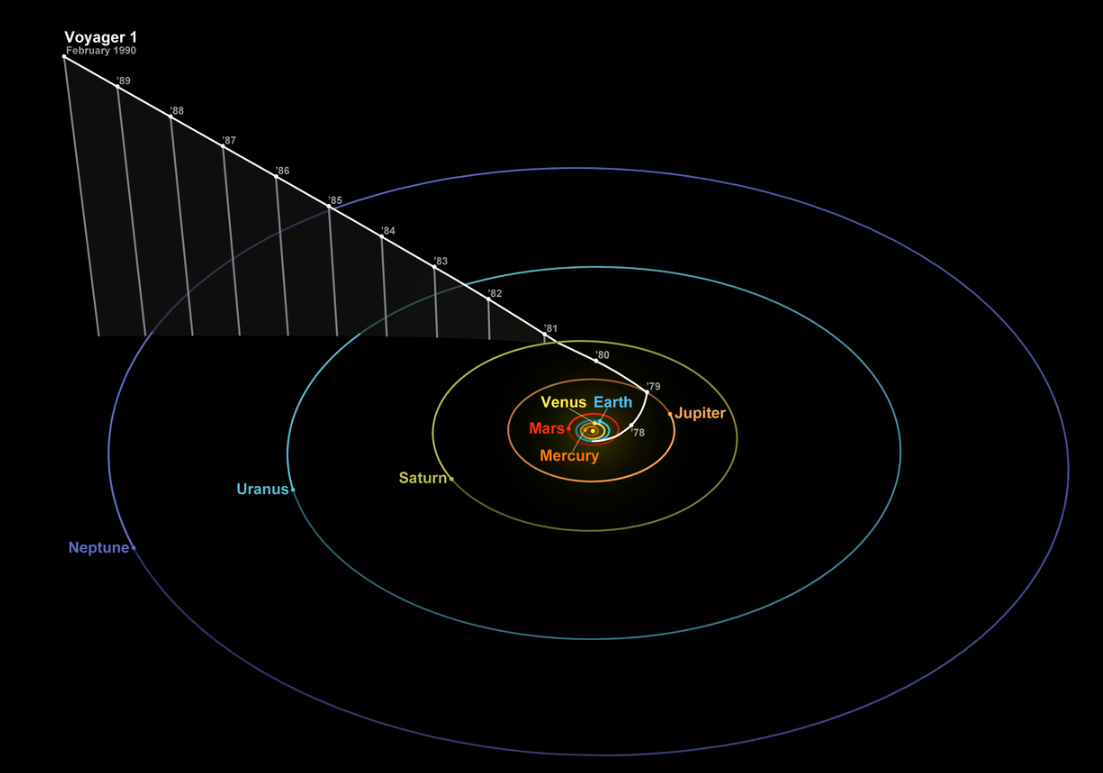
Prologue: I want to give my bona fides on appreciation of the “US space program.” For as long as I can remember I have been a space enthusiast. I followed projects Mercury, Gemini, Apollo, Skylab, X-15, Space Shuttle, ISS, Voyager’s 1 & 2, Cassini and others in real time. Even though space publicists mention scientific research, they never go into more than the very least they can get away with for fear of MEGO- My Eyes Glaze Over. To its credit NASA posts annual lists of research papers with links disclosing research results from R&D conducted in the orbital environment. Here is such a list. Much of the research might seem arcane but it is important to realize that the practical value is likely to come later as others incorporate it into their subsequent research and product development. This is how R&D works.

A few words about Elon Musk’s plans on moving mankind to Mars. As everyone knows, Musk is actively engaged in developing space craft large enough, numerous enough and powerful enough to take a great many people to Mars. His stated dream for humanity is to transport a large number of people to the red planet to establish a permanent settlement- a sort of Earth 2.0 for humans. There is even fanciful talk of terraforming Mars for more convenient and safer occupation. This is a colossal job, even for a small world like Mars.

All energy produced and consumed on Mars will be electrical via nuclear energy, solar, or maybe wind (??) generation. Combustion as we know it is out due to the absence of combustible materials and abundant oxygen. Solar power generation will be limited by reduced solar energy shining on Mars and by the practical problem of dust accumulation. Thermoelectric generation from a Radioisotope Thermoelectric Generator (RTG) has been the solution used on many Mars landers and deep space probes.

The best radioisotopes for RTG are alpha emitters. Alpha particles are +2 charged helium nuclei which cause a large amount of ionization over a short distance as it crams its way through matter, stopping in a short distance. Because they lose energy over short distances even in air, alphas require very little shielding, unlike beta and especially gamma radiation.

Betas themselves are easily shielded, but as they decelerate in matter, they can generate radiation called braking radiation, or bremsstrahlung x-rays, which are more penetrating. This is how x-rays are generated in an x-ray tube. Electrons impacting a target like copper generates x-rays. The effect is more pronounced in higher atomic number (high Z) elements like copper, but in low Z materials like plexiglass x-ray generation is much reduced. Consequently, beta emitters are commonly shielded with plexiglass.

The main downside to RTG is the low efficiency in converting thermal energy to electrical energy via the Seebeck effect– about 3-5 % currently according to most sources. So, for every 100 watts of thermal energy production, only 3-5 watts of electrical energy are available. This puts pressure on the supply of scarce radioisotopes.

On the good side of RTGs, they are stable, reliable and long lasting. Waste heat can be used to provide warmth for proper operating temperature in the craft or facility. The Mars lander Curiosity uses 4.8 kg of 238PuO2 to produce 100 watts of electrical power.

The deal with the devil you have to make with RTG power generation is that the best heat generating isotopes in terms of power density (watts/g) also have the shortest half-lives. For instance, 210-Po has a high power density of 140 watts/g but a half-life of only 0.38 years. It undergoes a 5.6 MeV alpha decay directly to stable 206-Pb, emitting a gamma only once in 100,000 alpha decays. Gamma emission poses shielding weight penalties and radiation hazards both in manufacture and operation in space. Even with no humans around, there is still the matter of electronic components that are sensitive to radiation. The more commonly used alpha emitter 238-Pu has a lower power density of 0.54 watts/g but a reasonably lengthy half-life of 87.7 years and minimal shielding requirements.

The background radiation environment in space by itself demands that shielding and radiation hardened electronics be used. Any added radiation from an on-board RTG only compounds the problem. The amount of shielding any given material provides is measured in half-thickness, not “full thickness” and is dependent on the type and energy of the particle. This value is the thickness of a specific material required to reduce the intensity to half of the incident radiation, not the total radiation emerging from the shielding material. This is because scattering can occur within the shielding material contributing to or minimizing the total flux. The point of this is that shielding only attenuates radiation to acceptable levels and not to zero.

238-Pu is a synthetic isotope that must be isolated from other Pu isotopes as well as a dog’s lunch of other elements in spent nuclear fuel or be selectively synthesized by nuclear chemistry. Isotopic separation of 238-Pu from other plutonium isotopes is difficult, slow and not the preferred method of producing it at scale. Nuclear chemistry that provides exclusively 238-Pu from a single transformation as with like 237-Np, offers a more productive route. This allows good old regular, valence-electron chemistry to effect the separation needed.

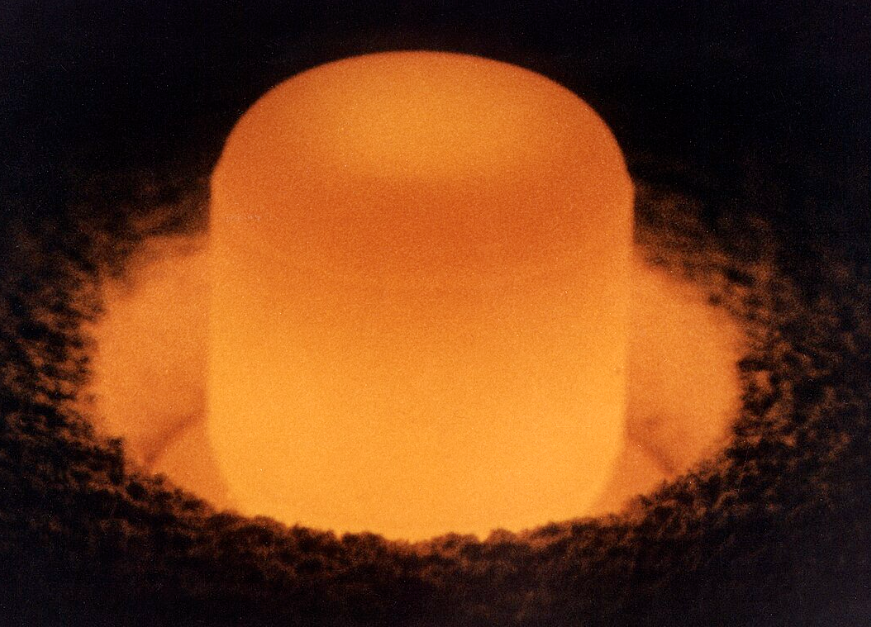
Source: Wikipedia. A pellet of 238PuO2 glowing from decay heat.

238-Pu is produced by neutron irradiation of 237-Np producing transient 238-Np with its 2-day half-life and subsequent beta decay to the 238-Pu. Chemical separation of the plutonium from residual neptunium is straightforward but, like all chemistry with radioisotopes, burdened by the need for radiation shielding for safety.

238-Pu is presently in short supply in the US. The Savannah River Site was producing “bulk” 238-Pu but was shut down in 1988. After closing of Savannah, the US purchased 238-Pu from Russia but the word is that Russia is short on it as well. In recent years other sites have been scaling up production where “scaling up” means producing in the several hundred grams to a few kilograms in a campaign.

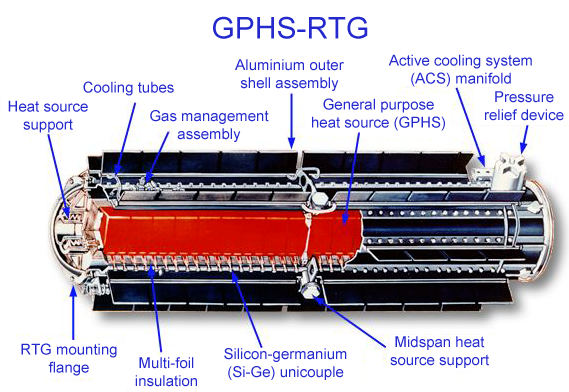
Source: Wikipedia. Just an example of an existing RTG generator.

In the RTG, plutonium is not used in the metallic state but as the oxide which is a ceramic or refractory** material like most heavy metal oxides. The plutonium is oxidized to 238PuO2, pelletized and clad in corrosion resistant iridium. According to NASA, this refractory form of plutonium is resistant to an accidental release in a variety of accident scenarios including Earth reentry and rocket propellant fires.

Source: NASA. 238-Pu clad in iridium for use in RTGs.

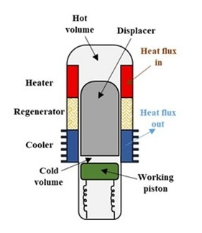
The Seebeck effect is not the only means of producing electrical energy from radioactive decay heat. The free piston Stirling Radioisotope Generator can use decay heat to drive a piston in a Stirling engine using helium gas as the working fluid. Waste heat is dumped at the cooled end of the engine and the linear reciprocating motion of the free piston is used to generate electrical power in the adjacent alternator.

The electric alternator is similar to the electromagnetic flashlight on the market. It works on the ordinary induction principle buy moving a magnet through a coil. You shake the flashlight to recharge it, causing the internal magnet to move back and forth through a coil. Shake it for 1 minute to get 4 minutes of light. The Stirling radioisotope free piston linear alternator operating in this manner can produce 4 times the electrical power of an RGT.

Source: Free-Piston Stirling Engine Technologies and Models: A Review, Carmela Perozziello; Lavinia Grosu; Bianca Maria Vaglieco, Energies 202114(21), 7009; https://doi.org/10.3390/en14217009

In 2020 workers Wong and Wilson at the NASA Glenn Research Center reported that they were able to operate a Stirling radioisotope power convertor for 14 years maintenance-free. 

Off we go!

Some thought will be needed on screening potential migrants to Mars for age, various physical ailments, dental health, genetic predispositions, sociability and underlying psychological issues. A manic crew member could drive fellow crew members to a murderous rage over time. Such screening has been done with astronauts for a long time. I wonder if choosing to migrate to Mars isn’t a sign of some precarious psychological condition in itself, after all the likelihood of a return to Earth may be slim. It would resemble going to jail in some ways.

Over time, the masses of new Martians living in Muskville will have to decide on what to do with themselves beyond exploratory geology, meteorology and engineering studies of Martian accommodations. Mars is a big, arid and frigid desert with no breathable air. But it may offer a few choices for recreation such as spacesuit hiking and shuffleboard. The outdoor choices will be limited by the Muskvillager’s battery, heating and oxygen supplies as well as ability to get around.

Eventually, all manner of psychological, social and physical maladies will manifest in Muskville and will have to be dealt with. People will spontaneously form cliques eventually giving us-vs-them issues requiring mediation. Unless the New Martian settlers are sterilized, pregnancy is a near certainty. An entire book could be written on complications this would bring. The alternative is to limit the inhabitants to a single gender or to gay individuals- most likely a non-starter.

Death on Mars means that your remains will need to rest somewhere outside the facility. A fresh body will freeze stiff in the Martian cold and remain that way indefinitely. Digging a grave will require energy expenditure and digging tools. Cremation will consume considerable power and may be out of reach.

Something like a hospital with medical supplies and trained staff will have to be present. The few physicians who might be present will be required to be generalists with exceptional diagnostic and surgical skills. A full medicine cabinet to cover a range of maladies will be needed to support this.

As Muskvillagers age out, the range of health problems will widen and require care. Diabetes, cancer, dementia etc. will fade in and people will age and die. This will leave job openings and duties behind which will have to be filled.

In general, the conveniences of modern living will be seriously cut short for the New Martians for a long time. A supply line with Earth that can withstand politics, business failure and war must be maintained.

If I were planning a migration to Mars, I’d worry about maintenance and spare parts for everything. Mechanical things will break. Perhaps an orange-colored Home Depot module will hitched to the back of the lander and sent along with a load of duct tape, assorted bolts and screws, sealant, O-rings, hand tools and cleaning supplies. Don’t forget a few bags of peanut M&Ms.

Wherein I jump to conclusions.

The human capacity for folly knows no bound. Woven in with folly are variable education, emotional inputs and diverse belief systems. The migrants will carry religious and political predispositions that they may or may not reveal in screening for candidates. Friends and relatives on Earth will sicken, age and eventually die but access to a return trip to earth may be severely restricted or effectively impossible.

On reflection, establishing even a modest Mars base will involve large energy inputs. Getting to the surface of Mars with enough reserve propellant for the return trip, the establishment of shelter, oxygen and water supplies are the priorities. Beyond just surviving day-to-day, there is interest in the possibility of putting Martian minerals to use as building materials or even water and oxygen production.

There are indications of frozen water on the surface of Mars in certain limited locations. Where there is water there is the possibility of using electric power to produce oxygen. The hydrogen produced may have utility somewhere but its use for combustion seems unlikely due to the corresponding amount of oxygen needed.

Anywhere you have silicates, aluminates and metal oxides, you have oxygen. Silicon and aluminum both have a strong affinity for oxygen and as such represent a thermodynamic well requiring steep energy inputs for oxygen extraction from minerals. Even worse, many silicates and aluminates are oligomers, chain polymers or network polymers that render them insoluble solids with high melting points. Silicates, aluminates and metal oxides are all comprised of a central atom- silicon, aluminum, or a metal -that are electron deficient by virtue of being connected to oxygen anions. In order to liberate oxide from oxidized silicon, aluminum or a metal, something negatively charged needs to come in and displace the oxide species. Metal oxides like the iron oxides are very often refractory requiring high temperatures to react. Then there is a long list of oxyanions like sulfate, phosphate, hydroxide, chromate, ferrates, molybdates, titanates, tungstates, manganates, etc., each with metal cations. After these there are the polyoxyanions …

The point is that there are a wide variety of oxide species to be found in rock and soil with differing properties. In the end, a negatively charged oxide anion must be oxidized to produce molecular oxygen.

In order to get molecular oxygen from minerals it will require a great deal of energy expenditure per kilogram of oxygen. Not only that but specialized equipment and chemicals. Any oxygen produced will have to purified and compressed into cylinders.

MOXIE

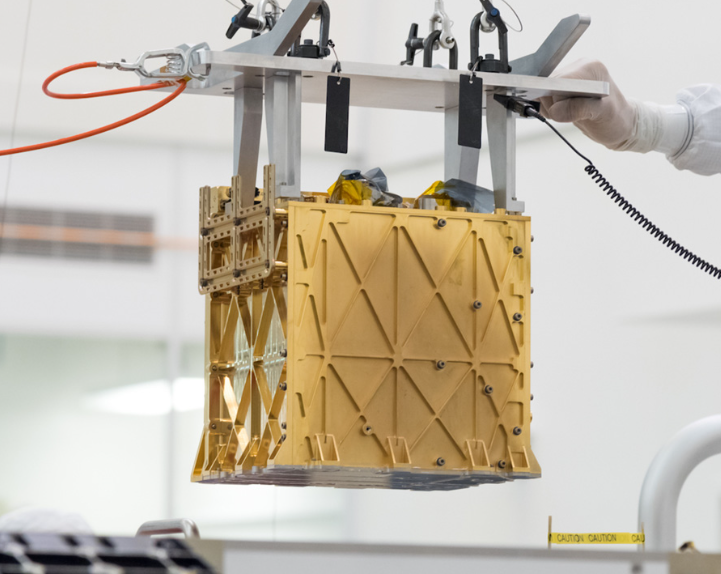
The extraction of molecular oxygen from the abundant carbon dioxide atmosphere seems desirable and has actually been put to the test on Mars. A prototype molecular oxygen generator called MOXIE went to Mars on the Perseverance rover and successfully produced oxygen from carbon dioxide beginning in 2021.

Source: NASA. The MOXIE package installed on the Perseverance rover.

The MOXIE oxygen generator is a solid oxide electrolysis device that operates at 800 oC and uses a stack of scandia stabilized zirconia ceramic electrolyte. An excellent source of information on MOXIE can be found at this Science site.

About 10 % yttria (Y2O3) or scandia (Sc2O3) will prevent the zirconia (Zr2O4) electrolyte from undergoing a phase change that causes the ceramic to fail at high temperature. From personal experience I know that scandia is chosen as a better diluent for zirconia because it allows lower temperature operation than yttria by perhaps 200 oC. The lower operating temperature with scandia allows for better sealing of the cell. High temperature seals are very problematic at these operating temperatures.

The MOXIE electrolysis cell uses a nickel coated cathode for reduction of the CO2, a ceramic zirconia/scandia electrolyte that allows oxygen anions to selectively pass through, and an anode where the anions are oxidized and combine to form O2 where it is captured. MOXIE produced O2 at a rate of 6-8 g/hr while on Mars. The process vents carbon monoxide waste as well as unreacted CO2 at the cathode where it is vented.

A limiting factor in operating MOXIE is the operating voltage across the cathode and anode. Two kinds of chemistry can occur within MOXIE. Carbon dioxide can be reduced to form oxide or carbon, depending on the flow rate of CO2 and the operating voltage. The Nernst voltage, VN, is the minimum voltage necessary to do the chemistry. At about 1.1 volts the cell will reduce CO waste biproduct to carbon on the cathode. This is called “coking”. Carbon formation on the cathode impedes the function of the cathode and reduces the output of the cell. The voltage for coking varies very little with flow rate.

The VN for the desired reduction of CO2 to oxide (O) and CO at a low flow rate is around 1.0 volts and at high flow rates drops to about 0.95 volts or just a bit lower. So, the “normal” operating voltage range then would be between 1.0 and 1.1 volts to prevent fouling the cathode with coke. The operating voltage window seems a bit narrow. It was found that while a stable operating voltage could be supplied, the resistance of the cell was very sensitive to temperature making stable operation a bit delicate.

Pyrochemistry

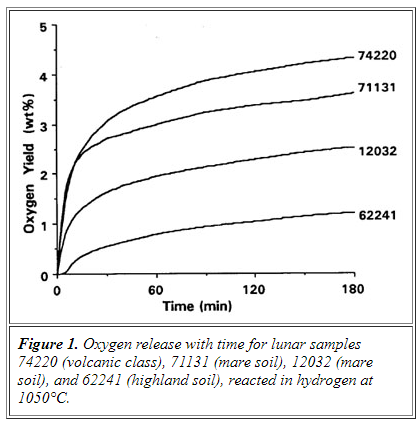
Extraction of oxygen from lunar mineral samples has been done previously (below). All of the mineral samples were iron rich and gave yields of 2 to 5 % in the form of water. The samples were from Apollo 17 and consisted of ilmenite (FeTiO3), basalt, soil and volcanic glass. The process uses hydrogen at a reaction temperature of 1050 oC producing H2O. Presumably the water vapor is mixed with hydrogen during and after the reaction. The water can be isolated by simple condensation in the presence of the hydrogen.

Reduction of Ilmenite:  FeTiO3 + H2 — > Fe + TiO2 + H2O

Source: Oxygen Extraction from Lunar Samples
by Carlton C. Allen
Lockheed Martin Engineering and Sciences Co.

To use the process described above, high temperature is required for the hydrogen reduction in a refractory vessel. This requires considerable electrical energy input to heat the thermal mass of the vessel and the regolith. Spent material will have to be removed and discarded. Perhaps the heat can be recovered for general facility heating. Oh yes, the recovered water will need to be electrolyzed to produce molecular oxygen and hydrogen. This process will use plenty of electric power as well as for the compressors to store the O2 in pressure bottles. In principle the hydrogen can be recovered for reuse in the hydrogenation vessel.

The above process applied to ilmenite produces metallic iron and titanium dioxide, a white pigment. FYI, ilmenite is a common raw material for high purity titanium dioxide production. It is high purity because the titanium dioxide is prepared from titanium tetrachloride which is isolated by distillation from the ore matrix after fluidized bed chlorination.

The first Martian settlers will have to bring every single thing necessary to live on the planet. That includes launching it and landing it on the surface intact. Landing on Mars is tricky because the atmosphere is too thin to provide much aerobraking. The Martian surface pressure is the same as the Earth’s at 80,000 ft altitude and the temperatures are frigid.

Let’s say we successfully land a crew and set up housekeeping. What are they going to do with their time? These missions are supposed to last about 2 years including a lengthy transit time. They can collect various kinds of data on Martian geology and weather and send it back to earth. Somebody will get publications out of it. Eventually, somebody will decide that there must be other things to do besides geology and meteorology. Naturally there will be much ongoing R&D on the pragmatics of living on a remote Martian outpost in a crowded pressure can.

Eventually, the question of what non-research living will look like. Shelter will need construction from some kind of materials. Every new section of shelter will need to be airtight and equipped with environmental controls, sanitation and power. Bulkheads between sections will need to be in place to isolate calamities.

Support staff will be needed one day to provide critical services and perform facilities maintenance. This would also include medical staff, emergency care, food & sanitary support, electronics and IT support and administrative staff for the inevitable paperwork. The lander will need rocket engineers for upkeep and repairs to assure launch reliability for the return trip. Do rockets exist that can sit for a year fueled and then reliably launch and insert into a trajectory back to Earth? There are many, many problems to be resolved in many areas.

After some period of time, a crime will happen on Mars. It could be petty theft, assault or even murder. Someone will have to be appointed to look after law and order. An astronaut-sheriff, sergeant at arms or just the po-leese. What kind of due process will be available to a suspect in a Martian colony? Guns will be too risky to have in the settlement given that a bullet could pass right through a bad guy and rip through the structure creating a leak.

On earth, doing independent research requires getting academic credentials, finding a position, grading exams for goddammed freshman chemistry, executing an R&D program, and then going home every day to refresh and have a social life. Imbedded in all of this we have courtships, marriage, mortgages, babies and divorce. We manage the ten thousand details of modern life and interact with our families and social networks. We mourn those we lose and celebrate our achievements. We enjoy good health and suffer injury and sickness and eventual death.

On Mars, the equation will be a bit different. Many of the above life elements will apply, but from a great distance. Instead, we will be confined to a small space with an unchanging group of fellow crew members. The distance to Earth from Mars is constantly changing and there will be a period absent any communication when the earth is behind the sun.

Eventually, research on living in space or on Mars will wind down to minutae if it hasn’t already and people will have to find other things to do. The funding for living off-world will have to switch from R&D to … what, a lifestyle? 

I wonder if there will ever be room for commerce and jobs on Mars. I can see running a canteen or restaurant for profit but stocking them with earth supplies will be prohibitively expensive and infrequent.

What joy can there be living in a pressure can on a hostile planet? What few hermit-astronauts there may be might find it acceptable if they never need a dentist. Perhaps dentures or implants should be routinely fitted to all visitors to Mars.

The second stage of Mars exploration will have to ramp up progress on sustainability. Using Martian soil as raw materials for construction and for crops. As the Martian population rises beyond the first few rotating crews, what will the immigrants do with their time in can-living on a hostile world? Would going to Mars to lead an utterly confined life with nothing to do be an attractive draw?

Epilog

I think that settling on Mars is not such a great idea overall and specifically would be wasteful of resources that should be applied to the rehabilitation of the biosphere on our home world. It would somewhat resemble living on the Amundson-Scott Station on the south pole but without the benefits of breathable air or supplies regularly shipped in. Further, the lack of radiation shielding on the surface of Mars will offer 40-50 times the background radiation as on Earth, not counting the occasional storm of angry solar protons the sun flings out now and then.

** NASA does not use the terms “ceramic or refractory” in its description of the 238-Pu heat source. This is my choice of words.

The Pale Blue Dot Revisited

I would reproduce some memorable text from Carl Sagan’s book The Pale Blue Dot, but that would be a copyright violation. Instead, I’ll chime in and echo his intent. That would be for all of us to pause occasionally to reflect on our tiny spherical paradise amidst the barren expanses of the universe. Earth continues to harbor life because it can. The right distance from an average star for liquid water, the planetary magnetic field protecting the atmosphere from being stripped away, the right combination of chemical elements for the ignition and propagation of life, and the long-term climate that allowed life to survive.

Image of Earth captured by Voyager 1 on Feb. 14th, 1990, just before the camera was shut down to conserve energy as it sped from the solar system. The bands of dim light are artifacts of the camera lens due to the angular proximity of the sun.

In 1989 Carl Sagan requested that an image of Earth be taken from a great distance even though the scientific value was nil. After some internal haggling, the administrator of NASA, Richard Truly, interceded and the imaging was approved. In 1990, the decision was made to allot time to image the Earth just before the camera Vidicon tube was scheduled to be switched off to conserve energy. Just 60 images were taken and stored on an onboard tape recorder until they were later relayed to Earth between March and May, 1990. The signal was received by the Deep Space Network after 5 1/2 hours of transit time.

Image Credit: from Wikipedia. The vertical bars are represent 1 year intervals. Voyager was launched in 1977 and was 40.47 astronomical units (AU) from earth by Feb. 14, 1990, when the image was taken.

Just looking at the image without any concern given to what is happening there at present, the Pale Blue Dot appears unremarkable. On the cosmic scale, it is just a tiny ball of wet rock. Yet with the right elements, compounds and plenty of time this bit of rock spawned sentient beings allowing the universe to become self-aware.

With all of the conflict and tension on Earth, someone has to stand up for the Earth’s biosphere. No matter what people do, nukes and all, planet Earth will remain in orbit spinning about its axis. It is civilization and the web of life -the carbon-based parts- that are serious risk. It is the birthright of each creature to share in the fruits of the earth. Politics and economics must adapt to a healthy and sustaining biosphere, not the other way around.

With the indecisive wars in Korea, Viet Nam, Iraq and Afghanistan, the US has been served many slices of humble pie. Yet, are we learning? Presently we are drawn deeper into the bottomless pit of the Israeli/Palestinian conflict. We have hitched our wagon to an Israel that pushed out the inhabitants of a piece of someone else’s land and colonized it. It is an undeniable historical fact. It should surprise no one that 2 million people now forcibly concentrated into a small patch of unproductive land and are militarily, politically and economically isolated are deeply resentful with their lot in life. As they have done many times in the past, the Palestinians have pushed back violently but this time with the help of others either directly or by proxy. The whole thing is further complicated by religious zeal on the part of both sides. Both claim to be doing God’s work, but to different ends. Magical thinking enforced by guns.

Elsewhere on the Pale Blue Dot, Putin’s savage invasion of Ukraine has thus far brought Russia only death and humiliation, though outwardly Putin postures himself as unworried. He is in tight control of a nation that has been under tight control for most of its history. Putin’s conventional military has surprised many by its brittle collapse in the invasion of Ukraine. As with the Soviet regime before him, much of his power rests only on the sandy pedestal of propaganda and the large bureaucracy to monitor or punish everyone. Putin’s real strength is his nuclear arsenal and his expressed willingness to use it.

The last time the Russian populace rose up to successfully overthrow tyranny was the Bolshevik revolution in 1917. Tsar Nicholas II was overthrown, murdered and replaced with a new type of totalitarian regime- The Union of Soviet Socialist Republics. Over time the USSR was able to modernize the state into a spacefaring, nuclear power but always retained and refined its authoritarian grip on its people.

Meanwhile in the west, a hornet’s nest of anger in the US has been awakened by a single charismatic and malignant narcissist who has attracted a dedicated following of the vocally disenfranchised. While his stunningly bad conduct should be obvious to anyone older than 12, no amount of pettiness, lies and over the top behavior seems to detract from his popularity. It has been said that he validates what his supporters believe. If that is true, then Trump is just the tip of a terrible iceberg.

Many 20th century dictatorships in history have been led by a charismatic idealist who understood the dark zeitgeist. Lenin, Mussolini and Hitler among others have risen to power and directed brutal attacks on whom they chose, sometimes driven by greed for power and other times by utopian fantasies. While Stalin didn’t author the Bolshevik revolution as Lenin did, he set the high-water mark for murder and cruelty in Russia. As bad as these actors were, all somehow avoided the assassin’s bullet during their heyday. One little piece of lead could have disrupted the timeline of terror each journeyed. Civilization does not have a provision that encourages this, though.

For crying out loud, people. Get a grip on how rare and special the Earth’s biosphere is. If there is another wonderous place like Earth, we are unaware of it and may never become aware. The earth is to be treasured.

The Golden Calf Plods Forward

As expected, New Hampshire Republicans rallied for their Golden Calf yesterday. Naturally, media people are using this to boldly predict the future. I’ve had to abandon NPR because they are serving wall-to-wall election coverage as though nothing else has happened. Despite the years of legal actions against the Orange Jesus, his popularity endures and Republican politicians and candidates continue to rally around him, hoping some of magic rubs off on them.

In interviews, Trumpsters confidently say that things were better during his presidency than under Biden’s despite what the numbers say about the economy at present. Even though inflation has dropped from 9.1 % to 3.2 % over the last year according to the AP, many consumers apparently expect prices to come down as well. Are the Trumpsters really upset about the economy or are they just angry that he lost the 2020 election?

“We don’t care about no stinkin’ 91 felony indictments. Yes, he’s committed fraud and sexual assault. But, but, but he is going to drain the swamp and halt immigration!!”

Reducing prices is not something that business people will do to make life easier for people. What industry will be the first to reduce their prices willingly because it is a “nice idea?” Prices are always set to what the customer is willing to pay. A common nightmare of a business person is that they may have left money at the table during a negotiation or a sale. Businesses charge as much as they can all the time. People who leave money at the table are not the people who rise into the thin air of the C-suite of business.

During the pandemic, supply chain interruptions helped trigger inflation. Businesses ratcheted up their prices to grow or maintain their margins. Many businesses had to raise their prices because their costs had risen, but not evenly across the board. Why waste a good opportunity to raise prices if others are doing it? For essentials, consumers soon adapted to it because they had little choice. Strangely, the economy has shown unexpected vigor during this inflationary period. Some products like pickup trucks and real estate, however, are suffering badly.

Along comes the Federal Reserve to slay the dragon of inflation. They pulled their one big tool out of its sheath for staunching inflation- raising interest rates. And so they did with success. The down-side is that it hurts those seeking a mortgage or other loans due to increased interest rates.

Another effect of the pandemic is the continuing trend of employees working from home. According to one source, the 1Q23 vacancy rate for NYC office space was 22.2 %. Remote work activity has caused businesses to reconsider the size of the office space they are leasing. Many are opting not to automatically renew their leases in favor of leveraging better terms or outright downsizing their space requirements. The new workforce shift has had a negative effect on surrounding businesses who rely on the daily flood of office workers to buy lunch and shop. It also has a big effect on the owners of office buildings who likely had business models and loans relying on higher occupancy rates. The knock-on effect is that the banks who made the commercial loans to the office building owners are beginning to see an increase in loan defaults. Commercial borrowers also face significantly higher interest rates than they started out with. News reports are very pessimistic for a reprieve in the near term.

The term that was coined for this is the urban “doom loop.” Reduced office occupancy leads to reduced tax revenue for municipalities who supply services like transit, police and street maintenance. But I don’t want to spoil it- Google “urban doom loop.”

Back to the Golden Calf.

I would offer that there is a portion of the grand American bell curve that probably shouldn’t be left in charge of a vast international economic and nuclear superpower wielding a military machine the likes of which the world has never seen before. Further, I would offer that just possibly many of the followers of #45 are comfortably squatting on that side of the bell curve.

As I see it, the Golden Calf getting back into office will adversely swerve the fate of Europe, the Balkan and the Baltic states into direct conflict with an expanding Russian Empire. Putin is obviously trying to reestablish and reenergize the reach of the former Soviet Union. He has little care for the lives of Russian soldiers as they fight and die on the battlefield, and even less for those who defy his wishes. They are expendable in the grand scheme of a Great Russian Empire of Tsar Putin.

The State of Ukraine traces back to October of 1917 when the Bolsheviks tried to capture Kyiv and failed. By January of 1918 the Ukranian revolutionary parliament declared the formation of Ukrainian People’s Republic. After much conflict, Ukraine was made part of the USSR.

In the 1930’s there was the Holodomor, or the “Great Ukrainian Famine” of 1932-33 with continued mass killing and exile of Ukrainian Kulaks to the east for the rest of the decade. The collectivization forced on Ukraine was brutal. Many thousands of Ukrainians were exiled to the east and disappeared. As Hitler invaded Poland and continued with Operation Barbarossa to Moscow, his plan to exterminate Jews went with him. The wholesale slaughter of Jews in Poland and Ukraine wasn’t limited to the concentration camps. Villages were captured by the Nazis and Jewish citizens were marched by the many tens of thousands into the woods and executed by a bullet to the head, falling into pits where they would be buried. No age or gender was spared. Hitler gave orders to Himmler to carry out the Final Solution in eastern Europe and Russia and he did with a vengeance.

The election of Trump has a ghastly downside for western civilization that is largely kept quiet by the popular media. In their desire to portray fairness, they tend to avoid topics like this for fear of the accusation of bias..

The Asymmetry of BS Assertions

Unfortunately, when someone utters something in conversation that is wildly divergent from reason, they make the claim in mere seconds. A proper rebuttal, though, can take paragraphs of content to dredge up facts and compile reasoning to refute the reckless assertion. Spouting nonsense is much easier than attempting to convincingly invalidate it. Many people avoid contradicting someone with doubtful assertions because either they don’t want to be disrespectful or they’re afraid to push the matter.

As a result, fools sermonizing nonsense often wander off with a false sense of victory because nobody pushed back. We all have friends and family that somehow went into the weeds and picked up some wild ideas.

One way to deal with fools spouting nonsense is to turn around and leave. Other times a gentle change of the subject can lead someone to a better topic. To expect someone to have an epiphany about some closely held yet nonsensical notion leading to a higher plane of awareness standing right there is unreasonable. Most of us fools will stand our ground and argue. Yes, that includes me. Despite being in a hole, I also have been known to keep digging the hole, though not so much anymore.

Wherein I digress.

College is a great place to pick up debating skills. My research group in grad school was a quite assertive and international group of people. Today most of them are either full professors or VPs of R&D at some pharma company. Since I decided against pharma early on, I was thankfully able to avoid the east coast. At that time there wasn’t much non-biopharma elsewhere. To thrive, I need to be around some interesting topography like here in the west.

In grad school I learned to pitch back as much guff as I received. By assertive I don’t mean quarrelsome, usually. I mean debate. Knowledge and reasoning had to be there, as it should be. Most of these “energetic discussions” were at the chalkboard where we preposed reaction mechanisms by pushing electrons. Fermented beverages were often present. Since it was a natural product and stereochemistry group, we had to be able to render our chalk structures in pseudo “3-D.” Our research professor was a master at this. He could draw complicated alkaloids and diastereomeric transition states with chalk to show stereochemical mechanisms as well as anyone.

Back to the BS people spew.

Back to the topic of the post. I’ve lost much of the desire I once had to debate people who espouse outright stupidity. An example would be a MAGA follower. My working theory is that once someone has tasted the Trump Koolaid, they are likely lost for good. They’ll live their lives out as Trumpers and go to their graves that way. Some Trumpers do have a revelation and recover, but most don’t.

Attempting to educate MAGA people for the sake of truth and accuracy is a waste of time. Is this a pessimistic view of life? Yes.