
Category Archives: CounterCurrent

US Patent Allowances to Foreign Entities

The United States Patent & Trademark Office collates and makes available online statistics relating to patent office activity. The data provided by the patent office could be thought of as a mine of information. A few companies make a business of collecting USPTO data and subjecting it to analysis.
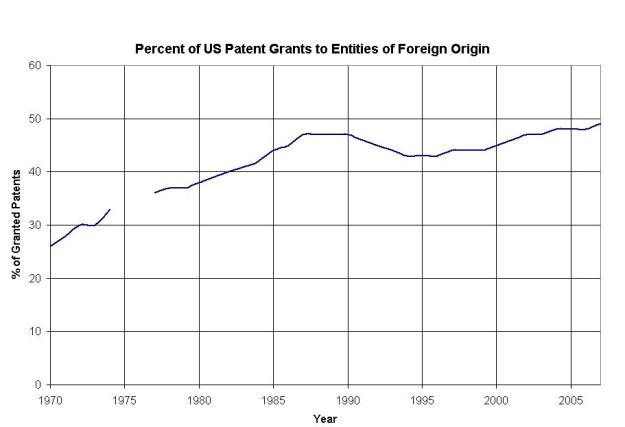
One of the more interesting things to be found is the % fraction of patents granted to foreign entities. As of 2007, the fraction of allowances to foreign entities is 49 %. The above graph shows the tend over time. The gap in the curve is due to the absence of data for 1975-1976 in the published data set.

The fraction of foreign patent allowances has remained approximately constant since ca 1985.  There was a dip in the 1990’s that may correspond to some sort of pullback in R&D activity. This drop off in issued patents lags by several years due to pendency.
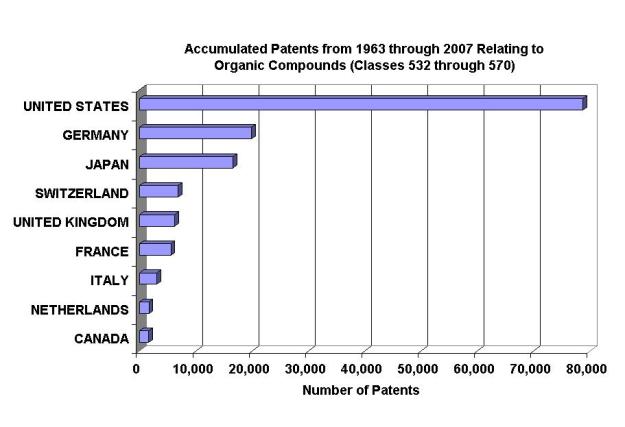
The above graph uses data published by the USPTO. Here we see the accumulated patent allowances to various nations over the period from 1963 through 2007. The data set is limited to Organic Compound classes 532 through 570 under the US classification system. For brevity, only the top 8 foreign applicants are shown in comparison to the US.

Very obviously Germany and Japan have the leading foreign awardees of US patents in this segment of R&D. I have not looked at how the reciprocal situation compares under PCT filings abroad by US applicants. 

What is of greatest interest is seen in the top graph: 50 % of the patent real estate being staked out at the USPTO is going to foreign interests.

A unique feature of chemical patents is the Markush claim. Markush claims allow the claiming of a  potentially large huge number of analogs defined by compact symbolism and covering vast swaths of the periodic table. 

It is thus possible for a professor in Osaka to own the composition of matter of a Markush set of hundreds or thousands compounds that would then bar a company in New Jersey from making even an obscure member. Under the PCT, the same is true in the other direction.

The reach of property rights in the world of invention has become so extensive, and the data provided by the various patent agencies and abstracting services is so inadequate, that the act of performing a due diligence search is nearly comical. In truth, you look for low to middle hanging fruit and hope that an obscure sentence somewhere doesn’t blow a hole below your waterline one day.

Chemical patents are in dire need of reform in terms of the nature of the disclosure. Patent offices must find a way to facilitate the extraction of crucial information so the public has a fair chance of understanding what is off limits.

We need a more lucid recitation of claimed compositions and better use of language in the detailing of processes. Patents should be written with abstracting in mind. It should be made possible to extract processes and compositions into a form that can be accumulated in databases for rapid review. This has to begin in the drafting phase of the application.

[For some great feedback, check out the comments- Th’ Gaussling]
Self-Imposed Complexity and the Ratchet Principle

The portfolio of laws that American citizens are subject to seems to grow without bounds. Every year our congress drafts a new collection of laws to submit to the process of enactment. State legislatures, county and city governments all are able to add new rules and constraints on our degrees of freedom. As if that weren’t enough, people willingly move into convenant controlled communities where they sign away basic freedoms like the freedom to choose house paint or to leave the garage door open.

We are gradually fencing in all of the free space where conduct is unregulated. Our Nanny State leaders are scaring the bejeebers out of us through defense initiatives and dire warnings about what could happen if terrorists took an interest in disrupting industry and infrastructure.

Our town of 6,000 has to comply with Homeland Security requirements by fencing in the town water tank in a certain way.  Some terrorist could poison the water. In fact, that fiend would probably be a psychotic local citizen bent on retribution, not a Shiite saboteur in sandals. Collectively, we are at much more risk from fellow citizens than from foreign bad guys. Perhaps that is the hidden agenda.

Citizens are turning over priceless freedom artifacts in exchange for promissory notes claiming to protect the bearer. Once we give up degrees of freedom in the conduct of our lives, we can never get them back. Govennment will not refund units of control.  As we increase the complexity of our world through an ever increasing statutory web of control, we forfeit degrees of freedom. It is like a ratchet. You can click forward, but there is no going back.

New subject. Read Jim Kunstlers post “Reality Bites“.

Geriatric Body Art

The number of young adults walking around with piercings, tatoos, and those curious discs in their ear lobes continues to grow. Whereas tatoos were once popular only among cannibals and sailors, todays suburban tatoo fashionistas come from all walks of life and sport technicolor displays of fantasy art that make a point of in-your-face incongruence. And with much of it on locations where the wearer can’t view it themselves.

I can’t help but imagine rest homes of the future where geezers and codgers will dodder in their twilight years, festoons of ear hair sprouting over gaping holes in their pendulous ear lobes like Amazonian witch doctors. The urine scented hallways will be populated with crones and the occasional geezer sporting once provocative tats, now blurred with age, protruding from private locations and shared only with the floor nurse.

It seems to me that the tatoo money would be better spent on a round of antibiotics after a trip to Phuket. At least it would have been a genuine experience of life on the edge rather than just an illustration of one.

Bacevich on Consumerism and the Imperial Presidency

While I have been struggling in my usual caveman way to express my frustrations with our national governance, whom should I stumble into but Andrew J. Bacevich, Boston Univ professor of history and international relations, who has been working on this matter for some time. Bacevich has written a book called The Limits of Power: The End of American Exceptionalism.  This exceptionally articulate fellow was recently interviewed by Bill Moyers on public television. 

His thesis comes down to the notion that American demand for consumer goods and credit has resulted in a kind of consumer imperialism. To facilitate this “domestic disfunction” or “crisis of profligacy”, the executive branch has acquired an excessive reach that exists only by the wither and atrophy of congress. By fiat of the executive, and the mumbling consent of a passive congress, our military adventures have distracted Americans from an examination of our continuous and undisclipined consumerism and indebtedness.

Georgia on my mind

I’m glad that the USA is able to scold CCCP Russia for its invasion of Georgia from our lofty position on the moral high ground. I suppose that the irony of our warning to Russia could be discounted as the delerium of a petroleum besotted empire in decline. While it may not be that bad yet, we certainly have been driven by our political leaders to a remote location in the desert and abandoned.

Western Civilization classes of the future will note that the inability of the USA to constructively engage post-communist Russia was perhaps one of the greatest opportunities lost of the 20th Century.

On wrecking your career

It’s the end of a rotten day and I’m fuming. There are many ways to see harm to or the obliteration of your career in the fabulous world of industry. It can be self-immolation or you can catch a bullet just by standing there. Sometimes you can be removed for reasons that are never clear- your division or your job description can be rendered obsolete by the geniuses driving the boat. Industry demands loyalty and the ability to absorb abuse through many forms of institutionalized intimidation.

Sometimes working in industry just sucks. There is no way around it nor is there a better description. The trick to weathering bad times is to find a way to reign in your temper when things get stupid. Speaking for myself- a large irritable mammal- this can be really hard to do. I am a smartass with a good vocabulary and a decent imagination- a detonable configuration and am unable to keep my mouth shut sometimes.

I had to learn this temper thing the hard way. I once beared my teeth and snapped back at a senior staff member who was behaving just horribly. He had a need for dominance and used his lengthy time in service to leverage it. Skipping to the conclusion, I ended up leaving and he stayed.  Moral of the story- for long term survival, find a way to let bad characters implode through their own weaknesses.  If you want to stay, then resolve to stay.

In industry it is quite important that your “deliverables” are not just visible, but also mission critical. Industry is cyclical and companies inevitably expand the head count. When times get tough, the head count is one of the first things they want to trim. While times are good, try to remain on important projects that are highly visible and valuable to management. Try to avoid being put on invisible projects.

Be judicious in how you use email. Don’t give others a stick that they can beat you over the head with. Never compose an email while you are angry. Always be fair and generous, especially to despicable characters. Even handedness in the face of conflict will always win friends and allies. Try to avoid blind copying and excessive cc’s to upper level people. Try to settle your disputes without making a comedy show of it in front of management.

You will eventually find that one of the major problems in life is the matter of control. Many kinds of conflict and ordeals derive from the need for control. Some people harbor pernicious control issues that disrupt everything around them. They are like typhoid carriers. I have yet to find a rule of thumb for such a situation. But the thing to remember is that such people could cause you to behave badly as well.  , so a person has to be on guard when certain people are around. This sounds simple, but it can be quite hard to do. I am writing this very post as a way to process my own frustrations.

Organic and Inorganic Carbon??

Thanks to a friend in Grand Rapids, I was linked to a blog hosted by the NY Times called Tierneylab.com.  The writer of the post was sounding off about a pet peeve relating to the use of the term “Organic”.  It seems that there is some confusion as to the use of the adjective organic in relation to certain carbon-containing substances. Tempest in a teapot, you ask? Let the chemistry community decide.

The problem begins to show itself when astronomers and planetary scientists start describing carbon containing materials found in planetary exploration as organic.  Back on earth, the word organic is burdened with both common and scientific usage. So, when descriptions of organic materials found on other worlds begin to arise in discourse, the intent of the usage becomes unclear.

For instance, it could suggest to people that such discovered materials were put in place by some kind of life form. It could suggest to nondiscriminating audiences that the presence of carbon implies life, past, present, or future. Or it might well suggest to higher level audiences that biology-ready raw materials are in place.

The scientists working with the Phoenix Lander have an interesting analytical chore in front of them. Using a robotic platform on Mars, they want to distinguish the presence of organic vs inorganic carbon. What is meant by organic and inorganic is less than clear. But it seems that organic refers to something other than CO2 and carbonate.

In the relatively few journal articles I’ve seen relating to this, the authors are not always precise about the kinds of molecules they are referring to as organic. Irrespective of what is said in the articles, when this work gets to a public forum, the meaning behind the word organic becomes even less clear.   

The TierneyLab post does bring up an interesting question about what is necessary for a substance to be considered organic.  Do graphite, diamond, Buckyball, or soot forms of carbon qualify as organic? What about CO2, CS2, carbonates, CO, HCN, or calcium carbide? Does it make more sense to refer to organic and inorganic carbon, where inorganic carbon is defined as … well, what? 

Seriously, what would it be? CO2? Carbon dioxide is incorporated into glucose by plants and this seems quite organic.  Carbonate? This anion is used to balance our blood pH. Our own metabolic CO2 helps to provide carbonate. This product of metabolism should qualify as organic. CO? Well, Carbon monoxide undergoes Fischer-Tropsch reactions to produce aldehydes. This seems very organic as well. Perhaps the target is a substance with C-H bonds?

There is nothing inherently biological about the C-H bond. The Saturnian moon Titan is blanketed with a thick layer of CH4 (methane) and it seems unlikely that it is of biological origin. Indeed, hydrogen is the most abundant element in the universe and carbon the 4th. That hydrogen and carbon atoms could find each other to form trace methane in a proto solar system isn’t too much of a stretch.

Organic and Inorganic Carbon.  How about we just leave it all as organic? 

Here is what I think. It does matter if a scientist or writer is using language in an imprecise way. If writing or speech implies, for instance, that Mars is rich in life giving organic nutrients when in fact Martian organic matter is really carbonate and CO2, then I believe the language must be altered to reflect that condition. A writer should not leave an impression of past or incipient planetary fecundity when in fact the planet may be an inert ball of metal silicates dusted with a bit of carbonate when the 6 torr CO2 atmosphere kicks up a breeze.

Jupiter Launch Vehicle Proposal. Safer, Simpler, Sooner.

The Space Shuttle Program is scheduled for shutdown sometime in 2010. At that time the reusable, tiled spaceplane concept (STS) will be put to rest in favor of the capsule-on-a-rocket design.  According to plans, there will be a 5 year interlude between the retirement of the shuttle and the implementation of a new man-certified lifter. Many have suggested that this idle period with no manned launch activity could lead to a brain drain in the ranks of skilled aerospace workers.

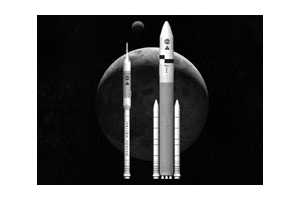
The successor to STS is the Ares Launch system consisting of a man lifter (Ares I) and a cargo lifter (Ares V).  Ares I is a two-stage system that will take a crew of 4 to 6 into low earth orbit. This vehicle will carry  55,000 lbs of provisions and astronauts to the ISS.  Additionally, it will be used to lift a lunar exploration team into orbit for docking with the lander module placed into orbit by the Ares V lifter. 

Ares V is a heavy lifter and is expected to be able to place 414,000 lbs into low earth orbit or send 157,000 pounds of payload to the moon.  Ares V uses two solid rocket boosters derived from STS and a central H2/O2 liquid fueled rocket using a cluster of 6 engines derived from the Delta IV system.

Ares I & V. Photo Credit- NASA

NASA has awarded contracts for this program and work is underway.

What has recently transpired is an alternative system proposed by a group of engineers. This system is called DIRECT, and involves the use of a single lifter called Jupiter.  The Jupiter lifter is derived directly from the STS lifter which consists of two solid rocket motors and a central H2/O2 tank which feeds the shuttle engines.  The DIRECT system would take advantage of existing technology, but with the addition of an O2 tank extension, a cargo section, and a cluster of engines to the existing liquid fuel tank. The proponents of this system claim that their system could get the next phase of manned space flight going sooner, simpler, and safer.

It is an interesting proposal. I hope it gets some serious consideration by the Congress.

InBev Chugs St Louis Utility Beer Maker

It is surely a sign of the End Times. Just as sure as the Four Horsemen of the Apocalypse and cats sleeping with dogs. A Belgian company buys Anheuser-Busch.  Wow.  Just the thought of it is too much for me to get my arms around. Michelob now has a kissin’ cousin named Stella Artois. 

What was that old brain teaser an Austrian colleague once asked-

Can you name 10 famous Belgians? 

I agree. It is a bit outrageous. I’m sure there are as many as 20 famous Belgians.

Who knows? This may be the European connection NASCAR has been looking for.  Watery beer, fast cars, and drunken hooligans. It’s universal.