
Category Archives: CounterCurrent

Drill Baby Drill!! The GOP Call to Arms.

I recall sitting on the sofa watching the 2008 GOP convention and hearing the intoxicating refrain “Drill Baby Drill”. It was like the sensation of sitting in the dentist chair with my brainstem bathed in cool nitrous oxide vapors and face numbed with lidocaine.  I found myself tumbling head over heals in a mild, drooling, narco-twilight state while my twitching eyeballs attempted to focus on McCain.  My fellow citizens had drummed themselves into an enchanted war dance and gathered to hear Colonel Kurtz, but without the banana leaves.

Then I snapped out of it.  Drill baby drill. This was not just a work order or a requisition for drilling staff to please set up a few drilling rigs in the morning. This was an exhortation to rip those smirking tree huggers from their stations, pulp the trees to make a paper dunce cap for Pelosi, and call in the Air Force to oversee saturation drilling of the continental shelves, and do it pronto!

“Drill baby drill ” was a catch phrase along the lines of “Damn the torpedoes! ” or “somebody get a rope! ” Its conception and use was a masterful bit of applied propaganda- A figurative running of the liberals out of town on a rail.

But what was lost in the excitement were the pragmatics of oil production. You need to boost refinery capacity to increase the supply of refined fuels.  And, what oil company is going to attempt to flood the market in a bid to drive down oil prices? What oil company is going to step in and provide cheaper crude to US refiners so that they can, dutifully, distribute cheaper gasoline when the global market price is so high? Only the dumb ones. Do they think that Santa Claus runs Exxon?

I thought GOP’ers were market savvy, laissez faire devotees swingin’ the big stick of Ronnie Reagan tough love? What has happened to these people?

Seems to me that oil in the ground is like money in the bank. Why are we so anxious to deplete North America of its supply??  What about pulling back on demand to counter the high prices? That is the one big stick that consumers have in the market.
A Case of the Vapors

There is an interesting debate happening in the weather and climate modeling wing of the blogosphere. Seems that over at Wattsupwiththat someone has pointed out the significant part water vapor may play as an absorber of solar energy. All you have to do is look at the absorbance spectrum of water vs CO2 and you’ll see that the game is suddenly more complex than the incessant drum beating about CO2 would suggest.

There are a number of good websites on weather and climate out there. Rabett Run seems well centered in terms of the science.  If you are interested in the level of play happening in the real, behind the scenes debate, check out the references to Kirchoff’s law.  Physical meteorology is at the center of the whole debate. Assumptions about the applicability of certain laws, assumptions about the value of key variables, and other details of equation building can drive the nature of the conclusions. Planetary atmospheres are really quite complex!

I think it will be several more solar cycles before the right modeling assumptions shake out.

The Chemical Entrepreneur. Part 2.

There are many reasons not to start a business. It’s risky. It inevitably requires many long hours sweating all of the ten thousand details. Building a company from scratch requires wildly diverse skills that are not commonly possessed by a single person. And it usually requires more resources than a typical wage earner can easily muster.

A chemical entrepreneur with an eye on manufacturing faces some unique challenges that, say, a fledgling purveyor of roasted coffee beans could avoid. Most obvious it the issue of a physical plant. Not only must the chemist or engineer have a workable chemical process, but also have a highly specialized facility in which to do the processing. This requires suitably zoned land, local review boards, environmental permits, a local work force, process equipment, a minimum of raw material inventory, and buildings to contain it all.

Then the entrepreneur must provide an infrastructure of chillers, boilers, electrical distribution, liquid nitrogen for inert gas, an analytical facility, an R&D facility, quality control, as well as administration, sales, and technical staff.  There must be a steady stream of cash flow to provide a steady payroll. Taxes must be estimated and paid in advance.

There are many sobering reasons not to go forward with a chemical business plan if one is risk averse or, shall we say, comfortable. Indeed, one of the common character traits of people who are analytically-minded is the tendancy to rattle off all of the reasons why something won’t work. We’ve all experienced this in meetings. A problem arises and meetings are called. After the problem is identified, much of the remaining time is spent in a recital of the additional problems that are expected. Soon, the problem mushrooms into a phantasm with imaginary components of awesome magnitude.

We’re all good at digging up reasons why something won’t work. And chemists suffer no lack of ability here.

But this is where the true entrepreneur stands out from the herd. One mark of a successful entrepreneur is the ability to ignore, or filter out, pessimistic predictions of an outcome. There is a spark within the some people that compels them to go forward. Sometimes it is a special insight. But just as likely the entrepreneur has an inner drive- some might unflatteringly call it “narcissism”- that moves them forward because they are certain of the outcome. It is not uncommon for an entrepreneur to consider him or herself the smartest person in the room.

In Part 3 we’ll look at examples of what kinds of businesses chemical entrepreneurs have started.

US Patent Allowances to Foreign Entities

The United States Patent & Trademark Office collates and makes available online statistics relating to patent office activity. The data provided by the patent office could be thought of as a mine of information. A few companies make a business of collecting USPTO data and subjecting it to analysis.

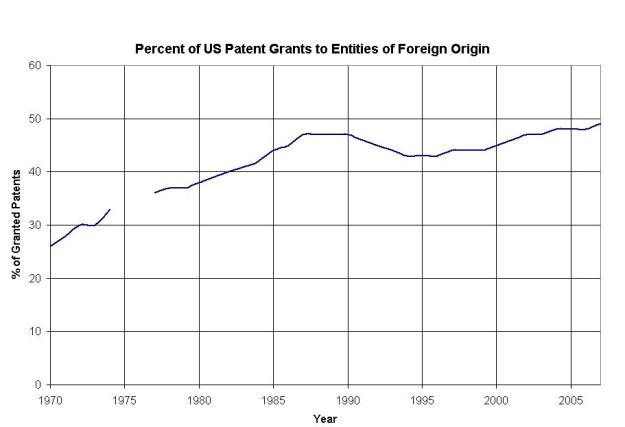
One of the more interesting things to be found is the % fraction of patents granted to foreign entities. As of 2007, the fraction of allowances to foreign entities is 49 %. The above graph shows the tend over time. The gap in the curve is due to the absence of data for 1975-1976 in the published data set.

The fraction of foreign patent allowances has remained approximately constant since ca 1985.  There was a dip in the 1990’s that may correspond to some sort of pullback in R&D activity. This drop off in issued patents lags by several years due to pendency.

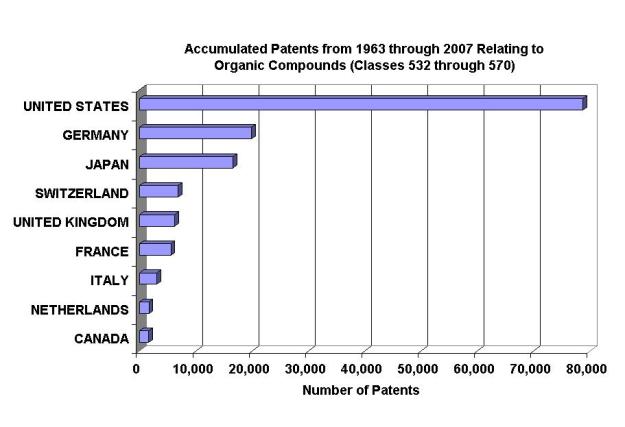
The above graph uses data published by the USPTO. Here we see the accumulated patent allowances to various nations over the period from 1963 through 2007. The data set is limited to Organic Compound classes 532 through 570 under the US classification system. For brevity, only the top 8 foreign applicants are shown in comparison to the US.

Very obviously Germany and Japan have the leading foreign awardees of US patents in this segment of R&D. I have not looked at how the reciprocal situation compares under PCT filings abroad by US applicants. 

What is of greatest interest is seen in the top graph: 50 % of the patent real estate being staked out at the USPTO is going to foreign interests.

A unique feature of chemical patents is the Markush claim. Markush claims allow the claiming of a  potentially large huge number of analogs defined by compact symbolism and covering vast swaths of the periodic table. 

It is thus possible for a professor in Osaka to own the composition of matter of a Markush set of hundreds or thousands compounds that would then bar a company in New Jersey from making even an obscure member. Under the PCT, the same is true in the other direction.

The reach of property rights in the world of invention has become so extensive, and the data provided by the various patent agencies and abstracting services is so inadequate, that the act of performing a due diligence search is nearly comical. In truth, you look for low to middle hanging fruit and hope that an obscure sentence somewhere doesn’t blow a hole below your waterline one day.

Chemical patents are in dire need of reform in terms of the nature of the disclosure. Patent offices must find a way to facilitate the extraction of crucial information so the public has a fair chance of understanding what is off limits.

We need a more lucid recitation of claimed compositions and better use of language in the detailing of processes. Patents should be written with abstracting in mind. It should be made possible to extract processes and compositions into a form that can be accumulated in databases for rapid review. This has to begin in the drafting phase of the application.

[For some great feedback, check out the comments- Th’ Gaussling]

Self-Imposed Complexity and the Ratchet Principle

The portfolio of laws that American citizens are subject to seems to grow without bounds. Every year our congress drafts a new collection of laws to submit to the process of enactment. State legislatures, county and city governments all are able to add new rules and constraints on our degrees of freedom. As if that weren’t enough, people willingly move into convenant controlled communities where they sign away basic freedoms like the freedom to choose house paint or to leave the garage door open.

We are gradually fencing in all of the free space where conduct is unregulated. Our Nanny State leaders are scaring the bejeebers out of us through defense initiatives and dire warnings about what could happen if terrorists took an interest in disrupting industry and infrastructure.

Our town of 6,000 has to comply with Homeland Security requirements by fencing in the town water tank in a certain way.  Some terrorist could poison the water. In fact, that fiend would probably be a psychotic local citizen bent on retribution, not a Shiite saboteur in sandals. Collectively, we are at much more risk from fellow citizens than from foreign bad guys. Perhaps that is the hidden agenda.

Citizens are turning over priceless freedom artifacts in exchange for promissory notes claiming to protect the bearer. Once we give up degrees of freedom in the conduct of our lives, we can never get them back. Govennment will not refund units of control.  As we increase the complexity of our world through an ever increasing statutory web of control, we forfeit degrees of freedom. It is like a ratchet. You can click forward, but there is no going back.

New subject. Read Jim Kunstlers post “Reality Bites“.

Geriatric Body Art

The number of young adults walking around with piercings, tatoos, and those curious discs in their ear lobes continues to grow. Whereas tatoos were once popular only among cannibals and sailors, todays suburban tatoo fashionistas come from all walks of life and sport technicolor displays of fantasy art that make a point of in-your-face incongruence. And with much of it on locations where the wearer can’t view it themselves.

I can’t help but imagine rest homes of the future where geezers and codgers will dodder in their twilight years, festoons of ear hair sprouting over gaping holes in their pendulous ear lobes like Amazonian witch doctors. The urine scented hallways will be populated with crones and the occasional geezer sporting once provocative tats, now blurred with age, protruding from private locations and shared only with the floor nurse.

It seems to me that the tatoo money would be better spent on a round of antibiotics after a trip to Phuket. At least it would have been a genuine experience of life on the edge rather than just an illustration of one.

Bacevich on Consumerism and the Imperial Presidency

While I have been struggling in my usual caveman way to express my frustrations with our national governance, whom should I stumble into but Andrew J. Bacevich, Boston Univ professor of history and international relations, who has been working on this matter for some time. Bacevich has written a book called The Limits of Power: The End of American Exceptionalism.  This exceptionally articulate fellow was recently interviewed by Bill Moyers on public television. 

His thesis comes down to the notion that American demand for consumer goods and credit has resulted in a kind of consumer imperialism. To facilitate this “domestic disfunction” or “crisis of profligacy”, the executive branch has acquired an excessive reach that exists only by the wither and atrophy of congress. By fiat of the executive, and the mumbling consent of a passive congress, our military adventures have distracted Americans from an examination of our continuous and undisclipined consumerism and indebtedness.

Georgia on my mind

I’m glad that the USA is able to scold CCCP Russia for its invasion of Georgia from our lofty position on the moral high ground. I suppose that the irony of our warning to Russia could be discounted as the delerium of a petroleum besotted empire in decline. While it may not be that bad yet, we certainly have been driven by our political leaders to a remote location in the desert and abandoned.

Western Civilization classes of the future will note that the inability of the USA to constructively engage post-communist Russia was perhaps one of the greatest opportunities lost of the 20th Century.