Category Archives: CounterCurrent

The Mother of Invention

There is an old saying that goes “necessity is the mother of invention.” Its meaning is obvious. It says that when you run into a problem, you can invent your way around it. Or at least try to. The other solution to a problem is simply to live with it.

I recall that during the Apollo project in the late 1960’s, many conservatives would complain about the cost of going to the moon. Social progressives likewise made a complaint that was directed at shifting those NASA funds to social programs here on earth. Technology progressives would retort that it is worth it because of all of the spin-offs that were appearing out of the effort. The reply to this was that if you wanted some shiny new widget, just invent it. You don’t have to go to the moon.

Presently I can look back at the two major research domains, academic and industrial, and make comparisons. In academia, a professor’s work product is split between research, teaching and service to the school. Research is commonly measured by the number of papers published, especially in the prestigious journals. In some institutions, patenting is also taken into account. As for teaching, there are student evaluations and performance reviews by the department chair or the dean. This includes past performance in committees. A motivation in the first few years is to get tenure. Academic research includes putting research results in the public literature for all to use.

So, what about the mother of invention? Generally, in chemistry an invention comes from some kind of investigative activity, curiosity or need. Sometimes you may want to invent around an active patent rather than go into a licensing agreement.

The US patent office allows only one invention per application. If you choose, you can lop off your other invention and file it separately as a divisional patent. You would do this because the patent examiner will have raised an objection to your original filing. Doing a divisional filing allows you to use content from the first, or parent, patent application and you get the filing date of the parent as well. Early filing dates are very important.

Sometimes patents are written very narrowly and leave “white space” or potential claims around them. This is not always desirable so the matter can be solved by the use of “picket fence patents.” You patent your core art as broadly as the patent office will allow, then you file for patents that cover related art that a competitor could conceivably patent that would allow them to compete against you. By raising the cost of entry into your market or narrowing the scope of new art, you can dissuade competitors from entry or at least make them pay a heavy price for it. Who knows, maybe they’ll decide to buy a license from you or even an entire patent. An argument against picket fence patenting is that patents can be very expensive.

Academic research has a high reliance on external funding. This requires that the funding organization recognizes the novelty and p[otential intellectual value of the research proposal. Industrial research has a high reliance on market potential of an invention. What is the breakeven time and sales potential of the invention? Will demand last long enough for the invention to provide a healthy return on investment?

Academics can and do patent their work on occasion, especially if the university pays for it. The thing I object to is that a great deal of research is paid for by the taxpayers. We pay for the research and then it gets patented and its use is restricted for 20 years. Maybe taxpayers (businesses) can enter into a licensing agreement, but maybe someone else has bought exclusive rights. Licenses can be somewhere between reasonable to absurdly restrictive, depending on the terms of the agreement. Many will want to add an extra fee based on the sales income of the product. This means that there will be an annual audit with pencil neck auditors poking around your business. It’s like having a ferret in your shorts. Avoid if at all possible.

But, many companies leverage their output through licensing agreements of technology they have no interest in developing.

Industrial research is quite different in terms of administration of the endeavor. Industrial chemists are supervised by an R&D director and use in-house technology and science and/or what they learned in college, but here the results are aimed at producing something for sale or improving the profit margin of a process. There is no desire to share information. Industrial research produces in-house expertise as well as, hopefully, patentable inventions. Industrial invention can be driven by competition in existing markets or by expansion into something entirely new. Often it is to provide continuous margin growth if market expansion is slow.

The argument can be made to keep everything as a trade secret. Publishing your art in the patent literature can help competitors have their own brainstorms about the subject, or some may even be tempted to infringe on your art that is carefully laid out in front of their eyes. Competitors may be cued into a new product’s capabilities and gives insight into new products.

Both academic and industrial chemists invent. The difference is that in industry some inventions or art are held in trade secrecy, even if they never get commercialized. Academic researchers can and do keep secrets when they are aiming for a patent, at least until the patent is granted. Compartmentalization in a research group is critical, since disputes about inventorship can kill a patent. Once issued, academics will publish as many papers about the patented art as possible. Commonly, patents are assigned to whoever pays for it- usually an organization. An academic patent is assigned to the inventor’s institution while in industry the company is the assignee. In both cases the inventor is usually awarded only a token of appreciation and the “satisfaction” of having a patent.

So, what about “necessity is the mother of invention”? There are some inventive projects that are too large or risky for a business or even a consortium of businesses to handle. I’m thinking of the Apollo Moon Landing program. The project required the resources of a government. A great deal of invention by many players allowed the moon landing to happen. The necessity for all of this invention was that the US government set a goal and farmed out thousands of contracts with vendors to make it happen. Much wealth was spread around into the coffers of industry, but with contracts having stringent specifications for man-rated spaceflight and tight timelines to be met.

That’s one of the values of having a government like we had in the 1960’s. They created the necessity and private industry made it happen. Despite the cultural upset of the 1960’s and the Viet Nam war, the Apollo Project worked. No astronauts died in space. This necessity/invention pressure does work.

Global Oil Refining Capacity Growth to Taper Off Soon

According to the International Energy Agency, IEA, the current wave of oil refining capacity growth is likely to be the last of it. IEA is forecasting that beyond 2030 global refining capacity growth will begin to recede. The latest World Outlook Report forecasts that global capacity will see 105.2 million b/d and by 2050 growth be tapering off to 105.8 million b/d. This is from 102.7 million b/d in 2022.

Remember, this is receding growth overall, not receding consumption overall. IEA expects North America to see reducing refinery capacity on the order of 1.4 % between 2022 and 2030. To meet emission reduction goals, North American capacity will have to reduce by 7.5 % from 2022 to 2030. By contrast, under current policies India is expected to see an increase in refining capacity from 7.2 to 7.5 milling b/d by 2050.

The Age of Petroleum is approaching a production plateau as the oxidation of hydrocarbons gives way to harnessing the reduction potential of metallic lithium. Oh, what a time we’ll have! Think of all of the new failure modes we’ll discover.

On top of all of the current challenges to fire departments, there is a new one. Source: Battery Fires.

Weed Decarboxylator from Amazon

So, I get an email from Amazon promoting its “Decarboxylator” product. The Amazon page shows a picture describing the device and shows a picture of someone loading it with spinach leaves. The title of the page says “Decarboxylator Machine to Make Butter, Oil, and More“. A link to ecru, the seller, extols the virtue of herb consumption for greater wellness. The device obviously is just a heated container with digital thermometer and temperature setpoint adjustment.

Source: Amazon.com. One version of the home decarboxylator.

Why bring this up? This was sent to me as an Amazon customer, but I also happen to be an organic chemist who knows about decarboxylation generally. Or, just maybe they know that already?? What on Earth is retail decarboxylation about I wondered. Well, a simple Google search immediately turns up the answer. Processing weed for use in edibles. The silly allusions to vegetable processing is just a ruse.

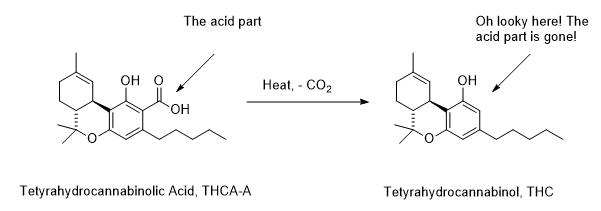
The decarboxylation of THCA-A to give THC. Graphics: Silly old me.

Apparently, there are two isomers of tetrahydrocannabinolic acid, THCA. They are THCA-A and THCA-B. THCA-A is present is large quantities in unprocessed marijuana. THCA-A is the direct precursor of THC in the plant. When you smoke weed or bake it into brownies the burning or baking process decarboxylates THCA-A giving the psychoactive product, THC. However, when you extract weed with a solvent without heating, the decarboxylation is very slow and affords reduced potency. Weed for edibles must be heat treated to induce decarboxylation for maximum potency. The Wikipedia page on tetrahydrocannabinolic acid is very informative. The THCA-A precursor has its own pharmacological effects which is interesting in itself, but that is for another day.

This handy-dandy whizbang device does the deed for home producers of edibles. Ain’t it grand?

Most popular post

It’s very interesting. The post with the most hits on this blog is for one I wrote May 15, 2008, titled Neutron Lethargy: This Weeks Obscure Dimensionless Quantity. It receives hits nearly every day. Is it revealing atomic secrets? No, it does not. Here is part of it-

Now mind you, this does not necessarily mean it was a glistening contribution to the nuclear zeitgeist of 2008. It’s more like the title attracted clicks. Excellence and clicks don’t overlap much. It shows that my intuition on what a popular post looks like is completely off.

What Does “Greatness” Really Mean?

I am going to bring up some observations that may be uncomfortable to many of my fellow citizens of the US. It has to do with the idea of “Greatness” that is frequently bandied about.

Definition: Bandied about

Phrasal verb; to mention something often, without considering it carefully. Source: Cambridge Dictionary.

Commonly, the word “greatness” is carefully chosen to swell the patriotic pride of American citizens. Swinging around the idea of greatness in public is often used as a rhetorical device to align people to a particular point of view. We are raised to see ourselves as the good guys. The use of “greatness” is a favorite buzzword of far-right conservatives to rub people’s noses into.

The conglomeration of US ultranationalist groups- a different name for homegrown fascism- along with Christian dominion ideology has produced a vocal a far-right political group who, on one hand demand libertarian-type free market dominance in lieu of government, while on the other sees protestant Christian reconstructionism providing guidance for a leading role in national and world affairs. The motivation is two-fold: first is to bring humanity under close Biblical law and the second is to prepare for the prophesied apocalypse and second coming of Christ. Many believed that Trump was to have a role in this. Imagine, the guy who invented DNA and set the galaxies spinning picking a bloviating wealthy-narcissistic-real estate developer-shyster-philanderer from Manhattan. Seriously? Something is wrong with this picture. For a preview of Biblical law, have a look at the bronze-age Book of Deuteronomy. Interesting as ancient history but, as a foundation for modern legal procedure, we can do a lot better going forward.

At the present time it is in vogue for the far right to parade around signaling their disapproval of US support of Ukraine in their battle against Russian invaders. Their grasp of history and judgement is sadly lacking.

  • Some Republicans have stated that the funds and war materiel sent to Ukraine could be better used at home.
  • Who believes that the Republican leadership would actually direct these savings to issues at home? Directing these funds internally for aid would be dismissed as “socialism” and ignored. Some insist that money that can be spent on Ukraine’s defense can also be cut altogether.

The US has seen much cultural achievement since our inception but sadly we have not been a universal force for good. Like everyone else, we have strengths and weaknesses. Sometimes we’ve been on the wrong side of history. Our treatment of native Americans from the very beginning was simply criminal. As if that wasn’t enough, an estimated 620,000 people died in a bloody civil war to shut down slavery, then we failed miserably at promised reconstruction. Women have long been denied equality and have received it only grudgingly. African Americans had long labored under the Jim Crow laws until only recently. Our government has meddled in the affairs of many nations in the Americas and elsewhere, with some of it blowing up in our faces (e.g., Cuba and Iran). We invaded Iraq in Gulf War II resulting in the violent death of hundreds of thousands of Iraqi citizens based on deception from the Bush administration.

On the other side, we’ve pushed medical advances like drug development and vaccination, brought food to the starving and saved millions of lives around the world. America has been generous with its growing base of scientific knowledge by publishing results obtainable from open sources. The American University-Industrial-Governmental research complex has produced wonders especially from WWII to this very day in everything from aerospace, electronics, pharmaceuticals and agriculture. The explosive growth of knowledge and technology in the 20th century is unparalleled in human history and the US has had a big part in that.

However, as comfortable as it may be, the theory of American exceptionalism has a few holes in it. Our practical capitalistic economics has some blind spots. Innovation usually moves forward only if a development has the possibility of creating profit and only if a small group of money people can be convinced of it. So, you say, this is just good sense. Why is that a blind spot?

Basic research is a hard sell to businesses. Stockholders must be convinced of a rapid payoff from the investment in discovery. It has been said that necessity is the mother of invention. This proverb traces back to Plato. If a business is plugging along making a satisfactory profit at maximum output, what is the motivation to rock the boat for a possible improvement? The answer is the prospect of even more profit via some improvement. But, what if that improvement would require something entirely new outside the capability of current technology and in-house resources? There is necessity but invention is out of reach.

While American industry has produced a tremendous range of innovations with in-house resources, it has done so greatly aided by the contributions of our university and government institutions. Universities provide industry with an educated R&D workforce, largely as a result of the application of government funding. Indeed, my graduate and postdoctoral work was supported by the National Science Foundation and the National Institutes of Health. I have been applying my business, chemistry and synthetic skills to the operation of private business for decades. And so does everyone else in industrial chemical R&D.

Here is the thing. The government funds the research universities which produces R&D results and an educated workforce. Most of the published academic R&D is of a fundamental nature and in the public domain. Chemical companies make good use of this information as a basis for their own R&D for product development. Sometimes the process Development part is begun quicker because the Research groundwork is mostly done by academia. With this, business gets invention quicker and cheaper with less risk because someone else initiated the necessity (the investigator/professor) and government funding paid for it. This represents industry getting a refund on some of their taxes.

In the military aerospace business, the US military provides the necessity by offering contracts for equipment under stringent specifications. Meeting the specs usually requires that materials and processes be developed to meet them. This is an example of the government providing necessity so industry will provide the invention.

  • A favorite notion in the US that persists is the “Greatness” of what has been a long period of leading financial and military power since WWII. Obviously, we in the US have a potent military and economy. The federal government plays a big role in these areas by supporting industrial and military readiness.
  • The US was not the first to put a satellite or man in orbit or land a craft on the moon. It was Russia. The US entered into the “space race” to primarily to match the threat of USSR’s space program. The USSR and communism were perceived as an existential threat to the US. Advances in rocketry could carry people, satellites or nuclear payloads. Did we win the race to the moon just because the USSR failed midway?
  • The US reacted vigorously to Albert Einstein’s warning of the possibility of a Nazi nuclear weapon. The Nazi secret program was under the guidance of Professor Werner Heisenberg. Rattled, the US put together a massive effort to beat the Nazis to the nuclear punch. Later, it was found that they were unable to produce a working nuclear reactor or weapon.
  • After the fall of Nazi Germany, the US scooped up a few of their best scientific minds, certainly more than the Russians did. The US benefitted greatly in rocketry and aerospace as well as engineering and physics.
  • The 1930’s was a decade of much advancement in the area of turbojet engines everywhere in the world but the US. We were late comers into turbojet engines. But post WWII we seized on the idea and did well.

US politics has been soured by a few extraordinarily awful people. I’m thinking of #45 in particular but many like-minded citizens have glommed on to his flying circus of bad ideas. Many people conflated business success with aptitude for governance. What they failed to consider was that a business is a type of dictatorship. It is not a democracy. It is run strictly from the top down. There is no bill of rights in business or first amendment. Trying to directly apply business experience to being chief executive of a democratic nuclear state is a fool’s errand. But, people still hold out hope for him.

  • Trump sailed into office in 2016 partly on his credentials as a “successful” businessman and television personality. For many voters, he was “famous for being famous.” Voters made the extrapolation that if he is a billionaire property developer in New York City then he was “obviously” qualified to be a president.

The allies won the Second World War for many reasons. What made the US stand out in that effort was the fact that North America was geographically isolated and was harder to bomb or invade at that time. The wealth of natural resources and industrial capacity in the US certainly enabled our ability to carry the war to the enemies. The notion of some kind of intrinsic moral superiority held by some is just a fantasy. The US had talented leadership and a workforce willing and able to stand up and be counted. This was not a uniquely American quality. Most nations can and will do this if resources and their leadership will allow it. Being rich in lumber, petroleum, steel and uranium gave the US a distinct advantage.

The US is an amazing country among other amazing countries, but there is much yet to do. My goal is to help sustain basic liberal democratic ideals and one of the pillars is simple kindness. Let’s back off on the self-congratulation and cultish adulation of a despicable billionaire and focus on the basics of operating a democratic republic under the rule of law and with equal protection for all of its citizens.

How much CO2 reduction do we actually need?

I am asking this question because the transition away from fossil fuels will have a serious knock-on effect on a very large sector of the global economy. Of the total liquid hydrocarbon production, 14 % goes to the petrochemical markets. Of natural gas production, 8 % goes to petrochemicals.

There is a serious complication connected with the idea of shutting down the combustion of hydrocarbon fuels. The elimination of oil and gas combustion activity means that crude oil production drops precipitously and therefore so would refining. Oil refineries are designed to maximize the volume of their most profitable products while minimizing their cost to manufacture. I refer to gasoline, diesel and aviation fuel. Petrochemicals come from oil and gas. Their economics ride on the coattails of fuel production to some extent in terms of scale. Refineries are physically large operations so as to operate with the maximum economy of scale. Maximum economy of manufacturing scale drives consumer prices downward.

Refineries produce much more than fuels. They produce asphalt, lubricating oil, polymer raw materials, petrochemicals for pharmaceuticals and other raw materials for thousands of products we take for granted. There are countless uses for petrochemicals beyond throw-away plastic bottles and bags. Just look around where you are sitting this very moment. Unless you are in Tierra del Fuego or Antarctica, you can’t help but see examples of hydrocarbon applications.

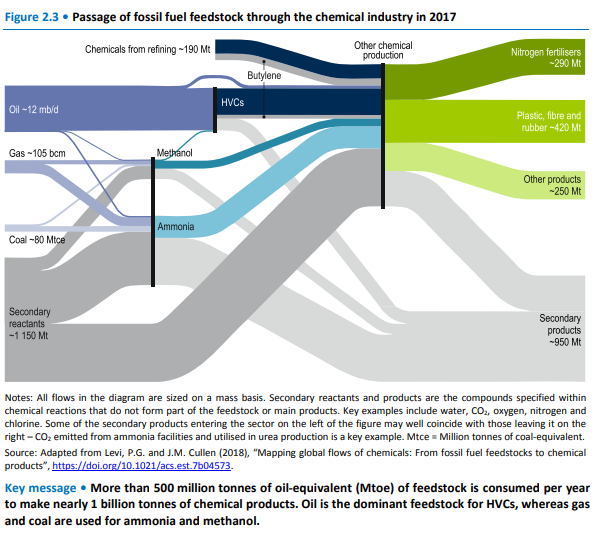
The Future of Petrochemicals, IEA
Flow of oil and gas streams to chemical product production. Source: The Future of Petrochemicals, IEA.

Could refineries adapt to the loss of a large fraction of their fuels production and still produce petrochemicals? Engineering-wise, I’d say yes. But as far as economics go, that is a harder question to answer. Company officers have a fiduciary responsibility to the stockholders. This is a baked-in feature of corporate business. The promise of ever-increasing margins and volumes is part of that. Switching gears towards sustaining the petrochemical sector in the face of declining fuel sales is natural in one sense, but if it involves declining EBITDA over time, it could be disastrous for the stock market. Petrochemical prices might have to climb drastically to sustain earnings. Players in the global oil & gas market are extremely twitchy. The mere suggestion of a potential problem is enough to send prices soaring or diving. Luckily, a wind-down of fuel production will take some time during which the players might be able to compensate.

Look around you. How many consumer goods come in plastic containers or plastic film-coated paper? All of our electronic devices are built into casings of some sort, most of which have plastic or fiberglass (resin impregnated glass fiber) components. The list is endless. For many or most of these things to stay on the market, a substitute material will be needed to replace the hydrocarbon-based materials. Wooden casings for computer monitors and iPhones? What about paint? Paint is loaded with hydrocarbon components.

A vast number of products we take for granted use hydrocarbon materials in some way. Perhaps renewable plastics will scale to meet certain demands. Recycling applies only to those plastics that can be melted- the thermoplastics. Thermoset plastics like melamine cannot be melted and so cannot be recycled. Recycling only works if consumers close the recycling loop. Plastics must be carefully sorted in the recycle process. When a mixture of plastics is melted, the blend can separate like oil and water producing inferior product. National Geographic has a good web page describing recycling.

Some plastics such as clear, colorless polyethylene films are usually pure polymer. Most synthetic polymers are colorless. In general, any synthetic polymer that is colored has pigments in it. Black plastic is loaded with soot for instance. Many polymer films for packaging are multilayered with different types of polymer layered together.

Waste thermoplastic with food residues is very problematic, especially those with oil residues. Waste plastic for recycle must be clean. Multilayer plastic films are not suitable for recycling either.

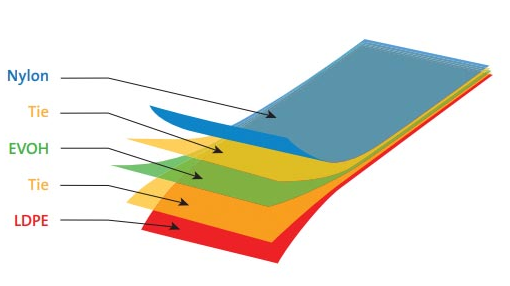
Source: Technical Bulletin, Saint Gobain. Multilayer film structure with 3 different films and two tie layers between them. The Nylon layer provides toughness and tear resistance. The polyethylenevinyl alcohol (ethylene-vinyl chloride copolymer) layer (EVOH) blocks the transmission of oxygen and carbon dioxide. Low density polyethylene (LDPE) layer provides broad chemical compatibility along with biocompatibility for safe handling of biopharmaceuticals. Not all polymers are compatible with melt bonding. The tie-layer is a melt-bondable adhesive polymer film that hold the layers of polymer into a single film. The tie layer polymer is often a polyethylene film that has a surface layer of organic acid or anhydride groups that can bind to other polymers by melt bonding.

Other additives such as plasticizers are present in flexible plastics like polyvinyl chloride (PVC) or other compositions where suppleness is important. Pure PVC is rigid. Additives are an industry unto its own. The varieties and grades in the plastics business is mind boggling. The variety of plastic compositions is too diverse to allow recycling of all plastics.

Polymer manufacturing is likely to continue indefinitely. There is simply too much money at stake for the big oil & gas and petrochemical players to deconstruct themselves to a large extent. They will, however, follow the consumer, but how far?

So, the question is this- for the sake of keeping a viable petrochemical stream in place while hydrocarbon fuel consumption declines, how much hydrocarbon fuel can we burn per year without exceeding the capacity of the earth to absorb the CO2 produced? We want to lower the slope of the atmospheric CO2 curve enough to achieve a reasonable steady state. The global economy depends very much on the production and use of petrochemicals. People will generally avoid economic suicide.

Where is the balance point for a sustainable production of necessary petrochemicals and the decommissioning of hydrocarbon fuel production? I certainly don’t know.

The Stupid in All of Us

I’ve been struggling to find the words to accurately and succinctly describe MAGA followers in the US with their silly contrarianism and shallow theories of patriotism. I do this because there is something truly peculiar about the shape of conservatism today. I’ve been avoiding the word “stupid” because I didn’t want to hurl the accusation towards people with genuine cognitive disabilities. After all, intelligence is a multilegged attribute that encompasses too many diverse abilities with a single word. But of late I’ve decided that the word is fine to use if you don’t associate it with cognitively disabled people. Online you can find a definition defining it as “behavior or actions that show a lack of good sense or good judgement.” If it isn’t a clean detachment from the cognitively disabled, then at least it is only a superficial scratch.

Ex-president #45 took a sharp swerve from the “norms” of American politics and examples are too numerous to list here. His angry movement didn’t fall out of thin air. In the 2016 election he attracted followers by his audacity and with the propaganda engines of Twitter, conservative radio and television news. They were already out there primed by the nascent Tea Party, but along comes #45 giving them a charismatic and bellicose populist leader with a knack for getting on the news. His rhetorical skills are unmatched and he knows instinctively how to attract and excite a crowd. Importantly, he is a master of social media muckraking. He is not in the least inhibited by social norms for civil discourse.

The big hammer that American conservatism wields is the view of the “good us vs the bad them.” Somehow, the “bad them” always involves liberalism. “Them” can be the flavor of the day- immigrants, abortion, Muslims, NATO etc. This is guaranteed to frighten a certain fraction of the electorate. Throw in the eschatology of conservative Christians claiming that American politics will lead to or accelerate the end times and you have potent brew of dread fear.

Just to be clear, in US history there have never been long stretches of time when citizens frolicked innocently in green pastures of civility and peace was upon the land. There has always been turmoil and hardship somewhere for someone. We’ve always had murderers and thieves preying on the innocent and unwary. Yet the US experiment with democracy and capitalism overall has thrived, dipped and recovered over time. Somehow, Americans have avoided fascism. Until now.

There have always been exceptional people in the world who were able to rally groups for an epic cause, whether it was for military, political or religious purposes. It is the story of history. Today is no different, although the means and speed of persuasive communication has advanced considerably. After the invention of the printing press, there was opposition by religious leaders claiming that easy and rapid availability of information or propaganda would destabilize their personal view of how the social order should be. Since then, ideas of all sorts have found their way into the minds of the masses at increasing speed to this very day. Today, populist rhetoric and opinion can travel internationally at speeds limited only by the clock speed of computers and the speed of light.

There has always been a fraction of any population that gets agitated or frightens easily. Fright can come from direct experience or persuasion. Anything that threatens perceived safety, stability or income will unnerve people to some extent and some much more than others. It is called economic disenfranchisement and it is widespread in the US. Money equals power and lacking it means that one is not invited to the party.

The feeling of being cheated also agitates people. And this is where #45 excels. Unfortunately, in the US there is a large group of people that have not been able to fully enjoy the fruits of our civilization. For many reasons they have been passed over in terms of opportunities to advance or just keep up with the times.

One effect of technological advance is the obsolescence of labor-intensive jobs. Labor costs are always a target for innovators and businesspeople in the eternal march towards greater efficiency. This has been happening since the invention of the wheel. Any given task can be the target of cost reduction by lowering of the headcount. It may seem coldhearted but, in society, it is as ever-present as gravity.

People who lack valuable skill sets or those made obsolete by technology or corporate maneuvering are at a serious disadvantage in American society. People who chose life paths that did not include educational enrichment such a trade school or college have long been at a disadvantage. A comfortable retirement after a lifetime of low wages is difficult or impossible. Some people manage to excel but most don’t. Some start businesses that take off. Most don’t because they don’t know how or lack startup capital. The market can only sustain so many nail salons or restaurants in a given location.

Indicted ex-president #45 discovered his knack for anger politics at some point and jumped on it at a time when conservative electronic media was blossoming. He couldn’t help himself. His authoritarian impulse found a venue in politics and wide acceptance.

All of us exhibit stupidity now and then. We all commit “behavior or actions that show a lack of good sense or good judgement.” I do, that much is certain. We live in a time when a great many fellow citizens assent to a movement that, in the end, is not to their best interests. Not all stupid behaviors are equal in magnitude or in the kind of harm produced. It seems to me that gladly accepting authoritarian leadership in anger is especially stupid. Democracy once forfeited is not easily retrieved.

Trading away many of the benefits of democracy for some perceived guarantee of social order is a prelude to dictatorial government. Democracy is inherently chaotic to some extent. This is at the core of the American experiment. In exchange a notch of social order we trade some measure of freedom and liberty. Voting for authoritarian governance is the final act of a democracy.

Post Card From Ukraine

Warning: Political content below.

I received a post card from Ukraine the other day because of a donation I made. It shows an event they are very proud of- the first attack on the Kerch bridge. I’m sure some Ukrainians feel abandoned by NATO’s refusal to let them join, but there is good reason behind NATO’s answer. Russia’s long-standing morbidly paranoid obsession with NATO and the “morally corrupt” West would only be validated by such a move. It would be destabilizing today and would definitely bring us closer to nuclear conflict. To do so today would immediately step NATO into direct conflict with Russia. Ok. Enough from Captain Obvious.

Source: A post card from Ukraine.

After the Russian revolution of 1918, the Bolsheviks tried to capture and Russify the Ukrainian territory. After several attempts in 1918-1922 they relented and Lenin finally consented to give them independence as a state within the Soviet Union. This was not because Lenin was interested in building a Ukrainian state, but rather it was a desperate move to mollify the Ukrainians while allowing the Bolsheviks to keep control over the territory. Lenin did not set out to create Ukraine.

During the early 1930’s, Stalin’s government was busy collectivizing the agricultural lands of the USSR. Collectivizing Ukrainian farmland meant getting peasants, especially those with greater than 8 acres of land (Kulaks) to turn over their land to the collective. This proved to be so messy that eventually Stalin closed off Ukraine and required internal passports. Thus began a 2-year famine leading to mass starvation. Ukrainian crops and animals were systematically removed by the Soviets in what were sometimes called “red trains.” During this time several million Ukrainians were starved to death, executed or imprisoned in a distant labor camp. This period covering 1932 to 1933 is called the Holodomor, or The Great Famine. You can read all about it on the interwebs.

As directed by Putin, Russia is presently attempting to extinguish Ukrainian culture again. The kidnapping of children and shipping them to be raised in Russian homes as well as other forms of Russification in the occupied territories of Ukraine are underway. For the Ukrainians, the Russian invaders are like the Borg from Star Trek in their needy desire to absorb them into their domain- “Resistance is futile.”

It should be remembered that the Ukrainian experience with Russia has been very bad for a long time.

Authoritarianism isn’t just a problem in some eastern European states. Seeds of it are being spread here in the US by a new brand of neoliberal GOP leaders. Many times they have the words “liberty” or “freedom” in the organizations names. This is a disingenuous and underhanded rhetorical maneuver in the same way that countries that use “Democratic” or “People’s Republic” in their names. Using the words “liberty” or “freedom” implies the sacred and wholesome attributes of Patriotism, motherhood and apple pie. Their utopian vision necessarily leads to the demolition of our present liberal democratic society. Neoliberalism is the road to oligarchy.

Neoliberalism advocates a deregulated, capitalist, globalist market economy, reifies individual greed, and markets a watered-down version of Austrian economics to left-liberals. This ideology manifests as a hybrid between right-and-left liberalism, where the social ideals of left-liberals (particularly, social equality) is attacked via economics and a worldview which views people as only making choices for themselves.”

Source: Rationalwiki.org.

Liberal democracy is the combination of a liberal political philosophy that operates under a representative democratic form of government. It is characterized by elections between multiple distinct political parties, a separation of powers into different branches of government, the rule of law in everyday life as part of an open society, a market economy with private property, universal suffrage, and the equal protection of human rights, civil rights, civil liberties and political freedoms for all people.” 

Source: Wikipedia.

Obviously, there is overlap between the two definitions above. Both neoliberals and democratic liberals can be unquestionably patriotic. Where they differ is in their respective overall theories of civilization. As a baby boomer, I watched the funeral of JFK, the Viet Nam War, the Chicago riots, the killings at Kent State, the deceitful Nixon years, all of the moon landings, and everything else to the present day. During this time, semiconductors went from discrete devices to integrated circuits and medicine has advanced to applied biochemistry. All of the sciences have taken advantage of improving technology and have advanced at incredible speed and the unit cost of advanced technology continues to drop. Of course there were bad times, but there were a great many good times as well. The overall result was a good standard of living for most people and freedom from most of the dread diseases of the past. Life spans have increased, an explosion of consumer goods & services providing employment and items making our lives more convenient.

According to the Pew Research Center, 44 % of Republicans and Republican-leaning independents say that the US is giving too much aid to Ukraine. Not only that, but many Republicans are, if not outright admirers of Putin, view him more favorably than Biden, Harris, or Pelosi according to the EconomistYouGov poll of January, 2022. Liz Cheney refers to these people as the “Putin wing of the GOP.” In particular they admire his opposition to NATO, Western liberalism and LGBTQ+ rights. Is this because these Republicans have made a scholarly study of Putin against the backdrop of history and have concluded that he is worthy of their admiration over and above our democratic principles? Or are they parroting some sense of admiration drifting down from the GOP leadership? Decide for yourself.

Fascist, authoritarian leaders throughout history have always drawn the admiration of some fraction of a population. The 20th century alone had many standout examples and the trend continues to this very day. These leaders have convinced millions of people to ignore their own best interests and civil rights to support a cause that may have sounded exciting at a rally but led only to eventual oppression.

The Deep State

It appears that there really is a deep state in the US. It is the dark web of supporters, fund aggregators, lobbyists and fundraisers for the new ultra-conservative Republican party. These people wish to take us in the direction of more authoritarian and White Anglo Saxon Protestant (WASP) governance by gradually normalizing it. It’s like boiling the frog. This is not a Hollywood movie: the good guys could easily lose in the end. Once established, authoritarian regimes tend to last a long time, or at least, to the death of the tyrant. But sometimes the death of the tyrant only leads to continuation by another tyrant.

Trump and his ilk are succeeding in the normalization of regressive policy. Government-hating neoliberals and libertarians like Charles Koch and many others have been funding a movement for the demolition of most of the federal government in favor of a capitalist market-driven neoliberal Shangri-La. Remember when libertarian Grover Norquist said “I’m not in favor of abolishing the government. I just want to shrink it down to the size where we can drown it in the bathtub?” Libertarians and neoliberals aren’t anarchists, they just want the people with money and property to have the major input. Naturally, there is sympathy for this from many resource-heavy people.

Power has been defined as the ability to allocate resources. US national and global power is currently guided by taxpayer funded government. Both the private and public sectors add up to American hegemony. American business trends to increasing consolidation and is dominated by companies with the largest share of the resources. The natural end-state is monopoly. Business leaders piously repeat their appreciation of competition when, in reality, they are always trying to defeat the competition for market dominance. They will claim that market dominance is the ultimate result of achieving their fiduciary responsibilities- maximizing profit for the stockholders.

Boiling it down, libertarians and neoliberals want to abolish much of the state and federal government and focus on some kind of self-regulating market-based system. US economists always say that the market provides the most efficient use of capital. A market-based America will inevitably lead to a monopolistic corporate-based America. This is a system of economics, not governance. A plutocracy does not benefit the majority of us.

American corporations are not democratic in nature and make no pretense of it. They are autocracies ultimately answerable to the stockholders through a CEO and board of directors. State and federal government holds them answerable for adherence to the laws of the land. If there are a large number of burdensome regulations applying to the conduct of business, it is because sometime in the past, some individual or company has committed a harmful act leading to regulatory control. Regulations often stem from the dark side of past human behavior.

Back to Ukraine

Circling back, how does this talk of American politics relate to Ukraine? The Russian invasion of Ukraine and the Chinese threats over Taiwan and the Indo-Pacific region represent a period when major autocracies are pushing their boundaries. Russia is only held back because of NATO and other Western countries. China is held back because of its economic dependence on exports to Western nations who, surprisingly, will band together against them if threatened. I’m sure that they have also noticed that an otherwise simple military action of rolling tanks and troops into a “passive” territory like Ukraine can turn sideways rapidly. If anything, Putin has accomplished the opposite of his strategic goal of splitting up the members of NATO. It is critical now that US politics NOT cause us to abandon world affairs which is where Trump was leading us. The reelection of Trump would be an epic disaster for the free world and democracy.

A United States that tolerates the aggression of Russia or China is a country that cedes its global influence to them. Despite having lots of ugly history and a long list of regrettable decisions, the US remains a place that people want to immigrate to. You don’t hear about boatloads of immigrants attempting to get into Russia. If the US leaves a global leadership vacuum, guess who will jump in to take its place? Another liberal democracy? Seems unlikely.

Americans should remember that in the bathwater of US history there is a baby that needs to be cared for and not thoughtlessly discarded.

Russian Aggression Towards Ukraine

Some Western-centric remarks.

  • The history of the present Ukrainian territory is not a happy one. The land has been soaked with Ukrainian blood by Hitler and Stalin. Not being a historian, I’ll defer to my betters for a more cogent account of the timeline of that territory.
  • I’m completely behind the Ukrainians in their resistance to Putin’s brutal war machine. Putin’s view is that Ukraine has been an administrative district of Russia all along and is now infested with NAZI brutes. That Ukraine fell under the control of NAZIs is absurd on its face, but to a Russian public trapped in a deep information silo, it is apparently plausible.
  • According to Ukrainian historian Serhii Plokhii at the Ukrainian Research Institute at Harvard, from 1918 there were repeated failed attempts by the Bolsheviks to gain control of Ukraine. Lenin relented and concluded that it was necessary to grant Ukraine formal independence by 1922. This was necessary for the Bolsheviks to maintain control over Ukraine. Ukraine was granted autonomy as an independent state within the Soviet Union.
  • In the recent 2023 meeting in Vilnius, NATO declined to accept Ukraine joining the organization. Russia has long made a show of believing that NATO wants to commit aggression against them. That NATO is a defensive pact somehow never sunk in. Ukraine joining NATO will only be seen by Putin as the latest and largest threat to Russian state security. Given how well the conventional military apparatus has performed in the attack on Ukraine, it isn’t safe to conclude that steady hands are hovering over the nuclear button.
  • With the violent history of Russia in eastern Europe, why would anyone want to start a war of aggression against Russia there? Let’s say that the West waged war against Russia and won. They are not a nation of people begging for western-style democracy. Russia resents the cultural, military and political dominance of the West, that is, Western hegemony. The collapse of the USSR was a major loss of face for a great many in the Soviet Union, especially for Lieutenant Colonel and later FSB director Vladimir Putin. Putin openly seeks to “Make Russia Great Again,” and like Trump, is surfing on a wave of fear and nationalism.
  • It seems certain that once Ukraine is in hand, Putin will continue with his murderous land-grab. The Baltic states, Poland, Georgia and a land corridor through Poland to Kaliningrad are all at risk and they know it. It is what was called the “Domino Theory” back in the cold-war days of the Viet Nam war. It was used to justify many military responses by the west to Russian expansionism.
  • For the West, the challenge is to keep Putin’s Russia contained and yet away from the nuclear precipice. It is a game of who can outlast who.
  • American apathy with foreign affairs has long been a common affliction. Sadly, the US Republican party is making a virtue out of admiring Putin and the burgeoning autocracy in Hungary. Since World War II, the US and Europe (formerly Western Europe) have had hegemony in the areas of dominant currency, finance, English language, military power projection and general commerce around the world. Today, Russia and China are quite clear that they wish to bring down this historical Western hegemony as soon as they can.

Definition: Hegemony, \hih-JEM-uh-nee\ noun. 1 : preponderant influence or authority over others : domination. 2 : the social, cultural, ideological, or economic influence exerted by a dominant group.

Wikipedia.

Definition: Liberal democracy is the combination of a liberal political philosophy that operates under a representative democratic form of government. It is characterized by elections between multiple distinct political parties, a separation of powers into different branches of government, the rule of law in everyday life as part of an open society, a market economy with private property, universal suffrage, and the equal protection of human rights, civil rights, civil liberties and political freedoms for all people. To define the system in practice, liberal democracies often draw upon a constitution, either codified or uncodified, to delineate the powers of government and enshrine the social contract. 

https://en.wikipedia.org/wiki/Liberal_democracy#:~:text=In%20liberal%20democracy%2C%20an%20elected,distributes%20economic%20and%20social%20benefits.
  • Under Chinese or Russian hegemony the world order will be very different than that held by the US and Europe. The US and Europe have various versions of liberal democracy and support other nations who do as well. To view the future, just have a look at how these two countries conduct government in their own countries. Care to live under the Chinese Communist Party’s or under Putin’s world order? As an American, the English lingua franca, for better or worse, seems to work fairly well. Imagine Westerners switching to written and spoken Mandarin. At least Russian is based on an alphabet. Am I biased towards alphabetic languages? Definitely.

“… radical-left Democrats, Marxist, communists and fascists …”

I’m running out of words to describe the deplorable ex-president #45. Just when you think he can’t add to his steaming heap of manure called a legacy, he shovels on more. It seems like there is no limit to the falsehoods he is willing to declare in public and no limit to what his supporters are willing to accept.

In regard to his indictments, he was recorded as saying something to the effect of “They’re not after me, they’re after you … I’m just standing in their way!” He is turning his indictments into the image of him sacrificing himself on the cross for the millions of Americans. A blood sacrifice for his beloved followers. If you supposed that this vaudevillian stunt was transparently phony to everyone, you’d be wrong.

#45 has been referring to “… radical-left Democrats, Marxist, communists and fascists …” in his gimmie-all-yer-lovin’ rallies. How absurd. Leftists aren’t fascists- they are antifascists. And by the way, what is wrong with being against fascism? #45 is using his usual mirror tactic of taking accusations against him and aiming it back at his critics. He knows very well that he isn’t being held accountable for truthfulness by the people he counts on. He tells big lies and repeats them over and over. It works for him. The very boldness of his lies somehow validates them in the minds of his followers.

Marxism and socialism have been in the scrapyard of history for a decades. The Soviet experiment with using socialism to get to communism was an abject failure. Stalin’s USSR was a brutal, murderous dictatorship tarted up to appear as a people’s paradise for those outside the iron curtain.

China today is a single party communist dictatorship that practices centralized control and nationalistic state capitalism. Previously, however, under the command of Chairman Mao Zedong, it is estimated that 40 to 80 million people died as a result of starvation, persecution, prison labor and execution in order to achieve his personal dream of a communist paradise.

It is difficult to find a communist state where people have the liberties that we in the US take for granted. It seems that to compel people to hand over their belongings to the state, a good bit of muscle is needed. Stalin found this out when he tried to collectivize Ukraine in the early 1930s. He ended up causing mass starvation and sending people to the gulags. The notion that the US is under threat from communist influence is without credibility. The odd communist may pop up now and then but they are little more than a curiosity not worthy of concern.

It is hard to know what Republicans regard as radical about Democrat ideals. Could it be that anyone who disagrees with today’s GOP is a “leftist radical”? If there are actual living, breathing Marxists among liberals in the US, they are likely to be lonely. There is Richard D Wolff at UMass, Amherst. Wolff is against capitalism and makes some fair points, but the momentum of history won’t be going his way any time soon. People still remember the Soviet experiment with Marxism-Leninism which was a disaster.

So·cial·ism: noun; a political and economic theory of social organization which advocates that the means of production, distribution, and exchange should be owned or regulated by the community as a whole.

Source: Google

Will citizens of the US ever acquiesce to turning over private property to a socialist government? Clearly, there is not a chance. The accusation that US liberals harbor socialistic desires is a Republican fever dream. The same with communism. The current population of US citizens would never embrace communism. Too many past instances of communist or socialist dictatorships in the world, and besides, Americans love their private property and would defend it with the umpteen hundred million guns under their pillows.

It is a Republican fantasy that only they are the true patriots in the US. This gives them license to posture as the only “real” Americans worthy of the title. This froze out as axiomatic for them many years ago, especially since the years of Mr. “trickle-down economics” Reagan.

Having social services is not the same as having socialism. A capitalist economy that provides a social safety net through taxation is not socialism. The capitalists still own their means of production, distribution and exchange.

Ordinary citizens in the US pay taxes to support the Army, Air Force, Space Force, Marines, Navy and Coast Guard. We also pay taxes and fees for upkeep on state and national infrastructure like roads, bridges, air traffic control and many other things. All of this goes to support our capitalist means of production, distribution and exchange.

Citizens pay exorbitant tuition to educate themselves to a level where they can contribute to operating our capitalistic enterprises. Payment for the common good isn’t borne exclusively by business. Both citizens and our capitalist enterprises benefit from this arrangement.

The business side should recall that citizens contribute to their corporate existence by funding their government contracts and by purchasing products that they off-shored to China to the detriment of US workers and security.