A grassroots movement to elect Michael Palin for President has begun. He is being touted as the preferred Palin. Good luck and God’s speed, Michael!
Michael Palin For President!
Leave a reply

A grassroots movement to elect Michael Palin for President has begun. He is being touted as the preferred Palin. Good luck and God’s speed, Michael!
Eurogiant BASF recently announced the launch of their new organozinc halide capability. BASF is offering a portfolio of organozinc halide reagents on the strength of a licensing agreement with Rieke Metals of Lincoln, Nebraska. The value proposition that BASF is pushing is the compatibility of organozinc species with functional groups that are normally incompatible with organolithium or organomagnesium reagents. Likewise, the zinc reagents will undergo a variety of coupling and Michael-type reactions, though apparently with additives.
It is interesting to speculate as to the basis of the license. Does Rieke have a proprietary process to license? Is it based upon trade secrecy or a patent? Certainly Rieke Metals has considerable expertise with organozinc chemistry plus a grip on its trademarked Rieke ®Zinc.
A perusal of the patent literature comes up with only one patent application by Rieke Metals as the assignee. However, Prof Rieke has been patenting for the University of Nebraska and obtained fifteen patents as of this date. The most recent patent is US 5,964,919 issued Oct. 12, 1999. A number of them could contain the value that BASF would require to step into this venture.
Of interest is US patent 6,603,034 issued to “Consortium fr Elektrochemische Industrie GmbH” for “A process for preparing organozinc halides in a solvent, comprising reacting a reactive halogen compound with zinc in at least one carboxylic ester, to produce a solution.” Hmmm.
I’m a distant admirer of Rieke Metals. I respect how they have grown into their niche and have remained focused on the prize. I hope the venture goes well for all concerned.
Until last night, I thought that an Obama win was uncertain only by how big the margin would be. After listening to the speech by VP candidate Palin, I’m not so sure now. Palin delivered what can only be regarded as a superb speech in terms of a crisp delivery and scrappy rhetorical barbs. With the best speech writers PAC money can buy, and with a large dollop of natural Ability, she delivered at the big event. Check out Mudflats for a fun post.
The St. Paul event center was packed to the rafters with plump, pasty-faced plutocrats and a few blond Barbie-Doll delegates within easy camera range. Conventions are engineered specifically for television and both the DNC and RNC have talented empressarios to put on a memorable show.
No matter what you think of any of the candidates, it is bound to be an interesting home stretch to election day.
The United States Patent & Trademark Office collates and makes available online statistics relating to patent office activity. The data provided by the patent office could be thought of as a mine of information. A few companies make a business of collecting USPTO data and subjecting it to analysis.
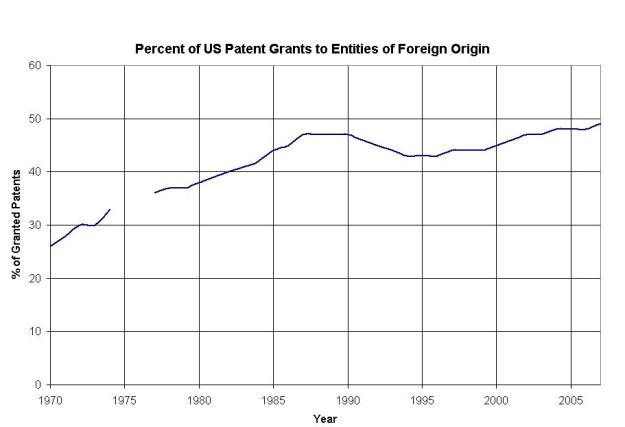
One of the more interesting things to be found is the % fraction of patents granted to foreign entities. As of 2007, the fraction of allowances to foreign entities is 49 %. The above graph shows the tend over time. The gap in the curve is due to the absence of data for 1975-1976 in the published data set.
The fraction of foreign patent allowances has remained approximately constant since ca 1985. There was a dip in the 1990’s that may correspond to some sort of pullback in R&D activity. This drop off in issued patents lags by several years due to pendency.
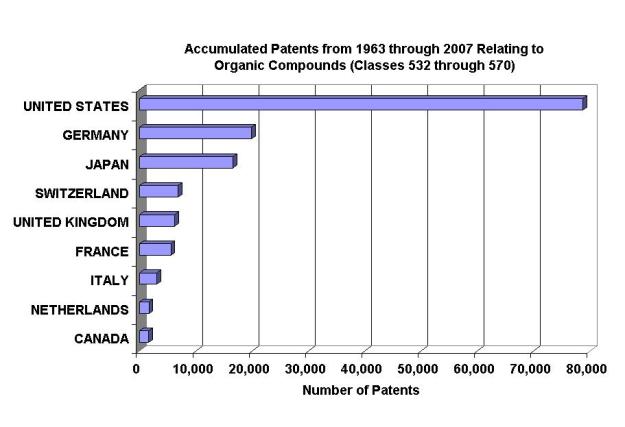
The above graph uses data published by the USPTO. Here we see the accumulated patent allowances to various nations over the period from 1963 through 2007. The data set is limited to Organic Compound classes 532 through 570 under the US classification system. For brevity, only the top 8 foreign applicants are shown in comparison to the US.
Very obviously Germany and Japan have the leading foreign awardees of US patents in this segment of R&D. I have not looked at how the reciprocal situation compares under PCT filings abroad by US applicants.
What is of greatest interest is seen in the top graph: 50 % of the patent real estate being staked out at the USPTO is going to foreign interests.
A unique feature of chemical patents is the Markush claim. Markush claims allow the claiming of a potentially large huge number of analogs defined by compact symbolism and covering vast swaths of the periodic table.
It is thus possible for a professor in Osaka to own the composition of matter of a Markush set of hundreds or thousands compounds that would then bar a company in New Jersey from making even an obscure member. Under the PCT, the same is true in the other direction.
The reach of property rights in the world of invention has become so extensive, and the data provided by the various patent agencies and abstracting services is so inadequate, that the act of performing a due diligence search is nearly comical. In truth, you look for low to middle hanging fruit and hope that an obscure sentence somewhere doesn’t blow a hole below your waterline one day.
Chemical patents are in dire need of reform in terms of the nature of the disclosure. Patent offices must find a way to facilitate the extraction of crucial information so the public has a fair chance of understanding what is off limits.
We need a more lucid recitation of claimed compositions and better use of language in the detailing of processes. Patents should be written with abstracting in mind. It should be made possible to extract processes and compositions into a form that can be accumulated in databases for rapid review. This has to begin in the drafting phase of the application.
[For some great feedback, check out the comments- Th’ Gaussling]
I have a dream. I dream of a time when election crazed talking heads find some new metaphores. I dream of a time when networks lengthen the news sampling interval from 5 minutes to something greater. I dream of a time when microanalysis of the faintest political nuance is recognized for what it is- gossip. I dream of a time when broadcast news people understand the concept of signal to noise ratio.
Finally, I dream of a time when people focus on the core of MLK’s dream- nonviolence- rather than the attention deficit parroting of the 4 words for the sake of loftiness.
A detailed description of the swim suits worn by the US Olympic Team can be found in the US patent application by Speedo International, US 2008/0141431. These sophisticated garments are multilayer, multipanel affairs that the inventors claim will reduce surface and form drag in the water. According to section [0066] of the description, the stretch constant of a given panel can be defined by the manufacturer so as to provide more or less compression to a particular part of the torso.
August 2, 2008. Kwajalein Atoll. In the third failure in the fledgeling commercial SpaceX launch program, a Falcon 1 lifter failed to achieve orbit shortly after liftoff. The payload package consisted of two NASA packages, one DoD package, and one package for Celestis, Inc. The Celestis payload consisted of ca 208 vials of the cremated remains of customers who paid to have their ashes delivered into orbit.
Among those disappointed customers were the late actor James Doohan (“Scotty” from Star Trek) and astronaut Gordon Cooper. Curiously, this was their second successive space disaster together. The package of remains previously fell to earth and landed in the White Sands area in May of 2007 following an earlier failure of a launch vehicle.
Wende Doohan, James Doohan’s widow, told the Associated Press news agency her late husband “probably wished he could have stayed [in orbit]”. -BBC
Internet mogul Elon Musk said, “It was obviously a big disappointment not to reach orbit”. Musk is a founder of SpaceX and PayPal. According to SpaceX, the failure occured when a thrust transient during first stage shutdown caused it to recontact the second stage soon after separation. This contact perturbation caused the vehicle to fail to reach orbit.
“Laddy! Would ya be needin’ a little somethun’ to wash that doon with?”
-Cmdr Montgomery Scott
Zambia’s largest mining operation, Konkola Copper Mines plc (KCM), is nearly ready to commission the Konkola Deep Mining Project. This mine expansion project, in combination with the new Nchanga Smelter, will increase the mine’s output from 200,000 tonnes per year to 500,000 tonnes per year by 2010.
In order to enable the increase in ore output, a new shaft was sunk. The new production shaft # 4 reaches to 1,490 meters below the surface and will service production levels at 1050, 1150, 1250, and 1350 meters depth. The company anticipates returning 40 % of the tailings back underground for remediation purposes.
The Konkola underground mine is known as the wettest mine in the world. The mine must be continuously pumped to remove the copious water seepage. Underground improvements will increase the “water make” from 290,000 cubic meters of water to 430,000 cubic meters of water per day. The water pumps are expected to draw 90 MW of continuous power to do their job.
KCM has invested US$12 million in new sulfuric acid capacity at Chingola. This sulfur burning plant will produce 500 tonnes per day of sulfuric acid for use in the Nchanga Tailings Leach Plant.
KCM also operates an open pit mine nearby.
22 August, 2008. It is a remarkable collapse in pricing. Rhodium has fallen from a high of US$10,100/toz (toz = troy ounce) in early June of 2008 to opening price of US$3950/toz on 21 August, 2008, on the EIB. Bad news from automotive manufacturers General Motors, BMW, and Nissan is cited by Reuters and posted on Mineweb as the principle cause of the collapse. According to Reuters, the automotive industry accounts for 80 % of the demand for rhodium.
Other reasons are cited as contributing to the price fall. Electrical distribution problems interrupting mine activities has reportedly eased, reducing the jitteryness of buyers.
The rhodium market is small and illiquid, and few traders are prepared to speculate on a floor for prices.
The metal’s recent price falls have been blamed by some traders on forward selling, or hedging, by producers. If this is the case, the market should stabilise as these sales tail off.
Mineweb, 15 August, 2008
Ruthenium prices have been sitting at US$300/toz for months now. Apparently the news that sparked the major uptick in Ru prices last year has failed to produce real demand.
Gold opened on the EIB yesterday at US$835.57/toz. This is down considerably from mid July, no doubt adding some tarnish to the spate of ads urging consumers to buy gold.
Palladium has fallen to US$295/toz from the recent high of US$480/toz in mid June of ’08. This is good news for the chemical industry and chemical researchers.
Finally, Platinum has seen a price decline as well, opening at US$1465/toz against the Feb ’08 high of US$2275/toz. This is also good news for the chemical industry. Hopefully chemical buyers are in a position to hedge their PGM positions a bit.
The portfolio of laws that American citizens are subject to seems to grow without bounds. Every year our congress drafts a new collection of laws to submit to the process of enactment. State legislatures, county and city governments all are able to add new rules and constraints on our degrees of freedom. As if that weren’t enough, people willingly move into convenant controlled communities where they sign away basic freedoms like the freedom to choose house paint or to leave the garage door open.
We are gradually fencing in all of the free space where conduct is unregulated. Our Nanny State leaders are scaring the bejeebers out of us through defense initiatives and dire warnings about what could happen if terrorists took an interest in disrupting industry and infrastructure.
Our town of 6,000 has to comply with Homeland Security requirements by fencing in the town water tank in a certain way. Some terrorist could poison the water. In fact, that fiend would probably be a psychotic local citizen bent on retribution, not a Shiite saboteur in sandals. Collectively, we are at much more risk from fellow citizens than from foreign bad guys. Perhaps that is the hidden agenda.
Citizens are turning over priceless freedom artifacts in exchange for promissory notes claiming to protect the bearer. Once we give up degrees of freedom in the conduct of our lives, we can never get them back. Govennment will not refund units of control. As we increase the complexity of our world through an ever increasing statutory web of control, we forfeit degrees of freedom. It is like a ratchet. You can click forward, but there is no going back.
New subject. Read Jim Kunstlers post “Reality Bites“.
 Lamentations on Chemistry