The next president of the US, # 47, was heard to proclaim very recently the slogan ‘Drill Baby Drill‘. This slogan was first used by Lieutenant Governor Michael Steele of Maryland at the 2008 Republican National Convention. It was quickly picked up and made famous by Sarah Palin at the 2008 vice-presidential debate with Joe Biden. The slogan was used frequently by former president DJ Trump in his 2024 presidential campaign.
As slogans go, Drill Baby Drill successfully hit a nerve with Trump’s constituency if for no other reason than as a shout-in-your-face taunt. There was and is conservative consternation with liberal push-back on the practice of hydraulic fracturing (‘fracking’). It is not just fracking either. Opening public land to oil exploration was met with howls of dismay by Democrats over the plan to open up ANWR and other public lands to oil exploration, drilling and pipelines.
Many seem to believe, MAGAs in particular, that increased drilling and fracking will automatically decrease gas and diesel prices at the pump. From 50,000 feet up, that might seem to be true. More supply, lower prices or so the thinking goes. But economics learned in the back yard drinking beer while playing corn hole or from TikTok only takes you so far. There are many details that have their origins national and global politics as well as the many particulars of how the oil & gas supply chain actually works.
An excellent source of data on the global oil & gas situation is the International Energy Agency, IEA. They offer an excellent pdf report of the global oil picture extending to 2030. Here are the highlights from the IEA November 2024 Oil Market Report:
Consider
World oil demand is forecast to expand by 920 kb/d this year and just shy of 1 mb/d in 2025, to 102.8 mb/d 2024 and 103.8 mb/d 2025, respectively. The slowdown in growth from recent years reflect the end of the post-pandemic release of pent-up demand and below-par underlying global economic conditions, as well as clean energy technology deployment. (kb/d = kilobarrels per day; mb/d = million barrels per day)
Global oil supply rose by 290 kb/d in October to 102.9 mb/d, as the return of Libyan oil to the market more than offset lower Kazakh and Iranian supplies. OPEC+ delayed the unwinding of extra voluntary production cuts to January, at the earliest. Non-OPEC+ producers will boost supply by roughly 1.5 mb/d in both 2024 and 2025.
Refinery margins improved in October as seasonal maintenance and economic run cuts supported product cracks. Global refinery runs hit a seasonal low in October before starting to recover in November and will average 82.8 mb/d this year and 83.4 mb/d in 2025. Annual growth of roughly 600 kb/d is driven largely by OECD Americas (+360 kb/d) this year and by non-OECD regions in 2025.
Global oil inventories plunged by 47.5 mb in September, to their lowest level since January, led by a sharp draw in OECD oil products and non-OECD crude oil stocks. OECD industry stocks fell by 36.4 mb to 27.99 mb, 95.3 mb below the five-year average. Provisional data suggest total global stocks decreased for a fifth consecutive month in October.
‘Global oil markets face a surplus of more than 1 million barrels a day next year as Chinese demand continues to falter, cushioning prices against turmoil in the Middle East and beyond, the International Energy Agency said.’
As you may know, lately China has been having a rough go of it economically with their construction and real estate crises. Bloomberg reports that-
‘Oil consumption in China — the powerhouse of world markets for the past two decades — has contracted for six straight months through September and will grow this year at just 10% of the rate seen in 2023, the IEA said in a monthly report on Thursday. The global glut would be even bigger if OPEC+ decides to press on with plans to revive halted production when it gathers next month, according to the agency.’
The linked Bloomberg article paints a picture of static global demand for oil and weak prices extending into 2025 and possibly longer. So, this leads us to the question- How anxious does this picture make oil executives who are always looking for a reason to increase oil & gas exploration and drilling? Obviously, their planning goes well past 2025. Lower wholesale prices of gasoline and diesel out of the refinery do not automatically translate into proportionally lower retail prices at the pump. What would be the reason that a gas station owner would lower the retail price just because his wholesale fuel costs have dropped? Why would they forfeit profit margin to offer lower pump prices when they could keep prices as high as the market allows?
Do you think that a MAGA gas station owner with a red hat would offer reduced margins and prices to MAGA customers in red hats just … because he/she is generous? I don’t think so.
The reality has always been that fuel prices are based on what the customer is willing to pay. A president or candidate promising lower fuel prices in the USA should be viewed with serious skepticism. The entire supply chain from drillers to gas station owners struggle to maximize their profit margins and sales volumes 24/7. Do we really believe that the supply chain would bend to the price promises of some politico? Perhaps in Venezuela but look at what price fuel price meddling has done to that country.
Drill-Baby-Drill is a shallow chant used to polarize voters into opposing Democrats by lumping them into a contrived basket of anti-American fools. The trouble is that it works.
An effect of the internet and social media is that it brings the entire bell curve of voters to the table where many believe that all opinions are of equal merit. On the macroscopic scale, all citizens in the broader bell curve have a right to express their opinions. But just like at the microscopic scale of business, home and institutions, arguments and opinions without merit can be cast aside. Facts and solid logic should prevail over hand waving opinions.
I posted this essay December 19, 2016, and am reposting it with some editing today, November 22, 2024.
Much as I would like to indulge in witty and ironic commentary about the results of the 2016 general election, it would be yet another steaming load of pathetic word paste gumming up the internet. There are no words or sentences you could construct that would make a meaningful difference in the direction our wobbling American culture seems headed for.
I’m left with the conclusion that only civil disobedience can disrupt the unholy congress of corporate media, banking, energy and the foetid red-light district of governmental-industrial conjugation. After all, aren’t the B-school gurus always going on about disruption? It’s good, right?
Could it be that donors and lobbyists amount to a 3rd house of Congress?
Enormous corporations, it seems, no longer have need of our democratic republic. Fortunes are stashed abroad, sheltered in tax havens lest a slice finds its way into public kitty. Corporations benefit from the use of American infrastructure- you know, public education, Army, Navy, Air Force, Marines, Coast Guard, Border Patrol, FBI, FDA, NIH, NASA, NSF, public highways, airways, NOAA, etc., etc. Deregulation is creeping forward. We live in a period of reconstruction. Neoliberal doctrines are taking hold in state and federal government.
America has become a big barrel of fish, stunned by the high voltage of short life-cycle consumer goods and ever spiraling planned obsolescence. Neoliberalism seeks to help businesses harvest these fish. We relent and become increasingly compliant with the tightening harness of ever advancing complexity and the cloying whispers of big data and AI.
Neoliberalism has hoped for this moment for decades when a character like Trump and both houses of congress filled with MAGA Republicans take control the government. Project 2025 is a grocery list of desired policy reforms the bastards have been wanting forever. Like the quivering desire of a lusty 18-year-old, capitalism knows only one thing- that it wants more. Always more and in bigger gulps. The acceleration of dollars over time squared must be greater than zero in perpetuity. Our brains soon grow tired of static luxury and comfort. Satisfaction is only transient.
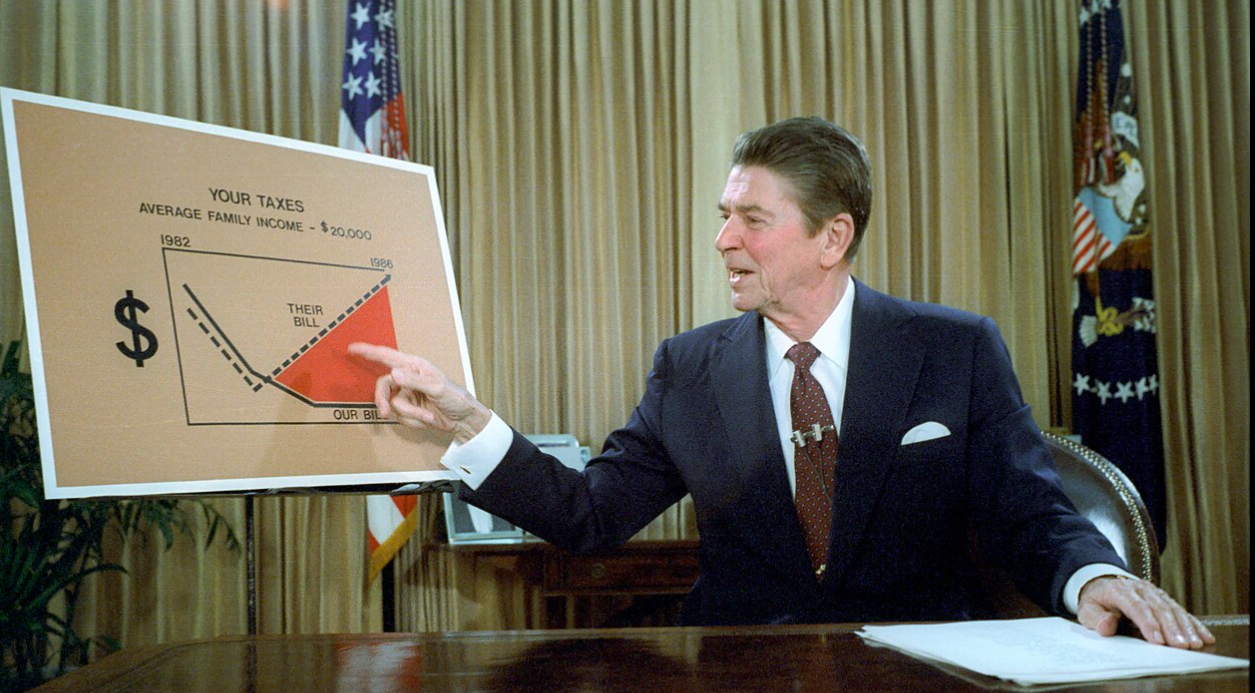
The invisible hand of the market, we’re told, will surely trickle down a baptism of unexpected benefits to the masses, if only the rotten buggers would let the acquisitive 1 % have their way. After all, if your taxes are lower, the first thing a business owner will do is to add hirelings. Right? Wrong. The extra profits will be socked away. Why hire people if demand is level but taxes drop? This libertarian dream was fomented in the early Reagan years as supply-side economics postulated by economist Arthur Laffer and his famous curve.
In the inflationary period we are just coming out of, why not raise your prices 25 % even though your costs have only risen 10 %? If other companies are raising their prices, raise yours by a like percentage to match. Your price increase may be taken by customers as part of the wide-spread inflation. After all, price is what the customer is willing to pay, right? If they are accustomed to inflation elsewhere, maybe they will just pay your new price, bogus as it may be.
The gospel of laissez-faire is practically physics if you listen to the economists and B-school graduates. A force of nature both inevitable and irreducible. Capitalism is fine if you have capital to use. If your capital is your own stoop labor or assembly work, then maybe it isn’t such a great thing.
Taking to the streets is a form of persuasion that has rewarded many movements here and abroad. In thermodynamics, power is the rate at which work is done through the transfer of energy. Anthropological power lies in the ability to allocate and focus resources on a need or desire. Money is power because for a price, you can persuade someone to get most anything done. There is no shortage of those who would step up to the challenge or sell their souls or accept any spiritual disfigurement for the hefty jingle of lucre in their pockets.
If the tin ears of corporate media are deaf to the reasoned voices of those who don’t buy advertising, then what is left for us to do? In this general election cycle a species of disrupter was reelected president. This charismatic fellow can work a crowd like Castro or Hugo Chavez or Mussolini or (add your own dictator)? A large crowd in the spell of a colorful and grandiose orator seeking high office meets the show business (i.e., news) definition of “compelling.” If the event results in fisticuffs or tempers flaring like Roman candles, so much the better. Media is hyper-focused on “compelling”. Either as a savior or a freak show, Trump attracts the eyeballs and pumps up the ratings. He has been on television every day somewhere for over 8 years.
Electronic news broadcasting is to a large extent a freak show. The whole news industry exists because of our irresistible primate compulsion to stand and stare. A key element of a good story is conflict. Look at any movie. The writers take a sympathetic character and do terrible things to them. There is a chase, violence, intrigue and reconciliation with a twisty ending in three acts. Sound familiar? TV is constructed to do this and they are good at it. And it sells. Watch Chomsky’s Manufacturing Consent.
Civil disobedience, as opposed to mere picketing, makes meaty footage because there is the possibility of imminent violent conflict. It is compelling. As an exercise in power, though, immediate resolution rarely happens. The power aspect comes to play when and if establishment politicians are forced to face reelection. Often establishment authority is refractory to public scrutiny. But when voter support disappears, it can fold like a lawn chair.
To overcome Trump we must put together compelling footage for broadcast.
The present situation is one whereby a large swath of the population, including K-12 students, are being exposed to an increased risk of bloody, violent death sustained by those who fetishize firearms. Whatever you may think of the 2nd Amendment to the US Constitution, the fact is that we are prioritizing an originalist interpretation over the lives of school children. We are allowing children to be sacrificed on the alter of the 2nd Amendment in order to satisfy people who idolize the idea of boundless access to metal tubes that discharge high energy bits of metal. We are not officially at war defending our borders in the US nor are we on the verge of a civil war. By far, most guns are not used to hunt. Most Americans lead peaceful lives in their neighborhoods without the need to shoot at people.
The very notion that the US government is going to wrench guns away from citizens in one of the most heavily armed democratic countries in the world is the fever dream of a fool. Any full-scale attempt to do this would lead to armed rebellion and the collapse of the USA as a democratic republic. Widespread gun confiscation is not politically feasible today or in the foreseeable future.
We must tone down and be less tolerant of the image of inflated machismo that guns confer to their users. Both in real life and in entertainment, gunplay is used to resolve conflict. By far, most gun owners do not commit violent acts with their guns. While they should not be penalized for the crimes committed by others, accepted mechanisms like driver’s and pilot’s licenses are a form of limitation and standardization that could be applied to access to firearms. But this reliably produces hysteria among the armed public. Like everything else in society, a few people have to ruin it for the rest of us.
The basic utility of a gun is to deliver crippling or fatal kinetic energy, or the threat of it, from a safe distance. The need for guns for peacekeeping use will last as long as there is dangerous criminality. What the US is presently suffering from is the use of rapid-fire, high-energy projectiles from guns designed to hit as many targets as possible in the shortest time. Man killers.
Sidebar
I took the hunter’s safety course sponsored by the NRA at the age of 9. The truth is that firing a gun is both fun and stimulating. I recall stealthily walking along a muddy creek in the Iowa countryside with a bolt action 0.22 caliber rifle desperately looking for some reason the fire the gun. I spotted fish, turtles and birds but something held me back from shooting at them except for once a few years later. With a BB gun I shot a sparrow perched on a small twig of an elm tree. The bird rotated backwards, still gripping the twig, and hung upside down for a minute or two. Then it released and dropped into an irrigation ditch with a small splash.
I was immediately gripped with regret and sorrow for what I had just done. I had just killed a random sparrow for utterly no reason than to see what happens. Even as a teenager I could see that this was a senseless action. I am sorry for killing the sparrow to this very day and, except for a few mice and bugs, I have never killed wildlife since.
Back to the essay
The point of the story above is that, for me, being in possession of a firearm could sometimes produce a strong urge to fire it. I’m confident that there are others who have felt the same way. The healthy release is to do target practice. Some people enjoy hunting. I do not indulge in this because I prefer the flavor of beef, pork and fish which, conveniently, are already butchered.
Male characteristics can have both good and bad attributes. A measure of focused male aggressiveness, ambition and territoriality can be beneficial for the wellbeing of loved ones and the community. Brute strength can be quite useful in providing for a family. Male rage, however, can be very destructive wherever it is directed, as we all know. A firearm or other weapon is a force multiplier for a raging male. Recent mass killings prove the point. Firearms provide the ability to kill or wound from a safe distance and the value of this is lost on no one.
It is hard to imagine that some restraint in the use of firearms without addressing the cultural and natural phenomenon of male aggression can be successful. We are saturated with violence in entertainment, on the streets and in the news. As long as we seek entertainment violence, show business will anxiously provide it.
I’m neither a Quaker nor a pacifist but I do admire their sincere dedication to non-violence. We need many early adopters of non-violence with considerable social standing and a non-violence vibe across the whole country. Destructive male behavior can be tamed to a great extent, but it has to start early and be immersed in non-violent surroundings. Where is the sign that Americans can summon the discipline to do it. I’m not seeing it.
Woke up to the worst news this morning. Trump has been reelected. To the international community I express my sorrow that for the second time, Trump has been elected President of the USA. There is nothing new to say about the guy that hasn’t already been said thousands of times.
But it gets worse. Trump’s Vice President is his ward, the inexperienced JD Vance, soon to be the former 2022 Senator from Ohio. Vance, contradicting his 2016 opposition to the now 78-year-old Trump, is only a few heart beats away from the Presidency. Setting aside for a moment how he might conduct the presidency, he would also be the leader or at least figurehead of the entire GOP political machine. Do we really think that a greenhorn like Vance would actually set the GOP agenda himself?
It is a given that Russia and previously the USSR has been conducting hybrid warfare in the West long before and during this election. Because of the asymmetric power balance between the West and Russia, Putin will be compelled to continue his deliberate corrosion of Western civilization long afterwards.
It is hard not to feel bad for Ukraine. They were watching our election closely. They understand that the election of Trump puts US spending for their defense in serious doubt. Not only could the money and weapons dry up, but Putin will be emboldened to continue his extermination of everything Ukrainian. Trump’s expressed lack of enthusiasm for NATO will certainly weaken its defensive posture in holding Putin east of present borders. Putin wants to take back what territory the collapse of the Soviet Union lost. That includes all of the now independent countries formerly part of the Soviet bloc. He is empire building and his boldness must be met with equal boldness in opposition.
There are serious repercussions in front of the free world because of this election. Withdrawal of American influence from any given acre or hectare in the world will create a vacuum soon to be occupied by someone, sometimes enemies of the West, namely China and Russia. They are playing the long game.
It is difficult for the USA to play the long game in international affairs due to the frequent transfers of power in the government. Policies puff up and soon collapse. It is difficult for other nations of the world to synchronize with this. Our frequent changes in administration and policy works against us when more patient but hostile nations encroach. It keeps everyone off-balance.
I think many Americans believe that the USA can continue to ride on past achievements and goodwill and that no one will notice. All free nations have to wake up every day and prove themselves anew.
One of the complaints about liberal democracy is that it lacks order and stability. Both China and Russia have stated this openly. President Viktor Orbán of Hungary is fond of referring to his reforms as part of a greater illiberal democracy. One definition of illiberal democracy is “nondemocratic practices behind formally democratic institutions and procedures”. This is just the larval form of authoritarianism.
Of course, liberal democracy is noisy and somewhat disordered. This is the nature of free people. The free exchange of ideas is called brainstorming. At some point time runs out and a consensus is taken and acted upon. Yesterday the national consensus was that Trump/Vance will win the Whitehouse. If the dimmer side of the bell curve votes in larger numbers, then they win. And that is that.
To friends in democratic states around the world. As you watch America’s clumsy slouch into an authoritarian/fascist state in real time, take heed. Level-headed Americans are astonished at the ease with which one insane populist has misled a venerable political party to mutate and turn against the foundational principles of our republic. The US has struggled to conduct a capitalistic democratic republic for 250 years. There have been many rough spots since our founding, some reprehensible. What is happening today is the decapitation of a powerful liberal democracy. The USA has been a prolonged experiment in mostly democratic governance where, in principle at least, today the leadership is elected fairly by all the people, not just property-owning white men.
The USA will be the only nation choosing fascism during a period of economic growth, abundant oil & gas and relative peace. Other nations in the world are battling but the US has no combat troops deployed to fight.
Lest anyone think that the MAGA movement was built from the urging of Trump alone, be aware that there has been a population of angry and disenfranchised white Americans for a very long time. Trump was just the seed crystal around which a concentrated population of teabaggers and other white Americans has crystallized. They have somehow been left behind on the road to a modern, prosperous future. If there was an actual trickle down of wealth that Ronald Reagan promised in the 1980’s, they were left high and dry.
We are witnessing a gradual overthrow by a party led by a man who is well understood to be a serial liar and a shameless, malignant narcissist who, in desperation for power and vengeance, will stop at nothing to take control of the USA. There is a word for what is happening- Lawfare, “the use of law as a means of accomplishing what might otherwise require the application of traditional military force“. This was popularized by Major General Charles Dunlap, USAF.
Trump’s immediate goal is getting even with his enemies. If that weren’t bad enough, he is firmly supported by loyal one third of the electorate. Many other Republicans cannot bring themselves to vote for a democrat for various reasons. The rabid supporters are known as MAGA- Make America Great Again– Republicans. These people see Trump as the key to America’s glorious future, but too intoxicated with revolutionary fervor to see Trump for what he really is- a grasping neofascist.
The 20th century was blighted with fascist dictatorships and even fascist organizations within liberal democracies, particularly in the 1920’s, 30’s and 40’s. A partial list can be found here. For some reason, the USSR has been omitted from this list. Today, the latest Russian dictator stands out in his attempt to resurrect the power and reach of the Soviet Union, and he must be stopped.
The origins of conservative and libertarian outrage against American progressivism traces back more than a century, even before the era of Franklin D. Roosevelt and the New Deal in the mid 1930s. By the end of the 1800’s, political machines and business monopolies were firmly rooted in the landscape of America. The rising middle class eventually overcame much of this through politics.
Some put the American Progressive Era as between 1896 and 1917. Before this period the US was beset with urban poverty, child labor, Victorian era patriarchy, long working hours and unsafe working conditions. Note to MAGAs, was this when America was great??
The New Deal was a series of public work projects, financial reforms, and regulations enacted by President Franklin D. Roosevelt in the United States between 1933 and 1938, aimed at rescuing the U.S. from the Great Depression.
“Major federal programs and agencies, including the Civilian Conservation Corps (CCC), the Works Progress Administration (WPA), the Civil Works Administration (CWA), the Farm Security Administration (FSA), the National Industrial Recovery Act of 1933 (NIRA) and the Social Security Administration (SSA), provided support for farmers, the unemployed, youth, and the elderly. The New Deal included new constraints and safeguards on the banking industry and efforts to re-inflate the economy after prices had fallen sharply. New Deal programs included both laws passed by Congress as well as presidential executive orders during the first term of the presidency of Franklin D. Roosevelt.” Source: Wikipedia.
The 20th century witnessed the United States grappling with a severe depression starting in 1929 which spread worldwide. Later, the US reluctantly engaged in World War II with other allied powers combating Nazi forces in Europe, Africa, and Japanese imperialism in the Pacific. Upon discovering Hitler’s nuclear ambitions, the US, with vital assistance from British and European scientists, developed nuclear weapons using isolated domestic uranium-235 and the synthetic element plutonium-239. Fortunately, the Allied forces managed to defeat the Nazis in Europe in 1945 before the necessity of releasing a nuclear weapon there. By August 9th of that year, Japan was defeated and the war ended. Sadly, it received two atomic blasts.
The US came away from the World War II period full of itself and bursting with optimism. Technologies that were spawned by the war like radar, jet engines, high performance aircraft, industrial production of every kind and a can-do spirit led to a boom in single family homes, babies, and consumerism. By the late 1940’s, television was well along the way and behind it, computers, and new designs in automobiles. Americans were puffed up and excited about modern life while much of Europe and Japan were still cleaning up after the massive devastation caused by the war. The remoteness of North America and its seemingly inexhaustible natural resources left it almost untouched by the war.
By the Reagan years in the early 1980s, religious conservative and libertarian groups were organizing and linking up to form what would become a powerful political machine. This conservative, evangelical Christian Zionist nationalism group has methodically wound itself up and this very day proposes to make the USA into a theocratic state. They have money and fanatical adherents willing to risk a civil war for their faith. They will support the state of Israel to the extent that it makes way for the second coming of Christ. This is the core of Protestant Evangelical Christian eschatology. Like all religious warriers, they believe they are fulfilling God’s very own plan. I think the 21st century is going to be difficult.
Many of us think this would be laughable bullshit if it weren’t so serious. To grease the skids of their feared ‘apocalypse’ involving a final battle in Israel, they see Trump as one who could aid the beginning of this nightmare. To their credit, many confess they will have to hold their noses while voting for him. An apocalypse of sorts may happen, but it is more likely to be of the usual unholy variety.
In eastern Europe, once Trump withdraws US assistance to Ukraine, Putin will do the predictable and step up his plans for the take-down of the Baltic states and Poland as well. Putin is already well underway with his hybrid warfare. His meddling in the US elections is one element of hybrid warfare. The goal is to shake the world’s confidence in liberal democracy.
Once his move has begun, NATO will be obligated to come to their defense. It is hard to predict whether or not the threat of NATO’s backing will fend off a Putin invasion if the US backs out or takes a neutral position to Putin. Putin’s military, already greatly weakened, would be even closer to claiming that the state is in danger of collapse. The collapse of the state is Putin’s criterion for the release of nuclear weapons. NATO will respond in kind to a nuclear threat, and it will likely get out of control.
The US and Russia each have a nuclear triad that requires presidential approval for a strike. Even if the command centers of both countries are in ashes, the ballistic missile submarines will still be mission ready. Imagine, if in a conflict, that the US and NATO will have to rely on Trump and his White House staff to be Commander and Chief of US forces. Trump is a man who, as President, has a long history of ignoring the advice of military specialists preferring to ‘winging’ on his own.
What in Trump’s past behavior and utterances makes anyone confident that he is qualified to make decisions in any other matter of warfare? Should he have access to the nuclear launch codes or to top secret plans?
Of course, there will be military general staff and advisors around him as would be the case if Harris is elected. But Trump was notorious for not reading his daily intelligence reports nor much of anything else. He spent a lot of time on Airforce 1 traveling to play golf at his resorts.
Harris has a disciplined and educated mind as well as the native intelligence and organizational savvy to listen to the experts and make decisions with the best and latest information. Being a district attorney and prosecutor, California Attorney General, California Senator and Vice President, she is well versed in the law at many levels and can be relied upon to follow it.
International friends, protect your liberal democracies from those who would degrade them into autocratic states under the guise of law and order. A democratic republic is messy, noisy and will test your patience. This is not a bug; it is a feature. Rejoice in it.
See that pale blue dot as a single pixel? It is a picture taken by Voyager 1 in 1990 at a distance of 3.7 billion miles from the sun. A band of idiots living there are about to do something very stupid and self-destructive tomorrow, 5 November 2024. Source: Nasa photograph.
“Technological triumphalism” is a term that surfaces infrequently, encapsulating the belief in our capacity to resolve almost any issue through the innovative use of technology. While technological progress has led to countless pivotal breakthroughs, such as antibiotics and the transistor, it has also given rise to means that magnify age-old human tendencies towards negative behaviors. As our tools and methods evolve with technological advancements, so too do our desires and avarice, often intensified by the fresh opportunities new technologies present.
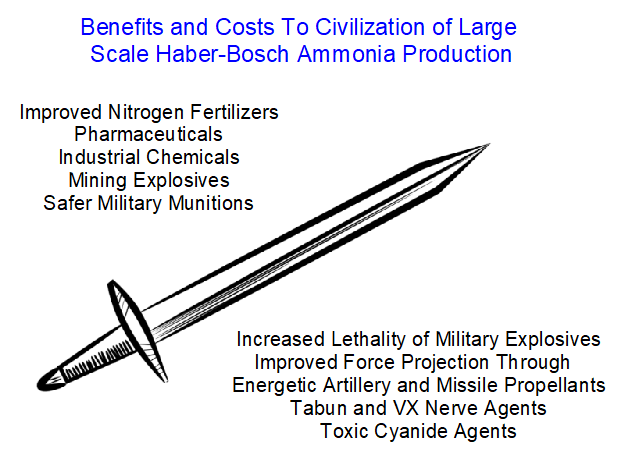
As an example of technology bursting on the scene producing both good and bad consequences, consider the Haber-Bosch process for the industrial manufacture of ammonia. An industrial feedstock like ammonia can split into several streams. On the plus side, cheap and available liquid or gaseous ammonia for fertilizing crops was a boon for mankind in terms of increased food production. Also, the combination of ammonia and nitric acid leads to the production of the solid fertilizer ammonium nitrate.
Another and wholly different product stream involving the oxidation of ammonia (Ostwald Process) is nitric acid production, HNO3. It is required for the manufacture of industrial intermediates, high explosive nitroaromatics like TNT, picric acid, nitroesters like nitroglycerine and even more powerful explosives. Explosives are neither inherently good or bad, their merits depend on how they are used. When used for construction or mining, explosives are a positive force in civilization. However, they cast a long dark shadow when used to destroy and kill.
Fritz Haber
A good example of unanticipated consequences of a technology uptick is found in the story of the German chemist Fritz Haber. Haber won the 1918 Nobel Prize for Chemistry for the invention of the Haber-Bosch synthesis of ammonia. It is estimated the 1/3 of present global food production relies on the use of ammonia from the Haber-Bosch or similar processes. Haber has been widely praised for his part in the invention of catalytic ammonia production using atmospheric nitrogen. These are important developments, but … [Wikipedia]
As a German nationalist, Haber was also known for his considerable contributions to German chemical warfare through WWII. Haber was responsible for the production of Zyklon A and Zyklon B.
It is claimed that neither Fritz Haber nor Carl Bosch were fans of National Socialism in Germany in the 1930’s. Haber claims to have done his WWI gas warfare work for Kaiser Wilhelm as a German patriot. Intimidated by German laws aimed at Jews and Jewish colleagues, Haber (a Jew converted to Catholicism) left Germany in late 1933 for a position as director of what is now the Weizman Institute in what was at that time Mandatory Palestine. He died while enroute in the city of Basel, Switzerland, at age 65.
Chemical warfare in WWI began with an idea from volunteer driver and physical chemist Walther Nernst who suggested in 1914 the release of tear gas at the front. This was observed by Haber who later suggested chlorine gas be used instead because of its density. Haber personally supervised Germany’s first release of chlorine gas at the Second Battle of Ypres in WWI. Supervising the installation of the 5730 tanks of chlorine were chemist Fritz Haber, chemist Otto Hahn, physicist James Franck and physicist Gustav Herz. Of the 5 scientists mentioned above, Nernst included, all would receive a Nobel Prize in their lifetimes.
‘Haber defended gas warfare against accusations that it was inhumane, saying that death was death, by whatever means it was inflicted and referred to history: “The disapproval that the knight had for the man with the firearm is repeated in the soldier who shoots with steel bullets towards the man who confronts him with chemical weapons. […] The gas weapons are not at all more cruel than the flying iron pieces; on the contrary, the fraction of fatal gas diseases is comparatively smaller, the mutilations are missing”.’ Source: Wikipedia.
The double-edged sword of ammonia. The military benefits apply to both offensive and defensive use. Graphics by Arnold Ziffel.
The Future
Ask yourself this- will your descendants in the year 2124 share in the creature comforts coming from the extravagant use of resources as we have? Doesn’t the word “sustainability” include the needs of 4-5 generations down the line?
There are wants and there are needs. For many of us in the 21st century, most our needs in the US are more than satisfied along with surplus income to satisfy many of our wants. Will our descendants a century from now even have enough resources to meet their needs after our continuing wanton and extravagant consumption of resources of the last 150 years?
Our technology stemming from the earth’s economically attainable resources has done much to soften the jagged edges from nature’s continual efforts kill us. After each wave of nature’s threats to life itself, survivors get back up only to face yet more natural disasters, starvation and disease. This is where someone usually offers the phrase “survival of the fittest”, though I would add ” … and the lucky“.
What will descendants in 100 or 200 years require to fend off the harshness of nature and our fellow man? Pharmaceuticals? Medical science? Fuels for heat and transportation? Will citizens in the 22nd century have enough helium for the operation of magnetic resonance imagers or quantum computers? Will there be enough economic raw materials for batteries? Will there be operable infrastructure for electric power generation and distribution? Lots of questions that are easy to ask but hard to answer.
If you are immune from concern for future generations, then this essay is a waste of your time.
Come to think about it, does anyone worry this far in advance? The tiny piece of the future called “next year” is as much as most of us can handle. Is the world a much smaller place than it used to be or is the scale just better understood?
A plug for climate change
Even the sky is smaller than we think. At 18,000 feet the atmospheric pressure drops to half that at sea level. This means that half of the molecules in the atmosphere are at or below 18,000 feet. This altitude, the 500 millibar line, isn’t so far away from the surface. From the 58 Fourteeners in Colorado, it is only 4000 ft up. Not that far. The breathable, inhabitable atmosphere is actually quite thin. The Earth’s atmosphere tapers off into the vacuum of space over say 100 km, the Kármán line. While this is more of an arbitrary designation than a physical boundary between the atmosphere and space, the bulk of the atmosphere is well below this altitude. With this in mind, perhaps it seems more plausible that humans could adversely affect the atmosphere.
The lowest distinct layer of the atmosphere is the troposphere beginning as the planetary boundary layer. This is where most weather happens. In the troposphere, the atmospheric temperature begins to drop by 9.8 °C per kilometer or 5.8 oF per 1000 ft of altitude. This is called the dry adiabatic lapse rate.
With increasing altitude, the atmospheric temperature gradient decreases to about 2 oC per kilometer at ~30,000 ft in the mid-latitudes where the tropopause is found. The tropopause is where the lapse rate reaches a minimum then the temperature remains relatively constant with altitude. This is the stratosphere.
Over the last 200 years in the West at least, advances in medicine, electrical devices, motor vehicles, aerospace, nuclear energy, agriculture and warfare have contributed to what we both enjoy and despise in contemporary civilization. The evolving mastery of energy, chemistry and machines has replaced a great deal of sudden death, suffering and drudgery that was “normal” with a longer, healthier life free of many of the harmful and selective pressures of nature. Let’s be clear though, relieving people of drudgery can also mean that they may be involuntarily removed from their livelihoods. It is quintessentially American to sing high praises to capitalism. It is even regarded as an essential element of patriotism by some. On the interwebs capitalism is defined as below-
Capitalism is an economic system based on the private ownership of the means of production and their operation for profit.
As I began this post I was going to cynically suggest that capitalism is like a penis- it has no brain. It only knows that it wants more. Well, wanting and acquiring more are brain functions, after all. Many questions stand out, but I’m asking this one today. How fully should essential resources be subject to raw capital markets? It has been said half in jest that capitalism is the worst economic system around, except for all of the others.
I begin with the assumption that it is wise that certain resources should be conserved. Should it necessarily be that a laissez faire approach be the highest and only path available? Must it necessarily be that, for the greater good, access to essential resources be controlled by those with the greatest wealth? And, who says that “the greater good” is everybody’s problem? People are naturally acquisitive, some much more than others. People naturally seek control of what they perceive as valuable. These attributes are part of what makes up greed.
Obvious stuff, right?
The narrow point I’d like to suggest is that laissez faire may not be fundamentally equipped to plan for the conservation and wise allocation of certain resources, at least as it is currently practiced in the US. Businesses can conserve scarce resources if they want by choosing and staying with high prices, thereby reducing consumption. However, this is not in the DNA of business leaders. The long-held metrics of good business leadership rest on the pillar of growth in market share and margins. Profitable growth is an important indicator of successful management and a key performance indicator for management.
Firstly, a broader adoption of resource conservation ideals is necessary. Previous generations have indeed practiced it, with the U.S. national park system serving as a notable example. However, the scarcity of elements like Helium, Neodymium, Dysprosium, and Indium, which are vital to industry and modern life, raises concerns. The reliance of Magnetic Resonance Imaging (MRI) operators on liquid helium for their superconducting magnets poses the question of whether such critical resources should be subject to the whims of unregulated laissez-faire capitalism. While some MRI operators utilize helium recovery systems, not all do, leading to further debate on whether the use of helium for party balloons should be permitted to continue, given its wasteful nature.
Ever since the European settlement of North America began, people have been staking off claims for all sorts of natural resources. Crop farmland, minerals, land for grazing, rights to water, oil and gas, patents, etc. Farmers in America as a rule care about conserving the viability of their topsoil and have in the past acted as a group to maintain it in good condition. But, agribusiness keeps making products available to maximize crop yields, forcing farmers to walk a narrower line with soil conservation. Soil amendments can be precisely engineered with micronutrients, nitrogen and phosphate fertilizers to reconstitute the soil to compensate for higher yields. Herbicides and pesticides are designed to control a wide variety of weeds, insect and nematode pests. Equipment manufacturers have pitched in with efficient, though expensive, machinery to help extract the last possible dollars’ worth of yield. Still other improvements are in the form of genetically modified organism (GMO) crops that have desirable traits allowing them to withstand herbicides (e.g., Roundup), drought or a variety of insect, bacterial, or fungal blights. The wrench in the gears here is that the merits of GMO have not been universally accepted.
Livestock production is an advanced technology using detailed knowledge of animal biology. It includes animal husbandry, nutrition, medicines, meat production, wool, dairy, gelatin, fats and oils, and pet food production. There has been no small amount of pushback on GMO-based foods in these areas, though. I don’t watch this in detail so I won’t comment on GMO.
The point of the above paragraphs is to highlight a particular trait of modern humans- we are demons for maximizing profits. It comes to us as naturally as falling down. And maximizing profits usually means that we maximize throughput and sales with ever greater economies of scale. Industry not only scales to meet current demand, but scales to meet greater future demand.
Extracting a resource to its exhaustion has been prevalent in history. The question is, is it inevitable or can or should it be throttled back?
Essentially everyone will likely have descendants living 100 years from now. Won’t they want the rich spread of comforts and consumer goods that we enjoy today? Today we are producing consumer goods that are not made for efficient economic resource recovery. Batteries of all sorts are complex in their construction and composition. Spent batteries may have residual charge left in them and have chemically hazardous components like lithium metal. New sources of lithium are opening up in various places in the world, but it is still a nonrenewable and scarce resource. This applies to cobalt as well.
Helium is another nonrenewable and scarce resource that in the US comes from a select few enriched natural gas wells. At present we have an ever-increasing volume of liquid helium consumption in superconducting magnets across the country that need to remain topped off. This helium is used in all of the many superconducting magnetic resonance imagers (MRI) and nuclear magnetic resonance (NMR) spectrometers in operation worldwide. Quantum computing will also consume considerable liquid helium as it scales up since temperatures below the helium boiling point of 4.22 Kelvin are required.
As suggested above, today’s MR imagers can be equipped with helium boil off prevention recovery devices that recondense helium venting out of the cryostat and direct it back into a reservoir. One company claims that their cold head condensers are so efficient that users do not even have to top off with helium for 7-10 years. That is a good thing. Hopefully it is affordable for most consumers of MRI liquid helium.
In the history of mining in the US and elsewhere, it has been the practice of mine owners to maximize the “recovery” of ore when prices are high. Recovery always proceeds to the exhaustion of the economical ore or the exhaustion of financial backing of the mining company. Uneconomical ore will remain in the ground, possibly for recovery when prices are more favorable. It is much the same for oil and gas. As with everything, investors want to get in and get out quickly with the maximum return and minimum risk. They don’t want their investment dollars to sit in the ground waiting for the distant future in order to satisfy some pointy headed futurist and their concern for future generations.
It is not normally in the nature of for-profit corporate C-suite executives to aim for resource conservation. People answerable to a board of directors have a fiduciary responsibility to maximize wealth generation for the shareholders. The world of industry is the world of growth. The world of “let’s make enough to get by” is not the world of people who rise to the C-suite. Unfortunate but true.
What is needed in today’s world is the ability to conserve resources for our descendants. It requires caring for the future along with a good deal of self-control. Conservation means recycling and reduced consumption of goods. But it also means tempering expectations of wealth generation, especially for those who aim for large scale production. While large scale production yields the economies of scale, it nevertheless means large scale consumption as well, In reality, this is contrary to the way most capitalism is currently practiced around the world.
Sustainability
The libertarian ideal of applying market control to everything is alleged to be sustainable because in appealing to everyone’s self-interest, future economic security is in everyone’s interest. If high consumption of scarce resources is not in our self-interest, then will the market find a way to temper it? As prices rise in response to scarcity, consumption will drop. ECON-101 right? Well, what isn’t mentioned is that it’s today’s self-interest. What about the availability of scarce resources for future generations? Will the market provide for that? What does “sustainability” really mean? Does it mean that today’s high consumption is sustained, or does it mean resource conservation?
Is the goal of energy sustainability to maintain the present cost of consumption but through alternative means? Reduced consumption will occur when prices get high enough. As the cost of necessities rises, the cash available for the discretionary articles will dry up. How much of the economy is built on non-essential, discretionary goods and services? The question is, does diminished consumption have to be an economic hard landing or can it be softened a bit?
Some chemical elements
Here is where we transition into some chemistry. Our transition into a more electric world requires the use of certain chemical elements that may be unfamiliar to many. Certain elements are critical such as copper, aluminum, steel, silicon, germanium, gallium, neodymium, lithium, indium, boron and some others. And each element requires industrial plants and mining to produce them. Mining and refining generally use large quantities of electric power and water. Most all of the equipment in the mines and industry rely on steel machinery which itself requires a cascade of resources to produce.
As of the date of this writing, we are already down the timeline by many decades as far as the R&D into alternative electrification. What we are faced with is the need for a rapid and very large scaling-up of renewable electric power generation, transmission and storage for the anticipated growth in power consumption for electric vehicles.
Price elasticity is where an increase in price fails to result in a drop in demand. Necessary or highly desirable goods and services may not drop in demand if the price increases at least to some level. As with the price of gasoline, people will grumble endlessly about gas prices as they stand there filling their tanks with expensive gasoline or diesel. Conservation of resources has to overcome the phenomenon of price elasticity in order to make a dent without shortages.
A meaningful and greater conservation of resources will require that people be satisfied with lesser quantities of many things. In history, people have faced a greatly diminished supply of many things, but not by choice. Economic depression, war and famine have imposed reduced consumption on whole populations and often for many years. When the cause is released, people naturally return to consumption as high as they can afford.
The technological triumphalism reflex of civilization has allowed us to paint ourselves into a resource scarcity corner. We are reliant on new technology that itself is reliant on more mature technology.
Added 10/30/24.
The habit of relying on future technological breakthroughs to solve current problems is universally seen as a positive expression except for those culturally disconnected from modernism such as the Amish, etc. The problem arises when we blunder forward, oblivious to consequences of the technology. Unforeseen consequences are notably difficult to visualize early in development and may be interpreted by some as negativism.
In chemical manufacturing we are accustomed to a performing PHA- Process Hazard Analysis -when starting up a new process. In a PHA meeting we list all of the potential points of failure in the process equipment and then brainstorm every possible failure mode and possible links to other equipment. It usually takes most of a shift and it is essential that engineers and plant operators are present to lend their expertise. As potential failures are identified they are rated according to their likelihood and seriousness. Each entry that calls for a dated action item by persons responsible for solving the problem.
What the PHA also does is to alert those involved in designing processes of problems that may be general in nature and worth remembering for the next process.
Social Media- An invention gone bad?
Did the persons who introduced the various social media platforms in the early days consider the possible malevolent use and consequences of their online products? Was anything other than the rapid development of their platform and getting online as fast as possible even considered? Was there a devil’s advocate in the building at the time? Once money is invested in a business plan or invention, the desire to go to market becomes insurmountable.
If the question is “could trolls and other online troublemakers have been avoided from the beginning?”, then perhaps the early social media developers should have some accountability to those who download the app. If not, what should be the developer’s role in solving the problem of online trolling or fraud?
As with so many useful things in the marketplace that have a dark side, weapons for instance, doesn’t the user have some responsibility for proper use? Well, yes and no. Someone who knows about guns should have the responsibility for its use, that’s yes. Going very dark, what about leaving a loaded and chambered pistol on a playground. Is it reasonable to expose children to the danger from mishandling? Should they be expected to know what the loaded pistol could do? Clearly not.
The core of the issue seems to be the matter of when a seemingly innocuous invention is released for global use and is unexpectedly misused by some users. Is the developer responsible for damages resulting from the misuse? Can the developer be forced to harden their product to attenuate the abuse?
Could it be that clamping down on trolls on a given app will involve a reduction of clicks or eyeballs? Would advertisers overlook this or negotiate a lower price?
It is doubtful that anyone in 1975 was begging for a Facebook to come on the market. Dot matrix printers were a marvel then. Eventually, when available, Facebook would take the world by storm. Demand appeared when people became aware of it. Is it a triumphal bit of technology? Both were built to exploit existing telecommunications technology and data collection systems. Facebook is a system that converts views and clicks into money over the internet. Facebook is a product that delivers our eyeballs and data to advertisers. Similar to a newspaper or television. Fb is triumphal to advertisers and Meta.
Conclusion-
Is there really such a thing as general Technological Triumphalism? I’m beginning to think that it might exist only as squinted at from 50,000 feet. In the very early 20th century, physicians longed for a magic bullet to cure infections apart from the toxic mercurials then in use. They needed a Technological Triumph, and it arrived in pieces through experiments over time. Along came sulfa drugs, then penicillin and both of these were explored for more potent analogs. As medicinal chemistry advanced, entirely new classes of antibiotics were discovered. The lesson of penicillin coming from mold led to the exploration of microbial and fungal sources from all over the world, producing antibiotics affecting a variety of systems in gram (+) and gram (-) bacteria. Once an active candidate is discovered, it’s structure and stereochemistry are determined. Once the composition is known, modifications can be prepared to explore the efficacy of analogs and sort out the mechanism of its antibiotic properties.
Technological Triumphalism can be a philosophy that in its hazardous form can lead people to believe that if a technology goes surprisingly bad, certainly something can be invented to make it better. Fix one technology with another. The discovery of antibiotics was the result of answering a question that begged for a solution.
An example is the problem of CO2 in global climate change. Should we compensate for rising CO2 emissions by scrubbing the atmosphere or should we find a way to reduce emissions by driving fewer miles? The first is a technological solution and the other is more of a lifestyle change.
[Note: Let’s get something straight here. I’m an industrial chemist and not a pencil-necked economist. I’m going to talk about some O&G economics from my industrial perspective. MAGA people are whining about increasing oil production to ease gas prices. My view is that these buggers are idiots, but I won’t say it like that. I’ll just discuss some pragmatics of oil refining.]
In an article published 10/1/24 in The Center Square the writer reports that a survey of voters in the key swing states of Arizona, Georgia, Michigan, Nevada, North Carolina, Pennsylvania, and Wisconsin that between 80% and 86 % of voters say that the price of daily necessities has gotten painful. Between 88 % and 94 % say they are concerned about inflation. This survey was obtained by Morning Consult/American Petroleum Institute poll obtained exclusively by The Center Square. “The poll surveyed nearly 4,000 registered voters Sept. 20-22 with a margin of error of 4%.”
From the article-
“Notably, the vast majority of voters in those swing states said more domestic oil and natural gas production would lower costs. Anywhere from 80% to 87% of those surveyed support more domestic energy production over more foreign production.” –The Center Square
Some refining basics
I think there is some misunderstanding generally about how the oil & gas (O&G) business works. First off, it is a global market and is subject to supply and demand pressures from all over the world. Second, there is O&G supply and there is refinery capacity. One might suppose that increasing O&G production domestically would automatically lead to lower fuel prices at the retail level. However, refinery throughput is limited to its particular capacity and storage. And, why would O&G producers increase output to an excess just to lower prices at the retail level? Leaving money at the table is against the instincts of every businessperson and is contrary to the fiduciary responsibilities of executives to stockholders.
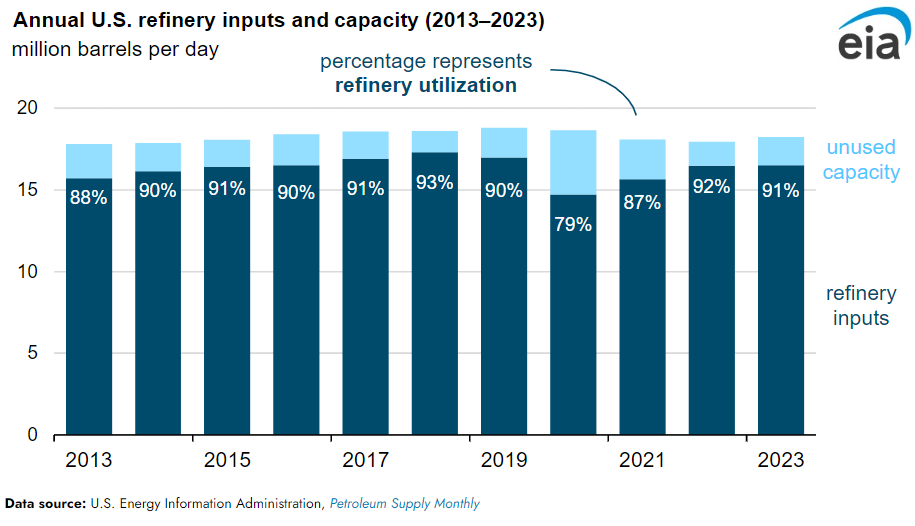
Refineries are usually operated at about 90 % capacity. Lest one think that refiners only need to tweak the throughput up a bit, it must be understood that it is unwise to operate a refinery or any other manufacturing plant at a constant 100 % capacity. Like any other factory, a refinery is subject to sudden or planned maintenance requirements, equipment failures, process upsets, variability in oil feedstock composition, hurricanes, variable demand in product spread or even infrequent operational error. A sudden unexpected shutdown can lead to a variety of complications as well as unleashing hazards at the large scale. Once a refining process line goes down, repair and restart can take one or more weeks to months to bring the process back to stable production.
A petroleum refinery is operated on a continuous throughput basis with series and parallel processing occurring simultaneously. Operating a refinery profitably is a complex job requiring a specialized skillset. As a PhD organic chemist, I am barely qualified to even set foot in a refinery, much less be of any kind of use there. Chemists may be found on site, but most likely in the quality control lab. These are the rarefied heights of the petroleum engineer.
A petroleum refinery is designed to take crude oil and gas inputs and shape them into an optimal spread of profitable products. The focus will be on maximizing the output of the most profitable products, especially motor fuels in the form of the various grades of gasoline and diesel. Your local gas station buys fuel from a wholesaler/distributor at a quoted price then sets a retail price depending on not just the wholesale price, but more importantly the local market prices and expected sales volume.
The general idea in pricing is this- always charge as much as the market will bear and adjust on the fly. There are two bookend pricing schemes available to the local gas station- specialty low volume/high margin pricing with minimum competition and commoditized high volume/low margin pricing due to competition. With electronic price displays at gas stations, prices can be adjusted very frequently. In most locations the time of day makes a difference in fuel sales volume.
Operating a refinery is a continuous flow exercise and is a bit delicate. A refinery is a web of continuous unit operations each with an input stream from one unit operation and an output stream to another operation. Each unit operation has a specific task to perform safely and efficiently. These unit operations subject the input hydrocarbon stream to heating, fractionation by distillation, and each of the many distillate streams are then subjected to their own unique processing. Other operations include alkylation, hydrotreating, sulfur scrubbing, catalytic cracking, isomerization, catalytic reforming, heat exchange, more distillation, blending and finally transfer to storage. Each operation is designed to process throughput at high flow rates to afford the best production rate of finished goods.
Waste process heat is directed to certain operations and used for greater efficiency. Oil refining inevitably produces light hydrocarbons whose recovery produces diminishing returns for recapture or comes from pressure venting where the vented gases are not suitable for recycle. In this case these gases are sent to a flare tower and burned. The flare tower plays an important safety role as it burns away flammable hydrocarbon gases that might otherwise accumulate and spread near the ground, posing a serious fire and explosion hazard.
Naturally, this requires considerable coordination to manage the rate of output of one operation to the input rate of the next. In fact the whole plant requires coordination of rates of throughput, pressure and temperature. A refinery is constantly monitoring and adjusting individual parameters with automation and human oversight to remain in “tune”.
During the recent COVID-19 pandemic and the reduction in demand, a number of refineries were shut down for maintenance or upgrades and a few were shut down permanently. This created a bottleneck in refining capacity nationwide and there was a shortfall in overall refinery output, leading to higher retail pricing of fuels as demand eventually rose.
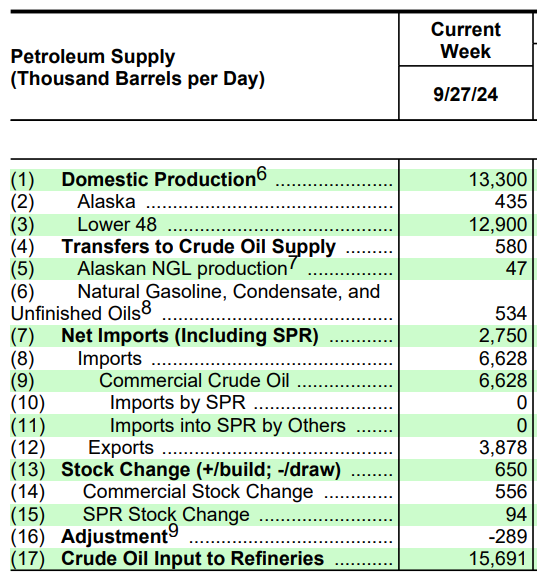
Today the USA both imports petroleum and exports it. The supply of crude oil and gas depends on contractual obligations and who is willing to pay the highest prices.
The United States in a net O&G exporter. Between imports and domestic output, the US is currently processing enough O&G for our needs with surplus to export. And what will an increase in domestic fracking really do for the US, again pricewise? It can increase the production yields at individual O&G wellheads bringing greater volume for the O&G producer over time. Done properly, fracking makes sense. However, if fracking provides a conduit for natural gas, oil or produced water into ground water, then it can be irredeemably harmful for those so affected.
Even if domestic O&G production is increased and released into the market, the near-term problem will be limited refinery capacity. The lead time for building a large oil refinery can be 4-5 years from design phase to commissioning. Permits, financing and societal pushback can add considerable time. Putting a complex refinery in the ground can cost $5-$15 billion. Startup and adjustment of a refinery is time consuming, complex and can be a bit hazardous. Accidents during startup and shutdown are not uncommon.
The politically popular opinion that what the US needs is an increase in oil production to drive down retail gas and diesel pricing rests on specious assumptions. The government provides regulatory oversight in many aspects of O&G production and refining. In my view, government oversight in regard to environmental protection and worker safety is of critical importance. Global free market control of O&G production and distribution, while often heavy handed and seemingly heartless, is the best model we have at present for production and distribution of hydrocarbon-based goods to consumers. For a historical example of government control of supply and distribution, we can look at the Soviet Union and its authoritarian centralized control of nearly everything. The Soviet model of governance and production of goods and services failed spectacularly by 1991. The leadership of the USSR dissolved the Soviet system themselves after concluding that it was no longer workable. For all of its many flaws, the overall western model of capitalism continued to thrive.
In short, it only makes sense to increase O&G production to keep retail fuel prices low if the refineries demand more crude to meet their distributor’s demand. Refined fuels could be imported for distribution here, but an uptick in storage capacity will likely be required. Refineries are fundamentally limited by their processing capacity. Refineries, like most manufacturing operations, are designed to provide an optimum output with the installed equipment. Greater throughput requires larger equipment or additional process streams
Anecdote: Every day I pass through the intersection of an east/west state highway and a north/south interstate highway. On the west side of this busy intersection there are four gas station/convenience stores competing for our gasoline and diesel business. Just a block to the west is a stoplight and at the four corners of this are three of the gas stations with direct access to the light. The fourth is not at the light so entry or exit to this station is not controlled by the light. During the early morning commute time, the four electronic signs indicate morning prices that invariably are $0.20 to $0.60 lower than mid-day prices. The tall electronic signs allow for convenient rapid response to competing prices. One station is beyond the single stoplight intersection, so both exiting eastbound vehicles and entering eastbound vehicles who need to turn left across uncontrolled heavy traffic have to wait for a break in the congested traffic. This is a competitive disadvantage for them. The other three stations have direct access to the stop light. Co-incidentally, the traffic-disadvantaged station nearly always has the lowest prices first. This tends to set the stage for a daily price war. This morning the 85-octane gasoline price was $2.719 at all four stations.
There are some plusses for the disadvantaged station mentioned above. Unlike the other three stations there is room for 18-wheelers to fill their tanks with diesel and park overnight next to a cheap motel and a Waffle House (Hey! Waffle House hash browns are the greatest). The left turn across traffic disadvantage to 4-wheelers is only a minor obstacle to the 18-wheelers using the station since they are apparently fearless in pulling into heavy traffic to execute a turn.
Econ 101 Conclusions
Like everything else, scarcity applies pressure on hydrocarbon prices up and down the supply chain- from wellhead to fuel tank. National politics can play a role in hydrocarbon pricing if it threatens to alter scarcity in some way. In chemical kinetics we are interested in finding the rate limiting step in a multistep chemical reaction. This step is the bottleneck that controls the overall reaction rate. In much the same way, a bottleneck in a supply chain will control the rate of output of a given product. The rate of delivery through the bottleneck controls the rate of wealth creation for those in the supply chain. To increase the rate of wealth creation, one must multiply the number of these bottlenecks in parallel or design a new bottle with a larger neck. Importantly, the rate of wealth creation can be a winning positive or a losing negative number. Excess capacity anywhere in the chain results from excessive money spent on unneeded production scale.
Note: There is much more to the macroeconomics of O&G production than what I have addressed. The economics of O&G production and distribution in the US depends on policy and regulatory factors as well as considerable anticipation and speculation (gambling) in the marketplace. Despite this, it is possible to make certain very broad statements in the context of general supply and demand principles. The finer, high resolution, details can be found elsewhere.
Note: First, let me make clear that I am not a computer scientist and while I’ve learned FORTRAN, BASIC and PASCAL in the early 1980’s followed by coursework in quantum chemistry in grad school- and somehow passed– the question of how quantum computation actually computes with qubits remains a mystery to me. Honestly, I’m weary of hearing about it. That said, I do continue to worry about the ever-increasing pressure on the liquid helium tit which quantum computing will definitely lock on to.
An interesting article came out in the current issue of Quantum Magazine giving some straight talk about how quantum computers might actually be used. All of us have been bombarded by breathless predictions of a wondrous future where we can find prime factors of stupidly large numbers and crack very secure cryptography.
Quantum chemistry is about orbiting electrons confined to particular regions of oddly shaped space around a positively charged nucleus, depending on their energy. That is a lifetime of study right there for me. I think I’ll stick to atoms and molecules.
Oh yes, in the early 80’s we used an IBM 360 and submitted our batch jobs as a stack of punch cards. Eventually we were allowed to use the DEC writer for BASIC programming. One sunshiny day an Apple 2 appeared in the chemistry department office. It had 16 K of memory, a green monitor and an external floppy disk drive. There were whispers that 32 and maybe even 64 K were on the horizon. Heady stuff.
There is an interesting substack post by historian and NYU prof. Ruth Ben-Ghiat discussing the latest filing by Special Counsel Jack Smith that was just unsealed and released by Judge Tanya Chutkan. The full 165 page document can be found here. Boiled down, the filing makes the case Trump is not immune from prosecution.
Ben-Ghiat summarizes-
”At its core, the defendant’s scheme was a private one,” the prosecutors’ document reads. “He extensively used private actors and his campaign infrastructure to attempt to overturn the election results and operated in a private capacity as a candidate for office.”
On that basis, the filing argues that Trump is not entitled to the immunity from prosecution granted him by Clarence Thomas, Samuel Alito, and other far-right ideologue-justices of the Supreme Court; that ruling would grant immunity for “official acts” executed as president.
The article goes on to say that Trump uses a ‘personalist’ model of governance where his personal, legal, political and financial needs take precedence over the party and the nation. And his needs are endless. The GOP is his personal storehouse of resources. His close followers are individuals who are strongly loyal to him and his mystique. He can convince others to conduct unsavory or even criminal acts, and when they fail, he’ll find someone else. This is not without precedent in the history of authoritarians.
The word ‘Lawfare‘ seems appropriate to Trump’s method courtroom delays and litigating to the hilt to sow confusion, expense and delay. it works, but is hugely expensive. Trump has been a wellspring of billable hours for the legal profession.
I just read that conservative influencers and even former president Trump have been referring to VP candidate Walz as ‘Tampon Tim’ over the state law mandating free menstrual supplies be available in grades 4-12 in Minnesota schools. The issue for some is that these supplies be made available to all needing access to the products, including transgender students, in whatever restrooms commonly used by students.
Editorial
I grew up in an America where such juvenile and scurrilous name calling would at least be kept out of the public discourse. It fell under the heading of “Mature and Common Decency” that most adults adhered to. That the insulting appellation “Tampon Tim” is being bandied about by a former US president in a presidential campaign watched by the world and being eagerly repeated by news outlets as infotainment. Even worse is the large population of MAGA citizens who accept and even encourage Trump’s troubling behavior. Trump is riding a wave that was already there waiting for someone like him.
Section 1. [121A.212] ACCESS TO MENSTRUAL PRODUCTS. A school district or charter school must provide students with access to menstrual products at no charge. The products must be available to all menstruating students in restrooms regularly used by students in grades 4 to 12 according to a plan developed by the school district. For purposes of this section, “menstrual products” means pads, tampons, or other similar products used in connection with the menstrual cycle.
The response by the Trump horde has been vigorous and execrable. Even #45 himself is calling Walz ‘Tampon Tim’ in the open.
“As a woman there is no greater threat to a woman’s health than leaders … who support putting tampons in men’s bathrooms in public schools,” Trump campaign spokeswoman Karoline Leavitt told Fox News on Tuesday. [Bold typeface mine] Source: CBS News.
Help me trace cause and effect here. ‘As a woman (ok, gender specific here) there is no greater threat to a woman’s health (a threat that could lead to what exactly?) than leaders … who support putting tampons in men’s bathrooms in public schools.’
What is the nature of the threat? Is it more threatening than male violence by murder, rape or physical abuse, because murder, rape and physical abuse is pretty bad already, right? How could a ‘tampon threat’ play out? What could men/boys do with a tampon, a wad of compressed fiber on a string, that would rise above an immature prank? A prank that would likely be played on boys by other boys?
Oh, right. Karoline said that the threat was from ‘the leaders … who support …’. So, what kind of harm could women suffer from a leader who makes free feminine hygiene products available in the public schools? Her statement obviously signals ‘danger’ from tolerance for transgenderism. The matter of gender dysphoria is listed in DSM-5-TR as a recognized condition, but not a mental illness. The Journal Psychiatry has a short and readable paper on diagnosing gender dysphoria. From the article, Gender dysphoria is ‘a marked incongruence between one’s experienced/expressed gender and primary and/or secondary sex characteristics.’
Conservative protestant evangelical leaders and many GOP politicians who rage about the illegitimacy of gender transition have taken the path of idiocy and are happy to be there. Gender dysphoria is a medically recognized condition based on a minimum set of criteria. Those so afflicted often lead lives of misery that frequently ends in suicide.
This sounds like little more than a regression to the Victorian age taboo about discussing the female body and its physical processes. Or the entire subject of sexuality.
In this case I tend to think that being a female making ridiculous claims about an exclusively female topic does not afford refuge from criticism, but only boils down to a person being a dipshit trying to influence others by stoking brainstem-level fear. This is the usual Republican means of grabbing power.


 Lamentations on Chemistry