Category Archives: Current Events

California to Decriminalize LSD

San Francisco, California. 11 July, 2008. In a landmark decision, the California Supreme Court ruled in favor of decriminalizing the psychedelic drug LSD.  The divided court ruled 4 to 3 in favor of striking down as unconstitutional the 48 year old statute banning recreational use of the substance.

Supporters and opponents alike held a contentious vigil outside the Earl Warren Building in San Francisco friday afternoon. The long anticipated Ergotte-v-State of California case has been a lightning rod for criticism and praise around the nation.

Dr. Besnik Keukomber, Chiquita Professor of Economics and Olfactory Studies at Pultroon College in Guapo, AZ, stated in an interview with CNN reporter Robert Stiphey that “This change is welcome in some large market sectors. LSD prices have been distorted by the unfortunate statutory freeze rendering the product illegal. The action of the court has put the supply of this product back on a rational economic basis. We are concerned, however, on the negative effect it will have on sellers of the LSD once the price drops.”

Pilsner Pharma Group stocks rose 5 % today on news that the pharmaceutical giant would start construction on a lysergamide processing facility in Quasimont, California. “We have been anticipating this for quite some time” stated CEO Hedrick van Preener.

Harriott Hotel Group announced that they will offer Psychedelic Suites in flagship hotels in selected California cities. Guests will have the opportunity to relax in the safety and comfort of a plushly padded suite and experience the pleasure of a supervised psychedelic experience. For the safety of the guests, psychedelic suite balconies have been replaced with a computer animated view courtesy of Industrial Light and Magic.  The initial floor of Psychedelic Suites will open at the Marquis in Los Angeles in Late 2010.

Not all are pleased, however.  Ephraim “Scarface” Erdstein, a South Bend, IN, drug kingpin operating out of a laundromat storefront said through his attorney that he plans on waging an appeal to the US Supreme Court in an effort to support prices by halting this unfortunate trend toward legalization. 

Roland Basbo, spokesman for “Tatoo Nation”, the national Tatoo Parlor trade association, expressed concern for declining business. Basbo said “We believe that as the demographics of LSD users moves upscale, the demand for body art will see a modest decline. We’ve noticed that boomers are freaked out by skin art in the middle of an acid trip”.

Jupiter Launch Vehicle Proposal. Safer, Simpler, Sooner.

The Space Shuttle Program is scheduled for shutdown sometime in 2010. At that time the reusable, tiled spaceplane concept (STS) will be put to rest in favor of the capsule-on-a-rocket design.  According to plans, there will be a 5 year interlude between the retirement of the shuttle and the implementation of a new man-certified lifter. Many have suggested that this idle period with no manned launch activity could lead to a brain drain in the ranks of skilled aerospace workers.

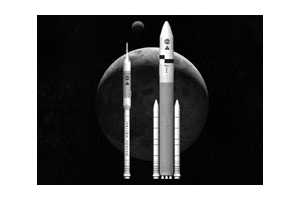
The successor to STS is the Ares Launch system consisting of a man lifter (Ares I) and a cargo lifter (Ares V).  Ares I is a two-stage system that will take a crew of 4 to 6 into low earth orbit. This vehicle will carry  55,000 lbs of provisions and astronauts to the ISS.  Additionally, it will be used to lift a lunar exploration team into orbit for docking with the lander module placed into orbit by the Ares V lifter. 

Ares V is a heavy lifter and is expected to be able to place 414,000 lbs into low earth orbit or send 157,000 pounds of payload to the moon.  Ares V uses two solid rocket boosters derived from STS and a central H2/O2 liquid fueled rocket using a cluster of 6 engines derived from the Delta IV system.

Ares I & V. Photo Credit- NASA

NASA has awarded contracts for this program and work is underway.

What has recently transpired is an alternative system proposed by a group of engineers. This system is called DIRECT, and involves the use of a single lifter called Jupiter.  The Jupiter lifter is derived directly from the STS lifter which consists of two solid rocket motors and a central H2/O2 tank which feeds the shuttle engines.  The DIRECT system would take advantage of existing technology, but with the addition of an O2 tank extension, a cargo section, and a cluster of engines to the existing liquid fuel tank. The proponents of this system claim that their system could get the next phase of manned space flight going sooner, simpler, and safer.

It is an interesting proposal. I hope it gets some serious consideration by the Congress.

InBev Chugs St Louis Utility Beer Maker

It is surely a sign of the End Times. Just as sure as the Four Horsemen of the Apocalypse and cats sleeping with dogs. A Belgian company buys Anheuser-Busch.  Wow.  Just the thought of it is too much for me to get my arms around. Michelob now has a kissin’ cousin named Stella Artois. 

What was that old brain teaser an Austrian colleague once asked-

Can you name 10 famous Belgians? 

I agree. It is a bit outrageous. I’m sure there are as many as 20 famous Belgians.

Who knows? This may be the European connection NASCAR has been looking for.  Watery beer, fast cars, and drunken hooligans. It’s universal.

Mt. Kraznydang Climbers Perish in Avalanche

5 July, 2008. Boulder, Colorado. The climbing community mourns today as the recovery of six bodies continues from the 2008 Mt Kraznydang expedition.  A makeshift morgue was set up in the capital city of Bleeny, in the Zapore Islands off the Kamchatkan coast near Gnoyniechok, Siberia. The international climbing team was lead by Gon Anandachopbalmanchoda, well known Thai explorer, climbing apparel designer, and raconteur.

Mt Kraznydang is the tallest mountain in the Podguznik range in the volcanic Zapore island chain. Also known as Stalin’s Carbuncle, 33,459 ft Mt Kraznydang has resisted several attempts at its summit since its height was revised in 2005 by satellite radar, making it the second tallest peak on earth.

The Anandachopbalmanchoda team was reportedly near the summit when an earthquake loosened a bank of snow, bringing the team careening down to the 9000 ft level in the avalanche. The last radio transmission was from an unidentified climber who exclaimed ” … Oh, for Petes sake!! … Son of a(garbled) … refund! (static)….”.

Bleeny is the Sister City of Boulder, Colorado. Services will be held at the Podguznik Mountaineering Center on the Pearl Street mall. Donations are appreciated.

From NIMBY to BANANA

The 2005 government report entitled Peaking of World Oil Production: Impacts, Mitigation and Risk Management, by Hirsch, Bezdek, and Wendling, is a sobering tally of the current picture of oil production and consumption in the world today. Often referred to as the Hirsch Report, the authors take a “now shot” of the global oil production scene and speak directly to the matter of mitigating the approaching economic disruption that must usher an unprepared nation into a future of peak and declining oil production.

If you read the Hirsch Report and pay attention to current events, you may be gripped by a kind of cognitve dissonance, or a haunting sense resembling a schizophrenic episode of contradictory voices in the collective consciousness.  While the global warming showboat is paddling up and down the Mississippi blowing steam and calliope music, nationalized oil producers are failing to answer calls for increased production in reply to a dramatic ramp-up in petroleum demand. Some call for increased exploration and others call for drop in replacements for petroleum. All the while, evidence accumulates that the ecosystem suffering from consumption and waste generation.

As with any discussion involving economics, it is possible for people to speak imprecisely when discussing supply and demand. Econobrowser takes Hirsch to task in this manner. It seems that many of us confuse demand with desire.

Supply equals demand today, supply will equal demand in 2025, and supply will equal demand in 2050. Whatever Hirsch means by “peaking of world conventional oil production,” it certainly isn’t the condition that “production will no longer satisfy demand.”

Our news media, now almost fully morphed into a perverse mix of gibbering Bill O’Reilly clones and entertainment news programming, prattles endlessly about the hurtful gasoline prices and truncated vacation plans. Government makes flatulent noises about more drilling, but hardly a peep about reduced consumption.  Where is the journalist corps? Who is asking the tough questions?

In isolation, either climate change or an exponential oil shock are more complex than nimrods leaders in the Bush administration can process. Together, these stresses add up to a major challenge to the way we live.  Maybe the situation is more complex than any nation can reasonably respond to. With global prosperity comes global demand for resources.  Western nations have built a house of cards based on cheap petroleum. Instead of wage growth in the past 20 years, we have been given easier access to credit. Instead of increased savings, we have found ways to burn up discretionary income.

A major part of what has to happen to adapt to the new reality of petroleum scarcity is a remodel of our infrastructure. We need more passenger rail lines and terminals with the necessary right-of-way issues taken care of. Workers need to live closer to their place of employment. The airlines have to figure out how to operate profitably with reduced passenger miles. We must upgrade our electric power distribution system to accommodate the increasing reliance on electrical energy. If wages do not change, we must adapt to having less discretionary income to spend. 

But a remodel of infrastructure will require that we adapt to living nearer to it. In the past, a proposal to build a power plant is met with a chorus of outrage or “concern”. It used to be called NIMBY- Not-In-My-Back-Yard.  The latest acronym is BANANA- Build-Absolutely-Nothing-Anywhere-Near-Anything. New power transmission lines and generating plants will have to go up and it will have to happen somewhere. People naturally fret about real estate prices and their view from the dining room window. I foresee more exercise of eminent domain in the future.

Farewell George Carlin

June 22, 2008, Santa Monica, California. Comedian and satirist George Carlin died sunday evening after checking into a Santa Monica hospital complaining of chest pains. He was 71.

Carlin was a brilliant social satirist and comic. He had the ability to look at ordinary things from a different angle and see the obvious obsurdity in things most of us accept as simple background noise. This is one of the key attributes of a successful satirist and comedian.

I think it’s the duty of the comedian to find out where the line is drawn and cross it deliberately. 

The very existence of flamethrowers proves that some time, somewhere, someone said to themselves, “You know, I want to set those people over there on fire, but I’m just not close enough to get the job done.”

I went to a bookstore and asked the saleswoman, “Where’s the self-help section?” She said if she told me, it would defeat the purpose.

There’s no present. There’s only the immediate future and the recent past.

Not only do I not know what’s going on, I wouldn’t know what to do about it if I did.

-George Carlin

Carlin was a serial quipster who pushed the boundaries of social norms. His Seven Dirty Words ended up as the center of a 1978 Supreme Court ruling that affirmed the right of the state to bar “indecent” of speech on the public airwaves.

While it is common for contemporary comedians to exploit “indecent” speech for shock value today, few seem to have the facility with language that Carlin had. He was able to reduce to a few short humorous sentences the dark uncertainties that many of us have with common subjects.  Carlin’s observations on taboo subjects put him well ahead of his time.

Secular Marriage. Gaussling’s 8th Epistle to the Bohemians.

Below is a comment that I left on the Volokh Conspiracy some time ago. Rather than squander perfectly good ramblings there, I have reproduced it here and attached a link.  Th’ Gaussling

Broadly, we have two kinds of marriage in the USA. One is before a god and the other is before the state. Marriage before a god is a supernatural arrangement that is beyond the scope of this letter.

It would seem that the states compelling interest in marriage is mostly confined to the disposition of debts, assets, and minor children during the marriage and in the event the marriage fails. Married partners have an obligation to the welfare of minor children born to them or adopted. Married partners also have a status that allows for decision-making in critical care situations. It seems to be a kind of partnership whereupon responsibility for the secular aspects of married life are defined. After all, the state is called in to make decisions as to the disposition of civil matters in the event of a divorce. Surely the state can clearly define certain basic responsibilities and privileges in advance.

The moral/spiritual aspects of marriage “can” be interpreted as being perpendicular or orthogonal (like the x and y axes in a graph) to the legal dimension of property rights and other secular aspects of married partners. The state is without supernatural powers, thankfully, so it is inherently impotent in the spiritual dimension. If that is the case, and in the absence of a uniform interpretation of supernatural governance, it should be silent on spiritual matters.

The state should have no interest in how married partners conduct their lawful affairs beyond the normal confines of civil and criminal law.

A code defining the responsibilities of married partners in a variety of configurations could be modeled easily. If you accept the premise that secular marriage is confined to the mundane matters that are already contestable in a court, then it is a simple matter to imagine same sex or plural marriages under the same constraints. What is the compelling interest of the state in barring same sex partners from having automatic authority in giving comfort to a dying partner? We already have codes regulating many other kinds of complex relationships between people- corporations, partnerships, LLC’s, government, etc. Minimally, the state should entertain the prospect of recognizing limited entry of some new definitions of marriage to adult parties wanting to be responsible members of society with the rights and responsibilities thereto appertaining.

Verbund Manufacturing

German manufacturing culture does many things very well, but a few things particularly stand out. One of these items pertains to the concept of verbund manufacturing. Verbund simply means “integrated” or “linked”. Verbund manufacturing sites are clusters of manufacturing units that take advantage of proximity. Clustering can offer certain logistic and energy advantages if done intelligently.

A cluster of manufacturing sites can operate and share a co-generation plant for the distribution of steam, waste heat, and electricity. Large capital items like steam plants can be shared so funds can be plowed into larger scale for better economy. Rail operations and other transportation resources can be shared as well. Clustering also provides for the possibility of vertically integrated manufacturing on site and a reduction in transportation costs.

Clustered manufacturing may also have the effect of concentrating the supply of skilled workers for the labor pool. A manufacturing nexus can attract community colleges and other vocational opportunities for the next generation of employees.

The USA has many manufacturing sites where similar industries congregate. Look at the Gulf coast with all of the refinery locations. But the extent to which there are synergistic interactions between companies is unclear.

In the US, corporations tend to behave as the Republic of Exxon or the Republic of the Union Pacific. This kind of a fragmented confederation of corporate states is becoming obsolete as we go up against nationalized business entities that control key resources and trade. The key to future vitality is greater efficiency with resources. Synergistic cooperation is one model that is available. But to do this requires trust and the desire to cooperate for mutual benefit. Competition begets gamesmanship and posturing which works against the verbund model for US businesses.

US corporations have much to learn from this business model.

Chemists and Engineers

What would happen to innovation in chemical technology if we had a more intimate comingling of chemistry and the engineering sciences?  What effect would there be on the stream of chemists graduating into the world if more schools had a chemical engineer on the chemistry faculty? Could a single engineer on the faculty actually make a difference in altering the direction of the boat a few degrees?

Why is such a change desirable? One way to change the trend of deindustrialization and economic repositioning of manufacturing out of North America is to stimulate innovation in the industrial sciences. To do this we can rely on business leaders individually to formulate strategic plans to upgrade plants and processes by way of step changes in technology. But for business leaders, the calculation for such a change must also take into account the alternative of moving production to another country. Many times it is easier and faster to move production to China rather than taking a gamble on the invention of better technology. A large amount of pharmaceutical manufacturing has been shifted to China, Mexico, and India for this very reason.

To rely on business leaders (top down) to ramp up innovation really means that one is relying on the market. While letting the marketplace drive the economics and distribution of manufacturing has a certain appeal to purists, the global marketplace is highly distorted by government and taxation. Letting “pure” market forces govern innovation as the sole driver is to bet all of your money on a horse that limps.  Why not find ways to stimulate innovation with an improved stream of chemical innovators and a renewed urgency?

Universities do this all of the time. But it is my sense that other disciplines perhaps do this better. It is all too easy for we chemists to invent a reaction or composition, publish it, and then move on to the next outcropping of opportunity. We do this thinking that surely somebody will pick up the ball and run it to the end zone of commerce.

But for any given paper published in SynLett or JOC or ______, the likelihood of commercialization is low. It is not automatically the role of academic science to drive its work towards commercialization. That has been the role of engineering. 

What has been lacking is more significant early overlap of the two disciplines. For a chemist to truly be a part of bringing a transformation to the manufacturing scale, the chemist has to begin thinking about how to prepare the chemistry for the big pots and pans. This is what the art of scale-up is about. And in scale-up, the practice of chemistry has to overlap with the practice of engineering.

Industry already provides for itself in this way by training chemists to do scale-up work. This kind of work has always been beyond the scope of academic training.  But what if there were a course of study wherein chemistry faculty and students could more thoroughly address the problems of chemical manufacture? What if engineering concepts would be allowed to creep into the training of chemists?

Chemistry faculty would begin writing grants for process oriented research. Schools without engineering departments might start hiring the odd engineer or two in an effort to “modernize” the chemistry department.  Gradually, a department might become known among recruiters and donors for producing a strain of BS, MS, and PhD chemists who are already adapted to process research.

It is important to stress that the goal is not to plop conventional engineering curriculum into the chemical course of study.  That will not work. But what is possible is to build a minor in industrial chemistry applications. This pill will be easier to swallow for the P-chemists because in short order it would be apparent that chemical engineering is heavily loaded with physical chemistry.

I have tried to make a case that one way to make a positive influence in chemical innovation in North America is to begin a grass-roots effort to stimulate the culture of chemistry. I believe that providing an avenue of study that includes early exposure to engineering and process economics will stimulate many more students and faculty to make significant contributions to entrepreneurism and industry.

The Chemistry Curriculum

It is time to have a frank talk about the fundamental merits of the college chemistry curriculum. This plan of study has remained substantially unchanged for decades (see comment by bchem). Certainly minor changes occur through nudges and bumps here and there pertaining to details. But in the last generation has there been a dialog or debate on the fundamental assumptions of the common curriculum? And I refer specifically to the ACS certified curriculum, which has been the gold standard across the country. Major changes that I have been witness to mainly accomodate an increased emphasis on biochemistry or new computerized instrumentation. 

The undergraduate chemistry curriculum is a very logical and thorough survey of the three pillars of chemistry- Theory, synthesis, and analysis. This covers the fields of inorganic, organic, physical, analytical, and biochemistry. Along the way we teach a few other areas of specialty by way of electives.

The current program of chemical pedagogy is certainly true to itself. There is genuine concern and care to avoid dilution of the content and over-inflation of grades, generally. The core domains of the subject are sorted out and given special consideration. Much work has been done to spark interest in the field and textbooks seem to be written quite well as a rule.  Resources like J. Chem. Ed. are a continuous stream of clever tools and tricks to make the subject more plain.

Our colleges and universities have been quite good at churning out chemical scholarship. And students are given scholarly exposure in their learning program. Not surprisingly, scholars are very good at producing more scholars.

But has the academy been keeping up with the role of chemistry in the world?  Just look around. How many CEO’s and upper executives in the top 100 chemical companies are chemists? I have not seen this statistic tabulated. But I am confident that relatively few chemists populate those ranks. Those that do often arise through marketing or finance channels.

But why should they? The field of chemistry attracts people interested in science, not business. Chemical educators have a responsibility to educate chemical scientists with a minimum proficiency in the field.  That requires a minimum number of semester hours of coursework within a 4 year period. There is only so much a department can do and so much a student can absorb.

Yet, the purpose of a college education is to prepare a student for a productive life. A learning program that is internally consistent but blind to the needs of the external world is a fantasy. Have we come to value programmatic tidiness more than practicality?

Chemistry is a highly practical field. It involves problem solving and production. Chemists make stuff. Chemists solve problems. Chemists are specialists in the transformation of matter. But chemists do not operate in a vacuum. They do their work for organizations, and there is the rub.

By training, chemists are woefully prepared to function outside the laboratory. And as a direct result, chemists are poorly prepared to leave the lab and function elsewhere in the organization.  Traditionally, education in the organizational arts has been considered on-the-job training. In a sense this is not unreasonable. How can educators anticipate the needs of a student 5 years into the future? 

What is under appreciated by educators and students alike are the many opportunities that will follow for a chemist in industry. Many if not most chemists will come to a fork in the road in their careers. Will they stay in the lab or will they go to the business side? Usually, the path to greater opportunity in a business organization is the business side. Technical sales, customer service, marketing, procurement, management, etc.

I am not proposing that chemistry faculty teach coursework that cover such material. I am trying to suggest, however, that chemistry departments take a closer look at what an industrial career really looks like and try to anticipate a few needs that will arise as a result of this career path. Advisors can talk to students about the possibility of a business minor. An accounting or marketing class could be very helpful for a student who is uncertain about his/her career path. These are painless actions that can be of great use to a graduate.

But there is more than the passive approach of suggesting alternatives to undergrads. There is a more active approach that would definitely serve the needs of students and society alike.

Elective coursework covering intellectual property and patents, business law, the regulatory world (TSCA, EPA, OSHA, CERCLA, REACH, etc.), industrial hygiene, and perhaps most importantly an introduction to chemical engineering. This last item I cannot overemphasize.  Chemical engineering includes the basics of unit operations, process economics, thermodynamics, and controls. I would offer that the whole package could be called Industrial Chemistry. 

There are junior college programs for chemical operators that do provide exposure to some engineering concepts. But this isn’t necessarily for management track graduates.

I would offer that the department with an industrial chemistry program would be very successful in job placement as well as attracting new majors.  Comments?