Category Archives: Current Events

Reply from Senator Salazar

Recently, I wrote a letter to Senator Salazar, (D)-Colorado, to voice my dismay at his Yea vote for S. 3930.  Below is the reply.  It took 10-14 days to send the reply, suggesting that perhaps an actual person read it- some staffer, no doubt. It was addressed to my proper name, but for the blog I changed it to Gaussling.

Dear Gaussling[name changed to protect the innocent- Ed.]:

Thank you for contacting me regarding the detainment and treatment of prisoners captured by the U.S. in the war on terror. As you know, the Senate recently dealt with these issues during its consideration of S. 3930, the Military Commissions Act of 2006.

I voted for this legislation because I believe we need to jumpstart the process to determine the guilt or innocence of hundreds of people the Bush Administration has held in captivity and in limbo for years. Some of these individuals are guilty; others may not be. But until now, no process has been in place to move forward with these prisoners.

I fought the Bush Administration’s proposal to abandon the Geneva Convention and allow torture of persons in captivity. I joined with Democratic and Republican Senators to ensure that the final bill preserved the Geneva Convention and barred torture. The final bill also requires evidence to be shared with defendants so they have the ability to defend themselves and bars the use of any evidence obtained by torture.

The final bill has its faults. It does not include the right of habeas corpus for these prisoners. I fought to include the provisions of habeas corpus,and the Bush Administration and Republican leadership resisted these efforts. I will continue to fight so that these prisoners may petition the courts.

Finally, I voted for a Congressional review of the entire system within five years. This effort was defeated by the Republican leadership. Please be assured, though, that I will work with my colleagues to ensure that thorough oversight and a meaningful review of this legislation occurs.

Again, thank you for writing.

Sincerely,

Ken Salazar
United States Senator

Politics is about compromise.  Sen. Salazar’s motivation was to get something moving. I’m not privy to the details, so it is hazardous to second guess.  Still, I wish that the Democrats could have mustered more of a unified vote. Dems today seem to be just a tossed salad of left-leaning ideologies whose unifying trait is that they are not Republicans.

And speaking of Dems, the article in the current Atlantic about Hillary Clinton is very interesting and worth the time to read. 

Now, I am become Death, the destroyer of worlds

The news of North Korea’s announcement of the detonation of their first nuclear weapon is reverberating around the world.  It is certainly an unwelcome development if true.  Now the question is, can that junior varsity Stalinist Kim Jong Il resist the temptation to use it in a warshot? Or, sell copies to a growing list of unwholesome groups bent on the delivery of radioactive hellfire to the infidel crusaders?  What may actually be worse than having one go off in the US is our possible response and the cascade of events that follow.  What would we actually do? Whose home soil would we vitrify in our wrath? Whom would we smite? I fear that our reply would have an Old Testament ring to it. 

 I’m reminded of the famous quote by J. Robert Oppenheimer-

We knew the world would not be the same. A few people laughed, a few people cried, most people were silent. I remembered the line from the Hindu scripture, the Bhagavad-Gita. Vishnu is trying to persuade the Prince that he should do his duty and to impress him takes on his multi-armed form and says, “Now, I am become Death, the destroyer of worlds.” I suppose we all thought that one way or another.

I vaguely remember talk of the nuclear genie when I was a skinny Iowa farm boy in the 1960’s.  Knowledgeable people assured that once the nuclear genie was out of the bottle there was no putting him back in.  North Korea and Iran remind us that the nuclear genie is still out of the bottle.  And while we worry less about a barrage of ICBMs flying over the north polar cap towards us, or Warsaw Pact forces storming into western Europe, we are stirred out of our slumber by third or fourth tier states cobbling together a fission apparatus. 

An hour and a half drive from where I am typing this can be found missile silo’s.  Deep underground in undisclosed locations Air Force Missileers monitor the status of their squadron of missiles while maintaining readiness.  Kim Jong Il’s shenanigans have brought back an immediacy to the matter.

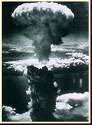
 Mushroom Cloud

Kim is aware that the fact of power is the act of power. And swinging around a nuclear bomb is definitely an act of power.  The real danger of a North Korean Bomb isn’t just in the immediate threat to possible victims. The larger threat lies in how the existying nuclear powers respond.  Once a North Korean nuclear bomb is triggered in anger, restraint will fly out the window. It would be a difficult time for the North Koreans and whomever bought their bomb.

Civis Romanus Sum

I am a Roman Citizen- Civis Romanus Sum. A friend sent along a link to a NYTimes article by Robert Harris, drawing certain parallels between the attack on the Roman port of Ostia in 68 BC and the 9/11 attack-

“The incident, dramatic though it was, has not attracted much attention from modern historians. But history is mutable. An event that was merely a footnote five years ago has now, in our post-9/11 world, assumed a fresh and ominous significance. For in the panicky aftermath of the attack, the Roman people made decisions that set them on the path to the destruction of their Constitution, their democracy and their liberty. One cannot help wondering if history is repeating itself.

Consider the parallels. The perpetrators of this spectacular assault were not in the pay of any foreign power: no nation would have dared to attack Rome so provocatively. They were, rather, the disaffected of the earth: “The ruined men of all nations,” in the words of the great 19th-century German historian Theodor Mommsen, “a piratical state with a peculiar esprit de corps.”

The article goes on to detail how 38 year-old Gnaeus Pompeius Magnus (Pompey) contrived to obtain unprecedented and unchecked authority over the military and the treasury.  Harris goes on to describe what happened-

“By the oldest trick in the political book — the whipping up of a panic, in which any dissenting voice could be dismissed as “soft” or even “traitorous” — powers had been ceded by the people that would never be returned. Pompey stayed in the Middle East for six years, establishing puppet regimes throughout the region, and turning himself into the richest man in the empire.”

I don’t want to put too fine a point on the comparison, but the action by Pompey is considered by some to be the end of the Roman republic.  Harris goes on to say- 

“In truth, however, the Lex Gabinia was the beginning of the end of the Roman republic. It set a precedent. Less than a decade later, Julius Caesar — the only man, according to Plutarch, who spoke out in favor of Pompey’s special command during the Senate debate — was awarded similar, extended military sovereignty in Gaul. Previously, the state, through the Senate, largely had direction of its armed forces; now the armed forces began to assume direction of the state.

It also brought a flood of money into an electoral system that had been designed for a simpler, non-imperial era. Caesar, like Pompey, with all the resources of Gaul at his disposal, became immensely wealthy, and used his treasure to fund his own political faction. Henceforth, the result of elections was determined largely by which candidate had the most money to bribe the electorate. In 49 B.C., the system collapsed completely, Caesar crossed the Rubicon — and the rest, as they say, is ancient history.”

History does not repeat itself, but particular scenarios seem to recur.  Power, once granted to a leader, is seldom returned to those who abandoned it.  US Senate bill 3930 sets a bad precedent for our republic. I believe that too much authority is granted to the executive branch in the bill. Something as fundamental as habeas corpus should be treated like national treasure.