Category Archives: Current Events

Amassing Cannon Fodder is an Old Soviet Tactic

After reading a biography of the Russian Marshal of the Soviet Union, Georgy Zhukov, it becomes apparent that there are parallels between Soviet tactics in WWII and those used in the Putin-Ukraine conflict. Beyond the deployment of similarly vintaged tanks and weaponry, General Zhukov was notorious for committing his forces to battle with little regard for casualties. Similarly, Putin’s military has been characterized by the use of inadequately trained and equipped conscripts. Additionally, it has been reported that Putin’s forces have positioned troops behind the front lines to prevent or even target any deserting or retreating frontline soldiers. Zhukov’s approach often involved rapidly advancing battalions and armor to the front with minimal planning, depending on the attrition of Nazi forces. This tactic was typically executed under Stalin’s direct orders, though sometimes initiated by Zhukov independently.

The conflict between Putin and Ukraine has evolved into a war of attrition. Initially, Putin thought he could swiftly deploy tanks and troops as he did in southern Ukraine in 2014, seizing territory through sheer intimidation. However, he miscalculated the armaments, determination and tenacity of the Ukrainian forces. Since 2014, tens of thousands of Ukrainian soldiers have received training from Western nations. By February 2022, they were significantly better prepared and less intimidated by Putin’s military. In conventional warfare, the Russian military turned out to be a paper tiger, at least with its conventional non-nuclear forces, that is. The Putin-Ukraine war is still unfolding but Russia will come out of it severely stunted win or lose and possibly with new leadership. Whatever the outcome, the winner will have a great deal of de-mining to do. The conflict continues to unfold, but regardless of the outcome, Russia is likely to emerge greatly weakened, potentially with a change in leadership.

Putin is a smart guy. Certainly he knows the consequences of releasing as much as a single low yield tactical nuclear weapon, even if it’s limited to a demonstration. Pandora’s box would swing wide open and out would slink an ever-expanding series of repeats of above ground nuclear blasts until a city would be hit. Then all out nuclear war could happen in the old eye-for-an-eye fashion. Dark days would follow indeed.

Putin surely realizes the dangerous situation his county is in with mounting military losses, the brain-drain of skilled workers leaving the country and a crumbling oil and minerals-based economy. Yet he wears the neutral expression of the Sphinx in public because he must. He has painted himself and his nation into a corner. He even resorted to making nice with the plump North Korean dictator which must have been a nauseating demotion for him.

A bit of history

The Magna Carta was an agreement signed in England on June 10th, 1215, at Runnymede along the River Thames. This agreement had the unique provision of the enforcement of limitations on the sovereign. Rather than a simple recitation of grievances by the barons, the Magna Carta contained ‘security clause 61’ which provided for the barons the authority to seize the castles and lands of King John and hold them until such time as he held to his responsibilities as agreed upon in the signed document.

The Magna Carta was not just a contract between wealthy barons and King John, rather it was a step change towards political reform that provided for enforcement on the King. From Wikipedia

Unfortunately, the distrust between the barons and the Crown, compounded by the annulment from Pope Innocent III, led to its swift failure. Just a few months after the agreement fell apart, the First Baron’s War erupted. However, this was not the final chapter. The document was reissued in successive versions, with the more radical language removed, in 1217, 1225, and finally in 1297, when its remaining elements were incorporated into England’s statute law. It was not unique in its attempt to limit the power of the Crown; similar efforts were seen elsewhere. Over time, the Parliament of England enacted laws that overshadowed the original document, diminishing its significance.

Back to Russia

The point of highlighting the Magna Carta, despite its failure, is that nothing of this type of significance happened in the history of Russia, at least until the Bolshevik Revolution. Perhaps this comparison is too facile, causing real historians to choke on their Starbuck’s latte. But allow me to finish. The Magna Carta was not entirely unique for its era. However, it was notable for including a provision that enforced the good faith by the King. It represented a collective bargaining effort by the 25 barons with King John to alleviate some of the monarchy’s oppression and, in doing so, progress the political atmosphere for a short time with fits and starts. As kings often do, King John protested to the Pope, who then exerted his authority in a manner only a Pope could. The Pope excommunicated the Barons and nullified the agreement, having been persuaded by King John that it undermined the Church’s authority.

Russia seems not to have a tradition of producing successful popular uprisings to the power of the Tsar. of course, the Bolshevik revolution is the shining counterexample. Not in the sense of overthrow so much, but as an enforceable agreement to relieve a measure of oppression by the monarchy at all levels. In contradiction to this sweeping generalization is the case of Tsars Alexander I and II. Alexander I introduced minor social reforms but he was a strict Russian nationalist and Slavophile. Many of the reforms he instituted early in his career were retracted later.

Tsar Alexander II , however, instituted many liberal reforms but is possibly most revered for his Emancipation of the Serfs in 1861. In the US, he is remembered as the Tsar who sold us Alaska. He was a supporter of the Union in the American Civil War and even sent ships to New York Harbor and San Francisco Bay to deter Confederate warships. Eventually he was assassinated in Saint Petersburg on March 13, 1881. The first assassin’s bomb thrown under his armored carriage left him dazed but uninjured. The second assassin’s bomb thrown shortly thereafter delivered the fatal injuries as he stepped out to investigate. The third assassin’s bomb was unused.

Zooming forward to the present, what actions can the Russian populace take regarding Tsar Putin? After centuries of political oppression aided by new thinking, modern technology, and nuclear weapons the current Tsar has built a deep and wide moat around himself and his allies within the Kremlin establishment. Beyond this moat stands a population conditioned to obedience by fear, a legacy of decades of Soviet rule. I believe that national pride will deter them from emulating Western forms of civil society and governance. And why can’t they develop an authentically Russian something-something ‘democracy’, or whatever? Russia has deep foundation of cultural, artistic and scientific achievements to take pride in, despite its history of authoritarian governance. Whatever Russia eventually does, it will be heavily Slavic and Eastern Orthodox.

Russians are just as pleasant and smart as everyone else in the world, obviously. Russian hospitality is first rate as I have personally experienced. They just have the heavy blanket of oppressive leadership over them that continues to drag through the generations. Even if Putin falls out of power, there is a line of replacements cut from the same cloth. Perhaps a leader of a reform movement could rebuild Russia? It could happen but just as likely it could revert into a system that is better at prosecuting a war of aggression and suppression of the population. The replacement of Putin could be good for the world, or it could go sour. The world has to wait it out and see. In the meantime, it is critical to keep Putin out of Ukraine, Poland and the Baltic states.

The Putin government is like a toxic gas- it will expand into all of the space available. After the decades-long stand down in tension since the collapse of the Soviet Union, the problem of an aggressive Russia arises again. The West must remain the sturdy counter example to the authoritarian culture of Putin’s Russia. We in the USA, especially, need to do a better job as the shining city on the hill. Lately the shine is wearing off.
Aromaticity, Asphaltenes, Maltenes, Asphalt and Asphalt Concrete

9/11/24. At present numerous oil production platforms in the Gulf of Mexico have been evacuated because of Hurricane Francine. One of them is the “Who Dat” O&G field. The Who Dat field produces O&G with low wax content and no asphaltene flocculation. The origin of the phrase “Who Dat” comes from the Acadiana region of Louisiana. There are numerous claims to the origin of the phrase and there have been legal spats as to the trademark ownership of the phrase. The NFL in particular has thrown its ponderous weight around in the matter. The reader is encouraged dive into ‘controversy’ for themselves.

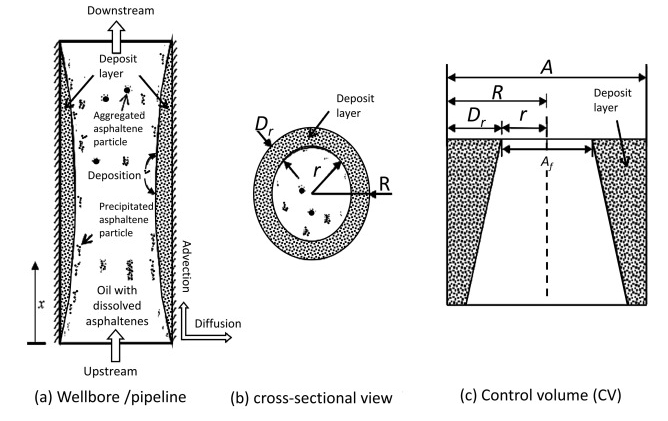
The low asphaltene-flocculation of the Who Dat field is fortuitous since asphaltenes can accumulate and choke the well bore or downstream piping, interfering with recovery. The graphic below is borrowed from a book chapter by Abdullah Hussein, Essentials of Flow Assurance Solids in Oil and Gas Operation, published by ScienceDirect in 2023. Fouling by asphaltenes can be removed by dissolution in aromatic hydrocarbons or detergents.

Source: Chapter 2 – Flow Assurance, Editor(s): Abdullah Hussein, Essentials of Flow Assurance Solids in Oil and Gas Operations, Gulf Professional Publishing, 2023, Pages 53-103, ISBN 9780323991186, https://doi.org/10.1016/B978-0-323-99118-6.00015-0 (https://www.sciencedirect.com/science/article/pii/B9780323991186000150). Reproduction of the graphic above is done under the Fair Use Doctrine.

As asphaltene-bearing oil rises in the wellbore, it will begin to depressurize and cool causing the asphaltenes to precipitate out of solution and aggregate, resulting in flocculation and fouling of the wellbore, downstream equipment and pipelines.

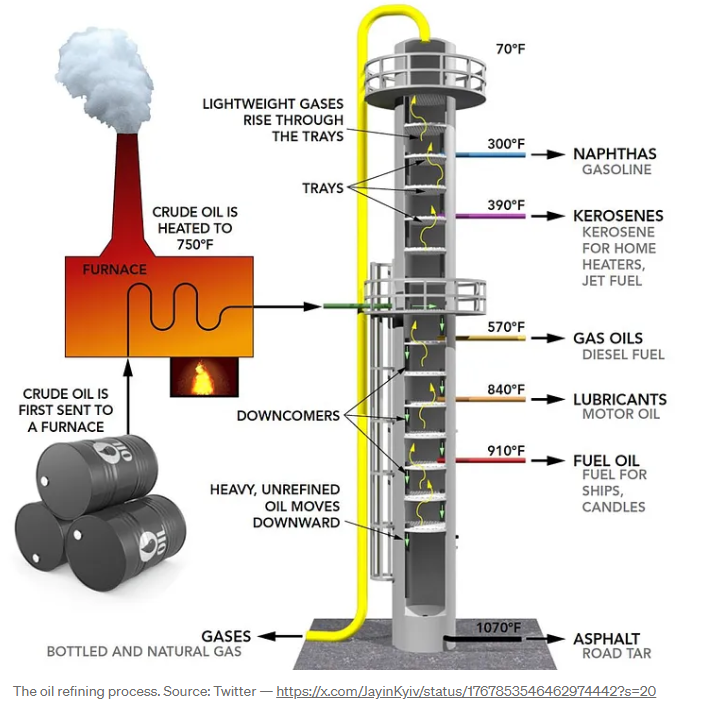
Graphic: Note that the higher the boiling point (heavies), the lower on the column a fraction is drawn from. In particular the asphalt fraction must remain quite hot to assure that it can flow away. The low boiling point fractions (lights) are vented off and sent elsewhere for processing. The graphic is sourced from here under the Fair Use Doctrine.

The simplified cartoon of a distillation column above shows that used in petroleum refining to isolate hydrocarbon components (fractions) in broad groupings by boiling point. These columns are quite tall and can be spotted easily as you drive by a refinery. Crude oil has suspended solids that are removed by water extraction which is then vaporized in a separate furnace under pressure. This hot, crude vapor is then pumped into the bottom of the distillation tower. For the non-industrial chemists out there who are accustomed to heating a reaction or distillation vessel directly nested in a heating mantle, this offset heat exchange approach is quite common. The fuel for the furnace can be several in-house sources.

Crude oil is a highly complex mixture of hydrocarbons and NSOs (nitrogen, sulfur, oxygen and heavy metals) with a broad range of structures and boiling points. These petroleum hydrocarbons contain a bit of nitrogen, sulfur and oxygen, produced water, natural gas, and inorganics. The hydrocarbons are further divided into linear, branched, aromatic/nonaromatic and cyclic carbon skeletons in which each can be subdivided again into differing molecular formulas and degrees of unsaturation. At this point the reader may need to take a cool refreshing dip into the pool of chemical bonding and the covalent bond in particular because this has a direct bearing on degrees of unsaturation.

A swerve into the weeds of chemical bonding

Here is the long and short of how the different types of chemical bonds affect the formula and structure of a molecule. Carbon atoms make up the skeleton of a molecule and are connected through the sharing of electron pairs. The shared electrons in a bond spend some fraction of their time in orbit between the two carbon nuclei and as such continue to screen out some of the mutual repulsion of the two nuclei. But that is not all. It turns out that this is where quantum mechanics rises from the murky depths of reality. The two bonding electrons are each able to occupy more space than what is available in the individual atoms and so drop in overall energy just a bit. This energy drop is manifested as heat which diffuses into the local environment. The amount of energy lost consists of a discrete quantity of electron orbital energy and occurs in a stepwise manner. This discrete step change is a “quantum jump”. [Note: a ‘quantum jump’ is often portrayed in the popular media as some type of Disneyesque dramatic and abrupt big shift in something or other. In reality it refers to a discrete step change in energy at the sub-nanometer scale.]

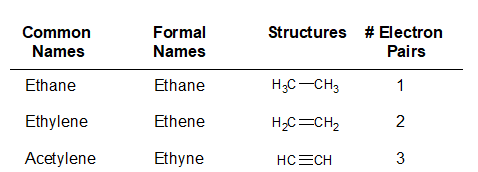
Graphics by Fred Ziffel. Each line between the Carbon atoms represents one pair of bonding electrons.

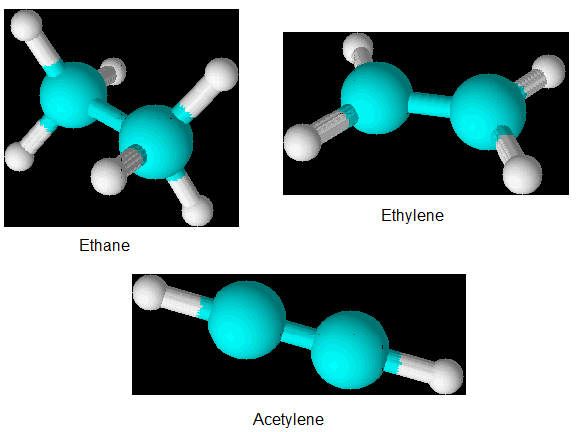
The number of bonds between the carbon atoms has consequences in the 3D shape of the molecule. In the 3 ball and stick representations below, only skeletal single bonds are shown (for reasons known only to ChemSketch).

Graphics by Arnold Ziffel. Bonds number 2 and 3 are omitted in Ethylene and Acetylene to emphasize the shapes. Note the flat planar shape of Ethylene compared to Ethane.

But what do you mean by ‘aromatic’?

The aromatic feature of a molecule is very special. It has a unique type of pi-bonding involving ‘special’ numbers of bonding electrons arranged in a ring and limited by the formula (4n + 2), where n is a counting integer. For n = 0, 1 2, etc., the numbers of electrons involved will be 2, 6 and 10 bonding electrons alternating in a ring. The most frequent ‘special’ number of electrons is 6, as in 3 alternating pairs of 2 electrons. Here, aromatic does not refer to fragrance, although many aromatic compounds like vanillin do have a fragrance. A cyclic group of 3 alternating bonding pairs of electrons will spontaneously ‘delocalize’ and occupy a lower energy level- a much-favored situation. That is, they will circulate around in a continuous ring and occupy a space above and below the ring atoms in a ‘sandwich’ fashion. Okay, we’re drifting a little too far into the weeds.

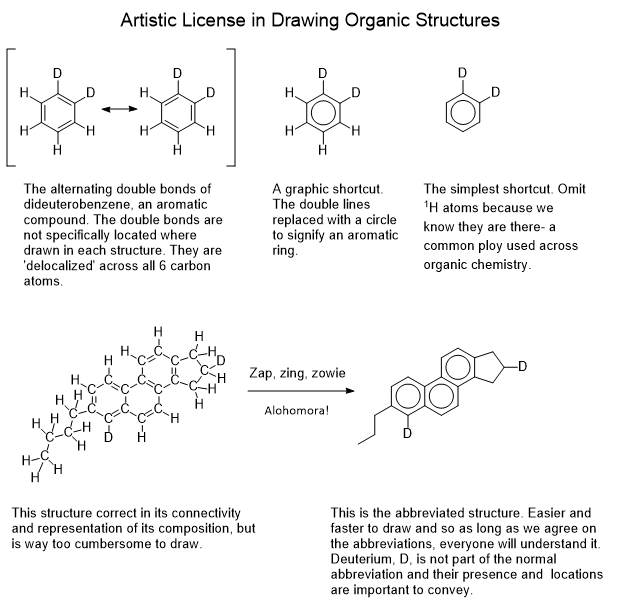
Graphics by Arnold Ziffel. Organic chemists draw a lot of chemical structures and, frankly, it can become tedious. To make life easier, certain graphical norms have arisen to stem the tedium.

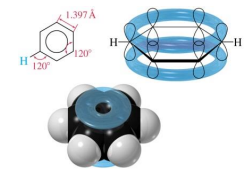
Knowing full well that I am presenting a highly truncated explanation of aromaticity, I have borrowed 3 representations below of the aromatic compound benzene. Given that single C-C bonds are longer than double C=C bonds, one might expect to find that with both C-C and C=C bonds present, 3 bonds would be longer than the other 3. But this isn’t what’s observed. Measurements show that all 6 CC bonds are of the same length, 1.397 Angstroms. And the CC bond angles are all 120 degrees, again different from C-C bond angles. These observations tell us that all 6 CC bonds are equivalent yet different from isolated CC bonds. Note in the upper right structure the 2 blue rings situated above and below the carbon skeleton. These rings represent delocalized electrons that are off-axis to the C-C bonds. They sandwich the carbon skeleton of C-C bonds. The blue rings show the space where the 6 C=C bonding electrons may be found. The bottom structure is a space filling model showing approximately the space occupied by the electron cloud. Think of it as the location of where another molecule will collide with it.

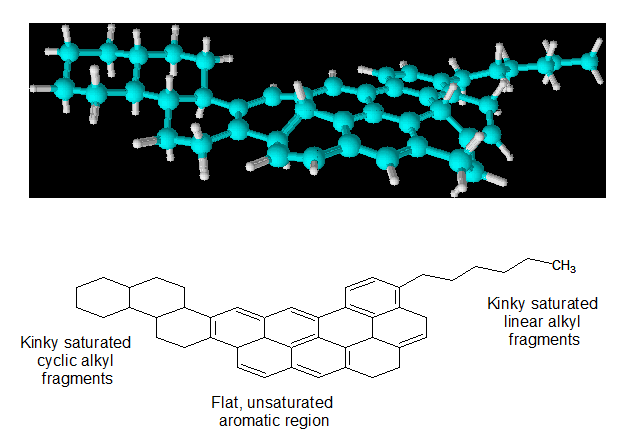
The imaginary large molecule shown below consists of a central region that is flat and two domains that are kinked and bristling with hydrogen atoms. The structure is shown stationary but in reality, it is vibrating vigorously, tumbling in solution, being battered by adjacent molecules and mashing its way through any liquid that may be around it. You know, the usual liquid scenario. The cyclic alkyl groups on the left are locked in space allowing only limited wagging motion, but the alkyl group on the right is free to rotate about all of the C-C bonds allowing the chain to writhe and snake around in its immediate 3D space.

Graphics by Sam Hill. 3D and 2D structures of an imaginary asphaltene. The aromatic section of the molecule is flat while the alkyl parts are kinked and bristly.

Above I referred to “… the sharing of a pair of electrons.” This is only just 1 part in a story of several kinds of chemical bonding. One carbon atom can bond to another carbon atom with 1, 2 or 3 pairs of electrons, producing 1, 2 or 3 chemical bonds. Carbon can also bond by sharing electrons (covalent bonding) with other atoms like nitrogen, oxygen and sulfur to form single or multiple covalent bonds. Atoms like hydrogen, boron, fluorine, chlorine, silicon, phosphorus, bromine and iodine bond well with carbon but with only a single bond. In general, as we move to the left and down on the periodic table the sharing of electron pairs becomes more and more one sided favoring the atom nearest to the upper right of the table. [Note to the purists: we are going to ignore carbanions, carbocations and carbenes in this post.]

Back to our regularly scheduled program

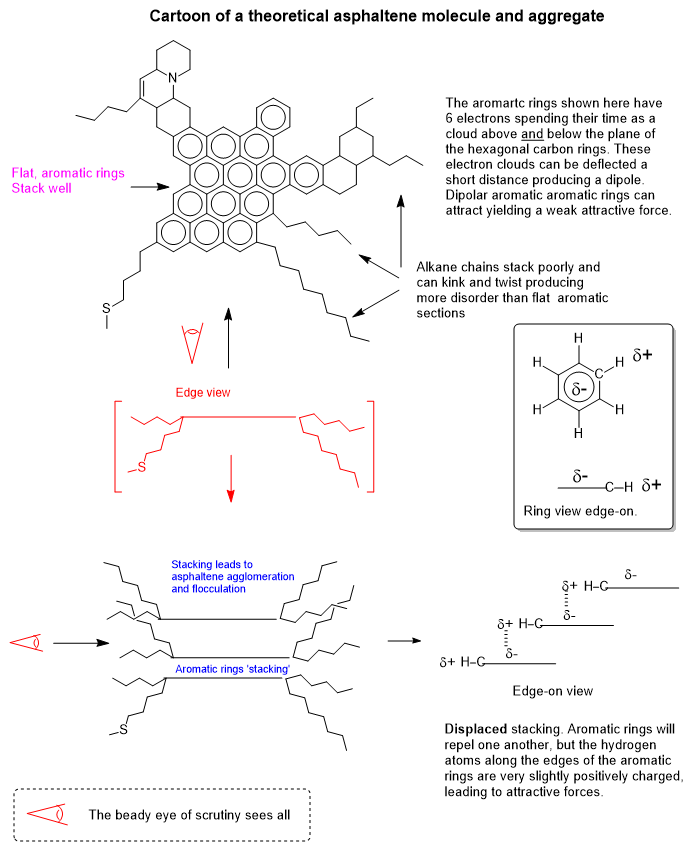
So what does all this bonding jazz have to do with asphaltenes? The type of chemical bond that makes aromatic rings flat, the pi-bond, is very abundant in asphaltenes. An aromatic ring of 6 carbon atoms has 3 alternating pi-bonds. Such compounds are commonly referred to ‘unsaturated’ meaning they have multiple bonds between carbon atoms rather than bonds with hydrogen- they are unsaturated with hydrogen atoms. These molecules consisting of hexagonal arrays, sharing edges like a thin honeycomb and are able to stack on one another- sometimes called pi-stacking.

Graphics by Arnold Ziffel. Agglomeration is when stacks of asphaltene begin to form. Flocculation is when groups of agglomerated asphaltenes mass together.

The asphaltene component of asphaltene (!?!) has been defined as that fraction which is soluble in aromatic solvents like benzene, toluene and xylene, etc., but not in alkane solvents. From this link, “Asphaltenes are referred to [as] the poly-dispersed distribution of the heaviest and most polarizable fraction of the crude oil.” This property derives from the large fraction of aromatic structures in the asphaltene.

Asphaltenes are a complex mixture of hydrocarbons containing variable amounts of nitrogen and sulfur atoms built into the structures. As a category, asphaltenes are substantially aromatic in nature with rather high molecular weights but may have cyclic and acyclic saturated hydrocarbon, or alkyl, fragments attached. These alkyl fragments lend solubility of individual asphaltene components in saturated hydrocarbon solvents (alkanes) and thus offer a means of semi-selective isolation. Maltenes are asphaltene components that are viscous liquids soluble in n-alkane solvents. Maltenes provide the adhesive qualities in asphalt. Asphaltene is divided into 2 fractions: Asphaltene and Maltene.

The words asphalt and bitumen are sometimes used interchangeably, both referring to the same material. Asphalt is the American English version. To help avoid confusion, the terms “liquid asphalt”, “asphalt binder” or “asphalt cement” are used in the U.S. to distinguish it from asphalt concrete. We recall that concrete is comprised of aggregate held together by cement.

Colloquially, various forms of bitumen are sometimes incorrectly referred to as “tar“. Asphalt or bitumen occurs naturally or can be manufactured. The roadbeds we drive on are “asphalt concrete” where stone aggregate is mixed with hot liquid asphalt as a binder that upon cooling forms a hard, durable surface. In common usage “asphalt concrete” is shortened to asphalt while the British call it tarmac.

Thus far, we have been talking about crude oil-based asphalt. Roughly similar materials like tar or coal tars are derived from sources other than petroleum. Generally, the words tar and pitch are used interchangeably but each can be considered specific to separate starting materials. Tar is a dark brown or black viscous liquid and is the result of the destructive distillation of a wide range of organic materials like wood, peat, coal. or petroleum. Pitch derives just from plant material.

In the early 1960’s, Dr. Fritz Rostler and coworkers of the Golden Bear Oil Company, now Tricor Refining LLC, discovered the cause of asphalt deterioration. He found that during the heat treatment used in asphalt processing and/or under prolonged exposure to sunlight in the presence of oxygen, the maltenes are degraded and their adhesive attribute is diminished, allowing the asphalt/aggregate components to crumble.

Francine Shuts Down a Quarter of Gulf O&G Production

According to the online news source “Upstream“, what is at the time of writing the Category 2 Hurricane Francine spinning northeastward in the Gulf of Mexico has resulted in the shutdown of approximately 23.5 % of gulf oil and 26.6 % of gas production. Approximately 35 % of the 371 manned platforms in the gulf have been evacuated according to the US Bureau of Safety and Environmental Enforcement (BSEE).

Francine is projected to make landfall along the Louisiana coast Wednesday on 9/11/24 and move up through Mississippi. That is, unless Trump gets out his Sharpie marker and wills it in another direction ...

The “Who Dat Field” and more

Naturally, when investigating the gulf shutdown I saw mention of the “Who Dat Field“, I had to look into it. It is located in the Mississippi Canyon (MC) blocks 503 / 504 / 547 in the Gulf of Mexico (GOM) in water depths of 945m.

The origin of the phrase “Who Dat” comes from the Acadiana region of Louisiana. There are numerous claims to the origin of the phrase and there have been legal spats concerning the trademark ownership of the phrase. The NFL in particular has thrown its ponderous weight around in the matter. The reader is encouraged dive into controversy.

Imaging Valence-Level Electrons in an Organic Molecule!!

Just WOW!! A team from Nagoya University in Japan performing synchrotron X-ray diffraction experiments at SPring-8 were able to selectively extract an image of valence level electron density in the amino acid glycine. Did you get that? And guess what they found? The valence electrons were occupying a space the shape of a molecular orbital also derived from computation!! Amazing.

The aerial view of the facility is shown below. Despite the ring being situated on bedrock, the alignment of the magnets in the storage ring is so precise that the moon’s tidal forces can have a measurable impact on the ring’s performance.

Source: SPring-8 and the CernCurrier.
Source: Spring-8. Schematic of the overall beamline.
Source: Spring-8. There are 62 beamlines coming from the synchrotron storage ring.

The experimental work in question is that of Takeshi Hara, Masatoshi Hasebe, Takao Tsuneda, Toshio Naito, Yuiga Nakamura, Naoyuki Katayama, Tetsuya Taketsugu, and Hiroshi Sawa*, “Unveiling the Nature of Chemical Bonds in Real Space”, Journal of the American Chemical Society, accepted July 10, 2024. https://doi.org/10.1021/jacs.4c05673. As of this writing the full journal citation was not available.

Density Function Theory (DFT) calculations were performed with Gaussian 16, revision A.03.

Below is an illustration by a Riken artist comparing the theoretical valence level molecular orbital (MO) of glycine by DFT calculations and the experimental valence electron density distribution, or VED, collected by synchrotron x-ray diffraction at SPring-8.

Credit: Reiko Matsushita / RIKEN. Results from the XRD study of glycine.

If you’ve been through college chemistry, then no doubt you are familiar with atomic orbital theory beginning with Linear Combination of Atomic Orbitals, LCAO. Beyond LCAO is MO theory which goes on to help in the understanding of optical, electronic, magnetic and bonding properties of molecules. In the 1980’s and 90’s commercial software became available (and affordable)

Experimental details from the JACS paper-

Source: The Sawa paper cited above. The experiment was a single crystal X-ray Diffraction (XRD) study using the very narrow x-ray beam available from the synchrotron ring. The underlined text above reveals that the 1s2 orbital electron density was subtracted from the total experimental electron density. This would leave the partially filled 2s and 2p valence level MOs in isolation.

While structural determination by x-ray diffraction has been around for a very long time, what makes this work notable is the detection and imaging of electron density in valence level MOs and the close correlation to computational modeling.

For more information about the SPring-8 synchrotron storage ring, visit their website. The name stems from “Super Photon ring8 GeV”.

Putin: Latter Day Soviet or Just Another Tsar?

Note: Not residing in Russia, I cannot grasp the full extent of the events and mood unfolding there. All that remains is to perch on a power pole across the polar cap and try to discern fact from fiction.

>>> Let’s ask a very basic question about today’s Russia. Why can’t Russia Putin play nice? <<<

Like most, I have anxiously watched Putin’s invasion of Ukraine. The prevailing Russian narrative is trying to say that the sovereign nation known as Ukraine has historically been a part of Russia or some earlier Russian empire, a view promoted by Putin. Following the Bolshevik Revolution, Lenin directed the Bolsheviks to seize the territory now recognized as Ukraine. The goal was to claim territory for the Soviet Union, but also territory that was extremely fertile. Stalin ordered that Ukrainian industry and agriculture were to be collectivized. An independent Ukrainian government was briefly established but just as quickly collapsed. After several years of intense Ukrainian resistance and significant suffering, Lenin conceded and established Soviet Ukraine, enabling its incorporation into the Soviet Union as a constituent republic.

In the current action, with the support of an extensive security apparatus, Vladimir Putin has resolved that what is now Ukraine will be assimilated into a growing Russian empire. The process will methodically transform its Ukrainian identity through Russification, transforming it into southwestern Russia. Ukraine is expected to become an agricultural hub and potentially a strategic forward base for further military operations into Poland the Baltic states, and likely Moldova.

Why does Putin desire Ukraine when there is considerable open land to the east and north? Well, it’s the geography. The land beyond to the north and east of Moscow consists of vast stretches of challenging subarctic taiga and arctic permafrost, much of which is now thawing, making it unsuitable for roads, urban development, agriculture, and industry. In contrast, Ukraine boasts rich, productive farmland with significant annual grain exports. Additionally, along its southern coast, including Crimea, Ukraine possesses the only warm water ports available in the region, other than possibly the Neva River to the north which are vital for commerce and the military.

Historically, western European colonization was driven by the prospect of trade opportunity including raw materials, cheap labor as well as power projection. Like all countries, Russia would like room for its prosperity to grow. It is desirable that agricultural and industrial capacity also rise. However, Russia has learned the hard way the value of having a buffer zone between Moscow and Western Europe. The relative ease with which both Napolean and Hitler crossed the Eastern European territory enroute to Moscow, Leningrad and other cities through greater Russia did not go unnoticed by Stalin. By absorbing the Eastern European territories after WWII, Stalin built a picket fence protecting the Soviet state.

As the Nazi’s Operation Barbarossa was failing and Stalin’s Red Army began pushing the Germans into a westward retreat, the Soviets took advantage of the opportunity to install Soviet political structure in captured Nazi territory like the Baltic states, Eastern Europe and the eastern half of Germany. While Stalin did not share Hitler’s enthusiasm for exterminating Jews, he did act to eliminate preexisting local political structures which included substantial Jewish presence. This meant executions and large-scale banishment of politically unreliable people to the Russian gulag system. Poland was hit particularly hard by both Hitler and Stalin because it was directly between Russia and Germany and had a large Jewish population.

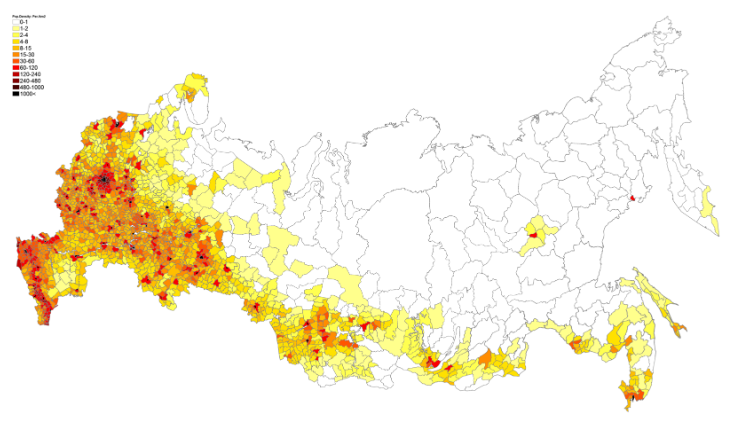
The above map shows the population density of Russia. A substantial fraction of Russians live in the southern and western regions of the country. If you assume that people are living there because it is at least somewhat livable, then the map shows the extent of land poorly suited for habitation.

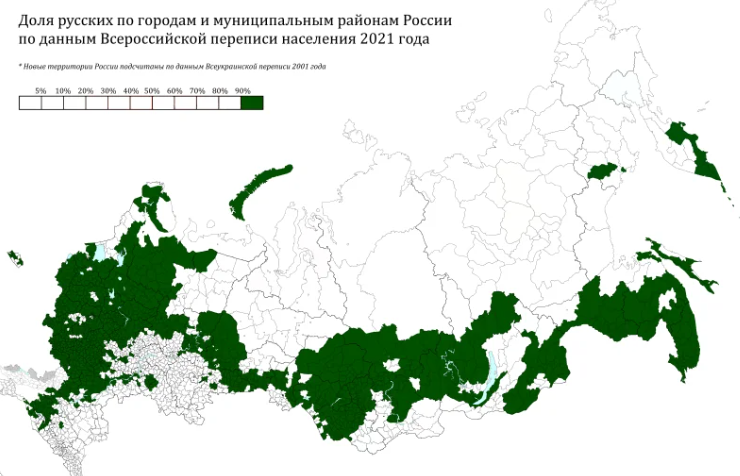
Map of Russia showing areas that are 90 % populated by ethnic Russians.

Russia has a great deal of acreage but the livable turf is much smaller.

Putin views the world partially from the old cold war perspective. It’s Russia against the aggressive, corrupt and immoral west, but without the fever dream of a Soviet-style socialist world. Putin’s state-controlled media endlessly repeats that the west wants what the Russians have and stokes the fires of fear. For the Soviets, “aggressive, corrupt and immoral” included resistance to Soviet influence.

The Soviets were ardent promoters of global socialism. Although not overtly socialist, Putin appears more focused on preserving Russian culture and dominance from across a substantial territorial buffer with the West. He asserts his aim to shield Russia from Western cultural influences and what he perceives as a “belligerent” military stance.

Historically, Russia has endured invasions by King Charles XII of Sweden, Napoleon, and later Hitler. The history of the Kievan Rus from 830 to 1241 is jammed with bloody feuds, wars and invasions. From the Principality of Moscow in 1281 to the end of the Tsardom in 1917, and even beyond into the era of the Soviet Union and into Putin’s time, near continuous conflict has plagued the Russian people. Fortunately, Russia’s northern geography and harsh winters have often played to its advantage, compelling invaders into prolonged conflicts and misery with eventual withdrawal. But not always.

Most nations would like to have global hegemony. Putin is fond of saying that Russia has suffered greatly from American and Western hegemony since WWII and hopes to put an end to it. He has reestablished a Soviet-like security state apparatus with strict media control when he assumed power after the 8 years of Yeltsin’s chaos following the collapse of the Soviet Union. He is trying to resume for present day Russia the former Soviet Union’s international status but largely without the manpower and resources of the former adjacent Soviet states.

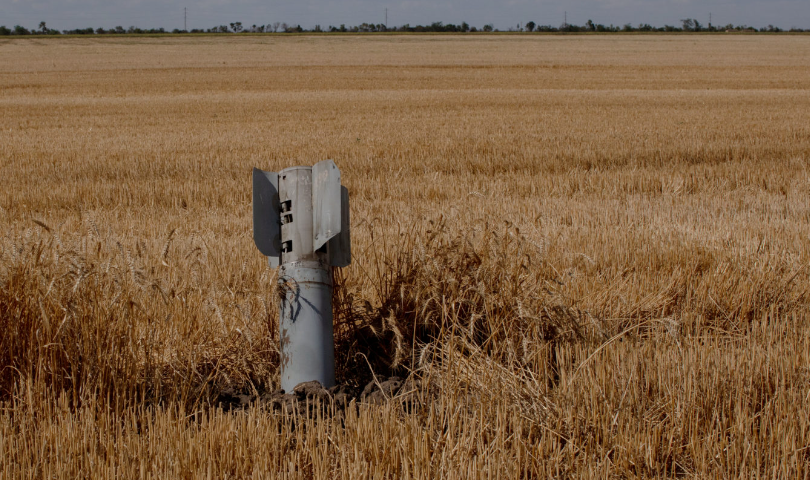
Source: The Fuller Project. Unexploded cluster bomb in Ukrainian wheatfield.

Like his Soviet predecessors, Putin both envies and worries about overreach of western hegemony and is moving to unseat the West. For that matter, so is China. This is only natural. I believe they resent western influence generally. The English language as the global lingua franca and the US dollar as the standard international currency are seen as an annoying affront to their own cultures, sovereignty and political significance. Again, this is only natural. And so is the temptation to use power projection or coercive propaganda to achieve their own hegemony. Casualties would be considered the West’s fault for being in the way.

Both Russia and China have long been critical of the West for internal propaganda purposes but to be fair there has been some valid criticism as well. In truth, the US has done some bone-headed things that we should not be proud of and that hardly serve to highlight our presumed “special” nature. But in fairness, most all cultures can look back at regrettable conduct in their history. Neither Chairman Mao’s China or Stalin’s USSR have sparkling clean histories either. Often the benefit of hindsight doesn’t come into focus until far down the timeline.

The Soviet Union in the person of Joseph Stalin, had brutalized Ukraine previously in an attempt to halt its independence. The Holodomor, meaning death by starvation, of 1932-33 is estimated by scholars to have killed 3.5 to 5 million people. This period of time is marked by forced collectivization of agriculture and industry in the USSR and Ukraine. Collectivization meant taking control of farmland owned by the peasants (especially the Kulaks), many times banishing them to the gulags never to be seen again. Already by 1931, Moscow had taken 42 % of the Ukrainian grain harvest, forcing some locations even to turn over seed for the following harvest. By early 1932 some districts in Ukraine were already experiencing famine. The governing committees in Ukraine in 1932 believed that the 6 million tons of grain demanded by Moscow was unachievable, yet they ratified the plan anyway.

The current brutal murder and devastation of Ukrainian citizens and their infrastructure and agriculture will take a generation or more to repair even if Russia prevails. Russia has done great damage to the Ukrainian environment in addition to the many casualties. Much of the country is cratered, littered with destroyed vehicles and war debris, denuded of vegetation, and rendered deadly by the landmines.

The great equalizer among the leading nations is Mutual Assured Destruction, or MAD, by virtue of the threat of the use of nuclear weapons for mutual annihilation. Sometimes just called “the bomb”, it was indeed invented by an international cast of scientists and engineers using American uranium and Plutonium and first used in successive releases by the US on Japan near the end of WWII in the Pacific theater. This will darken a stretch of American history indefinitely. Some continue to argue that the bombing was not necessary because Japan was soon to surrender, but it happened, and nothing can change that. However, to our credit, the US has never used it since and has actively sought with other nations to suppress the proliferation of nuclear weapons and remove the hair triggers for their use. That said, the US remains a no-first-use country but will participate in the principle of Mutual Assured Destruction as needed.

A Nuclear Sidebar

Very soon after the discovery of nuclear fission in December, 1938, in Nazi Germany by German-born chemists Hahn and Strassmann, and Austrian-born physicists Meitner and Frisch, the theoretical potential of using the vast energy output of nuclear fission for a bomb was quickly realized.  On May 4, 1939, Frédéric Joliot-Curie, H. Von Halban and L. Kowarski in Paris filed for three patents using a fission chain reaction. Two involved power generation and the third was for an atomic bomb, patent No. 445686. Fission was experimentally discovered in Dec. 1938, theoretically explained in January 1939, and a patent for the atomic bomb was filed on May 4, 1939.

The point of this atomic interlude is to highlight the short time interval between the discovery of nuclear fission, conceiving the idea of the atomic bomb and filing for a patent by scientists. On August 2, 1939, a letter written by Leo Szilard and signed by Albert Einstein was sent to President Franklin D. Roosevelt warning that Germany may be developing an atomic bomb. This led to the Manhattan Project and America’s entry into nuclear weaponry.

During and after the Manhattan Project, Stalin’s spies detected and infiltrated the American bomb project and presumably used important stolen information for their own nuclear program. This was an important shortcut benefitting the Soviets greatly. The first Soviet atomic bomb burst so soon after the war shocked the world.

Humans have a gift for the invention and use of weapons. I’m sure it has always been that way for humans. The inclination for war and conquest is also an ancient instinct. It is hard to see how aggression will ever change. In view of this distressing thought, how are we to proceed?

Looking forward

In the short term we in the west must continue to discourage Putin’s expansionist push. A win for Ukraine will set a precedent that might even unseat Putin. It is up to the many good people in Russia to be rid of him. However, Russian citizens will have to struggle against the vast authoritarian political machine in place just like the Poles, East Germans and the other Soviet states had to do in the late 1980’s. The intimidation and resources of the Putin authoritarian state are a huge obstacle.

My guess is that in general, doing the “right thing” in a culture of normalized authoritarianism, bribery and corruption is more difficult to accomplish than doing the “right thing” in a free and open culture where doing the right thing is occasionally practiced and always admired.

To a westerner like me, Russian withdrawal from Ukraine seems like the optimal solution to Russia’s present economic and military race to the bottom. Even in winning, Russia will inherit a devastated region that will require vast resources and a decade to repair, as well as a population of angry and vengeful citizens looking to kill a Russian or two. Then there are all of the land mines to contend with. There is amputation or death by landmines in the future for many unsuspecting people regardless of who wins.

A cessation of hostilities led by Putin is likely to end his career. Thus far, Putin’s invasion has led to over 500,000 Russian casualties, of which there have been over 80,000 Russian fatalities. In a way, this pales in comparison to Stalin’s murderous handiwork, but the comparison is really more like “terrible versus really, really terrible.”

Whether or not Putin is a reanimated Soviet leader or “just” another Tsar isn’t a question to dwell on. He is a creature of his time who happens to be a former Soviet KGB officer but has rejected Marxist/Leninism and rules by a roughly mafia-style kleptocracy behind closed doors in the Moscow Kremlin. For Russian citizens, the rule of thumb is if you stay out of political business, the government will stay out of your business.

Reuters Receives Raw Materials for Fentanyl

The news service Reuters recently published an article on the ease with which the raw materials for the production of the opioid Fentanyl. From their $3600 expenditure on raw materials they estimate they could have produced $3 million worth of Fentanyl.

For an estimated 74,702 Americans in 2023, Fentanyl provided them with a narcotic experience prior to death. The lethal dose is reported to be 2 milligrams for an adult. It is 20 to 40 times more potent than heroin.

Outside of medical use Fentanyl should be described as a highly (neuro)toxic substance rather than just an opioid. Yes, it is an illegal narcotic, but it is also a potent deadly poison. Hidden with other illegal drugs in pill form, it is just a highly toxic contaminant.

On January 5, 2024, I posted a piece titled “A Bit of Fentanyl Chemistry” which is reproduced below. It turns out that the Janssen synthetic chemistry I wrote about then is quite close to what the investigators at Reuters had in mind for their story. In the world of chemical commerce, a process using easily available raw materials is highly favored.

My take-home message from the Reuters story is that unless China seriously clamps down on those who export the raw materials, all that is left to do is to suppress demand. The import of Fentanyl raw materials is aided by deceptive packaging and small quantities needed. Worse, Fentanyl raw materials have other uses in pharmaceutical chemistry and are too useful to completely shut down. The death and incarceration that Fentanyl can bring in the US does not appear to be sufficiently convincing to the at-risk American population. Nothing new here.

=========================

A recent raid on a clandestine drug lab in the Hatzic Valley east of Vancouver, BC, netted 25 kg of “pure” fentanyl and 3 kg which had already been cut for street use. Precursor chemicals used to manufacture the fentanyl were also seized. Along with the drug, the raid also seized 2,000 liters of chemicals and 6,000 liters (about 30 drums) of hazardous chemical waste, according to an RCMP news release 2 November, 2023.

The police said that the seizure represented 2,500,000 street doses.

In August of 2023 the police in Hamilton, Ontario, announced the results of Project Odeon. This was a large-scale sweep of illicit drug production in the Hamilton and Toronto area. From January 1, to July 30, 2023 there were 606 incidents related to suspected opioid overdoses and 89 suspected drug related deaths in the Hamilton area. Twelve people were charged for a total of 48 criminal charges. The police disclosed the following items that they seized-

  • An operational fentanyl drug lab at 6800 Sixteen Road, Smithville.
  • A dismantled fentanyl drug lab at 4057 Bethesda Road, Stouffville.
  • Approximately 3.5 tons of chemical byproduct from fentanyl production.
  • 800 gallons of chemicals commonly used in the production of fentanyl
  • Lab equipment commonly used in the production of fentanyl
  • 64.1 kg of illicit drugs, including 25.6 kg of fentanyl, 18 kg methamphetamine, 6 kg of ketamine
  • A loaded, Glock firearm and ammunition and four extended magazines
  • Over $350,000 of seized proceeds, including cars, jewelry, furniture and cash

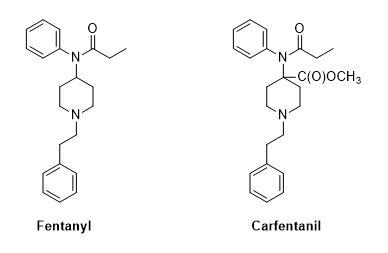
Fentanyl is a synthetic drug first prepared in 1959 in Belgium by Paul Janssen (1926-2003). Janssen was the founder of Janssen Pharmaceuticals, now a subsidiary of Johnson & Johnson. In addition to fentanyl, the Jenssen team developed haloperidol, the ultrapotent carfentanil, and other piperidine based congeners. Piperidine itself is a DEA List 1 substance in the US.

Carfentanil is just modified fentanyl. Graphics: Will O. de Wisp

The elephant in the room with fentanyl is its extraordinary potency as an opioid. In pharmacology, potency is a quantitative measure of the amount of dose needed to elicit a specific effect on an animal or human in terms of dose weight per kilogram of body mass. Potency is subject to variability across a population and rises to an asymptote which can be difficult to pin down. For these reasons potency is reported at 50 %. For highly potent drugs like fentanyl, the measure is expressed as milligrams or micrograms of dose per kilogram body weight (mg/kg or mcg/kg body weight). One milligram per kilogram is one part per million (ppm).

When matters of toxicity arise, it is important to remember the maxim that “the dose makes the poison”. This observation traces back to Paracelsus in the mid-sixteenth century.

Fentanyl acts much like morphine in regard to its affinity for one particular opioid receptor. Morphine is commonly the “standard” with which other opioids are compared. For instance, fentanyl is said to be 50-100 times more potent than morphine. Only 2 mg of fentanyl is equivalent to 10 mg of morphine. Carfentanil is more potent still at 10,000 times the potency of morphine.

Morphine is an agonist which activates the μ-opioid receptor. Activation of this receptor with morphine produces analgesia, sedation, euphoria, decreased respiration and decreased bowel motility leading to the earthly delights of constipation. Fentanyl is thought to interact with this receptor as well.

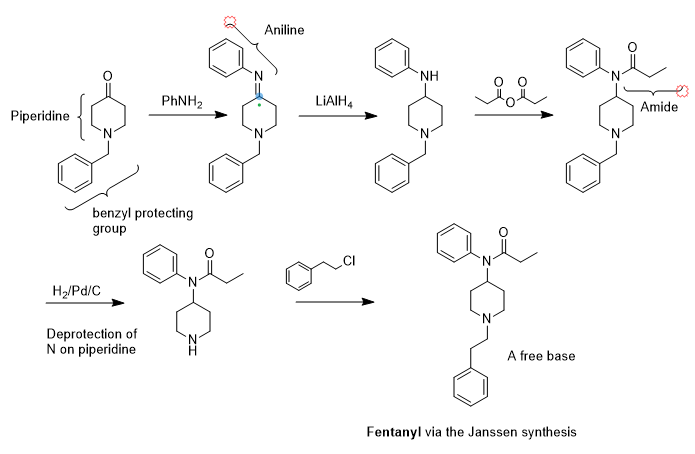
Original fentanyl synthesis by Janssen. Graphics: Will O. de Wisp

So, how is fentanyl synthesized? See the synthetic scheme above. I’ll just comment on the Janssen synthesis and some issues. I have no idea of how it is made out in there by the Mexican cartels and in ramshackle American trailer parks. The synthesis above has some steps that may be undesirable for backwoods or jungle operations like hydrogenation. In the first step, aniline will be needed to make the phenyl imine. It’s pretty toxic and stinks to high heaven. Next, lithium aluminum hydride is needed to reduce the imine double bond to an amine. This innocent looking grey powder is very hazardous and should only be used by an experienced chemist. It is also available as a solution in tetrahydrofuran. The next step is the formation of the amide with propionic anhydride. While the reaction entails a simple reflux, you still have to isolate the product. Once you have recovered the amide, the benzyl protecting group on the piperidine nitrogen must be removed. It allowed amide formation exclusively on the upper aniline nitrogen and has served its purpose. Finally, the piperidine nitrogen must be festooned with a phenylethyl group and phenylethyl chloride was used to afford the fentanyl product. 

An excellent review of the pharmacology and drug design of this family of opioids, see Future Med Chem. 2014 Mar; 6(4): 385–412.

In chemical synthesis generally, substances are prepared in a stepwise manner and with as few steps as possible to give high isolated yields. To begin, one must devise a synthesis beginning with commercially available raw materials as close to the target as possible. If the product has many fragments hanging off the core structure, it’s best to solve that problem early. Synthetic chemistry is almost always performed in a non-interfering solvent that will dissolve the reactants and allow the necessary reaction to occur. A low boiling point is preferable for ease of distillation. An important side benefit from a solvent is that it will absorb much of the heat of reaction which can be considerable. Left on its own, a reaction might take its solvent to the boiling point by self-heating, generating pressure and vapor. The benefit from evaporation or reflux boiling is that as a solvent transitions from liquid to vapor there is a strong cooling effect which helps to control the temperature. An overhead condenser will return cooled solvent to prevent solvent loss.

You can do any chemical synthesis in one step with the right starting materials. Unfortunately, this option is rarely available. The next best option is to take commercially available starting materials through a known synthetic scheme. People who run illicit drug labs are never interested in R&D. They want (and need) simple chemistry that can be done by non-chemists in buckets or coke bottles at remote locations. Chemical glassware can be purchased but sometimes the authorities will be notified of a suspicious order. This is especially true with 12 liter round bottom flasks.

The most difficult and risky trick to illicit drug synthesis is obtaining starting materials like piperidine compounds in the case of fentanyl and its congeners. In the case of heroin, acetic anhydride shipments have been investigated for a long time because it is used to convert morphine to heroin- an unusually simple one-step conversion. Solvent diethyl ether is similarly difficult to get outside of established companies or universities. Many other common drug starting materials are difficult to obtain legally in the US or EU by the criminal element. However, China is thought to be a major supplier of starting materials outside the US and EU. Countries with remote coastlines, loose borders, lackadaisical or corrupt law enforcement reduce the barriers for entry of drug precursors.

China in particular has a large number of chemical plants that make diverse precursors for legitimate drugs. Unfortunately, some of these precursors can also be used for illicit drugs or existing technology adapted for this use. Precursors can be sold to resellers who can do as they please with them. Agents may represent many manufacturers and can mask the manufacturer’s identity and take charge of the distribution abroad. Shady transactions become difficult for authorities to detect and trace. The identity of illicit precursor chemicals are easily altered in the paperwork to grease the skids through customs. Resellers can repackage chemicals to suitable scale, change the paperwork and jack up the price for export. It has been my experience that many if not most Chinese or Japanese chemical manufacturers conduct business through independent export agents. However, behind the curtains there often a byzantine web of connections between companies and agents, so you may never know who will manufacture your chemical. As an aside, this complicates getting technical information from the manufacturer since the agent will not disclose a contact at that manufacturer.

Highly potent drugs like fentanyl must be taken in very small dosages which means that kilo-scale batch quantities of drug result in many individual sales per kilo. Small quantities of highly potent drugs are more easily smuggled than bulky drugs like weed with its strong odor.

There is a down-side to the illicit manufacture of drugs like fentanyl. It is quite toxic at very low dosages and must be handled with the greatest of care lest the “cook” and other handlers get inadvertently and mortally poisoned. Good housekeeping helps, but I have yet to see a photo of a tidy drug lab.

Fentanyl can be sold as a single drug but perhaps is cut with a solid diluent that some random yayhoo decided was Ok to use. Other drugs of abuse like heroin may be surreptitiously spiked with fentanyl to kick up the potency. In either case, a given dosage may or may not be safe even for a single use. There is no way for a user to know. Also, the concentration or homogeneity of mixed solids may be subject to wide variation. For more than a few people, their first fentanyl dose will be their last.

Russian Death-Tanks

Numerous YouTube videos depict the widespread destruction of Russian tanks in the invasion of Ukraine, giving the impression that these tanks are more lethal to Russian soldiers than their opponents. Despite being equipped with Explosive Reactive Armor (ERA), their ability to withstand artillery, mines, and drone attacks seems minimal. Moreover, when the armor is breached, the cannon gun propellant tends to ignite violently, causing the warheads to explode and instantly killing the crew. Occasionally, the force of ammunition blasts is so strong that it hurls the turret with gun barrel into the air, a stark illustration of the power of such explosions. Consequently, videos frequently capture Russian tank crews abandoning their crippled vehicles and fleeing for safety. Instead of offering protection, tanks have become conspicuous and cumbersome targets, prone to devastating attacks.

One might question the practical value of reactive armor. The landscapes of eastern Ukraine are strewn with thousands of destroyed Russian tanks, their ERA blocks still intact. Perhaps its practical value lies in bolstering the confidence of tank crews to engage in battle, trusting in the ERA’s protective capabilities. However, it is now challenging to believe that ERA instills a sense of safety in tank crew members. The effectiveness of reactive armor seems negated by potent penetrator warhead countermeasures capable of breaching the ERA. The pertinent question remains: does the ERA diminish the impact of an incoming shell sufficiently to be considered effective?

The conflict between Putin and Ukraine will eventually conclude, and the victors will promptly seek to repurpose the battlefields for peacetime activities. However, they must first contend with numerous challenges, including the presence of unexploded ordnance. Thousands of mines may remain hidden, posing a threat for decades unless they are securely disposed of or neutralized.

The landscape of the battle zones is marred by bomb craters, charred vehicles—many with unexploded ammunition—minefields, unexploded ordnance scattered about, live explosive reactive armor on destroyed armored vehicles, and soil polluted with shrapnel and residues from countless detonated artillery shells.

Numerous cities and villages, particularly those near the Russian border, have been completely obliterated by Putin’s military, resulting in tens of thousands of civilian casualties and leaving most without homes. The remnants of homes, businesses, and infrastructure stand as a testament to the survivors. For them, social and economic frameworks are now just distant memories. Civilization has been set back by at least a generation due to Putin’s distorted ambitions for an imperial legacy. The man is not insane or unintelligent; he is quite astute and fully aware of his actions—he is simply a terrible person. Currently, the US is facing its own challenge with a figure of ill repute seeking control of the government, backed by a significant number of misguided followers.

The conflict has been a catastrophic event for the region’s flora and fauna, significantly hindering the biosphere in numerous areas. Ukraine, until recently, was a significant grain producer and exporter, essential for the sustenance of millions. In the early stages of the conflict, Russia targeted and destroyed much of Ukraine’s grain distribution infrastructure, aiming to debilitate the economy and hasten a surrender. The bombings of civilian residences, hospitals, and other infrastructures will tarnish Putin’s reputation, marking him as a tyrant and a fundamentally flawed individual. Additionally, the reported abduction of thousands of Ukrainian children by Russia for forced assimilation and adoption raises serious legal and humanitarian questions. These actions are meticulously recorded for potential future war crimes proceedings and historical record.

Elon: Right-Wing Culture Warrier

[Warning: Snarkiness ahead.]

Note: Soon after Biden’s announcement of stepping down from the presidential race and his support of Kamala Harris, Musk announced that he was backing out of his plan to donate to Trump. Fancy that.

Republican oligarch Elon Musk has announced that he will be donating $45 million per month to a Silicon Valley super-PAC run by conservatives Joe Lonsdale and the Winklevoss twins supporting the reelection of #45, DJT. If there was any doubt before, it is crystal clear now that Musk is a full-throated carnival barker for DJT-JDV, $45 million for #45.

The richest guy in the world (whose liquidity is questionable) is blossoming into a real kingmaker for America. Holy red crab snappers, Batman, isn’t that swell?

Everyone knows that these megadonors bankroll Republicans as an investment. This assertion sounds like blaming a crocodile for eating people- it’s just what they do. Both Trump and Vance have publicly denounced electric vehicles. Even if Musk’s $180 megabuck donation does not result in cash back, there is certainly continued access to the rarefied heights of politics. Perhaps the Trump-Vance dynamic duo will revisit their stance on electric vehicles.

Musk’s SpaceX has received billions in federal contracts and Tesla has benefitted from electric vehicle subsidies. It’s hard to say that it has been different under the Biden Democrats.

It is bad enough to have a wannabe fascist, Putin-admiring dictator become president again, but to have the world’s wealthiest demagogues heaping cash into the kitty to tip the balance is yet another shit sandwich for the USA. Where does much of this money go? To advertising, payroll, campaign staff, printers and to entertainment venues for campaign events. Why don’t the electronic media go after #45 for his obviously felonious and vile behavior with a large helping of dictatorial inclination? Advertising revenue, silly. To hold back screen time on the Orange Jesus would be to bite the ad buyer’s hand that feeds them.

As an independent voter, I blame the national Democratic Party for gross dereliction of duty in failing to groom talented successors to Biden over the past decade. Where are they? The senior Dems in congress are talented where they are, but none seem to be interested in gambling on a run for the White House.

Source: Amazon.

A Soviet-Style Trip the Hermit Kingdom.

Note: Recently I posted an early revision of this essay by accident and had to pull it down. Trembling with embarrassment, I wiped the egg from my face and am now posting the intended version. A thousand pardons.

Imagine the frustration of the Russian President, Vladimir Putin, as he discovers the shortcomings of what was presumed to be a premier conventional military force. Decades of corruption and neglect have eroded the military from within. Meanwhile, their nuclear submarines continue to lurk in the depths of the Atlantic, assessing NATO’s day-to-day preparedness and gathering intelligence. Strategic nuclear forces are best used as a deterrent, or so the thinking has been. Coincidentally, their naval procession to Cuba, intended as a demonstration of power, was no doubt monitored by our network of acoustic sensors.

Runup to the invasion

Why did Putin begin his invasion of eastern and southern Ukraine in February 2014? Publicly he claimed to “de-Nazify” Ukraine. At the time, Ukrainian president Viktor Yanukovych was facing the Euromaidan uprising beginning in November 2013, over his rejection of closer integration with the EU. This large-scale protest was in response to Yanukovych’s refusal to sign the European Union-Ukraine Association Agreement rather than strengthening ties to Russia.

Putin’s essay

Just prior to the 2022 invasion the Kremlin published an article online by Putin going into great detail on his rationale for a “triune” state consisting of Russia, Belorussia and Ukraine. It was a “come to Jesus” appeal intended to show doubters that a common ethnic brotherhood existed that far exceed the differences between Ukrainians and Russians. He describes the current Ukrainian state as an anti-Russian project also serving the interests of other entities rather than ethnic unity with Russia.

It’s worth noting that in Russian occupied parts of Ukraine, Russification has been underway in order to make Ukrainians forget their culture and to assimilate into Russian culture. Children were kidnapped early in the 2022 invasion and taken to Russia for assimilation.

Here Putin combines the Ukrainian famine, the Holodomor of 1932-33, with the wider Soviet famine of 1930-33 as a unifying experience that should in his view bring people together in shared tragedy. Whether or not Stalin had intended to cause a genocide of Ukrainians during the Holodomor is still being debated. However, Ukrainians were forcibly prevented from leaving the territory and their agricultural produce was taken from them. The Soviets even took their seed for the next year’s crop (see: Timothy Snyder, “Bloodlands“, 2016, ISBN-13 : ‎978-0465031474). Whatever the case, the singular focus of Stalin’s first 5-year plan beginning in 1928, was to industrialize the Soviet Union. In Marxist-Leninist political theory, the more prosperous kulaks were class enemies of the poorer peasants. Kulaks were either arrested, executed, sent to the gulag, or to labor camps.

Russian military in the 2022 Putin/Ukrainian war

Within the many layers of rank in the Russian military, there is a notable absence. There is no non-commissioned officer (NCO) level like that found in the US military. Yes, they do have NCOs, but they are technical specialists, or enlisted professionals taken from conscripted or contracted soldiers, uninvolved with small unit leadership and training. That is left for the officer corps. The result has been poor and inconsistent training of recruits. Hazing has long been a problem for the new recruits. Many view the Russian system of military leadership structure as inherently weak and a stubborn vestige of the past.

Perhaps fortified by a misjudgment of their military posture, Putin launched a full-scale military invasion of Ukraine on February 24, 2022, into what has been a sovereign country under the pretense of neutralizing a non-existent threat from supposed Nazi troublemakers as a way to protect Russia. Russian forces quickly began to suffer significant losses in personnel and equipment. Moreover, these defeats have unfolded before an astonished global audience. Fortunately for Putin, his dictatorial foresight had led him to seize control of all media outlets within his borders in the years prior. He watched as his senior military commanders depleted his standing army. Under the pretense of “patriotism,” he drafted civilians and prisoners with the promise of attractive contracts to participate in his ill-conceived “special military operation.” Unfortunately, these soldiers became cannon fodder against the NATO fortified Ukrainian forces. Despite the overall drubbing the Russian military is taking and the half million casualties suffered, they retain the eastern and southern territories annexed prior to the Feb. 2022 invasion.

Putin pays a visit to Kim

Putin’s recent trip to North Korea, reminiscent of Soviet-era diplomacy, and his signing of a mutual assistance agreement with Kim Jong-un, prompted South Korea to reconsider its stance and contemplate supplying arms to Ukraine.South Korea, a manufacturing giant, currently has minimal incentive to engage with Russia as a neutral entity. Russia’s economy, struggling and cash-strapped, requires goods and services. It has been excluded from the international banking system and has seen a decline in amicable trade relations.

Now the word is that DPRK will be sending military engineers to the Putin/Ukraine war. While DPRK’s construction and engineering forces are not referred to as a fighting force, you have to believe that they will fight to defend themselves if they claim to be threatened. What the threshold for “threat” is will eventually be revealed.

Another threat made by Putin is that Russia will send arms to DPRK if the west continues to supply arms to Ukraine. The transfer of technology and materials in aid of the DPRK’s nuclear ICBM ambitions is sure to be the big prize Kim is after. Launching a payload is one thing, but accurate targeting is quite another. I suppose he can use GPS like everyone else does.

We’re hearing that wounded Russian soldiers are being sent back to the front, many with shrapnel from previous combat. I guess they figure that since they are wounded anyway, they might as well get the last bit of mileage left in them. This is certainly no less moral than leaving their dead behind or sending “meat curtains” of poorly trained troops to the front lines. Or, shooting their own soldiers if they retreat from the fighting.

The Kremlin has used “weaponized migration” elsewhere and is now trafficking immigrants across its western borders through Belorussia, into Finland, the lower Baltic states and Poland in order to overwhelm western border protection and to distract them as he transfers military forces east to the front. At the borders they have been creating a commotion causing western security resources to focus there. This is Russian hybrid warfare and is likely led by Russian intelligence services. Immigrants from various nations like Syria, Iraq and Somalia are given visas in an attempt to make it look like legitimate immigration. One of the goals of these roving throngs of civilians is to travel to western Europe to strain their economies and raise bureaucratic headaches for western governments like Germany. Naturally, saboteurs, spies and terrorists are likely planted in with the immigrants.

Russia has allegedly been jamming or spoofing GPS signals in the Nordic and Baltic Sea region causing interference with commercial air traffic. More Russian hybrid warfare. This affects not only air traffic but ground and sea navigation as well. Commercial air traffic can still fly under inertial navigation or by ground radar between airports and by terminal radar on approach and departure. Terminal radar guides aircraft into the airport instrument landing system (ILS) which is ground based and not affected by GPS. Airlines do monitor their aircraft with the help of GPS, however.

Fighting the last war

There is a saying, attributed to French Prime Minister George Clemenceau, warning generals not to enter conflict by fighting the last war. Putin began with fighting “the last war” with artillery and WWII-era tanks while keeping the Russian population calm with well-crafted fake news continuously delivered to the public. Unexpectedly, he did not seek air superiority starting the first day of the invasion before bringing in ground forces.

The propaganda in Russia today is that they are actually at war with NATO itself with extra blame on the US and UK. Russian war bloggers are even claiming that Ukraine’s drones and missiles can and are being controlled directly by NATO from remote locations. There are many voices on Russian television and in the blogosphere calling for the use of tactical nuclear weapons. Putin and Medvedev have also waved this big stick around as well.

In response to Putin’s unwarranted invasion, most of the free world made the decision to withdraw its financial and trade connections, especially with the purchase of oil and gas (O&G). O&G is a huge money maker for Putin’s dictatorship and funds much of Russia’s government. Interestingly, while initially very concerned, the Oligarchs have learned to stop worrying.

Economic effects

An urgent problem presently in the Russian oil industry is the matter of upkeep on imported technology like oil refineries. Russia previously hired foreigners to build and maintain most of its oil refineries and licensed proprietary unit operations. Many of the foreign businesses that supplied these services have left Russia. As the clock tick-tocks along, equipment breaks down or misses scheduled maintenance. Replacement parts have become very difficult to obtain. This has a huge influence on the country’s refinery output in particular and on other industry in general.

Russia’s loss of trading partners is having a deleterious effect. Tax revenues are down into the deficit range across the board and the Russian government is working to introduce new taxes on the people. There is even word that laws are being drafted to increase the range and cost of fines against citizens who fail to put in the required extra effort. According to Forbes, the State Duma is tightening laws relating to labor and business operations are forcing employees to work weekends and holidays, especially if the business is military related.

Nukes behind the curtains

Of course, Putin has his nuclear armaments to fall back on. Much was made previously of the Soviet’s continuum theory of nuclear weapons, whereby they didn’t recognize a firebreak separating conventional and nuclear warfare as the west does. Putin and former president Medvedev both have been rattling their swords, threatening to use their nuclear weapons if the west does not back down in supplying Ukraine with arms. Most think that they threaten to use tactical nukes only. Both sides are quite aware what a nuclear exchange between NATO and Russia would look like. That said, only the first use will be a difficult decision.

Nuclear response in kind by NATO to Russia’s first use in the Russia/Ukraine battle space could possibly be limited to tactical use, but it will have let the nuclear genie out of the bottle nonetheless. Both NATO and Soviet/Russian military institutions have certainly war-gamed a similar scenario to many possible outcomes. People safely distant from the fighting will have to decide the intensity of a nuclear exchange and at what point to release strategic weapons, if needed.

One thing seems clear- a strategic exchange will be WWIII and Russia’s seething hatred of the US will not allow North America to survive untouched by war. Given the geographic and military limitations of Russia and the broad stretches of open ocean around most of the US, shallow trajectory ballistic or cruise missiles launched from Russian submarines are likely to be at play. Maybe an EMP weapon will be used. (Hell, a nuke hidden in a bale of weed could get into the country.) It seems likely that Russian hybrid tactics will first begin to soften the defensive, electric power, transportation and communication structures of the US by interfering with software-controlled everything. Naturally, the fragile stock market will collapse promptly, and unemployment will skyrocket. Toilet paper will vanish as if by magic from the store shelves.

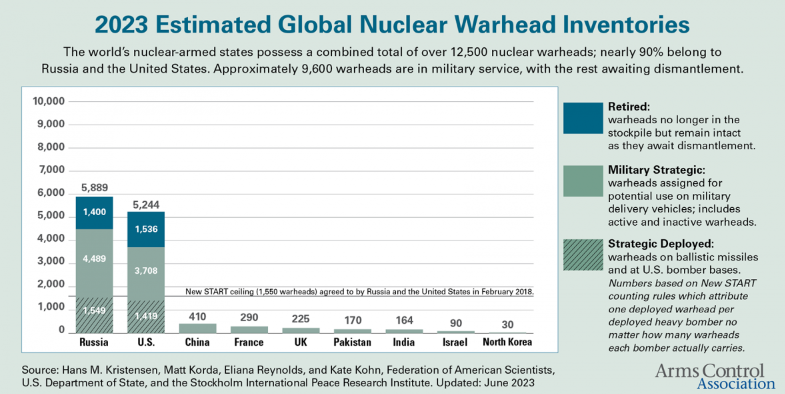
Both NATO and Russia have enough nuclear weapons to go back and bounce the rubble a few times at leisure with their ICBMs and SLBMs. The total warhead count in the world’s nuclear powers is shown below as tallied by the Arms Control Association. The total warhead count for each country includes both tactical and strategic weapons as well as retired warheads. Nuclear weapons have a shelf-life and require some refurbishment over time. For instance, the tritium booster gas in the pit is subject to decay with tritium’s short half-life.

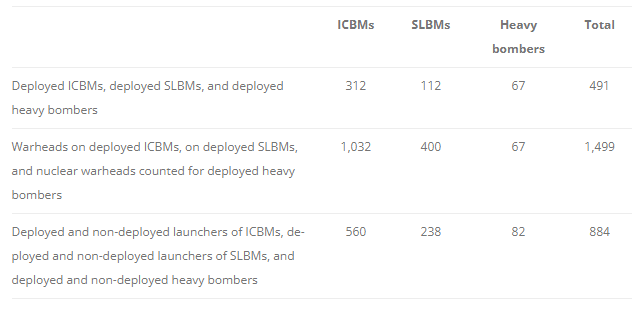
New START data on Russia’s strategic nuclear weapons inventory is shown below. As you can see, Russia’s strategic nuclear weapons inventory is poised to make quite a mess of their target areas from a great distance. On the strategic side (below), nuclear weapons can be delivered to a target across the world via strategic bomber, or a ballistic missile. Intercontinental Ballistic Missiles (ICBMs), Sea Launched Ballistic Missiles (SLBMs), and a collection of shorter range arial platforms could be used in combination.

Source: NuclearForces.org.

Will Russia be tempted to try using a tactical nuclear weapon in Ukraine, even if NATO is sure to reply? At what point will a tactical exchange between Russia and NATO runaway to a strategic exchange? It seems unlikely given the terrible strategic downside of NATO retaliation. Certainly, if allowed to act unobstructed, Russia could make quite a nuclear mess in Europe and North America. However, NATO commanders will not allow their nuclear arsenal to be destroyed in storage.

The late Gene Sharp was known for his theory of non-violent resistance. Sharp argued that

Dictators do not often yield their power without violence, but now and then one will see the futility of fighting to the death against overwhelming resistance and abdicate after a face-saving attempt to stifle the uprising. This happened in the late 1980’s in eastern Europe leading up to the collapse of the Soviet Union under Gorbachev in 1991.

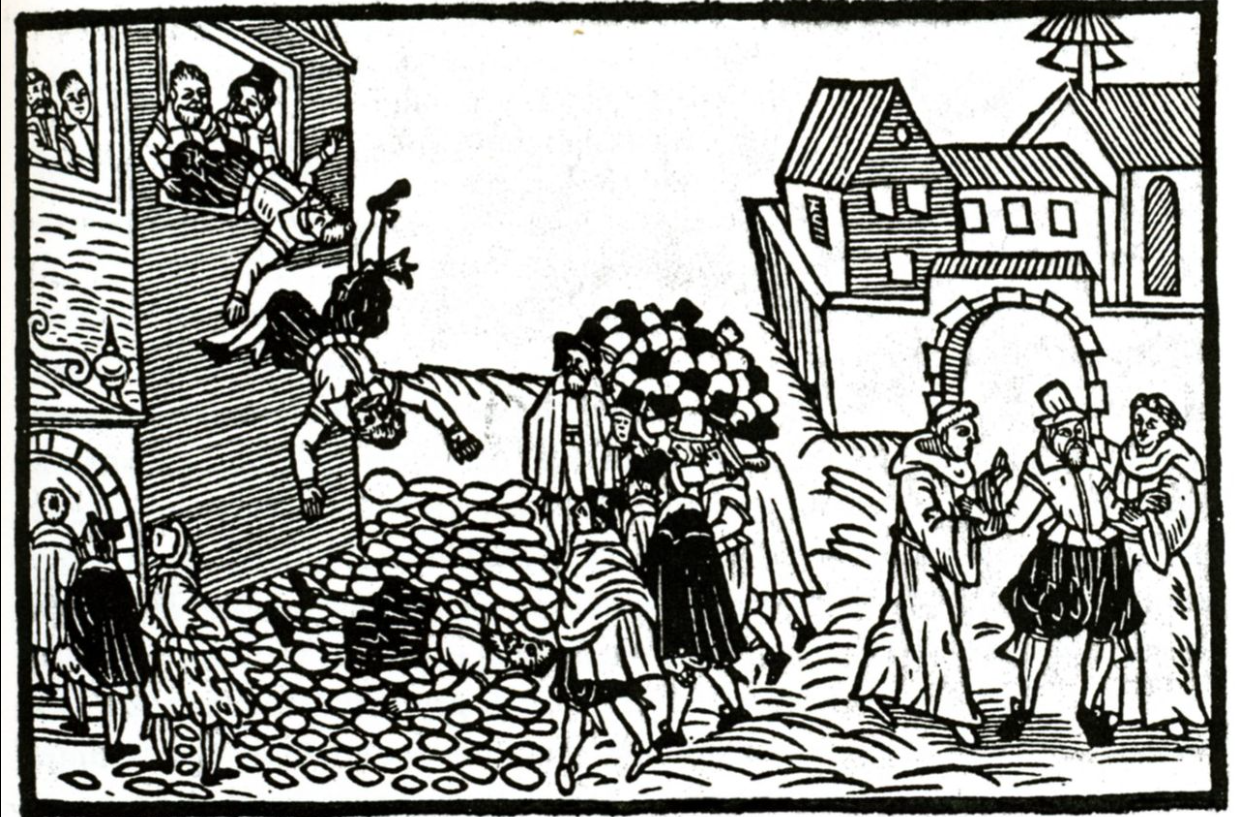
Russia will not change its ways until there is a decapitation at the upper few levels of its authoritarian police state. The population has been too passive for too long to expect a popular uprising like the Velvet Revolution in Czechoslovakia in 1989. Russian opposition leaders are either poisoned, defenestrated or sent to prison as a security threat. Only a military coup could pull off a major change in leadership, but then you have a military authoritarian state.

Source: Wikipedia. The Defenestrations of Prague.

A time-honored way to generate and maintain unity in a nation is to direct blame and struggle towards a foreign power. Both sides in the post-WWII cold war, NATO and the USSR, used this to focus resources and political angst in their respective favor. Putin has managed to revive this “good vs evil” duality not only to secure his power, but also to drive ethnic Russians toward his goal of a Greater Russian Empire.

Mass Groveling of the GOP Brain Trust

The news today from Faux News is that picayune Rep. Greg Steube, R-Fla., wants to rename the Exclusive Economic Zone after Donald J. Trump. All 4,383,000 square miles of it. He proposes to call it the “Donald John Trump Exclusive Economic Zone of the United States.” The EEZ extends out 200 miles offshore around the entirety of the US and possessions.

According to Mirriam Webster-

This is after the earlier attempt to rename Washington-Dulles Airport after the orange felon. The brainwave behind this was Rep. Guy Reschenthaler, R-Pa., the House GOP’s chief deputy whip. This was supported by Reps. Michael Waltz, R-Fla.; Andy Ogles, R-Tenn.; Chuck Fleischmann, R-Tenn.; Paul Gosar, R-Ariz.; Barry Moore, R-Ala.; and Troy Nehls, R-Texas.

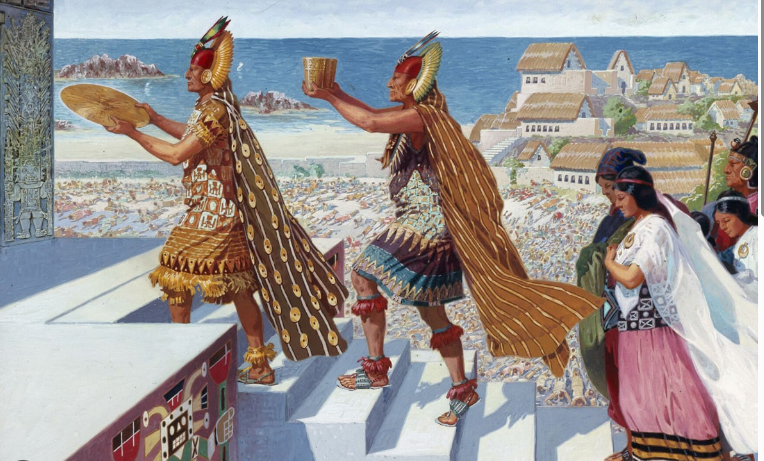
Do we actually have to say it? How can this be any more than open groveling for favor by orthodox MAGA-mites at the top of the pyramid holding up an offering to the Orange Sun God. Could it actually be more pathetic?

Congressional Republican Mandarins pleading before the Orange Sun God for a bountiful election.