An article by Kevin Crowley, Bloomberg News, 9/23/23, reports that ExxonMobil Corp. has already begun to adapt to the decline in demand for gasoline and diesel as the switch to electric vehicles and renewable energy progresses. ExxonMobil operates the largest oil refining network in the world with 13 refineries presently in operation. It sold 5 refineries in the last 4 years in order to focus on cost cutting and improvements in performance of the highest performing facilities. ExxonMobil’s interest in refining dates back to the early days of its progenitor, Standard Oil Company, founded by John D. Rockefeller.
The oil majors are not blind and deaf to the swing towards the replacement of gasoline and diesel powered vehicles. In the case of ExxonMobil, they are planning on switching to production of petrochemical feedstocks in their refineries. They expect that their high-performance chemicals will see 7 % growth per year. Exxon believes the key to its success will be in chemical products. These chemicals are used in manufacturing of industrial and consumer products, from lubricants to pharmaceutical raw materials. Many of the ingredients you see in consumer products have their beginning as crude oil flowing out of the ground somewhere.
Colorado’s very own congressperson, the twice elected Rep. (R) Lauren Boebert of the 3rd Congressional District, was caught misbehaving during a theater presentation of Beetlejuice at the Denver Center for the Performing Arts the other day. Besides vaping and some very mild hooliganism, she was caught on surveillance video making out with her date. Like many others who have attended Beetlejuice, they couldn’t resist the urgent pull of their tingly bits. You may recall that Pee Wee Herman had a similar problem as well.
Let me emphasize that there is nothing wrong with making out, mind you. I know many who claim to have done this. After all, this was the true purpose of the drive-in movie theater in years past. Heaven only knows how many solid citizens walking around today were conceived at a drive-in. I think that the move away from bench seating in the automobile had a negative effect in this. But I digress.
Colorado’s 3rd District covers quite a bit of turf as you can see. Most of it is desiccated and somewhat vertical so the overall population density is low, thus the large size. A lot like Wyoming. There is a bit of agriculture but no real corn and soybean acreage like a proper farm state.
As with other western states, Colorado has a mix of folks of polar opposite politics who find themselves concentrated in separate zones. Running down the middle of the state is the majority of the population stretching from Ft. Collins to Colorado Springs. Nobody can decide if Pueblo is part of this corridor despite being on I-25. This is the urban corridor along interstate highway I-25 and west to the start of the Rocky Mountains. This band of settlement has for the last few election cycles voted majority Democrat and has driven state politics in the legislature and the governor’s office. Oh, and the House of Representatives and the Senate too. This includes the I-70 corridor running west halfway to Utah. There are scattered islands of liberalism like Durango smack in the middle of Boebert country. I feel for them- really, I do.
Some have tried to explain away Boebert’s behavior as being not uncommon for a refugee from that Fertile Crescent of sweaty redneck-ism, Florida. She is after all a pistol packin’ grandma at age 36 and close to being properly “deevorced.” Regardless of her background, she has lifted herself from the obscurity of the swamps to become a full-throated Centurion of MAGAstan. It is a real accomplishment.
America is now a place where audio and video tapes of titillating content starring national politicians will not lead to their downfall. Instead, they get an uptick in their popularity by rabid apologists who will make urgent whataboutism style counter-claims about Hunter’s laptop. MAGA folk cheer their politicians like people do at a professional wrestling match- with vigor and encouragement of more violence.
East of the I-25 corridor you soon encounter another conservative swatch of the state, border-to-border between two state panhandles- Nebraska and Oklahoma. This area has much more pivot irrigated farmland than in the western side of the state. Corn, wheat, and sugar beets are popular crops east of the interstate. Through what I suspect were underhanded dealings in the past, Oklahoma is said to have been paid to be a buffer between Colorado and Texas. Many will say that this was a smart move. (Relax- it’s a joke)
In Colorado we have two bookend corridor cities that are well known for their politics. Boulder, northwest of Denver, is to Colorado what San Francisco is to California, but without Silicon Valley or a suspension bridge. It is liberal progressive and a bit on the exotic side. The Hippie movement arrived in the 60’s and never faded away completely. In the 70’s and 80’s you could see ex-hippies with thinning gray ponytails tooling around town in their Beamers. No one bats an eye when weird news sprays out of there. It’s expected. Every state should have a Boulder. Look at Texas of all places- they have Austin.
Colorado Springs, on the other hand, is deeply entangled with far-right conservative Christian evangelicals. Add to this mix a large population of very conservative retired military and you have something very special. The city plays host to Fort Carson and the North American Air Defense Command, NORAD, deep within Cheyenne Mountain southwest of town. You can bet that the Russian and Chinese strategic commands have the exact coordinates of this facility. The US Air Force Academy resides in the forest north of town with its unique chapel jutting proudly above the landscape.
Located at the base of Pikes Peak, “The Springs” enjoys considerable scenic splendor and a conservative upper middle-class tenor. None of my liberal friends contemplate moving there no matter how splendiferous the place may be. It’s a cryin’ shame. This is the city where the wedding cake bakery went to the Supreme Court to protect their right to decline to make a wedding cake for a gay couple. They won. If I were a bakery owner who didn’t want to do business with someone, I would have given an outrageous price or a 12-month lead time or both with payment up front. There are easy yet subtle ways to poison an awkward business deal.
It will be interesting to see if Lauren gets reelected in 2024 given her antics. I have a nauseating feeling that she will be reelected given the demographics of her district. It’s one of those “she may be an idiot, but she’s OUR idiot” things that MAGAstan people can relate to. We’ll see.
The news cycle is presently focused on the meeting of Putin with a certain dictator of an impoverished nuclear state. Evidently, they agreed to hold hands against western imperialism and hegemony. That agreement just drips with irony about fighting imperialism. But it’s in the nature of dictators to claim to protect the state against the very thing they bring to their nations.
Having to stoop to sourcing arms and making nice with the waddling leader of the land of missiles and starvation must nauseate Putin in his reflective moments. But for now, he is tarting up the relationship as “statesmanship” with a former client state. Ok, maybe he’ll have to share secret rocket science technology and lessons in orbital mechanics with the tin-pot dictator of Asian Lilliput. Has to be done, I s’pose.
Over time, many of Russia’s institutions have been hollowed out to a husk by corruption and theft. Was this a symptom or a feature of Tsar Putin’s leadership? Maybe that is how you retain power- allow people to pilfer but rack-up debt to the leader.
At minimum, an influx of arms from what’s-his-name can only mean prolonging the Putin-Ukraine war. Putin’s people will do battle with garden tools if he so desires it. Ole Pootie-poot is just followin’ in the footsteps of Uncle Joe.
I am going to bring up some observations that may be uncomfortable to many of my fellow citizens of the US. It has to do with the idea of “Greatness” that is frequently bandied about.
Commonly, the word “greatness” is carefully chosen to swell the patriotic pride of American citizens. Swinging around the idea of greatness in public is often used as a rhetorical device to align people to a particular point of view. We are raised to see ourselves as the good guys. The use of “greatness” is a favorite buzzword of far-right conservatives to rub people’s noses into.
The conglomeration of US ultranationalist groups- a different name for homegrown fascism- along with Christian dominion ideology has produced a vocal a far-right political group who, on one hand demand libertarian-type free market dominance in lieu of government, while on the other sees protestant Christian reconstructionism providing guidance for a leading role in national and world affairs. The motivation is two-fold: first is to bring humanity under close Biblical law and the second is to prepare for the prophesied apocalypse and second coming of Christ. Many believed that Trump was to have a role in this. Imagine, the guy who invented DNA and set the galaxies spinning picking a bloviating wealthy-narcissistic-real estate developer-shyster-philanderer from Manhattan. Seriously? Something is wrong with this picture. For a preview of Biblical law, have a look at the bronze-age Book of Deuteronomy. Interesting as ancient history but, as a foundation for modern legal procedure, we can do a lot better going forward.
At the present time it is in vogue for the far right to parade around signaling their disapproval of US support of Ukraine in their battle against Russian invaders. Their grasp of history and judgement is sadly lacking.
Some Republicans have stated that the funds and war materiel sent to Ukraine could be better used at home.
Who believes that the Republican leadership would actually direct these savings to issues at home? Directing these funds internally for aid would be dismissed as “socialism” and ignored. Some insist that money that can be spent on Ukraine’s defense can also be cut altogether.
The US has seen much cultural achievement since our inception but sadly we have not been a universal force for good. Like everyone else, we have strengths and weaknesses. Sometimes we’ve been on the wrong side of history. Our treatment of native Americans from the very beginning was simply criminal. As if that wasn’t enough, an estimated 620,000 people died in a bloody civil war to shut down slavery, then we failed miserably at promised reconstruction. Women have long been denied equality and have received it only grudgingly. African Americans had long labored under the Jim Crow laws until only recently. Our government has meddled in the affairs of many nations in the Americas and elsewhere, with some of it blowing up in our faces (e.g., Cuba and Iran). We invaded Iraq in Gulf War II resulting in the violent death of hundreds of thousands of Iraqi citizens based on deception from the Bush administration.
On the other side, we’ve pushed medical advances like drug development and vaccination, brought food to the starving and saved millions of lives around the world. America has been generous with its growing base of scientific knowledge by publishing results obtainable from open sources. The American University-Industrial-Governmental research complex has produced wonders especially from WWII to this very day in everything from aerospace, electronics, pharmaceuticals and agriculture. The explosive growth of knowledge and technology in the 20th century is unparalleled in human history and the US has had a big part in that.
However, as comfortable as it may be, the theory of American exceptionalism has a few holes in it. Our practical capitalistic economics has some blind spots. Innovation usually moves forward only if a development has the possibility of creating profit and only if a small group of money people can be convinced of it. So, you say, this is just good sense. Why is that a blind spot?
Basic research is a hard sell to businesses. Stockholders must be convinced of a rapid payoff from the investment in discovery. It has been said that necessity is the mother of invention. This proverb traces back to Plato. If a business is plugging along making a satisfactory profit at maximum output, what is the motivation to rock the boat for a possible improvement? The answer is the prospect of even more profit via some improvement. But, what if that improvement would require something entirely new outside the capability of current technology and in-house resources? There is necessity but invention is out of reach.
While American industry has produced a tremendous range of innovations with in-house resources, it has done so greatly aided by the contributions of our university and government institutions. Universities provide industry with an educated R&D workforce, largely as a result of the application of government funding. Indeed, my graduate and postdoctoral work was supported by the National Science Foundation and the National Institutes of Health. I have been applying my business, chemistry and synthetic skills to the operation of private business for decades. And so does everyone else in industrial chemical R&D.
Here is the thing. The government funds the research universities which produces R&D results and an educated workforce. Most of the published academic R&D is of a fundamental nature and in the public domain. Chemical companies make good use of this information as a basis for their own R&D for product development. Sometimes the process Development part is begun quicker because the Research groundwork is mostly done by academia. With this, business gets invention quicker and cheaper with less risk because someone else initiated the necessity (the investigator/professor) and government funding paid for it. This represents industry getting a refund on some of their taxes.
In the military aerospace business, the US military provides the necessity by offering contracts for equipment under stringent specifications. Meeting the specs usually requires that materials and processes be developed to meet them. This is an example of the government providing necessity so industry will provide the invention.
A favorite notion in the US that persists is the “Greatness” of what has been a long period of leading financial and military power since WWII. Obviously, we in the US have a potent military and economy. The federal government plays a big role in these areas by supporting industrial and military readiness.
The US was not the first to put a satellite or man in orbit or land a craft on the moon. It was Russia. The US entered into the “space race” to primarily to match the threat of USSR’s space program. The USSR and communism were perceived as an existential threat to the US. Advances in rocketry could carry people, satellites or nuclear payloads. Did we win the race to the moon just because the USSR failed midway?
The US reacted vigorously to Albert Einstein’s warning of the possibility of a Nazi nuclear weapon. The Nazi secret program was under the guidance of Professor Werner Heisenberg. Rattled, the US put together a massive effort to beat the Nazis to the nuclear punch. Later, it was found that they were unable to produce a working nuclear reactor or weapon.
After the fall of Nazi Germany, the US scooped up a few of their best scientific minds, certainly more than the Russians did. The US benefitted greatly in rocketry and aerospace as well as engineering and physics.
The 1930’s was a decade of much advancement in the area of turbojet engines everywhere in the world but the US. We were late comers into turbojet engines. But post WWII we seized on the idea and did well.
US politics has been soured by a few extraordinarily awful people. I’m thinking of #45 in particular but many like-minded citizens have glommed on to his flying circus of bad ideas. Many people conflated business success with aptitude for governance. What they failed to consider was that a business is a type of dictatorship. It is not a democracy. It is run strictly from the top down. There is no bill of rights in business or first amendment. Trying to directly apply business experience to being chief executive of a democratic nuclear state is a fool’s errand. But, people still hold out hope for him.
Trump sailed into office in 2016 partly on his credentials as a “successful” businessman and television personality. For many voters, he was “famous for being famous.” Voters made the extrapolation that if he is a billionaire property developer in New York City then he was “obviously” qualified to be a president.
What nobody considered was that #45 was the CEO and major shareholder of his many private businesses. Not having experience leading a publicly owned corporation, he enjoyed zero transparency in his business activities. As CEO of his private companies, he never had fiduciary responsibilities to public stockholders. A private company is a dictatorship where he thrived.
The allies won the Second World War for many reasons. What made the US stand out in that effort was the fact that North America was geographically isolated and was harder to bomb or invade at that time. The wealth of natural resources and industrial capacity in the US certainly enabled our ability to carry the war to the enemies. The notion of some kind of intrinsic moral superiority held by some is just a fantasy. The US had talented leadership and a workforce willing and able to stand up and be counted. This was not a uniquely American quality. Most nations can and will do this if resources and their leadership will allow it. Being rich in lumber, petroleum, steel and uranium gave the US a distinct advantage.
The US is an amazing country among other amazing countries, but there is much yet to do. My goal is to help sustain basic liberal democratic ideals and one of the pillars is simple kindness. Let’s back off on the self-congratulation and cultish adulation of a despicable billionaire and focus on the basics of operating a democratic republic under the rule of law and with equal protection for all of its citizens.
Congratulations are in order to India’s space agency, the Indian Space Research Organization (ISRO), on their successful moon landing with Chandrayaan-3. This is a great achievement for any organization and India well deserves their feeling of pride in the accomplishment.
A soft touchdown on the moon is a challenging task every time it is done and requires that a great many systems in a lengthy sequence of events perform perfectly. Presently, the rover has deployed properly and is in motion.
The Chandrayaan-3 spacecraft is comprised of a propulsion module, a lander and a rover. Each is equipped with scientific instrumentation.
Lander
Chandra’s Surface Thermophysical Experiment (ChaSTE) will measure the thermal conductivity and temperature of the lunar surface.
Instrument for Lunar Seismic Activity (ILSA) will measure the seismicity around the landing site.
Langmuir Probe (LP) will estimate the near-surface plasma density over time.
Rover
Alpha Particle X-Ray Spectrometer (APXS) will derive the chemical composition and infer the mineralogical composition of the lunar surface.
Laser-Induced Breakdown Spectroscope (LIBS) will determine the elemental composition (Mg, Al, Si, K, Ca, Ti, Fe) of lunar soil and rocks around the lunar landing site.
Propulsion module
Spectro-polarimetry of Habitable Planet Earth (SHAPE) will study spectral and polarimetric measurements of Earth from the lunar orbit in the near-infrared (NIR) wavelength range (1–1.7 μm [3.9×10⁻⁵–6.7×10⁻⁵ in]).
Russia’s Roscosmos Space Agency suffered a setback in its moon landing ambitions with the loss of its Luna-25 lander. Launched August 10 from the Vostochny Cosmodrome in southeastern Russia, contact with the craft was lost after a command was sent for it to lower its orbit around the moon. By August 20 Roscosmos had to conclude that the vehicle had impacted the moon. This was the first Russian attempt to land a probe on the moon since Luna-24 in 1976. The goal was to land at the 100-kilometre-wide Boguslawsky crater.
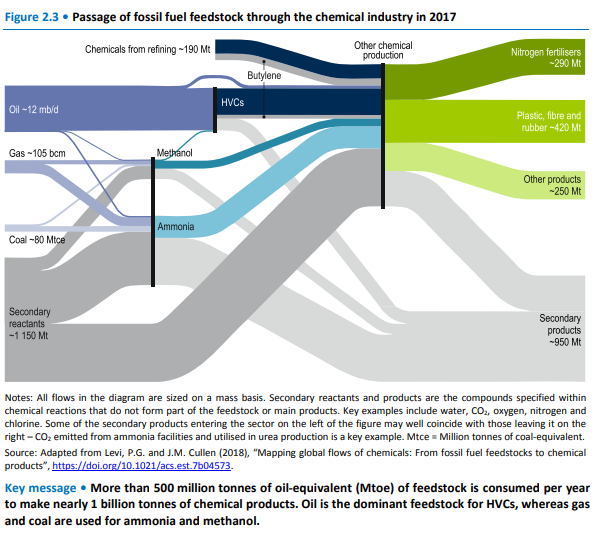
I am asking this question because the transition away from fossil fuels will have a serious knock-on effect on a very large sector of the global economy. Of the total liquid hydrocarbon production, 14 % goes to the petrochemical markets. Of natural gas production, 8 % goes to petrochemicals.
There is a serious complication connected with the idea of shutting down the combustion of hydrocarbon fuels. The elimination of oil and gas combustion activity means that crude oil production drops precipitously and therefore so would refining. Oil refineries are designed to maximize the volume of their most profitable products while minimizing their cost to manufacture. I refer to gasoline, diesel and aviation fuel. Petrochemicals come from oil and gas. Their economics ride on the coattails of fuel production to some extent in terms of scale. Refineries are physically large operations so as to operate with the maximum economy of scale. Maximum economy of manufacturing scale drives consumer prices downward.
Refineries produce much more than fuels. They produce asphalt, lubricating oil, polymer raw materials, petrochemicals for pharmaceuticals and other raw materials for thousands of products we take for granted. There are countless uses for petrochemicals beyond throw-away plastic bottles and bags. Just look around where you are sitting this very moment. Unless you are in Tierra del Fuego or Antarctica, you can’t help but see examples of hydrocarbon applications.
“Our economies are heavily dependent on petrochemicals, but the sector receives far less attention than it deserves. Petrochemicals are one of the key blind spots in the global energy debate, especially given the influence they will exert on future energy trends.” Dr Fatih Birol, Executive Director, IEA
Could refineries adapt to the loss of a large fraction of their fuels production and still produce petrochemicals? Engineering-wise, I’d say yes. But as far as economics go, that is a harder question to answer. Company officers have a fiduciary responsibility to the stockholders. This is a baked-in feature of corporate business. The promise of ever-increasing margins and volumes is part of that. Switching gears towards sustaining the petrochemical sector in the face of declining fuel sales is natural in one sense, but if it involves declining EBITDA over time, it could be disastrous for the stock market. Petrochemical prices might have to climb drastically to sustain earnings. Players in the global oil & gas market are extremely twitchy. The mere suggestion of a potential problem is enough to send prices soaring or diving. Luckily, a wind-down of fuel production will take some time during which the players might be able to compensate.
Look around you. How many consumer goods come in plastic containers or plastic film-coated paper? All of our electronic devices are built into casings of some sort, most of which have plastic or fiberglass (resin impregnated glass fiber) components. The list is endless. For many or most of these things to stay on the market, a substitute material will be needed to replace the hydrocarbon-based materials. Wooden casings for computer monitors and iPhones? What about paint? Paint is loaded with hydrocarbon components.
A vast number of products we take for granted use hydrocarbon materials in some way. Perhaps renewable plastics will scale to meet certain demands. Recycling applies only to those plastics that can be melted- the thermoplastics. Thermoset plastics like melamine cannot be melted and so cannot be recycled. Recycling only works if consumers close the recycling loop. Plastics must be carefully sorted in the recycle process. When a mixture of plastics is melted, the blend can separate like oil and water producing inferior product. National Geographic has a good web page describing recycling.
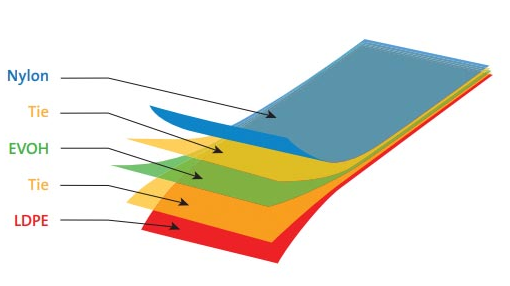
Some plastics such as clear, colorless polyethylene films are usually pure polymer. Most synthetic polymers are colorless. In general, any synthetic polymer that is colored has pigments in it. Black plastic is loaded with soot for instance. Many polymer films for packaging are multilayered with different types of polymer layered together.
Waste thermoplastic with food residues is very problematic, especially those with oil residues. Waste plastic for recycle must be clean. Multilayer plastic films are not suitable for recycling either.
Source: Technical Bulletin, Saint Gobain. Multilayer film structure with 3 different films and two tie layers between them. The Nylon layer provides toughness and tear resistance. The polyethylenevinyl alcohol (ethylene-vinyl chloride copolymer) layer (EVOH) blocks the transmission of oxygen and carbon dioxide. Low density polyethylene (LDPE) layer provides broad chemical compatibility along with biocompatibility for safe handling of biopharmaceuticals. Not all polymers are compatible with melt bonding. The tie-layer is a melt-bondable adhesive polymer film that hold the layers of polymer into a single film. The tie layer polymer is often a polyethylene film that has a surface layer of organic acid or anhydride groups that can bind to other polymers by melt bonding.
Other additives such as plasticizers are present in flexible plastics like polyvinyl chloride (PVC) or other compositions where suppleness is important. Pure PVC is rigid. Additives are an industry unto its own. The varieties and grades in the plastics business is mind boggling. The variety of plastic compositions is too diverse to allow recycling of all plastics.
The point of this plastics background is to suggest that there are so many types and blends of plastic on the market- which is made even more complex by labels and additives -that the scope of polymer recycling must be narrowed to a few of the larger volume plastics. This is what is done today. LDPE, PP and PETE are the major polymers that are recycled in the US. Apparently, Japan is good at recycling. We in the US do poorly.
Polymer manufacturing is likely to continue indefinitely. There is simply too much money at stake for the big oil & gas and petrochemical players to deconstruct themselves to a large extent. They will, however, follow the consumer, but how far?
So, the question is this- for the sake of keeping a viable petrochemical stream in place while hydrocarbon fuel consumption declines, how much hydrocarbon fuel can we burn per year without exceeding the capacity of the earth to absorb the CO2 produced? We want to lower the slope of the atmospheric CO2 curve enough to achieve a reasonable steady state. The global economy depends very much on the production and use of petrochemicals. People will generally avoid economic suicide.
Where is the balance point for a sustainable production of necessary petrochemicals and the decommissioning of hydrocarbon fuel production? I certainly don’t know.
I’ve been struggling to find the words to accurately and succinctly describe MAGA followers in the US with their silly contrarianism and shallow theories of patriotism. I do this because there is something truly peculiar about the shape of conservatism today. I’ve been avoiding the word “stupid” because I didn’t want to hurl the accusation towards people with genuine cognitive disabilities. After all, intelligence is a multilegged attribute that encompasses too many diverse abilities with a single word. But of late I’ve decided that the word is fine to use if you don’t associate it with cognitively disabled people. Online you can find a definition defining it as “behavior or actions that show a lack of good sense or good judgement.” If it isn’t a clean detachment from the cognitively disabled, then at least it is only a superficial scratch.
Ex-president #45 took a sharp swerve from the “norms” of American politics and examples are too numerous to list here. His angry movement didn’t fall out of thin air. In the 2016 election he attracted followers by his audacity and with the propaganda engines of Twitter, conservative radio and television news. They were already out there primed by the nascent Tea Party, but along comes #45 giving them a charismatic and bellicose populist leader with a knack for getting on the news. His rhetorical skills are unmatched and he knows instinctively how to attract and excite a crowd. Importantly, he is a master of social media muckraking. He is not in the least inhibited by social norms for civil discourse.
The big hammer that American conservatism wields is the view of the “good us vs the bad them.” Somehow, the “bad them” always involves liberalism. “Them” can be the flavor of the day- immigrants, abortion, Muslims, NATO etc. This is guaranteed to frighten a certain fraction of the electorate. Throw in the eschatology of conservative Christians claiming that American politics will lead to or accelerate the end times and you have potent brew of dread fear.
Just to be clear, in US history there have never been long stretches of time when citizens frolicked innocently in green pastures of civility and peace was upon the land. There has always been turmoil and hardship somewhere for someone. We’ve always had murderers and thieves preying on the innocent and unwary. Yet the US experiment with democracy and capitalism overall has thrived, dipped and recovered over time. Somehow, Americans have avoided fascism. Until now.
There have always been exceptional people in the world who were able to rally groups for an epic cause, whether it was for military, political or religious purposes. It is the story of history. Today is no different, although the means and speed of persuasive communication has advanced considerably. After the invention of the printing press, there was opposition by religious leaders claiming that easy and rapid availability of information or propaganda would destabilize their personal view of how the social order should be. Since then, ideas of all sorts have found their way into the minds of the masses at increasing speed to this very day. Today, populist rhetoric and opinion can travel internationally at speeds limited only by the clock speed of computers and the speed of light.
There has always been a fraction of any population that gets agitated or frightens easily. Fright can come from direct experience or persuasion. Anything that threatens perceived safety, stability or income will unnerve people to some extent and some much more than others. It is called economic disenfranchisement and it is widespread in the US. Money equals power and lacking it means that one is not invited to the party.
The feeling of being cheated also agitates people. And this is where #45 excels. Unfortunately, in the US there is a large group of people that have not been able to fully enjoy the fruits of our civilization. For many reasons they have been passed over in terms of opportunities to advance or just keep up with the times.
One effect of technological advance is the obsolescence of labor-intensive jobs. Labor costs are always a target for innovators and businesspeople in the eternal march towards greater efficiency. This has been happening since the invention of the wheel. Any given task can be the target of cost reduction by lowering of the headcount. It may seem coldhearted but, in society, it is as ever-present as gravity.
People who lack valuable skill sets or those made obsolete by technology or corporate maneuvering are at a serious disadvantage in American society. People who chose life paths that did not include educational enrichment such a trade school or college have long been at a disadvantage. A comfortable retirement after a lifetime of low wages is difficult or impossible. Some people manage to excel but most don’t. Some start businesses that take off. Most don’t because they don’t know how or lack startup capital. The market can only sustain so many nail salons or restaurants in a given location.
Indicted ex-president #45 discovered his knack for anger politics at some point and jumped on it at a time when conservative electronic media was blossoming. He couldn’t help himself. His authoritarian impulse found a venue in politics and wide acceptance.
The acceptance of authoritarian leadership is particularly stupid for a citizen in a democracy. Our democracy is extremely unusual in human history. Many of us fail to appreciate that.
All of us exhibit stupidity now and then. We all commit “behavior or actions that show a lack of good sense or good judgement.” I do, that much is certain. We live in a time when a great many fellow citizens assent to a movement that, in the end, is not to their best interests. Not all stupid behaviors are equal in magnitude or in the kind of harm produced. It seems to me that gladly accepting authoritarian leadership in anger is especially stupid. Democracy once forfeited is not easily retrieved.
Trading away many of the benefits of democracy for some perceived guarantee of social order is a prelude to dictatorial government. Democracy is inherently chaotic to some extent. This is at the core of the American experiment. In exchange a notch of social order we trade some measure of freedom and liberty. Voting for authoritarian governance is the final act of a democracy.
When I look around I marvel at how quickly some things can happen. How is it that so many people prostrate themselves in front of a madman like Trump since 2015? So many people are able to ignore the lies, aspersions and exaggerations that he casts about, and they even increase their support for the man as the felony indictments accumulate. Who would have guessed that America would fall into this tar pit of absurdity?
I’ve always suspected that the American experiment would collapse at some point, like all empires do. But to do so at the hands of a cartoonish, thuggish wannabe dictator-real-estate-developer-TV-star is just too much to bear. It’s so incredibly disappointing.
The Trump lovers seem unlikely to respond to reason in their lifetimes. They will go to their graves having given themselves to a confidence man who spoiled the American experiment.
My, my, my. Rober F. Kennedy Jr. really screwed the pooch with his comments on ethnically targeted COVID-19. Reportedly, he said “there is an argument that (COVID-19) is ethnically targeted”, adding “Covid-19 is targeted to attack Caucasians and Black people. The people who are most immune are Ashkenazi Jews and Chinese …. we don’t know whether it’s deliberately targeted or not.” If this quote is correct, he did not actually say that COVID-19 was ethnically targeted, but rather that “there is an argument …”. It is much like saying “is Bob still beating his wife? I just don’t know …” Whether he endorses the targeting theory or not isn’t clear, but he was willing to trot out this provocative statement to make his point. There was much blowback. Given the racial undertones, it was a large blunder.
RFK Jr. is well known as an advocate for conspiracy theories, some of which are whoppers. The online news magazine Slate has an article that compiles them. I find that his portfolio of mania is exhausting. The thought of pushing back against such seems like a fool’s errand. It reminds of a line in the movie True Grit: “What have you done when you have bested a fool?” What is the point in debating him?
RFK Jr. is a Harvard grad and went the University of Virginia School of Law to get his JD degree. He had a few slip ups early in his career but recovered. He spent most of his career as an environmental lawyer and has fought many laudable battles for environmental justice. Somewhere along the line he went off the rails and landed in the crackpot ferry to conspiracy land. RFK Jr. is a penetrating anti-vaccine voice who can draw large crowds if for no other reason just to see him.
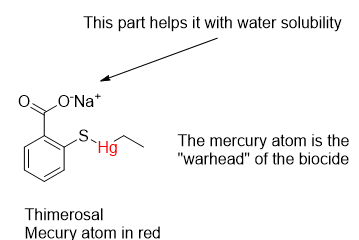
The substance of concern behind much of the anti-vaccine Sturm und Drang is Thimerosal. It is a synthetic organomercurial compound that is effective against bacteria and fungi. Its biocidal properties have been known since the around 1930. Mercurials have been used since the time of the Swiss alchemist Paracelsus (Philippus Aureolus Theophrastus Bombastus von Hohenheim) in the 1500’s. Paracelsus is known for the pronouncement that “only the dose makes the poison.” This remains a fundamental principle of toxicology.
The early mercurial medicaments used by Paracelsus were simple inorganic salts of mercury(II) like mercuric chloride, HgCl2, or mercury(I) like mercurous chloride, Hg2Cl2, also known as the mineral calomel. Mercuric chloride is prepared by treating liquid mercury with sulfuric acid followed by addition of sodium chloride for anion exchange. Mercurous chloride is prepared by heating mercuric chloride with mercury to do the reduction of Hg++ to Hg+.
Thimerosal is sometimes wrongly compared to methylmercury, a known and tragically toxic compound with the formula CH3Hg+X–. The X anion can be chloride, hydroxide or a thiol, depending on the source. It is an easy comparison to make because of the similarity of methyl (CH3) to the ethyl (CH3CH2) hydrocarbon group in Thimerosal, but research has proven it to be a poor comparison. Methylmercury compounds can be produced by aquatic microorganisms in water bodies in the presence of inorganic mercury. The methylation of natural biomolecules is a well-known process.
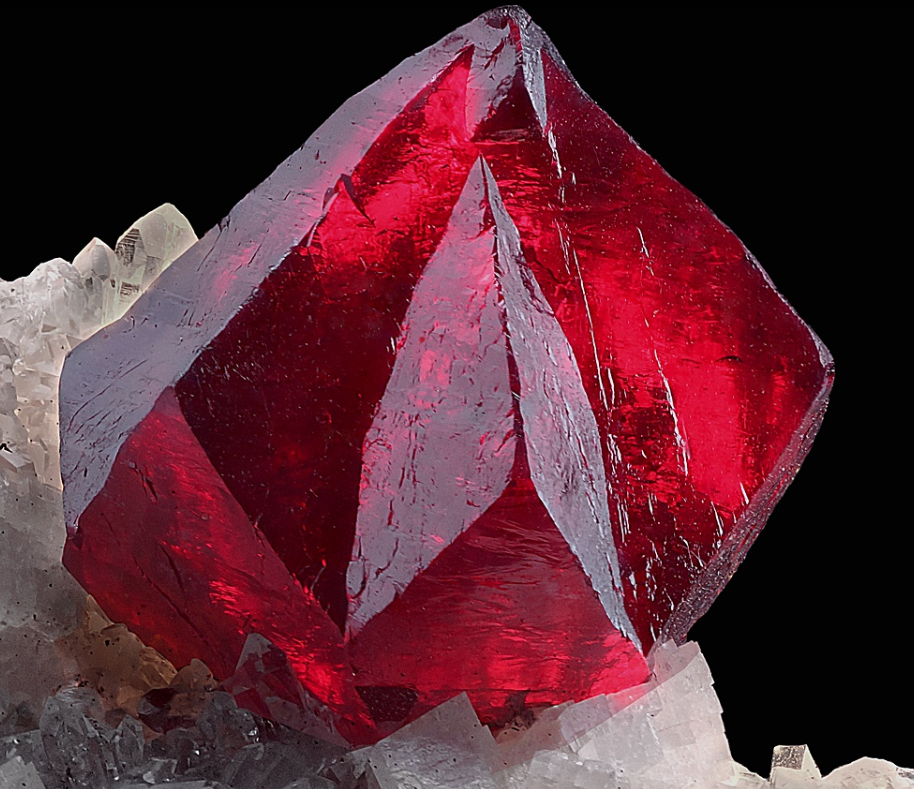
Like many metals, mercury has an affinity for sulfur, occurring naturally as mercury (II) sulfide, HgS, as deposits of Cinnabar or as a minor constituent with other minerals. It also has an affinity for sulfur-containing amino acids such as methionine, cysteine and homocysteine found in proteins. In the bloodstream mercury binds with proteins like albumin to the extent of 95-99 %. While in the body and exposed to water it decomposes to thiosalicylate and ethylmercury. Ethylmercury cation (CH3CH2Hg+) disperses widely and can cross the blood-brain and placental barriers.
According to Doria, Farina, and Rocha (2015) in Applied Toxicology, a comparison of effects between methylmercury and ethylmercury gave essentially the same outcomes in vitro for cardiovascular, neural and immune cells. Under in vivo conditions, however, there was evidence of different toxicokinetic profiles. Ethylmercury showed a shorter half-life, compartmental distribution and elimination compared to methylmercury. Methylmercury and ethylmercury toxicity profiles show different exposure and toxicity risks.
For many years, Thimerosal was sold as an antiseptic under the name Merthiolate as a tincture (an ethanol solution) by Eli Lilly and Co. Like most households in the 1960’s, we had it in the medicine cabinet or its cousin Mercurochrome. They were used for topical application to burns, cuts and scratches. Thimerosal has been used as a preservative in many health-related preparations such as vaccines, eye drops and contact lens disinfecting solutions. While the CDC has cleared it of doing harm, anti-vaccine mania hit the fan well before COVID-19 and RFK Jr. put his credibility and name recognition behind it.
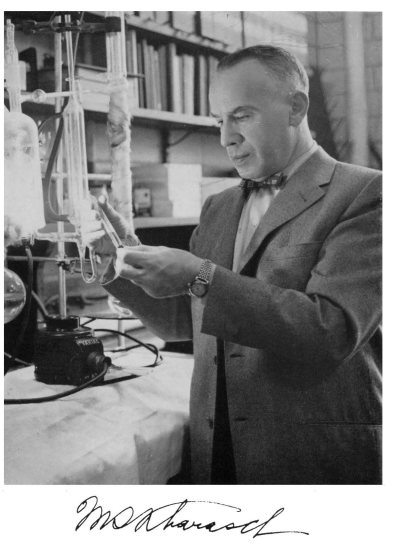
Thimerosal was first prepared by chemist Morris Kharasch at the University of Maryland in 1927. An interesting technical summary of the substance can be found on Drugbank Online.
Kharasch is known for his pioneering work in free radical chemistry in the 1930’s at the University of Chicago but before that began his work with organomercury chemistry during the 1920’s while at the University of Maryland. His development of Thimerosal was a result of his organomercury work. He is also credited with opening the door to organic free radical chemistry leading to improvements in rubber polymer chemistry and manufacture. His work led to the use of peroxides to reliably induce the so-called anti-Markovnikov addition of a protic acid (HX) to olefins. The presence of trace peroxides was behind the unexpected “reverse” Markovnikov addition of seen in work with the addition of hydrogen bromide to bromopropene.
Kharasch’s early work in organomercury chemistry led to the invention (and patenting) of what became known as Merthiolate (thimerosal). Kharasch later worked as a successful consultant for Eli Lilly, the Du Pont Company, US Rubber, the US Army and others. In many cases these companies were the assignees of the patents.
Little mention is made of Morris Kharasch as a prolific and wide-ranging inventor with, by my count, 117 US patents with him as the inventor. So, why did Kharasch bother to patent Thimerosal? Did he anticipate its biocidal and preservative properties?
Kharasch references make mention of a 1931 patent regarding Thimerosal. That patent is STABILIZED BACTERICIDE AND PROCESS OF STABILIZING IT, US 1862896, appln. filed August 22, 1931, assignee: no party disclosed. The patent claims a process for and claims of water-soluble solution compositions. Numerous additives include antioxidants, alkyl amines, ethanolamine and borax. Claim 19 is telling. It claims the composition of sodium ethyl mercurithiosalicylate (Thimerosal), monoethanolamine, borax as a buffer and enough sodium chloride to make the composition sufficiently isotonic with the body fluids. In this patent the Thimerosal composition itself is not claimed, but as a component of a stabilized water solution. Claim 14 claims a water solution composition of sodium ethyl mercurithiosalicylate and an antioxidant which tends to “inhibit the acquisition” (odd choice of words) of burning properties by the solution. This plus the claim of an isotonic composition strongly suggests anticipated medicinal applications.
STABILIZED ORGANO-MERCUR-SULFUR COMPOUNDS, US 2012820, appln. Feb 17, 1934, assignee: Eli Lilly and Company. Claims a stabilized solution of alkyl mercuric sulfur compounds in water with aliphatic 1,2-diamines. Also claims Ethylenediamine ethylmercurithiosalicylate composition. This is similar to the ‘896 patent but specified ethylenediamines.
As mentioned above, the biocidal nature of inorganic mercurials had been known for a long time. There was actually limited success in the treatment of syphilis. But they were long known for being very harsh on the patient and grew out of favor when better treatments came along.
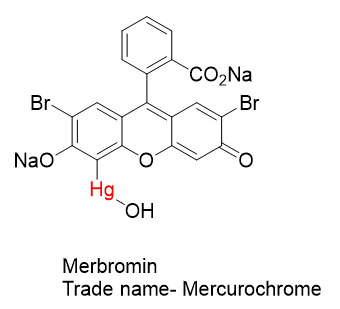
The antiseptic properties of Mercurochrome were discovered in 1918 at Johns Hopkins Hospital by urologist Hugh H. Young. Mercurochrome is essentially a dye molecule with an attached mercury warhead. There are three groups on the organic structure that aid in its solubility in water- NaO, CO2Na, and HgOH. Water solubility is often an important attribute in medicinal substances.
Given that antiseptic properties of organomercurials were known, it is perhaps not surprising that an enterprising Ukrainian immigrant with an interest in organomercurials like Morris Kharasch might want to patent his invention.
The history of the present Ukrainian territory is not a happy one. The land has been soaked with Ukrainian blood by Hitler and Stalin. Not being a historian, I’ll defer to my betters for a more cogent account of the timeline of that territory.
I’m completely behind the Ukrainians in their resistance to Putin’s brutal war machine. Putin’s view is that Ukraine has been an administrative district of Russia all along and is now infested with NAZI brutes. That Ukraine fell under the control of NAZIs is absurd on its face, but to a Russian public trapped in a deep information silo, it is apparently plausible.
According to Ukrainian historian Serhii Plokhii at the Ukrainian Research Institute at Harvard, from 1918 there were repeated failed attempts by the Bolsheviks to gain control of Ukraine. Lenin relented and concluded that it was necessary to grant Ukraine formal independence by 1922. This was necessary for the Bolsheviks to maintain control over Ukraine. Ukraine was granted autonomy as an independent state within the Soviet Union.
In the recent 2023 meeting in Vilnius, NATO declined to accept Ukraine joining the organization. Russia has long made a show of believing that NATO wants to commit aggression against them. That NATO is a defensive pact somehow never sunk in. Ukraine joining NATO will only be seen by Putin as the latest and largest threat to Russian state security. Given how well the conventional military apparatus has performed in the attack on Ukraine, it isn’t safe to conclude that steady hands are hovering over the nuclear button.
With the violent history of Russia in eastern Europe, why would anyone want to start a war of aggression against Russia there? Let’s say that the West waged war against Russia and won. They are not a nation of people begging for western-style democracy. Russia resents the cultural, military and political dominance of the West, that is, Western hegemony. The collapse of the USSR was a major loss of face for a great many in the Soviet Union, especially for Lieutenant Colonel and later FSB director Vladimir Putin. Putin openly seeks to “Make Russia Great Again,” and like Trump, is surfing on a wave of fear and nationalism.
It seems certain that once Ukraine is in hand, Putin will continue with his murderous land-grab. The Baltic states, Poland, Georgia and a land corridor through Poland to Kaliningrad are all at risk and they know it. It is what was called the “Domino Theory” back in the cold-war days of the Viet Nam war. It was used to justify many military responses by the west to Russian expansionism.
For the West, the challenge is to keep Putin’s Russia contained and yet away from the nuclear precipice. It is a game of who can outlast who.
American apathy with foreign affairs has long been a common affliction. Sadly, the US Republican party is making a virtue out of admiring Putin and the burgeoning autocracy in Hungary. Since World War II, the US and Europe (formerly Western Europe) have had hegemony in the areas of dominant currency, finance, English language, military power projection and general commerce around the world. Today, Russia and China are quite clear that they wish to bring down this historical Western hegemony as soon as they can.
Definition: Hegemony, \hih-JEM-uh-nee\ noun. 1 : preponderant influence or authority over others : domination. 2 : the social, cultural, ideological, or economic influence exerted by a dominant group.
Wikipedia.
Definition: Liberal democracy is the combination of a liberal political philosophy that operates under a representative democratic form of government. It is characterized by elections between multiple distinct political parties, a separation of powers into different branches of government, the rule of law in everyday life as part of an open society, a market economy with private property, universal suffrage, and the equal protection of human rights, civil rights, civil liberties and political freedoms for all people. To define the system in practice, liberal democracies often draw upon a constitution, either codified or uncodified, to delineate the powers of government and enshrine the social contract.
Under Chinese or Russian hegemony the world order will be very different than that held by the US and Europe. The US and Europe have various versions of liberal democracy and support other nations who do as well. To view the future, just have a look at how these two countries conduct government in their own countries. Care to live under the Chinese Communist Party’s or under Putin’s world order? As an American, the English lingua franca, for better or worse, seems to work fairly well. Imagine Westerners switching to written and spoken Mandarin. At least Russian is based on an alphabet. Am I biased towards alphabetic languages? Definitely.



 Lamentations on Chemistry