Category Archives: Economics

Crossing the OS Rubicon- From MS Windows 11 Across to Linux Ubuntu

After viewing an alarming report on YouTube concerning the shady situation with Microsoft’s business strategy in general and Microsoft Windows 11 in particular, I’ve decided to cross the Rubicon to Linux Ubuntu. It’s not just about what I’ve learned about Microsoft’s intrusion into my personal computer’s files. My latest update of MS Outlook ab.so.lute.ly stinks. My relearning and expectations of Windows 11 Outlook is contaminated by my prior familiarity with the previous rev. The blurred familiarity of the new version is twisted with years of habit and expectations. I’ve had enough.

I’ve been using Microsoft products since the Jurassic age of home computing, ca 1986. I refer to both “IBM” machines of that age and Apple’s McIntosh. As a result, both my entire professional and personal computer lives are deeply invested in Microsoft products, MS Word especially. I’ve heard that transfer compatibility going from Word documents to whatever Linux app is problematic, except for pdf files.

My plan is to experiment with an inexpensive laptop from Amazon with Linux Ubuntu already installed. The goal is to make a parallel assessment of Ubuntu with my personal and consulting work on MS Windows.

Remember the scene from Saving Private Ryan where a German soldier is killing an American soldier by struggling to push his bayonet into his chest on the upper floor of a building? While the German soldier is pushing the blade closer and closer, all the while he is attempting to quell the American’s panic with soft words, shushing and a pleading for him to stop resisting. It’s very disturbing and reminds me of the banality of evil.

Many companies, including Microsoft, are constructing business models that remind me of this disturbing scene. They are encouraging customers to switch from Windows 10 to Windows 11 by aging out Windows 10 updates. In doing so, Windows has become a subscription service rather than your personal property in the privacy of your hard drive. Instead of buying MS windows once, you are now paying for a subscription and allowing MS to examine your files. What do they do with what they may find? Overall, they want to turn your proclivities and interests into cash through selective advertising and sales of marketing data to third parties.

They are trying to force users to use their cloud storage where they will have access to all of our data. Worse yet, their AI “helper” encourages users to ask for help that reveals what the user is thinking. That help can be in the form of rewriting your text or actually producing content for the user. The AI system resides in one of their data centers and who knows what kind of analysis and business planning that results in.

This approach is really about shooting fish in a barrel and is increasingly appearing on social media with advertisers pushing subscriptions rather than outright purchases. Amazon does it as well with certain food stuffs. I understand the business motivation to exchange a single larger sale for monthly payments of smaller dollar amounts over time. This works best when charges are hidden in your credit card statements disguised as lengthy character strings rather than intelligible names. Also, that particular human frailty of losing track of what you are paying for by credit card is a real issue for people. Do we actually think that the C-Suite knobs who oversee their sales operations haven’t thought of this? They know exactly what they are doing.

Ostensibly, the “genius” of the free market is to maximize the efficient use of capital. Obviously, history bears (or bares?) out that there is much evidence for this assertion. The downside of this is that decisions contrary to your personal choice are made by others who decide what efficiencies that you will pay for while they retain their margins.

Do you want to produce a product that results in a few single-item sales of a dollar each or a product that produces a larger number of nickels over time? Obviously, it depends on the product.

Like hundreds of millions of others, I have helped to keep Microsoft afloat and remain a great investment for their stockholders. We’ve done our part. But now it is time to say “so long and thanks for all of the fish.”

China Restricts Exports of Critical Metals to the US

Trump’s ill-tempered brinksmanship and his coarse criticism of both long-term allies and old adversaries has begun to cost the US access to strategic materials. In particular, China has announced that it has banned the export of a group of metals and non-metals to the US. Specifically, China had previously imposed export controls on Rare Earth Elements (REE), gallium (Ga), germanium (Ge), antimony (Sb) and graphite (C). More recently it has included tungsten (W), tellurium (Te), bismuth (Bi), indium (In) and molybdenum (Mo) products.

In case the reader is unfamiliar with the uses of the above elements, a list of them with a short description is given below.

Many of the elements listed above are by-products from the refining of other metals like aluminum, copper, lead and zinc. Reduced production of aluminum, copper, lead and zinc will also reduce output of their accessory metals as well.

  • Gallium– Primarily used in semiconductors; is used to produce the denser, stabilized δ allotrope of plutonium for use in nuclear weapons.
  • Germanium– Primarily used in semiconductors; a by-product found in copper-lead-zinc ores.
  • Indium– Primarily used in semiconductors or other electronic applications; it is a by-product found in sulfidic zinc (Sphalerite) and copper ores (Chalcopyrite). Indium tin oxide (ITO) forms a thin, transparent and electrically conductive layer on glass for touch-screen applications such as smart phones.
  • Tellurium– A scarce element at an average occurrence 1 ppb in the crust and never the primary ore in mining. It is mostly found combined with gold as Calaverite (AuTe), Sylvanite (AgAuTe) or Krennerite (AuTe2 Orthorhombic gold telluride.) Tellurium has use in a large variety of applications. Unfortunately for gold miners, calaverite ore is not susceptible to cyanide extraction for gold recovery. Calaverite can be roasted and tellurium volatiles removed from the gold residues. However, commercial scale roasting of minerals is problematic in the US.
  • BismuthBismuth is never the primary ore in mining. It is found with lead, copper and tungsten. Broad applications across many domains. No longer produced in US. Bismuth is the highest atomic number element that is not naturally radioactive. Well, it’s half-life has been determined to be 1.9 × 10¹⁹  years which is still “pretty stable”.
  • Antimony– The largest antimony mine in the world is the Xikuangshan mine in Lengshuijiang Hunan, China. This mine produces 50 % of the world’s antimony. The mine produces antimony from 2 different minerals, stibiconite (Sb3O6(OH)) and stibnite (Sb2S3).
  • Molybdenum– Mined as the primary metal ore. About 86 % of molybdenum is used in metallurgy with the rest used in chemical applications. An important molybdenum mineral is molybdenite, MoS2. Important US mines are the now-defunct Henderson Mine and the now operating Climax Mine, both in Colorado and both operated by Freeport-McMoRan. The Climax Mine resides at the summit of Freemont Pass at 11,360 ft altitude and to the north of Leadville, Colorado. Molybdenite deposits can be found as far away as Questa, New Mexico, with the Chevron Questa Molybdenum mine which is now closed and undergoing reclamation as a superfund site.
  • Graphite– Natural graphite arises from metamorphization of carbonaceous sediment. It can mined or produced synthetically. Graphite is the most chemically stable allotrope of carbon at standard pressure and temperature.
  • Tungsten– Also known as wolfram (W), tungsten has the highest melting point and lowest vapor pressure of the elements. As a refractory metal, tungsten us often used in high temperature applications such as welding and for its relative chemical inertness affording high resistance to corrosion. In military applications tungsten is exploited for its combination of high density, hardness and refractory properties in projectiles and other applications. In chemical form, it is often found as a polyoxometallate anion such as WO4−2, “orthotungstate”. These polyoxometallate anions can form higher order cage structures.

All of the above elements are well established in diverse products and are a part of numerous leading-edge technologies in use today. All ores are subject to the market price of their mined and milled products. All of the elements listed above are produced in various simple but purified forms that customers will plug into their own production lines. The economics of their mine operation has a high reliance on the margins offered by their raw material costs. If the raw material supplier goes a step further and captures value-added profit margins by offering an advanced intermediate or even the final product, then the customer faces having to use the more costly value-added materials. The effect can be that they must raise prices on their product or step away from the market. This is just the old familiar path of competition.

As luck would have it, early in geologic history China won the mineral lottery when many ore-forming processes valuable ores in its present territory. We have all heard of China’s supremacy in rare earth element (REE) reserves. China eventually made the choice of halting exports of rare earth minerals as the oxides in favor of offering value added finished products instead. Business-wise, this was a smart and inevitable choice for China, but users who manufactured REE products from their imported REE raw materials were suddenly facing stiff competition from abroad.

Since this policy of China metering closely the export of REE minerals, western countries have made considerable progress locating REE deposits elsewhere. Incidentally, the same holds true for lithium deposits.

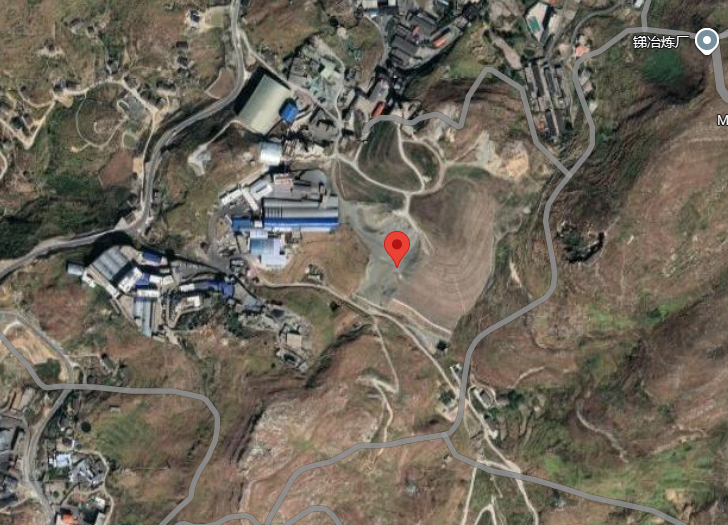
From Google Maps. An aerial view (supposedly) of part of the large Xikuangshan mine in Hunan, China.

Restrictions on exports of the above elements will have a large impact on many industries in the US. My question is this: Could a better diplomatic approach to imports from China have been made?

It isn’t all bad news. Difficulties with raw material prices and availability frequently motivate users to invent a way around problematic raw materials. There is nothing like the motivation to fire up the inventive juices than to seek a work-around for a raw material supplier problem.

Sustainability? Can We Reinforce the House of Cards that Civilization has Become?

Ask yourself this- will your descendants in the year 2125 share in the creature comforts coming from the extravagant consumption of resources that we presently enjoy? Shouldn’t the concept of “sustainability” include the needs of 4-5 generations down the line?

The word ‘sustainability’ is used in several contexts and in contemporary use remains a fuzzy concept with few sharp edges. In this post I will refer to the sustainability of raw materials, fully recognizing that it covers numerous aspects of civilization.

There are wants and there are needs. For the lucky among us in 21st century developed nations, our needs are more than satisfied leaving surplus income to satisfy many of our wants. Will our descendants a century from now even have enough resources to meet their needs after our historical wanton and extravagant consumption of resources dating to the beginning of the industrial age? Our technology stemming from the earth’s economically attainable resources has done much to soften the jagged edges of nature’s continual attempts to kill us. After each wave of nature’s threats to life itself, survivors get back up only to face yet more natural disasters, starvation and disease. This is where someone usually offers the phrase “survival of the fittest”, though I would add ” … and the luckiest”.

What will descendants in 100 or 200 years require to fend off the harshness of nature and our fellow man? Pharmaceuticals? Medical science? Fuels for heat and transportation? Will citizens in the 22nd century have enough helium for the operation of magnetic resonance imagers or quantum computers? Will there be enough economic raw materials for batteries? Will there be operable infrastructure for electric power generation and distribution? Lots of questions that are easy to ask but hard to answer because it requires predicting the future.

Come to think about it, does anyone worry this far in advance? The tiny piece of the future called “next year” is as much as most of us can manage.

Humans would do well to remember that a great many of the articles that we rely on are manufactured goods, such as: automobiles, aerospace-anything, pharmaceuticals, oil & gas, metals, glass, synthetic polymers (i.e., polyethylene, polypropylene, PVC, polystyrene etc.), medical technology and electrical devices of all sorts. Each of these categories split off into subcategories all the way back to a farm or a mine. And let’s remember that both mining and farming are both reliant on big, expensive machinery and lots of water.

Each of the contributing technologies holding up any given apex technology were new and wondrous at one time. Think of a modern multicore microprocessor chip. Follow the chip’s raw materials back to the mines and oil & gas wells where the raw materials originated. Once you’ve done that, consider all of the people and inputs necessary in each step getting from the mine to the assembly of a working microprocessor. Each device, intermediate component or refined substance is at or near the apex of some other technology pyramid. To keep moving forward, people need to connect each apex technology input in a way to get to their own apex endpoint.

We mustn’t forget all of the machinery and components, energy to power them, transportation and trained personnel needed to manufacture any given widget. Skilled hands must be found to make everything work.

A given technology using manufactured goods is a house of cards kept upright by constant attention, maintenance, quality control and assurance, continuous improvement and hard work by sometimes educated and trained people. Then, there is a stable society with institutions, regulations and a justice system that must support the population. The technology driving our lifestyles does not derive from sole proprietor workshops in a corrugated iron Quonset building along the rail spur east of town. The highly advanced technology that is driving economic growth and the comfortable lives we enjoy comes from investors and factories and international commerce. A great many products we are dependent on like cell phones are affordable only because of the economies of large-scale production.

So, what is the point of this? Sustainability must also include some level of throttle back in consumption without upsetting the apple cart.

A plug for climate change

For a moment, let’s step away from the notion that the atmosphere is so vast that we cannot possibly budge it into a runaway warming trend. The atmosphere covers the entire surface of the planet with all of its nooks and crannies, but its depth is not correspondingly large. In fact, the earth’s atmosphere is rather thin.

At 18,000 feet the atmospheric pressure drops to half that at sea level. The 500 millibar level varies a bit but is generally near this altitude. This means that half of the molecules in the atmosphere are at or below 18,000 feet. This altitude, the 500 millibar line, isn’t so far away from the surface. From the summits if the 58 Fourteeners in Colorado, it is only 4000 ft up. That is less than a mile. The Andes and the Himalayan mountains easily pierce the 500 millibar line.

Our breathable, inhabitable atmosphere is actually quite thin. The Earth’s atmosphere tapers off into the vacuum of space over say 100 km, the Kármán line. Kármán calculated that 100 km is the altitude at which an aircraft could no longer achieve enough lift to remain flying. While this is more of an aerodynamics based altitude than a physical boundary between the atmosphere and space, the bulk of the atmosphere is well below this altitude. With the shallow depth of the atmosphere in mind, perhaps it seems more plausible that humans could adversely affect the atmosphere.

The lowest distinct layer of the atmosphere is the troposphere beginning as the planetary boundary layer. This is where most weather happens. In the lower troposphere, the atmospheric temperature begins to drop by 9.8 °C per kilometer or 5.8 oF per 1000 ft of altitude. This is called the dry adiabatic lapse rate. (With increasing altitude the temperature gradient decreases to about 2 oC per kilometer at ~30,000 ft in the mid-latitudes where the tropopause is found. The tropopause is where the lapse rate reaches a minimum then the temperature remains relatively constant with altitude. This is the stratosphere.)

Over the last 200 years in some parts of the world, advances in medicine, electrical devices, motor vehicles, aerospace, nuclear energy, agriculture and warfare have contributed to what we both enjoy and despise in contemporary civilization. The evolving mastery of energy, chemistry and machines has replaced a great deal of sudden death, suffering and drudgery that was “normal” affording a longer, healthier lives free of many of the harmful and selective pressures of nature. Let’s be clear though, continuous progress relieving people of drudgery can also mean that they may be involuntarily removed from their livelihoods.

It is quintessentially American to sing high praises to capitalism. It is even regarded as an essential element of patriotism by many. On the interwebs capitalism is defined as below-

As I began this post I was going to cynically suggest that capitalism is like a penis- has no brain. It only knows that it wants more. Well, wanting and acquiring more are brain functions, after all. Many questions stand out, but I’m asking this one today. How fully should essential resources be subject to raw capital markets? It has been said half in jest that capitalism is the worst economic system around, except for all of the others.

I begin with the assumption that it is wise that certain resources should be conserved. Should it necessarily be that a laissez faire approach be the highest and only path available? Must it necessarily be that, for the greater good, access to essential resources be controlled by those with the greatest wealth? And, who says that “the greater good” is everybody’s problem? People are naturally acquisitive- some much more than others. People naturally seek control of what they perceive as valuable. These attributes are part of what makes up greed.

Obvious stuff, right?

The narrow point I’d like to suggest is that laissez faire may not be fundamentally equipped to plan for the conservation and wise allocation of certain resources, at least as it is currently practiced in the US. Businesses can conserve scarce resources if they want by choosing and staying with high prices, thereby reducing demand and consumption. However, conservation is not in the DNA of business leaders in general. The long-held metrics of good business leadership rest on the pillars of growth in market share and margins. Profitable growth is an important indicator of successful management and a key performance indicator for management.

First, a broader adoption of resource conservation ideals is necessary. Previous generations have indeed practiced it, with the U.S. national park system serving as a notable example. However, the scarcity of elements like Helium, Neodymium, Dysprosium, Antimony and Indium, which are vital to industry and modern life, this raises concerns. The reliance of Magnetic Resonance Imaging (MRI) operations on liquid helium for their superconducting magnets poses the question of whether such critical resources should be subject to the whims of unregulated laissez-faire capitalism. While some MRI operators utilize helium recovery systems, not all do, leading to further debate on whether the use of helium for frivolity should continue, given its wasteful nature.

Ever since the European settlement of North America began, settlers have been staking off claims for all sorts of natural resources. Crop farmland, minerals, land for grazing, rights to water, oil and gas, patents, etc. Farmers in America as a rule care about conserving the viability of their topsoil and have in the past acted to stabilize it. But, agribusiness keeps making products available to maximize crop yields, forcing farmers to walk a narrower line with soil conservation. Soil amendments can be precisely formulated with micronutrients, nitrogen and phosphate fertilizers to reconstitute the soil to provide for higher yields. Herbicides and pesticides are designed to control a wide variety of weeds, insect and nematode pests. Equipment manufacturers have pitched in with efficient, though expensive, machinery to help extract the last possible dollars’ worth of yield. Still other improvements are in the form of genetically modified organism (GMO) crops that have desirable traits allowing them to withstand herbicides (e.g., Roundup), drought or a variety of insect, bacterial, or fungal blights. The wrench in the gears here is that the merits of GMO crops have not been universally accepted.

Livestock production is an advanced technology using detailed knowledge of animal biology. It includes animal husbandry, nutrition, medicines, meat production, wool, dairy, gelatin, fats and oils, and pet food production. There has been no small amount of pushback on GMO-based foods in these areas, though. I don’t follow this in detail, so I won’t comment on GMO.

The point of the above paragraphs is to highlight a particular trait of modern humans- we are demons for maximizing profits. It comes to us as naturally as falling down. And maximizing profits usually means that we maximize throughput and sales with ever greater economies of scale. Industry not only scales to meet current demand, but scales to meet projected future demand.

Essentially everyone will likely have descendants living 100 years from now. Won’t they want the rich spread of comforts and consumer goods that we enjoy today? Today we are producing consumer goods that are not made for efficient economic resource recovery. Batteries of all sorts are complex in their construction and composition. Spent batteries may have residual energy left in them and have chemically hazardous components like lithium metal. New sources of lithium are opening up in various places in the world, but it is still a nonrenewable and scarce resource. This applies to cobalt as well.

Helium is another nonrenewable and scarce resource that in the US comes from a select few enriched natural gas wells. At present we have an ever-increasing volume of liquid helium consumption in superconducting magnets across the country that need to remain topped off. This helium is used in all of the many superconducting magnetic resonance imagers (MRI) and nuclear magnetic resonance (NMR) spectrometers in operation worldwide. Quantum computing will also consume considerable liquid helium as it scales up since temperatures below the helium boiling point of 4.22 Kelvin are required.

As suggested above, today’s MR imagers can be equipped with helium boil off recovery devices that recondense helium venting out of the cryostat and direct it back into a reservoir. One company claims that their cold head condensers are so efficient that users do not even have to top off with helium for 7-10 years. That seems a bit fantastic, but that has been claimed. Helium recovery is a good thing. Hopefully it is affordable for most consumers of MRI liquid helium.

In the history of mining in the US and elsewhere, it has been the practice of mine owners to maximize the “recovery” of run-of-mill product when prices are high. Recovery always proceeds to the exhaustion of the economical ore or the exhaustion of financial backing of the mining company. Uneconomical ore will remain in the ground, possibly for recovery when prices are more favorable. It is much the same for oil and gas. As with everything, investors want to get in and get out quickly with the maximum return and minimum risk. They don’t want their investment dollars to sit in the ground waiting for the distant future in order to satisfy some pointy headed futurist and their concern for future generations.

What is needed in today’s world is the ability to conserve resources for our descendants. It requires caring for the future along with a good deal of self-control. Conservation means recycling and reduced consumption of goods. But it also means tempering expectations for extreme wealth generation, especially for those who aim for large scale production. While large scale production yields the economies of scale, it nevertheless means large scale consumption as well. In reality, this is contrary to the way most capitalism is currently practiced around the world.

Sustainability

The libertarian ideal of applying market control to everything is alleged to be sustainable because in appealing to everyone’s self-interest, future economic security is in everyone’s interest. If high consumption of scarce resources is not in our long-term self-interest, then will the market find a way to prolong it? As prices rise in response to scarcity, consumption should drop. ECON-101 right? Well, what isn’t mentioned is that it’s today’s self-interest. What about the availability of scarce resources for future generations? Will the market provide for that?

Is the goal of energy sustainability to maintain the present cost of consumption but through alternative means? Reduced consumption will occur when prices get high enough. As the cost of necessities rises, the cash available for the discretionary articles will dry up. How much of the economy is built on non-essential, discretionary goods and services? The question is, does diminished consumption have to be an economic hard landing or can it be softened a bit?

Where does technological triumphalism take us?

The generation and mastery of electric current has been one of the most consequential triumphs of human ingenuity of all time. It is hard to find manufactured goods that have not been touched by electric power somewhere in the long path from raw materials to finished article. As of the date of this writing, we are already down the timeline by many decades as far as the R&D into alternative electrification. What we are faced with is the need to continue rapid and large scaling-up of renewable electric power generation, transmission and storage for the anticipated growth in renewable electric power consumption for electric vehicles.

Our technological triumphalism has taken us to where we are today. The conveniences of contemporary life are noticed by every succeeding generation who, naturally, want it to continue. This necessitates that the whole production and transportation apparatus for goods and services already in place must continue. We have both efficient and inefficient processes in operation, so there is still room for more triumph. But eventually resources will become thin and scarcity of strategic minerals becomes rate limiting. Economies may or may not shift to bypass all scarcity of particular articles.

Perhaps a transition from technological triumphalism to minimalist triumphalism could take place. The main barrier there is to figure out how to make reduced consumption profitable. Yes, operate by a low volume, high margin business model. That already works for Rolls Royce, but what about cell phones and sofas?

Something else that stymies attempts at reduced consumption is price elasticity. This is where an increase in price fails to result in a drop in demand. Necessary or highly desirable goods and services may not drop in demand if the price increases at least to some level. As with the price of gasoline, people will grumble endlessly about gas prices as they stand there filling their tanks with expensive gasoline or diesel. Conservation of resources has to overcome the phenomenon of price elasticity in order to make a dent without shortages.

A meaningful and greater conservation of resources will require that people be satisfied with lesser quantities of many things. In history, people have faced a greatly diminished supply of many things, but not by choice. Economic depression, war and famine have imposed reduced consumption on whole populations and often for decades. When the restriction is released, people naturally return to consumption as high as they can afford.

The technological triumph reflex of civilization has allowed us to paint ourselves into a resource scarcity corner.

I’d like to believe that humanity could stave off the enviable conflict that would spark from numerous critical resource shortages, but I doubt the people and nations of the world can do it.

Pride and Shame

Having been born, educated and now nearing retirement from a scientific career in the USA, there are things about this country I am proud of and things that I’m ashamed of. I take ‘pride’ to mean that ‘I value my association with’. I take ‘shame’ to mean my negative reaction to and regret with certain instances of moral turpitude.

What shame I may have in my country’s actions and policies over time isn’t necessarily due to uniquely American traits. We’re humans after all with all of the pluses and minuses that go with it. However, the pluses and minuses in conjunction with our burgeoning economic power over time and the rich natural resources we hold allow us to impose our will with in-house treasure. Conveniently, we don’t have to invade another country for oil or iron ore to drive our industry. However, our lust for cheap oil & gas has led to considerable trouble.

American Pride

I’m proud of the founders who disconnected from Great Britain despite the sacrifices in blood and treasure during the late 18th century and founded this unique republic. While the founders wisely developed a founding document to avoid the problems of monarchy and establish a functioning republic, there were significant omissions such as banning slavery or establishing equal rights for women.

I’m proud of our steady progress in all of the various technologies that have removed the sharp edges from what nature has historically imposed on us: Disease, predation, high infant mortality, brief lifespans and primitive life. In many ways the march of technological advancement has been a benefit to all of us and the rest of the world as well.

I’m proud of the advancement of women, albeit too slow, in our civilization. The march forward is not nearly finished, but to have advanced women from chattel to some level of equality is a plus.

I’m proud of our country for the advancements made towards global peace and prosperity since WWII. The years of our liberal democracy since then are unmatched in history.

I’m proud of the positive global interventions for peace we’ve made since the start of WWI.

I’m proud that my country has been a prominent global influence for peace and justice.

I’m proud of my country’s positive moral actions toward feeding the hungry and spreading medical care.

I’m proud of our periods of military restraint and our caution with nuclear weapons after having once used them.

I’m proud of America’s role in restraining Chinese, Japanese, Russian and Soviet imperialism.

American Shame

I am ashamed of our part in the worldwide patriarchy and the lethargic progress towards equal rights for women.

I am ashamed of the horrors that befell the Native Americans throughout the American settlement of North America. The murderous expansion by fortune-seekers and land-grabbers across the continent and the penury and ten thousand privations forced on them is inexcusable and remains a bloody disfigurement on the American character.

I am ashamed of our part in the slavery industry in the Americas and the number of people who had to die in a bloody civil war to end it.

I am ashamed of my country’s covert meddling into the affairs of other nations as in Southeast Asia, South and Central America, Cuba and elsewhere.

I am ashamed of the many wars and conflicts we have participated in over absolutist ideologies and the deep senselessness of our political parties.

I am ashamed of our enthusiastic part in the development of nuclear weapons and our perverse cleverness in optimizing their design.

I am ashamed of the influence of capitalism on internal and foreign policy and the greedy idolatry it brings.

I am ashamed of the neoliberal right turn the country is presently taking and the acceptance of autocratic enthusiasm asserted therein.

I am ashamed of America’s reelection of a felonious man of low moral character and proven dishonesty and especially the large-scale support he enjoys among voters.

Whiners Going on About Increasing Oil Production

[Note: Let’s get something straight here. I’m an industrial chemist and not a pencil-necked economist. I’m going to talk about some O&G economics from my industrial perspective. MAGA people are whining about increasing oil production to ease gas prices. My view is that these buggers are idiots, but I won’t say it like that. I’ll just discuss some pragmatics of oil refining.]

In an article published 10/1/24 in The Center Square the writer reports that a survey of voters in the key swing states of Arizona, Georgia, Michigan, Nevada, North Carolina, Pennsylvania, and Wisconsin that between 80% and 86 % of voters say that the price of daily necessities has gotten painful. Between 88 % and 94 % say they are concerned about inflation. This survey was obtained by Morning Consult/American Petroleum Institute poll obtained exclusively by The Center Square. “The poll surveyed nearly 4,000 registered voters Sept. 20-22 with a margin of error of 4%.”

From the article-

Some refining basics

I think there is some misunderstanding generally about how the oil & gas (O&G) business works. First off, it is a global market and is subject to supply and demand pressures from all over the world. Second, there is O&G supply and there is refinery capacity. One might suppose that increasing O&G production domestically would automatically lead to lower fuel prices at the retail level. However, refinery throughput is limited to its particular capacity and storage. And, why would O&G producers increase output to an excess just to lower prices at the retail level? Leaving money at the table is against the instincts of every businessperson and is contrary to the fiduciary responsibilities of executives to stockholders.

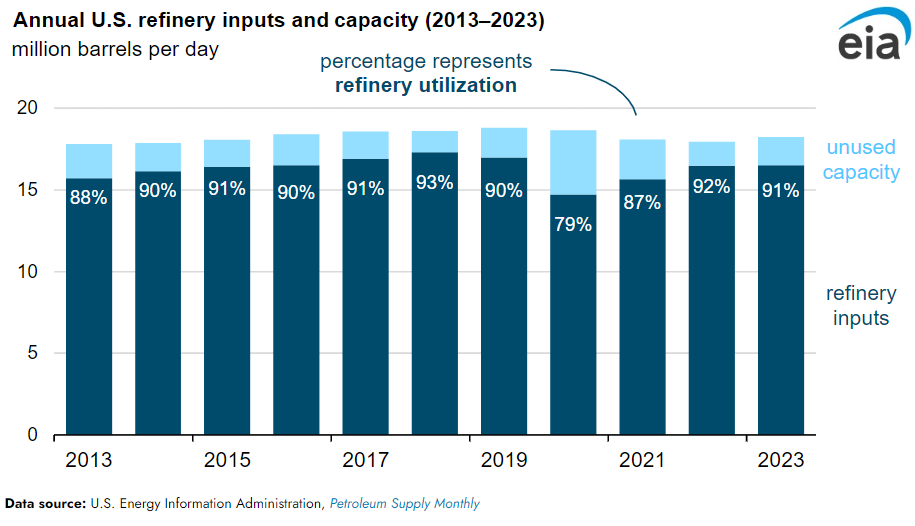
Refineries are usually operated at about 90 % capacity. Lest one think that refiners only need to tweak the throughput up a bit, it must be understood that it is unwise to operate a refinery or any other manufacturing plant at a constant 100 % capacity. Like any other factory, a refinery is subject to sudden or planned maintenance requirements, equipment failures, process upsets, variability in oil feedstock composition, hurricanes, variable demand in product spread or even infrequent operational error. A sudden unexpected shutdown can lead to a variety of complications as well as unleashing hazards at the large scale. Once a refining process line goes down, repair and restart can take one or more weeks to months to bring the process back to stable production.

A petroleum refinery is operated on a continuous throughput basis with series and parallel processing occurring simultaneously. Operating a refinery profitably is a complex job requiring a specialized skillset. As a PhD organic chemist, I am barely qualified to even set foot in a refinery, much less be of any kind of use there. Chemists may be found on site, but most likely in the quality control lab. These are the rarefied heights of the petroleum engineer.

A petroleum refinery is designed to take crude oil and gas inputs and shape them into an optimal spread of profitable products. The focus will be on maximizing the output of the most profitable products, especially motor fuels in the form of the various grades of gasoline and diesel. Your local gas station buys fuel from a wholesaler/distributor at a quoted price then sets a retail price depending on not just the wholesale price, but more importantly the local market prices and expected sales volume.

Operating a refinery is a continuous flow exercise and is a bit delicate. A refinery is a web of continuous unit operations each with an input stream from one unit operation and an output stream to another operation. Each unit operation has a specific task to perform safely and efficiently. These unit operations subject the input hydrocarbon stream to heating, fractionation by distillation, and each of the many distillate streams are then subjected to their own unique processing. Other operations include alkylation, hydrotreating, sulfur scrubbing, catalytic cracking, isomerization, catalytic reforming, heat exchange, more distillation, blending and finally transfer to storage. Each operation is designed to process throughput at high flow rates to afford the best production rate of finished goods.

Waste process heat is directed to certain operations and used for greater efficiency. Oil refining inevitably produces light hydrocarbons whose recovery produces diminishing returns for recapture or comes from pressure venting where the vented gases are not suitable for recycle. In this case these gases are sent to a flare tower and burned. The flare tower plays an important safety role as it burns away flammable hydrocarbon gases that might otherwise accumulate and spread near the ground, posing a serious fire and explosion hazard.

Naturally, this requires considerable coordination to manage the rate of output of one operation to the input rate of the next. In fact the whole plant requires coordination of rates of throughput, pressure and temperature. A refinery is constantly monitoring and adjusting individual parameters with automation and human oversight to remain in “tune”.

During the recent COVID-19 pandemic and the reduction in demand, a number of refineries were shut down for maintenance or upgrades and a few were shut down permanently. This created a bottleneck in refining capacity nationwide and there was a shortfall in overall refinery output, leading to higher retail pricing of fuels as demand eventually rose.

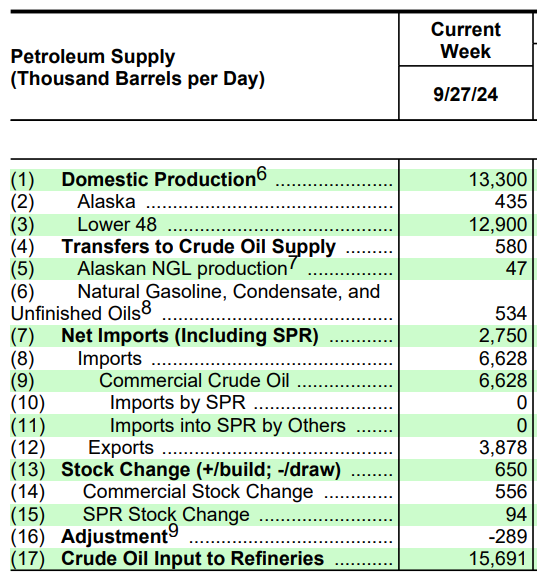
Today the USA both imports petroleum and exports it. The supply of crude oil and gas depends on contractual obligations and who is willing to pay the highest prices.

Source: US Petroleum Balance Sheet, week ending 27 Sept 2024, Energy Information Administration (EIA)

The United States in a net O&G exporter. Between imports and domestic output, the US is currently processing enough O&G for our needs with surplus to export. And what will an increase in domestic fracking really do for the US, again pricewise? It can increase the production yields at individual O&G wellheads bringing greater volume for the O&G producer over time. Done properly, fracking makes sense. However, if fracking provides a conduit for natural gas, oil or produced water into ground water, then it can be irredeemably harmful for those so affected.

Even if domestic O&G production is increased and released into the market, the near-term problem will be limited refinery capacity. The lead time for building a large oil refinery can be 4-5 years from design phase to commissioning. Permits, financing and societal pushback can add considerable time. Putting a complex refinery in the ground can cost $5-$15 billion. Startup and adjustment of a refinery is time consuming, complex and can be a bit hazardous. Accidents during startup and shutdown are not uncommon.

The politically popular opinion that what the US needs is an increase in oil production to drive down retail gas and diesel pricing rests on specious assumptions. The government provides regulatory oversight in many aspects of O&G production and refining. In my view, government oversight in regard to environmental protection and worker safety is of critical importance. Global free market control of O&G production and distribution, while often heavy handed and seemingly heartless, is the best model we have at present for production and distribution of hydrocarbon-based goods to consumers. For a historical example of government control of supply and distribution, we can look at the Soviet Union and its authoritarian centralized control of nearly everything. The Soviet model of governance and production of goods and services failed spectacularly by 1991. The leadership of the USSR dissolved the Soviet system themselves after concluding that it was no longer workable. For all of its many flaws, the overall western model of capitalism continued to thrive.

In short, it only makes sense to increase O&G production to keep retail fuel prices low if the refineries demand more crude to meet their distributor’s demand. Refined fuels could be imported for distribution here, but an uptick in storage capacity will likely be required. Refineries are fundamentally limited by their processing capacity. Refineries, like most manufacturing operations, are designed to provide an optimum output with the installed equipment. Greater throughput requires larger equipment or additional process streams

Anecdote: Every day I pass through the intersection of an east/west state highway and a north/south interstate highway. On the west side of this busy intersection there are four gas station/convenience stores competing for our gasoline and diesel business. Just a block to the west is a stoplight and at the four corners of this are three of the gas stations with direct access to the light. The fourth is not at the light so entry or exit to this station is not controlled by the light. During the early morning commute time, the four electronic signs indicate morning prices that invariably are $0.20 to $0.60 lower than mid-day prices. The tall electronic signs allow for convenient rapid response to competing prices. One station is beyond the single stoplight intersection, so both exiting eastbound vehicles and entering eastbound vehicles who need to turn left across uncontrolled heavy traffic have to wait for a break in the congested traffic. This is a competitive disadvantage for them. The other three stations have direct access to the stop light. Co-incidentally, the traffic-disadvantaged station nearly always has the lowest prices first. This tends to set the stage for a daily price war. This morning the 85-octane gasoline price was $2.719 at all four stations.

There are some plusses for the disadvantaged station mentioned above. Unlike the other three stations there is room for 18-wheelers to fill their tanks with diesel and park overnight next to a cheap motel and a Waffle House (Hey! Waffle House hash browns are the greatest). The left turn across traffic disadvantage to 4-wheelers is only a minor obstacle to the 18-wheelers using the station since they are apparently fearless in pulling into heavy traffic to execute a turn.

Econ 101 Conclusions

Like everything else, scarcity applies pressure on hydrocarbon prices up and down the supply chain- from wellhead to fuel tank. National politics can play a role in hydrocarbon pricing if it threatens to alter scarcity in some way. In chemical kinetics we are interested in finding the rate limiting step in a multistep chemical reaction. This step is the bottleneck that controls the overall reaction rate. In much the same way, a bottleneck in a supply chain will control the rate of output of a given product. The rate of delivery through the bottleneck controls the rate of wealth creation for those in the supply chain. To increase the rate of wealth creation, one must multiply the number of these bottlenecks in parallel or design a new bottle with a larger neck. Importantly, the rate of wealth creation can be a winning positive or a losing negative number. Excess capacity anywhere in the chain results from excessive money spent on unneeded production scale.

Note: There is much more to the macroeconomics of O&G production than what I have addressed. The economics of O&G production and distribution in the US depends on policy and regulatory factors as well as considerable anticipation and speculation (gambling) in the marketplace. Despite this, it is possible to make certain very broad statements in the context of general supply and demand principles. The finer, high resolution, details can be found elsewhere.

Global oil demand growth to flatten in 2028

The International Energy Agency (IEA) is predicting that growth in annual demand for crude oil will shrink from 2.8 million barrels per day to 0.4 million barrels per day by 2028. This is interpreted to be the result of the global shift to cleaner energy alternatives as well as high prices and security of supply issues. By 2028 IEA says that peak oil demand may be in sight.

IEA also predicts that the use of oil for transport fuels will go into decline by 2026. Many more insights into the global oil market are to be found in the link.

Note that this report is about oil, not natural gas.

The Diesel Crack Spread

Here is an intriguing headline for you. The diesel crack spread. What is it?

It is the amount of profit you can make from cracking a barrel of crude oil into shorter chain diesel fuel. The current crack spread reached a 30-year seasonal high of nearly $70 per barrel yesterday, compared to the less than $20 per barrel this time last year. Worse, US diesel stockpiles are at the lowest since 2000. Going into the winter season, we’re likely see diesel demand and prices increase as high natural gas prices cause some to switch to diesel in the northeast US.

Does the oil & gas market have a brain?

In the course of my professional society memberships I receive an email newsletter called API SmartBrief from the American Petroleum Institute. An article caught my attention today. The API newsletter blurb read-

Senators say methane rule will have unexpected impact

“The Obama administration doesn’t understand the full economic effect of new federal rules meant to cut methane emissions from oil and natural gas production, according to a letter signed by Sen. David Vitter, R-La., and colleagues. “Given that so many of our communities are being impacted by current market conditions, [italics added for emphasis] any new regulations impacting oil and natural gas should be based on reliable, transparent data that is devoid of any political considerations,” read the letter sent to Environmental Protection Agency Administrator Gina McCarthy.” 5/23/16

This API summary is sourced from HoumaToday.com.

The alarm expressed by Vitter, API, and unnamed others struck me as amusing. The methane rule will have unexpected impact. Golly Mr. Wizard, tell us more. Naturally, API is beating the drum for petroleum interests. It is their charter, after all. Vitter bemoans the cost impact on workers and communities in his state and, to be sure, that is his job. Thus, the interpenetrating political-industrial partnership seems aligned in their opposition to possible rule making by EPA. Alles ist in Ordnung.

The funny part is that the current market condition cited by Vitter and, I would suppose, API, is the result of years of delirious drilling and hydrofracturing of oil and gas deposits. Perhaps someone of credible standing mentioned that a bubble was forming and that maybe, just maybe, we’ll end up with a glut. If such a voice did arise, it was not widely cited, at least to my knowledge.

So, this self-inflicted malady of excess supply and low prices has crept up on this colossal industry with it’s legions of swingin’ d**ks leasing and drilling methane glory holes. Boom and bust is not new to big oil. Not unexpectedly, OPEC failed to cooperate and reduce their oil production, the greedy bastards. King coal is staggering like a large sauropod after an asteroid impact. And even more dismaying to big petro is that solar, wind, and who knows what else is creeping upwards in power production and taking market share.

With all of this recklessness with oversupply, could it really be that big oil is bad at basic price collusion? Shiver me timbers!

My point is that using a self-inflicted market down-turn to justify reckless disregard in furthering large scale contamination of the atmosphere is a malfeasance of the first magnitude. If the free market gave birth to such an awful turn of events as an oil and gas oversupply, how can we expect the invisible hand of the market to steer us away from certain ecological ruin through destruction of the biosphere from accelerating consumption and advancing overpopulation?

The market is like the male sex organ. It has no brain and seeks only one thing- More.


Kansas tries harder to drown the beast.

I know there are a lot of smart people in Kansas. It’s just that they tend not to end up in elective office there. The latest examples of Kansas-being-Kansas are staggering. Take for example the matter of Gov. Brownback’s massive tax cut on business profits.  From what I understand by reading news material from the corporate controlled news media, Kansas, under Brownback and the GOP controlled legislature, have managed to end taxes on business income.  The fact that Koch Industries is based in Wichita is more than a little coincidental, I’m guessing.

Evidently the GOP “leaders” in the KS legislature have been dueling it out with Missouri, awarding tax incentives for companies to move across the border to the Kansas side. This kind of fratricidal fiduciary hijinks is not uncommon. All states are eager to raid other states for businesses.  Tax concessions are the pieces-of-eight in this interstate piracy. Our states are in a race to the bottom in their pursuit of business transplants.

Of interest relating to Kansas is this little nugget.  AMC Entertainment Inc. announced that it is moving to Leawood, KS, from the Missouri side. But, about the same time it was announced that the Dalian Wanda Group would buy AMC Entertainment. Dalian Wanda Group is about to reap the benefits of Brownback’s tax policy by operating in KS.  A Chinese company makes one of the largest buyouts of a US company and lands just in time in the Kansas tax haven.

Let me speak plainly. A Chinese company owns a largish US company headquartered in Kansas will be taking advantage of infrastructure put in place over generations by hard working Kansans and US citizen taxpayers. All have contributed in many ways to Kansas infrastructure by way of grants for electrification, roads & highways, universities, military bases, as well as protection by all of the branches of the US military.  This Chinese company will enjoy greatly reduced tax liabilities by operating in Kansas. The controlling stockholders are Chinese and will benefit from operation within US borders at the expense of Kansans as a result of the Kansas GOP. These foreign owners will instead allow their employees to contribute to the public coffers.

The burden for expenses related to responsibilites previously administered by the state will be unpooled and relocalized.  The purpose and benefit of taxation has been that pooling funds can bring the benefits of civilization to the state without having to rely on the Darwinistic forces of the market. It is ironic that a state so rabidly against evolution has embraced such a Darwinistic approach to social policy.

The stated intent of GOP leaders (like Dick Army, etc.) cloaked  behind the curtain has been to “drown the beast”. That is, kill federal and state government by unfunding it. You do that by electing serial government haters like Gov. Brownback and possibly by having the Koch boys behind the scenes pulling strings. Not only has Kansas stuffed a dagger in the chest of civic administration of government services, they have opened the pipeline for profits to stream out of the US from a state tax haven from the operation of a corporation by a Chinese conglomerate.

The Kansas GOP has accelerated the transition of power from a constitutionally backed system with structural transparency to the private concentration of power with no transparency and no civic obligation.  Way to go boys. The full import of this should be evident in a generation when most of the GOP legislators who enacted this shit sandwich will be long gone.

Make no mistake. The GOP euphamism of “drowning the beast” is really about the transfer of power from the many to the few. The slogans about liberty and freedom are a plush teddy bear for the masses of low information voters to embrace. Power is in the ability to allocate resources. As the public loses its ability to allocate resources, it loses power. As private or corporate interests accumulate resources, their ability to exercise power rises.  There is nothing new here. Power always concentrates.

[Note:  A copy of this essay appears in the Daily Kos.]

Facebook IPO- Not a banner day

The IPO of Facebook stock on friday was a bad business day on two accounts.  Most obviously, the anticipated share price “pop” didn’t happen by the end of the trading day. FB shares opened at $38.00 per share and ended the day at $38.23 per share.  According to Andrew Bary at Barron’s, early investors paid an average of $1 per share. With lockup provisions on 1.8 billion shares expiring in the August to November time-frame, large scale selling could drive down share prices later in the year.

The Barron’s article quoted a tech trader who said

“Like most IPOs in tech land, Facebook is geared toward enriching early investors and employees while sticking public investors with shares burdened with poor voting rights and high growth expectations.”

There is nothing new in this statement of condition. Cashing in one’s shares in a risky investment of time and money in a startup is a commonly executed means of capturing reward. Risk takers are entitled to a payoff when a venture achieves success.

But this trader’s sentiment reveals something deeper about business and it’s role in our culture. This was a public offering of fractional ownership whose sole means of income is advertising. It is clearly designed to transfer future risk to public investors who have precious little voice in corporate governance.

Facebook has offered public investors a kind of sh*t sandwich: A chance to buy into a public corporation that is structurally configured to retain controlling interest by one of the founders.

Has Facebook created wealth or is it just capturing the market share of other advertisers? Facebook, like Google, is a creature of advertising. And, like Google, it is a magic version of the Yellow Pages that automatially anticipates or finds the listings you may want. But it is more than that. It is a directory that supplies the listings it wants you to have. Instead of the full page ads of the advertising print period where trees were actually pulped to provide something called “paper”, today’s ads are hot links to the advertisers website.

Facebook and Google are really just newer versions of the old circus of broadcasting. Broadcasters supply eyeballs and ears to adverisers who then have tens of seconds to mesmerize viewers and listeners with their magic. It is like rattling a stick in a bucket of swill. Facebook supplies amusement as a so-called social network and Google supplies entertainment as well as utilitarian services.

It was also a bad business day for broadcasters covering the FB IPO.  All of the cable television business progamming was set on this blessed and much anticipated initial public offering. Regrettably, the event was delayed for technical reasons until mid day EDT. When the stock was finally released, “experts” were standing by to render their opinion on the last 20 seconds of market activity.  Like all stock market data, it is marked by a jittery, noisy curve, sometimes trending upwards and then downwards.  Over one minute anything looks like a trend.

Faced with the possibility of hours of air time to fill before something exciting happens, the CNBC talking heads natter on and on with a variety of experts who natter on and on. All-the-while stock footage of the NYSE floor and the post-pubescent hoodie-boy CEO of FB loop cycles endlessly. For this we allocate broadcast spectrum?

In the end, there was no excitement. FB closed the day pennies above to where it started. I like to think this is because investors aren’t as foolish as the cynical people who are behind the offering believe on the opening day, at least.

An excellent analysis of Facebook valuation has been posted by Aswath Damodaran, Professor of Finance at NYU.