Category Archives: Economics

America’s Cold Civil War.

Note: The following has been determined to be a diatribe and not a screed. A screed would be several times longer.

This period in US history contains enough meat on the bone to keep both scholars and crackpots gnawing for decades. Collectively, we are in the overlap space of a sociological Venn diagram. The overlapping domains of economic calamity, political paranoia, shrinking international stature, and withering military expense combine like cyan, magenta, and yellow to form a white hot zone of malcontent.

It is no overstatement to say that many if not most Americans have chosen a part of the political pool they want to swim in. Listen to the voices at McCain/Palin rallys. Listen to people being interviewed upon leaving a McCain/Palin rally. They’re invariably angry and fearful. They distrust the “Liberal Media”. Do they mean to include Rupert Murdoch’s media empire? Do they also include most of the AM band talk radio programs? Is this the deep end of the pool or the shallow end?

I cannot help but conclude that conservatives are a fearful bunch. Study the McCain/Palin campaign advertising. Go back to any recent presidential campaign and recall Willie Horton or the Swift Boat attack on the democrats. Fear is the unifying ingredient in conservatism and the people who run the GOP machine know how to swing this stick.  Democrats do the Fear theme poorly and as a result, cannot summon the same kind of existential panic that the GOP can pull from their bag of tricks.

McCain is starting to see some of the visceral response to the possibility of Obama as president from underneath all of the rocks and behind all of the tarpaper shacks in the political back-40 acres. He has been openly challenged by angry citizens about the viability of his campaign.

That cartoon figurehead of the GOP, Rush Limbaugh, was practically apoplectic in his frustration with McCain. Strangely, this political freakshow impressario is now towing the line on McCain and has focused his leagions of ditto-zombies on bringing down the reputation of Obama with a mezmerising whisper campaign of slander.

I’m beginning to think that McCain wouldn’t be the worst kind of GOP president to have, especially if the conservatives of the land are this uncertain of him. But Palin as runner-up to the Whitehouse leaves me speechless. A country so brain-addled as to put Palin in national office is perhaps a country that needs to have its nose rubbed in it for a taste of its own collective stupidity. McCain/Palin in Washington may be what it takes for the complete implosion of the GOP.

Having watched the rise of Bush II and the conduct of the 2008 campaign, I have begun to understand what it might have been like to have lived in the period leading up to the American Civil War. This was a period intense division between citizens regarding deeply held beliefs. Civil and religous laws were invoked by both sides to justify their actions. Both Lee and Sherman believed that they marched in righteousness. It was brother fighting brother with a kind of hostility that is startling to people even today.

I sense a widespread and internal hostility along with a rigid adherence to doctrine that marks a divided country. I believe that America is in a type of cold civil war. There is a fulmination of anger and frustration out there that is beginning to partition the meaning of America into distinct translations that suit the adherents. 

Countries that experience economic and political upset are prone to the surfacing of latent fascism. Fascism is a kind of fever that spreads through the vectors of blame and jingoism. Anti-intellectualism and ethnic hatred are common manifestations of a country having a bout of fascism fever.

Witness the accusations of “elitism”  and the whisper campaign questioning the citizenship and religious affiliation of Obama. We have elite military forces, elite police forces, and elite athletes- why not elite chief executives? Why would we demand that politicians be just like the down-home folks like you see, say, running the Tilt-O-Whirl at the carnival? Don’t we want the chief executive to be someone who has honed his skills for public life? The Army has its War College. Why can’t the executive branch have its Administration school?

I think we have a civil cold war brewing in the USA right now and if 20-25 % of the workforce loses its paycheck because of the banking fiasco, I think there’ll be trouble. But no doubt, the DHS has thought of this and has soldiers and Darkwater contractors ready to deal with the sh**storm.

US Mint Suspends Sales of Gold Coins

Reports have been circulating that the US Mint has suspended the sales of gold coins. The mint has been experiencing unprecedented demand for gold and silver coins. A short list of favored dealers has been drawn up for distribution of the limited supply.

What is curious about this is that the US Mint has “suspended” sales rather than simply announcing that it has a backlog. Only the govenrment would respond to demand in this way. I understand that minting gold coins is not nearly as automated and fast as base metal coins. But by their manner of responding to the demand, they can only accelerate the rise in price for these coins.

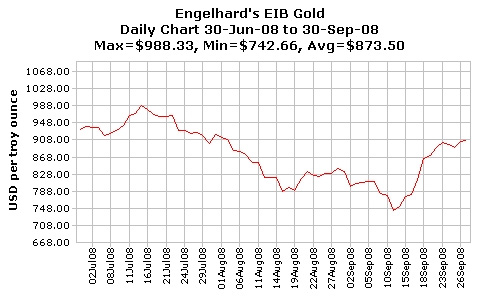
I have captured a snapshot of PGM pricing from the BASF EIB website. I hope BASF isn’t too hacked off.

The Canadian Maple and South African Krugerrand gold coins are available, as far as I can tell from internet sources.

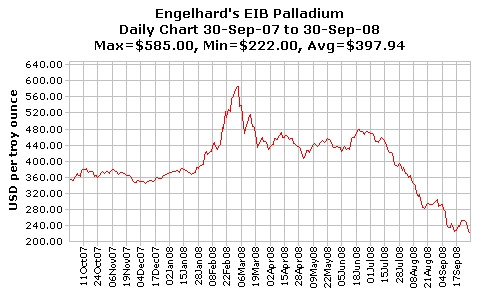
Of interest to the catalyst world is the falling price of Palladium. The chart below is scaled to show the price of bullion for the last 12 months. This is surely a kind of economic indicator affording a clue as to the vitality of some particular and narrow market sector.

I wonder where the opportunities are in this difficult time? Now is a good time to keep your head on a swivel for unique opportunity.

Lets All take a Deep Breath and Stop the Hyper-Analysis

Could it be that we Americans are over reacting to the problems in the market? The market is very much a collaborative structure resting heavily on trust in the power of the vast American economic engine. What we are witnessing right now is the multichannel, speed-of-light, propagation of panic through the miracle of electronic communication. Wagging tongues and chin music from our esteemed news commentators as well as we, the blogging community, are only fanning the fire of panic. The USA is on the verge of freaking itself into an economic collapse.

We don’t need additional and more concise descriptions of the foolishness of the players. That’s been done. I participated in this too. Ascerbic wit and biting rhetoric needs to be turned to constructive service. The first thing that we can do as bloggers citizens is to tone down the negative buzz and quit getting each other twittered. It serves no purpose and is counter-productive.

Citizens need to start asking constructive questions and make suggestions to all who will listen on how best to minimize panic and the damage it will cause to our economy. We need to take some time from blogging to focus on communicating with our friends and colleagues and members of congress to keep a steady hand in the coming months.

We also need to start asking about the details of the financial mess. Of the “bad mortgages” we hear about, how many are actually in default vs how many are just in the category of subprime? Are the banks possibly exaggerating the size of the losses? If banks are over extended in their loans, what fraction of their subprime loans are still in good graces? In other words, exactly how is the bad debt manifested? What is the true magnitude of the thing? How many mechanisms are available to bring this thing to a survivable landing?

It is not unheard of for a company to write off as much loss as it can if it is inevitable that it must report losses. An MBA friend pointed this out to me. He worked for a semiconductor firm whose habit was to maximize the losses if it could not avoid reporting a loss. They’d throw some of the ugly furniture overboard with the trash to clean house. To what extent is this happening now?

Maybe we can raise the bar a bit by helping to ask better questions. The best questions get the best answers.

Views on the Subprime Mortgage Mess

I have no real expertise in banking or real estate. Neither fields hold much interest for me. But I am interested in failure behaviour of large complex systems. There are a few posts out there that hold better than average insights on the current financial mess and I wanted to post links to them.

Jim Kunstler‘s blog, the full name of which is a bit too coarse to post here. None-the-less, Kunstler writes one of the best blogs out there on business topics.

Georgetown Law Faculty Blog has posted part of an article intended for the banking community. It is lifted from the American Banker which, sadly for me, requires a subscription. The theme supports my contention that business- banking included- should be treated as part of contemporary anthropology rather than an abstract exercise in arithmetic.

Business isn’t just an math exercise. There is a lot of anthropology to it. Unfortunately, anthropology isn’t on the curriculum of most MBA programs.  MBA’s worry me. They seem to be hustling the rest of us into an Orwellian future with methodologies taught by faculty members who are more interested in tidy formalisms than people. 

There are a lot of cocky bastards in business who are always certain, but frequently wrong. This banking mess is an example of what happens when they achieve a quorum. In fact, I think they have ascended to the level of mythical archetype.

Bush II and His Faith-Based Bailout

Where is the Decider President? He sent his creepy surrogate, Dick “Rasputin” Cheney, slinking around to urge members of congress to support the bailout plan, but where is George?.  I suppose Bush II is lying low to avoid casting the long shadow of the GOP on this banking train wreck.

But it’s just so striking; in the run up to the largest business bailout in the history of the solar system, Secretary Paulson’s boss is strangely absent. No frank and heartfelt talk with the American people. All the Bush administration can do is to attempt to hustle congress into a mysterious plan. Take our plan on faith- we know what we are doing.

No details have been released to the citizens regarding how this number, $0.7 trillion, was arrived at. Is this large sum actually large enough? How does the country recoup this outlay?  Is the stated urgency related to the election?

Citizens must learn to save more cash and be smarter about the terms of the mortgage they sign. We must consider that our banking system is much like the municipal water system- it’s integrity must be scrupulously maintained and those who manage it must be held accountable for its operation.

Update:  Bush II will make an announcement to the nation this evening. I wonder if there will be any folksy anecdotes?

Are B-Schools Paying Attention to this Fiasco?

The dam burst of banking disasters and federal bail-outs of firms “too big to fail” has brought to light the fragility of our banking and investments system. Like a tropical depression that forms in the eastern Atlantic ocean and gradually feeds on the warm waters and moist air until it makes landfall as a rampaging storm, the combination of greed, financial deregulation, and enthusiastic liquidity on the part of the Fed has now spun up into a full fledged economic storm.

In an essay posted on CNN.com, Columbia Professor Joseph Stiglitz, among others, points to some causes of the present calamity on the banking and financial businesses. Stiglitz says-

“One can say the Fed failed twice, both as a regulator and in the conduct of monetary policy. Its flood of liquidity (money made available to borrow at low interest rates) and lax regulations led to a housing bubble. When the bubble broke, the excessively leveraged loans made on the basis of overvalued assets went sour.” 

“The new “innovations” simply hid the extent of systemic leverage and made the risks less transparent; it is these innovations that have made this collapse so much more dramatic than earlier financial crises …”

The mess that taxpayers and investors are left with is the result of greed and recklessness on the part of elite “business leaders” in conjunction with Federal officials only too anxious to deregulate and discount. This is not a failure based on physical reality. It is a failure based on greed and poor judgement. It rests on a morally shallow and sadly misguided philosophy that mere acquisition of currency is reason enough for being and is the sole measure of success.

As a start, it is my hope that the Deans and faculty of our business schools can summon some kind of movement to reform their admissions standards and refine their ethics curricula.

Perhaps certain finance practitioners need to be trained and certified in a manner similar to actuarial professionals?  Seems to me that the people who launch financial instrument schemes with the potential to collapse an economy should be at least as well trained in risk management as an actuary.

A firm proposing a financial instrument for sale to the public should be required to prepare a mathematical model with macroeconomic inputs to model the potential for instability. The kind of discipline needed to do this modeling could help people refine the fund structure so it remains manageable in a broader range of economic conditions. This would also provide for a real transparency to regulating agencies and possibly even investors.  But most importantly, if you want to model it, then you have to understand it. And that is part of what has been lacking.

Down Gauging Plastic Films

The world of commodity goods and services may seem static to outside observers, but behind the curtain there is almost always a seething churn of battles occuring between competitors and with vendors. In the high volume, low margin world of commodity polymer manufacture, the price of resin (or “plastic”) feedstocks is subject to the variability of the global hydrocarbon market.  The market determines your price and your costs. The trick is to avoid getting squeezed when unit costs and prices converge.

In the resin film and injection molding business, the ability to raise prices is constrained by the complex relationship between the manufacturer of polymer resins and the buying side of the market. The relationship between thermoplastic polymer (i.e., PE, PP, PS) manufacturers and the end user is not always direct. 

The actual manufacturers of thermoplastic polymers produce their resin product in the form of squat little beads. There are several reasons for this. Beads are what you get when you cut extruded spaghetti noodles from the output side of the polymer reactor. This cutting process happens in a stream of water to remove process heat. The water rapidly cools the resin and prevents the beads from agglomerating. It also provides a means of conveyance to move the beads elsewhere in the processing facility.

The beads are removed from the water and subsequently moved to silos by pneumatic conveyance.  Beads have the happy property of flowability. You can pour beads into a properly designed hopper and they will flow by gravity into a rail car or an extruder.

There is an intermediary customer called the converter. The converter buys resin beads from a manufacturer or distributor and converts them into higher value forms. Converters make films and injection molded items from these resin beads. Converters practice a high art. Some of their products, like films, may be pure resin.  But a great many other products in the injection molding arena are highly modified with additives that provide desired attributes in the molding process itself or in the finished good. Additives are the output of a highly specialized industry.

Because the polymer market is very competitive, it is difficult for any given producer or converter to simply raise their prices. One of the tricks of the trade is something called “down gauging”.  It is simple to understand. To improve manufacturing economics, converters will make their films thinner (in resonse to marketers of films) so as to make more sq meters of film with the same material input. The reader may have noticed that over time, plastic bags or wrappers have gotten much thinner. This is the result of down gauging.

Converters have to face material limitations in their resin feedstocks. For films, melt strength is one of the key parameters in processability and a big selling point for manufacturers of resin feedstocks. When you make a blown polymer film, your are actually extruding molten resin through an annular die to form a cylindrical bubble. The bubble rapidly cools to form a continuous tube of film that is then rolled as is, or slit to form a continuous sheet. This is a very common technique for making commodity films. If the molten bubble is not strong enough to withstand the effects of gravity and processing forces, it will collapse and fail.

One of the improvements to come along beginning in the early 1990’s is the availability of metallocene polymers, specifically mPE.  This technology provides for greater control over the molecular structure of the polymer and subsequently, greater control of the rheology of polymer melts. Improvements in melt strength can lead to greater processing controllability for the converter and more options in gauge.

If you want to understand the PE and PP industry, you have to understand the relationship between resin manufacturers and converters. While converters do not drive the boat exclusively, they do have a large input into which direction the boat is pointed.

Zambian Copper Mine to Boost Output

Zambia’s largest mining operation, Konkola Copper Mines plc (KCM), is nearly ready to commission the Konkola Deep Mining Project.  This mine expansion project, in combination with the new Nchanga Smelter, will increase the mine’s output from 200,000 tonnes per year to 500,000 tonnes per year by 2010. 

In order to enable the increase in ore output, a new shaft was sunk. The new production shaft # 4 reaches to 1,490 meters below the surface and will service production levels at 1050, 1150, 1250, and 1350 meters depth.  The company anticipates returning 40 % of the tailings back underground for remediation purposes.

The Konkola underground mine is known as the wettest mine in the world. The mine must be continuously pumped to remove the copious water seepage.  Underground improvements will increase the “water make” from 290,000 cubic meters of water to 430,000 cubic meters of water per day.  The water pumps are expected to draw 90 MW of continuous power to do their job.

KCM has invested US$12 million in new sulfuric acid capacity at Chingola. This sulfur burning plant will produce 500 tonnes per day of sulfuric acid for use in the Nchanga Tailings Leach Plant.

KCM also operates an open pit mine nearby.

PGM Prices Tumble During Summer of 2008

22 August, 2008.  It is a remarkable collapse in pricing. Rhodium has fallen from a high of US$10,100/toz (toz = troy ounce) in early June of 2008 to opening price of US$3950/toz on 21 August, 2008, on the EIB.  Bad news from automotive manufacturers General Motors, BMW, and Nissan is cited by Reuters and posted on Mineweb as the principle cause of the collapse. According to Reuters, the automotive industry accounts for 80 % of the demand for rhodium. 

Other reasons are cited as contributing to the price fall.  Electrical distribution problems interrupting mine activities has reportedly eased, reducing the jitteryness of buyers.

The rhodium market is small and illiquid, and few traders are prepared to speculate on a floor for prices.

The metal’s recent price falls have been blamed by some traders on forward selling, or hedging, by producers. If this is the case, the market should stabilise as these sales tail off.

Mineweb, 15 August, 2008

Ruthenium prices have been sitting at US$300/toz for months now. Apparently the news that sparked the major uptick in Ru prices last year has failed to produce real demand.

Gold opened on the EIB yesterday at US$835.57/toz. This is down considerably from mid July, no doubt adding some tarnish to the spate of ads urging consumers to buy gold.

Palladium has fallen to US$295/toz from the recent high of US$480/toz in mid June of ’08. This is good news for the chemical industry and chemical researchers.

Finally, Platinum has seen a price decline as well, opening at US$1465/toz against the Feb ’08 high of US$2275/toz. This is also good news for the chemical industry. Hopefully chemical buyers are in a position to hedge their PGM positions a bit.