Category Archives: Economics

Russian Oil Production in Apparent Decline

According to an article by Greg Walters at Bloomberg.com, crude oil output in Russia is expected to decrease for the first time in 10 years.

“Two years ago, we said the growth rate was falling, and we said this was bad for Russia, remember?” Trutnev said in televised remarks after a government meeting in Moscow today. “Now we’re saying the production rate is falling this year. This is not a bogeyman, unfortunately, this is real,” Trutnev said, without giving a specific forecast.

The petroleum problem in Russia seems to stem from the lack of investment in exploration in combination with exorbitant taxes on the industry.

Gail the Actuary has an interesting post on the post-peak-oil economy. Gail is a contributor to The Oil Drum Discussions.  It’s all kind of gloomy.  Time for a nice glass of Bordeaux.

Monte Carlo Analysis

Th’ Gaussling is surfing the net looking at freeware. The possibilities are amazing. It’s like I’ve crawled up from underground onto a sunny Brazilian beach full of nubile sunbathers frolicking in the waves. It’s all just too wonderful to be true …

[sound of needle scratching across record]

So I’m new to Monte Carlo simulations. I have some economic modeling to do and it has become apparent to me that mere spreadsheet grinding isn’t enough.  To make a more convincing case I need to introduce plausible cost variances somehow by mixing and blending various kinds of guesswork distribution curves from the elements of the project. There is a particular Project Risk and Contingency Analysis software that seems reasonable to start with. It would be interesting to hear of experiences others may have had with Monte Carlo project modeling.

Ear to the Ground

My comments on recession come strictly from news and from petrochemical industry publications. I have not seen any indication that manufacturing of specialty chemicals (at least in the waters I swim in) are as yet affected by the economic turmoil that the lending fiasco triggered. Eventually orders will taper some, but the how much and when is not at all clear.

It takes a while for the effects of a downturn to filter upstream to all sectors of chemical manufacturing. The first effects will likely be a pushback on delivery of existing orders. Then, the period between succesive orders will lengthen as businesses closer to the consumers will start to trim down inventories and throughput.  Finally, sales forecasts will begin to report spotty sales projections 2 or 3 quarters out. Eventually, you run into those weak quarters and have to find a way to limp through them.

The important question relating to petrochemicals (aromatics, naphtha, ethylene, propylene, etc) is where does price elasticity really kick in for hydrocarbon intensive goods as crude prices continue to rise and the dollar continues to devalue? 

Packaging materials like PE, PS, and PP, etc. are very often not the primary product consumers are looking for. They are produced for sellers of consumer goods as packaging materials. The purchasing decision maker is not the person strolling down the isles of Wal-Mart, but rather the product manufacturers who have to package the goods. 

This economic disturbance seems unique. Demand from the global middle class is growing as the US economy falters.  Demand for hydrocarbon fuels and manufacturing feedstocks is strong from Asia for their own consumption. But Asian production is also strongly linked to the demand of their products from the west. Predicting how this thing plays out is very tricky. 

Polymer membranes, HDPE pipe, PVC pipe, automotive assemblies and fascia are all large consumers of hydrocarbon products. Demand for these materials, obviously, should parallel the health of construction and automotive industries. But as the US transitions to a net importer of polymers, the connection to US economics is murky.

I suppose the best business to be in is war profiteering and security, at least as long as a war president is in office. It seems to be shielded from the raw forces of economics. As long as the gov’t can print money, special interests can be paid.  A good career would be as a translator between Arabic and Mandarin.

Platinum Group Metals Update

14 March, 2008. As the deepening US gravity well continues to tug at the recession asteriod that is looming ever larger in the sky, we see a steady line of investors boarding Platinum Group Metal (PGM) investment vehicles for immediate launch off this doomed planet. 

Monday and friday opening EIB prices over the week of 3/10/08 thru 3/14/08.

Silver–  US$19.70/toz;  US$20.77/toz.

Gold–  US$971.55/toz;  US$1,0005.86/toz

Palladium–  US$470.00/toz;  US$516.00/toz

Platinum–  US$1,960.00/toz;  US$2,110.00/toz

The geology of PGM deposits is quite interesting. There are numerous resources detailing the Bushveld Igneous Province (or Complex) in South Africa. Check it out.

Shermer’s “Mind of the Market”

Google has been posting a series of interesting talks by contemporary authors. This talk is by Michael Shermer, author of Mind of the Market, and editor of the popular magazine Skeptic. It is a lengthy 53 minute video, but I would highly recommend it. I think Shermer has a good grasp on the anthropology of our present world.

This is off-topic, but useful. This link gives a bunch of really good hints on how to save money for your start-up company.

PGM Prices Remain Strong

The Platinum Group Metals (PGM’s) continue to trend upwards.  Last friday 0n the EIB rhodium opened at US$9,050.00/toz. Rh remains in strong technical demand and prices are propped by a great many overlapping factors. Uncertainties in the mining business in South Africa buoy uncertainty among investors. Recent electrical distribution shortfalls and blackouts have interrupted production as have mine floods, labor disputes, and a shortage of experienced miners and managers.

Automotive pollution catalytic converters dominate the demand for platinum and rhodium. As demand for Pt and Rh continues to grow, look for companies to switch to palladium in key applications.  Russia holds a strong position in Pd inventories. As demand for Pd rises, look for Russia to exercise its muscle.

As Au and Pt prices continue to climb, look for jewelry demand for these metals to taper off.  Asian demand for these metals is substantial. Eventually, jewelry prices will temper demand for gold and platinum.  Meanwhile, interest grows in North American PGM resources.

Literature Swim. The Guo-Liu Catalyst.

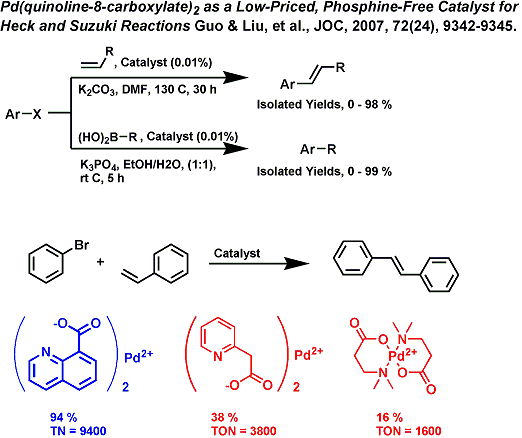
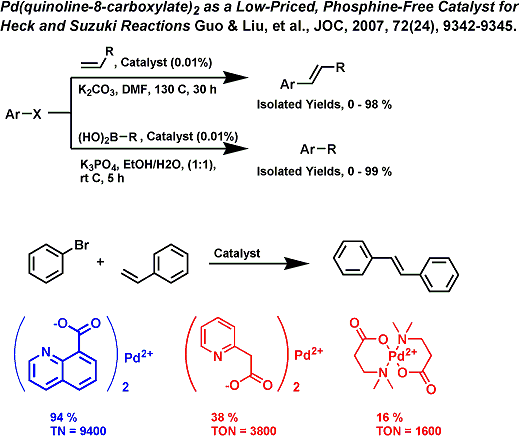
Guo & Liu Catalyst

The literature train station is overflowing with diverse catalysts for the large variety of coupling reactions out there, as is the patent literature. Parties scramble to get window seats on the IP Express, the high speed non-stop to that Golden City on the Hill. 

A recent JOC article disclosing an inexpensive catalyst system that struck me as interesting.  The article by Guo and Liu emphasizes economy and so discloses a phosphorus-free bidentate ligand system that affords Heck and Suzuki-type coupled products.  There are pluses and minuses to this system, as is the case for most catalysts.

On the plus side with the Heck and Suzuki reactions, both activated and deactivated aryls gave decent yields. On the minus side, the Heck coupling reaction is a bit slow. A fair amount of energy input was needed- 130 C in DMF over 30 hours. On the Suzuki side, most reported reactions resulted in good yields, except for the aryl chlorides. The relative inertness of chlorides is not particularly unusual, but it may cause this catalyst to be passed over in some applications where the less atom-efficient bromides and iodides have been targeted for replacement.

Finally, the apparent requirement of DMF is rarely happy news. Regardless, I have no doubt that this catalyst will find its way into the future literature and many clever applications will be revealed.  As of this writing, I was unable to find a US patent by inventors Guo and Liu claiming this technology. Since there is a 1 year limit on the filing of a patent application following disclosure, this technology could be in patent prosecution at present. Or not. Wouldn’t it be a happy thing for it to be in the public domain?

Economic Katrina

I’m reluctant to sound alarmed, but with the apparent shape of an impending economic Katrina moving over North America, it is getting harder to grant the benefit of the doubt. The dollar is sinking, exposing this import-heavy nation of ours to price increases in nearly every sector. The petroleum resources that energize global production and grease all economic skids is generating considerable doubt and turmoil in financial circles.

Oil production is flat in many key regions but the demand for consumer goods by the global middle class is expanding.  Our television-enchanted population, brains scrambled to numbness by chronic exposure to American Idol, are seeing only what the media powerbrokers want us to see. The eternal message that comes from TV is spend, spend, spend

The popular economic indicator is the stock market. The DJIA up- good. The DJIA down- bad. It is a sort of pallative. We’re lulled into a false comfort zone by the meta-stability of todays stockmarket.  Other dots are beginning to line up into a harmonic convergence, however.

Yesterday, as a humorous conversation starter, I asked a senior colleague well placed in the petroleum industry this question- “when will crude oil hit $150/bbl?”.  His reply surprised me. He estimated that it would happen this summer. Later, tempering his answer somewhat, he suggested that it would be more like $130/bbl, and mostly on the strength of nervousness in the market. He added that at present, crude oil stocks in the USA were in ample supply. 

The extended weakness in the dollar seems to favor American exporters and disfavors import consumers. Hmmm.  Does gov’t inaction on the weakness of the dollar amount to bias for corporate constituents and neglect of unincorporated citizens? Curious.

Advice- payoff as much debt as possible. Insulate your house. Get rid of that gas guzzler. Accumulate greater savings. A lot of the soon-to-be-unemployed are going to face higher higher gasoline prices for their commute to the new job at the auto salvage yard. And when they get back to their trailer at night, the thermostat will be set low due to higher heating costs. Beans and weenies, Mac-n-Cheese. Bon apetite!

Polyolefin Migration

The worlds burgeoning middle class has a voracious appetite for polymers and this has compelled other regions of the world to execute a refining and manufacturing buildup that will cause an upcoming oversupply situation. In particular, Middle Eastern and Asian PE and PP capacity will take a sharp upturn, shifting supply patterns and causing margins to fall. Demand for North American (NAm) polyolefin (PO) products will enter what is projected to be a permanent decline as capacity and market share shifts to other longitudes.

Fortunately for US interests, many PO producers have anticipated this and have diversified through significant structural changes increasing access to the far regions of the world. This fact alone should buffer the upcoming downturn in the industry. Projections I have seen suggest that the NAm PO market should be back up to present levels by 2012 as the new capacity operates as price taker rather than a price maker. Eventually for NAm and the EU, finished goods imports will overtake market growth and a period of decline will ensue.

The new world I am describing is projected to happen in 2009. We are about to feel the gravitational pull of the “New Gulf”. The Old Gulf- Gulf of Mexico- will take a back seat to the Gulf in the Middle East.

One weakness of the New Gulf seems to be ethylene. US capacity for the extraction of ethane from natural gas and its conversion to ethylene is an advantage that will buoy NAm PE business for a while. But once Middle East and Asian operators learn to run their plants efficiently, NAm facilities will face the somber truth of the marketplace. NAm will become a net importer of PO’s. 

Asian demand for PO’s is growing so rapidly that it may never become a net exporter of PP and PE.

One factor that I do not understand yet is the effect on petroleum supplies and the cost pressures therein. Increased capacity giving lower prices could increase petroleum and gas scarcity resulting in increased prices of petro-energy.

Changing Petrochemical Center of Mass

The Middle East (ME) is currently undergoing a dramatic change in petrochemical supply and refining capacity. Multiple projects in several countries are underway that will offer greater capacity of key hydrocarbon feedstocks as well as fuels. 

The current run up in crude oil prices has produced an abundance of cash for oil producing states in the ME.  Acutely aware of the transient nature of their oil reserves, the cash generated has been applied to infrastructure. Social infrastructure as well as industrial infrastructure has been expanded in the ME with facility no doubt eased by the nationalized nature of the petroleum companies. 

In the USA, a run up in crude oil prices has not resulted in a major uptick in refinery capacity, port expansion, or the birth of new universities. Instead, US oil companies have plowed investment into new discovery activity in an attempt to sustain the current rates of consumption. Profits are channeled into CEO salary packages and to shareholders, who, in turn, go to great lengths to shelter their funds from taxes that support US infrastructure.

Saudi crackers alone are expected to add 14m tonnes/year of extra ethylene capacity by 2015. ME market share of PE and PP is expected to double by 2011. So large will the demand for ethane be that there is considerable skepticism that the full potential of the buildup will be realized.

Since ethylene comes from the cracking of ethane, and presently a large share of ethane comes from natural gas, the question arises as to the effect on natural gas prices as ethane scarcity becomes apparent.  Naphtha crackers are part of the answer to the question of supply. The US has (had) abundant natural gas and a corresponding reliance on the extraction and cracking of ethane from this resource. Elsewhere in the world, a large fraction of ethylene comes from naphtha feedstocks.

And so it is that the Saudis are building crackers to bolster their feedstock supplies. The Dow/Siam Cement JV is also addressing their ethylene supply issue with a second naphtha cracker in Map Ta Phut (ICIS, 2007, December 3-16, p 6).

The largest petrochemical complex in the world is under construction at Ras Tanura in the eastern province of Saudi Arabia.  This US$20 Bn project is being developed jointly by Dow and Saudi Aramco and is expected to come onstream in 2012. The goal is to integrate the existing Ras Tanura and Yanbu refineries into a single operation offering petroleum refining and production of value added hydrocarbons like ethylene.  Clearly, the principals have downstream conversion in mind. The project will have the first naphtha cracker in the ME and will offer ethylene cracking and aromatics capacity as well.

According to the article in ICIS, Basell claims that the ME will be the only net PE and PP exporting region by 2011.  And so it was that the petroleum scare in the first decade of the 2000’s financed and expedited the migration of dominance in the polyolefin industry to the Middle East.