Note: This is one of my most instructive memories from 10th grade and has been dredged up from the murky past. By 10th grade I had already absorbed a book on the electronics of vacuum tube radios. At this time you could go to a drug store and find a vacuum tube tester which also had an inventory of common vacuum tubes shelved below the tester. If the tube you plucked out of the TV set failed the test, you could buy a replacement. A burned-out filament was common and easy to spot because the tube was not illuminated by the filament from inside and was dark.
Oh yes. The involuntary grunting noise is the sound one makes while being electrocuted.
=================
Make magazine is one of my very favorite publications. It’s made for hillbilly engineers and aspirants like myself. Their Maker Shed Store offers kits as well as plans for making all sorts of cool gadgets.
Kit building and garage engineering are important activites for aspiring young scientists. We senior scientist types should be on the ready to mentor local high school students in their bid to learn about technology from the ground upwards.
Electronic experience is invaluable to all experimentalists- physicists, chemists, geologists, biologists, etc., and is a subject of lifelong utility. Many students do not have peer groups or family members who can help them get into this subject. [for many years I’ve trained new hires twice monthly in electrostatic discharge safety and am constantly amazed at how few people know even the most basic aspects of electricity. This includes drawing a schematic of a flashlight which led to the shrugging of shoulders.]
As a junior high school kid, I worked on TV sets (tube electronics) and acquired some electrical and mechanical ability in doing so. I actually fixed a few problems, surprisingly. A family friend had a TV repair shop (remember those?) and as a result I had a steady supply of TV chassis to take apart for my collection of parts like potentiometers, switches, vacuum tubes and variable capacitors.
Like most kids tearin’ stuff apart and eyeing the construction methods and components, I gained valuable electrical insights and personal experience with electrical current. Like the time I discharged a picture tube through my hand while trying to remove a flyback transformer from my grandparent’s color TV. It was great lesson in capacitance and isolated static charge. As my grandparents sat on the Davenport and watched, they heard a sudden and involuntary grunting noise burst from my mouth as I hurled myself from a squatting position by the opened console TV set and backwards across the room. I probably absorbed more joules of energy from landing on my backside than the joules absorbed by my hand. Luckily, I was not burned. The next day I learned how to properly discharge the aquadag in the picture tube.
A strong electric shock is nothing at all like tangling with an vicious animal who might stand there after the altercation spent and panting, wondering in its little badger brain how to tear an even bigger chunk out of your leg. A discharged electrical device bears the same silent affect before as afterwards. It’s wicked electrons are inanimate and unparticular in their singular drive to find ground. An unexpected jolt from a device is much like a magical experience. It comes from nowhere and everywhere and is over in the blink of an eye. Afterwards you stand there in shock and awe of the effect of even modest amounts of energy.
The impulse to do science is also the impulse to find boundary conditions of phenomena. Where are the edges? How does it switch on or off? You have to be willing to leave some skin in the game to find out about things.
Today I have a slightly different demographic of readers of this blog than in the past, so I’ve been dredging up old posts into the light of day. This is a renamed post from September 3, 2011. I’ve changed some wording to be a bit more mellifluous if that’s even possible.
==========
I’ve had this notion (a conceit, really) that as someone from both academia and industry, I should reach out to my colleagues in academia in order to bring some awareness of how chemistry is conducted off-campus. After many, many conversations, an accumulating pile of work in local ACS section activities, and visits to schools, what I’ve found is not what I expected. I expected a bit more academic curiosity about how large-scale chemical manufacturing and commerce works and perhaps what life is like at a chemical plant. I’d guessed that my academic associates might be intrigued by the marvels of the global chemical manufacturing complex and product process development. Many academics would rather not get all grubby with filthy lucre. Not surprisingly, though, they already have enough to stay on top of.
What I’ve found is more along the lines of polite disinterest. I’ve sensed this all along, but I’d been trying to sustain the hope that if only I could use the right words, I might elicit some interest in how manufacturing works- that I could strike some kind of spark. But what I’ve found is just how insular the magisterium of academia really is. The walls of the fortress are very thick. I’m on a reductionist jsg right now so I’ll declare that chemistry curricula is firmly in place on the three pillars of chemistry- theory, synthesis, and analysis. In truth, textbooks often set the structure of courses. A four-year ACS certified chemistry curriculum spares only a tiny bit of room for applied science. I certainly cannot begrudge departments for structuring around that format. Professors who can include much outside the usual range of academic chemistry seem scarce.
It could easily be argued that the other magisteria of industry and government are the same way. Well, except for one niggling detail. Academia supplies educated people to the other great domains comprising society. We seem to be left with the standard academic image of what a chemical scientist should look like going deeply into the next 50 years. Professors are scholars and they produce what they best understand- more scholars in their own image. This is only natural. I’ve done a bit of it myself.
Here is my sweeping claim (imagine waving hands overhead)- on a number’s basis, chemists apparently aren’t that aware of industrial chemical synthesis as they come out of a BA/BS program. That is my conclusion based on interviewing many fresh chemistry graduates. I’ve interviewed BA/BS chemists who have had undergraduate research experience in nanomaterials and atomic force microscopy but could not draw a reaction scheme for the Fisher esterification to form ethyl acetate, much less identify the peaks on 1HNMR. As a former organic assistant prof, I find it sobering and a little unexpected.
A mechanistic understanding of carbon chemistry is one of the keepsakes of a year of sophomore organic chemistry. It is a window into the Ångstrom-scale machinations of nature. The good news is that the forgetful job candidate usually can be coached into remembering the chemistry. After a year of sophomore Orgo, most students are just glad the ordeal is over and they still may not be out of the running for medical school.
I think the apparent lack of interest in industry is because few have even the slightest idea of what is done in a chemical plant and how chemists are woven into operations.
To a large extent, the chemical industry is concerned with making stuff. So perhaps it is only natural that most academic chemists (in my limited sample set) aren’t that keen on anything greater than a superficial view of the manufacturing world. I understand this and acknowledge reality. But it is a shame that institutional inertia is so large in magnitude in this. Chemical industry needs chemists of all sorts who are willing to help rebuild and sustain manufacturing in North America. We need startups with cutting edge technology, but we also need companies who are able to produce the fine chemical items of commerce. Have you tried to find a company willing and able to do bromination in the USA lately? A great deal of small molecule manufacture has moved offshore.
Offshoring of chemical manufacturing was not led by chemists. It was conceived of by spreadsheeting MBAs, C-suite engineers and boards of directors. It has been a cost saving measure that mathematically made sense on spreadsheets and PowerPoint slide decks. The capital costs of expansion of capacity could be borne by others in exchange for supply contracts. There is nothing mathematically wrong with this idea. Afterall, corporate officers have a fiduciary responsibility to their shareholders. Allowing profit opportunities to pass by is not the way to climb the corporate ladder.
We have become dependent on foreign suppliers in key areas who have control over our raw material supply. Part of control is having manufacturing capacity and closer access to basic feedstocks.
The gap between academia and industry is mainly cultural. But it is a big gap that may not be surmountable, and I’m not sure that the parties want to mix. But, I’ll keep trying.
There are more than a few definitions of science out there. Every scientist you ask will give their favorite variation on a common theme. The whole business of science is built ideally around the concept of the scientific method. One of the better broad definitions of the scientific method is this-
The scientific method – the method wherein inquiry regards itself as fallible and purposely tests itself and criticizes, corrects, and improves itself.
Wikipedia as a Source of Authoritative Information
First, a homily on Wikipedia as a resource. It’s been my observation that in areas that I am familiar with, i.e., chemistry, aviation, the history of science and a few others, the content I’ve encountered comports well with my general knowledge. The more links and references, the better. And, more often than not, the links actually reflect the content that referenced it. What’s more, Wikipedia encourages input and corrections by the broader community and if you go into edit mode, you can see the list of edits over time. I’ve contributed to a few edits myself. Are there errors or just simple BS in Wikipedia? Well, of course. It’s been said that a camel is a horse designed by committee. While Wikipedia may reveal some of this camel design in places, basically most everything we read or hear is subject to this shortcoming. The freedom to edit a Wikipedia entry is a type of “peer review” but the qualifications of the peers is unknown. Believe me, in science publishing, anonymous peer reviewing is populated with more than a few sanctimonious jerks whose motivations may not be pure.
I’ve spent my career diving into the primary chemical literature via Chemical Abstracts. Primary literature is crucial, but it is usually very narrow in scope and often subject to later revision. This is why review articles, books and monographs are so important. Someone has combed through the primary literature and brought together some structure in an area of study. Wikipedia has become a third tier of scientific information and access for anyone. While it seems quite accurate, we should always be using our best judgement as we read the content. Do the links support the statements? Are there enough links, etc.?
A great deal has been written about the scientific method by those more capable than I so I won’t attempt to blather through it. Instead, I will share an example of how asking a very basic question led me to a treasure trove of information expanding my understanding of the universe.
Back to the definition of science. From a Google search of “Science”: ”Science is the pursuit and application of knowledge and understanding of the natural and social world following a systematic methodology based on evidence.” I’ve quoted it because I can’t improve on it.
Science is frequently regarded with excessive reverence, suggesting that it is solely the realm of “proper scientists” and embodies the ultimate truth. However, in reality, it is open to anyone armed with curiosity and resolve. Curiosity drives inquiry, but it is also enhanced by a prepared mind. Some questions illuminate, while others can deceive. A well-posed question can propel one towards the heart of a matter. A ready mind can recognize false trails early on and steer clear of them.
How or Why?
I favor “how” questions over “why” questions because they foster a more mechanistic inquiry into nature and adhere to established physical principles. “Why” questions often carry philosophical or religious connotations and can be laden with presupposed motives or assumptions. This doesn’t render “why” questions invalid; however, they may veer away from the realm of observable natural phenomena, the foundation of scientific inquiry. Asking “How did Stella move the lamp?” may differ from “Why did Stella move the lamp?”. The interchangeable use of ‘why’ and ‘how’ in everyday language can result in imprecise thinking and sloppy conclusions.
Obviously both how and why questions are useful is answering a question. Judicious use of ‘how’ and ‘why’ can lead to more focused thinking about either a mechanistic or motivational question. ‘How’ gets to physical causality whereas ‘why’ often seeks mechanist details but may also leave room for psychological motivation. Either entry into a question is valid depending on what a person wants to know: Physics or psychology.
Sharply pointed scientific inquiry requires the meticulous use of language to convey exact meanings. This scrupulous attention to language demands a precise vocabulary that narrows the scope of interpretation. While this may seem tedious, the benefit lies in getting quickly to the heart of a question. Similarly, lawyers have developed their specialized legalese for this very reason.
Being more precise in one’s use of language is very useful if you’re plagued with complex situations, incomplete information or the need to focus on a mechanistic pathway. ‘How‘ thinking helps with this.
>>>The best questions lead more directlyto the best answers. <<<
As one accumulates a greater vocabulary over time, the ability to apply nuances into your thinking and communication increases as well since even synonyms can differ a bit in their meaning. As you spend more time in scientific pursuits, you start to realize the value of having good questions to ask. In fact, the skill with which you formulate questions can drive your research further into the unknown, which is where everyone wants to go.
I subscribe to “Your Local Epidemiologist” by email. It’s written by a PhD epidemiologist on her substack and is quite informative. Below are some excerpts on people doing their own research-
“The beginner’s bubble. In early stages of learning, confidence tends to increase faster than skill, meaning people often overestimate their accuracy when they are first learning something new.
The quest to “do it all on your own” can backfire.“Epistemic superheroes” want to figure out everything on their own and distrust other people’s information. But their task is impossible—nature is too complex for us to solve by ourselves. When the “trust no one” mantra inevitably leads to “I must decide who to trust,” it is easy to gravitate towards other like-minded skeptics. This creates a highly biased information bubble, the exact opposite of the original goal.
Assuming “unbiased” knowledge will contradict consensus. For many, doing their own research began with doubting the consensus view. Challenging consensus is healthy when new data emerges, but assuming “real” truth always opposes the consensus creates bias, undermining the search for unbiased answers.
Hmmm. Confidence rising faster than accuracy. How interesting.
Kristen Panthagani, MD, PhD is an emergency medicine physician completing a combined residency and research fellowship focusing on health literacy and communication. She is the creator of the newsletter You Can Know Things and author of YLE’s section on Health (Mis)communication. Views expressed belong to KP, not her employer.
The very idea that a person like RFK, Jr, would land in Trump’s cabinet as the Secretary of Health and Human Services seemed so farfetched as to be bad pulp fiction. Yet there he is.
I have no special insights or knowledge on HHS other than what I read. Everything that could be said about the pathetic case of RFK, Jr, and his place in pseudoscientific madness has already been stated by better writers than I.
If you wanted to purposely obliterate certain patches of modern medical developments from the last 120 years, there are few better hatchet-men than RFK, Jr. RFK, Jr., is not without a certain charisma. His strength of conviction is taken as a measure of truth. He is a talented speaker despite his speech impediment and, like most popular speakers, is a performer playing to the entire USA. His compelling position on the stage lends a credibility to his assertions. His slashing of HHS funding and staff is jaw dropping in its extent and coverage.
The University-Government-Industry R&D Complex
Until Trump, the USA had accumulated considerable technological ‘soft power‘ internationally since WWII. An element of that soft power is the American University-Government-Industry research complex. The government funds basic university research across the spectrum of science and the universities provide basic research and training of scientists and engineers. Industry taps into this valuable technology resource for skilled technologists and develops applied science for their projects.
The USA has been a very productive engine of ingenuity, especially since the beginning of WWII. However, our dear leader’s administration has been deconstructing agencies in the name of rooting out the deep state. In reality he is busy putting in place his own deep state.
Project 2025, hosted by the Heritage Foundation, amounts to a libertarian coup backed by libertarian hardliners and supported by conservative protestant evangelical Christians. I’m trying to be fair to the evangelicals, but they have woven Trump into their Christian eschatology. They may still support #47, but many are holding their noses in doing so.
Why not remove the university research funding and leave it to industry? To our neoliberal friends that might sound appealing. Universities could continue to produce scientists and engineers but leave the R&D to industry. After all, letting the open market take care of R&D is one of the goals, right? Let industry produce and pay for their own R&D talent.
The problem will be that new R&D chemists hired into a company at the PhD level would have to be trained on how to execute chemical R&D. Normally this happens in graduate school and in a post doc appointment. But wouldn’t business prefer to hire walking, talking, trained, young and energetic chemistry researchers? I think so.
In #47’s administration, research efforts are being discontinued willy nilly by inexperienced and scientifically untrained actors whose only goal is to rack up dollar savings. Their amateur appraisal of what constitutes valuable scientific activity is cartoonish.
Having been in both academic and industrial R&D, my observation is that basic and commercial science can be quite different activities. Universities have a continuous stream of fresh students and post docs to do the actual work of research at a time period in their lives when they are the most productive and at a far lower labor cost than could industry. Benefits, if any, are quite modest.
The current approach simultaneously trains scientists and engineers while at the same time developing basic science and engineering for the price of a one or more grants. In the process, the advanced instrumentation and the many subject matter experts walking around in the building aid academic research greatly. If a transformation (i.e., a reaction) goes poorly, an academic lab may try to find a mechanism. A commercial R&D lab exists solely for the purpose of supporting profitable production. This means developing the best routes for the fastest conversion and highest yields of chemicals into money. Along the way, commercial chemists may discover new chemistries or have unexpected outcomes. If they are lucky, any given R&D ‘discovery’ may lead to a new product or better control of a reaction. The result of commercial R&D may be more profitable processing but also it may be of scientific interest.
The role of the university is quite different from the role of industry in our society. Universities are funded to provide leading edge research. Here, knowledge is acquired by exploring the boundaries of particular chemical transformations or in the realm of calculation. The driving force in academic R&D is funding and publication. Every scientist wants to be the first person to discover new processes and compositions. It is not uncommon in academics for a research program to finish with a sample of 2 milligrams of product for spectroscopic analysis. For a proof-of-concept result, a sample small enough to analyze and still get a mass for the yield closes the work.
The preferred role of industry is to take up where academia leaves off. If a known composition and/or process is commercially viable, the captains of industry would prefer not to fund enough basic R&D to get a product to market. Thirty minutes on SciFinder should provide an indication of the viability of a process to produce a given chemical substance. They would prefer their chemists work on scaleup to maximize the profit margin of a market pull product rather than wading into the murky waters of technology push.
You learn to do laboratory research by doing laboratory research. Reading about it is necessary but not enough. The success of much research requires broad and deep knowledge and specialized lab and instrument skills.
The industrial end is a bit different from academia. In applied science there are two bookends in business-to-business product development-
Market Pull is development to produce products that are already articles or processes of commerce or are analogs of existing solutions. At the commodity level, a producer must compete with existing suppliers. Market pull is the domain of producers who compete on price and service, offering products that may be substantially similar.
Technology Push is the development of new technologies (components and processes) awaiting first adopters. A customer must be convinced that a new technology is worth the risk of committing to it. Customers are generally aware that a new technology may develop teething pains leading to unanticipated expenses and disruption of the timeline.
In order for a company to allocate resources for an R&D project, sales projections, cost and margin studies must be performed to convince management to proceed. A great starting point is with a known substance and a good public domain procedure for it. This is where academia really shines. Industrial R&D will collect academic research papers on all aspects of the production of a new product.
One serious caveat for industrial R&D is the intellectual property (IP) status of all of the compositions of matter and the processes used therewith. In chemistry, IP is divided between the composition of matter and the method or process. Chemistry patents are often written with Markush claims that use variables to enrobe vast swaths of compositions of matter within patent coverage.
Some academics file for patents as inventors, leaving the ownership costs to the university assignees. The thinking has been that the university may someday collect license fees from the invention. The wild-eyed inventors may honestly believe that industry will beat a path to their door wanting licenses. More chemical patents of all kinds are allowed to quietly expire unlicensed than most realize.
Research Issue
University
Industry
Discovery of new chemistry
Built to excel in it
Can do but would much rather avoid the expense and time
Publication of results
Critical to career growth and scientific progress
Research developments are confidential
Patenting IP
Mixed views. Some patents may provide revenue to the university. Patents that are contested are very expensive to protect.
Patents enforce exclusivity for 20 years and cement competitiveness of the assignees.
R&D
Much time and care can be spent on the research. Research is distributed through publications and seminars.
Prefers that existing R&D be applied to scale-up and process improvements
Career growth
Students, post docs and professors can choose academics or industry
Scientists can take the business path or stay on the R&D path
Safe and smart technology
Academics have the ability to pursue environmental and safety matters with the chemistry.
Industry is a slave to quarterly growth. Changes that will increase the quarterly EBITDA are most favored by the C-suite and the board of directors.
“A patent is only as good as the latest attempt to invalidate it”. -Arnold Ziffel.
Some loose talk about patents
Many in academia view a patent as a publication that they can stuff into their vitae. While being awarded a patent is a validation of an idea, it also means that the examiner was unable to find a reason to deny the patent. Citizens are entitled to patents and the USPTO must find a reason to deny the application. The language in a patent application must be internally consistent, be written in the ‘patent dialect’ and provide a description for others to understand the claimed art enough to avoid infringement. The USPTO does not require that the reality of the claims be proven. (I’ve been involved in 2 technology startups based on patents that were not proven by prototyping because it was not required by the USPTO. Both were business disasters because the claimed art didn’t workwell enough).
Patents can induce a high credibility impression that may or may not be valid. Patents are commonly used to impress investors and are found stapled to a business plan. The startup may have an attorney on the board of directors who is supposed to serve as council. The attorney may or may not be a patent attorney. But if they do not possess patent and technical knowledge, they can only help with word smithing documents like NDAs, contracts, and sitting in on meetings to catch the odd procedural misstep. They can bring confidence and comfort to the startup founders with business structure, agreements, and negotiations etc., sorta like a big ole’ teddy bear for the CEO.
Summary
One of the purposes of government is to protect ourselves from each other. Another purpose that has worked well until now is that gov’t has been able to blunt many of the harsh and brutal forces of nature like disease, famine, drought, earthquakes and storms.
The USA has excelled in medical research for decades. The Food and Drug Administration (FDA) was begun to assure that food and drugs were safe for the public to consume. Every new drug developed in the USA has a paper storm trailing behind it. To be compliant with FDA generally, a sizeable amount of operational rigor must be demonstrated and practiced. Food safety in restaurants and in the food supply chain as well as drug development and testing are all subject to complacency or outright evasion without gov’t oversight. People and organizations will always drift away from safe practices if nobody is watching and auditing.
Organizations, like individuals, behave like a gas. They will expand to the space available. Retiring government regulations means that there will be a good deal of new space to expand into. Regulations were originally conceived to solve or prevent problems.
Writing is simply using language to convey intended information, meaning and to persuade. Many activities in life contribute to this skill. Learning to effectively speak in public is a big contributor. While overcoming shyness, a serious problem for some of us, a person learns to put together language to persuade others of something.
One of the extracurricular activities in high school that paid off later in life was forensics. No, not crime scene investigation. In case the reader doesn’t know, high school forensics is competitive public speaking. A ‘speech team’, led by a communications or other teacher trains students in one of several categories like debate, drama, humor and extemp. I competed in extemp- extemporaneous speaking.
In a speech meet, the extemp competitors from several schools draw from the hat a current-event topic to argue for or against, then given 30 minutes to prepare. When the time is up, the competitors gather in a classroom and are called up one after another by a judge to make their case. The judge will rate the effectiveness of their ‘performances’ and rank them. The judge may or may not offer advice, or a post-mortem, to each student. To prepare we would scour the better magazines like US News & World Report for background on current events and create a card file for preparation.
In the speech meet my school hosted, the extemp competitors came up with a few ridiculous topics like- what will be the effect on American society of replacing the diamond with cubic zirconia in wedding rings? The kid who drew it nearly cried.
The effect of competitive speaking later in life for me was profound yet incomplete. In my college public speaking class I would more fully come out of my shell. In Air Force ROTC we were taught to give military-style briefings. Grad school required us to give two public seminars on topics of our own choosing. Then we had both a preliminary oral exam and a final oral exam in front of our graduate committee. The preliminary oral exam was defending an original research plan. My paper exercise was developing a novel asymmetric synthetic method and as proof of concept, dream up something interesting to do with it. I proposed the synthesis of enantiomerically enriched quercus lactone. Whiskey lovers would rejoice.
Still later, I was a founder of a local theater group and we began to produce theater performances. By the time I ‘retired’ from acting I had performed in 17 productions. In the end, my stage fright had evaporated.
An unanticipated consequence of losing my stage fright turned out to be that I can quickly switch on my actor’s countenance in public. In doing so, I’ve been known to take people to task in public when I’m faced with ridiculous situations. On one occasion, after waiting 40 minutes and giving 3 reminders to the server for the au jus for my now cold French dip sandwich, I marched into the kitchen and addressed the cooks shouting authoritatively ‘Order up! Au jus please’. Their surprised faces and the puzzled stare of the assistant manager were priceless. Before leaving the kitchen I explained the situation with the assistant manager who listened politely and then gently ushered me out of the kitchen and back to our booth. There I met my horrified spouse and frightened teenaged kid staring at me in shock. I quickly received my au jus. I put on an extemporaneous show. It was hilarious, but my sanity was now in question.
I’ve been writing Lamentations on Chemistry since 2006. Part of the reason is that occasionally I get a seed crystal of an idea floating around in my ADHD consciousness. [Note: Here is where a dear reader put his foot down and demanded that I explain to the other dear readers what a ‘seed crystal’ is. This thing I shall do.].
Usually, the seed crystals are intrusive thoughts that have blundered into the maelstrom swirling vortex of my mind. Outside of work I can squelch myriad intrusive thoughts simply by watching YouTube or BritBox. But at work I am trapped at my desk, unsupervised and alone in a closed and silent room. I could die in here and nobody would notice for days. Maybe they would resort to waking up the company cadaver dog and going for a look.
A digression. What is a seed crystal?
Let me say at the outset that the ability to produce purified crystals from a less-than-pure solid substance is a mark of the laboratory skill of a synthesis chemist. It is quite satisfying to struggle with purifying a new compound and finally contrive a way to grow crystals. It is a thing of beauty.
Imagine a glass of warm water into which sugar has been dissolved. Sugar is added and added and soon the warm solution can hold no more sugar. You quickly pass the warm solution through a filter into another glass and remove all of the sediment. You again warm the sugar solution with stirring so there are no more solids remaining. You put a lid on the glass and as the solution cools, it invisibly goes from a condition of saturation to supersaturation. With the glass sitting still and allowing no evaporation of water, the clear solution continues to cool to room temperature and remains clear. Now you gently lift the lid and drop in one or two tiny sugar crystals. As they drop to the bottom of the solution you see a cloudy/granular-looking event spread quickly through the solution. Solid sugar is precipitating, forming sugar crystals.
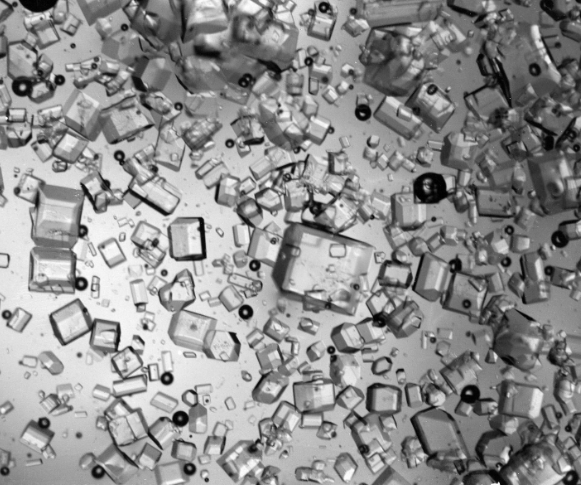
Sugar crystals. Source: Vancouver Archives. Any one of these crystals can act as a seed crystal, providing a surface on which sugar molecules can slip into place and grow the crystal. Crystallization is also an exothermic process that can be easily demonstrated in a calorimeter.
The crystal you dropped into the solution is called the ‘Seed Crystal’. It begins to grow, and rapidly other crystals will begin to grow, often causing an avalanche of individual crystal formation throughout the solution. If one allows the water to evaporate, more of the dissolved sugar will precipitate, increasing the yield of crystals. If the mixture is allowed to dry, the remaining dissolved sugar will cement the precipitated crystals together into a solid mass. Crystallization is a form of isolation and purification where contaminants may remain in solution. Allowing the solution to dry means that the purified crystals become cemented together with any remaining sugar and contaminating substances. This defeats the purpose of crystallization as purification.
Okay, back to writing
In my experience, the process of writing helps me find coherence out of the dust devil of my mind and, through some kind of synthesis, into something bigger than I had first considered. I usually have 20-30 drafts going simultaneously. If after months of latency I can find a way to complete an essay I may post it. But many will be deleted to avoid public embarrassment.
The very act of laying out an essay requires one to deconvolute thoughts and emotions. Usually it becomes obvious that some background reading online is necessary and then sprinkle around relevant links. Typically, some sentences begin to appear and are quickly edited. With the help of Ms. Google, words are double-checked for spelling and meaning or more suitable synonyms may be found. Often I find that I have been misusing a word. Soon, a paragraph is temporarily tacked in place and another is begun. Sometimes the order of paragraphs is changed thanks to the inventor of ctrl c and ctrl v. Then there is always ctrl z to save the day.
All of this organizing of language while writing causes me to reevaluate preconceived notions and find previously unseen connections and pathways. Often, the compelling thought originating an essay vanishes because half-assed notions are cast away or entirely new arguments materialize. In 7th grade I realized that certain alternative words could alter one’s thinking. Even synonyms may hold nuanced meanings that may or may not sharpen your language, and they are worth considering.
Writing is better thinking. It can lead to sharper analysis and helps to straighten out kinks and connect discontinuities in your communications.
In the end, I like to write but ‘I like to have written‘ even better.
Historically, scientific papers have been not where loud, confident proclamations are made about academic research results. The trend has been a sort of unpretentious modesty to avoid overconfidence and exaggerated claims. A sort of snobismus. Instead, conclusions from research results tend to be more guarded in the interpretation of data. An article in the Scienceinsider section of the AAAS journal Sciencepublished 28 July, 2023, has reported that of 2600 papers published in Science between 1997 and 2021, there was a drop of about 40 % in the use of hedging language. Researchers in the study scanned for about 50 terms including “might,” “probably,” “could,” “approximately,” “appear to” and “seem.” They found that these hedging words dropped from 115.8 per 10,0000 to 67.42 per 10,000.
Analyses of other scientific journals and a 2022 paper that examined nearly the same group of papers from Science have found growing use of a positive, promotional tone—expressed with superlatives such as “groundbreaking” and “unprecedented”—which may lead to exaggerated claims.
The authors suggested that researchers are increasingly unwilling to undersell their work and instead, are using more hyperbolic language such as “groundbreaking” and “unprecedented.”
In an earlier study by C.H. Vinkers et al., published in BMJ, 2015, finished his paper with the following paragraph-
“Currently, most research findings could be false or exaggerated, and research resources are often wasted. Overestimation of research findings directly impairs the ability of science to find true effects and leads to an unnecessary focus on research marketability. This is supported by a recent finding that superlatives are commonly used in news coverage of both approved and non-approved cancer drugs. The consequences of this exaggeration are worrisome since it makes research a survival of the fittest: the person who is best able to sell their results might be the most successful. It is time for a new academic culture that rewards quality over quantity and stimulates researchers to revere nuance and objectivity. Despite the steady increase of superlatives in science, this finding should not detract us from the fact we need bright, unique, innovative, creative, and excellent scientists.”
If you sit through a week of presentation sessions at an American Chemical Society national meeting or walk through a poster session, you’ll see a mix of enthusiastic young chemists standing next to their posters and you’ll sit through talks by more established researchers anxious to emphasize the importance of their work. Giving a talk or a poster at a meeting is inherently a promotional activity. It is getting the word out about you and your work in a particular area in front the scientific community and possibly some influential people. It also is something to add to your resume.
Self-promotion by scientific publishing and participation in meetings, called “ballyhoo” in the movie business, is a great way to expose yourself to greater and more frequent opportunity. Make no mistake, the quality and frequency of publications is a very important metric of your accomplishments and potential. This is a sad reality for some and a fortunate reality for a few, but it is reality.
It is hard to draw much from the above research on the hedging frequency as a metric of … what, the unseemly disappearance of proper modesty? The competitive environment of “big academic science” for funds and exposure to impress colleagues and the rank and tenure committee is inevitable. It has been like that for a very long time, but perhaps hidden under the veil of snobbery.
You never know who you might meet at these venues for academic ballyhoo. I once loaned my laser pointer to Al Cotton (who kept it!) and I met Glenn Seaborg at a poster session at the Disney Hotel in Anaheim, CA. I had too many gin & tonics before I spoke with Seaborg and I’m sure that it showed. At a symposium at Purdue University in honor of H.C. Brown (in attendance), I got to see two prominent scientists get into a rather strong “discussion” during a question-and-answer period about who discovered what first. Professor Suzuki (Suzuki coupling) from Japan said something that got under the skin of prof Negishi (Negishi coupling) from Purdue, so they began with point-counter-point exchange (a type of coupling?) which soon accelerated into an argument. As it got more contentious, they switched to speaking Japanese and continued their argument. After a short time, they realized it was best to just sit down as they were providing a “Clash of the Titans” spectacle. This is not a criticism, just an amusing anecdote. Guys like this should battle it out in public more often.
Self-promotion using exuberant language isn’t inherently bad. It is likely that others have already judged you based on far smaller misperceptions. If someone wants to embarrass themselves, let ’em.
So, I get an email from Amazon promoting its “Decarboxylator” product. The Amazon page shows a picture describing the device and shows a picture of someone loading it with spinach leaves. The title of the page says “Decarboxylator Machine to Make Butter, Oil, and More“. A link to ecru, the seller, extols the virtue of herb consumption for greater wellness. The device obviously is just a heated container with digital thermometer and temperature setpoint adjustment.
Source: Amazon.com. One version of the home decarboxylator.
Why bring this up? This was sent to me as an Amazon customer, but I also happen to be an organic chemist who knows about decarboxylation generally. Or, just maybe they know that already?? What on Earth is retail decarboxylation about I wondered. Well, a simple Google search immediately turns up the answer. Processing weed for use in edibles. The silly allusions to vegetable processing is just a ruse.
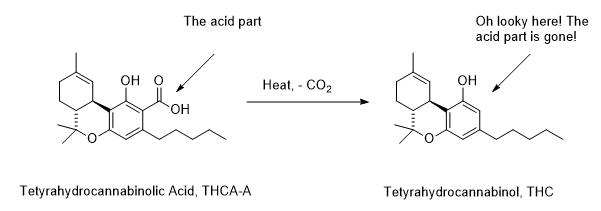
The decarboxylation of THCA-A to give THC. Graphics: Silly old me.
Apparently, there are two isomers of tetrahydrocannabinolic acid, THCA. They are THCA-A and THCA-B. THCA-A is present is large quantities in unprocessed marijuana. THCA-A is the direct precursor of THC in the plant. When you smoke weed or bake it into brownies the burning or baking process decarboxylates THCA-A giving the psychoactive product, THC. However, when you extract weed with a solvent without heating, the decarboxylation is very slow and affords reduced potency. Weed for edibles must be heat treated to induce decarboxylation for maximum potency. The Wikipedia page on tetrahydrocannabinolic acid is very informative. The THCA-A precursor has its own pharmacological effects which is interesting in itself, but that is for another day.
This handy-dandy whizbang device does the deed for home producers of edibles. Ain’t it grand?
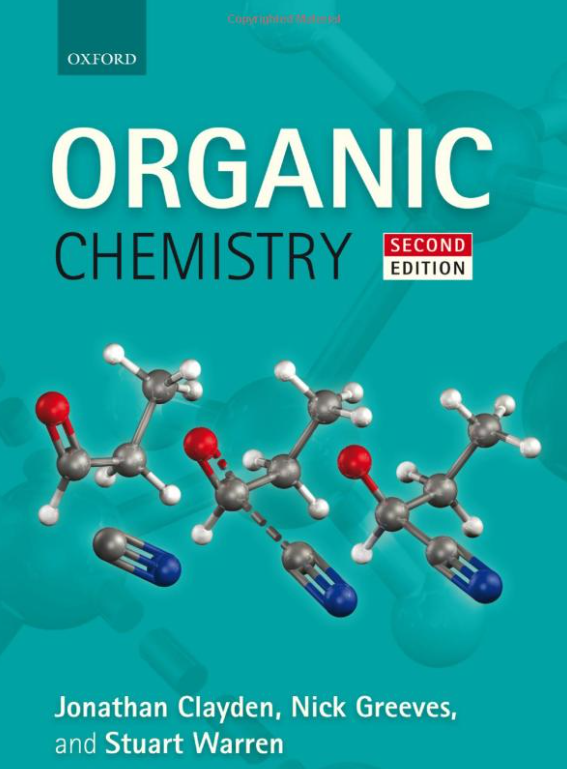
On occasion I step off the industrial hamster wheel for a few minutes to have a look around. In Linkedin this morning I saw a post for the 2nd edition of Organic Chemistry by Jonathan Clayden (Author), Nick Greeves (Author), Stuart Warren (Author), Oxford University Press, ISBN-13 : 978-0199270293. From inside the hole along the creek where I spend my free time, I was never aware that Warren had an O-chem textbook.
Amazon allows you to examine a bit of content on-line. If you teach O-chem, this text is worth a look in my estimation.
Many of us are familiar with Warren from his bookOrganic Synthesis: The Disconnection Approach, 1st edition 1982. A second edition was released in 2008. Retrosynthesis was spreading around to the far-flung corners of the chemistry polygon then. Warren’s book was quite useful in demonstrating that technique for devising an organic synthesis.
An interesting interview of Warren can be found at The Skeptical Chymist from 2009. Warren died in 2021 at age 81.
I saw the words “thoriated tungsten” somewhere in the literature and became curious as to what brought these two metals together. Before I get to thoriated tungsten, I’ll give a little background on tungsten and filaments made from it. There is a surprising amount of art and science in tungsten filaments. Tungsten filaments split into two broad applications- illumination and thermionic emission.
I’ve been curious about the effect of surging LED lighting demand on the tungsten filament business and tungsten demand overall. Naively, I guessed that there might be a noticeable effect on tungsten demand. A Google search only turns up people who want to sell a market research document. One of these web sites claims that demand for tungsten is expected to nearly double from 2021 to 2029 from $4.41 Billion to $7.56 Billion. The major demand for this metal is from the mining and drilling industries in the form of tungsten carbide cutting tools. The major producers of tungsten are China, Russia, Portugal, Austria and Bolivia, with China producing the vast majority.
All have a +2 cation and the tungstate -2 oxyanion. The WO4-2 tungstate anion has tetrahedral geometry similar to sulfate and can also form polyoxotungstates with octahedral WO6 geometry. Polyoxotungstates can form clusters by the sharing of octahedral oxygens similar to silicates. A large number of interesting polyoxotungstates have been identified.
Tungsten filament- a coil of coils.
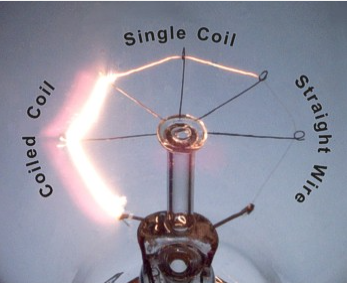
Tungsten turned out to be a perfect choice for light bulb filaments due to it high melting point and its mechanical integrity at high temperature. The coiled coil filament design proved to be much superior to a single coil or a straight filament. Below is a picture found at this website showing the illumination differences in the 3 configurations of the tungsten element. The difference in filament geometry is striking.
The photo above shows a 240 VAC 60 Watt bulb where a coiled coil has been uncoiled to produce a single coil section and a straight section. The whole coil is there. Light bulbs are filled with a mixture of inert nitrogen and argon at below atmospheric pressure. A coil allows a greater length of tungsten wire to be easily placed in the bulb and a coil of coils even more so. During operation the filament suffers heat losses by conduction and convection of the bulb gases. The primary coil and the coil of coils serve to reduce exposure of the filament to the cooling gas flow. The coil provides some self-heating due to the proximity of the coil to itself. It intercepts some of the radiant energy and heats further. In the coil of coils, this effect is much more pronounced as seen in the picture above. The Lamptech website containing this photo is well worth a visit.
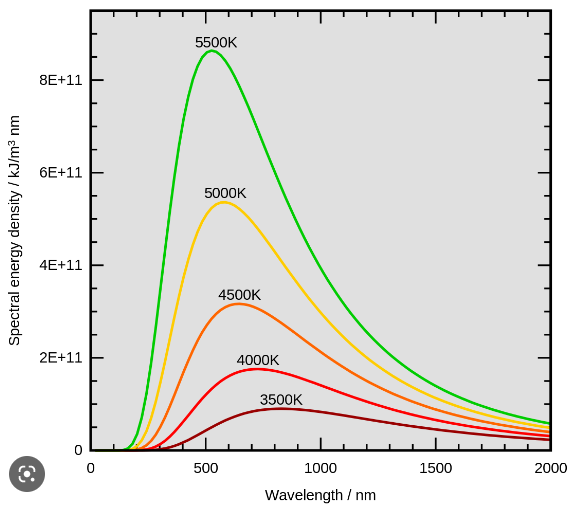
As mentioned above, one advantage of using tungsten as a filament is that it has an extremely high melting temperature of 3422 oC (3695 K). This allows the filament to be heated to very high temperature with the resulting blue shifted black body curve (above), This allows the spectrum to be brighter in the shorter wavelengths and consequently less reddish to the eye than a lower temperature filament. Wiens Law is the basis of color temperature.
When you shop for LED light bulbs, you might notice that LED bulbs are rated on the basis of color temperature. The lower the color temperature, the more yellow/red the light will be. The higher the color temperature, the more whitish the light will be.
However, with high operating temperatures a filament can evaporate, removing mass and robustness. Tungsten filaments, among others, are susceptible to this mode of failure. Another mode of failure occurs when a tungsten filament is hung vertically. Convection of the hot gasses in the bulb causes the top of the filament to get hotter and fail sooner. You’ll notice that lamp filaments tend to be strung horizontally.
Why tungsten halogen? Over time a tungsten filament will evaporate enough tungsten to blacken the bulb and become fragile. The presence of a halogen vapor in a light bulb causes a reaction between the tungsten and the halogen leading to redeposition of the tungsten back to the filament. However, this process requires higher bulb envelop temperatures, i.e., >250 oC. I have to assume that the small size of halogen lamps is to assure that the bulb temperature remains high for the tungsten-halogen recycle.
Thermionic Emission
Tungsten filaments in light bulbs is an application familiar to everyone. But there is another important use of tungsten filaments. The production of electron emission from filaments has been in use for a very long time. A hot filament or other hot surface under vacuum can be made to produce electron beams that can be accelerated or deflected and focused to do useful things. The electron beams can be made to carry modulated signals that can be put to use in detecting or radiating radio signals for radio, television or a myriad of other uses. The old vacuum picture tubes in early television used a filament to generate an electron beam that could be directed to scan across a phosphor coated surface to produce moving images.
What caught my attention when sorting through the tungsten literature was the mention of thoriated tungsten filaments. This topic goes back to the 1920’s with Irving Langmuir. In 1923 he published a paper in Physical Review Langmuir found that the rate of electron emission from 1 to 2 % thoriated tungsten to be “it was discovered that by suitable treatment the filaments, containing 1 to 2 per cent of thoria, could be activated so as to give an electron emission many thousand times that of a pure tungsten filament at the same temperature.” He found that the efficiency and life of a tungsten filament could be extended by spiking the tungsten with thorium oxide. He postulated that thorium is reduced and migrates to the surface of the tungsten filament forming at most an atomic monolayer. Thermionic emission occurs when a hot object like a filament evaporates electrons.
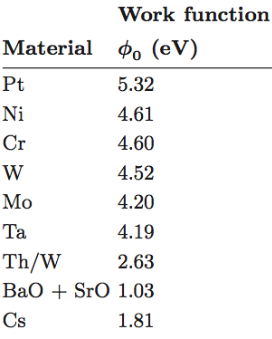
Every substance has work function energy in eV that is required to remove an electron from a surface. Additives to tungsten like lanthanum, cerium or thorium or their oxides have a lower energy work function than does tungsten and will produce a greater flux of electrons. This even applies to TIG welding where an electric discharge must jump across a workpiece and a sharpened tungsten rod.
A 1-2 % thoriated tungsten welding rod or filament will allow thorium to migrate to the surface via grain boundaries while in operation and deposit on the surface. The work function energy of thorium is lower than that of tungsten, so the thoriated surface can release more electrons at a given temperature.



 Lamentations on Chemistry