Category Archives: Education

Electrostatic Discharge Safety and Basic Electricity Principles

One of my work duties is to give safety training on the principles of electrostatic safety: ESD training we call it. The group of people who go through my training are new employees. These folks come from all walks of life with education ranging from high school/GED to BS chemists & engineers to PhD chemists & engineers. In order to be compliant with OSHA and with what we understand to be best practices, we give personnel who will be working with chemicals extensive training in all of the customary environmental, health and safety areas.

I have instructed perhaps 80 to 100 people in the last 6 years. At the beginning of each session I query the group for their backgrounds and ask if it includes any electricity or electronics study or hobbies. With the exception of two electricians in the group, this survey has turned up a resounding zero positive responses.

Admittedly, there could be some selection bias here. It could be that people with electrical knowledge generally do not end up in the chemical industry. My informal observations support this. But I’m not referring to experts in the electrical field. I refer to people who recall ever having heard of Ohm’s law. One might have guessed that the science requirements for high school graduation may have included rudimentary electrical concepts. One might have further suspected that hobby electronics could have occupied the earlier years of a few attendees. Evidently not. And it does not appear that parents have been very influential in this matter either.

I’m struggling to be circumspect rather than righteous. It is not necessary for any given individual to have learned any particular field of study. It is not even necessary for most people to have studied electricity. But it is important for a core of individuals to have done so. So, where are they? And why aren’t more people curious enough to strike out on their own in the acquisition of electrical knowledge?

Back to electrostatics. In order to have a working grasp of electrostatic principles, the concept of the Coulomb has to be conveyed. Why the Coulomb? Because it is the missing piece that renders electrostatic concepts as mechanistic. It is my contention that a mechanistic grasp of anything can help a person to reason their way through a question. The alternative is rote memorization. The mechanistic approach is what drives learning in the natural sciences.

To be safe but still effective as an employee, a person needs to be able to discriminate what will and what will not generate and hold static charge to at least some degree in a novel circumstance. By that I mean how accumulated or stranded charge can form and what kind of materials can be effectively grounded. If you are working with bulk flammables, your reflexes need to be primed continuously to recognize a faulty ground path in the equipment around you. At the point of operation, somebody’s head has to be on a swivel looking for off-normal conditions.

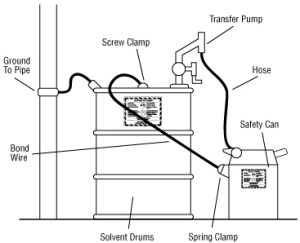
It is possible to cause people to freeze in fear and over-react to unseen hazards like static electricity. But mindless spooking is a disservice to everyone. To work around flammable materials safely requires that a person understand and respect the operating boundaries of flammable material handling. Those boundaries are grounding and bonding (see NFPA 77), avoiding all ignition sources, good housekeeping, and maintaining an inert atmosphere over the flammable material.

Much of electrostatic safety in practice rests on awareness of the fire triangle and how to avoid constructing it.

Back to electrical education. There are numerous elements of a basic understanding of electricity that will aid in a person’s life, including safely working around flammable materials. One element is the concept of conduction and what kinds of materials conduct electric current. Another is the concept of a circuit and continuity. Voltage and its relationship to current follows from the previous concepts.

I would offer that the ability to operate software or computers is secondary to basic knowledge of how things work.

Connecting these ideas to electrostatics are the Coulomb and the Joule. One volt of potential will add one Joule of energy to one Coulomb of charges. One Ampere of current is one Coulomb of charges passing a point over one second. Finally, one Ohm is that resistance which will allow one Ampere of charge to move by the application of one volt.

For a given substance- dust or vapor- a minimum amount of spark energy (Joules) must be rapidly released in order to cause an ignition. This is referred to as MIE, Minimum Ignition Energy, and is commonly measured in milliJoules, mJ.

A discussion on sparking leads naturally into the concept of power as the rate of energy transfer in Watts (Joules per second), connecting to both the Joule and Ohm’s Law. Rapid energy transfer is better able to be incendive owing to the finite time needed for energy to disperse. Slow energy transfer may not be incendive simply because the energy needed to initiate and sustain combustion promptly disperses into the surroundings.

A discussion of energy and power is useful for a side discussion on how the electric company charges for energy in units of kilowatt hours (kWh). This is a connection of physics to money.

The overall point is that a rudimentary knowledge of electrical phenomena is of general use, even in the world of chemical manufacturing. I often hear people talk about the importance of “tech” in regard to K-12 education. By that they seem to say that using software is the critical skill.  I would offer that the ability to operate software or computers is secondary to basic knowledge of how things work. Anyone with a well rounded education should be able to learn to use software as they need it.


Addendum 8/16/18.  Since I wrote this essay, I’ve taught another 2 groups of trainees and not a single one of the 12 individuals could say that they had heard of Ohm’s law. All were high school grads over an age range of 22 to ~50. One had fresh BS Chem. E. degree.  Evidently none had enough inclination in their travels to noodle their way through a rudimentary grasp of volts, ohms, amperes and basic electronic components. I find this incredible given the penetration of electrical contrivances in our lives.

This feeds into a pet theory of mine that true expertise is being replaced with software skills. I know this because it seems to be happening to me as well. Is this an aspect of the Dunning-Kruger effect?

Some useful instructions

How to follow directions-

  1. Look at the person
  2. Say ‘OK’
  3. Do it

How to do anything-

  1. Start at the beginning
  2. Proceed through the middle
  3. Stop when finished

How to save electrical energy-

  1. When leaving an area, Turn Off the Goddamned Lights!

I’ll confess that I am especially peevish about the last instruction.

What instructions do you have to share, dear reader?


Comments on Adult Education/Training on the Job

One of my job responsibilities is to educate new hires on reactive hazards and the basics of electrostatic discharge safety in the chemical manufacturing environment. The attendees are usually new plant operators with the occasional analytical chemist also in attendance. The educational background for the operators is nearly always a high school diplomaย with work experience of widely varying durationย in non-chemical industries. Since we are far from the regional chemical manufacturing centers in the USA, we rarely encounter applicants from our industrial sector.ย Commonly the analysts arrive withย a BA/BS in chemistry, biochemistry, or even biology sometime in the past.

In their 1 to 2 weeks of introductoryย training I’m given 1 hour for each of the 2 topics- barely enough time to wedge in important vocabulary let alone develop a command of, well, anything. My approach is to first talk about the difference between hazard and danger with some folksy examples. Then I introduce the general concept of stability using examples boxes on a rising incline. From there, we talk about stability as related to variously truncated inverted conical objects. The notion of instability, meta-stability, and stability are teased out of examples of the tipsiness of inverted cones leading to a change of stateย under the influence of external forces. This is very concrete and primes the mind to begin to grapple with the abstract notion ofย substances undergoing change depending on the precariousness of their initial state or the intensity of external influence.

Synthetic chemistry is very much about the careful manipulation of instability in order to produce the sort of change that is desired. Highly stable materials, i.e. sand,ย are not desirable in a chemical synthesis minimally because they are resistant to alteration. Many reaction stepsย may be performed and much cost incurredย in order to produce features (functional groups)ย thatย are sufficiently unstable to undergoย the series ofย desired connections.

After all of the above, the remainder of the hour is spent talking about chemical hazards and how some of them may be passivated by paying attention to the fire triangle. Also the matter of chemical compatibility is introduced as well as the existence of various categories of substances with examples. Of course, this means nothing to them. It’s just a bunch of new words arranged in unfamiliar ways. I’m quite well aware of this, but the purpose is to prime the pump so that when they hear these solvent names and words like acidic, caustic, basic, pH, quench, etc., then can begin the long process of connecting the dots to produce a better picture of their workspace.

The topic of ESD – electrostatic discharge – has its own peculiar challenges. First of all, static charge is invisible, pervasive, and unless you have direct measurements, provides hazards of an unknown risk. To understand ESD hazards, the learner should be exposed to theย units describing static charge. These include the Coulomb (C), the volt (Joules/C), theย Joule (J), area charge densityย (ยตC/m^2), power (Wattsย = J/sec), the Ohm (ฮฉ = V/A)ย and the Siemens (S = 1/ฮฉ), and theย Ampere (A = C/sec).

Herein lies the real point of this essay. In teaching ESD safety for 4-5 years, I have met perhaps 2 attendees (engineers)ย out of many dozensย who recall having taken coursework relating to basicย electricity. I always begin the seminar by taking a poll on who has heard of Ohm’s Law. In reality, I don’t expect electrical proficiency from folks who have not worked in an electrical field. What surprises me is that so few can recall havingย heard of Ohm’s Law. How is it that we are letting so many people graduate from high school without some course work introducing the very basics of electricity?? This related to one of the most pervasive and influential technologies in our time.ย I think this is a stunning oversight.

“A’hem, cough cough,” you sputter, “but surelyย …” –short pause for effect- “… students who have taken high school physics have had instruction in electricity,” you reply with obviousย incredulity.

If you had said this you’d be correct. But the educational profile of many factory workers doesn’t seem to include many people who have, in our experience,ย taken physics in high school. Those from the electrical trades tend not to show up from the temp agency for screening.

So let me end this by asking the mandarins of our school districts why we let students not college boundย  graduate without some background in the basics ofย electricity or electronics? To repeat, this is a stunning oversight, given the extensive use of electrical functions and objects in our lives.


Education is struggle, not just knowing what to click

The local school board has recently voted to spend $482,000ย to purchase iPads for a high school. “If we don’t do this now, and are already behind, we will get swamped. Instead of buying for a grade level or a school, it’s going to have to be for every kid in the district,”ย stated the board president. Chiming in was the superintendent who said “It’s not the wave of the future, it’s here now,”ย Mr. XYZย said. “It’s about the digital world we’re in more than it is about the device. We just have a device now that allows us to do that. The struggle now is getting everyone up to speed.”

There is utterly nothing novel or surprising about these sentiments among educators. The eternally open door to the brave new world beckons educators to outfit their classrooms with the latest and greatest. This is a healthy and vital impulse that I hope we allย value.

From where I sit as a 59ย year old industrial chemist, the image of new iPads holding a key to mending our educational woes seems like only the latest false prophet to pass our way.ย  Am I just grumpy or quietly jealous of the lucky young pups getting their iPads? Well, I am prone to grumpiness. Jealous of the students? No. I have declined the issuance of an iPad at work.

I think part of what we see is FOMO: Fear-Of-Missing-Out. To be sure, iPads or other brandsย are popular for a reason. They’re a wonderful tool for finding information about nearly anything and they are just plain fun to monkey with. So, as a resource to students, theย iPad willย obviously provide an ever widening portal to the world’s treasure of information. For this it has merit.

Two things can happen to those who frequent cyberspace. First,ย we find information through the use ofย search termsย that lead us to a great many sources to choose from. But which are the most credible sources? Are they out dated? ย Eventually, if civilization holds up long enough, we’ll relearn the importance of rigor in publishing. Secondly, and critically, when we find some information will we understand it? Searching and finding are not equivalent to substantiveย understanding.

A psych prof once related to me that true learning requires struggle. In my experience I have found this to be a fairly accurate truism. In my college teaching years I always conveyed to students that part of the secret to success in chemistry was to read the text several times and strive to understand the reasoning inย the example problems.ย ย Just as importantly,ย always do the assigned problems. Freshman chemistry is heavily weighted in quantitative concepts and math problems. In fact, freshman chemistry can often morph into a math class for many students. First year chemistry is a struggle for most students. The trick for the educator is to convince the students that struggle is not the equivalent to failure.

Being an organikker I taught sophomore organic chemistry. Chemistry is highly vertical meaning that successive course work depends on content from previous classes. Organic chemistry is a bit different in that much of it is qualitative and heavily weighted with new vocabulary and the symbolic language of reaction mechanisms. I used to say that sophomore organic was the year of 10,000 structures. An important part of learning organic is the rote mechanical-tactile brain activity of drawing structures by hand. We chemists areย just crazy about structures.ย Drawing pictures helps to seal the connection between vocabulary and structure. Being asked to draw structures correctly and adding functional groups forces one to associate symbols with composition and vocabulary, but also to acknowledge the 3-D aspects of molecules. Like freshman chemistry, organic requires a good bit of struggle.

In the past I was involved in public outreach with the science of astronomy. Having racked up many seasons of observing and studying the topic I was conversant enough to give star talks and usher visitors for a chance to peer through the 18 inch Cassegrain in the dome. I did this forย some years but finally tired of it. What wore me out was that the public rarely had more than superficial interest in the topic. They were just happy to see the moon.ย It was infotainment and I had been an infotainer. What I finally realized was that to truly appreciate the wonder of astronomy and theย mechanisms that grind the universe forward, a visitor would have to sit down and grapple with a lot of physics and new phenomena. A person has to be willing to commit to some struggle to gain the wonderfulย insights. My hard wonย knowledge offered to visitors just washed over them for the most part. It was a show and I was a performer.

So let me close the loop by connecting struggle with educational technology. It is my fervent hope that curriculum does not confuse learning to operate a device as evidence of subject knowledge. Most devices are designed to be easy to learn. What is crucial in K-12 education is that a groundwork of basic facts and knowledge of systems and processes are absorbed by students. A basic knowledge of geography facts, government facts, history facts,ย math facts, grammar and vocabulary facts, sciency facts, etc. are still necessary to have to build upon in the future. Any notion that facts can be left by the wayside in favor knowing where to look for them is a tragic mistake. Eventually people have to draw upon facts to properly search Google. After all, facts have names and to dig deeper into a topic, the user must supply the right search terms. The wrong synonym in a given search may not take the searcher to what they are looking for. Facts in your brain are still very necessary.


An organic chemist looks at evolution

I wrote this essay a few years ago but did not publish it. I don’t remember why. This is not written for evolutionary biologists. For better or worse, here it is.

On weekends I check in on C-SPAN 1 and 2 to see what folks are talking about. A couple of weekends ago onย Earth Day there was a C-SPAN 1 broadcast of an April 19th, 2017,ย panel discussion on the ” March for Science and Threatsย to Science.” The segment was hosted by The Heritage Foundation and featured a number of well dressed folks who were quite authoritative and highly skilled in the rhetorical arts. Curious thingย that the Heritage Foundation chose this topic to weigh in on.

The discussion followedย various lines of conservative analysisย of the 4/22/17ย March for Science andย touched onย the New Atheism, Neo-Darwinism,ย with allusions toย a supposed endemicย misanthropy of some March for Scienceย participants.

One of the panelists was a fellow named Stephen C. Meyer who is a senior Fellow and founder of the Discovery Institute. Meyer is a very articulate and persuasive proponent of creationism. His contribution to the discussion was a recitation of the pro-creationist argument on the weakness’s of Neo-Darwinism. The thrust of his argument centered on the disagreement among scientists memeย in the field of biological evolution and how this delegitimizes the whole concept. This line of argument is a common (dareย I say standard?) rhetorical trick used by creationists to cast doubt on the science of evolution.

Pro-creationist adherentsย have learned that they do not have to prove evolution is incorrect. They need only make a case for disagreement in the scientific community of its veracity or infer scientific misconduct.ย As a friend once quipped, they stir up a dust cloud and then complain because they can’t see anything.

Darwin and the story of the expedition of theย HMS Beagle is a tale of 19th century discovery that is inspirational andย iconic. Too often, however, Darwin’s writingsย on natural selection is notย portrayedย in the historical context relative toย modern molecular biology. When I hear creationists discuss evolution,ย the discussion seems toย remain with the work of Darwin. I would maintain that if Darwin and Lamarck had not developed their work on natural selection, modern molecular biologists would have had to postulate evolution themselves.

Public discussion of evolution in the limited context of Darwinย is frequentlyย burdened with misinterpretations and half-truths by adherents and deniers alike. It is not unusual for people toย become confused by the use of imprecise language when discussing evolution-as-Darwinism. For instance, I’ve heard knowledgeable people assert “… the species evolved (such and so) in order to adapt …”. Well, yes and no. The species may well haveย over timeย evolved some adaptation. However, the words “… the species evolved …” may be misinterpreted by some as meaning that a species, when presented with some survival challenge, may have taken the chance to unsheath some mechanism to respond by rejiggering its genetics in a way that would lead to survival of subsequent generations. A more accurate description might be that fortuitous genetic mutations in the past have allowed the organism to survive challenges presented by a changing environment. There is a critical qualifier, however. The lucky mutation must be survivable and facilitate the continued reproduction of the critical trait to subsequent generations. Mutations occurring after the possibility of reproduction lead only to an evolutionary dead end.ย  Evolution is blind going forward.ย Descriptive language must be built around that concept.

Rather than consumingย time and bandwidth reciting the history and elements of Darwinism, the reader is invited to pick this up elsewhere.ย Instead, I would like to throw an idea on the table. Perhaps writers and public figures should deemphasize Darwin’s workย andย emphasize the mutability of the genome.

If we considerย that the large scaleย structuralย morphologies of organisms are an emergent phenomenon and arise as a result of molecular and cellular scale structures, then we can begin to see evolution much like a performing symphony orchestra is comprised of many instruments, each with characteristic effects. The overall effect is the sum total of all the contributing instruments. Evolution then becomes a matter of changing the score a bit here and there to produce variants. The notion of life as an emergent phenomenon is itself evolving to a high level of theory. See: Pier Luigi Luisi, The Emergence of Life: From Chemical Origins to Synthetic Biology 2nd Edition, 2016, Cambridge University Press.

With 19th century Darwinian theory, we are limited to observing evidence of change at the macroscopic level but with no credible mechanism for the manner of change or a cause for initiating a change. Without a mechanism, plausibility is a tough sell to students, teachers, and the rest of the lay public. Darwinism is a tidy package with an appealing story. However, without mention of its mechanism it resembles magic. Evolution at the molecular scale can offer mechanisms and measurements. I would offer that Darwinism could be treated in a historical context, but a transition to the level of ย molecules appropriate to the intended audience should happen. Evolution rests on the mutability of genes.

Another troublesome aspect of explaining evolution is the plausibility of random change leading to organisms of greater complexity. The notion that the human eye or hand is the result of random change is simply too incredible for non-sciency people to accept. For them, it is an intellectual cul-de-sac that, in parallel with their religion, only validates “creation implies creator”. To folks firmly affixed in concrete reasoning, the notion of non-living, disorganized matter somehow spontaneously organizing to form elaborate life forms is beyond comprehension. This argument is often brought up as a coup de grace against evolution. Randomness as a successful driver seems so implausible.

Perhapsย Darwinism is better expressed asย only anย introduction to the story ofย  molecular evolution.

Standing in the way of a matureย understanding of evolution is the plausibility of random change giving way to greater complexity. What exactly do we mean by random? Does random change imply an infinite range of categories of influence and outcome? What exactly is it that is random? This is difficult even for scientists, let alone the lay public. Let’s consider some relevant aspects of the world of the molecule.

Axiom 1: The initiation of life may be a quite different chemical mechanism from the reproduction of life.

The origin of life and the evolution of life are different processes. The physical conditions and available substances amenable to evolution necessarily diverge from those present when and where life arose.ย  Origins and subsequent evolution must be pulled apart into separate arguments for the sake of clarity.

Axiom 2: Evolution is a molecular phenomenon.

In order to have macroscopic change there must be microscopic change. The DNA molecule is well established as the repository of stable organizational information necessary for the construction and operation of living things. If change characteristics are to be passed along through successive generations, then DNA has to change accordingly. DNA is ordinary matter and subject to the constraints of chemistry and physics. A part of being subject to chemical change is the effect of adverse conditions to contend with in general (bio)chemical synthesis. Biochemistry is largely aqueous chemistry with all of the constraints and degrees of freedom that follow: Solubility, Gibbs free energy,ย transition states, polarity, acidity, concentration, catalysis, stability in an aqueous environment, reaction rates, stoichiometry, time, temperature, and reduction/oxidation potential.

All of the parameters listed above represent variables with their own range of values that must be in alignment in order for life to happen. Rather than be overwhelmed by them, they could be considered as a finite number of channels in which a limited range of inputs give rise to a limited range of outputs.

Axiom 3: Atoms and molecules must collide in order to react.

A generalization in chemistry is that atomic and molecular interactions require the components to collide at some range of favorable trajectories. The mobility necessary for atomic and molecular interactions to occur is available in fluids but not solids. If molecules are held in place in a bulk solid phase, then they don’t have the opportunity to bump into one another just right and interact. The most abundant element in the universe is hydrogen. Water, H2O, is comprised of the most cosmically abundant element bonded to oxygen, the most abundant terrestrialย heavy element.ย  A planet that has water with a climate and pressureย amenable to the liquid phase is a planet that has a start on supporting life. Life is substantially a solution phase phenomenon.

Axiom 4: There is a menu of limitations in the behavior of molecules.

  1. The set of atoms necessary for constructing life on earth is of limited number and variety
  2. The behavior and properties of a given atom is based on the physics of electric charges and the best description of how and where electrons spend their time. This is successfully described by quantum mechanics.
  3. Because of physics and more to the point, quantum mechanics, the electrons which do the chemistry are capable of a finite variety of allowed states according to selection rules.
  4. There is a limited set of ways that a given atom can attach to other atoms to make chemical bonds under ordinary terrestrial conditions.
  5. Molecules are made of atoms. These atoms naturally form a set of characteristic groupings within a molecule that are energetically preferred and thus common. The groupings are called moieties or functional groups. Examples are stable 5 and 6 member rings of atoms (pentagons and hexagons), carbon chains long and short, single, double, and triple chemical bonds. The variety of connected atoms in living systems include carbon-oxygen, carbon-carbon, carbon-nitrogen, carbon-sulfur, carbon-phosphorus, oxygen-phosphorus, oxygen-hydrogen, carbon-hydrogen, nitrogen-hydrogen, sulfur-hydrogen, and maybe a few more. Atoms can connect or disconnect, but in a finite number of ways. The atoms that make up “biomolecules” have certain features that make them amenable to dissolution in water. In particular nitrogen and oxygen have non-bonding electron pairs that attract certain hydrogen groups to make something called a hydrogen bond. This behavior lends water solubility to biomolecules.
  6. Certain groupings of molecules can intimately comingle indefinitely in the liquid state, but other groupings spontaneously separate into separate “phases” or layers to minimize contact. Consider oil and vinegar and how they spontaneously separate for minimum contact in salad dressing. Molecules that have a charged end and a long water insoluble end may form organized structures called micelles in water. It bears a resemblance to the cell wall. It is an example of spontaneous organization because it is energetically favorable.
  7. The assembly, behavior, and disassembly of biomolecules follows finite, definable chemical interactions. Synthetic biomolecules are indistinguishable from the biological version.
  8. A limited number of liquids are compatible with living systems. Life as we know it requires that molecules are mobile during certain periods. Living things reproduce and grow. This requires changes that are only possible if molecules can move within the system. Movement happens within a fluid system.

The list above sketches out some limitations that atoms and molecules are subject to. It is useful to note that the atoms and molecules of life are subject to constraints that prevent them from behaving in a completely random fashion. Molecules in general will not form in every conceivable connective permutation under terrestrial conditions. Particular routes and end-states are energetically preferred. Things that have only specific behaviors are things that will always behave or react in a particular set of ways to give a limited range of products. Products from molecules that react along alternative pathways will favor the end-state of the fastest pathway. That means that there is exclusion of some molecular products. This is another loss of randomness overall.

Contrary to your camp counselor’s advice, not just anything is possible. What makes the universe sensible and relatively stable is the fact that objects and events interact or unfold in ways characteristic to their building blocks. What follows from the limitations of objects and events is that many forms of behavior or channels of interaction are therefore excluded. That is, there are not an infinite number of ways that a biomolecule can behave. The interactions in which a biomolecule can behave is channeled through a limited number of pathways due to the nature of the chemical pathways that are energetically favorable. The universe is surely chaotic, but not entirely so. Organization in biomolecules, or should we say a finite number of energetically favored structures, are the result of the limited number of ways that molecules can interact under terrestrial conditions.

Is is a common assertion by creationists that the odds of a hand or eyeball spontaneously forming could result from random interactions is 1 in some extremely large number. To the contrary, there is a case to be made that the hand or eyeball is the result of a series of natural molecular collisions, each constrained to a limited range of reaction possibilities over a very, very long period of time. What’s more, a molecule at room temperature is colliding with another molecule at maybe a frequency of 10^12 or 10^14 per second*. Scale that up to 1 million years and you have a tremendous number of opportunities to produce change.

* These frequencies may be off a bit, but it is what I seem to remember.

The Amateur Scientist by C.L. Stong: A Remembrance.

Of theย 1332 posts I have pollutedย cyberspace with, the most frequently visited is a post on the topic of neutron lethargy written in May of 2008.ย The post is titled Neutron Lethargy- This Weeks Obscure Dimensionlessย Quantity. My intent was to write about some of the obscure yet interestingย factoids and concepts that I run into in my daily travails.

I’ve been drawn to nuclear topics since junior high school.ย Sometime in 8th grade I began toย to build several scientific projects as described in the Scientific American column The Amateur Scientist written by C.L. Stong. Stongย published a collection of articles in a book titled The Scientific American Book of Projects for the Amateur Scientist, 1960, Simon and Shuster. This book was (is)ย a treasure trove of information on how to assemble equipment for scientific investigation.

In jr highย I spent some time trying to assemble an “Atom Smasher” (p 344). It was an evacuated glass tube with filament electron source a meter away from the positively charged target. The target was aย 3 x 1/4 inch diskย of aluminum with many perforations over which aluminum foil would serve to seal in the vacuum.ย The aluminum foil was to serve as a windowย through which electrons couldย collide with a sample on the exterior.ย Sadly the project eventually endedย due to the lack of accessย to a McLeod gauge, bulk mercury, and aย diffusion pump. The requiredย Van de Graff generator was available for a few hundred dollars. The failure was perhaps fortuitous because even if I had managed to assemble the thing, I might have been exposed to x-rays during the accelerator’s operation.

Turning my attention to more feasible projects I did manage to do some biology experiments. The most interesting was growing protozoans from an infusion ofย grass and soilย in standing water. After several days the water would turn cloudy and fetid. Using a decent Christmas microscopeย we were able to view a magical world of microorganisms scooting around in their herky-jerky manner. It was mesmerizing.

A glove box project afforded a place for growing microorganisms with petri dishes purchased at a hobby shop.ย I was able to grow mold and some blend of bacteriaย on Jelloย in the petri dishes, but the microscope didn’t have the resolution for bacteria. Since I had no interest in pathogens, the glove box was not really needed. But it looked cool.

By 10th grade I did manage to successfully build the cloud chamber project (p 307). Unfortunately I only witnessed stray cosmic rays and background radiation. As it turned out, the polonium 210 alpha source loaned to me by a physics teacher had long since decayed to inactivity. Building the chamber was a tremendous learning experience made possible through the use of the metal shop at school. It was of sheet metal construction with a dry ice and methanol coolant chamber built in. The actual chamber was made fromย  the bottom quarter of aย Folgers coffee can cut and fitted with a glass viewing port and Plexiglass illumination ports. As I recall, the most problematic aspect of the construction was finding an adhesive that would not detach at dry ice temperature.

An electromagnet was built in an attempt to bend the path of the particles by a magnetic field, but was wholly inadequate for the job. Learned another lesson there too.

The book by Stong was something that lit up my curiosity and put a fire in the belly to explore. This was the beginning ofย what turned out to beย life-long career in science. Strangely, the total lack of interest by the adults around me only strengthened my resolve to build and learn.

Thoughts on Academia

The blog post by Terran Lane of the University of New Mexico provides a good example of the frustrations in academics today. Much of this is well plowed soil. I link to it because I think he is spot on about more than a few things.

The availability of external funding for the lastย 30 yearsย has equipped American colleges and universities with a great deal of equipment and facilities. The availability of funding for grad students and post-docs has energized a vast educational complex that has come to depend on external grant money to maintain built up infrastructure. Naturally when an institution expands in good times, it finds itself top heavy in overhead when the good times end.

Ambitious people step forward when presented with the opportunity to grow programs and institutions when times are cash rich.ย  But when the cash influx begins to taper off, these same people find themselves in the position of having to decomission or dismantle parts of the very organization they helped to build.ย  It is hard for people in any circumstance to feel like they are moving forward when they have to make do with less.

One response to restricted university resources is to increase competition for teaching positions and tenure. Candidates with the best potential for winning grants are highly prized in any candidate search. The result of this is that professors today are burdened by administrative expectationsย in the hunt for resources in order to maintain close to what they already have.

Friends at PUI institutions are also feeling the heat, possibly due in part to the rise in undergraduate research programs that took off in the 1980’s. ย Undergraduate research in chemistry, at least, has grown into an expectation rather than a plus. This brought the buzz saw of the grant machine into the grassy quads of many quiet institutions.

Certainly no untenured prof is going to throttle down their scholarly activity for the greater good of science funding.ย  Faculty will continue to struggle with this as long as grants are a major metric in rank and tenure.

Which brings me to my final point. Scientific knowledge as national treasure.ย  I am sifting through Chemical Abstracts Service data bases searching for something nearly every day. This resource of ours, scholarly and pragmatic knowledge,ย is one of the crown jewels of human civilization. It is the collective contribution of people and institutions going into the distant past and across the curved surface of our world.ย  We should cherish it for what it is- an archive of achievement, a repository of knowledge for application to future challenges, and a representation of the best of what we are capable of.

The notion that academia is the apex of the life intellectual has never been entirely true. You do not have to be in industry for very long before it becomes quite clear that there are a great many smart and creative people outside of academia. People who become professors are people who are in love with the very idea of the university and of higher education. We must find a way to allow research activeย faculty to throttle down the grant cycle just a bit so they may throw their energies into serving their institutions in the traditional manner. By service to ย their students, to scholarship, and to the advance of civilization.

That said, it seems embarrassingly obvious to say that our academic institutions are a critical part of our civilization past, present, and future. But todayย our institutions are in peril of substantial decay if left to antagonistic legislators and fulminating demagoguesย bent on terminating programs in the name of socialย reconstruction.

We know how to operate our university/research complex. Absent some of the mania in theย horse race for grants, perhaps we can offer a bit more student contact with professors.ย A BA/BS degree must be understood toย mean that a graduate has absorbed knowledge, sharpened reasoning ability, accrued some judgement,ย and has developed a professional demeanor that can only come from the personal interaction between people. We should expect from our institutions that a professor is a professor, not a shift supervisor.

Research Squatters. When Universities and Corporate Behemoths Collaborate.

Recently I had the good fortune to get to meet for a consultationย with a young and talented chemistry professor (Prof X)ย from a state university elsewhere in the US.ย Profย X has an outstanding pedigree and reached tenure ratherย rapidly at a young age.ย This young prof has won a very large number of awards already and I think could well rise to the level of a Trost or a Bergman in time.

Not long ago this prof was approached by one of the top chemical companies in the world to collaborate on some applied research.ย What is interesting about this is that the companyย has begun to exploreย outsourcing basic research in the labs of promising academic researchers. I am not aware that this company has done this to such an extent previously.ย  They do have an impressive corporate research center of their own and the gigabucks to set up shop wherever they want. Why would they want to collaborate like this?

R&D has a component of risk to it. Goals mayย not be met or may be muchย more expensive that anticipated. ย Over the long term there may be a tangible payoff, but over the short term, it is just overhead.

The boards and officersย of public corporations have a fiduciary obligation to maximize the return on investment of their shareholders. They are not chartered to spread their wealth to public institutions. They have a responsibility to minimize their tax liability while maximizing their profitability. Maximizing profit means increasing volume and margins. Increasing margins means getting the best pricesย at the lowest operating expense possible.

Corporate research is a form of overhead expense. Yes, you can look at it as an investment of resources for the production of profitable goods and services of the future. This is what organic growth is about. But that is not the only way to plan for future growth. Very often it is faster and easier to buy patent portfolios or whole corporations in order to achieve a more prompt growth and increase in market share.

The thing to realize is that this is not a pollenization exercise.ย The company isย not looking to just fertilize research here and there and hope for advances in the field. They are a sort of research squatter that is setting up camp in existing national R&D infrastructure in order to produce return on investment. Academic faculty, students, post-docs, and university infractructure become contract workers who perform R&D for hire.

In this scheme, research groups become isolated in the intellectual environment of the university by the demands of secrecy agreements. Even within groups, there is a silo effect in that a student working on a commercial product or process must be isolated from the group to contain IP from inadvertant disclosure. The matter of inventorship is a serious matter that can get very sticky in a group situation. Confidential notebooks, reports, and theses will be required.ย  Surrender of IP ownership, long term silence on ones thesis work,ย and probably secret defense of their thesis will have to occur as well.

While a big cash infusion to Prof X may seem to be a good thing for the professor’s group, let’s consider other practical problems that will develop. The professor will have to allocate labor and time to the needs of the benefactor. The professor will not be able to publish the results of this work, nor will the university website be a place to display such research. In academia, ones progress is measured by the volume and quality ofย publications. In a real sense, the collaboration will resultย in work that willย be invisible on the professors vitae.

Then there is the matter of IP contamination. If Prof X inadvertantly uses proprietary chemistry for the professor’s own publishable scholarly work, the professor may be subject to civil liability. Indeed, the prof may have to avoid a large swath of chemistry that was previously their own area.

This privatization of the academic research environment is a model contrary to what has been a very successful national R&D complex for generations. Just have a look in Chemical Abstracts. It is full of patent information, to be sure, but it is full of technology and knowledge that is in the public domain. Chemical Abstracts is a catalog and bibliography that organizes our national treasure. Our existing government-university R&D complex has been a very productive system overall and every one of us benefits from it in ways most do not perceive. We should be careful with it.

Is this as good as it gets?

I’ve had this notion (a conceit, really)ย that as someone from industry, I should reach out to my colleagues in academia in order to bring some awareness of how chemistry is conducted out in the world.ย  After many, manyย conversations, an accumulating pile of work in ACS activities,ย and a few visits to schools, what I’ve found is not what I expected. I expected a bit more curiosity about how commerce works and perhaps what life is like in a chemical plant. I really thought that myย academic associates might be intrigued by the wonders of the global chemical manufacturing complex and product process development.

What I’m finding is more along the lines of polite disinterest. I’ve sensed this all along, but I’d been trying to sustain the hope that if only I could use the right words, I might elicit some interest in how manufacturing works; that I could strikeย some kind of spark.ย  But what I’ve found is just how insular the magisterium of academia really is. The walls of the fortress are very thick. We have our curricula firmly in place on the three pillars of chemstry- theory, synthesis, and analysis. In truth, textbooks often set the structure of courses. ย A four year ACS certified curriculum cannot spare any room for alternative models like applied science. I certainly cannot begrudge folks for structuring around that reality.

It could easily beย argued that the other magisteria of industry and government are the same way.ย  Well, except for one niggling detail. Academia supplies educated people to the other great domains comprising society.ย  We seem to be left with the standardย academic image of what a chemical scientist should look like going deeply into the next 50 years. Professors are scholars and they produce what they best understand- more scholars in their own image.ย  This is only natural.ย I’ve done a bit of it myself.

Here is my sweeping claim (imagine theย air overhead roiled with waving hands)- ย on a numbers basis, most chemists aren’t that interested in synthesis as they come out of a BA/BS program. That is my conclusion based on interviewing fresh graduates. I’ve interviewed BA/BS chemists who haveย had undergraduate research experience in nanomaterials and AFM, but could not draw a reaction showing the formation of ethyl acetate.ย  As a former organic prof,ย I find that particularly alarming. This is one of the main keepsakes from a year of sophomore organic chemistry.ย  The good news is that the errant graduate can usually be coached into remembering the chemistry.

To a large extent, industry is concerned with making stuff.ย  So perhaps it is only natural that most academic chemists (in my sample set)ย aren’t that keen on anything greater than a superficial view of the manufacturing world. I understand this and acknowledge reality. But it is a shame that institutional inertia is so large in magnitude in this and all endeavors.ย  Chemical industryย really needs young innovators who are willing to start up manufacturing in North America. We could screen such folks and steer them to MIT, but that is lame. Why let MIT have all the fun and the royalties?ย  We need startups with cutting edge technology, but we also need companies who are able to make fine chemical items of commerce. Have you tried to find a brominator in the USA lately?

The gap between academia and industry is mainly cultural. But it is a big gap, it may not be surmountable, and I’m not sure that the parties want to mix. I’ll keep trying.