Category Archives: Education

Listening skills of the highly educated

Like everyone else, Th’ Gaussling has been sailing through life, tacking to windward usually, but occasionally a breeze astern will fill my sails and I can unfurl the spinnaker and just enjoy the ride.  You know the sensation, one blunders forward smoothly in life only to run aground on an uncharted sand bar.   <<< end metaphor>>>

I was met with one of those sandbars recently when my spouse pointed out an observation she had made.  She observed that, in conversation, 

the more highly educated a person was, the more likely they were to spend their listening time formulating their next sentence, rather than actually … listening

Jeepers. It is hard to refute that one.  After she made the remark, I knew instantly that it was not just a random comment.  There I was.  Exposed.  Metaphysically naked. 

What I, Th’ Gaussling, find is that as time goes on, I tend to give answers to questions that I wish were asked, rather than those that were actually asked.  It is a poor habit, I’ll admit. But it stems from the notion that the best questions give the best answers.  If someone isn’t going to ask the best questions, then by George, I’ll give answers to the better questions.

PhD Disease. Gaussling’s 2nd Epistle to the Bohemians.

As I continue to cross off yet more days behind me in the great calendar of life, I am increasingly aware of just how truly strange and perhaps artificial my station in life is. Occasionally I detach my consciousness from the abstractions of my work and intellectual life and join those who live in the “eternal now” of daily life.  It is the world of real estate, car repair, and weeds. 

Having an advanced degree in anything marks a person as a kind of freak.  Not automatically in a pathological sense, though that is possible.  A freak in that to have gotten from freshman year through PhD is unusual in the statistical sense.  Not a large fraction of the population even try to do it.  To have done this is to be relegated to the far end of the bell curve by virtue of low frequency. 

Many people seem to be overly impressed by someone with a PhD.  To be sure, there are many PhD’s who are extraordinarily bright people.  But it takes more than just smarts for most of us.  It requires focus, tenacity, and endurance.  It takes a willingness to absorb abuse as well.  Getting through grad school has a large political component and a wise player learns how to negotiate with difficult people- advisors, post docs, and other faculty. 

Speaking only for myself, I have become quite aware that my path on this adventure will not be followed by any family members. My love affair with the science of chemistry is my lone passion and the wonders and elegance of its form cannot be fully shared with loved ones. That is a shame.

This lurking sensation of strangeness is especially noticeable at parties.  Say you spent the week trying to isolate a new product; noodled through numerous GCMS fragmentation patterns; or attempted to find meaning in the oddities of phosphorus NMR.  Suddenly friday night you find yourself at a party nursing a Fat Tire in a crowd where most of the people are in construction or real estate.  All of the conversations are about, well, construction or real estate. You find a friendly group and try to fit into the conversation. 

But here is the hard part.  You’re not running a construction site and you don’t deal with construction workers.  The price of copper pipe or the vagaries of the uniform building code have no impact in your life.  You’re just a freakish white collar worker who uses vocabulary that means almost nothing to nearly everyone on earth. You worry about selectivity, isomerization, and line broadening.  It really is a bit odd.

So, after you’ve made a few wry comments and patiently listened to the conversation, someone asks the question “What do you do?”.  This is where everything can fall apart.  You want to be accurate, but concise.  You can’t use obtuse language. If you are a synthetikker, you don’t want to say merely “I’m a chemist” because it is certain that the questioner will imagine that you wear a lab coat while you pour test tubes of “toxins” into the river to mutate the poor fishes.  And, for the love of god, you can’t let them think you’re an … analyst.  Good gravy, what would the neighbors think?

No, you say something to the effect that you make some product or other and it is used for ____.  This is that fork in the road that someone will take to get another beer or suddenly recognize some lost associate across the room.  Others will notice that something is wrong with their watch and pull out the cell phone to get the time, feigning discovery of a voicemail that they have to get. There many ways to eject from a conversation gone bad.  I have seen many of them and invented a few myself.

What I hate to see is the person who wears their PhD degree on their sleeve.  The blatant insertion of this status into the mix is like a turd in a swimming pool. Once it’s spotted, nobody wants to jump in.  For myself, I only use the title of “Dr.” in official company correspondance where I have to establish some credibility to weigh in on a certain range of matters.  Otherwise, I will admit that I have this degree only if people ask. The effect of title dropping on certain groups of people is that they shut down discussion when you walk into the room.  This is bad if the goal is to brainstorm or do a debriefing and the result is that people clam up. 

It’s best to let the strength of your arguments advance your cause. I don’t have a PhD in life- just a thin slice of chemistry.  And that slice seems to get narrower all the time.

Infotainment, Chemistry, and Apostasy

In the normal course of things Th’ Gaussling gives school chemistry talks or demonstrations a couple of times per year and until recently, I had been giving star talks at a local observatory more frequently.  The demographic is typically K-12, with most of the audience being grades 3-8.  From my grad student days through my time in the saddle as a prof, I was deeply committed to spreading the gospel of orbitals, electronegativity, and the periodic table. I was convinced that it was important for everyone to have an appreciation of the chemical sciences.  I was a purist who knew in his bones that if only more people were “scientific”, if greater numbers of citizens had a more mechanistic understanding of the great intermeshing world systems, the world would somehow be a better place. 

In regard to this ideology that everyone should know something about chemistry, I now fear that I am apostate.  I’m a former believer.  What has changed is a newer viewpoint based on some observations.  

Chemical knowledge is highly “vertical” in its structure.  Students take foundation coursework as a prerequisite for higher level classes.  Many of the deeper insights require a good bit of background, so we start at the conceptual trailhead and work our way up. But in our effort to reach out to the public, or in our effort to protect self esteem, we compress the vertical structure into a kind of conceptual pancake.  True learning, the kind that changes your approach to life, requires Struggle.

What I find in my public outreach talks on science- chemistry or astronomy- is the  expectation of entertainment. Some call it “Infotainment”.  I am all in favor of presentations that are compelling, entertaining, and informative.  But in our haste to avoid boredom, we may oversimplify or skip fascinating phenomena altogether. After all, we want people to walk out the door afterwards with the answers. We want Science to be accessable to everyone, but without all the study.

But I would argue that this is the wrong approach to science.  Yes, we want to answer questions.  But the trick is to pose good questions.  The best questions lead to the best answers.   People (or students) should walk out the door afterwards scratching their heads with more questions.  Science, properly introduced, should cause people to start their own journey of discovery. Ideally, we want to jump-start students to follow their curiosity and integrate concepts into their thinking, not just compile a larger collection of fun facts. 

But here is the rub. A lot of folks just aren’t very curious.  As they sit there in the audience, the presentation washes over them like some episode of Seinfeld.  I suspect that a lack of interest in science is often just part of a larger lack of interest in novelty.  It is the lack of willingness to struggle with difficult concepts.  But that is OK.  Not everyone has to be interested in science.

Am I against public outreach efforts in science?  Absolutely not.  But the expectation that everyone will respond positively to the wonders of science is faulty.  It is an unrealistic expectation on the 80 % [a guess] of other students who have no interest in it.   I’m anxious to help those who are interested.  It’s critical for students interested in science to find a mentor or access to opportunity.  But, please God, spare me from that bus load of 7th graders on a field trip. 

What we need more than flashier PowerPoint presentations or a more compelling software experience is lab experience.  Students need the opportunity to use their hands beyond mere tapping on keyboards- they need to fabricate or synthesize. You know, build stuff. 

It is getting more difficult for kids to go into the garage and build things or tear things apart.  Electronic devices across the board are increasingly artifacts of microelectronics.  It is ever harder to tear apart some kind of widget and figure out how it works.  When you manage to crack open the case what you find is some kind of circuit board festooned with cryptic resin-encased devices. 

The emphasis on information technology bypasses the fact that we still need to build things.  Kids need to develop their mechanical skills. And they do that by building things. 

Blam!

There are quite a number of YouTube videos featuring explosions.  One that caught my eye recently features the reactions (explosions) of the heavier alkali metals, Rb and Cs.  The “experiments” could be legitimate, but with television you never know.  Then there is the lab demo of the reaction betwen bromine and potassium.  My personal favorite is the combustion of Magnesium in CO2 (Dry Ice).

Some years back I decided that I would treat my class to a demo on the reduction of CO2 with magnesium.  I had already done the Mg/CO2 demo before, but I learned in Bassam Shakhashiri’s book on demonstrations that the addition of a smidgen of potassium chlorate to the magnesium would assure that the Mg would ignite properly.  Make no mistake, Shakhashiri is much beloved in the chem educator field and rightfully so. His demonstrations are legendary.

I was a little uncertain of the wisdom of using potassium chlorate, so I decided it would be prudent to try out Shakhashiri’s modification in advance. One evening in my research lab I chiseled out a small indentation in a block of dry ice and added a Mg ribbon “fuse”, Mg turnings, and the recommended mass of potassium chlorate.  I ignited the ribbon and held the second dry ice block in front of me, ready to place it on the burning Mg.  As the burn reached the chlorate there was a blinding flash and a loud BLAM! When I opened my eyes I saw that the papers on the benchtop were ablaze and that the block of dry ice I was holding prevented burning Mg frags from lodging in my clothing. The air was cloudy with MgO dust, my ears were ringing, and expletives were flying out of my mouth.

Better that it happened in private than in front of 65 students. The students’ burns would heal.  But, more importantly, the damage to my reputation would have been horrific.

A few years later at an ACS meeting, in the mens room at the convention center in San Diego, I was standing at the urinal when who should take the urinal right next to me?  Bassam Shakhashiri.  I pondered the opportunity this might present.  Suddenly the moment passed and we both finished our business and went on with our day.  One of us nearly left with a wet shoe.

Jane Goodall

Went to a public lecture by Jane Goodall last night. The arena was packed.  She and members of her institute have found a type of formula for combining conservation and economic growth.  At some point she realized that you can’t sell conservation in a vacuum.  People who live near fragile preserves like Gombe have to make a living.  They need food and firewood. 

Human population pressures also threaten the shrinking wildlife preserves all over the world and in Africa in particular. One way to encourage lower population growth is to look after public health and, in particular, the welfare of women. They’ve noticed that families naturally tend to have fewer babies when infant mortality rates lower. Lower mortality rates can be achieved through the application of very fundamental improvements in hygiene and health care.

One of the critical approaches they are taking in Africa is to improve the life of women through micro loans.  This has proven effective in many other parts of the world and Goodall reports it is having a beneficial effect in Africa as well.

As I sat and listened to the lecture, I was overcome with the futility of our ever increasing consumerism.  Take our collective response to the increasing scarcity of petroleum.   The big ideas seem to involve finding new ways to sustain high consumption- e.g., the replacement of petroleum with ethanol or hydrogen.  The idea that we might have to throttle back our per capita consumption of stuff extracted from the ground is ignored.

Well, of course the national stage isn’t filled with people promoting reduced consumption.  There is no money in reducing demand. Who wants to hear that? 

Minimally, the USA must go the way of Europe in terms of lower average consumption.  Higher population density combined with higher priced energy will lead to more modest consumption of goods due to lifestyles adjusting to scarcity. 

Teaching College Chemistry in the Internet Age

It has been 10 years since I was an Asst. Prof. of Chemistry.  My jump to the dark side (business) has largely disconnected me from the latest trends in chemical education. Much has changed in regard to information technology.  Students now show up in class with laptop computers and cell phones. They didn’t 10 years ago.

I do have a question in regard to the Internet and how it may add or subtract from use of the literature.   Are students referencing web sites in lab writeups or papers? How does that work? Just what kind of legitimacy does the internet enjoy today as a “reference”?  How has the internet affected how we archive information? 

And just how do you handle the matter of students and their cell phones?  Calls and text messaging could be pretty disruptive to the classroom.

Organic Qualitative Analysis. RIP.

One of the chemistry classes I took as an undergrad continues to assist me in my synthetic endeavors mid-career.  The class was organic qual.  It was designed to take the student through the determination of an unknown organic compound , or mixture, with the aid of qualitative tests and derivitization to figure out the compound. We did small visual tests to guage acidity, basicity, water solubility, etc. We did sodium fusions to look for halides, 2,4-DNP hydrazones for carbonyls, picrates of amines, and flame tests to make a guess at saturation. We were given just so many grams of unknown and we had to perform several tests to support a claim of identity. It was an excellent experience because an organic prof taught the actual lab section.  We had access to the lab during the week to work on the unknowns. 

We used derivitization to determine some of the more difficult unknowns. CRC Press had a book of physical properties of a large range of known compounds that were derivatized, so you’d compare mp’s, color, bp, solubility, etc., to make a case for identity.

I would be interested to hear if this is still in the curriculum out there. I fear that it has passed along into history in the face of the hyphenated cryptozoology of todays analytical instruments.  That’s a pity.  Organic qual gave me the chance to handle chemicals, perform reactions, deal with ambiguity,  and do tests that might be hard to work into the rest of the curriculum.   Part of being a good organic chemist is racking up lots of time in the lab doing stuff, polishing up the physical intuition and mechanical skills.

I am embarrassed to admit that at one time I embraced the idea that the organic microlab experience was good pedagogy.  I now see it as more of a phenomenon meant to stretch department budgets. The idea of giving students barely enough reagents to make 100 mg of something is pretty dubious.  If the student goofs and spills something or makes a mismeasure, they might end up with 25 mg of product. The isolation of this amount of mass is problematic for fresh learners.  I miss the days when the organic lab kit had 25, 50, 100, and 250 mL flasks in it (19/22 ST joints, of course). 

The argument goes something like this: Our conversion to microlab equipment is justified because of the cost saving gained by going to a lower scale. We buy fewer grams of expensive reagents and we lower waste generation for the department. Well, this is a bunch of self-serving crap. I can just see the department chair’s pointed head nodding in agreement as some tenured Poindexter drones on about minimizing the negative impact on the environment.  

For Christ’s sake, we’re talking about chemistry, not church camp.  Minimally, chem majors should not be cheated by limiting them to the microscale experiments.

If you want to save the environment, stop driving your SUV down to 7-11 to get cigarettes.  Or, don’t bring home so much cheap plastic crap from Big Box Mart.

Colleges should be giving their chemistry majors more synthesis experience, not less.  In industry it can be a real problem finding fresh BS/BA graduates that have lab experience beyond sophomore organic lab.  Schools that promote lab-based synthesis research for undergrads (as opposed to computation) are doing their students a bigger favor than they may realize. 

A mote in the eye of Schrodingers Cat

I have made some adjustments to the blogroll. It turns out that physicists, to a greater extent than chemists, have taken up the craft of blogging.  Why chemists seem less inclined to blog remains unclear.  This tendency is seen on the shelves of book stores as well.  Whereas, bookstore science shelves are clogged with treatises on Quantum _____ (fill in the blank), works on chemistry are often limited to chemical dictionaries or Schaums Outlines.  Here in Colorado, where the per capita college education is reasonably high, in certain counties at least, urban bookstores may have chemistry titles that go ever so slightly beyond the study guides and dictionaries. 

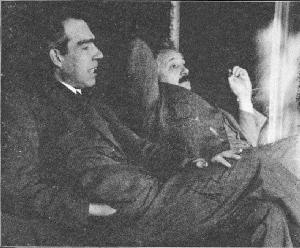
It seems to me that many of the popular quantum mechanics books on the market are peddling to people looking for a mystical experience.  Fred Alan Wolf and a few others have made a career of feeding this need.  I recall the quote by Niels Bohr-

‘There is only an abstract quantum physical description. It is wrong to think that the task of physics is to find out how nature is. Physics concerns what we can say about nature.“. 

 Bohr and Einstein

But I’ve ventured out on a limb. I am but a lowly synthetic organic chemist, a plebian scribbler in the scientific pecking order, who has not used a Hamiltonian operator or a Kroniker delta since grad school. My fragmented knowledge of quantum mechanical formalism is but a mote in the eye of Schrodingers cat.

Note: I’ve deleted The Volokh Conspiracy from the blogroll. They have developed an unfortunate neocon twitch that I find distasteful.