Category Archives: Energy

Dow Goes Nuclear

It has been announced that Dow and X-Energy will be building a nuclear power plant to feed Dow’s 4700 acre Seadrift, TX, manufacturing facility. The plant will be comprised of a 4 pack of Xe-100 80 Megawatt (electric) High Temperature Gas Cooled Reactor (HTGR) pebble bed reactors. The reactors are spec’d to each produce 200 MW thermal and 80 MW electric. The design is referred to as a small modular reactor facility and is part of the U.S. Department of Energy’s (DOE’s) Advanced Reactor Demonstration Program (ARDP).

According to Wikipedia, the history of pebble bed reactor operation is checkered by design and operational problems, many of which relate to the tennis ball sized graphite pebbles themselves. During operation of the pebble bed, radioactive graphite dust is generated leading to eventual contamination problems. Pebbles getting stuck within the equipment are difficult to dislodge and can lead to fracturing in doing so. The reactor needs fire protection because the hot pebbles are combustible when exposed to air.

The HTGR pebble bed design has many features that are very positive. The spaces between the pebbles duct the cooling gas, avoiding the need for coolant piping in the reactor. The absence of water prevents the formation of hydrogen by neutron collisions with the water. Hydrogen generated in a reactor will migrate into metal components and cause embrittlement leading to possible component failure. Overall, the design of a HTGR pebble bed reactor is considered to be much less complex than a water moderated reactor due to the lack of an elaborate water cooling system.

Despite the happy talk about their technology the maker of the system, X-Energy, will have to show how past problems with the pebble bed design have been overcome. Their website gives no clues about overcoming problems encountered in the past. The Nuclear Regulatory Commission is a tough crowd and both Dow and X-Energy will have to provide a strong case for safe operation.

I wish them success.
Wyoming wants to ban sales of new EVs by 2035

The Wyoming legislature has produced SJ0004 – Supporting the phasing out new electric vehicle sales by 2035. Below is a copy of the proposed bill. It’s just a joint resolution. Am I surprised that the square state sitting just north of my square state has produced this? Not in the least.

SENATE JOINT RESOLUTION NO. SJ0004

Phasing out new electric vehicle sales by 2035.

Sponsored by: Senator(s) Anderson, Boner, Cooper and Dockstader and Representative(s) Burkhart and Henderson

A JOINT RESOLUTION

for

A JOINT RESOLUTION expressing support for phasing out the sale of new electric vehicles in Wyoming by 2035.

WHEREAS, oil and gas production has long been one of Wyoming’s proud and valued industries; and

WHEREAS, the oil and gas industry in Wyoming has created countless jobs and has contributed revenues to the state of Wyoming throughout the state’s history; and

WHEREAS, since its invention, the gas-powered vehicle has enabled the state’s industries and businesses to engage in commerce and transport goods and resources more efficiently throughout the country; and

WHEREAS, Wyoming’s vast stretches of highway, coupled with a lack of electric vehicle charging infrastructure, make the widespread use of electric vehicles impracticable for the state; and

WHEREAS, the batteries used in electric vehicles contain critical minerals whose domestic supply is limited and at risk for disruption; and

WHEREAS, the critical minerals used in electric batteries are not easily recyclable or disposable, meaning that municipal landfills in Wyoming and elsewhere will be required to develop practices to dispose of these minerals in a safe and responsible manner; and

WHEREAS, the expansion of electric vehicle charging stations in Wyoming and throughout the country necessary to support more electric vehicles will require massive amounts of new power generation in order to sustain the misadventure of electric vehicles; and

WHEREAS, the United States has consistently invested in the oil and gas industry to sustain gas-powered vehicles, and that investment has resulted in the continued employment of thousands of people in the oil and gas industry in Wyoming and throughout the country; and

WHEREAS, fossil fuels, including oil and petroleum products, will continue to be vital for transporting goods and people across Wyoming and the United States for years to come; and

WHEREAS, the proliferation of electric vehicles at the expense of gas-powered vehicles will have deleterious impacts on Wyoming’s communities and will be detrimental to Wyoming’s economy and the ability for the country to efficiently engage in commerce; and

WHEREAS, phasing out the sale of new electric vehicles in Wyoming by 2035 will ensure the stability of Wyoming’s oil and gas industry and will help preserve the country’s critical minerals for vital purposes.

NOW, THEREFORE, BE IT RESOLVED BY THE MEMBERS OF THE LEGISLATURE OF THE STATE OF WYOMING:

Section 1.  That the legislature encourages and expresses as a goal that the sale of new electric vehicles in the state of Wyoming be phased out by 2035.

Section 2.  That the legislature encourages Wyoming’s industries and citizens to limit the sale and purchase of new electric vehicles in Wyoming with a goal of phasing out the sale of new electric vehicles in Wyoming by 2035.

Section 3.  That the Secretary of State of Wyoming transmit copies of this resolution to the President of the United States, each member of Wyoming’s congressional delegation, the President of the United States Senate, the Speaker of the United States House of Representatives, the governor of Wyoming and the governor of California.

Oil Tanker Shipments

The Energy Information Administration (EIA) is a primary source of data relating to global petroleum and distillate use. It follows production, transport and prices. In addition to supplying data, they provide some interpretation of the global picture. There is so much BS circulating about fuel costs that a credible source of information is welcome.

Oil tankers come in two varieties- clean and dirty. A clean tanker hauls low-sulfur distillates. A dirty tanker hauls crude oil. Since the invasion of Ukraine, tanker shipments from Russia to the west have fallen off and longer voyage shipments have increased. This has increased the cost of transport and floating storage of petroleum and distillates. In the time between February 2022 and November 2022, Very Large Crude Carrier (VLCC) rates from the Middle East to the US Gulf Coast (USGC) have more than tripled. The rates from USGC to Rotterdam have increased from $8.00 to more than $27.00 per metric ton. Rates of shipments on Suezmax ships have also tripled. Dirty tanker rates from Russian ports in the Baltic and Black Sea have gone up due to increased insurance rates. Also, add to all of this the increased cost of bunker fuel for longer voyages.

Shipments of LPG (propane) have been delayed by long waiting times for passage through the Panama Canal. Congestion at the Neopanamax locks has led to increased scarcity of Very Large Gas Carriers (VLGC). Propane is both a fuel and an industrial feedstock. Propane is dehydrogenated to propylene and used for the production of polypropylene. Propane is also a fuel whose demand is highly seasonal with greatest demand in the winter months. VLGCs in the Middle East are drawn out of the area by better rates in the US, creating scarcity there.

US Lithium Battery Recycling

It was announced that a US company will be supplying critical components for Electric Vehicle (EV) batteries to Panasonic. Redwood Materials, Inc., is set to supply EV battery cathode components from its facility in Kansas City. Redwood Materials was founded to close the battery recycle loop by JB Straubel. Straubel was a co-founder and former CTO of Tesla.

A lithium-ion battery doesn’t just rely on lithium. Other substances work together with lithium and the whole composition will vary between manufacturers. The Wikipedia entry for lithium-ion batteries lists the Panasonic cathode material as LiNiCoAlO2. Panasonic works in cooperation with Tesla to supply batteries using Lithium Nickel Cobalt Aluminum Oxide cathode batteries. As alluded to above, Redwood will be supplying cathodes made of recycled battery materials.

The lithium battery electrolyte is almost always contains a lithium salt such as LiPF6, lithium hexafluorophosphate, in a non-aqueous organic carbonate electrolyte like ethylene or propylene carbonate. These two carbonates function as high boiling, polar aprotic dispersants. The substances are cyclic carbonate ester compounds and have a high dielectric constant. The high dielectric constant means that the molecules are polar enough to coordinate Li+ ions to aid in electrolyte mobilization of the Li salt. The electrolyte may also contain a solvent like diethyl carbonate to decrease viscosity and lower the melting point. The PF6 anion is a large, charge diffuse, weakly coordinating anion that helps keep the lithium cation mobilized and loosely bound in the polar aprotic carbonate solution. This anion is inert enough and lends solubility in organic solvents making it useful for many applications. Ammonium salts with PF6 anion are often used as ionic liquids. Weakly coordinating anions are used to allow the corresponding cation to be partially unsolvated and therefore more available for reaction chemistry.

Both in producing power and in recharge, when electrons are being passed around between chemical species and changing oxidation states, it means that chemical changes are occurring. When chemical changes (reactions) are happening, it means that heat is being absorbed or evolved. In the emission of heat, the amount of heat energy per second (power) produced can be large or small. It is critical that the temperature of the battery not exceed the boiling point of the lowest boiling component which may be the carbonate dispersant, as in ethylene carbonate (bp 243 C) or viscosity modifier like diethyl carbonate (bp 126 C). A liquid phase internal to the battery flashing to vapor can overpressure the casing and rupture the battery. A liquid changing into a vapor phase wants to increase its volume by from ~650 to 900 times or beyond. To make matters worse, a chemical reaction generally doubles its rate with every 10 degrees C of temperature rise. Runaway reactions generate runaway heat production.

Lithium batteries have flammable components such as ethylene carbonate (flash point 150 C) and diethyl carbonate (flash point 33 C) that could be discharged and ignited if the battery bursts open, possibly leading to ignition of the surroundings, be it in your pants pocket or in the cargo hold of a passenger aircraft.

LNG Ships and Shipping

An interesting bundle of factoids arrived in my daily newsletter from the American Petroleum Institute, API. The cost of shipping LNG is disclosed. I’ll just cut and paste it for convenience. The source is Freightwaves.

From API- “Liquefied natural gas charter rates were estimated to average $313,000 per day for the most efficient LNG carriers and $276,700 per day for tri-fuel, diesel engine carriers as of Monday, according to Clarkson’s Securities, some analysts predict rates could climb as high as $500,000 per day or even $1 million in the fourth quarter amid tight ship availability on the spot market. “According to brokers, owners can now achieve three-way economics, which means they are compensated not just for a regular round voyage but also for positioning voyages,” said Clarksons Securities analyst Frode Morkedal.”

Ok, I like big boats and I cannot lie. When you look into the shipping vessels themselves you can find a wondrous horde of information on LNG carrier details, such as tri-fuel, diesel engine (TFDE) powered ships. These are ship propulsion systems that drive the propellers with electric motors that in turn are energized by generators driven by engines that can burn diesel oil or LNG.

There are many advantages to the TDFE propulsion systems. Due to the low boiling point of LNG (-161.5 C), loss of LNG to evaporation is unavoidable. Fortunately, the boil-off vapor from the LNG tanks can be piped down to the engine room and used for propulsion. This LNG boil-off can be used to generate steam or can be used directly by powering two-stroke engines. The newer TFDE system, or the DFDE (Di-Fuel Diesel Electric) engines require less space than conventional diesel engines with all of their ancillary features. This leaves more room for payload.

The Bright Hub Engineering site says that a typical TFDE electric generator system produces 8 to 12 megawatts of power from each of its 4 generators at 6600 to 11000 volts at 60 Hz. The electric propulsion motors are coupled together with a reduction gear to turn the props.

As alluded to above there are duel fuel 2-stroke marine engines in use. The duel fuel engines combine Heavy Fuel Oil (HFO), also called bunker fuel, or Marine Diesel Oil (MDO) with LNG in the Diesel cycle with a load range of 10 to 100 %. The mixture of HDO or MDO with LNG is injected directly as opposed to being premixed with air. Because the autoignition temperature of LNG is high, a small amount of pilot oil is injected as well to ensure ignition. The actual mixture used can be adjusted to best match the price and availability of the fuel oil.

The di- and tri-fuel systems have the advantage of producing considerably less pollution that conventional bunker fuels. This is especially important in port where emission controls can be very strict.

The Diesel Crack Spread

Here is an intriguing headline for you. The diesel crack spread. What is it?

It is the amount of profit you can make from cracking a barrel of crude oil into shorter chain diesel fuel. The current crack spread reached a 30-year seasonal high of nearly $70 per barrel yesterday, compared to the less than $20 per barrel this time last year. Worse, US diesel stockpiles are at the lowest since 2000. Going into the winter season, we’re likely see diesel demand and prices increase as high natural gas prices cause some to switch to diesel in the northeast US.

New oil refining capacity set for 2023

Since 2019, the US has lost over 1 million barrels per day of oil refining capacity, according to Energy Intelligence. On top of this, 2023 will see an additional loss of 268,000 barrels per day refining capacity with the closure of the LyondellBasell refinery in Houston, TX. Loss of oil refining capacity translates directly into greater scarcity of fuel distillates, which exerts upward pressure on retail fuel prices.

But, there is good news as well. In 2023 there will be a combined 505,000 barrel per day uptick in refinery capacity according to Energy Intelligence. ExxonMobil will see an increase in capacity at its Beaumont, TX, refinery. Valero Energy will be adding two coker and sulfur recovery trains to increase their heavy sour crude oil throughput to provide a 55,000 barrel per day increase in fuels output at their Port Arthur, TX, plant.

The controversial Limetree Bay refinery in St. Croix in the US Virgin Islands, now owned by West Indies Petroleum Limited and Port Hamilton Refining and Transportation, LLLP, is scheduled to reopen, but information is scarce. Formerly the Hovensa facility, a joint venture of Hess Corp. and Petroleos de Venezuela SA, this refinery processed Libyan and Venezuelan crude and has supplied much of the US gulf coast. According to Energy Intelligence, the refinery is thought to be able to restart and produce 200,000 barrels per day. However, the former Hovensa facility has a recent history of losses, Clean Air Act violations and a bankruptcy sale. It doesn’t sound like the situation has fully played out yet.

LyondellBasell to Produce Pyrolysis Oils from Plastic

According to Reuters, LyondellBasell is considering converting it’s Houston refinery to the production of pyrolysis oils. The Houston crude oil refinery is scheduled to close at the end of 2023. The new operation would recycle plastic waste by pyrolysis and convert it to a stream of hydrocarbons referred to as pyrolysis oil. The company announced that hydrotreaters on the current plant site could be used to upgrade the pyrolysis oil. ICIS reports that they will use a selective catalyst in the process to produce a pyrolysis oil that is said to be similar to naphtha.

ICIS reports that the pyrolysis oil could be transferred to a nearby Channelview cracker by pipeline to crack the pyrolysis oils into a into undisclosed products.

LyondellBasell announced in May of 2021 from Wesseling, Germany, that it has been making steps toward a circular economy by converting polymer waste to virgin quality polymer. It was reported that they intend to produce ethylene and propylene monomer from their process. Virgin quality polymer would open the food contact market to the product. Details are limited.

Polymer waste contains a good deal of potential energy locked in the hydrocarbon chains. Conversion to liquid fuels would represent a type of energy recovery. I have not seen thermodynamic calculations revealing the energy efficiency in converting polymer waste to fuel.

Most synthetic organic polymers are substantially hydrocarbon in composition and can be thermally depolymerized or otherwise cracked to produce valuable liquid chemical feedstocks. Some companies are now realizing the value locked into polymer waste.

LyondellBasell has pledged to reduce CO2 emissions 15 % per ton of product worldwide.

Uranium Town: Uravan, Colorado

The town of Uravan, Colorado, shows up on maps and road signs. You might think it is a physical town. It sits north of Naturita (pronounced natter reeta), CO, on Hwy 141 about 15 miles up the narrow San Miguel River valley. If you look at it’s Wikipedia page, you’ll see a picture of a bare area of ground. Today all that remains at the surface is a ball field and picnic tables. Every bit of the town and the mill has been demolished, shredded and buried within the confines of a Superfund site. Even contaminated bulldozer blades were buried on-site. Also remaining is a Umetco commercial building. Umetco, a Dow Chemical subsidiary, was responsible for managing the reclamation of the site which lasted from 1987 to 2007.

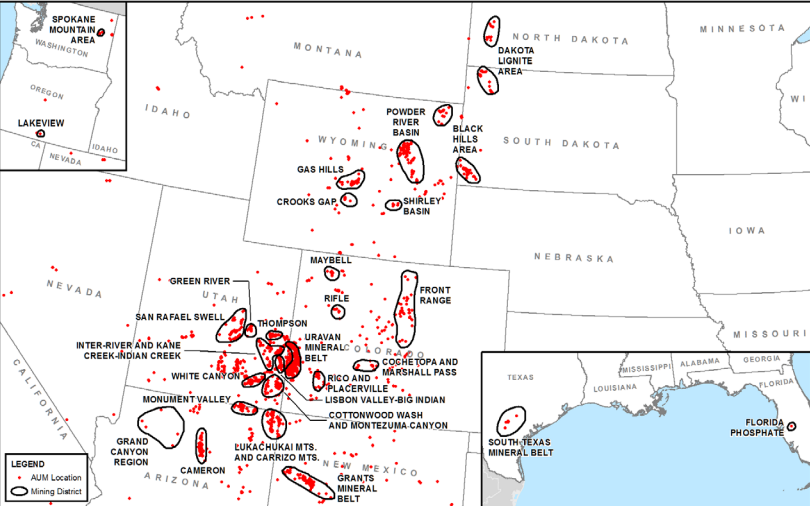
Main uranium deposits in the US (DoE Office of Legacy Management, 2015)

The local topography consists of sandstone canyons and mesas. The map below (north is up) shows a large area of land west of the valley mill site and up above on Club Mesa. This is the location of buried mill tailings and other contaminated materials. The major radiological contaminant is Radium-226 and its daughter products. Radium is a common and troublesome constituent in uranium-bearing ore.

As an aside, I would recommend taking Colorado Hwy 141 from Naturita north through Gateway enroute to Grand Junction if you’re in the area. Truthfully, Uravan isn’t along the route to somewhere most people would want to go except for locals. This stretch of road is called the Unaweep-Tabeguache Scenic Byway and is absolutely gorgeous. Just like in nearby Arches and Canyonlands National Parks, red sandstone is the dominant country rock in that part of the Colorado Plateau. You’ll drive through breathtaking canyons of red sandstone along the Dolores River, south of Gateway.

During its post-WWII heyday, the company town of Uravan, CO, was one of a number of thriving yellowcake boomtowns in Wyoming, Utah, Colorado, and New Mexico. Overall, there were over 900 uranium mines in operation. The name “Uravan” comes from the URAnium-VANadium ore that was processed there. Uravan was one cog in a large wheel of uranium production first for the Manhattan Project then for the Atomic Energy Commission..

Uravan produced concentrate which was was trucked to Grand Junction, CO, to the Climax Uranium Mill for further processing. Activity at the Climax site began in 1943 for uranium procurement and processing of vanadium mill tailings for uranium.

An excellent timeline of uranium history in western Colorado can be found at the Museums of Western Colorado web site.

Uravan Mineral Belt (Wikipedia)

The earliest mining activity at what became Uravan was for radium recovery beginning in 1912 and falling off by 1923. By 1935 the mill was expanded for vanadium recovery and from 1940 to 1984 the mill was used to process uranium and vanadium.

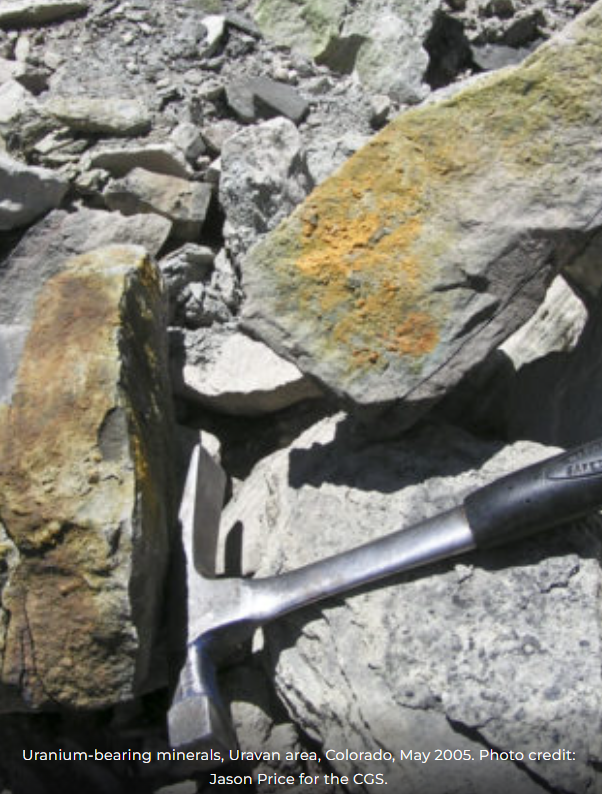
The predominant ore that was processed at Uravan was Carnotite with a nominal composition of K2(UO2)2(VO4)2·3H2O with variable waters of hydration. Elemental uranium is a dense silvery metal that oxidizes in air, reacts with water and dissolves in oxidizing acids. It has two important oxidation states: the +4 uranous oxidation state which is green and the +6 uranyl oxidation state, UO22+, which is yellow. The uranous form is found in the UO2 mineral Uraninite and the uranium silicate Coffinite. The uranyl vanadate form is found with potassium cation in Carnotite, with cesium in Margaritasite, and with calcium in Tyuyamunite.

Yellow carnotite ore (Colorado Geological Survey)

Uranium-vanadium rich sandstone is found in Club Mesa to the west and just above the town of Uravan. This occurrance is part of the larger Uravan Mineral Belt which encompasses local commercial grade uranium ore. The mesa covers 6 sq miles and is bounded by the San Miguel River, the Dolores River, Saucer Basin and Hieroglyphic Canyon. According to the United States Geological Survey (USGS), the average grade of the ore ranged from 0.25 to1.5 % U3O8 and 1.5 to 5.0 % V2O5 (ref 1).

From an extensive drilling study by the USGS, the Salt Wash member of the Morrison formation sandstone of the late Jurassic age was found to be the host for most of the commercial-grade (in 1957) uranium-vanadium in the Club Mesa area.

Beginning in 1936, the mill site was owned by US Vanadium Corporation and built up to process vanadium ore. An entire town was constructed on site to accommodate workers. It also produced a uranium oxide side-stream as a yellow pigment. Then along came the nuclear age.

References

(1) Results of US Geological Survey Exploration for Uranium-Vanadium Deposits in the Club Mesa Area, Uravan District, Montrose County, Colorado, Boardman, Litsey, and Bowers, May, 1957, Trace Elements Memorandum Report 979.

Flame and Ash

Fire is something that we are all familiar with. Everyone has experienced the simple fact that certain things can burn and in doing so are irrevocably changed. For mankind, fire has been an agent of change from the beginning of its use. A simple campfire can be thought of as a crucible where organic matter is destructively distilled and oxidized to carbon dioxide and water and where inorganic matter is consolidated to metal oxides, carbonates, and phosphates.

The flame of a campfire sits in place over the fuel source, appearing to be stationary. But in reality, a flame consists of hot flowing gas. It is the combustion process that is stationary.  A campfire is a kind of air pump pulling air in from the sides and lifting it upwards due to the buoyancy of hot combustion gases. As the gases rise, microscopic particles of glowing carbon are lifted above the wood giving the appearance of an envelope of glowing gas.  Properly mixed propane or natural gas give a flame that has a bluish appearance with much less luminosity. Reading is possible by the light of a campfire. It is not so good by the blue flame of a camp stove.

A wood campfire will consume the wood down to ash. But before the wood becomes ash it can be observed to change from a fibrous solid to a glowing ember of black carbon. The early phase of burning is characterized by the evolution of abundant volatiles that distill into and fuel the flame. Early gas lighting used the flammable gases destructively distilled from coal to provide flame lighting for streetlights and home lighting. The problem with coal gas was that it was free of particulates so the brightness of the flame was poor. The problem of poor gas flame luminosity lead to invention of the limelight and the lantern mantle.

The lantern mantle was developed to overcome the problem of poor gas flame luminosity. A fabric bag soaked in thorium nitrate solution (with 1 % cerium) was dried and then attached to a burner. The gas ignition process burned the fabric and caused the thorium to calcine in place, forming a gossamer webbing of thoria ceramic. The heat capacity (Cp) of thoria is relatively low and the melting point is exceptionally high. Low heat capacity materials require less energy to raise the temperature to a given point relative to high heat capacity materials. The result is that a flame of ordinary energy can raise the temperature of the low Cp thoria to produce high luminosity. The ceria in the mantle dampened the green tinge of glowing thoria to produce a relatively natural light.

Thoroughly burned wood produces an ash that is largely inorganic in nature and at one time was considered quite valuable for soap making and gunpowder. Wood ash was used to provide saltpeter for early gunpowder formulations.  In the early days of gunpowder, saltpeter was extracted from various sources and used with mixed results. The potassium nitrate or nitre form of saltpeter is found in wood ashes. Elsewhere, potassium nitre would appear in damp patches of organic-rich earth as a whitish solid clinging to twigs and plant matter on the ground looking much like hoar frost. Caverns have long been a rich source of sodium nitrate saltpeter. Mammoth Caves in Kentucky and Carlsbad Caverns in New Mexico were mined for their nitrate rich sediments long before tourists began tramping through them.

In 15th and 16th century England, saltpeter was systematically cultivated and extracted on saltpeter farms.  These farms had deep beds of manure and plant matter that underwent air oxidation and were covered to shield them from rain.  After an aging period, the beds were transferred to a large basin and leached with water. The leaching solution was then boiled to dryness to give crude saltpeter. This crude nitrate was carefully recrystallized from water to produce a purified white crystalline product.

Saltpeter is a nitrate salt comprised of a nitrate anion and a cation like potassium, sodium or calcium. In the early days of gunpowder, quality and reliability of the powder was highly variable. One of the variables was the extent to which gunpowder attracted moisture. Powder makers eventually learned by trial and error that gun powders made from wood ash saltpeter were much less likely to be passivated by humidity than those made from sodium saltpeter. It became common practice to combine wood ash with saltpeter extracts from another source to produce what we now know to be potassium nitrate.

As an interesting aside, an important development in gunpowder came along when it was prepared in a form that was much less powdery. A technique known as “corning” was applied to the composition that made it more granular in form. This gave much improved burning characteristics.

Saltpeter from the guano beds of Chile were rich in sodium nitrate while material from the great nitre deposits along the Ganges river in India were substantially potassium nitrate. Indian nitre was an important commodity of the East India Company and strategic material for the British Crown.  Until the invention of the Haber-Bosch process of synthetic nitrogen fixation in 1909 and subsequent oxidation of ammonia to nitrate, the world’s guano beds, wood ashes and cave soils were the major sources of nitrates.

The first World War has been called the chemist’s war in part because of the tremendous casualty counts due to the mass implementation of nitroaromatic explosives like trinitrotoluene and picric acid. Haber is notorious for his part in the development of war gases, but the subsequent production of nitrates from his process was of no less consequence.