Category Archives: Environment

Chemicals on My Yard: Prodiamine and Dicamba

In the US, it’s common to enhance one’s home with greenery, notably a grass lawn. However, a lawn requires ongoing attention. I have a lawn care service fertilize and treat our lawn with herbicides throughout the growing season. Recently, I’ve scrutinized the herbicides they use. They used prodiamine and dicamba.

Hold on a minute. Wasn’t the 2020 registration of dicamba nullified recently in federal court? Yes, it was. Why has it been sprayed on my lawn? The ruling applies to the use of dicamba on soybean and cotton crops that have been genetically modified to be resistant to it. The high volatility of dicamba has been quite deleterious to crops in adjacent farmland and to plants that are pollinated by bees because of drift resulting in crop losses and sharp decrease in honey production. Dicamba is a broadleaf herbicide, though not effective against grasses.

A Brief Meteorological Interlude

Nature continually directs hostility towards our lawns and gardens, both from above and the sides. Living in a semi-arid climate with only 14 inches of annual moisture, the lack of precipitation is immediately detrimental. The desiccating rays from the sun, located only 8 light minutes away, evaporate vital moisture from plants and soil. Compounding the problem, dehydrating winds whisk away the moisture cooking off the soil. Since moist air is more buoyant than dry air, it rises and is carried away by convection into the prevailing winds.

At higher elevations, the combination of increased moisture and decreased temperature can lead to cloud formation. Moisture ascending from the ground combines with the air above. The lower temperatures at these heights cause the moisture to transition from a gaseous to a liquid state, resulting in clouds. This change, although it appears innocent, has thermal consequences. For humidity to condense into liquid, the surrounding air temperature, which reveals “sensible” heat, must be low enough to absorb the “insensible” or latent heat released during condensation without causing a significant rise in temperature. If not, an increase in temperature would hasten the shift from condensation back to evaporation. There is a delicate equilibrium in this phase transition.

As latent heat is released, the air’s density decreases, enhancing its buoyancy and causing it to rise further. The ascending misty air cools, allowing more moisture to condense, which adds to the cloud’s mass. But wait, there’s more—

A rising air parcel causes the surrounding air to be drawn inward from below towards the ascending convective column. Consequently, a significant volume of air may be uplifted, enhancing the moisture levels above the ground contributing to the formation of a convective cumulus cloud. Latent heat supplies part of the energy needed for the vertical ascent of air. This cycle persists until a net downward movement of rain occurs, pulling down cooler air from higher altitudes. The cessation of upward momentum in cloud formation leads to a rapid downward surge of air with the rain, which, upon reaching the ground, spreads out horizontally, occasionally at high speeds. This explains why cool gusts of wind often signal the approach of a rainstorm.

Prodiamine

On to Prodiamine and Dicamba. These two herbicides provide broad coverage by virtue of different biochemical mechanisms. Dicamba is a selective postemergent broadleaf systemic herbicide.

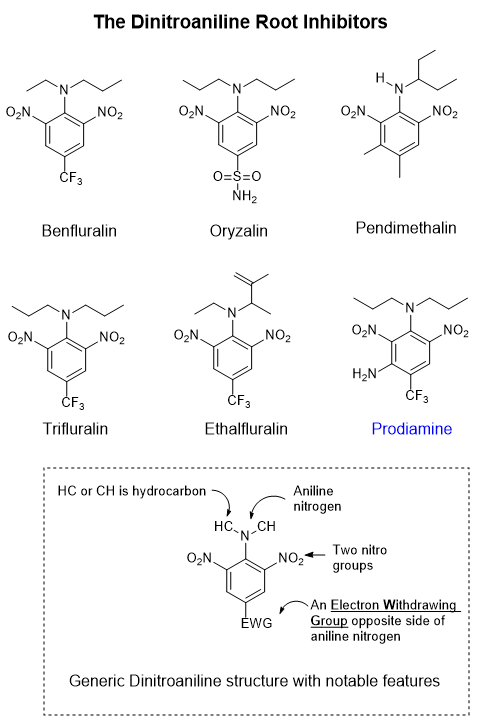
Prodiamine is a pre-emergent herbicide effective on crabgrass and annual blue grass, goosegrass, spurge, chickweed. A pre-emergent herbicide like prodiamine is injected into the soil where it binds to soil particles. A close analog called Trifluralin, prodiamine without the NH2 group, has been shown to have sufficient volatility that sufficient vapor can penetrate root tissue where it expresses its activity.
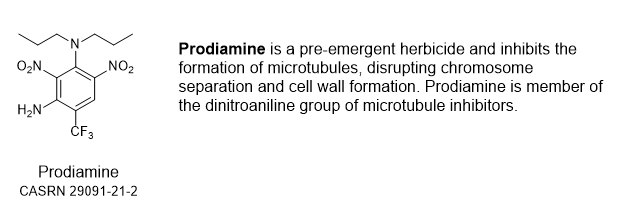
Source: Jinyi Chen, Qin Yu, Eric Patterson, Chad Sayer, Stephen Powles,” Dinitroaniline Herbicide Resistance and Mechanisms in Weeds”, Front. Plant Sci., Sec. Crop and Product Physiology, 24 March 2021 Volume 12 – 2021 | https://doi.org/10.3389/fpls.2021.634018.
Graphic: By Sam Scratch. A series of Dinitroaniline root inhibitors.

Comments on Patenting of Chemicals

When a biologically active substance is discovered, usually is the case that particular features and the shape of the molecule are crucial to the activity. Not just attachments but also the spatial relationship between them. The subject molecule is likely to be active in interacting with a pocket on an enzyme. That pocket has a particular 3-D shape that the molecule has to fit. Not only that, but the enzyme pocket is likely to have protein amino acid groups that have an affinity for charged or water insoluble features on the incoming molecule.

Looking at the prodiamine structure and analogs above, we can see that all of the analogs share certain features: two Nitro groups, -NO2; 1 Aniline nitrogen group with one or two hydrocarbons attached, -N(hydrocarbon)2 groups; a single 6-member hexagon ring (a benzene ring) from which to hang all of the appendages. Opposite to the top aniline nitrogen is an attachment present which 4 of the 6 analogs have: a -CF3 (trifluoromethyl) group attached. This doesn’t happen by accident- someone decided that it should be there because something useful happens with it there. A -CF3 group acts to pull electrons in the ring to lean in that direction, affecting how the electron charge is distributed on the whole molecule. Another analog has a -S(=O)2-NH2 group. This thing, called a sulfonamide group, also pulls ring electrons towards it. Why -CF3 versus -S(=O)2-NH2? Perhaps one is more potent or selective than the other or possibly because one was claimed in a patent and at the time the other was not. Either one could be a me-too herbicide. Analogs of a basic motif arise frequently in a competitive marketplace.

Often times, when a new and successful motif of pharmaceutical or agrochemical comes along, the race begins for competitors to develop close analogs, though being careful not to infringe on any patents. With chemical patents the composition of matter can be claimed, the method for making the substance as well as the method of use. Composition of matter, method of manufacture and use claims are often split into separate patents for IP safety in case one patent gets knocked down. What’s more, a composition of matter patent can be written so as to claim a vast number of analogs to broaden the IP real estate. This is called a Markush claim where a variable letter substitutes for a large or small set of chemical groups. A single structural framework can have many Markush groups giving rise to an astronomically large set of claimed combinations. Some companies, hide the composition of the best analogs in the Markush claims so as to minimize competitive intelligence losses to competitors.

Dicamba

A weed is a valueless plant growing wild that is in competition with a desired crop. The three major morphological categories are: grasses, sedges, and broadleaf weeds. A weed represents lost soil fertility.

Dicamba is a member of the benzoic acid subgroup of the aromatic carboxylic acid group of herbicides. This group of compounds are synthetic auxins, or plant hormones, that interfere with plant growth.
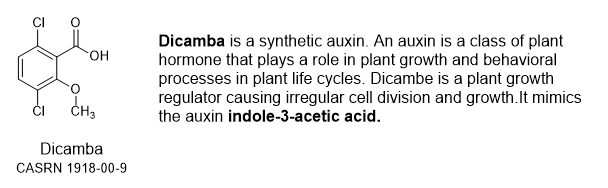
Source: Robin Mesnage, Michael Antoniou, “6 – Mammalian toxicity of herbicides used in intensive GM crop farming”, Herbicides: Chemistry, Efficacy, Toxicology, and Environmental Impacts, Emerging Issues in Analytical Chemistry, 2021, Pages 143-180. https://doi.org/10.1016/B978-0-12-823674-1.00007-9.

Other popular herbicides

Other carboxylic acid herbicides besides dicamba are the 2,4-D analogs.
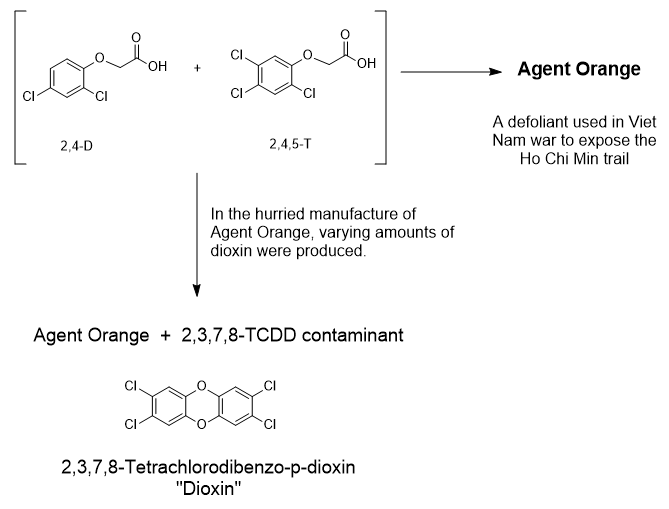
Graphics: Sam Scratch. The much-dreaded toxicant dioxin (TCDD) was a side product in the manufacture of the herbicide 2,4,5-T. When 2,4,5-T was blended with 2,4-D to make agent orange, the dioxin came along.

Of the numerous forms of the dioxins, the species that is often discussed is the 2,3,7,8-TCDD version. The positions and number of chlorine atoms varies. The mechanism above shows the dioxin analog coming from 2,4,5-T. The 3-ring structure of TCDD is the dioxin core structure.
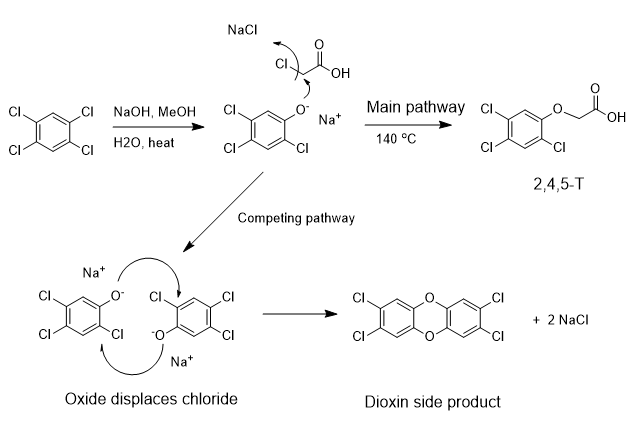
Graphics: Sam Scratch. How dioxin was formed in the 2,4,5-T process. The chemical mechanism begins with the displacement of 1 chlorine atom of the 1,2,4,5-tetrachlorobenzene by a hydroxide anion turning the tetrachoro ring into 2,4,5-trichlorophenol. In the presence of NaOH, the phenol turns into a phenolate which attacks the chloroacetic acid to form 2,4,5-T. However, a competing reaction involving the trichlorophenolate attacking another molecule of itself over a few steps can lead to the cyclization of the trichlorophenolate to the 2,3,7,8-TCDD. The displacement of a ring chlorine is somewhat slower than the displacement of a chlorine from acetic acid, so dioxin formation would be a minor side product.

2,4-D is a synthetic auxin, similar to dicamba in mechanism, that causes uncontrolled and unsustainable cell growth. The herbicide is absorbed through the leaves and is moved to the meristem where uncontrolled cell growth follows.
Incinerating plastics for electric power

Abstract: I’m going to make a pitch for incinerating plastic. Yes, it will indeed produce CO2. But as we go merrily down the reduced carbon footprint path, I think it is reasonable to exempt certain activities from stringent reduction. One of them is incineration of waste. It can be done efficiently while generating electrical power and can be put to use in getting rid of BTU-laden waste combustibles like plastic.

Synthetic polymers, i.e. plastics, long ago rose to a high level of production due to demand. In particular, plastics like polyethylene (PE), polypropylene (PP), polystyrene (PS), polyethylene terephthalate (PET), polyvinyl chloride (PVC), polyvinyl acetate (PVA), polyurethanes, polymethylmethacrylate (PMMA), various polyamides and adhesives are produced at incomprehensible scale. Within several of these major polymer varieties are their copolymers. LDPE is a good example. Low density polyethylene is a copolymer of ethylene and alpha-olefins like 1-butene, 1-hexene, and 1-octene. Placing the olefin group (C=C) exclusively at the 1-position requires some large-scale wizardry as internal olefins are thermodynamically more stable. Generally, commodity scale alpha-olefins have the terminal olefin put in place as they are made, not afterwards. These comonomers interfere with crystal formation within the bulk polymer. This has a large effect on many things including melt temperature, melt strength, stiffness, glass transition temperature, puncture resistance, tensile strength and lower density.

||| Side Note: Alpha olefins have other uses besides polymer manufacture. They are a crucial raw material for plasticisers, soaps/detergents, lubricants and oilfield chemicals. Interestingly, ethylene is a ripening hormone used by fruit.

The low unit price of plastic products like films, food packaging and medical packaging along with steady marketing has conditioned the consumer to expect such goods as disposable. And the plastics industry is happy to fill that expectation. Single use applications fill homes, businesses, hospitals … everywhere. Single use plastic waste also fills landfills, the countryside, waterways, and increasingly the oceans.

Recycling of plastic waste is complicated. Plastics may be made of just the pure homopolymer with only a single repeat monomer or along with a copolymer. A blend of mixed polymer waste may also contain a dog’s lunch of pigments, soot, intumescent additives, plasticizers, glue residues or labels, multiple layers of different polymers and UV blockers- components that you are unlikely to want to transfer into the final product. Even if you neglect the additive problem, there is always the immiscibility of different polymers. Yes, mixed polymers do not always form a homogeneous melt. This is a problem for everyone down the value chain.

Making polymers

While the end-use consumer is the final customer of the producer’s polymer, it is the converters who order the resin pellets directly from the polymer producers or wholesalers. Those who design the plastic article may or may not do a deep dive into the exact brand and grade of plastic to be used. Certainly there many articles (toys) that can be made from a variety of plastic brands and specifications where buyer input may be unknowledgeable or minimal. For many buyers of finished plastic goods, like everything price is likely to be the major parameter.

Users of performance polymers for demanding applications requiring particular polymer specifications will be more specific in their requirements.

The converters blow continuous films or do the injection or blow molding for those who set the final product specs. The converters buy their raw polymer on the basis of specified properties. One measure of the suitability of a particular polymer grade relates to the torque required to produce the maximum number of widgets per hour from the extruder. The converter’s business economics depend on throughput. A polymer that is otherwise wondrous to behold but its melt is too viscous will be problematic for the converter if it requires considerable torque from the extrusion equipment.

Make no mistake, retailers like Home Depot or Menard’s neither know or care about polymer specifications, nor do the end users. The companies who distribute wholesale products are specialists in warehousing and shipping and are unlikely to know polyurethane from HDPE because they don’t need to. The engineers who design and specify properties for the manufacturer are the key decision makers in the value chain.

The plastic manufacturer produces a polymer to give a set of particular physical properties. The converter takes the polymer pellets and combines them with additives, if any, to meet particular specifications. Polymer properties depend to a large extent on their thermal history. Once melted and cooled a polymer’s physical properties can change. Heating and cooling can lead to new phase transitions not present in the pellets. One change could be the glass transition temperature where the rigidity of a polymer changes from glassy to rubbery. Imagine a plastic coffee cup with a glass transition temperature of 75 oC trying to hold 87 oC coffee. Such a cup sags when the coffee is poured in. This is no good. The phase changes like glass transition temperature or melting temperatures can be identified with Differential Scanning Calorimetry (DSC).

Synthetic polymers such as PE are everywhere in our lives. These polymers are made from crude oil or, especially in the US, natural gas feedstocks. Collectively we consume and throw away massive amounts of polymer waste. The effort to recycle plastic in the US has largely been a failure due in part to insufficient segregation and cleaning. Closing the loop with a strong demand for recycled plastics has also faltered. Apart from recycling, what else can be done with it?

Plastics as fuel

Sending a metric ton of polyethylene plastic to the landfill produced the same energy as sending a ton of gasoline or diesel to the landfill in terms of potential energy. Synthetic polymers are either entirely hydrocarbon in composition or mostly so with some oxygen, nitrogen or chlorine thrown in. The fundamental fact is that these polymers are high in BTU content. The downside is that they ignite poorly due to the lack of volatiles. The polymers have to be thermally “cracked” or depolymerized to form volatile components that have a lower flash point. This cracking requires higher ignition temperatures than liquid or gas fuels.

Specific energy density refers to the amount of chemical energy per kilogram of material. In the table below the top three listings are pure hydrocarbons. Coal contains hydrocarbons but also minerals that do not contribute to overall combustion energy.

SubstanceSpecific Energy (MJ/kg)
Diesel Fuel45.6
Methane55.6
Polyethylene (PE)46.3
Coal, Bituminous24 – 35
Specific Energy. Source: Wikipedia.

In liquid combustion, it is the vapor above the liquid that burns. All liquids have a certain fraction of substance in gas phase at equilibrium above it at a given temperature. The flash point is the temperature in which the vapor can sustain combustion. Here is the official definition-

Source: Wikipedia.

In normal use, flashpoint (Fp) is used to gauge the ease of ignition of a substance when exposed to air. The Fp allows us to partition high hazard from lower hazard combustible materials high flashpoint liquids like motor oil pose less of a fire risk than does gasoline or propane. In the Globally Harmonized System (GHS) of Classification and Labeling of Chemicals,-

Flammable liquids are categorized by flammability, from Category 1 with a flash point < 23 °C and initial boiling point < 35 °C to Category 4 with flash point > 60 °C and < 93 °C.

Naturally, in the US we do it a bit differently with categories Flammable and Combustible

Flammable– Flash point < 100 oF (38 oC), e.g. gasoline, methanol, acetone, natural gas

Combustible– Flash point > 100 oF (38 oC), e.g., paper, organic dusts, cooking oils

The US system is easier to remember than is the GHS but is perhaps a bit imprecise.

Plastic combustion

Why all of this vapor pressure stuff? It turns out that most plastics like polyethylene or polyethylene terephthalate (PET) have insignificant vapor pressures at room temperature. This is due to the extremely long chain lengths of the polymer and its subsequent high molecular weight. Considerable energy is needed to loosen these polymers from the liquid phase into the gas phase. So, the trick is the use pyrolysis to crack the long chains into shorter and more volatile pieces. This can be called destructive distillation like the process used for making coal gas. But this requires an input of energy to raise the temperature high enough to do the cracking.

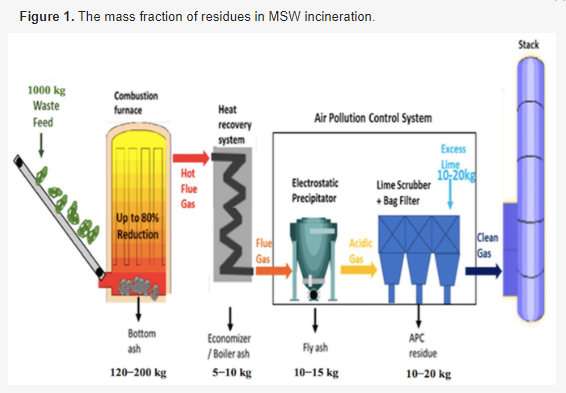
Source: Kanhar, A.H.; Chen, S.; Wang, F. Incineration Fly Ash and Its Treatment to Possible Utilization: A Review. Energies 202013, 6681. https://doi.org/10.3390/en13246681

Plastic pyrolysis is conducted at temperatures between 300 oC and 1000 oC with residence times between 0.5 seconds to 100 minutes, depending on the temperature. YouTube has videos of people using homemade pyrolysis reactors to produce a diesel-like composition. The thermally cracked polymer produces vapors that are condensed and recovered. There are a few examples of homebrew crackers that vent the exhaust subsurface into water to condense the vapors. Seems clever until you realize that when the cracker begins to cool, the fluid in the condenser tank will siphon back into the still hot cracker and flash explosively into vapor. An inline trap could easily prevent this.

Columbia Climate School

In addition to heat for steam production to drive electrical generators, pyrolysis of plastics will indeed produce CO2, hydrochloric acid (from PVC) as well as ash and char. Properly done, the ash, char and hydrochloric acid can be effectively scrubbed. Some thought will have to be given to the ultimate disposition of solid residues which will contain what remains of the mineral additives found in some plastics. Some may not be friendly.

By merely existing on Earth, humans will continue to produce air, water and soil pollution. We’ll continue to burn fossil fuels to some extent and continue to belch combustion gases into the air. I think this is a given. Humans will continue to collect raw materials for manufacturing. A mass movement to live a more modest, low consumption zero carbon footprint life is unlikely to occur. But, how about just a lower carbon footprint?

The point of this little pyrolysis excursion is that plastics are a potential energy resource that we wantonly toss into the landfill or in the street. Pyrolysis always produces solid waste residues which must be disposed of, so waste is still being produced, but a smaller volume than the plastic waste. As usual, the costs and benefits of the process depend on the balance of input costs vs output value.

As of March 2024, the CO2 level is a 425 ppm. We should remember that we do not have to drop the atmospheric CO2 to the level of the year 1800, just below some value like 350 ppm according to Columbia University. What we can do now is to begin living a somewhat lower consumption life. Instead of driving 5 miles to 7-Eleven in your F-150 to buy Miller Lite, cigarettes and lottery tickets, consider making all of your purchases next time you gas up. Consider backing off just a bit on plastic consumption.

Oh, and shut off the damned lights when you vacate a room. Unplug “wall-wart” device chargers that are not in use. They draw a trickle charge even when not in use. Have an “instant-on” TV or stereo not in use? Unplug it. The instant-on feature uses electricity to stay instantly ready for you. If it doesn’t “click” or it switches on/off by remote, it is likely an instant-on device. There. I’m finished now.

Drilling Wastewater Capacity is Running Out in the Permian Basin

BNN Bloomberg published an article by David Wethe about a crisis building up in the Permian Basin shale-oilfield in west Texas. Drilling is facing the possibility of shutting down unless the new wastewater disposal wells are found. Wastewater is generated at a rate of 16 million barrels per day in the area and is pumped into disposal wells. The water can be up to 10 times saltier than seawater. These wells are seeing increasing backpressure indicating they are nearing capacity. Without disposal well space, oil drilling cannot continue to move forward. Associated with the disposal wells are earthquakes in the region.

From the article-

The Texas Railroad Commission, which regulates drilling in the largest US oil state, in December announced cuts to water disposal in certain areas after a 5.4-magnitude quake rocked the region. 

“We are one earthquake away from having a whole different dynamic” in the shale sector, Railroad Commissioner Jim Wright told the Oilfield Water Markets Conference in Fort Worth this week. Drilling will “come to a screeching halt” unless the industry develops “seismic-resilient” disposal techniques or alternative uses for the 16 million barrels (672 million gallons) of wastewater injected underground in the Permian region on a daily basis.

The water-recycling sector only has the capacity to process about 30% of the waste flows for reuse in fracking, Amanda Brock, CEO of Aris Water Solutions, told the conference. 

Credit: https://www.bnnbloomberg.ca/shale-oil-drillers-are-running-out-of-places-to-dump-toxic-wastewater-1.1922000

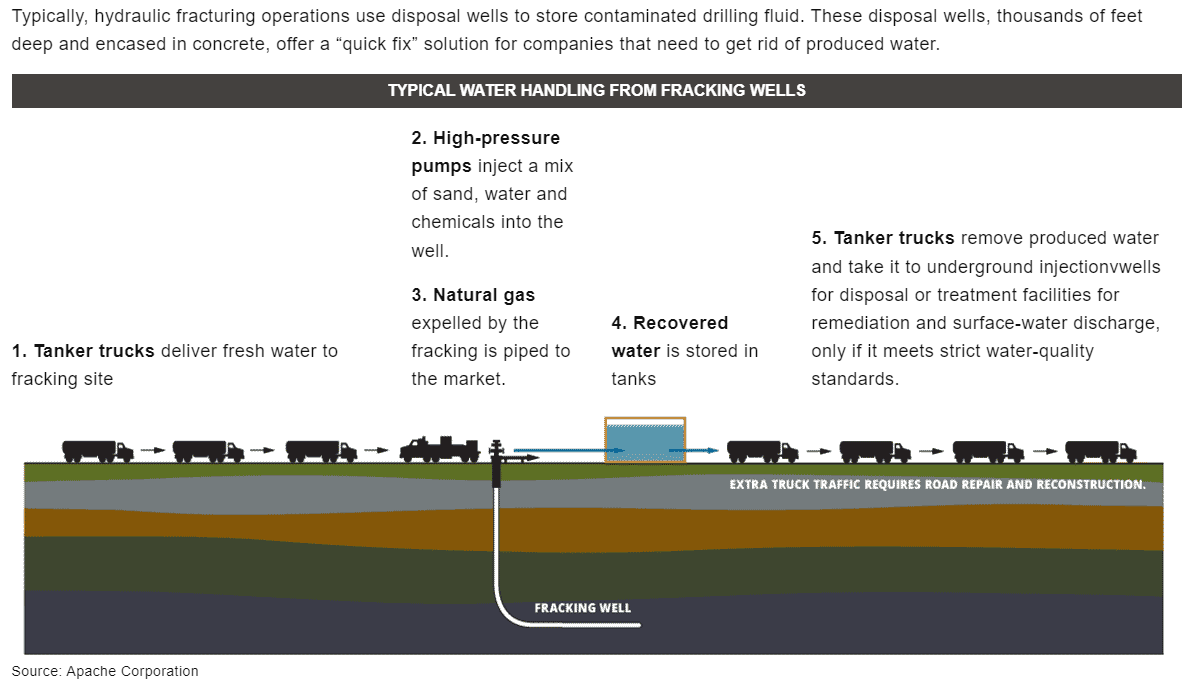
Houston-based Oil & Gas producer Apache Corporation was cited by the Texas Comptroller website as an example of applied water conservation.

Credit: https://comptroller.texas.gov/economy/fiscal-notes/2015/october/fracking.php

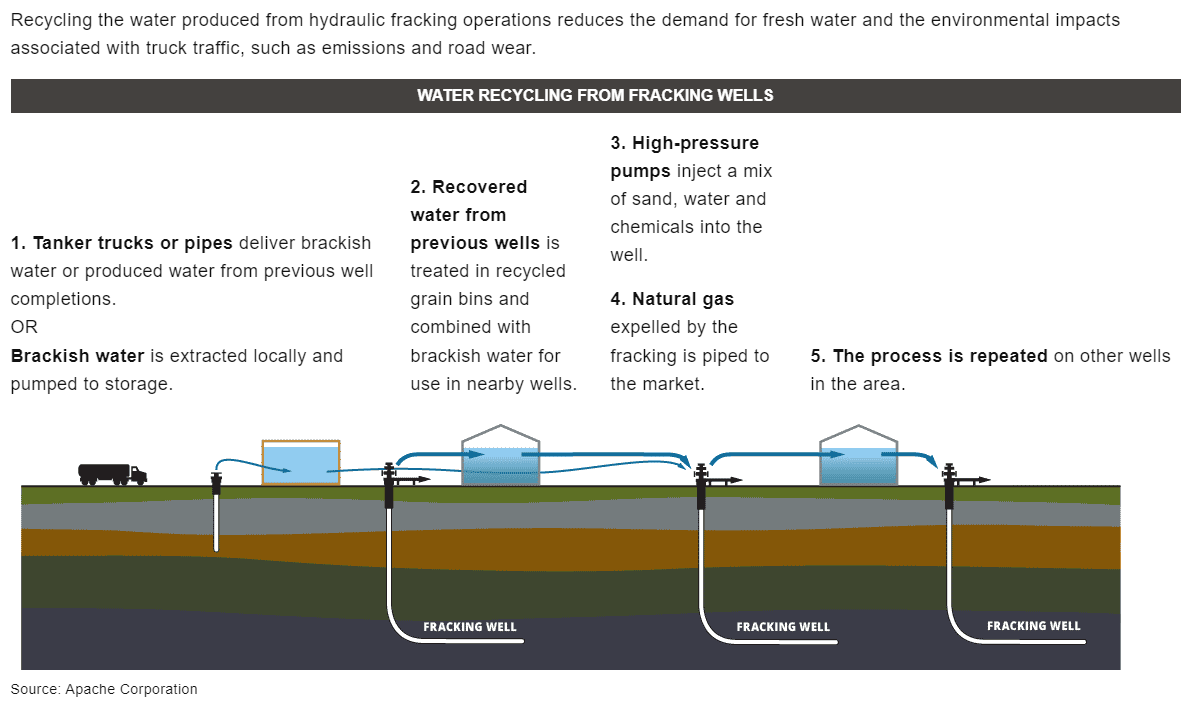
According to Apache, hydraulic fracturing, or fracking, can use 340,000 barrels of water per well. In order to conserve water, they treat and reuse water recovered from previous well completions. They also use brackish water from the local Santa Rosa aquifer which they collect in lined containment basins which can be transferred by pipes to other drill sites.

Say what you will about oil & gas companies, but this seems pretty progressive to me. The financial pressures on exploration and drilling people is immense. Compounding it is the highly volatile oil & gas market adding to the risk. It is no wonder that opening a new oil field is called a “play.”

Somehow Apache found the motivation and the funds to conserve water in an industry not known for progressive actions like this. The scheme does not seem technically difficult at first blush. It does, however, require up-from money to be allocated to the recycling infrastructure. Should the day come when recycling of water becomes mandatory, Apache will be in a good spot.

Credit: https://comptroller.texas.gov/economy/fiscal-notes/2015/october/fracking.php

Hydraulic fracturing is a very contentious subject. Proponents cite the urgent need for oil & gas energy in the economy. This is meant to justify what environmental damage may come from it with their chosen practices. Opponents cite the adverse effects of leakage of both fracking fluid and produced water to potable groundwater. A pathway for drilling fluid migration also opens a pathway for oil & gas seepage as well. One EPA draft-document from 2011 is available for scrutiny. It is in regard to fracking activity in the Marcellus Shale area of Pennsylvania.

It is interesting to note that Radium-226 was identified in the water samples. Ra-226 is the most stable decay of the radium isotopes (alpha decay, half-life 1600 years) and derives from the uranium-238 decay chain. Ra-226 alpha decays to radon-222 (alpha, half life 3.8 days) followed by numerous alpha and beta decays to Lead-206 which is stable.

Drilling muds are highly engineered fluids that have very specific properties. They must have closely controlled density and rheology in order to perform properly. Returning drilling mud is stripped of drilling chips and sent back down the hole for recycling. Managing your drilling mud is an important part of the art and science of drilling for oil. I am unaware of the significance of ground contamination by drilling mud.

Online you can find a long list of substances used in hydraulic fracturing. There is a large variety of formulated commercial products, possibly containing multiple chemicals, that are used in fracking fluids in the US. Determining the actual chemical hazards at any given fracking site will require knowledge of what they are using. Safety Data Sheets may or may not be helpful in uncovering the chemical composition of a fluid. The hazards associated with fracking fluids naturally depends on the identities of the chemicals present, the amount of chemical and the way it is presented in the environment. Dose makes the poison as Paracelsus said in 1538.

Note to the wise: If you plan on raising a stink about “chemicals” in the local fracking activities, try to find out what chemicals are being used. Chemicals can vary widely in their toxic potency and health effects. Be armed with specific information to the extent possible. If you stand there angrily gibbering on about “chemicals” it will be seen as loudmouthed histrionics. Hand waving arguments can be brushed off with handwaving dismissal. If you can talk about specific chemicals, then you can bring the issue into a sharper focus and demand facts.

Hydraulic Fracturing Disclosure Mandates Work!

The Energy Policy Institute at the University of Chicago has released a study in January, 2023, titled Internalizing Externalities: Disclosure Regulation for Hydraulic Fracturing, Drilling Activity and Water Quality by Pietro Bonetti, Christian Leuz, and Giovanna Michelon. This rather opaque title refers to a study performed to gauge the efficacy of mandating targeted transparency with hydraulic fracturing (HF).

For the study the authors used 4 ions considered signatures of HF-related activity- chloride, bromide, barium and strontium. These ions were considered the likely mode of detection if and when surface waters were affected. They are usually found in high concentration in flowback and produced water from HF wells and are considered signatures.

Some vocabulary-

Environmental externalities– the negative consequences on nature and biodiversity that result from human activity. (Google)

Internalities– An internality at the organizational level (an “organizational internality”) is the product of organizational practice, which part or all of an organization engages in that produces a cost or benefit within the organization, which is not considered when engaging in that practice.

Produced water– Produced water is composed of formation water, hydrocarbons, and fluids introduced during drilling.

Some Key Findings-

  • Significant improvements were found in water quality based on signature salts after mandates are introduced.”
  • After disclosure mandates, operators pollute less per unit of production, use fewer toxic chemicals, and cause fewer spills and leaks of HF fluids and wastewater.”
  • They “… show that disclosure enables public pressure and that this pressure facilitates internalization“.

Barium is injected into oil and gas wells in the form of barite (BaSO4) to densify the drilling fluid although ilmenite (FeTiO3) has been used as well.

The barium we can account for as being from the barite in the drilling fluid. But what about the strontium? A USGS article titled “Use of Strontium Isotopes to Detect Produced-Water Contamination in Surface Water and Groundwater in the Williston Basin, Northeastern Montana

Produced waters typically have large ionic strengths including large Sr concentrations compared to surface water and shallow groundwater. If the Sr isotopic compositions of produced waters differ substantially from surface water and groundwater, then the Sr ratios could be a valuable and sensitive indicator of small amounts of contamination from produced water.

The strontium isotopic ratio (87Sr/86Sr) can be an indicator of produced water contamination in surface water.

Uranium Town: Uravan, Colorado

The town of Uravan, Colorado, shows up on maps and road signs. You might think it is a physical town. It sits north of Naturita (pronounced natter reeta), CO, on Hwy 141 about 15 miles up the narrow San Miguel River valley. If you look at it’s Wikipedia page, you’ll see a picture of a bare area of ground. Today all that remains at the surface is a ball field and picnic tables. Every bit of the town and the mill has been demolished, shredded and buried within the confines of a Superfund site. Even contaminated bulldozer blades were buried on-site. Also remaining is a Umetco commercial building. Umetco, a Dow Chemical subsidiary, was responsible for managing the reclamation of the site which lasted from 1987 to 2007.

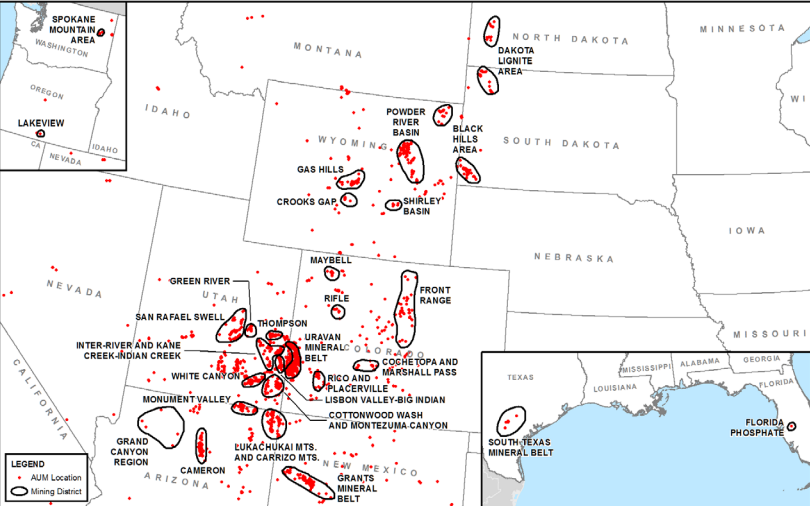
Main uranium deposits in the US (DoE Office of Legacy Management, 2015)

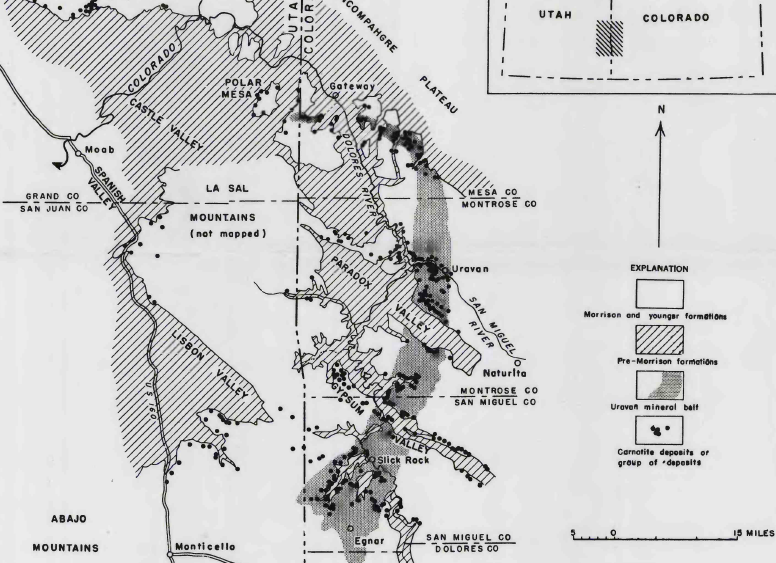
The local topography consists of sandstone canyons and mesas. The map below (north is up) shows a large area of land west of the valley mill site and up above on Club Mesa. This is the location of buried mill tailings and other contaminated materials. The major radiological contaminant is Radium-226 and its daughter products. Radium is a common and troublesome constituent in uranium-bearing ore.

As an aside, I would recommend taking Colorado Hwy 141 from Naturita north through Gateway enroute to Grand Junction if you’re in the area. Truthfully, Uravan isn’t along the route to somewhere most people would want to go except for locals. This stretch of road is called the Unaweep-Tabeguache Scenic Byway and is absolutely gorgeous. Just like in nearby Arches and Canyonlands National Parks, red sandstone is the dominant country rock in that part of the Colorado Plateau. You’ll drive through breathtaking canyons of red sandstone along the Dolores River, south of Gateway.

During its post-WWII heyday, the company town of Uravan, CO, was one of a number of thriving yellowcake boomtowns in Wyoming, Utah, Colorado, and New Mexico. Overall, there were over 900 uranium mines in operation. The name “Uravan” comes from the URAnium-VANadium ore that was processed there. Uravan was one cog in a large wheel of uranium production first for the Manhattan Project then for the Atomic Energy Commission..

Uravan produced concentrate which was was trucked to Grand Junction, CO, to the Climax Uranium Mill for further processing. Activity at the Climax site began in 1943 for uranium procurement and processing of vanadium mill tailings for uranium.

An excellent timeline of uranium history in western Colorado can be found at the Museums of Western Colorado web site.

Uravan Mineral Belt (Wikipedia)

The earliest mining activity at what became Uravan was for radium recovery beginning in 1912 and falling off by 1923. By 1935 the mill was expanded for vanadium recovery and from 1940 to 1984 the mill was used to process uranium and vanadium.

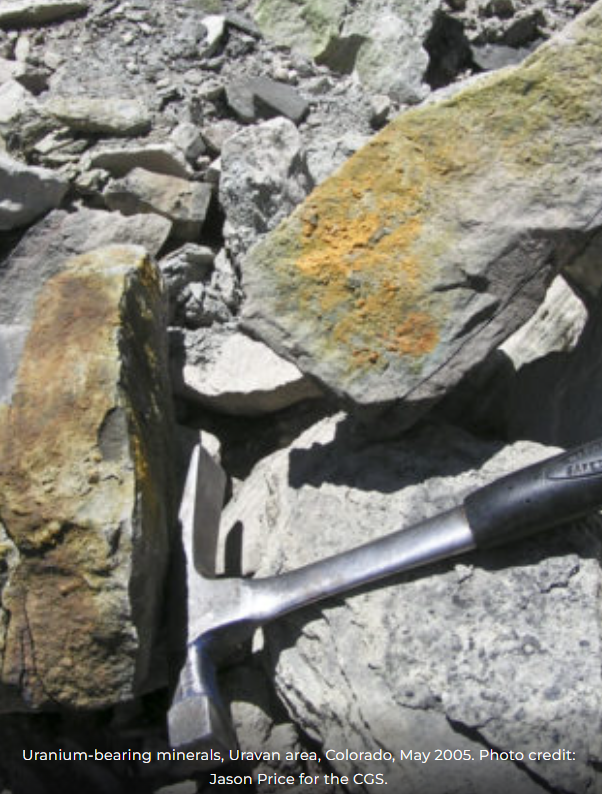
The predominant ore that was processed at Uravan was Carnotite with a nominal composition of K2(UO2)2(VO4)2·3H2O with variable waters of hydration. Elemental uranium is a dense silvery metal that oxidizes in air, reacts with water and dissolves in oxidizing acids. It has two important oxidation states: the +4 uranous oxidation state which is green and the +6 uranyl oxidation state, UO22+, which is yellow. The uranous form is found in the UO2 mineral Uraninite and the uranium silicate Coffinite. The uranyl vanadate form is found with potassium cation in Carnotite, with cesium in Margaritasite, and with calcium in Tyuyamunite.

Yellow carnotite ore (Colorado Geological Survey)

Uranium-vanadium rich sandstone is found in Club Mesa to the west and just above the town of Uravan. This occurrance is part of the larger Uravan Mineral Belt which encompasses local commercial grade uranium ore. The mesa covers 6 sq miles and is bounded by the San Miguel River, the Dolores River, Saucer Basin and Hieroglyphic Canyon. According to the United States Geological Survey (USGS), the average grade of the ore ranged from 0.25 to1.5 % U3O8 and 1.5 to 5.0 % V2O5 (ref 1).

From an extensive drilling study by the USGS, the Salt Wash member of the Morrison formation sandstone of the late Jurassic age was found to be the host for most of the commercial-grade (in 1957) uranium-vanadium in the Club Mesa area.

Beginning in 1936, the mill site was owned by US Vanadium Corporation and built up to process vanadium ore. An entire town was constructed on site to accommodate workers. It also produced a uranium oxide side-stream as a yellow pigment. Then along came the nuclear age.

References

(1) Results of US Geological Survey Exploration for Uranium-Vanadium Deposits in the Club Mesa Area, Uravan District, Montrose County, Colorado, Boardman, Litsey, and Bowers, May, 1957, Trace Elements Memorandum Report 979.