Category Archives: Geology

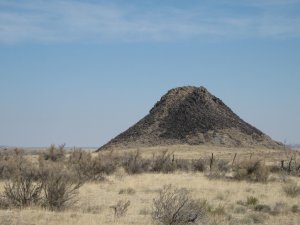
A Nevada Cinder Cone

Whilst doing a survey of Lithium mining in North America, I blundered into a small cinder cone. It is found in the Clayton Valley of western Nevada south and west of Tonopah.

A link from the University of Nevada, Reno, gives some details on this cone as well as some interesting photographs.

Just to the south of this cinder cone is the Chemetall Foote Corporation Silver Peak brine facility. Lithium rich brines are pumped into evaporation ponds for concentration of the lithium salts. US 7390466 says that the Silver Peak brines contain 0.02 wt % Li.  The richest Li brine can be found in the Salar de Atacama brines in Chile. The Atacama brines contain from 0.15 to 0.193 wt % Li.

Redoubt Volcano Continues to Show Activity

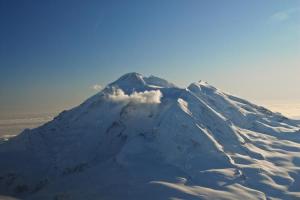
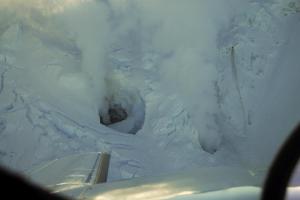
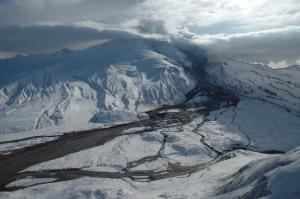
The Redoubt volcano is making its presence known. It has played havoc with some petroleum infrastructure (Drift River Oil Terminal) and has begun to dump ash. Lahar activity has flooded a runway and generally made a mess. The photos below do not show the volcano in a major eruption. Most of the AVO/USGS close up shots seem to be taken when the mountain is quiet.

Mud & debris flows from Redoubt (Photo AVO/USGS)

Mud & debris flows from Redoubt (Photo AVO/USGS)

North Flank of Redoubt 1-31-09 (Photo AVO/USGS)

North Flank of Redoubt 1-31-09 (Photo AVO/USGS)

Redoubt Eruption Plume from MTSAT (photo National Weather Service)

Redoubt Eruption Plume from MTSAT (photo National Weather Service)

Redoubt Fumaroles 1-31-09 (Photo AVO/USGS)

For detailed information on the Redoubt Volcano and it’s ashfalls and other activity, click to the Alaska Volcano Observatory (AVO).

Carlsbad Caverns

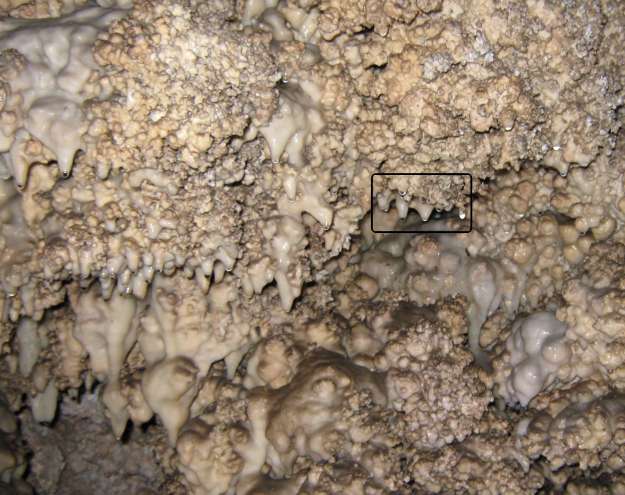
Carlsbad Cave Popcorn

Carlsbad Cave Popcorn

The problem with Carlsbad Caverns today is the same problem that plagued it from the very beginning- it is very isolated and is not even on the way to many other places of major interest (except El Paso, of course). For the first 20 years or so, the cavern was primarily a source of bat guano fertilizer for the California citrus orchards. Slowly, and with the persistance of a few key individuals, word of this wondrous underground cathedral spread.

Today, Carlsbad Caverns is visited by approximately 500,000 people per year. The cavern is in remarkably good shape considering the large number of people who walk the several miles of underground trails 364 days per year.  Curiously, one of the big pollution concerns is lint from the clothing of shuffling visitors which settles on the formations.

The above photo is a snapshot of a common evaporite formation referred to as cave popcorn. The box in the photo encloses an area about the size of the palm of your hand and if you look closely, you can see water droplets clinging to the small mineral protuberances.  The colors in the photo are a good representation of most of the cavern.

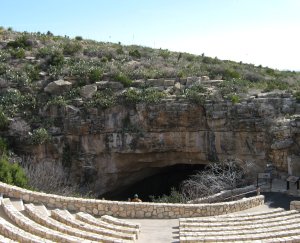
Entrance to Carlsbad Caverns

Entrance to Carlsbad Caverns

The decorated caverns are the result of several kinds of chemical processes. The internal spaces were dissolved out of the regional limestone formation. This formation is thought to be the remnant of an ancient reef. It is believed that aqueous hydrogen sulfide migrated up from the anaerobic permian formations below and was subsequently (air) oxidized to more corrosive species.

The park people point out that H2S was oxidized to sulfuric acid which is responsible for the chemical digestion of the limestone. Sounds reasonable to me, though the chemistry of sulfur oxidation is full of many kinds of intermediary species on the way from sulfide to sulfate. The presence of gypsum (calcium sulfate) inside the cavern supports the claim that sulfuric acid was the corrosive agent. What was not mentioned was whether or not sulfate is found in the surrounding formations. [Note: a commenter made a good point about the bio-oxidation of sulfide]

Stalactites festooned with cave popcorn, Kings Palace caves, Carlsbad Caverns

Stalactites festooned with cave popcorn, Kings Palace caves, Carlsbad Caverns

The decoration of the interior spaces left by digestion of the limestone happened by the action of seepage of rainwater and carbonic acid though the upper layers of sedimentary rock. The water dissolves many mineral components including calcium. The calcium carbonate rich liquors seeping in from the roof of the caverns wetted the surfaces below and deposited calcite and other mineral species by way of intermittant accretion.

If you examine the few smaller and broken mineralizations along the trail, you can clearly see that the accretion results in substantially crystalline material. So, while the formations are not large calcite or aragonite crystals, the small scale structure is crystalline.

There is much to see in the world if you just bother to look. Along I-25 in southern Colorado is a modest looking feature. It is called Huerfano Butte and sits along the highway near Walsenburg. This igneous intrusion is more resilient to weathering than the surrounding sedimentary formations.  Radiating from the nearby Spanish Peaks are an array of dikes indicating the presence of past magma intrusion.

Huerfano Butte- a weathered igneous intrusion.

An synthetic chemist is in a great position to absorb some geochemistry. Once one is keyed into a bit of geology, the mechanisms of mineral formation begin to become apparent, with a little study of course. For myself, this is a great motivation to kick around in the weeds and explore the world. Gotta watch out for rattle snakes, though.

Gold Refining with Borax

According to the GEUS, the Geological Survey Office of Denmark and Greenland, it is possible to concentrate and isolate gold from the ore using borax and charcoal. This method has the immediate benefit of making mercury “redundant” in gold isolation.

Extraction of gold by amalgamation with mercury is a simple means of producing metallic gold in the field.  After contact with gold enriched ore, mercury is evaporated into the air by direct application of a torch flame to the puddle of metal leaving purified gold metal.

It is thought that there are millions of miners who scratch out a subsistance living working a small patch of ground for gold. It’s called small scale mining. In the course of this activity, environmental contamination can accrue to the immediate area as well as the watershed at large. Sadly, the toxicological insult to the miners from exposure to mercury vapor can be severe.

This method is an inexpensive and simple alternative to the mercury process. Perhaps the chemistry community has something to contribute by way of education or improved methods of extraction.

8/25/10  Update.  I have revisited this post and am compelled to comment further.  While I am unable to offer a good chemical explanation for the effect of borax on gold ore, I can say that the use of borax as a flux  for smelting goes back to the 19th century during the American gold rush period.  The process described in the link appears to be a smelting process for enriched ore containing elemental gold, as opposed to sulfide, or sulphuretted ore. The function of a flux is to modify the flow and phase separation properties of host rock so as to partition away from the gold phase or layer.  In other words, a flux modifieds the slag to help the gold to separate cleanly from the rock.

It’s the Schist and a Lot More

The Front Range of Colorado is roughly comprised of those mountains that can be seen from the eastern plains. There is no precise definition that I am aware of, so this will have to do. 

Superficially, these mountains run north/south and appear to be organized into ranges, which are really just a series of roughly parallel ridge structures punctuated with the occasional high points that are refered to as peaks. The origin and orientation of these ranges is defined by the orientation of faults and with the effect of eons of erosion to form river channels. Erosion has the effect of removing the weakest materials and leaving behind the most resistant rock structures.

The present epoch of the Rocky Mountains are the result of the Laramide Orogeny, the most recent period of mountain building thought to have begun 70-80 million years ago in the late Cretaceous period. The cause of this mountain building episode is attributed to a shallow angle of subduction of the Kula and Farallon plates below the western margin of the North American plate.

Geologists propose that the shallow subducting slab of ocean bottom applied a drag on the root of overlying continental lithosphere. These forces lead to the broad belt of disturbance to the overlying rock leading to the formation of the Rocky Mountains.

As mountian building proceeded, overlying sedimentary formations were bent and fractured along the margins of the upward moving rock. Today these sedimentary formations are visible in the form of ridges of protruding lamanellar sandstone, mudstone, and shales whose surface planes sit at a high angle  relative to the horizon. The uppermost sedimentary formations are exposed further east in the plains, and as one moves a few miles closer to the mountains, the deeper and correspondingly older sedimentary formations are exposed. These parallel ridges of exposed, upthrusted sedimentary formations are collectively referred to as “foothills”.

Along much of the northern Colorado front range, the westernmost sedimentary formation that abutts the metamorphic rock is called the Fountain formation. Adjacent to this upthrust of metamorphic rock is a layer of disturbed Fountain formation that has been drug upwards to a near vertical orientation. If you have been to Boulder, Colorado, and have seen the Flatirons, you have seen the Fountain formation. Red Rocks Amphitheater and the Garden of the Gods are also part of the Fountain formation.

Here is my question- Somewhere, there should be an interface (I think geologists call it an unconformity) between the metamorphic and sedimentary formations. Where can it be inspected? A road cut or riverbed?

So, it turns out that Th’ Gaussling’s brother owns a spread that is comprised of Fountan formation sandstone. He has a mountain. And down from this mountain and into his yard come elk, deer, mountain lions, bear, and rattle snakes. One of his house cats, in fact, was last seen in the jaws of a cannibalistic mountain lion trotting off to a quiet spot to munch this fresh, tender kitty morsel.

To satisfy my curiosity about this interface, Th’ Gaussling was out in the brush scrambling over snow covered rocks, cactus, and yucca looking at examples of the Fountain formation and, nearby, a formation comprised of schist and gneiss. Not surprisingly, I did not find it in a single outing. But I was close- it’s buried in deep rubble, no doubt. The hunt continues.

Redoubt’s Rumbling Redux

The Redoubt volcano along the Cook inlet in Alaska is showing seismic activity according to the Alaska Volcanic Observatory (AVO). Seismic activity may be a precursor to eruption. Dedicated seismic recorders show frequent bursts of activity on the volcano.  The USGS has a website with advice and information aimed at helping people cope with an ashfall. 

In the past, the prevailing winds have carried the ashfall in an easterly direction over and past Anchorage. According to AVO, Redoubt is a stratovolcano located several hundred km west of Anchorage. It has reportedly erupted explosively six times since 1778, with the most recent being in 1989-90.

Note to Wal-Mart:  You may want to stock up the anchorage stores with extra brooms and shopvacs.

Clowns to the Left of Me, Jokers to the Right

Pity Larimer County in northern Colorado. We poor sods who live here find ourselves sandwiched between two unexploited deposits of natural mineral wealth. To the east of Fort Collins, near the hamlet of Nunn, is a fairly large uranium ore body. In the northwest, there may be an exploitable diamond deposit. Perhaps hundreds of Kimberlite pipes may be lying in the CO/WY region waiting to be exploited.

Diamonds have already been mined in northern Colorado, near the Wyoming border. The Kelsey Lake diamond mine closed in 2002 due to bankruptcy. The Kelsy Lake mine produced the 5th largest diamond ever found. The yield of the formation is reportedly 4 carats per 100 metric tons of ore.

Given that the Colorado Front Range has been substantially gentrified, the discovery of mineral wealth in the vicinity of hobby ranchers and McMansions will make for some interesting times for the county commissioners. Uranium and Diamonds. NIMBY.

Stealers Wheel Video 1972.