Category Archives: History

Bleaches and in-process checks of the enlightenment

In his 1736 publication Smegmatalogia, or the Art of Making Potashes and Soap, and Bleaching of Linens, James Dunbar describes a process for the preparation of potash.  The intended user of the process was the common Scottish farmer. Dunbar was anxious to imbue the common Scot with the ability to “bleach” his own linens.  It is important to realize that the meaning of the word bleach in the early 18th century is different from contemporary use.  The modern use comprises notions of decolorization through oxidation of color bodies to produce a white appearance.  The 18th century concept involves the apparent cleansing and subsequent lightening of a fabric.

The book begins by detailing the preparation of a solution or extract from ashes called Lee.  To obtain this solution, the “Country-Man” would carefully collect Scottish vegetables such as the wood of oak, ash, beech, “thorns”, juniper trees, and “whins”. Suitable herbs included fern, breckens (or brackens), wormwood, thistles, stinking weed, and hemlock. 

Dunbar is careful to instruct that the vegetation should be burned in the shelter of a house but in such a way as to avoid burning down the house. The purpose of burning the vegatation in a shelter is to avoid having rainwater come into contact with the ashes.  My interpretation of this is that runoff carries away soluble potash.

The ashes are placed in a container and covered with water. The ashes are soaked in water until such time that the Lee “carries an egg on its surface”.  What Dunbar is telling us is that the extraction of the ashes needs to go until the worker obtains in the solution a particular specific gravity- this is a specification. There is some minimum specific gravity of the Lee that will float an egg.  And the higher the specific gravity, the more volume of the egg rises from surface of the Lee. The specification herein is required for the next operation.  In order to carry out a successful saponification of tallow, the Lee solution must be sufficiently concentrated. 

Dunbar then describes steps where the Lee is combined with the ashes of ash, beech, or fern followed by boiling the water off to afford “thickens of pottage“.  The residue is shaped into balls which are then calcined in a fire to afford a substance that may be stored in a dry container for the purpose of making soap. 

The discovery of chlorine in 1774 by Scheele and the subsequent of discovery of chlorine bleaching by Berthollet gave us our modern conceptual notion of bleach and bleaching. The develoment of bleaching powder was made by Scottish chemist Charles Tennant who took a patent in 1799.  Tennant’s associate, Charles MacIntosh, is thought to be a contributor to this invention.  Bleaching liquors and powders soon became an important raw material for the bleaching of paper and fabric.

The procedure described by Dunbar is a chemical process.  It tells the user when the extraction is complete, qualitatively at least, by a folksy means of specific gravity determination. This is really very clever- it uses a common object to do the test and the result is readily apparent.  Bleaching in the early 18th century involved the use of soaps and of urine treatment and bleaching fields- a far cry from what we now think of as bleaching.

Oil Well Torpedoes and Grubbin’ Stumps

We tend to think of some things as being relatively new. I’m thinking of the gas and oil extraction technique of fracturing, or fracking.  In the 1884 third edition of The Modern High Explosives, Nitro-glycerine and Dynamite by Manuel Eissler, p 311, there is a mention of the practice of exploding nitroglycerine charges at the bottom of oil and water wells to renew or increase the flow. The author states that this is a popular technique in Pennsylvania at the time of writing.

On p 318 of the same book, Eissler describes the economics of blasting stumps. In general, the process of removing stumps was called “grubbing”. Enterprising fellows knowledgeable with nitroglycerine took little time in applying the explosive power of this oily liquid to clearing the land of stumps.  

Eissler describes the economics of explosive grubbing as follows:  Three pounds of No. 1 dynamite cost $1.50, labor cost 20 cents per hour, 25 ft of fuse cost 1 cent per foot, and 17 percussion caps cost 1 cent each.  Grubbing 17 oak stumps cost $22.52 with 99 man hours for chopping and piling the pieces.  Grubbing with an axe took 142 man hours and cost $28.40.  No. 1 dynamite was comprised of 75 % nitroglycerin and 25 % absorbent.

Bertholet’s discovery of potassium chlorate (oxygenized muriate of potash) happened in 1785. He observed

“that it appears to include the elements of thunder in its particles; and Nature seems to have concentrated all her powers of detonation, fulmination, and inflammation in this terrible compound”. 

Eissler goes on to say that attempts to prepare gunpowder or blasting powder with potassium chlorate lead only to loss of life and limb for the luckless experimenters with this compound.  Two of Bertholet’s artisans employed to do experiments with this material were killed in 1788.  The hazards associated with both manufacture and use of compositions of potassium chlorate were too great to allow this substance to see much commercial application by the 1880’s.

The Black Hills- Of Chiselers and the Chiseled.

The Black Hills are a mountain range that stand in the southwest corner of South Dakota and extend a bit into northeastern Wyoming. The area is known for the natural beauty of its forested mountains and green meadows. The relatively low population density along with the dramatic monuments and natural wonders make this a satisfying destination. In rather stark contrast to the panoramic beauty of the area, however, is a geopolitical history that is quite a bit less than pristine.  

After decades of expansive settlement from the US in the east and the corresponding conflicts, a treaty was forged in 1868 between a confederation of northern plains Native tribes and the US government. This treaty deeded the Black Hills region to the Native confederation.

Within a few years the Native American confederation lost possession of the land granted to them by the Treaty of Ft Laramie. It seems to have happened not so much by the US government backing out of its obligations, but by lack of decisive government enforcement of the terms of the treaty.

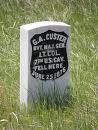
The discovery of gold in 1874 by the Custer expedition and the prompt announcement of this discovery lead to an irreversible economic migration to the area by gold seekers and those who would follow them. Many of the gold seekers were miners and entrepreneurs from other gold fields seeking new opportunity. Custer met his end in battle, hopelessly outnumbered by Indian forces.

Today the Black Hills of South Dakota are a locus of tourism, gambling, and recently, neutrino physics. Native Americans reside on a handful of reservations scattered throughout the eastern plains.

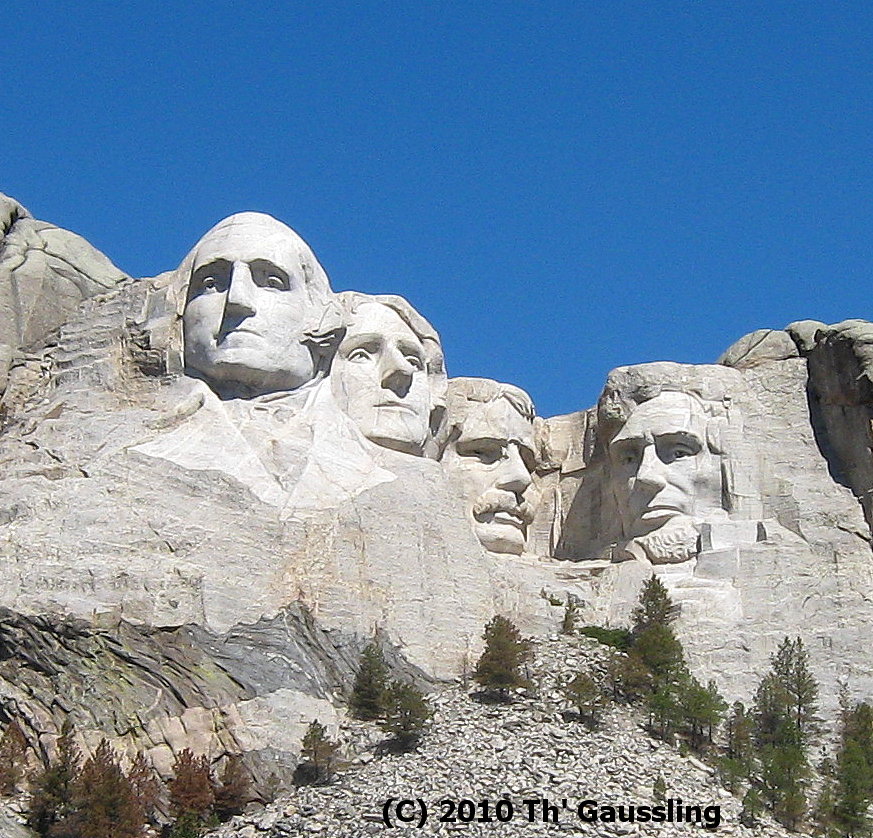
It is a curious contrast to behold. Today automobiles and tour buses disgorge well fed tourists by the hundreds of thousands each year to marvel at the spectacle of Mt Rushmore, buy souvenirs, and to rejoice in nationalistic self satisfaction.

Bikers make the annual sojourn-in-leather to nearby Sturgis in part to celebrate the freedom of motorcycling. All of this celebration of freedom in an area where the lust for gold has trumped the freedom of a hunter-gatherer society by those who had mastery of explosives, metallurgy, and steam energy. I suppose it was inevitable.

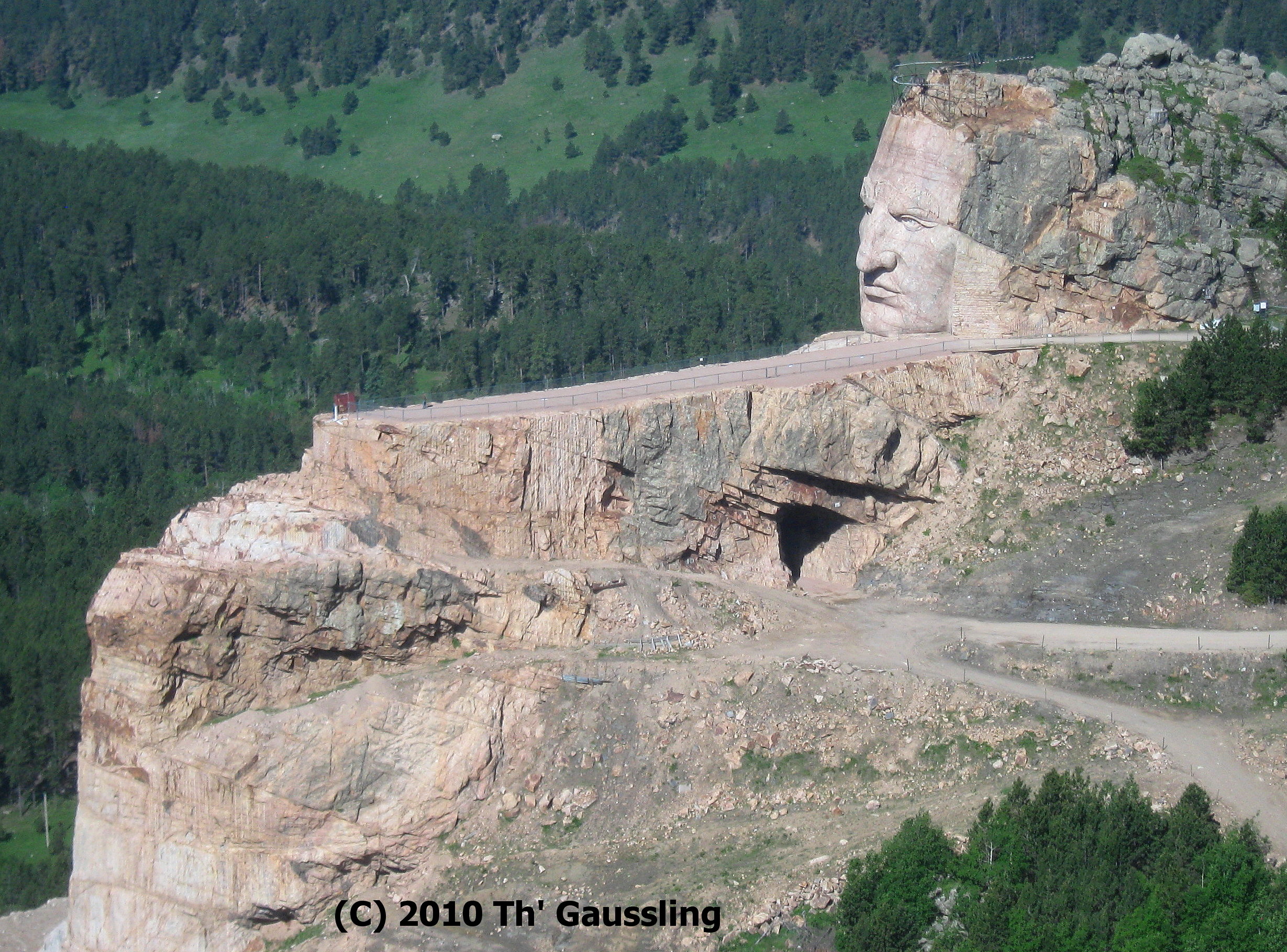
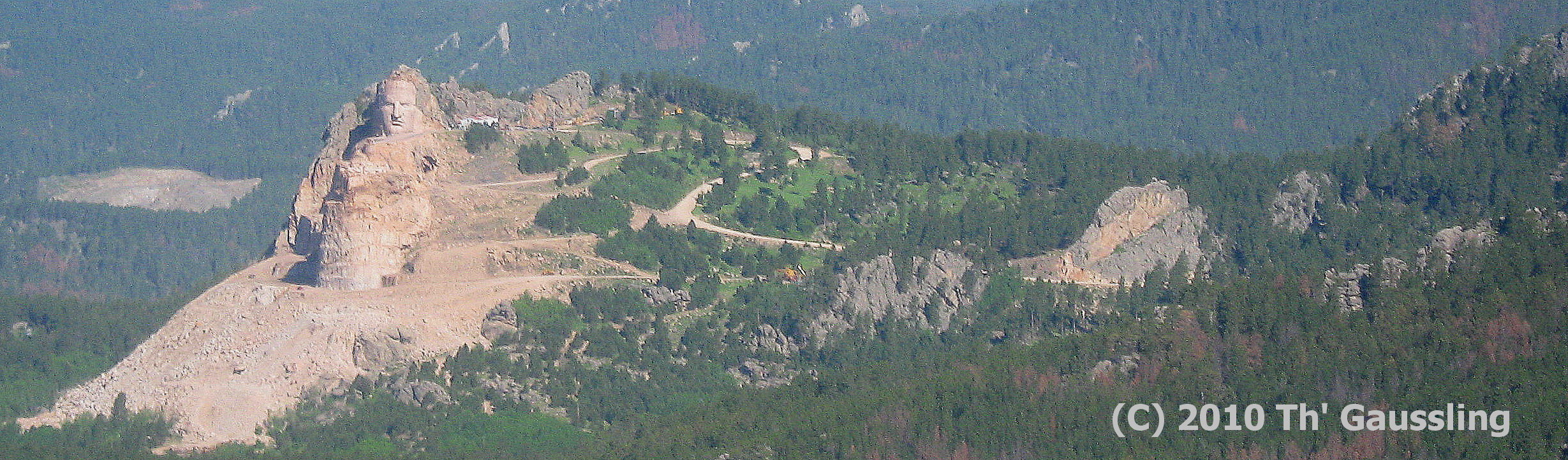
View of Crazy Horse Monument from Helicopter

Th’ Gaussling and family splurged (Yoww!!) on a helicopter tour of the Mt Rushmore and Crazy Horse area. It was just spectacular. The heliport was a mile from the Crazy Horse Monument so we were treated to two visits to the site.

Crazy Horse in Context

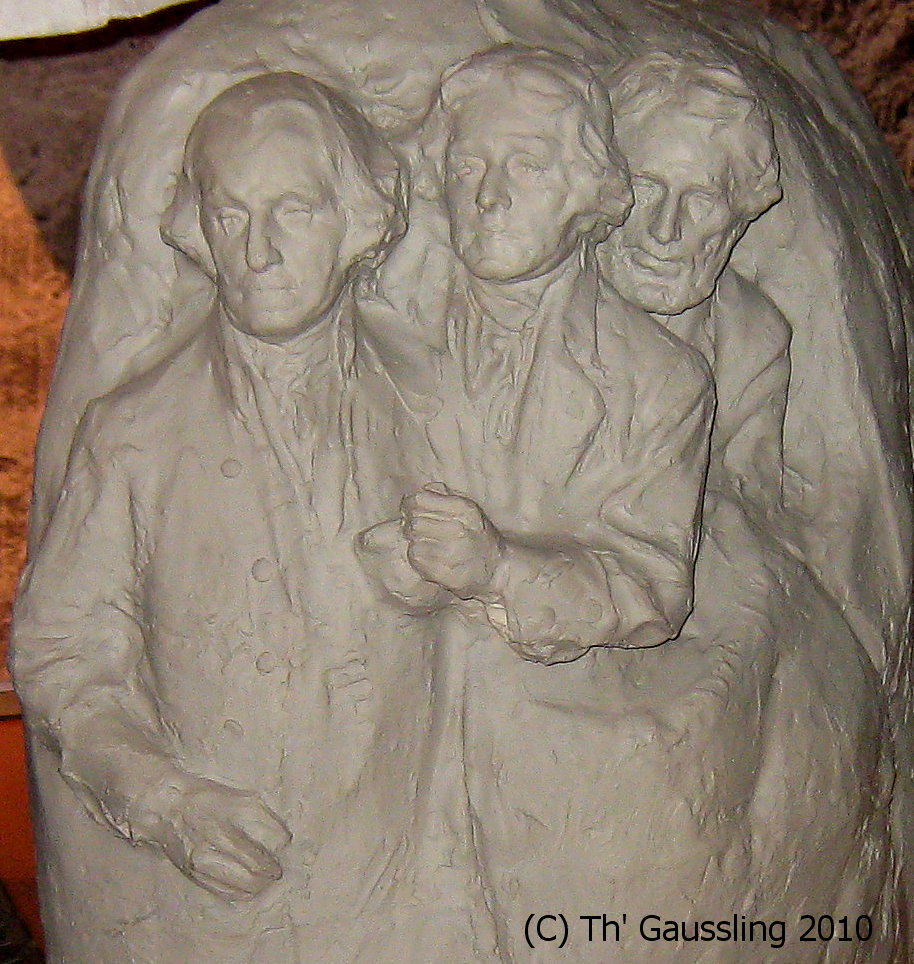
Gutzon Borglum launched his ambitious monument project on a mountain the locals called Mt Rushmore. The final form differed somewhat from early models.

A great deal of resources and effort went into the Mt Rushmore monument. It features a parking garage, gift shops, museum, two indoor theaters, an amphitheatre, cafe, and Borglums studio. The visior is free to simply sit and ponder the monument or dive into the historical details of its construction.

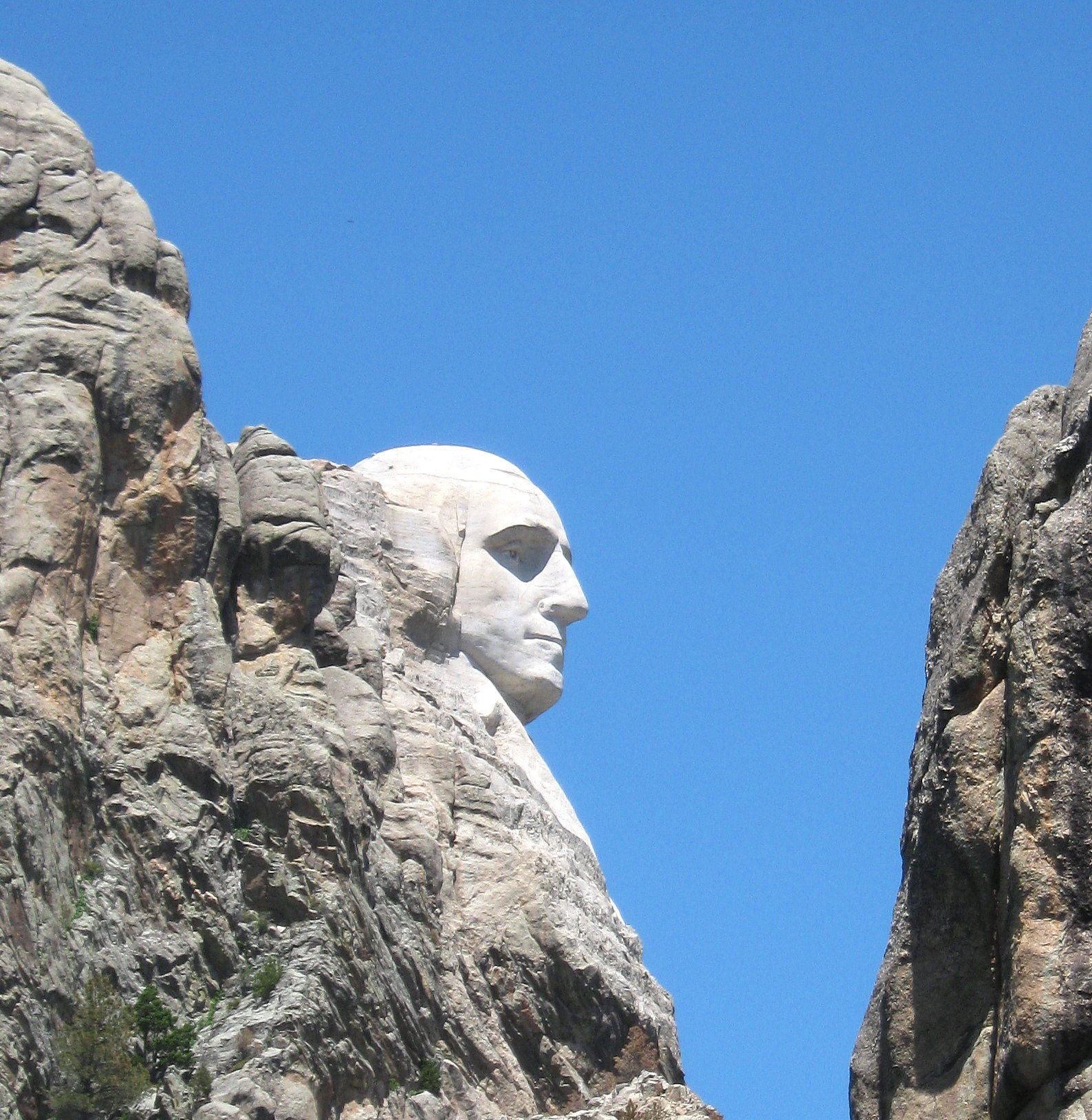
Mt Rushmore Profile View

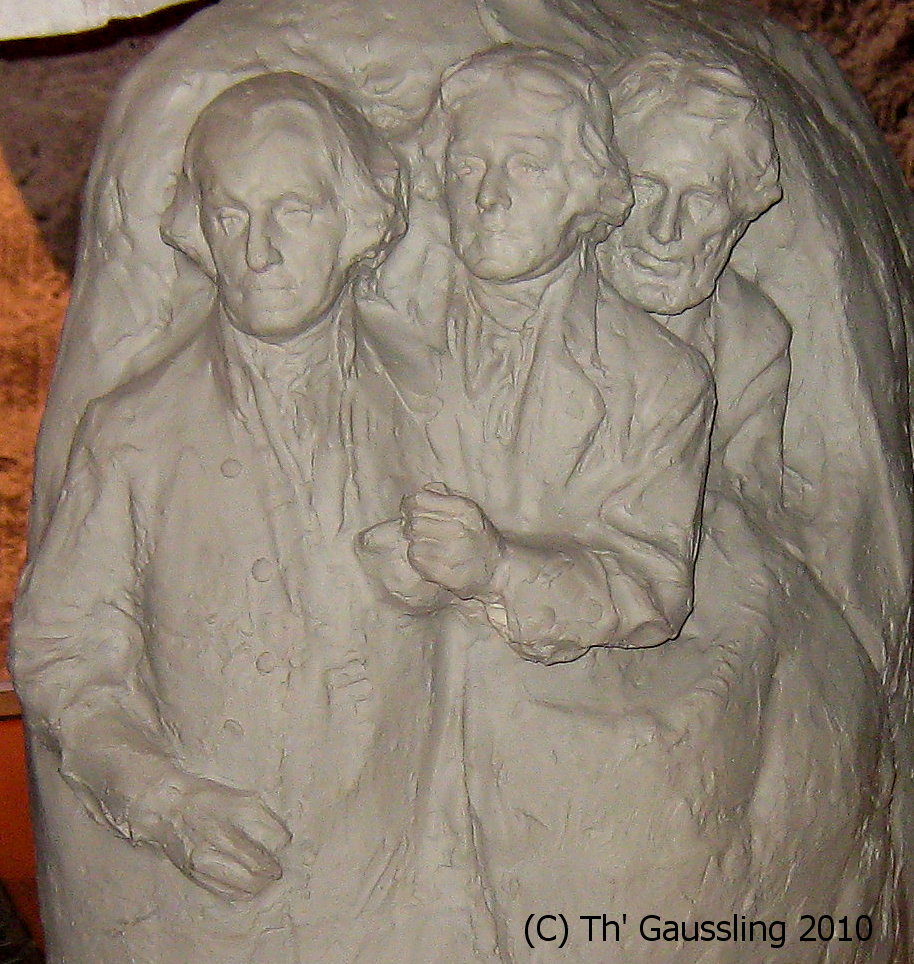
Borglum fabricated scale models of the subject faces in his workshop below the site and used a geometric device to transfer the dimensions to the mountain. A plumb bob hung below a protractor-style device mounted on the model. A rudimentary coordinate system would provide a basis for scale-up.

Scale Model Faces of Mt Rushmore

Borglum died of complications from surgery in March of 1941. Gutzon’s son Lincoln Borglum carried on with the project after his death. However, Lincoln left the project substantially in the form left by his father. The project was officially halted later in 1941 owing to a lack of funding.

Mt Rushmore

Mt Rushmore is a spectacular thing and everyone should see it. All of the fellows captured in stone had attributes worthy of meditation. The timeline between them and we of the present day is jam packed with fantastic events that they had a hand in initiating. I’m certain that they would say that our technology is different but human nature is the same.

On the road

Th’ Gaussling is off-site for a few days of happy motoring in the mysterious Black Hills of South Dakota, or Paha Sapa in Lakota. 

The discovery of Black Hills gold in 1874 by an expedition led by General Custer and the 7th Cavalry ultimately triggered another bout of  hostilities with the Lakota as the land deeded to them by the Fort Laramie Treaty of 1868 was pushed aside by miners and settler. Government agents were not able to prevent mining and settlment of the Black hills area. 

The blowback to Custer’s discovery of mineral wealth in the Black Hills was in the form of his defeat by Sitting Bull at the Little Bighorn River in Montana in late June of 1876.

The locals now mine tourists rather than gold.  The homestake mine has workings at 8000 ft below the surface! Over 1 billion dollars worth of gold was extracted between 1877 and 2004. Presently in the process of being set up for underground labs, the Homestake Mine in Lead, SD, will reopen in the coming years as a center of particle physics and dark matter research as the Sanford Underground Laboratory. Part of a program known as DUSEL, the new labs will exploit the great depth of the Homestake mine for the inherent radiation shielding at the lower levels of the site.  

Linkenschmutz

Links found whilst thrashing about the internets on my computer machine.

RCS Rocket Motor Components supplies, well, rocket motor components for the serious “non-professional”. RCS offers propellants, casting resins (i.e., polybutadiene), bonding agents, tubes, and other pieces-parts for the rocket builder. Good stuff, Maynard.

It turns out that my fellow Iowegian and former US President Herbert Hoover published a translated and annotated version in 1912 of De Re Metallica by Georgius Agricola (1556). Hoover’s translation can be found on the web and a copy is on display at the National Mining Hall of Fame and Museum in Leadville, CO. This work by Agricola is nothing short of amazing. A series of images of the text in the original Latin can be found as well.

It is interesting to note that Agricola (1494-1555)  and Paracelsus (1493-1541) were contemporaries in central Europe. Agricola, a Saxon, spent much of his time in Joachimsthal and Chemnitz whereas Paracelsus,  Swiss, is famous for being a bit of a wanderer. While I have not encountered a reference indicating whether these two polymaths had any knowledge of one another, they very much exemplify the meaning of Renaissance.

This USB temperature logger is pretty cool. I can hear it calling for me.

Here is a collection of links to monographs on Radiochemistry from LANL.

Franz Ritter von Soxhlet and the Hungarian Siphon

Franz Ritter von Soxhlet is credited with inventing an extraction apparatus in 1879 that now bears his name. Soxhlet was a German agricultural chemist of Belgian “extraction” from Brünn (now Brno in the Czech Republic) working in the area of milk characterization at the Vienna Agricultural Institute.

Soxhlet spent most of his career in the analysis of milk and its constituents. In an attempt to isolate the fatty constituents from milk, he (and students) had been attempting to use an extraction apparatus developed by another Brno chemist, Professor Zulkowski. Soxhlet developed a technique whereby milk was absorbed into a quantity of calcium sulfate powder and then submitted to extraction by ether. The Zulkowski apparatus proved problematic, however. Solids were able to find their way over the extraction tube and into the solvent reservoir. Modifications of the design also suffered from inefficiencies that apparently required extended operation.

A student of Soxhlet, a Hungarian fellow by the name of Mr. Szombathy, contrived a solution to the problem. Szombathy is credited with coming up with the clever siphon feature that so distinguishes what we now call the Soxhlet extractor.

It has been lamented that the efficiencies gained by the siphon discharge design have been partially lost due to the entertainment effect. Generations of chemists have dropped what they are doing to stand and watch the collection thimble fill and subsequently discharge dramatically through the siphon. You have to take your fun where you can find it.

Well done, Szombathy!

UnaTed the Bomber

An interesting piece of critical analysis of Ted Kaczynski (the Unabomber) and his manifesto can be found at The Technium. Much time has been dedicated to the pathological aspects of Kaczynski and his violent acts. But perhaps not so much energy has been expended on whether or not his writings made any sense in any context.

… the Unabomber is right that choices which begin as optional can over time become less so. First, there are certain technologies (say sewage treatment, vaccinations, traffic lights) that were once matters of choice but that are now mandated and enforced by the system. Then, there are other systematic technologies, like automobiles, which are self-reinforcing. Thousands of other technologies are intertwined into these systemic ones, making it hard for a human to avoid. The more that participate, the more essential it becomes.  Living without these embedded technologies requires more effort, or at least more deliberate alternatives.

The author points out that Kaczynski was concerned about the spread of what Jim Kunstler might call “technological triumphalism” and the lack of options we have in participation. Kaczynski was so concerned that he spent much of his life in a one room shack in the mountains of Montana.  But he did not live like a cave man. There was a certain minimum level of technology he was comfortable with.

Another person might have fashioned these ideas into the core of a brilliant academic or writing career. But for reasons or illness unique to Kaczynski, he followed a darker path by choosing to lob grenades from the margins. No matter how compelling the logic, we need to have social intelligence to temper the indulgence of violence in persuasion.

It’s the Schist and a Lot More

The Front Range of Colorado is roughly comprised of those mountains that can be seen from the eastern plains. There is no precise definition that I am aware of, so this will have to do. 

Superficially, these mountains run north/south and appear to be organized into ranges, which are really just a series of roughly parallel ridge structures punctuated with the occasional high points that are refered to as peaks. The origin and orientation of these ranges is defined by the orientation of faults and with the effect of eons of erosion to form river channels. Erosion has the effect of removing the weakest materials and leaving behind the most resistant rock structures.

The present epoch of the Rocky Mountains are the result of the Laramide Orogeny, the most recent period of mountain building thought to have begun 70-80 million years ago in the late Cretaceous period. The cause of this mountain building episode is attributed to a shallow angle of subduction of the Kula and Farallon plates below the western margin of the North American plate.

Geologists propose that the shallow subducting slab of ocean bottom applied a drag on the root of overlying continental lithosphere. These forces lead to the broad belt of disturbance to the overlying rock leading to the formation of the Rocky Mountains.

As mountian building proceeded, overlying sedimentary formations were bent and fractured along the margins of the upward moving rock. Today these sedimentary formations are visible in the form of ridges of protruding lamanellar sandstone, mudstone, and shales whose surface planes sit at a high angle  relative to the horizon. The uppermost sedimentary formations are exposed further east in the plains, and as one moves a few miles closer to the mountains, the deeper and correspondingly older sedimentary formations are exposed. These parallel ridges of exposed, upthrusted sedimentary formations are collectively referred to as “foothills”.

Along much of the northern Colorado front range, the westernmost sedimentary formation that abutts the metamorphic rock is called the Fountain formation. Adjacent to this upthrust of metamorphic rock is a layer of disturbed Fountain formation that has been drug upwards to a near vertical orientation. If you have been to Boulder, Colorado, and have seen the Flatirons, you have seen the Fountain formation. Red Rocks Amphitheater and the Garden of the Gods are also part of the Fountain formation.

Here is my question- Somewhere, there should be an interface (I think geologists call it an unconformity) between the metamorphic and sedimentary formations. Where can it be inspected? A road cut or riverbed?

So, it turns out that Th’ Gaussling’s brother owns a spread that is comprised of Fountan formation sandstone. He has a mountain. And down from this mountain and into his yard come elk, deer, mountain lions, bear, and rattle snakes. One of his house cats, in fact, was last seen in the jaws of a cannibalistic mountain lion trotting off to a quiet spot to munch this fresh, tender kitty morsel.

To satisfy my curiosity about this interface, Th’ Gaussling was out in the brush scrambling over snow covered rocks, cactus, and yucca looking at examples of the Fountain formation and, nearby, a formation comprised of schist and gneiss. Not surprisingly, I did not find it in a single outing. But I was close- it’s buried in deep rubble, no doubt. The hunt continues.

Archaic Chemical Terms

There are interesting sites out there that list antiquated chemical terms. One apparently authoritative site lists 18th Century chemical terms (compiled by Jon Eklund of Smithsonian Studies in History and Technology). 

Some terms seem to remain quite useful, some are hopelessly irrelevant, and others are just odd.  Naturally, I am attracted to the odd words. Have a look for yourself. Here are a few good ones copied verbatum from early in the alphabet-

Cohobation –Repeated distillations, or any cyclic process in which a liquid is vaporized and condensed as, for example, in refluxing.
Cucurbit – The lower part of an alembic. Shorter, more squat and ovoid than a matrass.
Decrepitation – Rapid physical decomposition of some crystals when heated. Characterized by a crackling noise.
Dephlegmation – To remove water from a solution, usually one of an acid or alcohol. There is a sense of purifying about the term, as opposed to simple concentration.
Desquamation – The process of removing scaly crusts which form on a surface.
Dulcification – Any process in which a caustic substance is rendered less corrosive.
Empyreumatic – Tasting or smelling or burnt organic matter.
Exalt – To make more spiritous, volatile, or generally more active; activate.

I wonder if any of these would get through the peer review process if one were to try to use them in a procedure submitted for publication? Perhaps if Roald Hoffmann used them, I suppose.

Late Night Thoughts on Twisters

Now that we are well into tornado season in North America, I thought I’d dredge this old post up out of the cobwebs in the dungeon. As Uncle Al pointed out in the comments, Middle Easterners did have dust devils so a vortex of wind was not unknown there. These, however, are no match for a full-blown F4 tornado.

==========

One has to wonder what the original inhabitants of North America thought of the tornado (how do you say “WTF” in Lakota?). I have visited a few museums in my travels but have never seen any artifacts or heard of any references to Native American perceptions of the tornado phenomenon.  Without a doubt, Native Americans were visited by tornadoes. The experience must have certainly left an impression. It would be interesting to hear any stories that may be out there.  An internet search just offers a Mulligan stew of hits with tired references to Pecos Bill or to the odd disaster in Kansas.

North America is climatically privileged in that there is the possibility that overland southerly flows of cold dry air from the north can readily contact flows of warm moist air from the Pacific, Gulf of Mexico, or the Atlantic.   Vertical mixing of unstable humid air results in convection cells that are further driven by the latent heat of condensation.  These humid flows are spun up by the coriolis effect and wind shear to afford monster anvil storm cells that can tower to 50,000 ft or higher.

Like many places, here in Colorado we often see lines of isolated storm cells in the early evenings of summer, red in color at low altitude changing to a billowy yellow-white at altitude near sunset. Very often you can see mammatocumulous features signifying violent mixing activity. It’s no place for an airplane.

It is interesting to speculate as to how our modern mythologies and iconographies might have been different if the tornado phenomenon had been common in the Mediterranean and the middle east.  Would Charleton Heston have summoned a tornado to smite Yule Brynner’s Egyptians rather than parting the Red Sea and drowning the buggers?  Perhaps the Pharaohs might have built great stone helices rather than oblisks.  Aristotle might have written a treatise on the handedness of helical flows or whether the air flowed radially into or out of a tornado.

If the tornado had been a common phenomenon in the middle east during the iron age would the “Big Three” Abrahamic religions today feature tornadic themes in their texts and monuments? If so, perhaps the great cathedrals of Europe might today have relief sculptures or stained glass windows portraying the Israelites or Philistines being driven hither and thither by the swirling wrath of the Almighty’s cyclone.

Well, that’s enough of that.