Category Archives: Humanities

The US Strategic Petroleum Reserve (SPR)

Many countries including the US have underground strategic gas & oil reserves. At present the US has 4 salt dome petroleum storage sites in Texas and Louisiana along the Gulf coast. Salt domes are convenient and inexpensive for underground storage of crude oil and gas. Salt mining has been done from underground workings of drifts and shafts employing underground miners. It has also been accomplished by hot water injection into the formation and retrieval of NaCl brine. Sometimes the salt dome is capped with a layer of elemental sulfur which is recoverable.

The dome formations, called ‘diapirs‘, are usually 1/2 to 5 miles across and rise to 500 ft to 6000 ft below the surface. The discovery of these salt formations coincides with the discovery of oil at Spindletop Hill near Beaumont, TX, in 1900. The current inventory in the SPR as of March 29, 2024, is 363.6 million barrels.
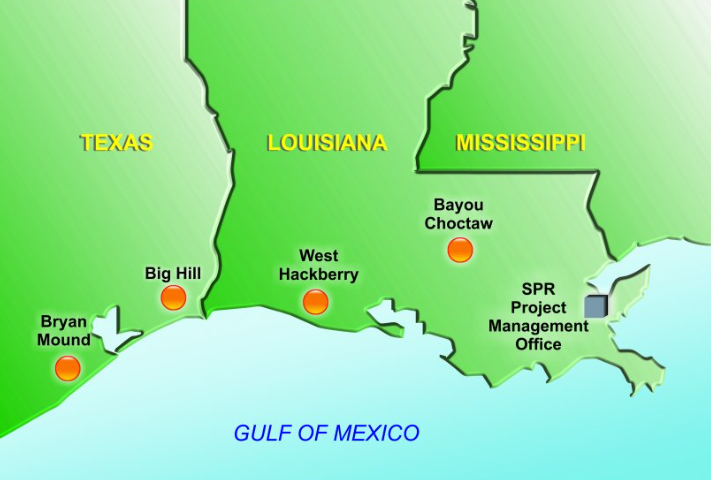
Source: Energy.gov. The 4 SPR sites in the US. The 4 sites have a combined 62 individual salt caverns.

The US acquired the sites in 1977 after the 1973 oil crisis hoping to buffer large disturbances in the crude oil supply. In October of 1973, the Organization of Arab Petroleum Exporting Countries (AOPEC or OPEC) embargoed any country that supported Israel in the 4th Arab-Israeli War. The US was embargoed after Richard Nixon requested 2.2 $ billion for support of Israel’s war effort. At about the same time, after the US had disconnected the dollar from gold, OPEC Ministers found that with the free-floating dollar, their income was lagging because they did not have institutional mechanisms to raise prices with fluctuations in the market price.

Oil storage is all very interesting but what’s the deal with salt domes themselves? What do they look like and where are they found? Why do they form domes?
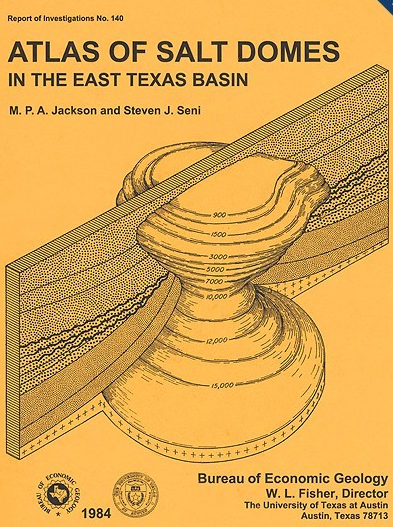
Source: Book cover from Jackson, M. P. A., The Atlas of Salt Domes in the East Texas Basin, 1984, doi.org/10.26153/tsw/4747. The Bureau of Economic Geology Store, UTexas.

The graphic above is from a 1984 Atlas of Salt Domes produced at UT Austin. It shows the intrusive nature of an idealized salt dome. Salt strata are able to deform upwards due to the weight of the formation on the lower density and lower strength salt (halite) layer. The term “salt tectonics” has been used.
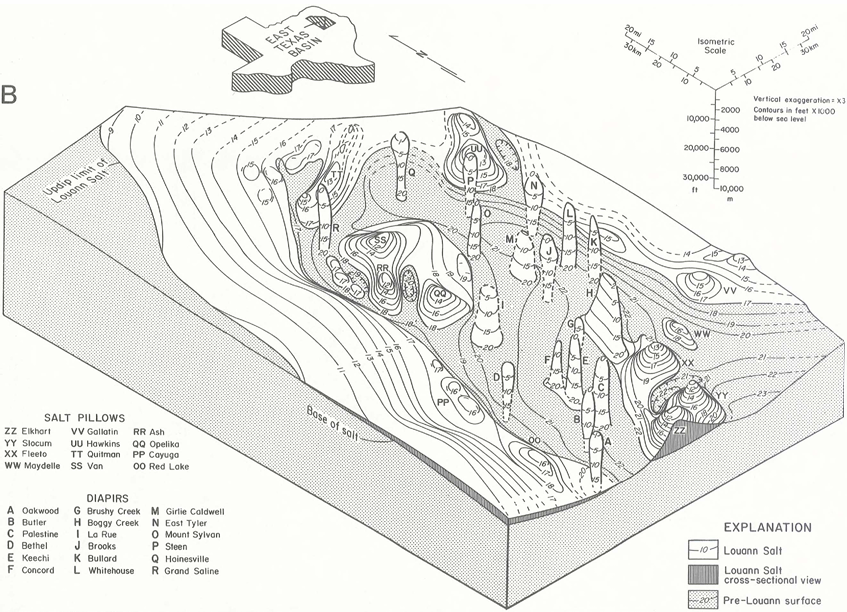

Source: ibid.

The collision of supercontinents Laurentia and Gondwana lead to compressional folding of strata and the formation of anticlines and synclines in the areas now lying in eastern Utah and western Colorado.

There are several types of diapirs: Magma, Salt and Mud. Salt diapirs start out as layers of salt sediment deposited. Here ‘salt’ refers to a number of ionic solids previously precipitated from an inland ocean. Changing sea levels and evaporation of shallow marine waters lead to the deposition of dissolved and suspended solids forming shales, dolomite, anhydrite, sodium and potassium salts, and black shale.

These salt strata do not consist purely of halite, NaCl, but rather contain other evaporites like hydrated gypsum, CaSO4 .2 H2O, and anhydrous gypsum or anhydrite, CaSO4. naturally, there may be layers of silt or sandstone included in the salt formation. If the salt strata form an anticline, oil, gas and water (or brine) may accumulate in the diapir.

Salt is less dense, has greater ductility and is more buoyant than the surrounding country rock. Under great pressure from the surrounding rock, salt can begin ductile flow in the direction of lower pressure which may be upwards. The salt formation has greater ductility than the surrounding rock, so the salt is extruded into faults and sediment layers above. This has been called ‘salt tectonics’.

Salt diapirs are more common than most of us realize. On the Gulf Coast they are found on both sides of the coastline and further inland. Sometimes they are associated with oil and gas deposits. Salt strata are found in Utah below Arches National Park and further south in the Moab valley and southeast into the Paradox Valley in western Colorado. The salt strata can be thousands of feet thick originating from marine transgressions of the Jurassic Sundance Sea. This is not to be confused with the later Cretaceous Western Interior Seaway.

The Sundance Sea moved in and out 5 times with a hiatus of erosion between transgressions.

At Arches National Park, over time the ground beneath the area had been rising, fracturing the sandstone above and producing the fin formations at the surface. The exposed rock, called the Entrada sandstone, is part of the Pennsylvanian Paradox Formation. The fins are comprised of many layers of sandstone. If the broad face of the sandstone fins erode enough, a hole can be formed giving the namesake arches. An aerial photograph shows parallel fin formations over a wide area.
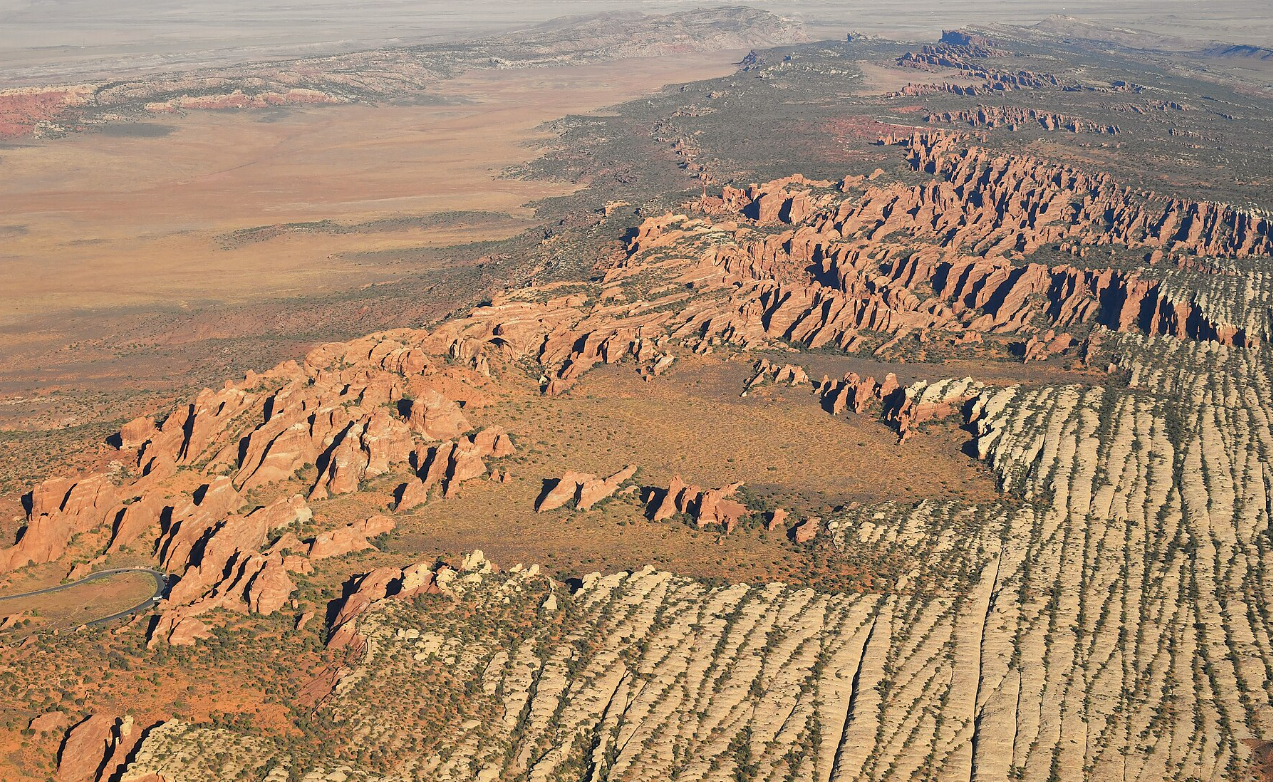
Source Image- Wikipedia. Fin formation.

If the reader has never explored Utah, by all means do so. It’s just gorgeous.
The King in Yellow

Being a devotee of the HBO series True Detective I became intrigued with the purported allusions to the 1895 book of short stories The King in Yellow by Richard W. Chambers. I received my copy from Amazon yesterday and read the first three stories.

I have never ventured into the horror genre so this is refreshing. Chambers was reportedly influenced by Ambrose Bierce. His prose is considerably less dense than Bierce’s- closer to a 20th century cadence and vocabulary. H.P. Lovecraft took notice of Chambers as well. Lovecraft and Bierce are next on my reading list.

As with the story line of True Detective, The King in Yellow (or Yellow King) is not really centered on the fictional play of the same name. Rather, it is a kind of story telling device that motivates and launches characters along the arc of another story. It’s an interesting device.

Alberto Gonzales as Jungian Archetype

For a good essay on the Alberto Gonzales mess, see The Smirking Chimp.  Th’ Gaussling has been searching for a Jungian archetype representing people who are “never in doubt, but frequently wrong”.  Maybe Gonzo is the man. 

There have been many possible nominees in the Bush II administration- POTUS, Cheney, Wolfowitz, Rumsfeld, etc. But Gonzo seems to be the most tragic of the lot.

Note to future generations: I was going to further criticize POTUS, but given that he is sure to be savaged by historians, I’ll just stand clear and let experts have at it.

Dammit. The three horses I bet on in the Kentucky Derby all lost.

Bush II. Sphericated or Flaticular?

Here along the front range of the Rocky Mountains we have a few alternative newspapers available- you know, the kind not owned by Rupert Murdoch. They tend to be a bit Bohemian and consequently are shunned by righteous Dittoheads. Other parts of the country have them as well- college towns mostly. They cater to those of us who aren’t afraid to be known as liberals.  These papers run a syndicated cartoon called This Modern World by a guy known as Tom Tomorrow. 

Because of copyright issues, I’ll have to link to the site rather than paste an image.   

30 Years of Star Wars

It has been 30 years since the release of the movie Star Wars. Back then I had just started a job at the local movie house as a projectionist. We had two Phillips-Norelco 35 mm projectors with Xenon arc lamphouses and 6000 ft reels. We’d splice 3 x 2000′ shipping reels onto one reel so that there would be fewer changeovers. 

The theater owner put down a $10,000 non-refundable deposit on the print and paid 90 % of the ticket sales to the distribution company for the first 6 weeks. So for the first month and a half, we made our money on popcorn, cokes, and Junior Mints.

In 1977 Star Wars was THE blockbuster of all time. We had sell-out crowds every show for the first 2 weeks. The concession girls could barely keep up with the popcorn demand. Other theaters were popping corn for us in an attempt to keep up. We blew through 5 gallon syrup cylinders like spent cannon shells on a battleship in Guadalcanal.

I ended up running Star Wars 186 times. But it was far from routine.  The projector chewed up a bit of the end of reel three, the famous dumpster scene. Unfortunately, I was operating the night the print failed. The projector shredded about 20 feet of film (18 inches/sec) in several places and the resulting film break  caused the automation to switch on the houselights, close the curtain, and start a Neil Diamond 8-track tape playing for the audience. After 3 seconds of bewilderment, the crowd turned ugly and started shouting and storming to the lobby to complain. The film stopped at a very exciting point and the customers were none too happy.  I didn’t venture downstairs.

I was a casualty of Star Wars and actually had to be taken to the hospital during the run.  In trying to investigate the source of some troublesome image chatter, I got my finger caught on a sprocket and ran it between the teeth and the guard post.  Ended up with a meaty gash that required stitches.  Of course, I never told George Lucas…

The print grew progressively worse over time. The dumpster scene would chatter through the film gate in defiance of our best adjustments.  But despite this, few complained when they walked out of the theater. It remains a great movie.  Eventually, as a college student I moved up to a 4-plex theater with platters and automated Simplex 35’s.  This night job paid for much of my BA in chemistry. I read much of Solomons Organic Chemistry in the projection booth.

The Murder Room

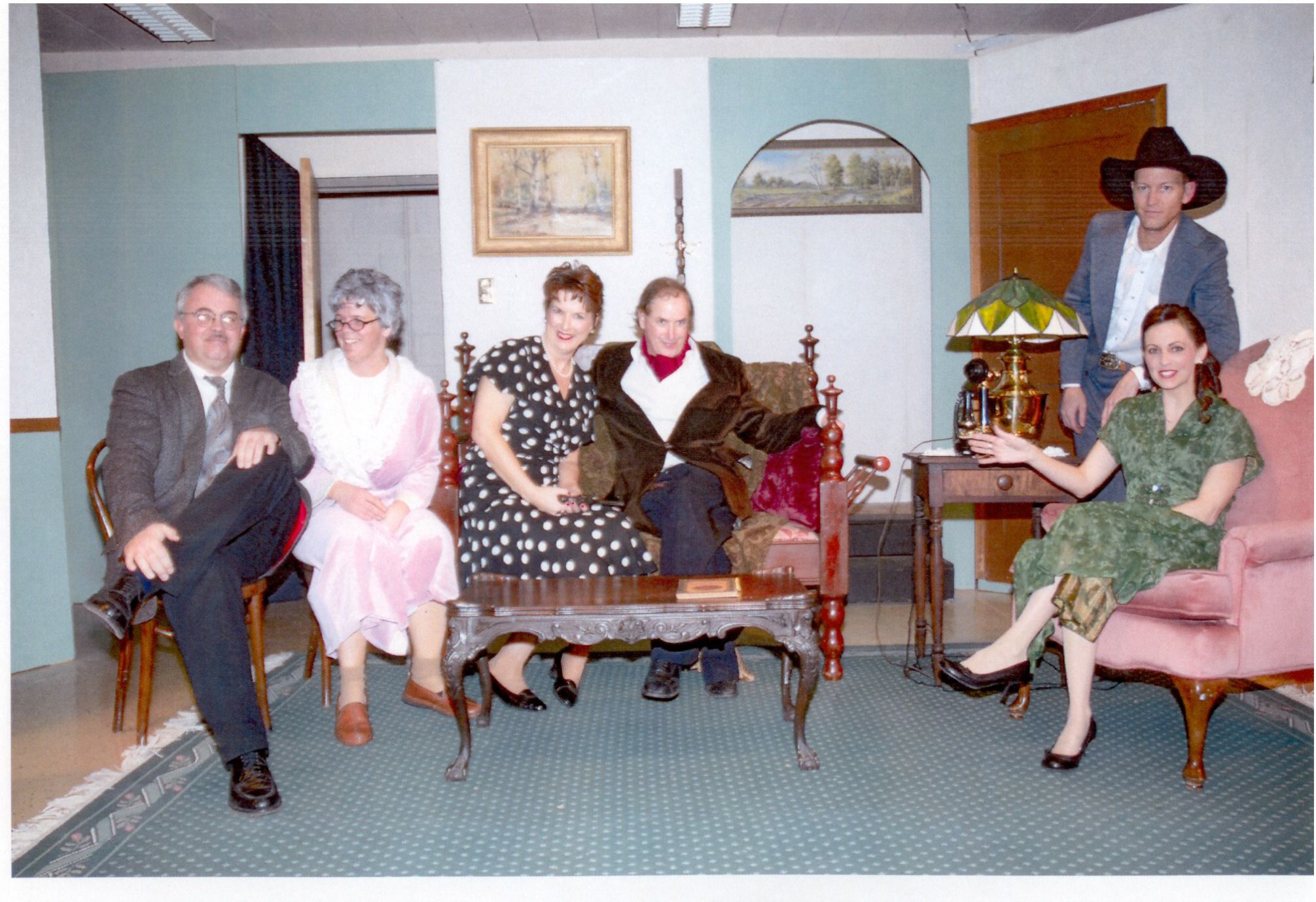
I have attached a cast picture of our recent production of The Murder Room.

murder-room-cast.jpg

It turns out that there is a small number of people walking around who do several plays per year.  They have no real designs on Hollywood or Broadway.  They do dinner theatre or community theatre just for the pure joy of it.  Despite the fact that the work is gratis, local, and not run by Spielberg or some other big name, it is nontheless a sizeable ordeal to prepare for. 

I am grateful that not a single bit of rotten vegetation was thrown my way and that at least some of my lines drew a smattering of laughter.  I did it with a British accent somewhere between Terry Thomas and Rex Harrison. 

The sensation of this kind of performance was what I would imagine ballroom dancing might be like. A fluid and coordinated dance of repartee, movement, and subtext. To have performed with experienced actors was great experience and I am eager to do it again.

In low gear

Th’ Gaussling is in low gear this week due to extra-curricular activities. I’ve been in rehearsal since October for a play that opened last night- The Murder Room by Jack Sharkey. It’s community theatre, which is the only way a hack like myself would have had a chance. This is my first time on stage and it has been quite an experience. Acting is a lot like flying an airplane- it is exhilirating and terrifying all at the same time.  And like flying, you can fall from such a height that it takes a long time to smack into the ground.

Acting requires a type of learning that is rather different from learning chemistry. First, there is rote memorization. There is no escape from knowing your lines. With experience the actor can develop the character around the structure of the dialog. 

It is nowhere near as easy as it looks, and it does require a large investment in time and effort. But in the end, performing with other actors and pulling off a complicated show is quite satisying. 

Moskva

Here is a picture of a younger Gaussling with chums Leon, Joe, and Karl.  Of course, Leon was never quite “right” again after his tragic incident with the ice-axe. 

Trotsky

[Editors note: Many thanks to Les for the image “enhancement”. ]

Cheers!

A Bunch of Blarney

I thought I’d disclose a picture of Th’ Gaussling for the one or two miscreants who might actually be interested.  I had the opportunity to visit Blarney Castle in Ireland a few years back. The Blarney stone is said to be part of the Stone of Scone given to Cormac McCarthy by Robert the Bruce of Scotland in 1314 as a reward for support in the Battle of Bannockburn. Yada yada. It is supposed to confer the power of eloquence.

I try not to think of all of the thousands of sweaty tourists that have hung backwards high in the air to kiss that clammy, dank stone. Yeah, I kissed it. Didn’t do a damned bit of good, though.

Blarney Stone

Cheers!