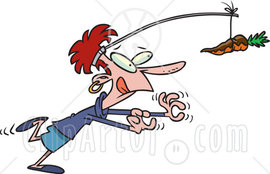
Good lord. Do I have to explain everything?? It’s not “carrot or stick”. It’s “carrot AND stick”. The phrase “carrot and stick” is not meant to imply a choice between pain and pleasure. It is meant to suggest motivation by the placement of a reward that is always just beyond reach. It’s motivation for donkeys, oxen, and the physics challenged. And the talking heads who read news in front of cameras.
Category Archives: Humor
xkdc cartoon
Yeah, you find pi in the funniest places.

This is how science really works.

Alien Fasteners. Wingnuts from space.
Imagine that you and a companion are out for an evening stroll after a big dinner, say in a park somewhere. You hear a curious whining sound and look up to see an alien spaceship on a landing approach to the park. The craft lands and the crew scuttles off to perform some tedious abduction or organ harvest in the neighborhood.
Your companion exclaims “Golly! There is something you don’t see every day!”. But you’re unmoved by your companions incisive commentary. Because you see this as a long sought opportunity to examine an alien craft up close.
What would you look at? The propulsion system? Or perhaps the weapons array or guidance system? Pffft.
I would look at something much more mundane. I think it would be very enlightening to see what kind of fasteners they use. That’s right. Fasteners. Nuts, bolts, latches, bungees, straps, nails, hinges, hooks & loops, and rivets. How do these confounded exo-buggers hold things together? What’s the deal?
Fasteners are mechanical contrivances used to restrain objects into a desired configuration, often by the application and fixing of tension or compression through some structural element. Think of all of the fasteners we encounter before we set foot out the door every morning.
Elastic articles of clothing perform a fastening function through the application of tension about numerous body parts through the miracle of Spandex/Lycra. Shoe laces are fastening devices that apply and hold tension on opposing shoe upper elements wrapped over the arch of the foot.
Moving upwards, the zipper is a fastener that works in concert with a trouser/skirt button or snap fastener. The belt and buckle are a fastener ensemble that together apply and hold tension about the circumference of the waist to keep ones trousers from succumbing to the pull of gravity.
Other fasteners include shirt buttons, brassiere connectors (damn those things!), earring wires, eyeglass frames (they connect to your face), cell phone belt attachments, the deadbolt on the front door, all manner of electrical connectors, and the list goes on and on. Electrical connectors are especially interesting because they combine the functions of electrical continuity and fastener. All are a compromise between the competing interests of biomechanics, convenience, safety, regulatory standards, and custom.
So, back to the space ship. How would space faring beings approach the problem of fastening materials and components. Would they use individual components fastened together or would they use integrated component assemblies that support multiple functions? Perhaps the mechanical fastener question is moot because components would be cast, glued, or welded.
Integrated components have a certain appeal, but, by their integrated nature could serve as a node from which to initiate failure propagation to multiple systems. For instance, if a battery was built to serve as a structural element for the craft, could a battery failure of some sort serve to initiate a structural failure mode? At what point is it foolish to integrate systems rather than leave them distributed? As always, it depends.
I think an alien spacecraft would have at least a few kinds of obvious fasteners. Surely alien technologies are subject to component failures and would require occasional repair. Of interest would be the concessions to alien biomechanics.
Humans occasionally use wingnuts to fasten objects that need not be permanently affixed. The wingnut is simply a style of threaded nut that has two modest protuberances that allow for torsion and compression to be applied by the fingers and wrist. The wingnut is not functional for beings who lack the sort of articulated digits that we have. Perhaps an alien being would have a latch or other contrivance to accommodate its appendages.
Of course, all of this alien talk is just a device with which to cast the matter of fasteners into a more interesting light. Fasteners are part of our collective technological heritage and are rather under-appreciated. But, if you are unfortunate enough to be abducted by aliens, I suspect that the matter of alien fasteners might be of immediate interest.

Hamthrax
So, the slang name for the H1N1 swine flu is “hamthrax”. Pretty funny. I suppose it could be called spamthrax as well.
As a kid I lived for a time in an Iowa town that had a Hormel Spam processing plant. During the winter in particular, the town of Fort Dodge, Iowa, would smell like cooked Spam. Ft Dodge sits atop the Des Moines River valley. During the cold months the valley would fill to the brim with the odor of Spam. It was an odd experience to drive into town and be overwhelmed by the smell of potted spiced meat.
Ft Dodge was (is) also known for the vast gypsum deposit that sits underneath the area. The word was that hair from the hogs at Hormel was blended with the gypsum to add strength to the sheetrock that was produced. I don’t know if this is true, but it made a great story for countless toe-headed farm kids who drove by the gypsum plant and pondered how they got the hair from the hogs and into the wallboard.
Uncle Junior
“Will ya shut up already? You talk worse than six barbers!”
Uncle Junior The SopranosPatent-isms
Odd descriptions of matter and the peculiar turn of phrase abound in the chemical patent literature. Here are just a few of my favorites (italics mine)-
- “… wherein the substituents have the following significations:”
- ionic layered compositions (translation- clay)
- Donor solvents (translation- certainly an ether, perhaps an ester)
- A non-coordinating dispersant (translation- a hydrocarbon solvent)
The deal with the devil that you make in getting a patent is this- in exchange for a 20 year monopoly, you must disclose to the public enough enabling information that a confused citizen could determine if he/she is infringing on the patent and reasonably avoid infringement. But this does not stop the use of opaque vocabulary and unusual juxtapositions because, after all, one skilled in the art should be able to decode the many obfuscations applied to their area of specialty. Shouldn’t they…? Or, perhaps the obtuse vocabulary is meant to daze and confuse the judge and jury. Hmmm.
Lamentations on the screw and the chip
At a meeting recently the topic of a particular computer was put on the table for discussion. A colleague who fancies himself a bit of a computer wrangler kept referring to the computer as a machine. This machine runs on Vista or that machine runs on XP. Jargonese flew out of his cake hole with such fluid grace and certitude that I found myself momentarily drawn in by the minute details of Cat 5 and internet protocols. I had to force myself to snap out of it.
This use of the word “machine” in reference to computers has always annoyed me, but in this case the annnoyance was starting to raise welts on my brain. This madness has to stop.
A computer is a circuit, not a machine. Get that? It’s a circuit comprised of chips soldered to a board.
I’ll give an example of a machine. The screws holding down the circuit board to the frame are elementary machines. A screw is a machine that converts rotational motion to translational motion. Oh yeah, it is a great fastener as well.
A machine can remove body parts, deglove your hand, or unload a cargo ship. A computer is a circuit that at worst, can provide annoyance, vexations, and spam.
Fellows, if you want to swagger around with manly bravado, stick to manly things. Sports cars, bulldozers, and beer. Computer jargon is for prissy little Nancy-boys with overbearing mother figures.
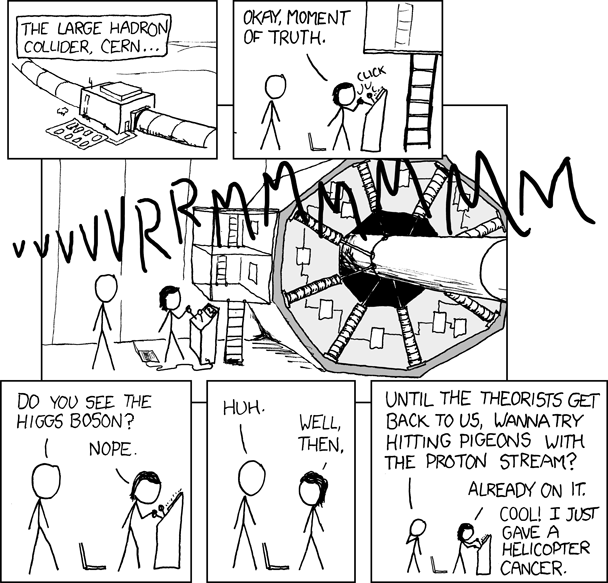
LHC Cartoon
Year of the Ox, 2009
According to high placed sources, 2009 is the Chinese year of the Ox. Hmmm. If you wanted to buy an Ox, where would you go? What does one look for in an ox? If an excellent ox was standing next to a bad ox, how would you know? Besides having tails suitable for stew, what else is tasty about the ox? Oxburgers?
An ox is a compact beast of burden- a sort of bulldozer on the hoof. Why didn’t Budweiser choose oxen to pull their famed lager wagon? If oxen were good enough for the Mormon trail and Paul Bunyan, why not for beer distribution? I’m gonna go have a beer and think about it.
Spoolhenge
Unlike many of my colleagues in the Chemical Industry, say in New Jersey for instance, Th’ Gaussling is able to enjoy a pleasant country drive to and from work every day. Among the many sights to enjoy is Spoolhenge. This curious archeological artifact is thought to have been constructed by ancient electricians in the early Cupracene Age of the Sparkezoic Era.
Who were these people? What strange rituals did they perform in this maze of paleospools? Only a few crude wirenuts fashioned out of elk antler remain in the soil surrounding these ruins.
Writer and amateur paleophrenologist Anders van der Klopp suggests the ruins may have been part of a temple built by ancient astronauts who crash landed on earth in the distant past. Van der Klopp’s panspermia theory is not taken seriously by mainstream paleophrenologists who balk at the idea of electricians in space. Perhaps one day we will solve the mystery.

Spoolhenge