The US needs many things, but now in particular we need a government that will strongly support Ukraine’s efforts to defeat Putin. Containment of Russia’s latest brutal dictator is a must for continued liberal democracy in the west. The US/NATO partnership is the necessary bulwark from the world’s two giant, grasping autocracies- China and Russia. Both will continue to be a challenge to the very existence of liberal democracies around the world for many decades to come.
Both China and Russia are weary of US hegemony in the world and seek to knock the US down and replace it with their own hegemony. The widespread use of English as the “lingua franca” of the world, US popular culture as well as the preeminence of the US dollar in world trade grates on their national pride. To coexist with US hegemony is to give consent. Both nations want to be masters of the realm. Simple human nature.
Perhaps Russia will emerge on the world stage one day as a guiding influence for decent civilization. But, that event will happen only after Russian citizens steer away from their long tolerance of autocratic and brutal leadership. It is up to the Russian citizenry to fix the Putin problem. Putin will not peacefully die in retirement. He’ll die in power like most of the former leaders of the Soviet Union from Lenin onwards did. Gorbachev had the grace to step down peaceably after he dissolved the Soviet Union. Somehow the pillars of support Putin has constructed over the years will have to crumble away. However, there is no guarantee that his successor will be much different.
The US had to be shaken from its isolationist trance to join in with WWI and WWII. Today, president #45 and others were showing a definite trend towards isolationism in the years prior to the onslaught of Putin’s savage war in Ukraine. #45’s tolerance and admiration of Putin was peculiar and very suspicious looking. Treating Putin like buddy is the wrong tack. George W. Bush said he peered into Putin’s eyes and saw his soul. Bush later said he regretted having said that.
It is not in the interest of the US or Europe to stand back as Putin goes on a land grab along the Russian frontier. So far Putin’s war has not devolved into a WWIII. The NATO countries have wisely avoided actions that would trigger a direct shooting war with Russia while at the same time sending resources to Ukraine. Yes, it is a proxy war. This support is expensive but it must continue.
With China showing interest in supporting Putin, we may find ourselves in a proxy war with them as well. However, China has much to lose in as much as the US is one of it’s biggest customers. Whatever the case, we’re on the way with Cold War II.
Henry Kissinger (HK) made waves at the Davos Conference in May of 2022 when he suggested that Ukraine and Russia return to the status quo ante. In a July 2, 2022 interview with HK in The Spectator, interviewer Andrew Roberts reports-
“If Russia stays where it is now, it will have conquered 20 per cent of Ukraine and most of the Donbas, the industrial and agricultural main area, and a strip of land along the Black Sea. If it stays there, it will be a victory, despite all the setbacks they suffered in the beginning. And the role of NATO will not have been as decisive as earlier thought.
The other outcome is an attempt made to drive Russia out of the territory it acquired before this war, including Crimea, and then the issue of a war with Russia itself will arise if the war continues.
The third outcome, which I sketched in Davos, and which, in my impression, Zelensky has now accepted, is if the Free People can keep Russia from achieving any military conquests and if the battleline returns to the position where the war started, then the current aggression will have been visibly defeated. Ukraine will be reconstituted in the shape it was when the war started: the post-2014 battleline. It will be rearmed and closely connected to NATO, if not part of it. The remaining issues could be left to a negotiation. It would be a situation which is frozen for a while. But as we’ve seen in the reunification of Europe, over a period of time, they can be achieved.”
HK supports the “equilibrium” of status of quo ante to the pre-February 24, 2022, borders rather than an attempt to defeat Russia. I think Ukraine would only agree to this if things were looking bad for them. As Putin has demonstrated, he lies all of the time. He is in no way dependable in a peace agreement.
Whatever it is that Putin responds to, we have to assume that overwhelming and superior firepower are high on the list. The US and NATO must present an iron fist in reply to Russian aggression. Putin has established himself as one of the major bad actors in modern times. The man’s ambition and swaggering macho is and will remain a threat to democratic states.
Modern Russian leadership has a pattern of oppression and intelligence gathering along with institutions to apply it everywhere they can. They are masters of propaganda and the psychology of intimidation. America is outclassed in the propaganda field.
American notions of social order were influenced by the British. The oppression of monarchy on the American colonies served as a negative example of how to govern. But, the British have the Magna Carta of 1215 in their history which was an agreement between a group of barons and King John of England providing protection of certain rights. The original charter was quickly annulled but was reissued in 1216. Over the years the charter became a part of political life in England.
The point of this history lesson is to suggest that Russian history has no similar example of democratic leanings. What did happen in 1861 in Russia was the Emancipation Proclamation by Emperor Alexander II abolishing serfdom. This edict was one of many liberal reforms during his reign (1855 to 1881) and gave 23 million serfs their liberty. While not democratic, it was a positive step change in Russian society. Another step change for Russia came with the Bolshevik revolution if 1917. Unfortunately, this gave rise to the Union of Soviet Socialist Republics (USSR) and all of the subsequent Stalinist and cold war turmoil that followed. Russia needs another step change to shake loose the dictatorship/kleptocracy model that Putin has put in place. Whatever it is that serves the needs of a peaceful Russia, it needs to arrive soon.
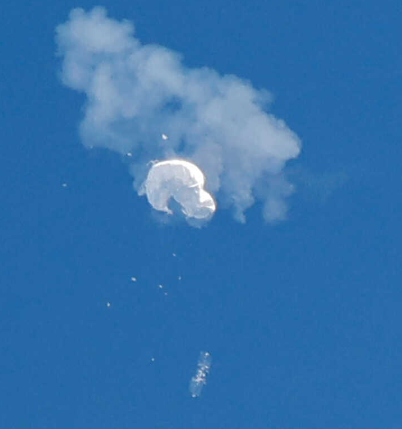
2/10/23. News is breaking that China wants to militarize the near space environment, defined as 12 to 60 miles in altitude. News reports are appearing that claim that the balloon was carrying radio antennas capable of receiving and possibly geolocating radio transmissions over the US according to The Guardian. A senior State Department source said that a U2 flyby was able to determine that the balloon was being used for gathering signals intelligence.
Chinese balloon in rapid descent maneuver.
According to CNN, the military was aware of the balloon from the very beginning and avoided any unencrypted radio communications along the flight path.
The Chinese government reacted angrily to the downing of the balloon, continuing to maintain that it was for weather research. It seems to me that the public display of anger is mostly for internal consumption although there could be those elsewhere who actually believe the official story. From various reports, it appears that the Chinese government is embarrassed that it got caught in a lie. Like other autocracies, it screeches in displeasure when contradicted.
The balloon was judged to be absent any threat to the US by the North American Defense Command when it was discovered off Alaska. Shooting it down over the US was determined to be unsafe for the citizens below. Later, in a press conference, Gen. Glen VanHerck, Commander, North American Aerospace Defense Command and United States Northern Command stated that the balloon debris that fell into the ocean is expected to be within a 1500 meter by 1500 meter field and in about 50 feet of water. The US Navy and Coast Guard are on station for recovery efforts.
From the press conference-
STAFF: Let’s go to — let’s go to Jennifer Griffin, Fox.
Q: Thanks, General VanHerck. Can I just ask you, on the record again, because there’s been a lot made in recent days still about why this was not shot down after it crossed or neared the Aleutian Islands? Can you just explain what you were watching then, what you were thinking then? What the decision-making process was. And why it — you didn’t have enough time to do so, if that was the case?
GEN. VANHERCK: Thanks, Jennifer. It wasn’t time. It — the domain awareness was there as it approached Alaska. It was my assessment that this balloon did not present a physical military threat to North America, this is under my NORAD hat. And therefore, I could not take immediate action because it was not demonstrating hostile act or hostile intent. [emphasis mine] From there, certainly, provided information on the status of the whereabouts of the balloon. And moving forward, kept the department and the governor — the government of Canada in the loop as my NORAD, I have a boss in Canada as well. Over.
Again, this is on record previously. We did not assess that it presented a significant collection hazard beyond what already exists in actionable technical means from the Chinese.
And with that said, you always have to balance that with the intel gain opportunity [emphasis mine]. And so there was a potential opportunity for us to collect intel where we had gaps on prior balloons, and so I would defer to the intel community, but this gave us the opportunity to assess what they were actually doing, what kind of capabilities existed on the balloon, what kind of transmission capabilities existed, and I think you’ll see in the future that the — that time frame was well worth it’s value to collect.
In following the savage Putin war against Ukraine I have become partial to watching short video’s on TVP’s Military Mind via YouTube. TVP is Polish public television. They have unique and up to date war footage and coverage every episode. The war footage they get is mostly drone or smart phone in origin and is pretty rough but it gives a sense of what it is like on the ground. If you are expecting politically balanced war reporting, this is not the place to get it. This Polish station is clearly wary of Russia, or Putin at least, and it’s geopolitical intentions.
Recently there was a particularly disturbing clip on TVP taken from a Russian television show called The Evening With Vladimir Solovyov. Solovyov is a state television mouthpiece for Putin. The format has guests standing at widely separated podiums and taking turns venting their sometimes murderous outrage. In it was a guest named Yevgeny Satanovsky who is President of the Institute of the Middle East who gave a very calm and matter-of-fact opinion on how to deal with their true enemies, the Americans. Russian TV has been startingly vocal about their perception of the “American threat” and what we deserve for standing up against them. From the Daily Beast article–
“First of all, our main enemy is certainly the United States. What does the U.S. react to? They react to two things: the threat of physical annihilation and the liquidation of a certain number of military personnel. What we know based on wars in Vietnam and Korea is that several tens of thousands of annihilated American servicemen will cause the public opinion in the U.S. to be severely strained. I will repeat: not several thousand, like in Afghanistan or Iraq, but a certain number of tens of thousands. Who will liquidate them, where they will be liquidated and in what way is completely irrelevant, but this is one of the objectives if we want to influence the American leadership. We have absolutely nothing to lose.”
Satanovsky concluded that based on how the Americans fought in Korea and Viet Nam, America could be counted on to limit it’s involvement up to a maximum of several “tens of thousands” of US casualties. They feign awareness of our dirty little secret of squeamishness about the body count in foreign engagements. Satanovsky said several times that Russia must “liquidate” several tens of thousands of Americans in order to stop America’s support of Ukraine. This is the key to American disengagement he says.
Resorting to grotesque threats in the same program, Andrey Kartapolov, head of the Russian State Duma Defense Committee, addressed the West with a line from an old Soviet movie: “Don’t worry, it won’t hurt when we cut your throat. We’ll slice just once and you’re in heaven… Our victory will take place wherever the Russian soldier will stop—and wherever he stops, from there he will never leave.”
Americanist Dmitry Drobnitsky commented: “In our country, we embraced one American we wouldn’t want to kill: that would be Tucker Carlson.” This is pathetic beyond words.
All of this is content generated by the host and his guests. But, their sentiments clearly are in line with the Kremlin’s interest in popular support for Putin’s war and antagonism towards the west. Much public sentiment seems to be tied up in national loss of face from the Russian military’s poor performance in the war but not so much in the actual need for the war. If you watch a few of these episodes you’ll see guests venting their white hot rage at America for it’s support of Ukraine peppered with references to WWIII and nuclear war with the west.
Propaganda, /ˌpräpəˈɡandə/, noun: information, especially of a biased or misleading nature, used to promote or publicize a particular political cause or point of view.
Americans should view some of this Russian television content to get an idea of the anti-American, anti-western bile being spewed continuously by the Russian propaganda apparatus. The Kremlin has been a master of propaganda for many years. They know the value of repeating big lies over and over. Unfortunately, certain Americans have been using this technique on our own population as well.
Hegemony, /həˈjemənē,ˈhejəˌmōnē/, noun: leadership or dominance, especially by one country or social group over others. “Germany was united under Prussian hegemony after 1871”
At present, Russia is publicly stamping their feet in outrage over western interference in their dirty little invasion, making every threat they can imagine. At the same time, actors for the state continue to conduct wave after wave of attacks on the west over the internet. Others are covertly interfering with our politics by trying to destabilize democracy. The overall goal the Russian’s share with China is to deflate American hegemony in the world and replace it with their own. You know, just your basic quest for world domination. It never ends.
Vlad Putin has been ominously reminding us that he will not rule out the use of nuclear weapons if the Russian state is under existential threat, whatever that means. Maybe now is a good time to review just a few basics of nuclear weapons and what they do.
There are a large number of internet sites that go into great detail about the dark art and history of nuclear weapons. No need to duplicate that here. I’ll just give my take on a few points.
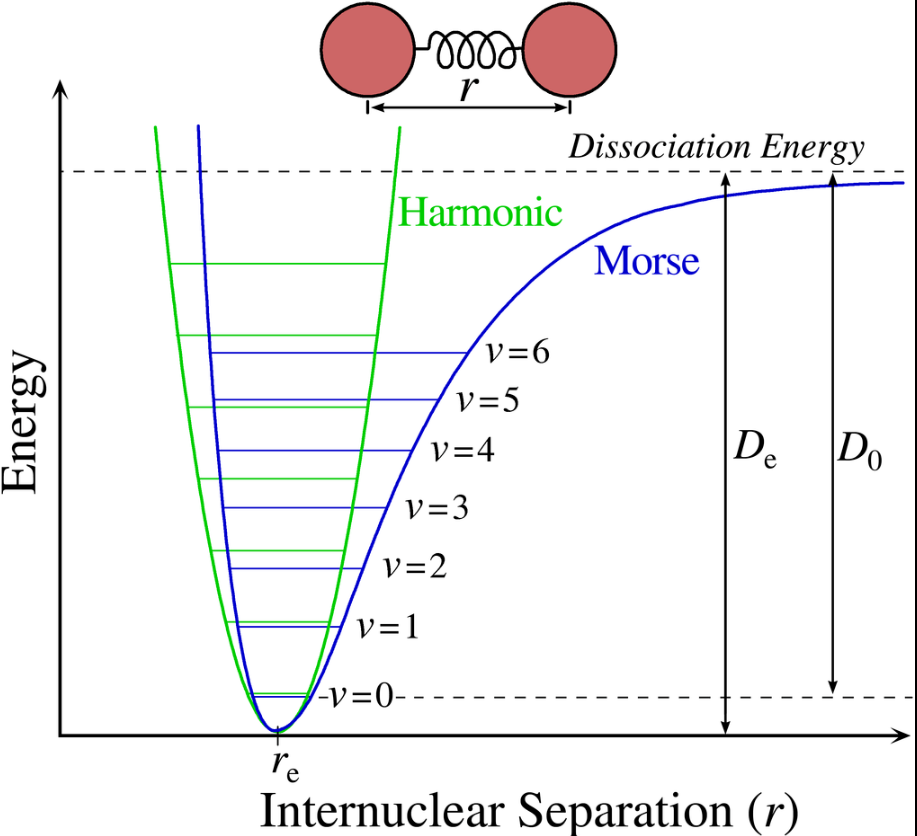
Remember the Morse curve from freshman chemistry? It describes the potential energy versus distance of two atoms at the scale of chemical bonds. The left side of the blue curve shows how steeply the repulsive energy potential rises (exponentially) with diminishing internuclear distance. By contrast, the attractive potential on the right of the blue curve flattens out with increasing interatomic distances. Keep this in mind.
When a fissile uranium-235 nucleus absorbs a neutron, the nucleus momentarily becomes unstable uranium-236. A stable nucleus has repulsive Coulomb forces between nucleons that are balanced at close proximity by the attractive strong nuclear force. The liquid drop model is useful for visualizing a nucleus as it fissions. On absorption of a neutron the uranium nucleus will distort to an elongated dumbbell shape leading to an imbalance of attractive and repulsive forces between nucleons. This can take the nucleus past the distance where the strong nuclear force attraction can hold it together. The strong nuclear force holding together nuclear particles (nucleons) falls off much faster with distance than does the Coulombic repulsion of protons. At the instant the nucleus separates into adjacent fragments, the two highly positively charged nuclei find themselves in very close proximity and are now only subject to net repulsive force. From the left side of the Morse Curve we can see that the repulsive force is exceedingly high in this moment. The highly repulsive potential energy is converted to kinetic energy at the moment the nucleus splits. The nuclear fragments fly apart at high velocity along with neutrons and dump thermal energy into the surrounding bulk material. But the kinetic energy of the fragments is not the only source of energy output.
Nuclear fission fragments are released in a highly excited state. Apart from their kinetic energy, nuclei have different energy levels with differing stabilities. A nucleus can undergo energy transitions from one state to another. These higher energy levels are called nuclear isomers and their stability can be expressed in terms of half-life. As fission fragments are formed they shed energy in the form of alpha, beta, gamma, and neutron emissions. Neutrinos are left out of this discussion for simplicity. As nuclei decay, they get closer to a stable ground state. Unstable nuclear fission products will decay in their characteristic ways, contributing to the overall energy release.
One challenge to weapons designers is to cause as many nuclei as possible to fission before the weapon undergoes “hydrodynamic disassembly” over the first 1 microsecond or less. After ignition the rapidly expanding plasma of the bomb core increases in volume and the probability of neutron collisions with nuclei diminishes rapidly. When a uranium or plutonium nucleus fissions, 2 or 3 neutrons are emitted which go on to strike other nuclei and induce fission in them. The cascading generations result in an avalanche of fissions. One of the ways to ensure that enough generations of fissions occur with enough neutrons flying about inside the supercritical assembly is to surround the core with neutron reflecting material. Ways of doing this can be found elsewhere.
One more thing about the strong nuclear force. This quote is from the Wikipedia entry for the strong interaction–
“The residual strong force is thus a minor residuum of the strong force that binds quarks together into protons and neutrons. This same force is much weaker between neutrons and protons, because it is mostly neutralized within them, in the same way that electromagnetic forces between neutral atoms (van der Waals forces) are much weaker than the electromagnetic forces that hold electrons in association with the nucleus, forming the atoms.“
A nuclear weapon produces a near instantaneous point source of energy release. These bombs can be detonated at or below ground or water level, or they can be set off in the atmosphere or space. The choice of where to do it depends on the intended effects. Subsurface bursts consume much of the explosive energy in moving soil or water which provides some radiation shielding to the surrounding area. Furthermore, bursts in contact with soil or water, especially when the fireball contacts the soil, tend to produce more fallout than air bursts. Air bursts deliver EMP, radiation and blast effects to a wider area, where “radiation” refers to neutrons, gamma and longer wavelengths of electromagnetic radiation. Thermal and blast effects produce considerable prompt destruction in the area surrounding the blast. As an approximate point source of energy, the intensity of the radiant energy falls off as some inverse square law. On an encouraging note, this means that radiation exposure falls off rapidly with distance. Distance is your friend.
There are numerous variations on the nuclear weapons theme. In the early cold war days, so called A-Bombs and H-Bombs were in the news. H-Bombs are also referred to as “hydrogen bombs or thermonuclear weapons.” An A-bomb, A for Atomic, was a basic implosion-type fission explosive and it was the typically the least powerful of the two. The H-Bomb was a nuclear fusion explosive that was triggered by a fission “primary.” That is, a fission trigger would be used to generate x-rays that would be “focused” onto fusion fuel, the “secondary,” which would initiate a runaway nuclear fusion explosion. The explosive yield of these bombs is much higher and can deliver a devastating blast to a larger area. Over time, the efficiency and compactness of these bombs has been greatly optimized.
The fusion explosive element was lithium-6 deuteride. The lithium atom would absorb a neutron, become unstable and decay into a helium-4 nucleus and a tritium (helium-3) nucleus. On a side note, in grad school I attended a seminar by Dieter Seebach from ETH, Zurich, who was talking about mechanistic work they’d done with lithium enolate complexes. He mentioned in passing that at that time, the mid-80’s, they had to be careful with stoichiometry because the commercial lithium that was available was often depleted of lithium-6 which was accumulated by the government for diversion to weapons. It was an unexpected brush with the cold war.
The main deleterious effect of radiation on human tissue lies in the formation of ions and radical pairs along the path of the penetrating radiation. The molecules of life are dissociated into ion pairs or radicals which may or may not collapse back to the original molecules. Given the amount of energy transferred into molecular dissociation along with random diffusion, the molecular destruction cannot be reversed. Heavy radiation particles like alpha particles produce a great many ions per centimeter of tissue penetrated. Penetrating, energetic photons like gamma rays produce relatively few.
There are 6 forms of hazardous radiation commonly considered- alpha, beta, gamma, x-ray, ultraviolet and neutrons. Of these 6, alpha, beta, gamma and neutrons are of nuclear origin. X-ray and ultraviolet are “electronic” in origin, that is they arise from electron transitions outside of the nucleus. The matter of the origin of x-rays is often confused in the literature with some authors implying that x-rays are from the nucleus. I prefer to define x-rays as resulting from electron transitions at the atomic level.
Of the 4 nuclear radiation types mentioned above, alpha, beta, and neutrons are particles. Gamma rays are photons. The atomic nucleus is comprised of so-called nucleons which are protons and neutrons. Nucleons are composite particles comprised of quarks and can bind by the strong nuclear force. Alpha particles are helium-4 nuclei and neutrons are neutral particles with approximately the same mass as a proton or about 1 atomic mass unit. Neutrons are not stable outside of the nucleus and have a half-life of about 15 minutes. Free neutrons will undergo radioactive decay into a proton, an electron, and an electron antineutrino.
Like gamma rays, neutrons are neutral in charge and have great penetrating ability. However, neutrons are effectively scattered by collisions with the hydrogen atoms of biomolecules and water. As a result neutrons can be very destructive to living tissue. As a side note, paraffin wax and water are effective shielding materials for neutrons due to the high concentration of hydrogen atoms. The collisions with hydrogen atoms in living tissues is a means of dumping neutron kinetic energy into the bulk matter, resulting in dissociation of biomolecules.
The so-called “neutron bomb” was an explosive that was designed to produce an abundance of neutrons at the expense of explosive yield. During the early Reagan years in the US there was much public handwringing about these bombs and their ability to kill people but leave buildings standing. People seemed indignant that somehow this reduced the value of human life below that of material things in the grand calculation of destruction.
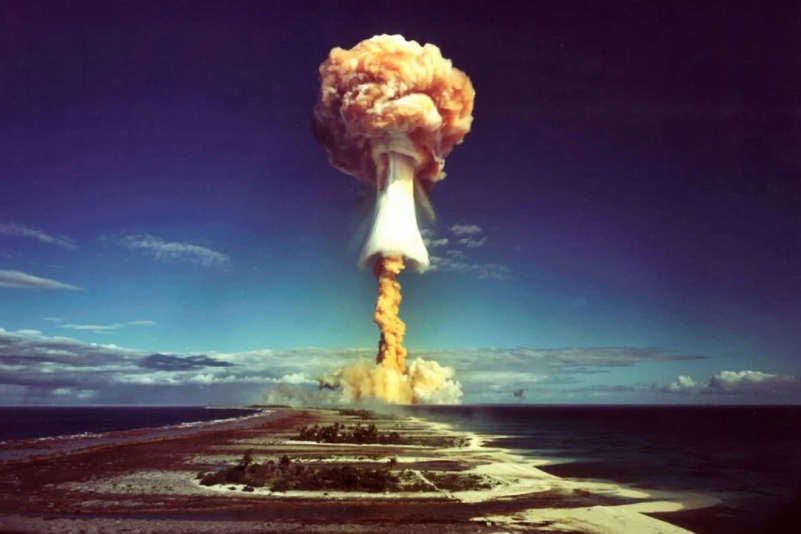
The characteristic mushroom shape rising to the sky after a nuclear air burst is just the result of a rapid release of energy and bomb debris in the air, but close enough to the ground to suck up soil. The “cap” of the mushroom results from the convectively rising point-source expansion of incandescent, debris-filled air from the point of energy release. The “stem” of the mushroom is a column of air that has rushed in to replace the rapidly rising fireball, picking up soil as it does so. There is nothing intrinsically nuclear about a mushroom cloud. Chemical explosives can do this as well.
Initially the fireball produces a strong pulse of thermal radiation. As this fireball develops, there is a momentary drop in radiant thermal energy due to the increasing opacity of the fireball. With further expansion the opacity of the fireball decreases and the thermal output increases. The shock wave and out-rush of air is obviously destructive, but the radiant thermal effects are not to be underestimated.
Another major effect of a nuclear blast is nuclear fallout. A nuclear blast unavoidably produces radioactive substances from the fission process and from neutron activation. A low altitude air burst is particularly troublesome because ground debris is sucked up into the air and contaminated with radionuclides. This material does what all suspended solids do, namely it is carried by the wind and falls back to earth gradually, contaminating a wide swath of ground. The finest particles remain suspended and are transported long distances, eventually falling out with rain or snow.
Finally, there are psychological effects associated with “the bomb.” It inevitably produces dread fear in people. This fear buttresses the idea of Mutually Assured Destruction or MAD.
Now that we are in a nuclear state of mind, let’s turn to what Putin intends to do with his nuclear arsenal. The Russians are not suicidal. Putin is neither crazy nor stupid. Russians have long understood where a nuclear confrontation with the West can go. They know escalation of nuclear war to full-scale would lead to mutual destruction of Russia and the West. The Russians know that the West has a policy of no first use with nuclear weapons and that we are extremely reluctant to use them. For the West, there is a firebreak between conventional and nuclear weapons. For the Russians, it is more of a continuum. They know that sabre rattling with their nuclear arsenal creates a good deal of anxiety in the rest of the world and Putin has been pushing this threat envelope to new levels and will keep doing so. Once a KGB guy, always a KGB guy. Putin obviously understands the pragmatics of coercion and the influential value of torture.
What nobody knows for sure is what happens when a Russian nuclear war shot is released. What does the West do? Respond in kind quickly or play the long game and see what happens next. How much planning has gone into nuclear conflict between two states outside of NATO? When would NATO step in? NATO is presently taking the side of Ukraine in terms of supplying money and arms but is studiously avoiding direct conflict with Russia. On the positive side, at least right now we aren’t bogged down with an endless middle east whack-a-mole exercise.
The best use of nuclear arms has always been and remains the threat of their use. Russia has been using this threat aggressively, even going so far as to blame Ukraine for planning a false flag operation with a “dirty bomb.”
Putin wants to see the alliance of the US and Europe disintegrate. He wants to see the American hegemony in place since WW II collapse. He wants to see the dominance of US culture, military reach, the influential dollar and prevalence of the default English language peel away. He wants to see Novorossiya rise from the ashes of the fallen USSR. But his vision requires the conquest of territory and cultural domination. The armed extinction project for Ukraine in process now will be followed by rebuilding the captured land with Russian infrastructure, political leaders and culture.
Russia, in its constant state of paranoia, wrings its hands about the “threat” of NATO at its border. The cruel irony is that it is hard to imagine that the West would find the conquest Russia possible or even desirable. The US-lead coalition was unable to get the medieval opium poppy kingdom of Afganistan under control with conventional weapons. How is it possible that we could even consider a preemptive invasion of Russia? Russia’s historical paranoia seems entirely self-serving for its authoritarian leaders.
One way to tear apart western alliances is to help them along with the demise of liberal democracy. Quietly support the internal cultural rot of individual nations by encouraging radical nationalism, white supremacy and political disharmony. It is happening all around us and especially here in the US. As badly as I’d love to entirely blame #45, I have to admit that he has only prodded a sleeping dragon. The MAGA and QAnon crowds were already out there. #45 has rallied them and validated their seething anger and indignation.
Today we have many people of great influence like Tucker Carlson, Alex Jones, Sean Hannity, nationalistic religious broadcasters, a stable of fringe political figures, and a mass of MAGA foot soldiers winning down-ticket elections moving their nationalistic and religious conservative agenda forward. Post-war baby boomers are being replaced with crowds and leaders who reject America’s present liberal democratic culture and leadership role in the world. There is growing open admiration for strongman authoritarian leadership. America’s experiment with fascism has already begun. Surprisingly, many Americans have expressed support for Putin.
Putin’s vicious attack on Ukraine, the rise of Trumpism with American fascism and a viral pandemic have overlapped within a narrow window of time- any one of which is a big problem by itself. It seems doubtful that MAGA right-wing crowds will have a change of heart in their vision for America. They will live out their lives within the same closed ideological space they are in presently. A political depolarization of America seems unlikely in the near term.
In this depressing global political climate it is more important than ever for the US to maintain its role as a thriving democratic culture and defender of those seeking democracy. Our leadership role in NATO must not waver against Russian aggression and expansionism. Russian expansionism will not end with Ukraine.
What will Putin do if he sees his internal political power structure collapsing? Will he ramp up the war to distract his opponents and rally the country? The present situation in Russia seems to suggest that rallying the population is more difficult than he anticipated.
It is hard to believe that Putin and his inner circle will change their ways in their lifetimes. They’ve painted themselves into a corner with their aggression and, like a trapped animal, will fight to the death. The cruel and murderous Joseph Stalin died in power. There is no reason to believe that Putin will be any different.
Russia sent a letter to the United Nations accusing Ukraine of preparing to use a ‘dirty bomb’ in their battle with Russia. Western countries have claimed that this is nothing but a transparent attempt by Russia to provide a pretext for their own use of a dirty bomb or some other offensive action.
This issue resembles the matter of Weapons of Mass Destruction (WMD) that the Bush administration in the US contrived as a pretext for taking down Saddam Hussein. A great many innocent people died and we damaged our moral authority in the world by that and other wars. It was an obvious lie to a great many Americans and allies yet the Bush administration went forward with the invasion. No WMDs were found.
According to Wikipedia, a dirty bomb is a conventional explosive packed with radioactive material that, on detonation, disperses the dangerous material in the target area. Such a thing could be made portable or assembled on site. It is not to be confused with a nuclear bomb. A dirty bomb blast would be a radiological calamity wherever it is set off as well as downwind of the explosion. Being non-nuclear, dispersion by a conventional explosive would be extremely limited in range in terms of blast effects, but intensely radioactive. As with any sudden generation of dust and smoke, there would be a plume of radioactive material (RAM) extending downwind from the release. Water soluble radioactive materials would pollute the watershed and possibly groundwater. Contaminated soil would exclude the area from farming for many decades if not longer. Great harm would befall the biosphere.
Construction of a dirty bomb could be quite problematic for its builders. Assuming the builders of the bomb are not suicidal, collecting RAM, assembling and delivering the bomb could be tricky. On one end of the scale, spent nuclear fuel could be used as the source of RAM. Assembly could be as simple as packing explosives around a container of RAM. To prevent serious exposure to the workers, there would have to be some kind of shielding present during the handling of the RAM. On the lower end, a small RAM source from a medical device could be used. Whatever the case, the containment must be fragile enough to rupture in the explosion but dense enough to provide some level of shielding for the handlers.
The harmful effects of a dirty bomb would be both radiological and psychological. On the psychological end, it is sure to cause dread fear in the general population and sway public sentiment toward one side or the other. Importantly, its use would be releasing the nuclear weapons genie from its bottle. It would lower the threshold and allow war planners everywhere to reconsider their own use of nuclear strategy and tactics because a precedent has been set. Once the genie is out, there is no putting it back, or so the saying goes.
In all of the war gaming and planning NATO has done over the decades, I wonder how much attention has been given to responding to nuclear conflict between non-NATO states? What should the NATO countries do if other actors engage in nuclear conflict? As always, it depends on the circumstances.
==========================
I have chosen to avoid using the term “explosive device” because I feel it has a certain sanitizing effect. A thing that is meant to cause death and destruction by the explosive release of energy is just a f*cking bomb with all of the meaning and negative connotation associated with the word. Even grudging admiration for someone’s cleverness should not be awarded for putting together a “device.”
It remains to be seen if the economic sanctions imposed on Russia by the west will have even a smidgen of effect on Putin. Western sanctions on the USSR had substantial effect on the Soviet people back in the cold war days, but the leadership of the USSR lasted for a very long time in this condition. It is naive of us to think that it will be any different with the Putin regime. Look at Iran and North Korea. They have lived under extreme sanctions for a very long time while under the tight control of their leadership and even have developed or will develop nuclear weapons.
One difference today in Russia is the relatively large middle class. They are accustomed to a lifestyle where goods and services are abundant. The smack down of the Russian economy will adversely affect them. But will it make a difference in Putin’s autocratic behavior? In the past, Putin’s response to dissent has been to crack down using the police and security services to enforce draconian law. Putin does not report to the Russian people. Like the old story of boiling the frog, he has cannily built a tight power structure around himself over time.
Will pinching the finances of the oligarchs make the difference? There is already talk of them turning to block chain schemes to park their money. Sanctions mean that money will begin to flow elsewhere. It seems doubtful that Putin would have allowed this kind of Achilles Heel of a powerful class to exist. Some think that the oligarchs report to Putin and not the other way around.
One beneficiary of this situation is thought to be China. It surely hasn’t gone unnoticed in China that the disconnection of western business will provide a great many business opportunities in Russia as well as an expansion of their sphere of influence. All we can do is to watch it unfold.
Putin’s invasion of Ukraine will bring negatives to his regime. Whether it will bring him down seems unlikely. Historical precedence does not give much hope to the idea that Putin will have a ‘come to Jesus’ moment and cause him to relent.
Russia’s status as a nuclear power worries everyone, of course. Adherence to the strategic doctrine of Mutual Assured Destruction (MAD) between nuclear states has limited warfare to the use of conventional arms for generations. It has been the doctrine of the US to incorporate a fire break between the use of conventional and nuclear arms. Whether this is true for Russia is unclear. They may see nuclear arms as part of a normal escalation in force. This would be most unfortunate if true. How the west would respond to the release of nuclear weapons in Ukraine or against other states of the former Soviet Union is also unclear, but there are surely contingency plans for this eventuality somewhere in the pentagon. I hope.
The unifying affect on the west in responding to Putin’s aggression is encouraging but it may not be enough to stop Putin from further invasions. Let us hope that this madman can be contained.
An article I read in Spiegel online deserves comment. My German is too paltry to be of use so I read Spiegel because it is in English and seems credible.
The article in question is titled “Russian Foreign Policy:‘We Are Smarter, Stronger and More Determined’ ” and is the transcript of an interview by Christian Neef of Spiegel. Neef interviewed Sergey Karaganov, known as the honorary head of the Council on Foreign and Defense Policy and Dean of Faculty at National Research University Higher School of Economics in Russia according to Wikipedia.
Karagonov is quite blunt in his distrust of NATO and confident in Russia’s determination to take it’s place as the dominant Eurasian power. Just a few bits of the interview-
Karaganov: The Russian media is more reserved than Western media. Though you have to understand that Russia is very sensitive about defense. We have to be prepared for everything. That is the source of this occasionally massive amount of propaganda. But what is the West doing? It is doing nothing but vilifying Russia; it believes that we are threatening to attack. The situation is comparable to the crisis at the end of the 1970s and beginning of the 1980s.
SPIEGEL: You are referring to the stationing of Soviet intermediate-range ballistic missiles and the American reaction?
Karaganov: Europe felt weak at the time and was afraid that the Americans might leave the continent. But the Soviet Union, though it had already become rotten internally, felt militarily strong and undertook the foolishness of deploying the SS-20 missiles. The result was a completely pointless crisis. Today, it is the other way around. Now, fears in countries like Poland, Lithuania and Latvia are to be allayed by NATO stationing weapons there. But that doesn’t help them; we interpret that as a provocation. In a crisis, we will destroy exactly these weapons. Russia will never again fight on its own territory …
July 13, 2016. Spiegel Online International.
It should not be a surprise that Russia has been steadily acquiring a gleaming confidence and a recharging of energetic nationalism under Putin. Too much ink has been spilled on Putin the man rather than Russia the state. I would question whether sufficient resources are being applied to diplomacy with this confident Russian state. I sincerely hope that our elected officials have the intellectual bandwidth to understand what is happening.
I shall now veer in a somewhat different direction.
It is my impression that the Fourth Estate in America is consistently failing in it’s responsibility to participate in the very democracy that facilitates its existence by not keeping the spotlight on the powerful. Worse yet, a distracted, flaccid American populace consistently fails to hold this pillar of our society accountable.
Elected officials and the agencies they fund are only too willing to keep our country on a perpetual war footing because the production of war materiel keeps people employed and stockholders fat and happy. Defense dollars pour into military installations in the US and the world round to maintain staff, pay contractors for supplies, and drive money into the local economy.
The influential petrochemical industry is only too happy to warn of the dire consequences of lost American influence in the far flung oily spots of the world. That the US is willing to send and keep forces abroad to protect petroleum interests- in the name of liberty- only adds credence to the meme that oil is worth almost any sacrifice in blood and treasure. Against such a longstanding and compelling circumstance, how can elected officials support alternative energy technologies that might undermine the profits of big oil who we’ve fought so hard to support?
Politicians find strident support from the electorate by the evangelical rhetoric of flexing our military might for God and country. And liberty, if you were lucky enough to be born in the US. They well know that a large segment of the electorate is susceptible to all of highly produced emotional imagery of flag waving, weeping veterans kneeling before a tombstone, and country singers belting out patriotic lyrics. Yet with all of the concern for American veterans, nobody has demanded satisfaction on the following question: Are we being careful enough in choosing where we send our troops? Is it based on rock solid information and against qualified threats? The youth who become our troops are national treasure. Yet we send them into battle spaces where combatants look like non-combatants and are fighting over conflicting religious doctrines. When they come home injured we turn them loose in a shamefully inadequate Veterans Administration hospital system. Perhaps a bit of time on the 4th of July and Veterans Day should be devoted to a meditation on this rather than beer and burgers? Is this our best effort?
Electronic media have a clear conflict of interest in their focus on the costly horse race aspects of politics. “Money has corrupted our electoral politics!!” is the shrill cry. But what fraction of that filthy lucre is channeled to the very media in the form of political advertising? More than a little, perhaps?
Once again we will have conflicting superpowers vying for global influence and resources. With Russia on the rise, do we have the unity and compelling interest to avoid armed conflict with them? What caliber of elected officials do we need to grapple with a future that seems sure to bring the threat of nuclear conflict back? Are we ready? We have never needed a quorum of mature adult voices demanding civilized behavior as much as we do today. Heaven help us all.

 Lamentations on Chemistry