Category Archives: Law

Fentanyl Now a WMD

US President Donald J, Trump has declared that the illicit synthetic opioid Fentanyl has been declared a weapon of mass destruction, WMD. Fentanyl precursors have been added to the Convention against Illicit Traffic in Narcotic Drugs and Psychotropic Substances of 1988. This WMD status is from casting about for justifications to be at war with Venezuela or other countries.

When you are in control of the world’s most powerful military, there must be tremendous temptation to use it to clobber someone. When you’re a hammer, everything looks like a nail.

Intermediates added to the Convention against Illicit Traffic in Narcotic Drugs and Psychotropic Substances of 1988:

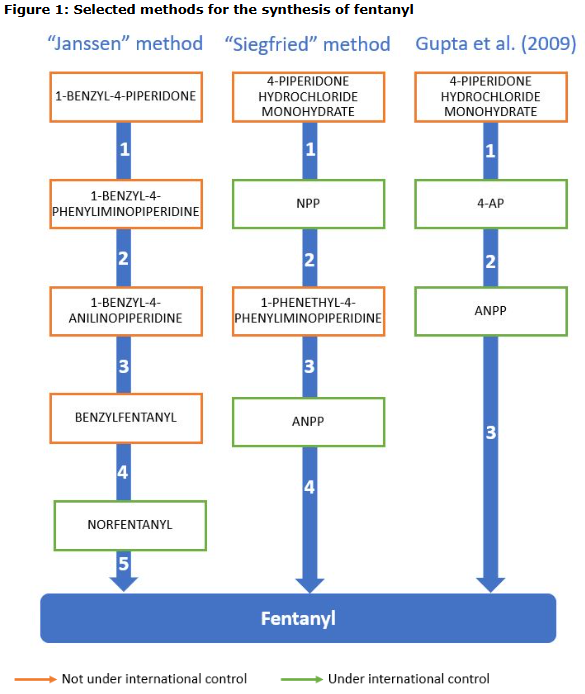
VIENNA, Austria – April 2022: At its 65th regular session from 14 to 18 March 2022, the Commission on Narcotic Drugs added three precursors that can be used for the manufacture of fentanyl and its analogues to Table I of the Convention against Illicit Traffic in Narcotic Drugs and Psychotropic Substances of 1988. Source: News: April 2022 – UNODC: Three precursors of the most common synthesis routes used in illicit fentanyl manufacture now under international control

From UNDOC

The WMD designation is clearly about legally mobilizing the military to interdict transport of fentanyl into the USA. The choice of fentanyl as a drug to manufacture by the cartels comes down to the extremely high potency and the relative ease of manufacture. The high potency, 2 milligrams for a lethal dose, means that it can be highly diluted with another drug and add to the overall potency. The high potency also means that a great many doses can be transported in small containers that may be easier to disguise and transport.

The obvious downside to fentanyl distribution is for the user. How careful are the people who spike intermediate quantities of substances, e.g., heroin or coke, so as not to provide a toxic product when repackaged for individual doses? Fentanyl should be redesignated as a highly potent toxic substance outside of the health care industry. As a drug distributor you probably don’t want your customers falling over dead from your product. That’s bad for repeat business. Regardless, user safety is unlikely to be a major concern to the distribution chain.

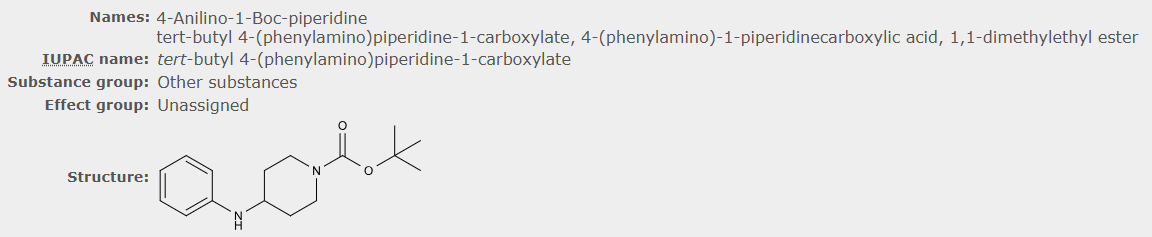
Sodium borohydride (NaBH4) can be used in the synthesis of fentanyl, so it is on the DEA Special Surveillance List. Sodium borohydride is a very useful and relatively safe hydride reducing agent that I and hundreds of thousands of others have used over the years in chemical synthesis. Sorry to see possible restrictions on its use.

The problem with this “designation of fentanyl and precursors” is that making a designer drug not cited in some list based the structure of fentanyl is that potent analogs can be dreamt up and produced if the right raw materials are available. Any organic or medicinal chemist should be able to come up with a list of candidates. Using existing drugs as a rough guide, producing obscure analogs is a skill set used by pharma companies frequently: Methyl, ethyl, butyl, futile … as the saying goes.

Wouldn’t it be nice to make some headway on the demand side too?

Fentanyl anecdote-

A few months ago I had surgery that involved my being anesthetized with fentanyl. I’ve been dosed with fentanyl several times and can report that it works well. What I didn’t note until the last instance was that it caused my face to itch badly for about 1 hour after surgery. Turns out this is a normal side effect and is not harmful. I had to wonder if addicts whose heroin was spiked with fentanyl had to suffer from both opioid-caused constipation and an itchy face. They have my sympathies there.

Navalny and Trump: Brothers in Sacrifice. Seriously??

Recently Trump has compared his troubles to that of Alexei Navalny, the recently deceased political opponent of Putin. Fox News aired a Trump interview with Laura Ingram where she asked how he is going to pay his enormous legal costs. He described his troubles as “a form of Navalny” and quickly pivoted to his large-scale legal woes. He stated that “We are turning into a communist country in many ways.”

First, 4 grand juries of fellow citizens in 4 jurisdictions indicted him on 91 felony counts. He has been given due process. For, Navalny, not so much. He was poisoned with nerve agent in 2020 (a particularly Russian trick) but managed to survive. Following treatment abroad, he returned to Russia where he was quickly apprehended, convicted and sentenced to 19 years in a maximum security prison for recidivists and those with life sentences for violence.

Source: Google Maps. The Fku-Ik3 facility in Kharp, Russia, Yamalo-Nenets Autonomous Okrug.

He was sent to penal colony number 3, a distant arctic prison in the Yamalo-Nenets Autonomous Okrug. According to Hugh Williamson of Human Rights Watch, “The Russian authorities have abandoned any pretense of justice in dealing with dissenters, and with Navalny they have thrown a litany of charges against him, each more brazenly absurd than the next.

Source: Google maps. Navalny’s Polar Wolf penal colony was in the town of Kharp in north central Russia, as indicated on the map. The town was built by Gulag prisoners in the Stalin era.

The Soviet Union had a large number of Gulags prior to its collapse. The map below shows the locations of the camps. During Operation Barbarossa in WWII, Hitlers army and Himmler’s SS were under orders to kill all Jews encountered and they did. Many non-Jewish Poles, Ukrainians and Belarusians were murdered during Hitler’s advance to Moscow and subsequent retreat. Poland in particular suffered greatly during this time. Some fraction of Jews were sent to various concentration camps but a great many were collected into groups and shot en masse just outside of their villages. As the Red Army moved into Poland killing and pushing the Germans west, Stalin gave orders to take over control of the country and establish a communist government. The participants of the weak non-communist provisional government of Poland were captured and killed by the Soviets and the Polish government was taken over under communist control. Many, many Poles were captured and sent into forced labor in the Gulag system. Poland was savaged by both the Soviets and Germans.

Source: Wikipedia, Gulag. According to Wikipedia, the Soviets had 423 labor camps as of March, 1940. It is said that 18 million people passed through the camps and 1.6 million died due to detention.

As an American, I have been exposed to the history of both the western European and Pacific theaters of WWII. However, the history of Central and Eastern Europe, especially from WWI through WWII has largely been absent in my experience. I just finished reading the 2010 Bloodlands by Timothy Snyder. Snyder is a Yale historian and writes in detail on the period in the Central and Eastern European regions between the times of the Bolshevik revolution and the end of WWII.

The period of 1932 to 1933 (the Holodomor) in Ukraine is particularly interesting and sheds light on the fear and revulsion Ukrainians must feel at the prospect of once again coming under Russian rule. During this time the Soviets, on orders from the Kremlin in Moscow, blocked any exit from Ukrainian territory and starved the Ukrainians in an effort to speed collectivization. Their agricultural products were stolen leaving Ukrainians to starve. Many tens of thousands were killed or sent to the gulags. Being sent to the gulags entailed being packed into rail cars and shipped off without food or warmth. Sometimes when they arrived, they found that they would be forced to build the prison camp they would be imprisoned in.

Some critics complained that the book presents nothing new. It is after all heavily referenced to extensive existing literature. Nonetheless, it is a very compelling read for we non-scholars. For Americans in general, this bit of history is probably unheard of.

For Trump to compare his “treatment” by the American Justice system to that of Navalny betrays great ignorance of the history and contemporary politics of Russia. His lack of compassion for Ukraine is only a small slice of his overall absence of compassion.

Handing over the presidency of the USA again to Trump would be a tragic mistake that might not be recoverable.

Shock and Awe Law Enforcement

The difficulties black citizens encounter with law enforcement are numerous and many have been severe. More than a few end up dead from a police encounter. Everybody has seen this in the news. I am not a legal scholar and have no official experience in law enforcement. I know only what I have observed.

What I have observed on video are episodes of escalating tension followed by a step change to violence over the course of an individual’s encounter with the police. A traffic stop results in a request for the driver’s documents. Sometimes the driver is reluctant to hand them over for some particular reason. The driver could have trouble with authority figures generally or is angered by the tone with which he is being spoken to. The driver could be frightened and given to poor judgement. Or, the driver could be wanted for some warrant or crime and is unwilling to be apprehended.

The driver could be perfectly innocent of crimes and just speeding a bit or could be carrying contraband in the vehicle. The officer is likely to be unsure of who they have stopped or may have found a vehicle they have been looking for. Officers need to be extremely careful in all interactions with the public.

What seems to happen in many of these violent encounters with police is that the officer repeatedly tries to get information from the citizen and something snaps. Either the officer loses patience or the citizen gets combative or both. Whatever the case, the officer at some point feels threatened and wants to restrain the citizen according to procedure. The citizen, not comprehending why this is happening and fearing the worst, resists following the directions of the officer. The officer notices the resistance and ratchets up the intensity. This is where things can go south.

At some point the officer may call in for other officers to help with the situation. Whether alone or with several officers present, an officer will repeatedly demand instant obedience. If there is not prompt obedience, the officer may escalate and draw and point a stun gun or service pistol at the citizen. If the citizen is agitated and out of control or threatens the officer, they might be subject to a stun or worse.

If the officer attempts to forcibly remove the citizen from the car, a struggle may ensue. In videos broadcast to the public, the officer remains with the citizen struggling for control, shouting instructions at the citizen. By this time the citizen is likely in a state of panic or anger and is irrational. The citizen could lash out violently or attempt to escape. Prompt and absolute yielding to force and shouting isn’t necessarily natural to the citizen.

It seems to be in the nature of police training that once a non-compliant citizen has been encountered, the police will not stop until they apprehend them. This approach can escalate to physical harm or the death of the suspect or the officer. Also evident, the method police use is what I can only refer to as a “shock and awe” approach. It is meant to confuse and overwhelm the suspect with police power and authority. The problem is that it doesn’t always work. As the suspect continues to struggle the officer(s) may begin to fear for injury or death. Or, the officer(s) may become unable to contain their rage. Whatever the case, a service pistol may be drawn and discharged. Pardon my ignorance, but it has never appeared to me that the police shoot to wound or disable- only to kill.

It appears that the requirement perceived by the officer is that once they have a suspect in hand they may apply whatever it takes, even as much as shooting, if they are unable to control the suspect in a reasonable time.

We have to ask, is an apprehension technique that relies on arresting officers to overwhelm and outwrestle the citizen the only technique available? Officers do not start with this shock and awe. They ask for license, registration and proof of insurance first. During that time the citizen has time to think about how he or she will react to the situation.

What happens in other countries?

Plainly, a law enforcement agency will not interact in a way that would let the citizen escape if things became difficult. In principle, the law must always prevail lest it be known that all you have to do is struggle and you can get away. This seems reasonable, except that the officer may end up the judge, jury and executioner. Should a suspect die from a kill shot delivered by the arresting officer if the officer is just out of patience? Or if the suspect is physically too powerful? Is it ever OK for the officer to relent and let the citizen escape into the wind?

How can we educate people to avoid escalating an encounter with a police officer before the point where the officer pulls their gun? Either the citizen or the officer or both can suffer from hot headedness. But in the exchange between you and the police officer, the law will always get the upper hand eventually.

The police have a responsibility to use good judgement and the training to execute their duties. But I’d say that when citizens are stopped by the police, they must realize that they are in a situation where things could go irreversibly for them if they make some poor choices. That means knowing when to stop arguing and yield to the officer(s). If the officer has engaged you in a traffic situation, they have already called in your plates for warrants and other information. If a polite exchange of information has not convinced the officer to let you be on your way, then further haggling is likely to go badly for you. At this point, you’ve already lost the game and should relent.

The reason behind this essay is to explore the idea of shock and awe as an apprehension method. How often does it work? What do criminologists say about it?

Obviously, asking citizens to behave better is not an easy strategy. But physical actions by the police that confuse and frighten the citizen puts them on alert and may trigger a violent reply. Does any agency or other organization try to have a discussion with the public about this?

It’s not all about heavy handed officers out there. Citizens must learn that there are poor choices that will ruin or end their lives and that there may well be a time for submission. Due process still exists.

The Politics of Due Process

We’ve been treated to unceasing wails of unfairness by #45 in relation to his mounting legal woes. It’s all politics, he proclaims, meant to disrupt his presidential campaign. I have to agree that politics are definitely involved- the politics of democracy and due process.

Democracy does not derive from some natural physical law. It is something that we allot to ourselves by consensus and the axiom of certain inalienable rights. In its purest form, democracy is a type of political structure focused on the will of the majority and the inherent rights of the individual. In our democracy, elected representatives put laws into place by consensus. Admittedly, it is sort of janky and prone to abuse. But, in the end, it always manages to right itself after a storm. In truth, our system of laws is inherently political by the definition below.

Politics, noun

pol·​i·​tics ˈpä-lə-ˌtiks 

plural in form but singular or plural in construction

1athe art or science of government

bthe art or science concerned with guiding or influencing governmental policy

c: the art or science concerned with winning and holding control over a government

Source: Merriam Webster

Our system of laws is subdivided into many areas. One of them specifies the layers of fair treatment by the judicial system. We call it “due process.” All of us are entitled to due process under the law, even ex-presidents.

In the course of due process, #45 has been indicted 4 times resulting in 91 felony counts. Did this result from political action? Yes indeed- the politics of democracy under the lawful guidelines of due process. Evidence of wrong-doing was presented to a grand jury of citizens 4 times and 4 times indictments were issued from 4 jurisdictions. “Mr. ex-President, this is what due process looks like. Yes, it is the politics of democracy you idiot.”

Water Breaks in Tejas

Local laws mandating that 10 minute water breaks be given to construction workers every 4 hours have been eliminated by Tejas Governor Greg Abbott and the legislature under HB2127 titled “Texas Regulatory Consistency Act.” The bill was put forward by Rep. Dustin Burrows, R-Lubbock. The bill is seen as an effort to push back on progressive local laws by cities like liberal-leaning Austin and Dallas where ordinances have been put into place to protect construction workers against the oppressive heat of Texas. Abbott said the bill will “provide a new hope to Texas businesses struggling under burdensome local regulations.”

Hyperbole,  /haɪˈpɝː.bəl.i/, noun; a way of speaking or writing that makes someone or something sound bigger, better, more, etc. than they are

In Section 2 of the bill, it says the legislature finds that:  “(1) the state has historically been the exclusive regulator of many aspects of commerce and trade in this state; (2)  in recent years, several local jurisdictions have sought to establish their own regulations of commerce that are different than the state’s regulations; and (3)  the local regulations have led to a patchwork of regulations that apply inconsistently across this state.

The State claims to be the exclusive regulator of commerce and trade in the state pursuant to Section 5, Article XI, Texas Constitution. HB2127 was written to more closely define what kinds of codes local governments are free to do.

Given the state’s interest in commerce and trade, Section 6 removes any ambiguity in that regard. Labor regulations come under the heading of commerce and trade, so the state is the only lawgiver here.

HB 2127, SECTION 6.

Subchapter A, Chapter 1, Business & Commerce Code, is amended by adding Section 1.109 to read as follows:

Sec. 1.109. PREEMPTION. Unless expressly authorized by another statute, a municipality or county may not adopt, enforce, or maintain an ordinance, order, or rule regulating conduct in a field of regulation that is occupied by a provision of this code. An ordinance, order, or rule that violates this section is void, unenforceable, and inconsistent with this code.

Backers of the bill say that under OSHA, employers already have a duty to provide a safe workplace work place. A spokesman for the Associated Builders and Contractors of Texas said that “local rules impose a rigid scheme that, unlike OSHA guidelines, does not allow the flexibility needed to tailor breaks to individual job site conditions.”

However, according to David Michaels who led OSHA from 2009 to 2017, “Under OSHA law, it is employers who are responsible to make sure workers are safe,” said Michaels, now a professor at the George Washington University School of Public Health. “And we have compelling evidence that they are doing a very poor job because many workers are injured on the job, especially in Texas.”

Michaels also said that OSHA can issue a citation for a heat-related injury or death, but only after it has taken place. He also points out that OSHA has no national standard for heat related injury.

However, OSHA does have the General Duty Clause for situations where there are no specific standards applicable.

29 U.S.C. § 654, 5(a)1: Each employer shall furnish to each of his employees employment and a place of employment which are free from recognized hazards that are causing or are likely to cause death or serious physical harm to his employees.”

29 U.S.C. § 654, 5(a)2: Each employer shall comply with occupational safety and health standards promulgated under this act.

29 U.S.C. § 654, 5(b): Each employee shall comply with occupational safety and health standards and all rules, regulations, and orders issued pursuant to this Act which are applicable to his own actions and conduct.

The legislation to remove local laws regarding construction labor hazards was apparently motivated by the desire of the GOP to slap down islands of liberalism in Texas.

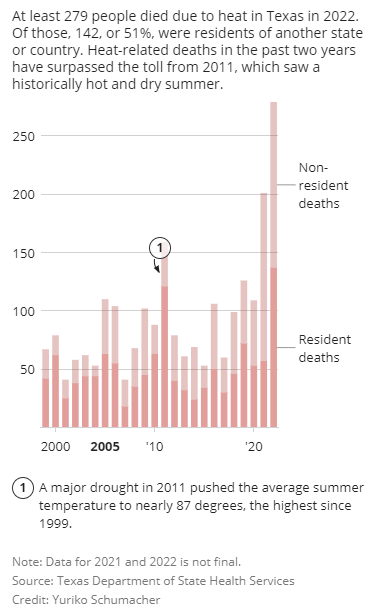
This graphic was produced by the Texas Tribune using data from Texas Department of State Health Services. Source: https://www.texastribune.org/2023/06/16/texas-heat-wave-water-break-construction-workers/

The chart above shows that known heat-related deaths in Tejas are up sharply in the last 2 years. Migrants and the homeless are hit particularly hard by hyperthermia.

I can understand the desire to smooth out the spotty nature of regulatory sovereignty across any state. It is really a matter of state vs local control and there shouldn’t be any confusing overlap of authority. Texas has chosen primacy over commerce and trade, of which labor is a part of. Somewhere in the process of this, someone noticed that regulations on water breaks mandated by municipal statute will be invalidated.

News stories came out with the shocking news that people working outdoors will not be guaranteed water breaks. The absence of statutory regulation on water breaks does not mean that workers will be denied water. Any employer who wants to retain employees will not deny water to employees. What has been invalidated are mandatory 10-minute water breaks every 4 hours. A workday is usually broken down into a break midmorning and midafternoon with lunch at around noon. These are 3 opportunities to grab a drink of water. A mandatory break after 4 hours past arrival places the break around lunch and quitting time anyway for an 8-hour day, so it is hard to imagine what advantage it gives for an 8-hour day. For longer days it would be beneficial. Employers who would deny water to employees should be punished.

Construction site managers object to rules that would interfere with things like concrete deliveries and crane work. Both are time sensitive activities. Even in the rough and tumble construction field, most companies will do the right thing and allow access to water at all times.

Texas HB2127 itself is silent on the matter of water breaks for workers. It simply reasserts authority already provided in the state constitution, namely as the, ” … exclusive regulator of many aspects of commerce and trade … ” and supersedes local statutes that overlap with what the state sees as its sovereignty. It seems a little sly, but not fundamentally corrupt.

So, the question becomes, will the State of Texas legislate mandatory water breaks for workers in hot environs? Given the rabid pro-business leanings of the state, it seems doubtful.

Am I taking the side of the Republicans on this? Goddammit, I hate to say it, but I suppose I am.

Florida Clicks Another Notch Towards Authoritarianism

State Senator Brodeur of the Republic of DeSantistan has introduced a bill that, among other things, proposes requirements on compensated bloggers. How are compensated bloggers different from professional journalists? Not being a constitutional scholar, it escapes me how this doesn’t violate the first amendment. You remember that one, it is just next to the 2nd amendment.

160 (2) If a blogger posts to a blog about an elected state
161 officer and receives, or will receive, compensation for that
162 post, the blogger must register with the appropriate office, as
163 identified in paragraph (1)(f), within 5 days after the first
164 post by the blogger which mentions an elected state officer.

Bloggers receiving compensation for their posts about elected state officers must register with the state and submnit a report-

181 (d) The reports must include all of the following:
182 1. The individual or entity that compensated the blogger
183 for the blog post.
184 2. The amount of compensation received from the individual
185 or entity, regardless of how the compensation was structured.

============================

Below is the text of the bill. The bill reads-

Florida Senate – 2023 SB 1316
By Senator Brodeur
10-00366B-23 20231316__
Page 1 of 9
CODING: Words stricken are deletions; words underlined are additions.
1 A bill to be entitled

2 An act relating to information dissemination; amending
3 s. 45.031, F.S.; deleting a provision requiring a
4 judicial notice of sale to be published for a
5 specified timeframe on a publicly accessible website;
6 amending s. 50.0311, F.S.; specifying that a
7 governmental agency may use the public website of a
8 county to publish legally required advertisements and
9 public notices if the cost for such publication is not
10 paid by or recovered from a person; creating s.
11 286.31, F.S.; defining terms; requiring bloggers to
12 register with the Office of Legislative Services or
13 the Commission on Ethics, as applicable, within a
14 specified timeframe; requiring such bloggers to file
15 monthly reports with the appropriate office by a
16 certain date; providing an exception; specifying
17 reporting requirements; authorizing a magistrate to
18 enter a final order determining the reasonableness of
19 circumstances for an untimely filing or a fine amount;
20 requiring that the Legislature and the Commission on
21 Ethics adopt a specified rule; providing penalties for
22 late filing; prohibiting the assessment of a fine for
23 the first time a report is not timely filed, under
24 specified conditions; authorizing bloggers to appeal a
25 fine within a specified timeframe; specifying the
26 appeal process; authorizing bloggers to request that
27 the appropriate office waive the reporting requirement
28 under specified conditions; providing that unpaid
29 fines for a specified timeframe may be recovered

30 through the courts of this state; providing an
31 effective date.
32
33 Be It Enacted by the Legislature of the State of Florida:

35 Section 1. Subsection (2) of section 45.031, Florida
36 Statutes, is amended to read

<<< Some code relating to government access to publicly available websites is omitted for clarityt. >>>

286.31 Blogger registration and reporting.—
139 (1) As used in this section, the term:
140 (a) “Blog” means a website or webpage that hosts any
141 blogger and is frequently updated with opinion, commentary, or
142 business content. The term does not include the website of a
143 newspaper or other similar publication.
144 (b) “Blogger” means any person as defined in s. 1.01(3)
145 that submits a blog post to a blog which is subsequently

146 published.
147 (c) “Blog post” is an individual webpage on a blog which
148 contains an article, a story, or a series of stories.
149 (d) “Compensation” includes anything of value provided to a
150 blogger in exchange for a blog post or series of blog posts. If
151 not provided in currency, it must be the fair-market value of
152 the item or service exchanged.
153 (e) “Elected state officer” means the Governor, the
154 Lieutenant Governor, a Cabinet officer, or any member of the
155 Legislature.
156 (f) “Office” means, in the context of a blog post about a
157 member of the Legislature, the Office of Legislative Services
158 or, in the context of a blog post about a member of the
159 executive branch, the Commission on Ethics, as applicable.
160 (2) If a blogger posts to a blog about an elected state
161 officer and receives, or will receive, compensation for that
162 post, the blogger must register with the appropriate office, as
163 identified in paragraph (1)(f), within 5 days after the first
164 post by the blogger which mentions an elected state officer.
165 (3)(a) Upon registering with the appropriate office, a
166 blogger must file monthly reports on the 10th day following the
167 end of each calendar month from the time a blog post is added to
168 the blog, except that, if the 10th day following the end of a
169 calendar month occurs on a Saturday, Sunday, or legal holiday,
170 the report must be filed on the next day that is not a Saturday,
171 Sunday, or legal holiday.
172 (b) If the blogger does not have a blog post on a blog
173 during a given month, the monthly report for that month does not
174 need to be filed

175 (c) The blogger must file reports with the appropriate
176 office using the electronic filing system:
177 1. As provided in s. 11.0455 if the blog post concerns an
178 elected member of the Legislature; or
179 2. As provided in s. 112.32155 if the blog post concerns an
180 officer of the executive branch.
181 (d) The reports must include all of the following:
182 1. The individual or entity that compensated the blogger
183 for the blog post.
184 2. The amount of compensation received from the individual
185 or entity, regardless of how the compensation was structured.
186 a. The amount must be rounded to the nearest $10 increment.
187 b. If the compensation is for a series of blog posts or for
188 a defined period of time, the blogger must disclose the total
189 amount to be received upon the first blog post being published.
190 Thereafter, the blogger must disclose the date or dates
191 additional compensation is received, if any, for the series of
192 blog posts.
193 3. The date the blog post was published. If the blog post
194 is part of a series, the date each blog post is published must
195 be included in the applicable report.
196 4. The website and website address where the blog post can
197 be found.
198 (4) Notwithstanding any other law, a magistrate is
199 authorized to enter a final order in determination of the
200 reasonableness of circumstances for an untimely filing of a
201 required report and the amount of a fine, if any.
202 (5) Each house of the Legislature and the Commission on
203 Ethics shall adopt by rule, for application to bloggers, the

204 same procedure by which lobbyists are notified of the failure to
205 timely file a report and the amount of the assessed fines. The
206 rule must also provide for, but need not be limited to, the
207 following provisions:
208 (a) A fine of $25 per day per report for each day late, not
209 to exceed $2,500 per report.
210 (b) Upon receipt of an untimely filed report, the amount of
211 the fine must be based upon the earlier of the following:
212 1. The date and time that the untimely report is actually
213 received by the office.
214 2. The date and time on the electronic receipt issued
215 pursuant to s. 11.0455 or s. 112.32155.
216 (c) The fine must be paid within 30 days after the notice
217 of payment due is transmitted, unless an appeal is filed with
218 the office. The fine amount must be deposited into:
219 1. If the report in question relates to a post about a
220 member of the Legislature, the Legislative Lobbyist Registration
221 Trust Fund;
222 2. If the report in question relates to a post about a
223 member of the executive branch, the Executive Branch Lobby
224 Registration Trust Fund; or
225 3. If the report in question relates to a post about
226 members of both the Legislature and the executive branch, the
227 lobbyist registration trust funds identified in subparagraphs 1.
228 and 2., in equal amounts.
229 (d) A fine may not be assessed against a blogger the first
230 time a report for which the blogger is responsible is not timely
231 filed. However, to receive this one-time fine waiver, all
232 untimely filed reports for which the blogger remains responsible

233 for filing must be filed with the office within 30 days after
234 the notice of untimely filing was transmitted to the blogger. A
235 fine must be assessed for any subsequent late-filed reports.
236 (e) The blogger is entitled to appeal a fine, based upon
237 reasonable circumstances surrounding the failure to file by the
238 designated date, by making a written request to the office for a
239 hearing before the magistrate from the Second Judicial Circuit.
240 Any such request must be made within 30 days after the notice of
241 payment due is transmitted to the blogger. The office shall
242 transmit all such timely, written requests to the chief judge of
243 the Second Judicial Circuit along with the evidence the office
244 relied on in assessing the fine. The magistrate, after holding a
245 hearing, shall render a final order, upholding the fine or
246 waiving it in full or in part.
247 (f) A blogger may request that the filing of a report be
248 waived upon good cause shown based on reasonable circumstances.
249 The request must be filed with the office, which may grant or
250 deny the request.
251 (g) Fines that remain unpaid for a period in excess of 100
252 days after final determination are eligible for recovery through
253 the courts of this state.
254 Section 4. This act shall take effect upon becoming a law.

A Kerfuffle over Science in Montana

One of Montana’s ‘elite’ conservative thinkers, State Senator D. Emrich has submitted 2023 Senate Bill No. 235 to limit science instruction in Montana to the teaching of scientific fact and not the teaching of scientific theory. The Bill reads-

2023 Montana Legislature

SENATE BILL NO. 235

INTRODUCED BY D. EMRICH, S. HINEBAUCH, T. MCGILLVRAY

A BILL FOR AN ACT ENTITLED: “AN ACT ESTABLISHING REQUIREMENTS FOR SCIENCE INSTRUCTION IN PUBLIC SCHOOLS; DEFINING “SCIENTIFIC FACT”; AND PROVIDING AN IMMEDIATE EFFECTIVE DATE.”

WHEREAS, the purpose of K-12 education is to educate children in the facts of our world to better prepare them for their future and further education in their chosen field of study, and to that end children must know the difference between scientific fact and scientific theory; and

WHEREAS, a scientific fact is observable and repeatable, and if it does not meet these criteria, it is a theory that is defined as speculation and is for higher education to explore, debate, and test to ultimately reach a scientific conclusion of fact or fiction.

BE IT ENACTED BY THE LEGISLATURE OF THE STATE OF MONTANA:

NEW SECTION. Section 1.Requirements for science instruction in schools. (1) Science instruction may not include subject matter that is not scientific fact.

(2)        The board of public education may not include in content area standards any standard requiring curriculum or instruction in a scientific topic that is not scientific fact.

(3)        The superintendent of public instruction shall ensure that any science curriculum guides developed by the office of public instruction include only scientific fact.

(4)        (a) The trustees of a school district shall ensure that science curriculum and instructional materials, including textbooks, used in the district include only scientific fact.

(b)        Beginning July 1, 2025, a parent may appeal the trustees’ lack of compliance to subsection (4)(a) to the county superintendent and, subsequently, to the superintendent of public instruction under the provisions for the appeal of controversies in this title pursuant to 20-3-107 and 20-3-210.

(5)        The legislature intends for this section to be strictly enforced and narrowly interpreted.

(6)        As used in this section, “scientific fact” means an indisputable and repeatable observation of a natural phenomenon.

NEW SECTION. Section 2.Transition. The board of public education, the superintendent of public instruction, and school district boards of trustees shall fully implement the requirements of [section 1] no later than July 1, 2025.

NEW SECTION. Section 3.Codification instruction. [Section 1] is intended to be codified as an integral part of Title 20, chapter 7, part 1, and the provisions of Title 20, chapter 7, part 1, apply to [section 1].

NEW SECTION. Section 4.Effective date. [This act] is effective on passage and approval.

============================

A lot of the kerfuffle stems from a misunderstanding of the word “theory”. According to Wikipedia

scientific theory is an explanation of an aspect of the natural world and universe that has been repeatedly tested and corroborated in accordance with the scientific method, using accepted protocols of observation, measurement, and evaluation of results. Where possible, theories are tested under controlled conditions in an experiment.

Now for a moment of reductionism. This is a bill that seeks to control how people think and to prepare a cozy nest for religious teaching in the schools. Florida is off and running with this ball. They are aiming at what they believe is the source- public education. Youth tend to be hungry for new ideas and open vistas. Science naturally fills some of this void. Science education aims to inform people on how the universe works based on measurement and analysis. You might suppose that this would appear to be neutral in terms of ideology. It doesn’t rely on ancient writings and the acceptance of a spirit world. It is the absence of theology in science that ruffles feathers.

It seems plain that the sponsors are focused on a few concepts that are most troublesome to them, evolution being one of them. Perhaps Critical Race Theory is another. Christians in particular have been riled up about evolution ever since the notion first appeared. You can explain the biochemistry and biology of evolution to religious followers until you are blue in the face. Unless they are willing to dive into a personal journey of discovery to learn about it for themselves, they will never see that it makes sense without having to invoke a universe driven by magic.

It isn’t clear that this bill will work its way into law. However, it would seem to be another thinly veiled attempt to pierce the delicate membrane between church and state. My guess is that the GOP Senator must be checking off all of the boxes to establish his conservative bona fides to the lunatic fringe.

We are all born ignorant. Some choose to live out their lives and die that way too.

God in the image of man

The portentous return of American protestant evangelical politics on the coattails of the Trump win has certainly been startling to me at least. As if to underscore this return is the announcement that the Supreme Court of the United States (SCOTUS) will take on the case No. 16-111 Masterpiece Cakeshop, Ltd., et al., v. Colorado Civil Rights Commission, et al. Petitioners.

According to the petition for a Writ of Certiorari, at issue is the following:

Whether applying Colorado’s public accommodations law to compel Phillips to create expression that violates his sincerely held religious beliefs about marriage violates the Free Speech or Free Exercise Clauses of the First Amendment

I for one sympathize with both parties. I would like to think that as a business man I had some control in the business arrangements I enter into. On the other hand, it seems quite reasonable that an order for a wedding cake should not be complicated by the theology of the baker. I gather that the sign over the door did not say “Bakery for Observant Christians Only”.

Having been in sales, I know there are a hundred ways to purposely kill a sale without it descending into a fight or bad feelings. A sky high price, a ridiculously long delivery time, kitchen remodeling, a diseased baker, etc. Ok, so it is a lie. It happens.

From my purchasing experience I know it is possible for a careful buyer to disclose as little information as possible so as not to cue a vendor to raise the price or decline to make an offer. The couple in question could have discretely asked for a cake without giving away their relationship or could have sent in a proxy. The figurine of a gay couple on top of the cake could have been purchased separately and set in place at a different location. Alternatively, the gay couple could have simply found another baker willing to do the job, say in Boulder to the north.

Yes, yes, yes. I know. Neither side should have to use subterfuge to complete this simple transaction. And neither side, in principle, should have to fear the consequences of their core values. But for crying out loud, this is Colorado Springs. A more conservative Christian enclave would be hard to find. The city is full of conservative retired military and a number of fundamentalist Christianist organization headquarters like Focus on the Family among others. But what are you going to do? Fight to the death everyone you find disagreeable? Does everything have to be consecrated to God? Crimony! Can’t there be secular activities like putting a lug nut on a bolt or buying baked goods?

If SCOTUS rules against Colorado’s public accommodations law to compel the petitioner to create expression that violates his sincerely held religious beliefs about marriage, then they will have set back the cause of LGBTQ rights, possibly for generations. Likewise, a ruling for the respondent might do similar damage for the conservative cause. Both sides could live with some ambiguity in this matter.

The notion that baking a cake for a gay couple somehow validates LGBTQ values seems to be a bit of a stretch. It seems to me that a conception of a God who would see the act of baking this cake with so negative a view as to impose an existential threat to the baker’s eternal salvation is to conjure up a very strange picture of the deity. If a human were to wield this kind of existential threat to the baker, that human might be regarded as psychopathic.

In my view, American evangelical Christianists have constructed a model of God in the image of a very cranky, peevish male human. A God who set the galaxies spinning, ignited our sun, breathed life into inanimate earth, and accounts for every flea riding the tail feathers of every bird would certainly have the insight and fatherly patience to see this gay Wedding Cake matter as a tempest in a teapot. Yes? Maybe? But perhaps that is me constructing God in the image of a mensch.

I like that- God as a mensch.


A fossil fuel job justifies X units of pollution

A lot of science is about trying to find the best questions. Because the best questions can lead us to better answers. So, in the spirit of better questions here goes.

By loosening environmental regulations aimed at pollution prevention or remediation, the mandarins reporting to POTUS 45 have apparently made the calculation decided that some resulting uptick in pollution is justified by the jobs created thereby.

Question 1: For any given relaxation in regulations that result in an adverse biological, chemical or physical insult to the environment, what is the limit of tolerable adverse effect?

Question 2: How will the upper limit of acceptable environmental insult be determined?

Question 3: Will the upper limit of acceptable environmental insult be determined before or after the beginning of the adverse effect?

For a given situation there should be some ratio of jobs to acceptable environmental damage.

Example: By relaxing the rules on the release of coal mining waste into a river, X jobs are created and, as a result, Y households are denied potable drinking water. What is an acceptable ratio of X to Y?

Those are enough questions for now. Discuss amongst yourselves.

Patent links

The blog Patently-O is a worthwhile site to visit periodically.  That is if you’re interested in the arcane cosm of patents like I am. The fellow who writes the blog is Dennis Crouch, Asst Prof. at the University of Missouri School of Law. The post on USPTO guidelines on obviousness is particularly interesting.  I find this to be the most vexing part of patent law. 

EDTexweblog documents patent litigation in the East Texas district. I especially like the litigation haiku.  Reference and comparison is made to Vogon poetry.

Anything Under the Sun, by Russ Krajek, is another useful site to visit if you want to glean useful tidbits on patent practice.  These sites are maintained by people interested in their field and are happy to share insights with others.