
Category Archives: Material Science

China Restricts Exports of Critical Metals to the US

Trump’s ill-tempered brinksmanship and his coarse criticism of both long-term allies and old adversaries has begun to cost the US access to strategic materials. In particular, China has announced that it has banned the export of a group of metals and non-metals to the US. Specifically, China had previously imposed export controls on Rare Earth Elements (REE), gallium (Ga), germanium (Ge), antimony (Sb) and graphite (C). More recently it has included tungsten (W), tellurium (Te), bismuth (Bi), indium (In) and molybdenum (Mo) products.

In case the reader is unfamiliar with the uses of the above elements, a list of them with a short description is given below.

Many of the elements listed above are by-products from the refining of other metals like aluminum, copper, lead and zinc. Reduced production of aluminum, copper, lead and zinc will also reduce output of their accessory metals as well.

  • Gallium– Primarily used in semiconductors; is used to produce the denser, stabilized δ allotrope of plutonium for use in nuclear weapons.
  • Germanium– Primarily used in semiconductors; a by-product found in copper-lead-zinc ores.
  • Indium– Primarily used in semiconductors or other electronic applications; it is a by-product found in sulfidic zinc (Sphalerite) and copper ores (Chalcopyrite). Indium tin oxide (ITO) forms a thin, transparent and electrically conductive layer on glass for touch-screen applications such as smart phones.
  • Tellurium– A scarce element at an average occurrence 1 ppb in the crust and never the primary ore in mining. It is mostly found combined with gold as Calaverite (AuTe), Sylvanite (AgAuTe) or Krennerite (AuTe2 Orthorhombic gold telluride.) Tellurium has use in a large variety of applications. Unfortunately for gold miners, calaverite ore is not susceptible to cyanide extraction for gold recovery. Calaverite can be roasted and tellurium volatiles removed from the gold residues. However, commercial scale roasting of minerals is problematic in the US.
  • BismuthBismuth is never the primary ore in mining. It is found with lead, copper and tungsten. Broad applications across many domains. No longer produced in US. Bismuth is the highest atomic number element that is not naturally radioactive. Well, it’s half-life has been determined to be 1.9 × 10¹⁹  years which is still “pretty stable”.
  • Antimony– The largest antimony mine in the world is the Xikuangshan mine in Lengshuijiang Hunan, China. This mine produces 50 % of the world’s antimony. The mine produces antimony from 2 different minerals, stibiconite (Sb3O6(OH)) and stibnite (Sb2S3).
  • Molybdenum– Mined as the primary metal ore. About 86 % of molybdenum is used in metallurgy with the rest used in chemical applications. An important molybdenum mineral is molybdenite, MoS2. Important US mines are the now-defunct Henderson Mine and the now operating Climax Mine, both in Colorado and both operated by Freeport-McMoRan. The Climax Mine resides at the summit of Freemont Pass at 11,360 ft altitude and to the north of Leadville, Colorado. Molybdenite deposits can be found as far away as Questa, New Mexico, with the Chevron Questa Molybdenum mine which is now closed and undergoing reclamation as a superfund site.
  • Graphite– Natural graphite arises from metamorphization of carbonaceous sediment. It can mined or produced synthetically. Graphite is the most chemically stable allotrope of carbon at standard pressure and temperature.
  • Tungsten– Also known as wolfram (W), tungsten has the highest melting point and lowest vapor pressure of the elements. As a refractory metal, tungsten us often used in high temperature applications such as welding and for its relative chemical inertness affording high resistance to corrosion. In military applications tungsten is exploited for its combination of high density, hardness and refractory properties in projectiles and other applications. In chemical form, it is often found as a polyoxometallate anion such as WO4−2, “orthotungstate”. These polyoxometallate anions can form higher order cage structures.

All of the above elements are well established in diverse products and are a part of numerous leading-edge technologies in use today. All ores are subject to the market price of their mined and milled products. All of the elements listed above are produced in various simple but purified forms that customers will plug into their own production lines. The economics of their mine operation has a high reliance on the margins offered by their raw material costs. If the raw material supplier goes a step further and captures value-added profit margins by offering an advanced intermediate or even the final product, then the customer faces having to use the more costly value-added materials. The effect can be that they must raise prices on their product or step away from the market. This is just the old familiar path of competition.

As luck would have it, early in geologic history China won the mineral lottery when many ore-forming processes valuable ores in its present territory. We have all heard of China’s supremacy in rare earth element (REE) reserves. China eventually made the choice of halting exports of rare earth minerals as the oxides in favor of offering value added finished products instead. Business-wise, this was a smart and inevitable choice for China, but users who manufactured REE products from their imported REE raw materials were suddenly facing stiff competition from abroad.

Since this policy of China metering closely the export of REE minerals, western countries have made considerable progress locating REE deposits elsewhere. Incidentally, the same holds true for lithium deposits.
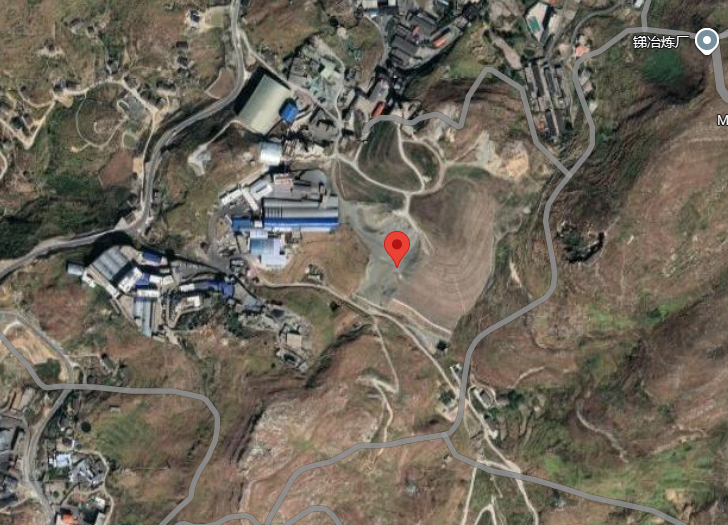
From Google Maps. An aerial view (supposedly) of part of the large Xikuangshan mine in Hunan, China.

Restrictions on exports of the above elements will have a large impact on many industries in the US. My question is this: Could a better diplomatic approach to imports from China have been made?

It isn’t all bad news. Difficulties with raw material prices and availability frequently motivate users to invent a way around problematic raw materials. There is nothing like the motivation to fire up the inventive juices than to seek a work-around for a raw material supplier problem.

A Perfluorinated Fiasco

Good gravy. What a freakin’ mess. It seems like everywhere investigators look, they find perfluorinated alkyl residues- drinking water, fish, people, etc. These fluorinated substances are known as PFAS, PFOS, PFOA, PFHxS or perfluorohexane sulfonic acid, and PFNA or perfluorononanoic acid. The “per” in front of perfluorinated just means that the molecule has as many fluorine atoms connected as possible.

According to the National Association for Surface Finishing, PFAS “properties are useful to the performance of hundreds of industrial applications and consumer products such as carpeting, apparels, upholstery, food paper wrappings, wire and cable coatings and in the manufacturing of semiconductors.

I will use the term “PFAS” to represent any and all of variations in this small molecule category of perfluorinated substances.

The EPA has kicked into overdrive and is ginning up new regulations, including drinking water standards. “EPA’s proposal, if finalized, would regulate PFOA and PFOS as individual contaminants, and will regulate four other PFAS – PFNA, PFHxS, PFBS, and GenX Chemicals – as a mixturePFOA and PFOS: EPA is proposing to regulate PFOA and PFOS at a level they can be reliably measured at 4 parts per trillion.” This is around the detection limit for these compounds.

From an EPA website

PFAS can be present in our water, soil, air, and food as well as in materials found in our homes or workplaces, including:

  • Drinking water – in public drinking water systems and private drinking water wells.
  • Soil and water at or near waste sites – at landfills, disposal sites, and hazardous waste sites such as those that fall under the federal Superfund and Resource Conservation and Recovery Act programs.
  • Fire extinguishing foam – in aqueous film-forming foams (or AFFFs) used to extinguish flammable liquid-based fires.  Such foams are used in training and emergency response events at airports, shipyards, military bases, firefighting training facilities, chemical plants, and refineries.
  • Manufacturing or chemical production facilities that produce or use PFAS – for example at chrome plating, electronics, and certain textile and paper manufacturers.
  • Food – for example in fish caught from water contaminated by PFAS and dairy products from livestock exposed to PFAS.
  • Food packaging – for example in grease-resistant paper, fast food containers/wrappers, microwave popcorn bags, pizza boxes, and candy wrappers.
  • Household products and dust – for example in stain and water-repellent used on carpets, upholstery, clothing, and other fabrics; cleaning products; non-stick cookware; paints, varnishes, and sealants.
  • Personal care products – for example in certain shampoo, dental floss, and cosmetics.
  • Biosolids – for example fertilizer from wastewater treatment plants that is used on agricultural lands can affect ground and surface water and animals that graze on the land.

Details on specific molecular pharmacology mechanisms are a bit thin. The perfluorinated part of PFAS is chemically quite inert and very hydrophobic, but often the perfluorinated group is connected to something polar like a carboxylic acid as with PFOA which can give surfactant properties. Most of the utility of PFAS comes from the fluorinated part. About the only way to get a chemical reaction with perfluorinated organic hydrocarbons is to contact them with alkali metals like sodium or potassium, or even with magnesium or aluminum. The last two are probably less reactive than the alkali metals. The good news is, precious few have alkali metals lying around to blunder into contact with TeflonTM.

All of this toxicity talk seems to be at the “increased this” or “decreased that” correlation stage presently. Another table from the EPA website-

Current peer-reviewed scientific studies have shown that exposure to certain levels of PFAS may lead to:

  • Reproductive effects such as decreased fertility or increased high blood pressure in pregnant women.
  • Developmental effects or delays in children, including low birth weight, accelerated puberty, bone variations, or behavioral changes.
  • Increased risk of some cancers, including prostate, kidney, and testicular cancers.
  • Reduced ability of the body’s immune system to fight infections, including reduced vaccine response.
  • Interference with the body’s natural hormones.
  • Increased cholesterol levels and/or risk of obesity.

Along the way to the consumer are the PFAS chemical manufacturers and their customers that formulate the PFAS into their products. Then there are the retailers who sell PFAS-loaded products to the consumer. The benefits of perfluorinated materials are often revealed as claims for non-stick, repellency or fire retardancy. At some point the whole chain will have to back off on their repellency marketing.

Just for fun, the only substance that a gecko’s foot cannot stick to is PTFE.

So, should all use of PFAS substances be abolished? I think that applications can be prioritized according to relative importance. Fire retardancy is a health and safety related use and is a very important attribute in certain circumstances like fire extinguishing agents. Liquid fuel fires are special because spraying water on burning fuel will result in the fuel floating on top of water and continuing to burn. Foam is used because it can float on top of the fuel and smother it. A thoughtful evaluation of retaining PFAS agents for a select few applications like fire suppression should be made.

Using PFAS to prevent grease stains from soaking through fast food wrappers, water repellency or stain resistance on carpets is likely a basket of applications that we can live without.

In doing background reading for this I found something very interesting. There is such a thing as “Teflon Flu”, also known as polymer fume fever. When a perfluorinated non-stick coating, say, on a pan is subjected to temperatures of around 450 C, the coating begins to decompose and will generate vapors that are hazardous.

We should all remember that TeflonTM is a Chemours trademark and refers to a polytetrafluoroethylene polymer (PTFE). PTFE is a macromolecule unlike PFAS substances. PTFE is in the same persistence class as a “forever substance,” but as an insoluble solid polymer it is not mobilized at the level of molecules so migration into the cellular architecture isn’t viable path as with PFAS. The PTFE polymer is extraordinarily useful in the world and has many, many uses as a polymeric, chemically inert material and should not be cast into the dumpster with its cousins, the PFAS compounds.

100-year concrete aging experiment ends in 2023

Somebody was thinking ahead at the University of Wisconsin-Madison in 1910. Civil engineering professor and later Dean of the College of Engineering, Morton O. Withey (1882-1961), began an experiment on the effect of age and environment on what was then a relatively new building material- concrete. Now, in 2023, a second 100-year batch of experimental castings are coming to completion.

Source: The Chi Phi Chakett, 1955

Withey, a 1904 Dartmouth graduate, began casting samples of various compositions of cement, sand and stone in 1910 when he initially cast 450 of the 6 x 12-inch cylinders. He cast other sets of samples in 1923 and 1937 for a total of over 2500 cylindrical castings.

According to the Wisconsin State Journal the 1910 samples were tested at the 100 year mark and the 1937 samples were tested at the 50 year mark. A comparison of the 1910 samples revealed that both the samples stored in the air and in water strengthened in similar increments for a time and thereafter the samples stored in water continued to strengthen. Exposure of the dry samples to carbon dioxide lead to chipping. The dry 1910 samples yielded to 75 tons of pressure whereas the wet samples yielded at up to 100 tons of pressure. This disparity is thought to arise from continuous hydration of the water-wet samples.

Since the time when the samples were cast, the chemistry of cement and concrete has changed to where the engineering data is no longer of interest for ongoing work. However, the experiment has broadened the envelop of known properties of various concrete compositions.

A wealth of interesting information on the properties of concrete can be found at the Wikipedia website.