Category Archives: Metals

Yellow Gold and Black Gold in the Ground

Some years back I visited the large CC&V open pit gold mine by Cripple Creek, Colorado. Standing at the bottom of the pit we could see haul trucks busily transferring ore to a staging site. Suspecting that it might be overburden, I asked what they were doing. Our guide, a geologist, said that this ore would be staged as unrefined until the price of gold rose to a certain higher value. The whole ore body had been mapped 3-dimensionally so at any given location and level where they blast, they have a rough idea of how much gold is present. At the time, ~10 years back, the geologist said that each large haul truck was typically carrying about $10,000 worth of gold. I don’t know how accurate that is, but there you have it.

The Cripple Creek gold load was discovered about 1893 and occurs in the throat of an extinct volcano. The ore contains gold and calaverite, AuTe2, a gold telluride mineral. The gold and AuTe2 is so finely dispersed that most people who work at the mine have never actually seen the gold. The recovery method they use is cyanide extraction. Unfortunately, tellurium interferes with this extraction process and unavoidably some of the gold as the telluride is left in the tailings. The ore is said to contain about 1 gram of recoverable gold per ton.

What prompted this essay was a moment of clarity I had reading a notice from the Energy Information Administration, EIA. It is common to hear about oil reserves. One might suppose that this refers to the total proven reserves in the ground. But this article referred to “economically recoverable oil resources”. When oil reserves are expressed in this way, the recoverable oil then becomes a function of the current oil prices. If oil prices are low, then the reserves are considered smaller than when oil prices are high. It seems so obvious but I never gave it a thought before. As with gold, the lesson is to pay attention to the type of reserves being discussed.

Uranium Town: Uravan, Colorado

The town of Uravan, Colorado, shows up on maps and road signs. You might think it is a physical town. It sits north of Naturita (pronounced natter reeta), CO, on Hwy 141 about 15 miles up the narrow San Miguel River valley. If you look at it’s Wikipedia page, you’ll see a picture of a bare area of ground. Today all that remains at the surface is a ball field and picnic tables. Every bit of the town and the mill has been demolished, shredded and buried within the confines of a Superfund site. Even contaminated bulldozer blades were buried on-site. Also remaining is a Umetco commercial building. Umetco, a Dow Chemical subsidiary, was responsible for managing the reclamation of the site which lasted from 1987 to 2007.

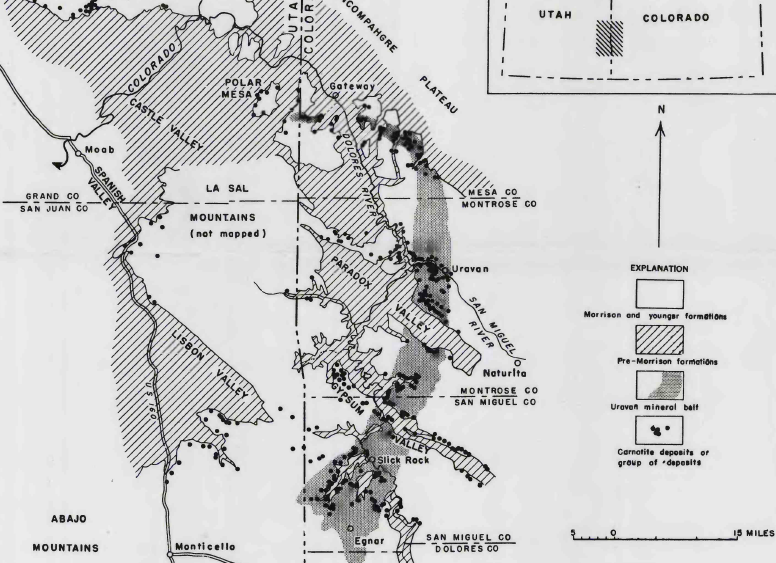
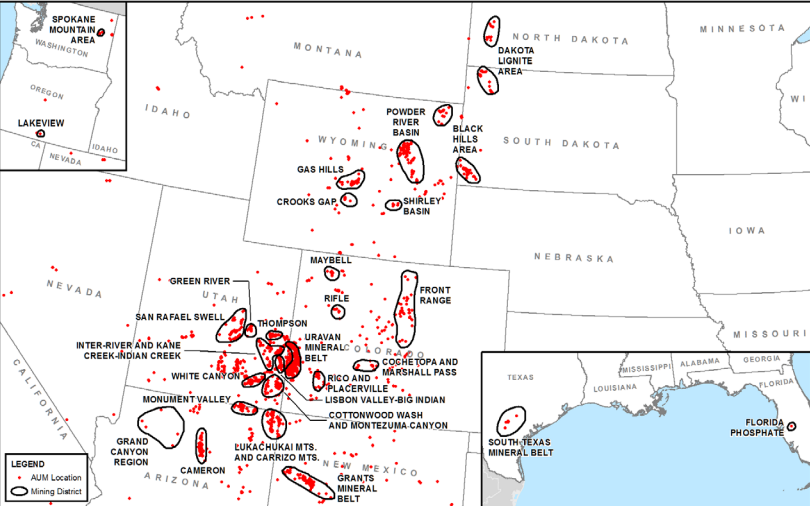
Main uranium deposits in the US (DoE Office of Legacy Management, 2015)

The local topography consists of sandstone canyons and mesas. The map below (north is up) shows a large area of land west of the valley mill site and up above on Club Mesa. This is the location of buried mill tailings and other contaminated materials. The major radiological contaminant is Radium-226 and its daughter products. Radium is a common and troublesome constituent in uranium-bearing ore.

As an aside, I would recommend taking Colorado Hwy 141 from Naturita north through Gateway enroute to Grand Junction if you’re in the area. Truthfully, Uravan isn’t along the route to somewhere most people would want to go except for locals. This stretch of road is called the Unaweep-Tabeguache Scenic Byway and is absolutely gorgeous. Just like in nearby Arches and Canyonlands National Parks, red sandstone is the dominant country rock in that part of the Colorado Plateau. You’ll drive through breathtaking canyons of red sandstone along the Dolores River, south of Gateway.

During its post-WWII heyday, the company town of Uravan, CO, was one of a number of thriving yellowcake boomtowns in Wyoming, Utah, Colorado, and New Mexico. Overall, there were over 900 uranium mines in operation. The name “Uravan” comes from the URAnium-VANadium ore that was processed there. Uravan was one cog in a large wheel of uranium production first for the Manhattan Project then for the Atomic Energy Commission..

Uravan produced concentrate which was was trucked to Grand Junction, CO, to the Climax Uranium Mill for further processing. Activity at the Climax site began in 1943 for uranium procurement and processing of vanadium mill tailings for uranium.

An excellent timeline of uranium history in western Colorado can be found at the Museums of Western Colorado web site.

Uravan Mineral Belt (Wikipedia)

The earliest mining activity at what became Uravan was for radium recovery beginning in 1912 and falling off by 1923. By 1935 the mill was expanded for vanadium recovery and from 1940 to 1984 the mill was used to process uranium and vanadium.

The predominant ore that was processed at Uravan was Carnotite with a nominal composition of K2(UO2)2(VO4)2ยท3H2O with variable waters of hydration. Elemental uranium is a dense silvery metal that oxidizes in air, reacts with water and dissolves in oxidizing acids. It has two important oxidation states: the +4 uranous oxidation state which is green and the +6 uranyl oxidation state, UO22+, which is yellow. The uranous form is found in the UO2 mineral Uraninite and the uranium silicate Coffinite. The uranyl vanadate form is found with potassium cation in Carnotite, with cesium in Margaritasite, and with calcium in Tyuyamunite.

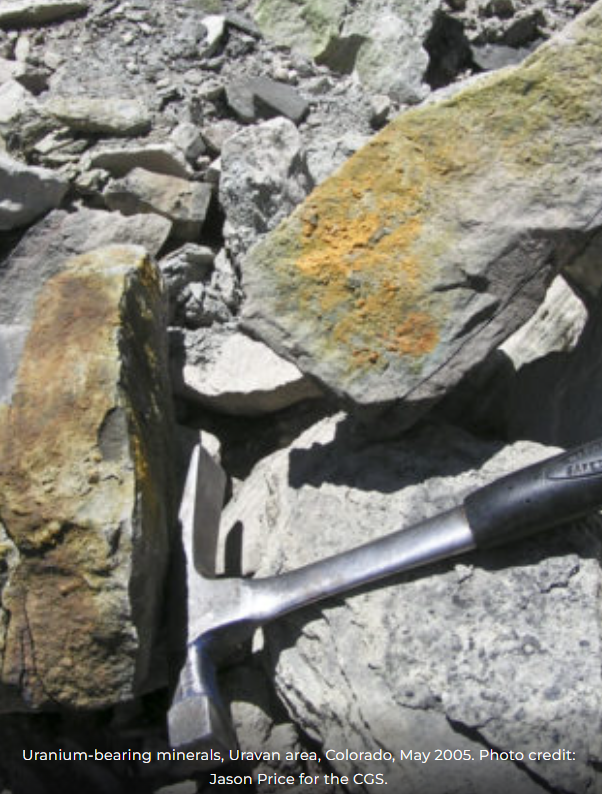
Yellow carnotite ore (Colorado Geological Survey)

Uranium-vanadium rich sandstone is found in Club Mesa to the west and just above the town of Uravan. This occurrance is part of the larger Uravan Mineral Belt which encompasses local commercial grade uranium ore. The mesa covers 6 sq miles and is bounded by the San Miguel River, the Dolores River, Saucer Basin and Hieroglyphic Canyon. According to the United States Geological Survey (USGS), the average grade of the ore ranged from 0.25 to1.5 % U3O8 and 1.5 to 5.0 % V2O5 (ref 1).

From an extensive drilling study by the USGS, the Salt Wash member of the Morrison formation sandstone of the late Jurassic age was found to be the host for most of the commercial-grade (in 1957) uranium-vanadium in the Club Mesa area.

Beginning in 1936, the mill site was owned by US Vanadium Corporation and built up to process vanadium ore. An entire town was constructed on site to accommodate workers. It also produced a uranium oxide side-stream as a yellow pigment. Then along came the nuclear age.

References

(1) Results of US Geological Survey Exploration for Uranium-Vanadium Deposits in the Club Mesa Area, Uravan District, Montrose County, Colorado, Boardman, Litsey, and Bowers, May, 1957, Trace Elements Memorandum Report 979.

Antimony is in Short Supply

Antimony, Sb, is an obscure metalloid that rarely gets much notice outside of a few highly specialized areas of technology. The element is most often found in the mineral Stibnite, Sb2S3. Antimony is a pnictogen found in Group 5 between arsenic and bismuth in the p-block of the periodic table. Crustal abundance is 0.2 to 0.5 ppm according to Wikipedia, making it several times more abundant than silver. It has many interesting properties and uses which will be left to the reader to discover. Interestingly, there is a rare allotrope of antimony that is explosive when scratched. Luckily, this is unusual.

In a May 6, 2021, article in Forbes, writer David Blackmon cites the many uses of antimony and where it occurs in greatest natural abundance. As it turns out, the US is not one of those locations where it is found in great abundance. China has the largest abundance of antimony- greater than half of the known reserves in the world, with Russia coming in second. At present, the US imports 100 % of this key strategic material. Blackmon writes-

“Antimony is a strategic critical mineral that is used in all manner of military applications, including the manufacture of armor piercing bullets, night vision goggles, infrared sensors, precision optics, laser sighting, explosive formulations, hardened lead for bullets and shrapnel, ammunition primers, tracer ammunition, nuclear weapons and production, tritium production, flares, military clothing, and communication equipment. It is the key element in the creation of tungsten steel and the hardening of lead bullets, two of its most crucial applications during WWII.

According to Blackmon, China currently supplies 80 % of the world’s antimony and also imports ore from other nations for refining. Here is the kicker- China may soon run short of the element. Running short of antimony doesn’t just mean that prices will rise in short supply. It could also mean that China may stop exporting much of its refined antimony in favor of internal consumption to produce goods up the value chain. China tried to do this with rare earth elements already. A country rich in strategic minerals and a sophisticated manufacturing base is a country that can wield significant power over the rest of the world. In the US, antimony is considered critical to economic and national security.

The US has had only one mining district that produced significant antimony. That would be the Stibnite mine in the Stibnite Mining District near Yellow Pine, Idaho. Mining activity stopped in the mid-1990s. The district, like most of Idaho, sits atop the granite Idaho Batholith. Volcanic activity in the past forced hot water through cracks and fissures in the rock, dissolving soluble minerals, moving mineral rich hydrothermal fluids that, when cooled, precipitated as mineral veins in the granite. Antimony minerals are often associated with another Group 5 element, arsenic, in the form of minerals like realgar and orpiment.

The Stibnite mine began as a gold mine in 1938 during the Idaho gold rush. Throughout WWII, the stibnite mine produced 40 % of the antimony and tungsten needed by the US. Tungsten, or wolfram, appears as the tungstate salt with a metal cation like iron, calcium or manganese paired with a WO4 oxoanion. The hydrothermal fluid partitions minerals in a rock formation into concentrated zones through selective solubility. This process is responsible for the formation of veins in solid rock.

Oh look. I’ve driven off into the weeds again rambling on about minerals.

Ferrocene as Insecticide

Enroute to other things I ran across an old Gulf R&D patent, US 3294685, titledย “Organic compositions containing a metallo cyclopentadienyl”.ย Sifting through the descriptionย my eye caught the interesting content below:

July 1941. A test spray was prepared by dissolving 2.5 grams (3.2 percent) of iron dicyclopentadienyl in ml. of a typical household insecticide base oil. The tests made with this solution employed a dosage of IO-second discharge. An equilibrium :period of 15 seconds followed by an exposure period of 70 seconds, during which the mist was permitted to settle on adult house flies confined in a screen-covered dish, was employed in the tests. The results of the tests showed that of the flies which had been contacted with the base oil containing 3.2 percent by weight of iron dicyclopentadienyl, 53.6 percent were dead after 24 hours. Of theflies which were contacted with the base oil alone, only 13.0 percent were dead after 24 hours. Check flies which were confined for 24 hours without having been contacted with either the base oil or the base oil containing iron dicyclopentadienyl had a death rate of only 0.4 percent. The better than fifty percent mortality of the flies treated with the base oil containing iron dicyclopentadienyl is indicative of the insecticidal properties of naphthas containing a small amount of iron dicyclopentadienyl. Naturally, the amount of metallo cyclopentadienyl used in insecticidal compositions-will vary with the particular compound employed and also depends upon the particular insects for which the spray is intended. The amount of iron dicyclopentadienyl employed in insecticidal compositions intended for use on flies is between about 1.0 and 10.0 percent by weight.

Ya know, aย greater thanย 50 % kill rate seems to be getting a bit sporty for the flies. The ol’ boys at Gulf were studying theย suitability of a variety of ferrocene analogsย for fuel additive application. What lead them to go from octane enhancement and smoke controlย to killing flies is not revealed in the patent.

Notice the nomenclature in the patent language. The word ferrocene is not mentioned.ย Looking at the timeline we see that the Gulfย ‘685 patent was filed April 21, 1952, not long after theย publication of this curious iron cyclopentadienyl compound by two groups,ย Kealy & Pauson on 12/15/51, and Miller, Tebboth, and Tremaine onย 1/1/52. Though Pauson and Keelyย published first,ย an examination of the papers show that Miller, Tebboth, and Tremaine were first to submit- July 11, 1951 vs August 4, 1951 for Pauson and Kealy.

The day before Gulf filed the patent application, April 20, 1952,ย a groundbreaking paper by Wilkinson, Rosenblum, Whiting, and Woodward was publishedย on the proposedย structure of ironย bis-cyclopentadienyl. It is reported that the name ferrocene was inventedย by Mark Whiting, a student of R.B. Woodward and coauthor of the 1952 paper in JACS. The name derives from theย ferrous ion and the aromatic (“benzene”)ย nature of the cyclopentadienyl ligands.

The curious structure was proposed largely on the strength of a single C-H IR band at 3.25 ฮผ. Since all of the C-H bonds appeared to be equivalent, the only structure compatible with the formula, chargesย and symmetry was the famous ฮท5 (eta five) sandwich structure. Laterย theย word metallocene finds use for this class of substances.

There is disagreement as to some of the details outlined above. An excellent article by Pierre Lazlo and Roald Hoffmann navigates some of the narrower channels in the history of ferrocene. It is well worth the read. Lazlo & Hoffmann suggest that Woodward is thought to have conceived the sandwich structure.

Ferrocene and derivatives would soon prove useful in many areas. A more obscure application is found in the field ofย rocket propellant additivesย and function asย burn rate stabilizers. In fact, certain ferrocene derivatives appear on the US Munitions List, 22 CFR 121.1, Category V, (f)(4) Ferrocene Derivatives. A good overview of ferrocene and other metallocenes can be found in Wikipedia.

Circling back to the beginning of this piece, the patent application for Gulf ‘685 was filedย 4/21/52,ย only 4 months after the publication on 12/15/51 of the Pauson & Kealy paper and two weeks later the Miller, et al., paper on 1/1/52. In the 4 months between Pauson & Kealy and the Gulf patent filing, two independent groups hadย published papersย reporting the preparation ofย iron dicyclopentadienyl by different methods, a Harvard group had postulated a structure for the compound using IR data andย a novel bonding type, and the Gulf R&D group had produced various analogues for testing as fuel additives. In this shortย time interval, the firstย organo-ironย compound was taken from a literature source through industrial R&D and a patent application. As a premium,ย Gulf even determined that it had insecticidal properties. Much happened in a short time.


Wilkinson, Rosenblum, Whiting, and Woodward J. Am. Chem. Soc., 1952, 74 (8), pp 2125โ€“2126. DOI: 10.1021/ja01128a527

Kealy and Pauson, Nature, 168, 1039 (1951).ย Received Aug. 7, 1951.ย  DOI: 10.1038/1681039b0

Miller, Tebboth, and Tremaineย J. Chem. Soc., 1952,0, 632-635. Received July 11, 1951.ย DOI: 10.1039/JR9520000632

Laszlo P., Hoffmann R. ACIEE, 2000 Jan; 39(1):123-124.ย  DOI: 10.1002/(SICI)1521-3773(20000103)39:1<123::AID-ANIE123>3.0.CO;2-Z

Magnesium still surprises a fellow

I have spent some time researching basic magnesium chemistry. Not anything synthetic but more safety andย thermochemically related. I amย not able to give a lot of particulars motivating the study, but I can say that one should consider that nitrogen over activated magnesiumย may not be as innocent as you think. While lithium is widely known to react with nitrogen gas to form a passivating nitride layer, the reaction of dinitrogen with magnesium is rarely encountered.

Activated magnesium residuesย fromย a Grignard or other magnesium metallationย reaction may self-heat to incandescence under a nitrogen atmosphere inย the right circumstances. Activated residues left isolated on the reactor wall or other features in a nitrogen blanketedย reactorย during an aqueous quenching procedure may self-heat to incandescence. In the presence of reactive gas-phase components like water vapor in nitrogen,ย activated metals can self-heat over an induction period of minutes to hours or longer.

Many metals, includingย magnesium and aluminum, can be rendered kinetically stable toย air or humidityย by the formation of a protective oxide layer. Once heated to some onset temperature by a low activation reaction, penetration of the protective layer by reactive gas composition can occur, leading to an exothermic reaction.

Performing a “kill reaction” or a quench of a reactive metal at the bench or at scaleย is always problematic and requires the skill and closeย attention of the process chemists and operators. I guess what I’d like to pass on is that nitrogen is not an innocent spectator in the presence of finely divided, activated magnesium.ย Humid nitrogen canย support a combustion reaction to produce nitrided magnesium once preheated to an onset temperature.

If you mean to kill any reactive residues, it is important to apply the quenching agent in such a manner thatย the heat generated can be readily absorbedย in the quenching medium itself. A good example of a quenching agent is water. Often a reactive must be killed slowly due to gasย generation or some particular. Adding aย quenching agent to a solution or slurryย by slow feed or titrationย may be your bestย bet. If you have another vessel available, a feed to a chilled quenching agent will also work. ย Dribs and drabs of water on a neat reactive material will lead to hotspots that may be incendive.

Gilded Blight

After a weekend in the Alma, CO, mining district, I have come around a bit on the merits of gold mining. Oh sure, I have always known that it wasย a dirty business, what with the mercury, the cyanide, the acidic tailings piles, and the blighted landscapes. But for God sakes man, it’s GOLD!

Last weekend was different. It wasn’t a dispassionate examination of mining history. I could see miles of blighted landscape heaped with spent alluvium along the road from Fairplay to Alma. To the north, over Hoosier Pass, are the McMansions of Breckenridge where new and old wealth mingle.ย  To the south of Fairplay is a sizeable expanse of gravel and cobble heaps from past placer mining.

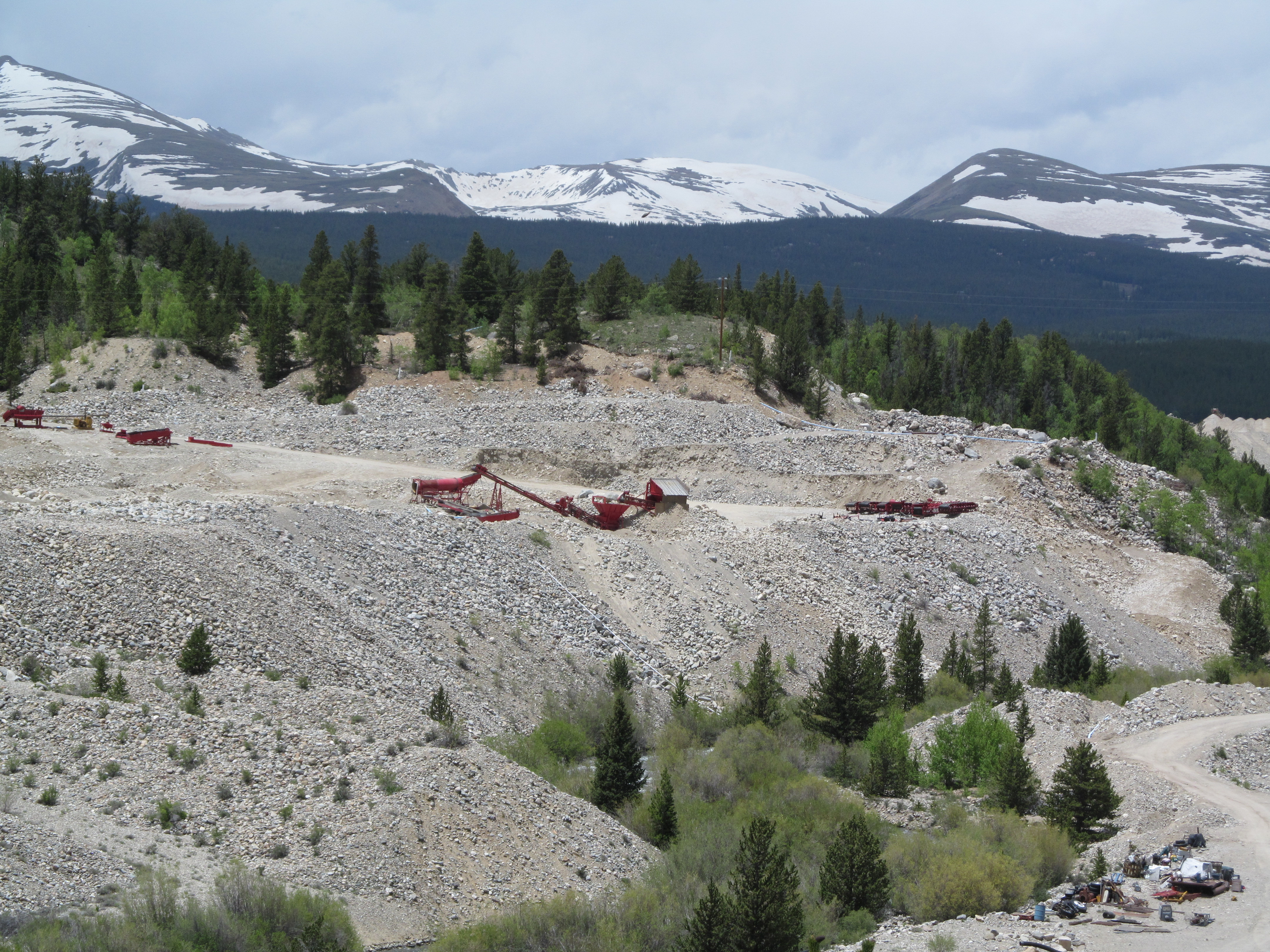
Placer mining north of Fairplay 6-14-14

The photo shows just a short stretch of the creek bed undergoing placer mining on the north end of Fairplay. Granted, the mining company is using gravity separation by way of the sluiceย to recover the gold. The stones are all rounded and well weathered, so one might expect the tailings to release little in the way of toxic leachate. But what a colossal mess they have made of the landscape. Perhaps they have put up a bond assuring that restoration of the landscape will happen when the mining ceases. I don’t know. That does not seem to be the way of past mining in the district.

My point is this. Isn’t there some madness in gold mining? At best aย handful of people get wealthy from putting more gold on the market. I would argue that gold does not have the utility of iron, aluminum, or copper for instance. It does not go into items that advance civilization and economics like tractors, bridges, shipsย or wires. Gold does not go on to enable the growth of industryย in the mannerย a base metal. Some of it adorns our fingers but most falls into the hands of anonymous individuals and governments who hoard vast caches of the metal. Granted,ย a bit of the annual production goes into electronics and a few other applications.

The madness in gold mining is that people are willing to go to any length or bankrupt themselves to obtain a metal that in the end benefits approximately no one. Most of the metal will quietly sit in a vault somewhere producing nothing. It won’t support a building or a roadway over a river. It won’t produce goods or services, nor will it bring a silent heart back to life. It can only support abstractions like the notion of value.ย We’re willing to put up with scarred landscapes, mercury pollution and acidicย runoff produced by other people for an abstraction.ย That is pretty funny.

ย 

Getting the pay out of pay dirt

This is an excerpt from a writing project I’m working on.

The impulse to find and extract gold and silver was one of the drivers of 19th century westward expansion in North America.ย  The discovery of gold in a California stream bed in 1849 and the subsequent discovery of gold and silver in other territories eastward to Pikes Peak and the Black Hills resulted in waves of migration of prospectors, merchants, investors, and swindlers from all directions, including Europe.

The staking of mineral claims in the American west by people who were engaged in the extraction of mineral wealth lead to an inevitable avalanche of settlers interested in tapping some of the wealth of the miners themselves. The open territory created a void that was filled by industrialists, merchants, government, and perhaps most importantly, the railroad. Miners needed supplies and their ore concentrates required transportation and beneficiation.

As claims were made on valuable mineral deposits, the outline of the geographical distribution of mineral value in a region eventually defined what came to be known as a district. The expansion of the railroad, sweetened by land grants, added permanence to the settlement of many regions around and en route to the mining districts.ย  The simple logistical requirement of frequent stops to fill the steam locomotive with water lead to the establishment of towns along the railway. This expanding transportation network, along with liberal access to land, lead to settlement by farmers and ranchers who then created a demand for goods exported from long distances by rail.

The history of manโ€™s fascination with gold and other metals is well documented and there is no need to reiterate that saga in the present work. The mania for gold and silver in the west is legendary. Indeed, clues to the history of gold and silver mining in the American west are quite apparent even to the casual observer today. A drive to Cripple Creek or Central City in Colorado will take the motorist past a great many long abandoned mine dumps, prospect holes, adits, and antiquated mineshaft head works. These quiet features of the landscape mark the location of what was in times past a great and bustling industry.

Throughout the American west today there are many โ€œtourist minesโ€ and mining museums operated by individuals and organizations who recognize the importance of keeping this part of our cultural heritage alive. Through their efforts, visitors can view 19th century mining technology on site and experience the dark and eerily silent realm of the miner. Visitors can see for themselves the intense and sustained effort required in hard rock mining and the occupational hazards miners were exposed to.

The tourist mines and museums often focus on the activity of mining itself as well as the specialized equipment needed to blast the rock and muck it out of the mine. This is only natural. The gold and silver rushes left behind a large number of artifacts. These items are of general interest to all.

The technology that is often glossed over relates the matter of getting the pay out of the pay dirt. Indeed, this is a central challenge to gold and silver extraction. Once the streams have been depleted of placer gold and the vein or lode has been discovered somewhere up the mountainside, the business of extracting gold or silver from hard rock becomes technically much more challenging and capital intensive.

The panning and sluicing of placer or alluvial gold, while labor intensive, is conceptually easy to grasp. High density gold particles can be transported by suspension in a water slurry of the water is moving sufficiently fast. Gold particles will tend to settle at low points in a crevice or a gold pan where the stream velocity slows. A gold pan or the bend in a stream for that matter will have a flow gradient that will tend to collect the gold particles where the stream velocity slows.ย  A sluice or a Wilfley table are just devices designed to trip laminar fluid flow by inducing turbulence to encourage the denser gold particles to settle. Riffles or channels serve to concentrate the gold particles.

While gravity and clever tricks with fluid flow can be used to collect placer gold, isolating gold or silver from a hard rock ore body is quite a different challenge.ย  Gold and silver may exist in reduced form within the ore. They may also be found alloyed with one another or otherwise combined with other heavy elements. While gold tends to be inert even under oxygenated conditions near the surface, silver is subject to more facile oxidation and may be found in ionic form with several anionic species. Thus technology for the isolation of gold may not serve as an exact template for silver extraction and isolation.

Gold or silver may exist in the metallic form as bodies visible to the naked eye within the solid rock. Or they may be dispersed in microscopic elemental form throughout the ore body. Gold ore may be rich in elements that complicate its isolation even though the gold is in reduced form.ย  Silver ore is commonly found in ionic form and with numerous ionic base metals present.

Disseminated gold or silver, that is, gold and silver found dispersed in an ore body, were subject to considerable variation in mineral composition. As a result, differences in isolation techniques and process economics arose among the various operations. Today cyanidation predominates with these ores.

In the 19th century a considerable body of chemical knowledge evolved as the gold and silver rushes progressed. This chemical knowledge was put into practice largely through the efforts of mining engineers.ย  It was not uncommon for the mining engineer to conceive of what today would be considered a process chemistry change, draw up plans, press the ownership for funding, and put the change into operation.

Twenty-first century chemists may recognize much of the nomenclature from this period as well as the intended inorganic transformations. However, the older literature is filled with obsolete nomenclature or that which is confined to the mining industry.ย  What should be apparent to the observant reader is the level of sophistication possessed by 19th century metallurgists and engineers in what chemists today might refer to as the โ€œworkupโ€.ย  That is, the series of isolation steps used to remove undesired components to afford a reasonably clean metal product. Mining engineers refer to this as beneficiation or as extractive metallurgy. Beneficiation of lode gold and lode silver involved chemical transformation in batch or continuous processing.

The story of the development of extractive metallurgy is in part the story of redox chemistry on complex compositions like rock. In the mid 16th century Europe, key individuals like Biringuccio, Agricola, and Ercker began to capture mining and extractive metallurgical technology in print. Vannoccio Biringuccio (1480-1539) published his De la pirotechnia in 1540, detailing economical methods of metallurgy and assaying. In 1556, the work of Georg Bauer (โ€œAgricolaโ€, 1494-1555) was published posthumously. His De re metallica is regarded as a classic of metallurgy. Agricolaโ€™s book describes the practical issues related to mining, smelting, and assay work and is illustrated with remarkable woodcuts.

By the year 1520, do-it-yourself books like Ein nรผtzlich Bergbรผchlein (A useful mountain booklet)ย and Probierbรผchlein were beginning to appear in Europe describing basic mining and metallurgy techniques.[1] By this time methods of cupellation and the separation of gold and silver were committed to print.

Cupellation is an assay technique wherein crucibles made of bone ash were used to fire prepared gold ore samples with an oxidizer, affording base metal oxides which then separated from the gold and absorbed into the crucible to afford an isolated button of gold.


[1] Aaron J. Ihde, The Development of Modern Chemistry, 1964, pp 22-24; Dover Reprint 1984, QD11.I44, ISBN 0-486-64235-6.

Comments on the cable TV series “Gold Rush”

I’m a fan of Gold Rush on the Discovery Channel and have been since the beginning. Aside from the producers constant over-dramatization and spreading the content a little too thin over the time block, I’d have to say that my main criticism would be with the miners themselves.

What I would throw on the table is the observation that there is a troublesome lack of analytical data supporting the miner’sย choices of where to dig a cut. The few episodes where core samples have been taken, useful data was obtained and decisions made therefrom. But the holes were paid for grudgingly and the range covered too miserly. A sufficiently capitalized operation would be sure to survey the ore body and make the decision to bring in the heavy equipment on the basis of data.

Obviously they have been chronically short of capital for their operations. Fortunately for them, over the last 2 seasonsย they have been able to upgrade their wash plants, trommels, and earth moving equipment.ย Must be the TV connection.

But I suppose it is the very lack of capitalization that forms the dramatic basis of the show. Without scarcity there would be no drama. Without the conflicting personalities and dubious decision making there would be only a documentary on gold mining.

I have to imagine that the recent collapse in gold prices will get folded into the dramatic context in the next season.

I truly wish Parker Schnabel, the Hoffman crew, and the Dakota boys the best of luck in their efforts. What the viewers can’t see are the 10,000 details and problems that remain on the editing room floor.

Why not encourage Iran and other states to develop thorium-based nuclear power?

It is a crying shame that we (the rest of the world) did not think to encourage Iran and other statesย to develop thorium-based nuclear power many years ago. The thorium fuel cycle provides nuclear-powered steam generation, but is largely absentย the useย of fissile isotopes in the cycle which may be used for nuclear proliferation.ย  Thorium-232 is more abundant that uranium-(235ย + 238) isotopesย and does not require isotopic separation as uranium does.

The great exploration boomย in progressย with rare earth elements would facilitate thorium supply. Thorium and uranium are commonly found in rare earth ores and, to the dismay of extractive metallurgists since the Manhattan Project, these elements tend follow along in rare earth extraction process. The isolation of thoriumย was developed long ago.ย  Point is, since so many rare earth element extraction process streams are either in operation or are pending, now is the time to accumulate thorium.

At present however, thorium is a troublesome and undesired radioactive metal whose isolation and disposal can be quite problematic. The best process schemes partition thorium away from the value stream as early in the process as possibleย and channel it into the raffinate stream for treatment and disposal in the evaporation pond.

The specific activity of natural thorium is 2.2 x 10^-7 curies per gram (an alpha emitter). The specific activity of natural uranium is 7.1 x 10^-7 curies per gram.ย  Alpha emitters pose special hazards in their handling. Dusts are a serious problem and workers must be protected especially from inhalation or ingestion. While alpha’s are not difficult to shield from, their low penetration through ordinary materials or even air makes them a bit more challenging to detect and quantitate relative to beta’s and gamma’s. In spite of the mild radioactivity of thorium, managing the occupational health of workers is known technology in practice in the nuclear industry.

Regrettably, most of the world’s nuclear power infrastructure is geared to uranium and plutonium streams. Thorium, the red-headed stepchild of the actinides, is thoughtlessly discharged to the evaporation ponds or to the rad waste repository- wherever that is-ย to accumulate fruitlessly. If we’re digging the stuff up anyway, why not put it to use? It is a shame and a waste to squander it.

Blogopithocene Man Smelts Tin. Meh.

The problem of the origin of Cu:Sn bronze has intrigued historians for many years. Bronze artifacts have been dated to 5000 BCE on the Iranian Plateau.ย  It is thought that the earliest bronzes were arsenical in nature. The presence of arsenic in copper metalย or copper ore is not uncommon.

Copper can be found as the native metal but the smelting of copper ore appears to date back to ca 5000 BCE in southeastern Europe in what is now Serbia.

Most commonly today, the word bronze refers to a range of copper alloysย comprising various proportions ofย copper (major, e.g., 88 %)ย and tin (minor, e.g., 12 %).ย  As the tin content increases, the resulting alloy changes properties and may haveย a unique purpose and name. For instance, a ratio of ca 2:1 ::ย Cu:Sn is called speculumย and was prized for it’s ability to take a high polish for mirror applications.

Further down the composition range are varieties of pewter which are alloys comprised substantially of tin and a few percent of copper andย antimony for hardening.ย  Many specalized compositions of pewter have been developed. Britanium or Britannia metalย is an alloy comprised of 93 %Sn, 5 % Sb, and 2 % Cu. This alloy serves as the base metal Oscar Award Statueย upon which gold is plated.ย  Pewters composed of Sn:Pb were commonly used as well.

Tin is not found in the metallic state in nature. It is oxophilic and occurs primarily as the tin (IV) oxide mineral, cassiterite. Tin ore was mined in Cornwall, England, for instance,ย for many centuries before recorded history.ย  Today, most of the worlds tin comes from Asia, South America, and Australia.

The jump to “engineered” bronze was a step change thatย involved the reduction of a tin mineralย either in situ with copper or in isolation to produce discrete tin. It is thought that polymetallic copper ores were smelted, producing Cu:Sn bronze directly. Eventually, tin ore was identified as a source of smeltable metallic tin. ย Why anyone would think to apply reduction conditions to a mineral as seemingly featureless and uninteresting as cassiterite is an intriguing question.

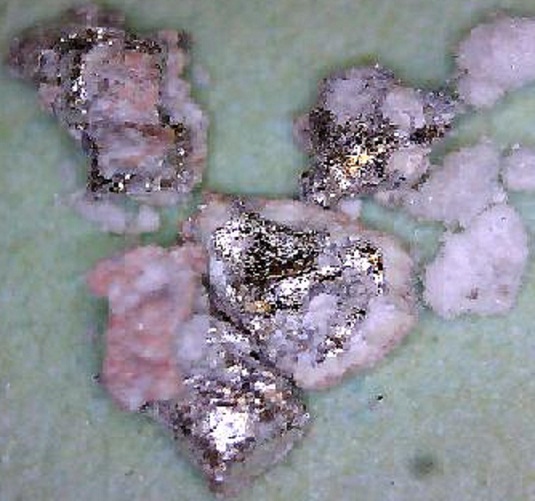
Below is a photo of the result of my first attempt atย smelting aย cassiterite simulant (SnO2, Aldrich). The SnO2ย was treated with carbon black at 900 C for 4 hours in a covered porcelain crucible in a muffle furnace.ย  After aย  failed attempt with a large excess of carbon, the ratio was reversed and heated for a longer period.ย  For the illustrated sample, the mass ratio of SnO2 to carbon black was ~2:1. All of the carbon black was consumed, leaving a white mass of needles on the granular solids.ย  Using a USB microscope I searched for evidence of reduction to the metallic state andย found numerous examples of sub-millimeter sized pieces of metal.ย  The yield of metallic tin is estimated at < 1 %.

The purpose of this exercise (for me)ย is to try gain a better sense ofย what problems people might have faced smelting tin in antiquity.ย  Using basic principles, I strongly heated the SnO2 under reducing conditions until the carbon was consumed.ย  What I did not expect was the large amount of white crystalline material produced. It’s composition is as yet unknown to me.

Next I will make some charcoal or even wood shavings as a reductant for authenticity sake. Who knows, maybe some carbon monoxide generation might be helpful. The muffle furnace does not simulate a reverberatory furnace very well. It could be that gases from a reducing flame are important.

Smelting of Cassiterite Simulant