Category Archives: Metals

Mining Asteroids

The founders of the Silicon Valley startup, Planetary Resources, have announced plans for mining asteroids for valuable metals. Peter Diamandis, Eric Anderson and investors including director James Cameron and Google CEO Larry Page are behind this venture.

I’m trying to be positive here. Perhaps these fellows should visit some earthly mines and see what it takes to break actual rock and extract the value from it.

Earth bound ore bodies near the surface are commonly the result of concentration by hydrothermal flows. In the absence of water-based geothermal concentration processes, or recrystallization of PGM’s in magma chambers, the reality of economically viable ore bodies in asteroids is an open question. A lot of survey work needs to be done to answer this question.

Oh, and one more thing. When you blast rock on a largish planet like earth, the fragments fall back to the ground. This won’t happen on an itty bitty asteroid.

The talk about recovering water from asteroids to subsequently crack and make propellant is a large challenge all by itself.

I predict that civilization will slump back to a 19th century Dickensian-style world of robber barons and sharecroppers before any hardware gets to an asteroid.  Children will ask “Momma, what’s an iPad?” as they walk from their rundown subdivision to a quonset where they strip insulation from wire for copper to barter for food. It’s all so clear now …

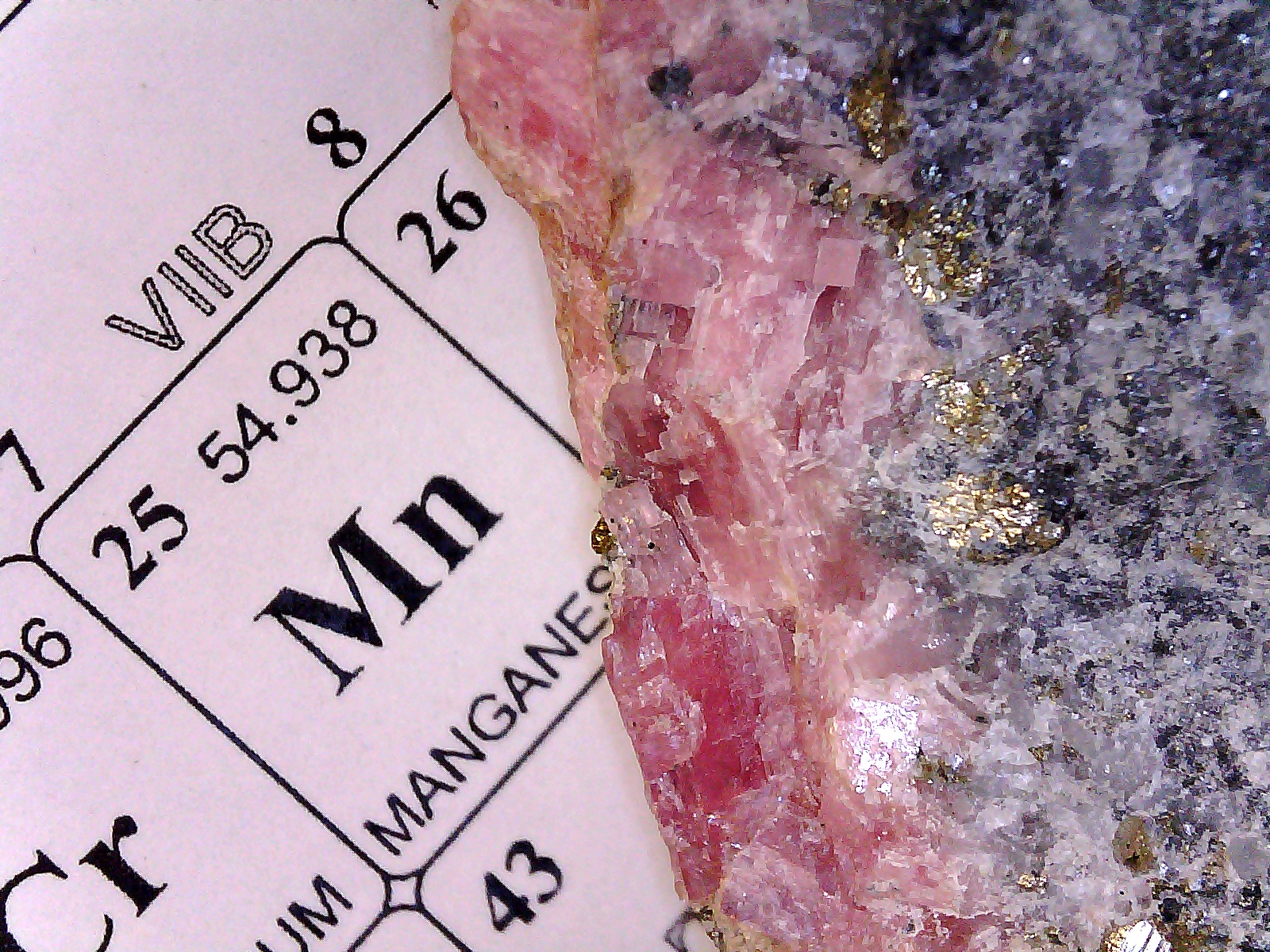
Rhodochrosite Sample

Rhodochrosite Specimen with Galena and Pyrite (Copyright 2012 Th' Gaussling)

Rhodochrosite is a mineral composed of MnCO3. The specimen above is in no way exceptional, other than as a curio. The mass is comprised of rhodochrosite, galena, pyrite, what looks like quartz, and possibly a trace of a gold colored metal.

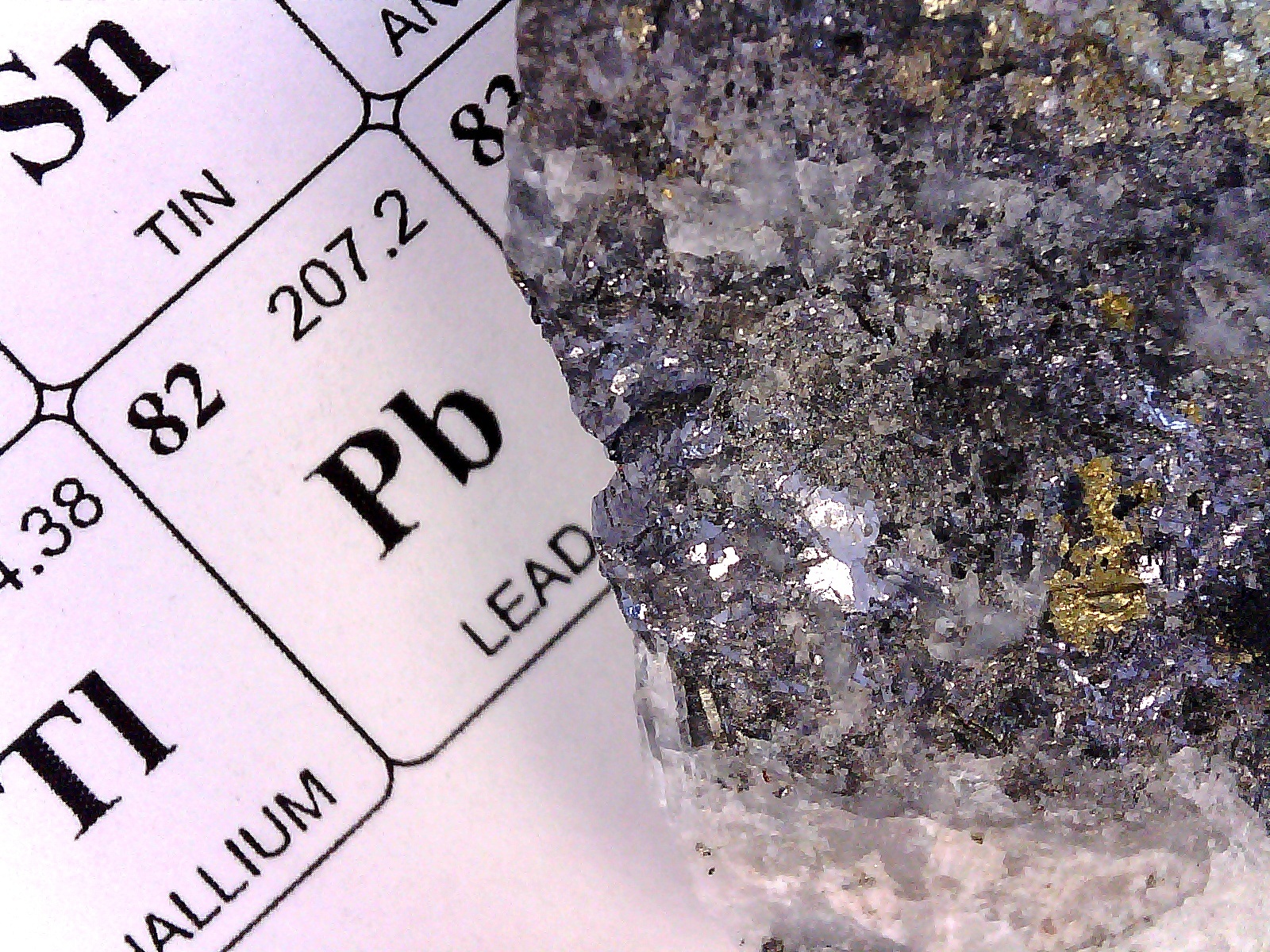
The photo below shows the galena, or PbS.

Same sample as above, showing the galena. (Copyright 2012 Th' Gaussling)

The photos were taken with a USB microscope.

Pinch Predicted in the Uranium Market

According to an article in Mineweb, the remaining cold war era uranium will be consumed in the next few years, leaving the nuclear industry with inadequate supply streams from mining.  Thomas Drolet of Drolet & Associates Energy Services, said that in 2010 mining produced 118 million pounds of uranium against a demand of 190 million pounds. Obviously, the balance was made up from decomissioned nuclear weapons stockpiles. The article did not say whether the numbers represented lbs of U or of U3O8. The oxide is commonly cited in relation to uranium mine production.

Drolet suggests that Japan will have to restart ca 30 of its 50 or so reactors in order to meet power demand.

It is my sense that the Fukushima disaster will not be the stake in the heart of nuclear power. The location of the Fukushima plant and a list of easily identifiable design features allowed the initiation and propagation of the incident. While the future of reactor operation in Japan may be stunted, most reactors elsewhere in the world are not located in tsunami flood zones. Regrettably, some are located in fault zones. But the insatiable demand for kilowatt hours will override everything. Commercial fission will continue into the indefinite future.

Return to fundamentals

As we labor away on our extractive metallurgy project, I continue to marvel at how even complex extraction schemes reduce to the application of fundamental chemistry and basic unit operations. It is crucial to have a comprehensive understanding of the composition of your ore and the fate of the components as they are exposed to unit operations. The extraction of desired metals from your ore requires extensive use of analytical resources in order to keep the process economics in line.

Extractive metallurgy also requires an extensive knowledge of descriptive inorganic chemistry- something that was glossed over when I was in college. When I took undergraduate inorganic chemistry the emphasis was on ligand field theory, group theory application to symmetry and vibrational modes, coordination complex chemistry, etc. Lots of content that took many lecture hours to cover. Basic reaction chemistry was neglected in favor of admittedly elegant theory.

The fun for me (an organikker) has been in learning lots of descriptive inorganic chemistry and inorganic synthesis.

Extractive metallurgy in practice comes down to a relatively short list of operations. Roasting or calcining, comminution & classification, extraction, dissolution, flocculation, frothing, dewatering and filtration, redox transformations, precipitation, and drying.  Since most of the solution work is water based, the main handles you have to pull are temperature, selective solubility, and pH.

My undergrad coursework in inorganic qualitative analysis, specifically the separation schemes, has been very valuable both in terms of benchwork as well as descriptive chemistry.

Vannoccio Biringuccio. Sixteenth Century Chronicler of Metallurgy.

By the early 16th century in Europe, metallurgy had become an established cottage industry in numerous locales. Artisans were sourcing copper, tin, zinc, antimony and iron ores for reduction, refinement and alloy production for cannon and bells among other products.  While there was no systematic science of chemistry in a form recognizable today, the necessity of constant proportions was understood and exploited to maximize the efficient use of scarce materials. Metallurgists of the 16th century would no doubt share the enthusiasm of developing technology with the same fervor as the technologists of today. 

Unfortunately for these 16th century technologists, the contribution of centuries of alchemy produced a confusing array of occult-based practices. These alchemical practices were based on Aristotelian notions of material “qualities” rather than a system of quantitative relationships of and between substances. It is thought that alchemy began with Grecian metalworker’s practical knowledge of metal preparation. Inevitably, this practical art was overprinted with a thick layer of theological mysticsm by the end of the first millenium. By the end of the alchemical age, any systematic theories of matter were blended into a Mulligan stew of early Roman Catholic mysticism,  incomprehensible nomenclature, and the false choices set forth by Aristotle in his theory of matter.

Fortunately for 16th century practitioners of the metallurgical arts, several encyclopedic works were published detailing the practical art of smelting and casting of metals and what we now know to be alloys.  A prominent early work published in 1540 was the Pirotechnia by Vannoccio Biringuccio (1480-1539). Born in Siena, Italy, over the course of his life Biringuccio traveled extensvely throughout Italy and Germany. His Pirotechnia is a series of books and chapters detailing foundry techniques that he witnessed first hand throughout his travels. He made every attempt to describe methods and techniques in enough detail to accurately capture the technique in question. Above all, he completely drops all the alchemical mysticism and bases his comments on process oriented details such as measured proportions and processing conditions.

Up to this point, what was missing from this very early form of chemistry was a systematic collection of facts and measurements and an accurate chemical model in which to give the facts meaning and predictive value.  Biringuccio, and later Agricola, would begin the disengagement of alchemical mysticism and provide a basis of metallurgical technology upon what might be called science. In a real sense, this helps to set into motion the western industrial revolution. Metallic goods would be produced by very pragmatic artisans who would continue to improve their art through the application of rudimentary measurement.  While it would be four centuries before atomic theory would be developed to make sense of the manner in which definite proportions operated, systematic methods of assay would begin to appear well before atomic theory. The ability to identify value in ores and quantitate it allowed the mass industrialzation of metals.

Thorium and Rare Earths. A Possible Market Synergy.

If one studies the economic geology of Rare Earth Elements (REE), it becomes clear that REE’s are frequently (usually?) found in deposits rich in other elements.  Deposits of zirconium, tantalum and niobium, for instance, are frequently co-located with REE’s.

The REE’s are found in ore bodies that are naturally enriched in either heavies (yttric or HREE’s) or lights, (ceric or LREE’s). The LREE’s seem to be the most common spread of the REE’s.  Molycorp’s Mountain Pass bastnasite deposit is a good example of this.

What is not so widely known is that thorium and/or uranium are nearly always found in these deposits.  This might be regarded as a good thing except that companies in the REE business seem to be less interested in actinides than lanthanides. The actinide business is fraught with complications related to the natural radioactivity of Th and U. If one is interested in rare metal production, the matter of radioactivity is unwelcome.

However, there is opportunity here if certain institutional thinking is allowed to expand. I refer to the global preference for uranium and plutonium in the nuclear fuel cycle. Nearly the entire world’s nuclear materials infrastructure was directed to the production of yellowcake and separation of U235 from U238 post WWII. While there has been some experimentation with thorium 232 in the US, and there are some limited initiatives in motion, it has been largely neglected in reactor design and the fuel cycle in favor of uranium and plutonium.

Rare earth element mining and processing naturally produces thorium and uranium. At present, those practicing REE extractive metallurgy have every incentive to avoid concentrating the actinide components owing to the radioactivity. However, if there were a coherent program for the development of an efficient thorium fuel program, this natural resource could be efficiently taken from the REE product streams now or in the future.

Our reliance on energy will trend substantially towards electricity. The greater absolute abundance of Th over U, as well as the ability to use 100 % of the predominant isotope makes thorium a good candidate for energy exploitation. The recent boom in REE exploration has uncovered new sources of thorium. The nuclear genie was let out of the bottle nearly 70 years ago. By now we should be a little smarter about how we use it.

Mercury Processing at the New Idria Smelter

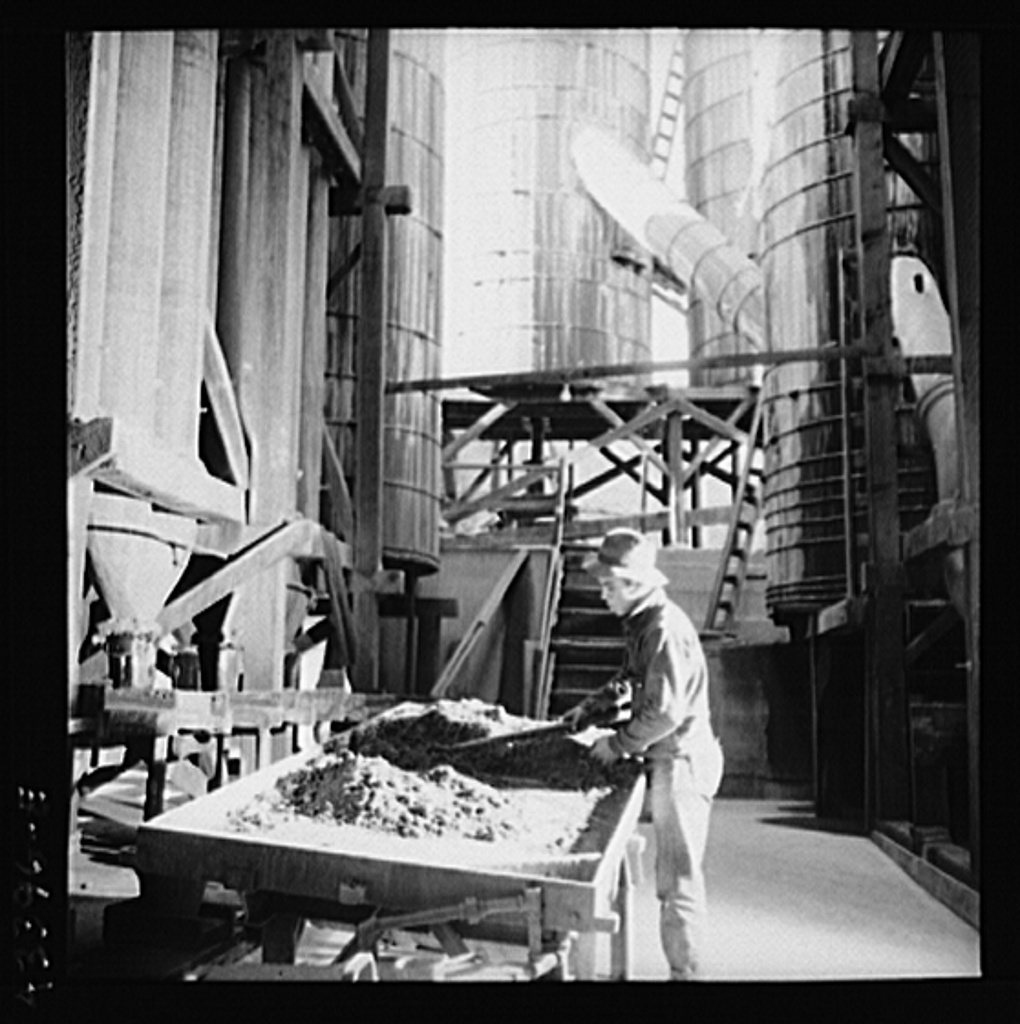
A few Andreas Feninger photos found at the Library of Congress are shown below.  The New Idria mine was a productive mine and smelting operation in central California. Note the fellow at the tilted sorting table, physically agitating the mercury from the solid soot and allowing it to run down the table for collection.  This is a gravity sorting process. Hard to know what kind of occupational exposure the poor fellow is into.

Worker collecting mercury from soot from smelter at New Idria mine, ca 1942. Library of Congress.

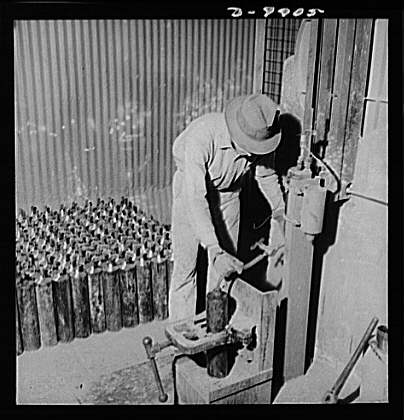
Since the early days of Spanish mercury trade, mercury has been packaged in iron flasks. According to my sources, the 76 lb sizing of the flask was based what laborers and pack animals could plausibly carry all day. In the picture below, a flask is being filled with mercury at the New Idria smelter.

Mercury Filling Station at New Idria Mercury Smelter, 1942. Photo by Andreas Feninger, Library of Congress.

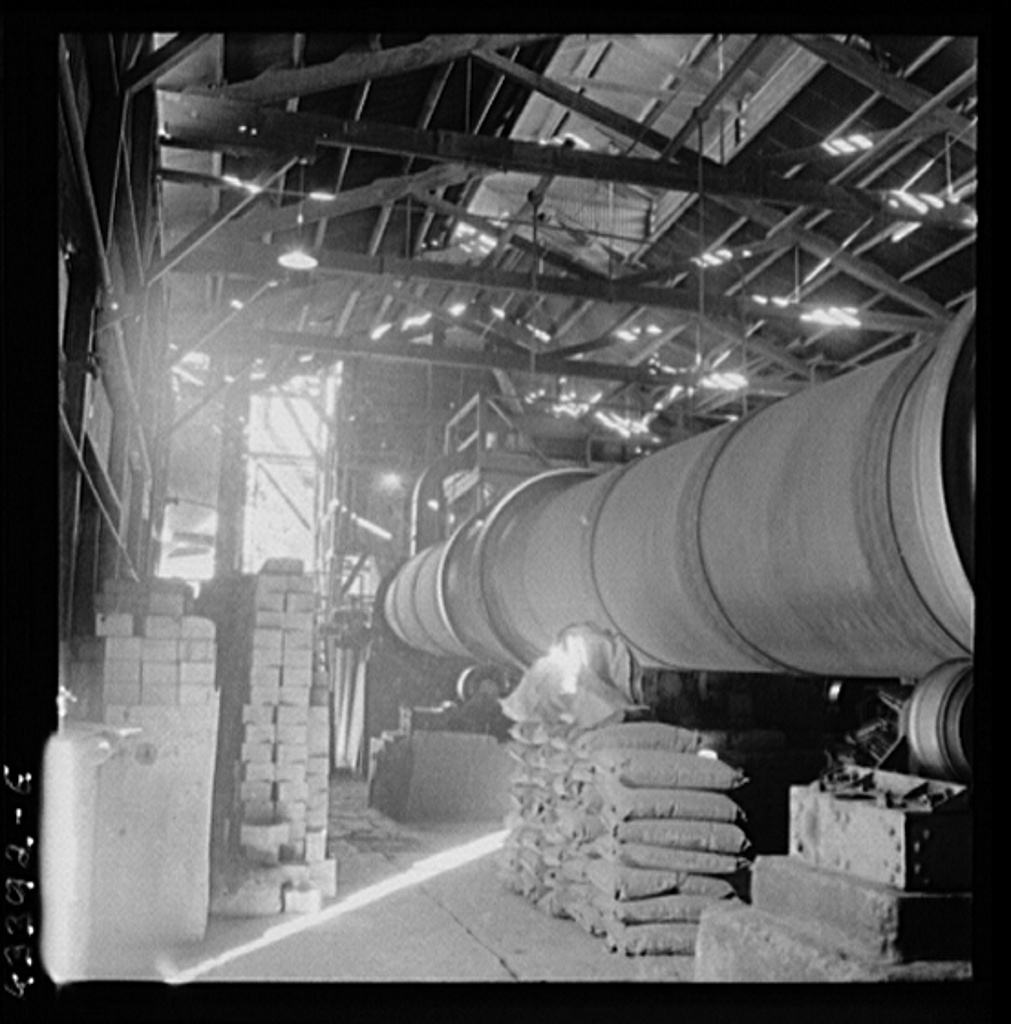
Cinnabar ore was crushed and then roasted in a rotary kiln. This process not only released the sulfur from the cinnabar (HgS), but also decomposed the oxide and volatized the mercury. The mercury vapor was knocked down from the exhaust gas in condensers.

Rotary Kiln at the New Idria Mine and Smelter, 1942. Photo by Andreas Feninger, Library of Congress.

Power Generation with Mercury Turbine

The South Meadow generating station was operated by the Hartford Electric Company in Hartford, CT. The unit described in the 1931 Pop Sci article used 90 tons of mercury in the boiler. The article states that the South Meadow generator produced as much as 143 kWh from 100 lbs of coal, as opposed to an average of 59 kWh from conventional coal fired plants and 112 kWh from exceptionally efficient coal fired plants. The article describes an incident at the plant where a breech of containment from an explosion in the mercury vapor system occurred, releasing mercury and exposing workers to mercury vapor.

The Schiller Mercury Power Station in Portsmouth, NH, is described in this link.

Conquistador’s preamble

The extraction of silver and mercury in Spanish new world was central to the expansion and upkeep of the empire. Silver provided wealth enabling the crown to project power and pay its debts. In the early years of the conquest the Spanish pilfered and exhausted Inca gold and silver available in stores and caches. Eventually, the Spanish found deposits of gold and silver and developed a form of forced mine labor (mita) wherein indian families were required to provide a worker for one year’s unpaid labor in the mines.

The Viceroyalty of New Spain and the Viceroyalty of Peru during the age of conquest developed many mines, yielding mostly silver. Many deposits, especially Cerro Rico in what is now Potosi, Bolivia, contained silver in the metallic form to some minor extent. The Incas had developed smelting before the Spanish occupation, but the process was inefficient and required fuel for smelting. Wind smelting was developed by the Incas, but was dependent on the winds to drive the fires. The discovery of amalgamation and recovery of silver and gold by retorting solved many problems in production.

After the discovery of the patio amalgamation process in 1554 in what is now Mexico, the importance of mercury was recognized as the key to efficient, large scale silver production. This discovery eventually enabled the large scale enslavement of aboriginal peoples to run the mercury mines and smelters of Huancavelica, Peru, and amalgamation operations in the many silver mines in the region.

The conquistador Mancio Serra de Leguisamo (b. 1512, d. 1589) lamented in a preamble of his will-

We found these kingdoms in such good order, and the said Incas governed them in such wise [manner] that throughout them there was not a thief, nor a vicious man, nor an adulteress, nor was a bad woman admitted among them, nor were there immoral people. The men had honest and useful occupations. The lands, forests, mines, pastures, houses and all kinds of products were regulated and distributed in such sort that each one knew his property without any other person seizing it or occupying it, nor were there law suits respecting it… the motive which obliges me to make this statement is the discharge of my conscience, as I find myself guilty. For we have destroyed by our evil example, the people who had such a government as was enjoyed by these natives. They were so free from the committal of crimes or excesses, as well men as women, that the Indian who had 100,000 pesos worth of gold or silver in his house, left it open merely placing a small stick against the door, as a sign that its master was out. With that, according to their custom, no one could enter or take anything that was there. When they saw that we put locks and keys on our doors, they supposed that it was from fear of them, that they might not kill us, but not because they believed that anyone would steal the property of another. So that when they found that we had thieves among us, and men who sought to make their daughters commit sin, they despised us.

Many Spaniards attempted to speak out for the Inca and other aboriginals. Few were effective. But by the time of the Fifth Viceroy of Peru, Francisco Alvarez de Toledo, it was recognized (by Toledo, at least) that reforms were needed to bring the Inca into Christianity and life in a world of laws. Perhaps it was unfortunate for 16th century Incas that King Phillip II was an especially enthusiastic proponent of the counter-reformation and the Inquisition.

Octopole and Quadrupole

Busy week learning to use the new ICPMS. Pretty flippin’ amazing instrument. Reaffirms my admiration for Bill and Dave. A lot of nuances and software to learn, but do-able.  Agricola and Biringuccio could’ve used one of these. Of course, they’d have needed 208 VAC single phase power …

Interesting approach to polyatomic ion interferences- run the beam through a He chamber to slow down the large cross section ions and use the octopole to steer the beam into the off-axis chamber exit and into the quadrupole mass filter. Clever monkeys.