Category Archives: Metals

XRF Magic

We’ve been looking at hand held XRF spectrometers.  If you have not been introduced to this, you may be in for a real treat. A variety of companies make them- Bruker, Thermo, and Innov-X to name a few. These things are in the low-end Lexus price category, but are they ever amazing.  It’s straight out of Star Trek.

Clarke’s Third Law states that any sufficiently advanced technology is indistinguishable with magic. I gotta tell ya that these hand held XRF’s are just amazing.  You point at a sample and it gives a tally of the elements present, or most of them at least.  Some even have a built-in GPS you can punch to take a waypoint of the location of the sample you just analyzed out in the field.  It is a great tool for mineral prospecting.  

What is embarrassing is that this is the first I’ve heard of it. Our geologist friends have been using these things for a while now. 

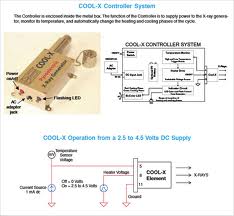
The whole thing depends on a miniature X-ray source.  I’ve been looking into this.  For the curious folks out there, lithium niobate- LiNbO3- is a very interesting material.  Crystals of LiNbO3 have the property of pyroelectric potential. A pyroelectric crystal is one that is able to generate a polarization across the crystal faces in proportion to the temperature.  A pyroelectric xtal placed on a heating/cooling block in a vacuum is able to generate a stream of electrons energetic enough that, when stopped by a copper electrode, will generate x-rays. 

One manufacturer, AmpTek, produces a miniature x-ray unit called the Cool-X that has a photon output equivalent to two milliCuries, with 75 % of the flux less than 10 KeV.  Elsewhere in the product literature, the output is described as 5 milliSieverts per hour.  So, the user has to be a little careful with this thing. But rad safety issues aside, this is quite an amazing source. The product literature doesn’t come out and say what kind of crystals are used, but they may be a tantalate salt.

AmpTek Cool-X

The unit does not operate continuously. It can only generate x-rays durig a thermal cycling period, The xtal starts out cool and as it’s heated, generates the electron flux that is de-accelerated by impacting the copper to produce the x-rays. The lit gives a cycling interval of 2-5 minutes.  It is referred to as a Kharkov X-ray generator.

It’s magic.

Comments on Gold Rush Alaska Program on the Discovery Channel

The program called Gold Rush Alaska which is being aired on the Discovery Channel is well worth watching if you are curious about what it takes to do placer mining.   In addition to the strenuous task of digging down to the gold bearing layer of sediment, the miners are challenged by the short mining season in Alaska (~100 days or 2400 hours) and the remoteness of the location. 

There are several unit operations in play. The first operation using the trommel classifies or sorts the sediment by size.  This results in cobbles and pebbles being excluded from the sand and silt. This is a classification process that uses gravity to roll the large rocks to a separate location. 

The next step is more of a density driven process wherein the material stream is taken through a shaker station where sedimentation of the dense fines is accelerated by mechanical agitation and the resulting material flow is transferred to a sluice where the heavy gold particles and nuggets are agitated by the riffling action of the water and settle to the bottom. The less dense solids are washed out of the sluice and discharged to a waste pile.

All of the slurry flow is gravity driven, so the process train must begin uphill and work its way down. The sluice section is where the density separation occurs in earnest and this is where the gold will accumulate.

Periodically, the sluice section must be cleaned out and the resulting gold laden silt must be further processed to isolate the gold. The fellows in the program must use panning or a shaker table to isolate the dust and larger pieces of gold.  This a definite disadvantage compared with miners in the past.

The buckets of silt isolated from the sluice would have been treated to amalgamation in times past.  This selective dissolution of gold and silver could be used to accumulate the gold until the amalgam would begin to solidify. This process requires less skilled labor than panning or using a shaker table. The amalgam would eventually be placed in a retort and heated strongly to distill out the mercury leaving the non-volatiles behind.

The gold would then be sold and sent to a smelter for further refinement (i.e., parting) of the crude gold.

Without mercury, present day miners have a rather more complicated task in isolating the gold.

Antimony Funnel Formation at Stibnite, Idaho

In the Pnictogen Hall of Fame there is at least one p-block compound with a town named after it. The ghost town of Stibnite, Idaho, sits silently in the Yellow Pine mining district 40 or so miles NW of Cascade, Idaho.  The town of Stibnite is named after the sulfide of antimony- Sb2S3.  The chemical symbol, Sb, is related to this mineral name.

Idaho sits in the great North American cordillera.  A cordillera is a grouping of mountain ranges at the continental scale. In the case of the North American cordillera, it begins ca 103 west longitude and extends to the Pacific ocean. The Black Hills are found somewhat east of 103 degrees, but I’m generalizing again. In the US, the Rockies, Wasatch, Cascades, and the Sierra Nevada ranges are part of the cordillera formation.
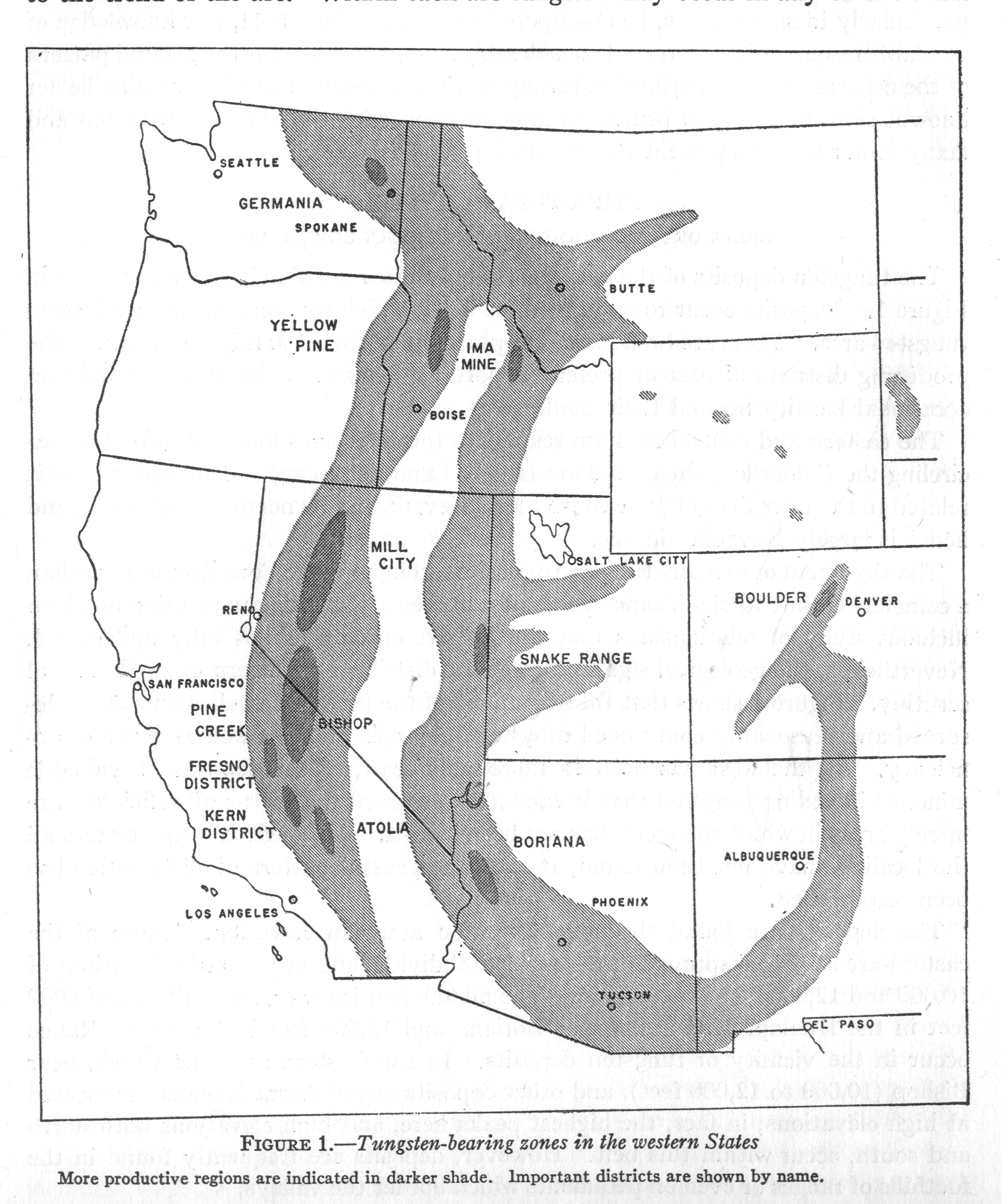
North American Tungsten Belt. From Paul F. Kerr, Tungsten Mineralization in the United States, 1946, Waverly Press.

One characteristic of the cordillera is the broad occurrence of economically important metal deposits. In the illustration above, the occurrence of tungsten is associated with the mountainous regions of the west. An important feature found in economic metal bearing districts within the cordillera are vein deposits. Metals can be disseminated in rock or concentrated in veins. 

In Colorado, the Cripple Creek & Victor mine is situated in the throat of an ancient volcano. This ore body is an example of highly disseminated gold ore which is interlaced with vein structures containing higher concentrations of gold.

Rather than perform underground mining, the economics allow the large  scale removal and crushing of rock to pebble size followed by extraction with cyanide to isolate the value.  This mining technique was not possible until the advent of large scale mechanization. In the early days, the Cripple Creek district was limited to underground mining of vein formations that were more highly enriched in gold.

What is crucial to the placement of a metal ore body is some process that leads to concentration of valuable metals. Recall that the definition of an ore is based on economic considerations.  At some level of dilution all ore becomes just gangue or country rock. Concentration of value in the ore body near the surface can arise from several mechanisms.

A common process that concentrates desirable minerals is hydrothermal deposition. This is found widely in the cordillera. A natural consequence of mountain building is the generation of stresses within the upthrusting  rock. At some point stress gets relieved by fracturing which results in the formation of void spaces within the rock.

Underground water, which at depth is at high temperature and pressure, will dissolve components of rock in contact with the water. This water will naturally convect and flow towards the surface, carrying whatever solutes that were favored by higher solubility.

Deposition occurs as the water flows to the surface within whatever fracture network the waters find themselves in and may continue to deposit until the vein seals itself shut. Over the fullness of time the formations are thrust upwards and erosion wears down the rock to expose outcroppings of the desired mineral at the surface. 

Such processes have put vein lodes in place all over the world, including the American west. Deposits of gold, silver, antimony, iron, mercury, and tungsten are examples of metals that are concentrated in this manner. Ostensibly, this is happening in geothermal hotspots like Yellowstone or Iceland today.

These exposed outcroppings weather and oxidize, generating new mineral compositions. In the case of gold, its relative inertness leads it to form the native metal in these weathered formations and, under the influence of gravity and the hydraulic forces of snowmelt, gold will work its way downhill and into the alluvium.

Other elements besides gold are also mobilized, particularly the sulfides. In the deep crust, well below the depth to which oxygenated meteoric water can flow, is an environment rich in the anionic subunits oxide, sulfide, silicate, and aluminate. Metals and metalloids like Cu, Sb, Ag, As, Pb, Hg, etc., form complexes with the various anions and correspondingly, 3 dimensional networks of inorganic polymeric species. To the extent that a 3-D network of shared atoms, edges, and faces of tetrahedral crystalline subunits can be formed, the resulting bulk material may have a high melting point and high strength.

However, when connectivity is lowered by chain or network terminating constituents, the melting temperature and hardness of the material may be lowered.  An example is soda glass. When silica is diluted with chain or network terminating components like soda or lime, the high strength and high melting point of quartz, which is just pure polysilicate, is lost. The same thing can happen naturally in mineral formation processes.

Other kinds of ore are put in place by fractional melt crystallization and layer deposition by density within a magma chamber. The major ocurrences of platinum group metal (PGM) deposits are an example of such a process. Eventually, tectonic processes raise the frozen and extinct magma chambers to the surface where erosion exposes a narrow banded horizons referred to as a reef.  The Bushveld Igneous Complex in South Africa and the Stillwater Complex in Montana are examples of this mechanism.

The deposits found near Stibnite, Idaho, are comprised of antimony and tungsten as well as lesser amounts of gold and silver. In about 1900 gold, silver, and antimony were discovered in the area, leading to a gold boom at Thunder Mountain.  During the years from 1938 to 1944, the Yellow Pine (W, Sb) and Meadow Creek (Au, Ag, Sb) mines in this part of Idaho were the largest producers of tungsten and antimony in the United States.

The details of this mining district can be found in:

John R. Cooper,  Geology of the Tungsten, Antimony, and Gold Deposits Near Stibnite, Idaho; 1951, Geological Survey Bulletin 969-F.  Stibnite Idaho USGS

In the abstract, Cooper describes the W, Sb, Au, Ag deposits as being confined to an area about 1 mile by 3.5 miles in scope (as of 1951). The principal rock of the area is quartz monzonite which is extensively fractured and has been penetrated by dikes of basalt, quartz latite porphyry, trachyte, and rhyolite.

Cooper describes a deposit whose metallization has taken place in three stages with intervening episodes of fracturing. The first stage is described as extensive replacements by gold-bearing pyrite and arsenopyrite.  The second phase of deposition or replacement is less extensive and is by scheelite (CaWO4) within the gold ore bodies.

The third stage of growth or deposition is of stibnite and silver, largely within the same fracture systems as the scheelite. The ore bodies occur with the Meadow Creek fault and associated subsidiary faults in the quartz monzonite. The tungsten-antimony ore body within the formation took the shape of a

“flat upright funnel flaring to its widest diameter at the surface and tapering to a narrow neck, which extends below the bottom of the minable tungsten ore. The underside of the ore body is very irregular in detail.  The highest grade of tungsten ore was concentrated toward the center of the mass and was surrounded by an envelope of antimony ore containing only a little tungsten.”    – John R. Cooper

The Meadow Creek ore contained 0.23 oz gold per ton and 1.6 percent of antimony.  The Yellow Pine ore contained little gold but 4 percent of antimony and 2 percent of WO3. The Yellow Pine deposit was exhausted of tungsten in 1945, producing 831,829 units of WO3 equivalents in the concentrate. One unit of WO3 is 20 lbs of tungsten trioxide.

Much of the scheelite was found disseminated in brecciated gold ore.  Some scheelite was found in branching stringers and veinlets within the groundmass.

The stibnite occured as “disseminations, microveinlets, stockworks, massive lenses, small fssure-filling quartz stibnite veins, and euhedral crystals coating late fractures. ”  Oxidized antimony minerals such as kermesite (Sb2S2O) were reported as being very scarce.

Agricola Christmas

I indulged in the purchase of a book I’ve had my eye on for a while. It is the English translation of De Re Metallica by Georgius Agricola, translated by Herbert Hoover and wife Lou Henry Hoover. This book (or collection of books) was published ca 1550. The English translation came out in 1912, written  by a young mining engineer from Iowa who would eventually become a US president. De Re Metallica is available in newly printed paperback form.

One issue that had stymied previous translators was the fact that Agricola wrote in Latin, a language that had been effectively dead for a thousand years, and Agricola needed vocabulary for situations that were not anticipated while the language was alive. So he invented vocabulary. Somehow the Hoovers were able to noodle  through this.  The translation is heavily footnoted.

Agricola was the first western scholar to document the mining arts as well as considerable geology and mineralogy. While I have not gotten too far with the book, it is apparent that mining technology in the European middle ages was fairly sophisticated by way of the mechanical contrivances used in the operations. Explosives would have been welcome then, but that was not to be for a long time.

They had milling machines, hoists, and sluices. They also performed cupellation, smelting, and calcining. Agricola discusses ore bodies, surveying, milling, property rights, and a host of other practical issues relating to oeprating a mine.

The book was published by a rare book publisher who performs print on demand (POD). There are a number of publishers who do this. Typically the copyright has fallen into the public domain.

Copper Prices at Record High Level

So, as we bob along in the US pablum news cycle, a news nugget unknown to many of us is the fact that China is undergoing a building boom that is driving the price of copper to record levels.  Despite reports of plummeting rents and rising office vacancies in Shanghai, China is consuming vast amounts of extracted resources from countries like Chile and Peru for large scale electrification projects.

In particular, copper is in heavy demand. And with heavy demand comes high prices.  On the Shanghai market, for instance, copper was recently selling at ca $4.50 per pound and a bit lower on the London exchange. Prices are up sharply since the Cu price collapse in 2008.

According to Bloomberg Business Week, 2009 copper sales of $9.8 billion to China represents 19 percent of exports and 6 % of GDP to Chile.  Chile is experiencing a boom in copper exports from what some are viewing as a Chinese construction bubble.

China is not buying copper in the form of finished goods. It is buying ore concentrates from operations like Cerro Verde in Peru.  After ball milling, the copper sulfide ore is concentrated by froth flotation and eventually put on a boat to China. There it will be refined to a grade suitable for electrical use.

And speaking of metals, China has announced it will speed up exports of rare earth elements to Japan.  This is good news for all of us since Japan is one of the major consumers of REE’s out side of China.  Interestingly, 20-30 % of China’s rare earth output smuggled out of the country.

Plutonium Mining

The WordPress blog website comes with a feature on the dashboard that lets you know what key words people are using to find your site. I just got two hits from people looking for “Plutonium Mining”.  Some folks out there are really confused.

My dear fellow: one does not mine plutonium. One mines uranium and breeds it into plutonium.  Plutonium may be had from two successive neutron absorption and beta decay events starting with U-238. Plutonium has two more protons than uranium, so two beta decay events have to occur to increase the proton count by two in the nucleus. And making certain actinide nuclei even more rich in neutrons is one way to encourage beta decay.

The age of the solar system is just too great for the heavy actinides to be left over from regional supernovae atomic weight building events. But imagine if plutonium was found in abundance in ore bodies. No doubt museum shelves would be full of artifacts fashioned from plutoniferous minerals. Glazed pots and fertility fetishes made from the pretty rock.  Perhaps the Egyptians might have had glow-in-the-dark burial artifacts and a hieroglyph for radiation burn or sudden hair loss.

Wherein the Vagaries of Rare Earth Elements are Considered

Th’ Gaussling was interested to read the August 30, 2010 issue of C&EN regarding the market situation with the rare earth elements. Or, at least certain rare earth elements (REE). The staff at C&EN has finally picked this matter up on their radar. Significant ore bodies are located in countries prone to reflexive autocracy, i.e., Russia and China.

More sgnificantly, as a friend and colleague recently pointed out, China has decided to exercise its Lanthanide fist in by slapping an embargo on rare earth materials available to much of the global market. The affected technologies include those using neodymium (or rare earth) magnets for power generation or motors. Rare earths are used in optics, ceramics, fuel cell membranes, and catalysts as well. It’s a pretty big deal for the rest of us. Lots of American R&D resources have gone into this technology.

This is the political chemistry of the REE’s. China is doing what China does- exercising national industrial policy through an emphasis on development of its natural resources. The USA, with its deep preference for free markets, is doing what it has done the last few decades- waking up surprised after a night of riotously drunken merrymaking in the marketplace. That is, responding to shortages well after the momentum has begun.

While US technologists were busy inventing things with REE’s, China was busy anticipating the upcoming demand for its REE’s. Why? Because raw mat sourcing is what R&D people do afterwards. They develop a widget and then ask how they will source the thing. Just natural. 

While the US was busy shutting down mining operations in the last decades of the 20th century, China has been systematically developing its resources.  China has an abundance of journals and workers devoted to REE technology.  The big corporate mind set in the US recoiled from investment in mineral wealth at home. A great many of the mining operations in the US are operated by Australians, Canadians, and South Africans. Somehow they are not afraid to extract minerals here, but the sons and daughters of the pioneers seem to be shy about it.

China seems more focused on developing its industrial base rather than its consumer base.  While there are some industrial policy lessons for the west here, the fact is that China is as China does.  We should not be surprised at this behavior.

The signals of a tougher Chinese trade stance come after American trade officials announced on Friday that they would investigate whether China was violating World Trade Organization rules by subsidizing its clean energy exports and limiting clean energy imports. The inquiry includes whether China’s steady reductions in rare earth export quotas since 2005, along with steep export taxes on rare earths, are illegal attempts to force multinational companies to produce more of their high-technology goods in China.

Despite a widely confirmed suspension of rare earth shipments from China to Japan, now nearly a month old, Beijing has continued to deny that any embargo exists.

Industry executives and analysts have interpreted that official denial as a way to wield an undeclared trade weapon without creating a policy trail that could make it easier for other countries to bring a case against China at the World Trade Organization. [Keith Bradsher, 10/19/10, NYT. Italics by Th’ Gaussling]

It’s not all doom and gloom. Molycorp has announced an IPO to raise funds for expansion and modernization of its Mountain Pass REE mine.  The geology of this ore body is described at this Cal Poly link.  One of the issues complicating the extraction of ore from this massive igneous and metamorphic carbonatite complex is the proximity to the Mojave National Preserve.

REE’s in geological context

In the cosmochemical bingo of hadean Earth, the landmass that we now refer to as Asia filled in the abundance bingo card with the rare earth group of elements. The combination of plate tectonics, crystalline partitioning of cooling magma, and erosion have lead to surface occurrences of rock rich in REE’s.   This group of metals is commonly defined so as to include Sc, Y, and the lanthanide metals. Others will include the actinides. All have a valency of  +3 in their natural compositions. A few of the lanthanides can attain +2 (Eu) or +4 (Ce, Pr) oxidation states, but these are unusual.  Sometimes scandium is left of the list. In other instances, both scandium and yttrium are left off the list.

A graph of lanthanide element abundance vs atomic number will show a saw tooth curve where the even atomic numbers will be represented with greater abundance. This phenomenon isn’t limited to the stretch of lanthanides and is referred to as the Oddo-Harkins rule.  One reference translated from Russian lists it as the Oddo-Kharkins rule (Ryabchikov, Ed., Rare Earth Elements, Extraction, Analysis, Applications; 1959, Academy of Sciences, USSR; Chapter by V.I. Gerasimovskii, Geochemistry of the Rare Earth Elements, p. 27).

It is not uncommon for REE’s to occur as a group in the same mineral, though Sc is often absent.  I’m aware of at least one mineral occurrence of Sc that is impoverished in lanthanides.  Among odd-numbered REE’s, Eu is especially low in abundance.

Within the REE group, two subgroups are often defined: the cerium subgroup (La, Ce, Pr, Nd, Pm, Sm, and Eu); and the yttrium subgroup (Gd, Tb, Dy, Ho, Er, Tm, Yb, Ln, and Y).

The REE’s show some interesting attributes. According to the Goldschmidt classification, the REE’s are lithophiles, literally “silicate loving”. More to the point, lithophiles are oxygen loving. The REE’s are known to form refractory oxides.  REE’s are commonly associated with pegmatites and, according to Gerasimovskii,  have a genetic connection with granites and nepheline syenites.

See the later post on the illuminating history of rare earth elements.

Some Realities of Modern Placer Gold Mining

Yesterday was spent doing set construction for our upcoming production of You Can’t Take it With You. The spouse of one of the actors is a gold miner and a pretty fair carpenter.  He returned early from a placer mining expedition this summer west of Dawson, YT, Canada, across the border on the US side.

My acquaintance- we’ll call him “Ted” because of confidentiality- was a bit reluctant to discuss the recent expedition only because he felt his part in the thing was minor. In fact, his comments were very telling of the kinds of hardships facing anyone with a fancy for placer mining in Alaska or the Yukon Terrritory.

Ted has plenty of experience in placer mining in Colorado, especially in the Fairplay region west of Denver.  Placer mining has a special appeal to those who want to mine for gold, but don’t want the grief and expense of underground mining of chemically complex ores.

Ted signed up to work for a New Zealand miner who had a sizeable claim an hour outside of Boundary, AK, along the Top of the World Highway. This site is reasonably remote, judging by the fact the nearest city where machine parts could be obtained was Dawson, across the border in Canada. Mining season is 100 days in duration, or 2400 hours. This is because of the climate and the hardships associated with work out in the bush. 

The gold bearing formation is a band of sand and gravel 3-6 ft in thickness and 6 ft below the topsoil. The gold bearing gravels sat atop the bedrock.  The miners use a floating separations plant consisting of a trommel and a sluice. The machine had a long elevator with a belt for transferring gravel and rock from the sluicing operation.

The gold is recovered in a densly knapped carpet positioned along the bottom surface of the sluice. The gold particles are trapped in the fibrous mat and are periodically flushed out into centrifuge bowls for further separation.

The operation requires a good deal of readily available water. Ted recounted that the sluice process water was returned to a pond for reuse.  The position of this pond had to be managed constantly.

Here is how the operation works. The overburden on the claim must be removed well before the sluicing is to begin. This is done with a D-9 Caterpillar. Owning a large piece of machinery in the wilds of Alaska is an expensive proposition. A small mining operation cannot afford a new Cat, so a used machine must be purchased and delivered. This machine consumes X gallons of diesel per hour and suffers from mechanical breakdowns on occasion.

A small mining operator must be able to do maintenance and repairs because having a mechanic on site may not be possible.  The operator must have plenty of working cash on hand to pay for very expensive fuel and parts. Flying parts in will consume much of the short mining season.

The operator must carefully scrape the overburden away to reveal the ore body.  Leaving too much overburden will consume extra sluicing plant time.  Once the ground is scraped a pond must be constructed in order to support a floating sluice plant.

The sluicing plant is fed by an end-loader or back hoe. The gravel and sands are loaded into a trommel to sort the material and remove the large rock. The finer mesh gravels are then washed onto a sluice where a flow of water will wash the material across riffles to cause deposition of the denser components like gold.  Carpet positioned below the riffles will trap the fines and prevent them from being washed away by overexuberant water flows.

Ted said that gold dust recoveries can be as much as 6 ounces per hour when everything was operating smoothly.  While this sounds like a lot of money at the current price of gold, bursts of profitable sluicing can easily be overcome with expenses and downtime due to logistical snags, equipment mishaps, and unanticipated difficulties with the deposit itself.

One of the problems that this kind of mining operation can encounter with subsurface deposits in Alaska is the presence of permafrost. Ted explained that his early departure form the site was due to extensive permafrost in the claim. If you cannot dig up the gravel, you cannot recover the gold from it. Like any other single continuous processing train, downtime leads to a cessation of operating capital.

In Ted’s experience this summer, all of the puzzle pieces were in position except for the condition of the gravel deposit. It happened to be frozen in place.  It remains to be seen if these operators will return next year.

A man, a plan, gossan! A chemist saves the Colorado Au and Ag industry.

I have been nursing a theory about the American gold/silver rush phenomenon of the mid to late 19th century. That theory held that the critical enabler of the gold/silver rush was the development of extraction technology, referred to as extractive metallurgy in the mining business.  Wouldn’t you know that not only has someone else developed this idea, but also written a book on it. A very good book, I might add.

The book I refer to is Ores to Metals, by James E. Fell Jr., 2009 (paperback), University Press of Colorado, ISBN 978-0-87081-946-9.  The books is actually a version of his dissertation. I wish I could publish my dissertation like that, but we won’t go there…

In 1858 groups of prospectors lead by the Georgians William G. Russell and John H. Gregory found placer gold in streams near present day Denver. These prospectors worked their way up Clear Creek and Ralston Creek looking for more placer gold and for the lodes that would be the origin of the placer deposits.  The modest success of the prospectors in locating placer gold quickly spread eastward and lead to the 1859 Pikes Peak Gold Rush.

Prospectors combing the mountains along the creeks soon found lode gold. Gregory is credited with being the first to find a lode on May 6, 1859.  Placer mining soon lead to subterranean workings and within a few years the mining districts of Blackhawk, Central City, Nevadaville, and Idaho Springs were abuzz with activity.

The surface exposures of gold veins were amenable to familiar methods of processing. Soon, stamp mills were built in the vicinity of the mines and ore was hauled to the mills for crushing and further processing.  Since the gold isolated early in the development of the mines contained gold in a form processable to sluicing or amalgamation, great optimism about the future of the districts lead to further relocation of people hoping to cash in on the rush.

However, by the mid-1860’s, the ore pulled from the mines was of a form that was quite resistant to extractive methods then in place. The ore that had been removed first was from a body of rock that had been long exposed to the weathering effects of water and oxygen. This type of altered ore is referred to as gossan.

To miners accustomed to placer mining, the extraction of gold from gossan was feasible in that the gold was found in native form and within a matrix that didn’t interfere with known isolation methods. What local miners had in their toolbox up to that point was comminution, sluicing, and amalgamation.  Within a few years of operation, miners had encountered a form of the ore that would be called a sulfphuret. Sulphuretted ore as it was then called was actually rock consisting of metal sulfide minerals. These metal sulfides were deposited into fractures and faults millions of years ago by the hydrothermal flows from deeper and hotter source rock.

Assay of gold by cupellation would reveal the gold content even in the sulphuret. However, the gold recovery experienced by the mines plummeted when they got to ca 100  ft below the surface and into the sulphuretted zone of the ore body.  By 1867, many mines and mills were shuttered due to the low extraction yields from the new type of ore encountered. The Pikes Peak gold bubble was collapsing and the sulphurets were to blame.

So, along comes a chemist in 1863. Professor Nathaniel P. Hill from Brown University in Rhode Island. Professor Hill had been engaged to go to Colorado by associates of William Gilpin, territorial governor of Colorado, who was investing in mining property. The early 1860’s had seen a wave of hucksters selling snake-oil methods of gold extraction to mine operators frustrated with the sulphurets. These hucksters were referred to as “process men”. Gilpin sought funding and expertise from out east for his own interests. Hill visited the property Gilpin was interested in and reported that the property held little prospect of gold. Hill returned to Providence with a notion of the possibilities in Colorado.

Hill was entranced with the prospects of wealth from the gold district of Central City and left Providence to operate his own mining company. While in Central City, Hill was engaged by an mine operator named James E. Lyon to provide consultation. During that time, ca 1864-5, Lyon had engaged two European smelters to develop and install a smelting process for sulphuretted ore. News of Lyon’s smelters gave the impression of success, but in a few years Lyon’s business failed in part do to poor management.

Meanwhile, Hill returned to Providence to perform experiments on smelting methods. He settled on the Swansea process of smelting to produce a copper matte containing gold and silver, and eventually went to Europe to investigate the technology in greater detail. Hill visited Swansea and learned much about the smelting process. Returning to Providence, Hill pulled together investors and produced a plan for building and operating a smelter in Blackhawk, Colorado, as the Boston and Colorado Mining Company. 

To make a long story short, Hill and coworkers produced a process for the calcining of sulphuretted ore by open pile roasting, followed by higher temperature roasting in a reverberatory furnace. The reverberatory furnace produced a slag layer and a lower layer of melt that was enriched in copper, gold, and silver that could be discharged from below the slag layer. 

This process produced a product called a matte that was then crushed and shipped to Swansea, Wales, for production of bullion. By 1870, Hill had developed and was operating a successful smelting operation that was buying ore from the local mines on a sliding price schedule. The Pikes Peak gold rush was resuscitated and gold and silver production was back.

Extractive metallurgy of the 19th century

The first gold lode discovered in Colorado was found where the town of Gold Hill, Colorado, now sits. Gold Hill is presently at the locus of the Four-Mile Canyon fire west of Boulder. As of  today, more than 170 structures have burned, including a few outhouses.

Today, a single gold mining operation remains active at Gold Hill. The kid and I recently visited the area and I wrote a post about Wall Street, south of Gold Hill.

In the last few years I have been fascinated by what started as a simple question-  How did they get the gold out of the ore in the 19th century?  What has become apparent to me as a chemist is the extent to which reasonably sophisticated multistep extraction schemes were employed by 19th century mills and smelters. Their methods of processing would not be unfamiliar to alchemists who practiced similar arts over 400 years earlier.

The alchemists had techniques of calcination, comminution, lixiviation, and distillation available to them. In using these processes, they were inadvertantly performing reduction and oxidation reactions so as to alter the composition of substances with the hope of improving the prospects for isolation of desirable metals.  The 19th century gold and silver mill operators inherited these techniques and mechanized them. One of the key improvements over their medieval predecessors was that they had reasonably sensitive analytical methods as well as some scientific knowledge of the chemical behavior of materials- we call it chemistry today. As the 19th century American gold rush went forward, there became available new methods of gold and silver extraction involving mercury, chlorine, cyanide, and sodium or potassium sulfide and thiosufate.

Any 21st century chemist will recognize most of the inorganic chemistry of 19th century milling and smelting of metals.  But in those days it was not referred to as chemistry- it was known then as it is today as Extractive Metallurgy.

Much of the technology for extractive metallurgy traces back through European mining engineers who had come to the American gold and silver districts.  Two mining engineers in particular stand out in 19th century Au/Ag metallurgy- Guido Kustel and Philip Argall. More about these fellows at a later date. Suffice it to say that they were prolific problem solvers in a time when mine and mill operators typically had more investor’s money than sense.

Some Milling and Smelting Business Models

Prospectors working alone or with investors backing them would prospect a promising area of ground for gold or silver, looking especially for vein outcroppings. If they has cause for optimism they would file one or more claims for the right to have access to the minerals therein. A patented claim was a claim issued by the federal government as a deed that could be bought or old like a a parcel of land. Most of the land of interest was state or territorial land. Many times a claim was filed based on speculation, and a nearby claim with a vein that might go in the right direction would potentially be valuable.

The miners would begin to develop the claim by digging an adit and drifting horizontally following a vein system, or they might dig a shaft in a promising spot in hopes of intercepting a vein rich in value.  Since they were focused on veins which were visible to the miners, the miners were able to dig along the direction of the vein. In doing so, they could hand sort unproductive rock into a waste pile and collect concentrated ore separately.  But then what?

Some mine operators were wealthy enough to have their own mill or smelter to extract the value. However, the majority of mines would sell their ore to a mill, which might be many miles away. A price based on an assay could be negotiated, and the ore sold outright to the mill. The mill would make its profits by selling the gold or silver it extracted. Sometimes a mine would pay the mill a tolling charge and keep ownership of the gold or silver.

Milling and smelting could be a lucrative business or it could result in a total loss. Mills and smelters were run by companies who had plowed a significant financial investment into+ the operation. They relied on the productivity of the gold or silver district. Not infrequently multiple mills or smelters would appear in a district affording lots of competition for ore.   Milling and smelting was labor and energy intensive. Old photographs often show the mills sitting in a mountainous area clear-cut of trees. Wood was needed for buildings and firewood. Refining operations required many cords of wood to run the furnaces or to generate steam for the stamp mills.  If a mill ran out of fuel, their operations were threatened.

Many mines produced ore that was sold to the mill. Mine operators might be paid for the assayed value per ton of ore delivered, or they might be paid a fraction of what was extracted by the mill. The mill could be just down the hill from the adit or shaft, or it might be many miles away.  As a rule, transportation costs were quite high.  Some districts like Caribou had teamsters who would haul ore by horse drawn wagons to mills some distance away. Other districts had rail transportation.

Naturally, ore samples could be tampered with by miners interested in increasing the apparent value of their ore. Sampling methods were developed to produce representative samples for assay. Mills had assay offices to test for the value in the ore and to measure the fineness of their bullion.  Cuppelation was a standard method of providing a gravimetric determination of the gold content of ore.  More on cuppelation in a later post.