Category Archives: Metals

Placer Gold Mining in the Wilderness

I recently had the occasion to sit and talk to an independent gold miner. This fellow had spend many seasons in the Yukon doing placer mining and had a few useful things to say about it.

In my friends experience the Alaskan placer mining season is very short- just 100 days or 2400 hours per year.  In that time you have to get your operation in place and process enough gravel and sediment through the sluices or centrifuge to isolate enough gold to make the process profitable. Sluicing and centrifugation are just forms of classification and your system must be able to separate gold particles in a manner consistant with the particle size range prevalent in the claim.

It is not uncommon for gold to be heavily represented in the 400 mesh range, or ca 0.037 mm particle size. In the old days, miners recovered fine particulate gold using amalgamation. Some large operations like Ashanti Gold in Cripple Creek use cyanide heap leaching to isolate the fines.

Sluicing operations in Alaska require considerable cash input and preparation. Sluicing generates considerable suspended solid and turbidity in the streams and the EPA, BLM, and wildlife agencies will have to be satisfied that the environmental impact is understood and minimized. Permitting is therefore a major hurdle for potential sluicing operations beyond the small scale.

My friend said that continuous centrifugation was necessary to capture the 400 mesh gold fines in the district he worked. As the capital equipment requirements increase, the volume of sediment to be classified must be scaled up to bring a satisfactory return on investment. Manpower and ancillary equipment requirements increase correspondingly. Soon you have a camp to maintain, payroll, and a crew to feed. In remote locations, air cargo transport is necessary to bring in the machinery and supplies. There is no Home Depot down the road to supply duct tape. Just like on a trip to Mars, you have to anticipate all needs and haul it in ahead of time.

A modest mining effort soon becomes a large logistics and financing problem. It’s a wonder that anybody still does this kind of thing. But, yet, they do.

Retrocurricular Translocation of Post-Modern Emphasis in Chemical Pedagogy

I couldn’t resist a sarcastic allusion to post-modernism, whatever the hell that is. What could possibly be under such a bullshit heading? Well, all of my tramping around chemical plants from Europe, Russia, North America, and Asia as well as local mines and mills keeps leading me to an interesting question. Exactly who is being served in the current course of chemistry education? Is it reasonable that everyone coming out of a ACS certified degree program in chemistry is on a scholar track by default? Since I have been in both worlds, this issue of chemistry as a lifetime adventure is never far from my mind.

What are we doing to serve areas outside of the glamor fields of biochemistry and pharmaceuticals? There are thriving industries out there that are not biochemically or pharmaceutically oriented. There is a large and global polymer industry as well as CVD, fuels, silanes, catalysts, diverse additives industries, food chemistry, flavors & fragrances, rubber, paints & pigments, and specialty chemicals. There are highly locallized programs that serve localized demand. But what if you live away from an area with polymer plants? How do you get polymer training? How do you even know if polymer chemistry is what you have been looking for?

Colleges and universities can’t offer everything. They attract faculty who are specialists in areas of topical interest at the time of hire. They try to set up shop and gather a research group in their specialty if funding comes through. Otherwise, they teach X contact hours in one of the 4 pillars of chemistry- Physical, inorganic, organic, and analytical chemistry- and offer the odd upper level class in an area of interest.

Chances are that you’ll find more opportunities to learn polymer chemistry as an undergraduate in Akron, OH, than in Idaho or New Mexico.  Local strengths may be reflected in local chemistry departments. But chances are that in most schools you’ll find faculty who joined after a post-doc or from another teaching appointment. This is how the academy gets inbred. The hiring of pure scholars is inevitable and traditional. But what happens is that the academy gets isolated from the external world and focused on enthusiasms that may serve civilization in distant ways if at all. The question of accountability is dismissed with a sniff and a wave of the hand of academic freedom. Engineering departments avoid this because they are in constant need of real problems to solve. Most importantly, though, engineers understand the concept of scarcity in economics. Chemists will dismiss it as a non-observable.

One often finds that disconnects are bridged by other disciplines because chemistry is so narrowly focused academically. It would be a good thing for industry if more degreed chemists found their way into production environments. I visited a pharmaceutical plant in Taiwan whose production operators were all chemical engineers. Management decided that they required this level of education. But, why didn’t they choose chemists?  Could it be that they assumed that engineers were more mechanically oriented and economically savvy?

Gold mines will hire an analyst to do assays, but metallurgists to develop extraction and processing. Are there many inorganic chemistry programs with a mining orientation? Can inorganikkers step into raw material extraction from a BA/BS program or is that left to mining engineers?

In my exploration I am beginning to see a few patterns that stand out. One is the virtual abdication of  US mining operations to foreign companies. If you look at uranium or gold, there are substantial US mining claims held by organizations from Australia, South Africa, and Canada.

So, what if? What if a few college chemistry departments offered a course wherein students learned to extract useful materials from the earth? What if students were presented with a pile of rock and debris and told to pull out some iron or zinc or copper or borax or whatever value may happen to be in the mineral?

What if?? Well, that means that chemistry department faculty would have to be competent to offer such an experience. It also means that there must be a shop and some kilo-scale equipment to handle comminution, leaching, flotation, and calcining/roasting. It’s messy and noisy and the sort of thing that the princes of the academy (Deans) hate.

What could be had from such an experience? First, some hours spent swinging a hammer in the crushing process might be a good thing for students. It would give them a chance to consider the issues associated with the extraction of value from minerals. Secondly, it would inevitably lead to more talent funneling into areas that have suffered from a lack of chemical innovation. Third, it might have the effect of igniting a bit more interest in this necessary industry by American investors. The effect of our de-industrialization of the past few generations has been the wind-down of the American metals extraction industry (coal excluded).

If you doubt the effect on future technologies of our present state of partial de-industrialization, look into the supplies of critical elements like indium, neodymium, cobalt, rhodium, platinum, and lithium. Ask yourself why China has been dumping torrents of money into the mineral rich countries of Africa.

I can say from experience that some of the most useful individuals in a chemical company can be the people who are just as much at home in a shop as in a lab. People with mechanical aptitude and the ability to use shop tools are important players. Having a chemistry degree gives them the ability to work closely with engineers to keep unique process equipment up and running efficiently.

Whatever else we do, and despite protestations from the linear thinkers in the HR department, we need to encourage tinkerers and polymaths.

This kind of experience doesn’t have to be for everyone. God knows we don’t want to inconvenience Grandfather Merck’s or Auntie Lilly’s pill factories. Biochemistry students wouldn’t have to take time away from their lovely gels and analytical students could take a pass lest their slender digits become soiled. Some students are tender shoots who will never have intimate knowledge of how to bring a 1000 gallon reactor full of reactants to reflux, or how to deal with 20 kg of BuLi contaminated filter cake. But I hasten to point out that there are many students with such a future before them and their BA/BS degree in chemistry provides a weak background for industrial life.

A good bit of the world outside the classroom is concerned with making stuff.  I think we need to return to basics and examine the supply chain of elements and feedstocks that we have developed a dependence upon. American industry needs to reinvest in operations in this country and other countries, just like the Canadians, South Africans, and Australians have. And academia should rethink the mission of college chemistry in relation to the needs of the world, rather than clinging to the aesthetic of a familiar curriculum or to the groupthink promulgated by rockstar research groups. We need scholars. But we also need field chemists to solve problems in order to make things happen.

Linkenschmutz

Links found whilst thrashing about the internets on my computer machine.

RCS Rocket Motor Components supplies, well, rocket motor components for the serious “non-professional”. RCS offers propellants, casting resins (i.e., polybutadiene), bonding agents, tubes, and other pieces-parts for the rocket builder. Good stuff, Maynard.

It turns out that my fellow Iowegian and former US President Herbert Hoover published a translated and annotated version in 1912 of De Re Metallica by Georgius Agricola (1556). Hoover’s translation can be found on the web and a copy is on display at the National Mining Hall of Fame and Museum in Leadville, CO. This work by Agricola is nothing short of amazing. A series of images of the text in the original Latin can be found as well.

It is interesting to note that Agricola (1494-1555)  and Paracelsus (1493-1541) were contemporaries in central Europe. Agricola, a Saxon, spent much of his time in Joachimsthal and Chemnitz whereas Paracelsus,  Swiss, is famous for being a bit of a wanderer. While I have not encountered a reference indicating whether these two polymaths had any knowledge of one another, they very much exemplify the meaning of Renaissance.

This USB temperature logger is pretty cool. I can hear it calling for me.

Here is a collection of links to monographs on Radiochemistry from LANL.

In pursuit of better slag- Fluorspar

On Saturday morning the kid and I arrived in Jamestown, Colorado, in search of mill sites and mine tailings. It does have a post office, but unlike many mountain towns it has managed to remain free of yuppie development. No Aspenization … yet.

This mining district lies on the northeastern extreme of the Colorado Mineral Belt. Once a hotbed of gold and silver mining, the area also produced considerable U3O8 and separately, fluorspar. Au and Ag ore bodies were enriched in copper, zinc, lead (galena), fluorite (CaF2), gold, silver, arsenic and tellurides.

UraniumCore announced in December of 2006 its purchase of 60 % interest in 88 claims in Colorado, including 46 unpatented claims in the Jamestown area. As seems to be the case in most minerals exploration activity in Colorado that I am aware of, the action is being driven by Canadian, Australian, and South African companies. The prinicpals heading up UraniumCore are Canadian.

While my brother-in-law is Canadian and while I would actually like to retire in BC, I can’t help but say that I would like to see more US companies involved in mineral exploration. There has to be a back story here.

Initially we tried to visit the 11 acre Burlington fluorspar mine site. This site was the focus of some environmental trouble for the locals in Jimtown. Unfortunately, the site was thoroughly fenced off, so interesting photos were not to be had. According to one website, Honeywell has completed remediation of the site.

Driving back towards Jimtown from the Burlington mine the kid spotted some old timbers jutting out of the hillside, so we stopped. Following what could only be a tiny stream of tailings runoff (having orange iron sediment) we found the remains of a mill site along a small creek.

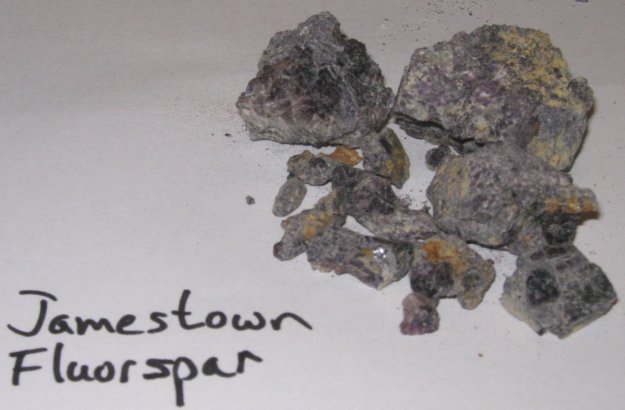
Jamestown Fluorspar 9-26-09 near Burlington Mine

Jamestown Fluorspar 9-26-09 near Burlington Mine

On the tailings pile we found some purple fluorspar and some rocks which under magnification, resemble gold ore I have seen elsewhere. There was the familiar sulfide odor in the area indicating the presence of surfaces of unoxidized sulfide minerals.

Fluorspar is used in iron and steel manufacture in quantities of up to 10 kg/ton of steel. Limestone and dolomite are added to molten iron in the steelmaking process (fluxing) to bring impurities out into a slag phase. We synthetic chemists have an analogous situation with “rag layers” or emulsions. Near as I can tell, slag resembles lava in the sense that it is a molten silicate.

Metallurgists apparently have to provide conditions for extraction and phase separation of unwanted components in a melt. A slag phase may be rich in silicates among other things. According to references I have seen, fluorspar is added to the mix as a fluxing agent to “increase the fluidity” of the slag, which I interpret as causing a decrease the slag viscosity. Whether this is purely a rheological effect or also a sequestering effect is inclear at present to me.

Day Trip to the Central City Mining District

The Central City mining district had its origin with the Pikes Peak gold rush. Placer gold deposits found in Denver area streams were quickly played out. Miners followed streams like Clear Creek up the canyon to their source, staking claims on the placer deposits in the streams along the way.  Eventually, the placer deposits played out causing miners to search for the lode deposits along the hillsides. Underground hardrock mining was the inevitable outcome of placer depletion.

The Pikes Peak gold rush began in 1859 and is named after the high  mountain peak that is visible from 100 miles into the eastern plains. While the immediate area of Pikes Peak produced little or no gold, it was a useful point of reference for arriving miners and settlers.

In many ways, the various gold rushes in American history are simply examples of economic bubbles 19th century style. The discovery of a resource that can generate substantial streams of cash will attract large numbers of wealth seekers. Not surprisingly, chance favored the early arrivals in the bubble. Many a weary participant gave up, hoping only to break even. Others realize that there is more stability in providing supplies and services to the miners.

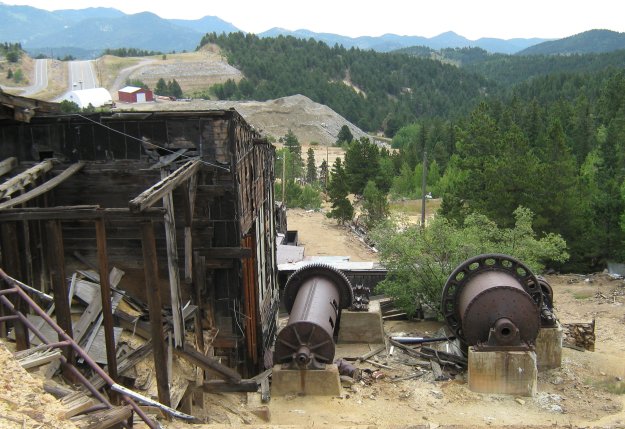
Abandoned Mill Near Central City, CO (Copyright 2009, all rights reserved)

Abandoned Mill Workings Along Russell Gulch Road (Copyright 2009, all rights reserved)

While mineshafts, adits, and tailings piles still mark the landscape in most mining districts, what has been lost for the most part are the mills. The photo above shows the remains of a mill operation between Central City and Russell Gulch. Mills were a crucial link in the generation of wealth from mining activity.

Mill Along Russell Gulch Road

Mill Along Russell Gulch Road

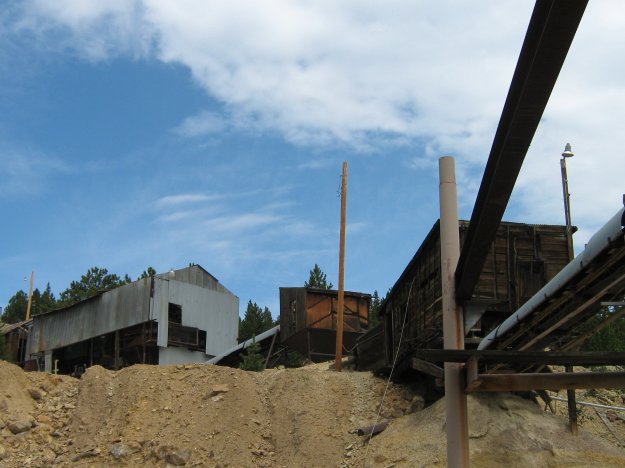
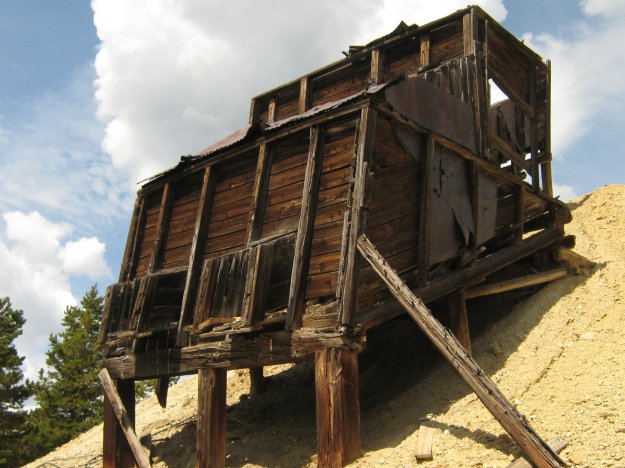
Mills were constructed near the richer lodes and were configured in various ways. Some processing buildings were built along the hillside and early mills had chutes with which to convey material  within the facility. Later mills had conveyors to transport materials.

Remnant of Surface Workings, Central City, CO (Copyright 2009, all rights reserved)

Remnant of Surface Workings, Central City, CO (Copyright 2009, all rights reserved)

Cominution was a key operation of the mill. Large rocks had to be reduced in size to expose greater surface area for value extraction. Stamp mills were very common and consisted of a powered camshaft that lifted and dropped a train of heavy cylindrical hammers on the ore. The output of the stamp mill was treated in various ways depending on the nature of the gold bearing ore.

Gold ore near the surface might be of a more highly oxidized nature from exposure to oxygen entrained in meteoric water. In that case, sulfur would have already leached from the formation leaving a higher level of metallic gold. Such ore was more amenable to extraction by amalgamation. Stamp mills could be constructed with mercury covered copper plates on the output side of the stamps. The mercury would amalgamate the gold particles from the mill feed, selectively trapping them on the plate. The amalgam would then be scraped off the plates and the mercury removed by the application of heat to evaporate the mercury. 

Gold ore from deeper deposits resisted direct amalgamation, however, and roasting was used to free the sulfur (and tellurium) from the value. Highly sulfurized ores would be roasted to liberate the gold from the sulfur in the matrix. The resulting calcined ore might be milled or just subject to mechanical agitation to dislodge the gold particles in a sluice or by amalgamation (source- discussions with mining museum people. I would like to find better documentation, however).

The extent to which amalgamation was used in gold recovery is largely forgotten or left unmentioned. The USGS has excellent documentation on this topic.  Chlorination by the application of Cl2 and cyanide extraction were introduced by the end of the 19th century as well, but that will be the topic of another post.

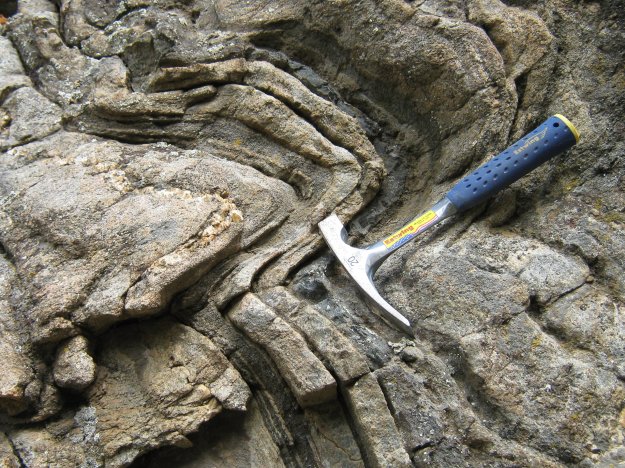
The folded rock in the photo below is shown only because it is visually interesting. Note how the various layers show signs of differential erosion. Nothing astonishing, just a reminder that seemingly ordinary things can be very interesting if one stops to have a look.

I’m going to get hit by a car one of these days from stopping at roadcuts. I can only hope it is over fast.

Folded Rock Formation , Roadcut on CO 119 near Blackhawk

Folded Rock Formation, Roadcut on CO 119 near Blackhawk

Manganese on my mind

I spent much of the weekend reading up on, of all things, manganese chemistry. It turns out that there is a tourist mine in Salida, Colorado, that offers a glimpse of a manganese mine. It is rather dramatically called the Lost Mine and the tour includes a 4WD ride to the site. This tour is on the master list of future visits – my teenage kid groaned when I let this news slip out. Pretty funny.

What piqued my interest is a rock I picked up at a rockshop in Leadville recently. It is a low grade sample of dispersed rhodochrosite with a bit of pyrite grown into it. Rhodochrosite is a light pink to rose colored semi-precious crystalline mineral and also happens to be the state mineral of Colorado. It is fairly scarce and increasingly sought after for collection and for jewelry.

The light pinkish color of rhodochrosite stems from the oxidation state of Mn- Rhodochrosite is MnCO3. Depending on the ligand, the Mn (II) will have a high spin d5 electron configuration. The high spin d5 configuration requires a forbidden electron transition consisting of a jump between d orbitals and a spin flip on absorption of hv. Since this is a low probablility occurance, the molar extinction is low and accordingly, the color of the xtal is faint.

A fellow at the CC&V mine lamented that the ore body they process for heap extraction is loaded with manganese. He said that once they move the rock from the pit, the Mn levels cause it to become a pollutant (or some other term) as defined by the EPA. Manganese seems to be relatively abundant in parts of the Rockies.

Significant New Molybdenum-Rhenium Find Announced

A significant new ore deposit of molybdenum and rhenium has been announced by Ivanhoe Australia. The Merlin Mo-Re deposit is located in western Queensland, Australia, south of Cloncurry. The deposit is said to be worth $6 billion Australian. The core sample shown on a download contains 2.25 % Mo and 29 g/t of Re, according to the company.  The principal ore is Molybdenite, or molybdenum sulfide.

Ivanhoe claims the advantages of the ore stem from the high grade and shallow depth. High grade ore requires a smaller refining facility. Ivanhoe says that its rhenium is not a byproduct.

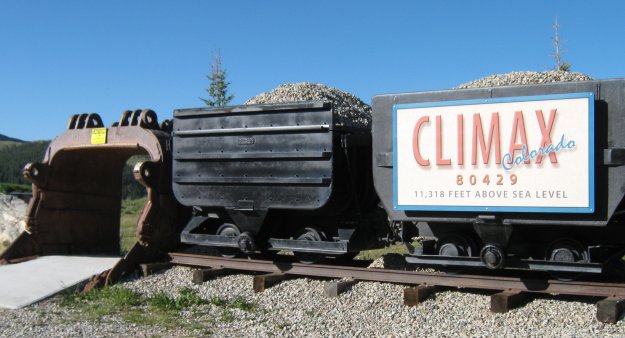
Climax Molybdenum, a Freeport-McMoRan company, is also a producer of rhenium products. Climax Molybdenum operates the Climax mine on Freemont Pass near Leadville, Colorado, and the Henderson Mine near Empire, Colorado.

The geochemical association of Mo and Re is apparently not limited to a unique location. Molybdenum deposits at Ivanhoe, Climax, and Copaquire all have associated rhenium.  Rhenium products such as rhenium pellets and ammonium perrhenate are supplied by Climax Molybdenum in addition to a variety of metallic moly and moly chemicals.

International PBX operates the Copaquire Mo-Re-Cu porphyry project in northern Chile.  The company estimates that 47,000 to 60,000 lbs of indicated rhenium reside in their part of the district. According to PBX announcement, the indicated moly is between 203 and 253 million lbs and indicated copper lies between 364 and 563 millions lbs. The company is quick to point out that 25 % of the deposit is above ground in a mountain.

As of 2005 the three leading producers of rhenium were Chile, Kazakhstan, and the USA, with the USA having the largest known reserves. How the Australian find will alter this distribution is unclear at this time. The estimated rhenium trade in 2005 was $32 million.

Rest Stop on Freemont Pass at Entrance to Climax Mine

Rest Stop on Freemont Pass at Entrance to the Climax Mine


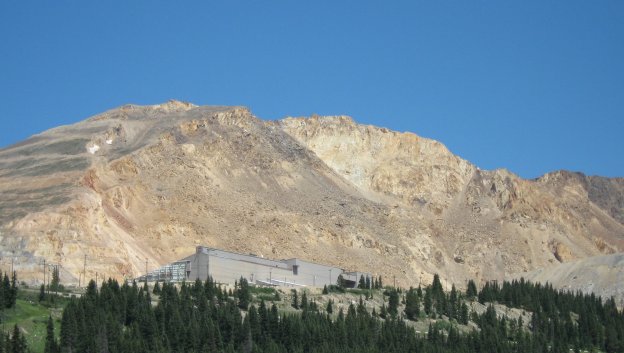
View of Climax Mine (Copyright 2009 All rights reserved)

View of Climax Mine (Copyright 2009 All rights reserved)

The above photo of the Climax mine shows a processing building with what remains of Bartlett Mountain behind it. In fact there is a considerable lode of moly remaining in the mine.

The Gangues of Leadville

The mining history of Leadville, Colorado, is well documented and the details are left to the reader to pry out of the internet. As a process chemist, my interest in mining is more directed to the geochemistry and milling of the ore. How did they get the pay out of the paydirt?

How does it come about that we can get our hands on particular elements like molybdenum, gold, silver, uranium, tungsten, vanadium, etc? How do the elements manage to concentrate into ore bodies that are worth the effort and expense to refine?

When you take the various mine tours around the country, the spiel offered by the guide is usually geared toward the lowest common denominator- our fascination with fabulous wealth. The miners were certainly taken with the possibility of wealth. Gold and silver mines are an easy sell because everybody has greed and everybody yearns to pluck a fat nugget of gold from a pan of gravel.  Other types of mines are a tougher sell entertainment-wise and require a bit more explanation of the relevance of the obscure element that is being extracted.

Mining is an activity with good and bad effects. To sustain modern civilization, if you can’t grow what you need, you have to mine it. Mining is inherently extractive in nature and requires that large volumes of earth be disturbed. Open pit mining requires that overburden be removed and the mineral value be moved to a processing site. Material sidestreams are generated and must be dealt with. 

Underground mines also generate large volumes of material that must be piled somewhere. To ensure responsibility for reclamation costs mining companies are required to put up a surety bond to cover the costs of future reclamation under 43 CFR section 3809.

The inevitable trade-off that a society must make is one of environmental insult for material goods. The balance point is always hard to find, and in fact is usually a moving target on account of politics, employment, and environmentalism.

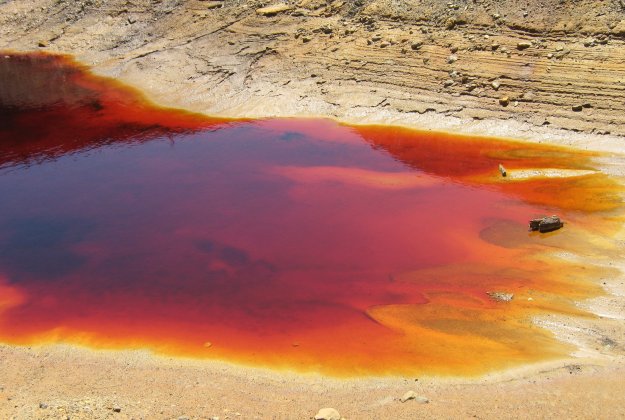
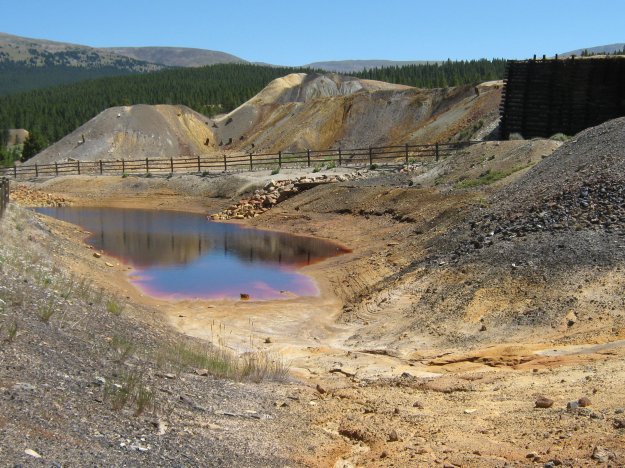
Mining can have substantial effects on the landscape, the watershed, real estate, and the future tax base. Land that is not available for habitation or sustainable commercial use is fundamentally limited in potential value. An area covered with mine tailings, mine shafts, the occasional blasting cap, and acidic runoff is an area that requires cash infusion on a long timescale.

But if we enjoy the benefits of lead batteries in our cars, or silver jewelry, tungsten elements in our light bulbs, zinc plated wire fences, or the ten thousand other metal products in our lives, we must come to grips with the consequences for having such material goods. At some stretch point, everybody becomes a Luddite. Question: How much technological triumphalism can we take? Answer: Whatever the market says we can take.  

Runoff Collection Pond from Mine Tailings in Leadville Mining District.

Runoff Collection Pond from Mine Tailings in Leadville Mining District.

Our society has benefitted greatly from metallurgy. The compulsion to recover metals from the ground is one of the great economic forces in civilization. No amount of highminded pontification will stop it. Metals enable industry and war which are forever entangled in politics and greed. The goal is to be smart about how we mine elements from the ground so that maximum value of the surrounding land may be enjoyed. The enthusiasms of the time come and go. But metals are forever.

Mine Waste, Leadville Mining District August 2009

Mine Waste, Leadville Mining District August 2009

Rhodium Coins Now Available

It has finally happened. The Cohen Mint in NYC began offering a Rhodium coin in May 2009. This silvery PGM, once familiar only to a few Poindexters in the catalyst lab, has now become one of the coins of the investor realm. Available as a one gram coin, the initial price came in below $100 ea. Today, as Rh bullion prices jet upwards, these coins should be following the market upwards as demand for automotive catalytic converters inevitably rises.

The Cohen Mint also produces palladium and platinum coins in small but affordably weighted denominations.

I cannot estimate the relative merits of hoarding Rh or Pd relative to Au, Ag, and Pt, other than to say that these two metals seem to be somewhat less volatile in pricing relative to the three more widely traded precious metals.

Gold, silver, and platinum are substantially placed in the jewelry market as well as the investment market as the physical metal and paper instruments. This kind of exposure to global trading makes their pricing a bit twitchy and subject to global neurosis.

Given the scarcity of Indium and Neodymium, I wouldn’t be surprised to see coins made from them. Or at least as foils wrapped around a chocolate center. \:-)

Gaussling’s 12th Epistle to the Bohemians. Elements Rock.

Some acquaintances have asked about my new interest in geology. What’s the deal with rocks and mining? 

What interests me is not so much the economic value and extravagant production of certain minerals and precious metals. What is of interest is the question of how it came about that there is such a thing as an ore body.  An ore body is a geological formation which is defined by a localized concentration of certain substances. How does it happen that chemical elements can become concentrated from a more distributed condition?

Celebrity astronomers are often seen on cable channels pedantically nattering on about “Star Stuff”.  OK, Dr. Skippy, what is star stuff and what does it do? What are the particulars about the local star stuff, ie., the earth? This is the realm of cosmochemistry and geochemistry- elective classes the TV glamour boys apparently skipped.

The nucleosynthesis of the heavy elements (C to U) and their subsequent ejection from exploding stars is an inherently dispersive process. Eventually, here and there, some heavy matter will aggregate to form a protoplanetary cloud which can then produce planetary bodies. Inevitably, some of the heavy matter is pulled into massive bodies dominated by the presence of thermonuclear fuels- that is, hydrogen and helium. Sufficiently large accumulations of these two highly abundant elements will compress and initiate a self-sustaining fusion reaction of hydrogen to form the (n+1)th generation of stars. All told, some heavy matter accumulates to form of planetary bodies while some of it siphons into the next generation of stars.

It is within the ability of gravity to concentrate matter into smaller volumes of space as a dense, bulk phase. The geometric shape that allows all of the mass to be as near the center of mass as possible is the sphere.  This is why we don’t see planets shaped like cubes, pyramids, or ponies. 

Once cooled well below incandescence, the matter in a sufficiently constituted and situated planet may begin to self-organize into chemical phases. Along the lines of the Three Bears allegory, Earth is parked in an orbit that is just right for the presence of liquid water. Irrespective of the needs of life, liquid water is critical for the eventual concentration of some elements into ore bodies.

Earth has a gas phase blanketing a liquid phase which wets much of the bulk rocky phase of the planet. A generous portion of water circulates in the maze of fractured recesses of the planetary crust. In the case of Earth, we know that our planet has a fluid core within a solid shell. This molten phase in the core energizes a kind of convective heat engine that will drive the shuffling motion of tectonic plates and episodic volcanic mass transfer on the surface. 

Matter has gravitationally self-organized at the planetary scale on the basis of density. But what is perhaps most interesting to a chemist is the phase composition of the planetary solid matter. On cooling, a body of magma will sequentially produce precipitates representing different chemical substances. Over geological time this igneous rock may experience modification by the hydrothermal action of hot water under high pressure. Depending on its circumstances, parts of the formation may be depleted of soluble constituents or it may receive a deposit of new mineral species.

On the scale of planets, the earth has self-organized into bulk phases of matter- Solid, liquid, and gas. But at a much smaller scale, the earth self-organizes into domains of chemical substances. This is evident by simple inspection of a piece of granite. A piece of pink granite shows macroscopic chemical domains of potassium feldspar, quartz, and mica. While these three mineral components of granite are compounds and not pure elements, they nonetheless represent self-organization of species based on chemical properties.

The forces that drive chemical differentiation in mineral formation are ultimately thermochemical in nature. Large differences in Ksp lead to partitioning and phase separation of distinct substances. Subsurface formations may be approximately adiabatic on a short time scale, but over deep time they can slowly cool and equilibrate to yield a sequence of fractional crystallizations of metal carbonates, oxides, silicates, and aluminates giving rise to a complex bulk composition.

Speaking only for myself, coming to an understanding of how mineral deposits form is a kind of hobby.  If I wanted immediate answers to specific questions, I suppose the most expedient thing would be to consult a geochemist. But where is the adventure in that? The answers are not the fun part. The real adventure is in the struggle to find the best questions. As it often happens, once you can frame the problem sufficiently, the answer falls out in front of you. Whoever dies with the greatest insight wins.