Category Archives: Metals

A Day Trip to the Caribou Mining District

The ghost town of Caribou, Colorado, sits a few miles west of Nederland. As a group the mining towns of Caribou, Nederland, and Ward reside at the northeastern extreme of the Colorado Mineral Belt. This mineral rich formation cuts diagonally across the state, terminating near Durango in the southwest part of Colorado.

Every western state  has its mining districts.  The eastern reaches of the USA have hard rock mining districts as well. The Appalachians have a long history of hard rock mining. An example of eastern hard rock mining activity is the Foote spodumene mine in the Kings Mountain district in North Carolina.
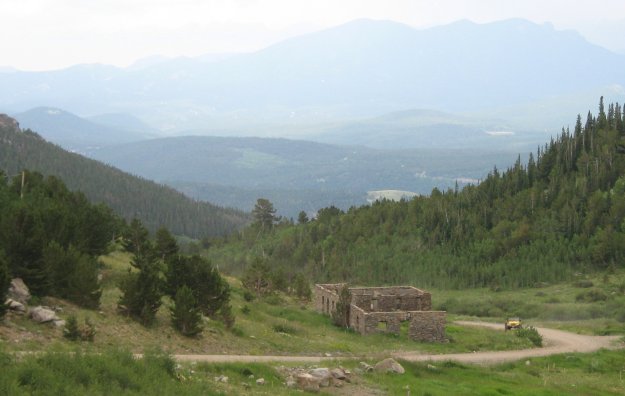
The Ghost Town of Caribou, Colorado (Copyright 2009 all rights reserved)

The Ghost Town of Caribou, Colorado (Copyright 2009 all rights reserved)

While the Caribou district was previously known primarily for silver and tungsten, current hard rock mining operations by Calais Resources is targeting silver and gold. A blurb on the Calais website says that they do not use cyanide extraction in Colorado.
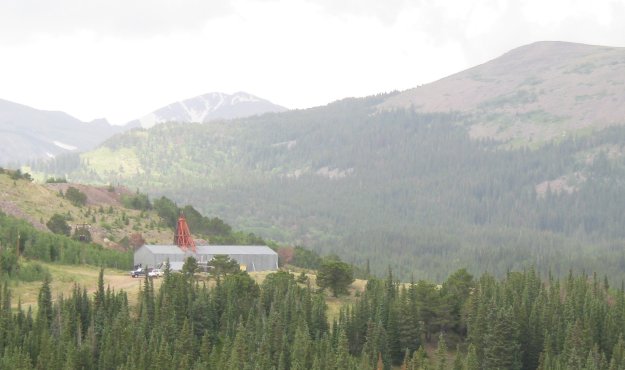
Calais Resources Comstock Shaft (Copyright 2009 all rights reserved)

Calais Resources Comstock Shaft (Copyright 2009 all rights reserved)

 This weekend the town of Nederland is celebrating its mining history with a miners festival. There were feats of strength and skill on display.
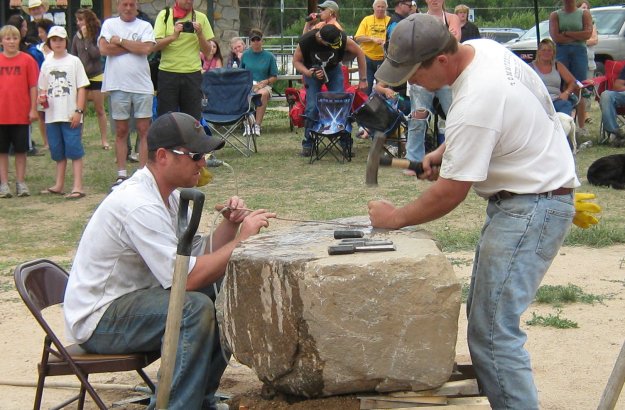
Hand drilling competition in Nederland July 2009

Hand drilling competition in Nederland July 2009

 Across town at the Mining Museum, a 1923 Bucyrus 50-B steam shovel was in operation. This 130,000 lb beast was powered by an antique air compressor this afternoon because the boiler is not servicable. It turns out that this very machine was one of 25 taken to the Panama Canal to move dirt and rock. All were scrapped at the canal but this one. The canal was finished in 1914, so it must have been used for modification of the canal workings.

This machine was in service at the Lump Gulch Placer a few miles south of its present location until 1978.  Bucyrus is still an ongoing concern in the mining equipment business.
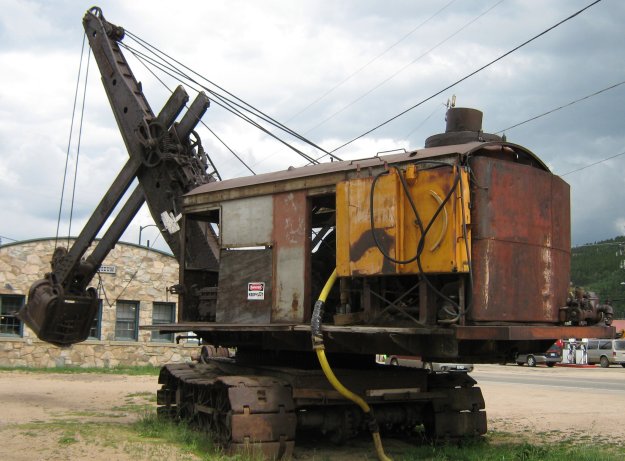
Bucyrus 50-B Steam Shovel (Copyright 2009 all rights reserved)

Bucyrus 50-B Steam Shovel (Copyright 2009 all rights reserved)

As one drives into the Ward area from the north, the rock type evident in the road cuts changes. South St. Vrain canyon is largely granitic in nature. As one moves south into the Mineral Belt, the road cuts plainly reveal that a new dominant mineral type is present. Hematite or other iron oxide species are extensively represented in the rock.

My reading indicates that many metal ore bodies are the result of extensive hydrothermal modification of fractured or disturbed formations. Metal sulfide saturated, superheated water penetrates a disturbed formation leaving precipitates forming vein structures. In this way, many metal species are mobilized on the basis of solubility properties and are transported and concentrated leaving deposits enriched in a variety of useful metals.

The superheating of deep ground water and the subsequent partitioning and concentration on the basis of physical properties like solubility and volatility are what make the recovery of many elements possible. Without these concentration mechanisms many scarce elements would be too diluted in the parent formation to be feasibly isolated commercially.
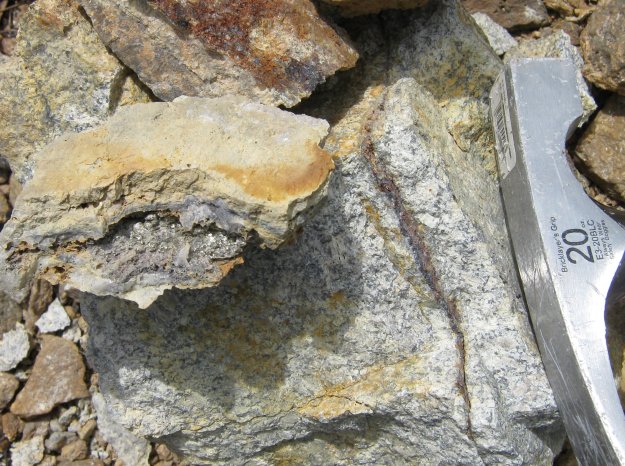
Pyrite vug from a tailings pile (Copyright 2009 all rights reserved)

Pyrite vug from a tailings pile (Copyright 2009 all rights reserved)

What Th’ Gaussling has found is that, while a PhD in Organic Chemistry isn’t entirely useless as a background for understanding rocks, it is closer to useless than I’d like. Edgemicated as I may be in a skinny band of chemistry, I have a lot yet to learn about minerals and petrology.
Mollie Kathleen Mine, Part 2.

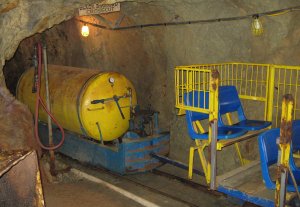
Underground Air Locomotive

Underground Air Locomotive

In Part 1 of my post on the Mollie Kathleen Mine in Cripple Creek, Colorado, I described the ride down to the 1000 ft level.  Having been in mines considerably less developed, I was impressed with the quality of the skip lift equipment and the general state of the mine workings above and below ground. The mine make heavy use of pneumatic equipment to minimize ignition sources.  The air locomotive above features a pressure tank which energizes an air motor to drive the contraption. It works quite well.

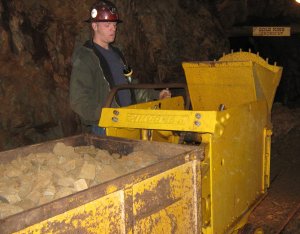
Mechanized Mucking with Pneumatic  Equipment

Mechanized Mucking with Pneumatic Equipment

Once at the bottom of the shaft, the mine appears to be little more than a hallway with steel tracks on the floor. In fact, it is a series of hallways, or drifts, and shafts. The goldbearing formation that the Mollie Kathleen mine has penetrated is a volcanic formation called a diatreme and it is composed of highly disturbed rock from ancient volcanic activity. The district contains gold in varying abundances. Certain features of the formation are more enriched than others.

In general, one does underground hardrock mining to exploit a network of veins enriched in value, in this case, gold.  By definition, an ore is a body of rock or mineral that contains commercially exploitable value such as gold. 

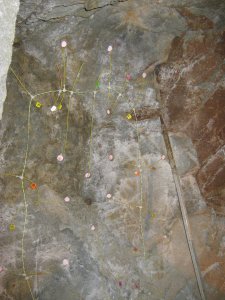
Blasting pattern prior to a shot

Blasting pattern prior to a shot

Solid rock is fragmented with explosives and loaded into ore carts. The rubble accumulated from blasting activity is called “muck”. Muckers were very important workers in a mine and the mines productivity hinged on their ability to load the ore carts as fast as possible. Until carbide lamps arrived, miners toiled in very low light levels in candle or kerosene lamplight.

With the advent of better technology came more effective and safer blasting agents, fuse cord capable of adjusting the timing of a blast sequence, and more efficient ejection of fragmented rock.  Near the center of the photo above is a pattern of holes filled with blasting agent. Well, except for one hole in the center of the pattern. This empty hole is placed specifically to provide for space for expansion relief.  A shot is timed to trigger the charges around the empty hole first, followed by concentric detonation of the blast pattern. Finally, a set of charges low in the pattern lift the muck out of the hole and onto the floor.

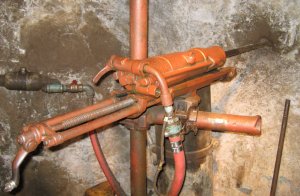
Pneumatic hammer for pounding a drilling steel into the rock wall.

Pneumatic hammer for pounding a drilling steel into the rock wall.

According to the tour guide, the Mollie Kathleen mine is fairly rich in gold but lacks access to a milling facility. Without milling and refinement, there is no point in pulling the ore out of the ground. So, until a scheme for beneficiation of the ore comes along, the gold will have to sit in the formation and make money for its owners as a tourist attraction.

As is common in mine tours, the staff is well versed in the history and mechanics of getting ore out of the formation. What seems to be glossed over or wholly ignored is the process of getting purified gold out of the ore. Being a chemist, I was naturally interested in the isolation process. The refining process I was able to “extract” from the mine tour operators was a simple but inefficient method.

Gold ore was pulverized and heated to high temperature in a way that resembles calcination. Diffuse wisps and pieces of elemental gold in the ore would melt and agglomerate so as to produce larger pieces of gold. The roasted ore could then be exposed to a mechanical/slurry agitation process that would dislodge the now larger pieces of gold and classify them by density much like the gold panning process.

The roasting process apparently oxidized the tellurium in the ore, resulting in a purification. The question is, did the roasting process just oxidize the free tellurium or did it free the gold from the gold telluride (Calaverite)?

Another process can be used to extract gold from the ore. It grossly resembles the mercury amalgamation method. Metallic lead is combined with gold ore and heated to some high temperature in a special container. A lead-gold alloy is formed which can be poured away from the gangue. The molten alloy is then exposed to air oxidation, forming litharge (PbO) and metallic gold which phase separate and can be separated mechanically. Assayers use a process called fire assay or cuppelation to extract refined gold for an assay.

Chlorine extraction was used to oxidize metallic gold to the soluble NaAuCl4 salt which could reduced by contact with carbon or by electrolysis. Chlorine water was used prior to the cyanide extraction methodology now in common practice.

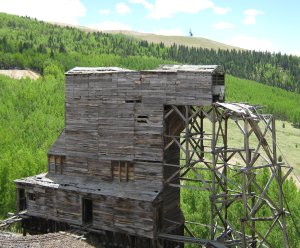
Old Headworks by the Mollie Kathleen Mine

Old Headworks by the Mollie Kathleen Mine

Touring the Mollie Kathleen Mine, Part 1.

By way of a prelude to this post let me say that, as a child, I was plagued with nightmares about elevator shafts. A tallish building in a nearby city had an elevator that, in the style of WWI-era buildings, was comprised of an open cage controlled by a matronly operator. On each floor the entrance to the elevator shaft was guarded by a collapsible metal gate that allowed the visitor to see, hear, and smell the greasy workings of the elevator in all its cabled creepyness.

I would stand next to the gate as the elevator went about its single-minded business and peer down into the dark shaft with its writhing black cables, fascinated yet deeply in tune with the prospects of what a fall down this hole would mean.  Like most young boys, I had bitter experience with the unblinking and impersonal side of gravity.

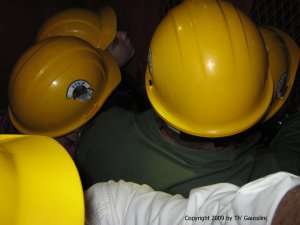
It was this memory that flashed into my mind yesterday as I stood in a manlift the size of a large domestic refrigerator, crammed tightly into the cramped cage with 6 other people. We looked like a can of vienna sausages.  The lift was a double-decker, with an identical cage of sausages below.

Crammed in Manlift

Crammed in Manlift

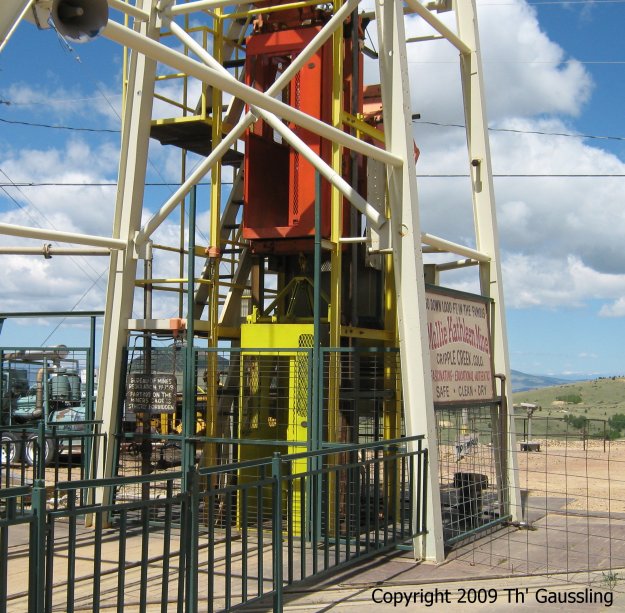
There we stood- a squashed parcel of humanity and hard hats in the orange lift, dangling above a 1000 ft column of air. Outside I could see the town of Cripple Creek, Colorado, sitting in the valley 400 ft below us. In two minutes, we would be 600 ft below the level of the town. As we began the descent and as daylight fell to darkness, I felt a my autonomic system select “Panic Mode”. But it was too late, we were committed. After 30 seconds, a graveyard calm replaced my momentary panic and all was well.

Double Decker Manlift at Mollie Kathleen Mine

Double Decker Manlift at Mollie Kathleen Mine

This was my first entry into the Mollie Kathleen Mine outside of Cripple Creek, CO. The tour begins in a drift 1000 ft below surface level. A “drift” is just a horizontal tunnel in an underground mine. I have toured a number of mines and caves and the common attribute to all of them is the absolute silence that is found underground. Today’s tour would be different.

The Mollie Kathleen Mine sits on the side of a mountain adjacent to the mammoth Cripple Creek and Victor (CC&V) open pit gold mine. The operators of both mines have independent claims to different parts of the same confined geological formation. The Mollie Kathleen is one of a great many underground mines in the area, of which only a very few are in operation today. It is presently open only for tours.  The CC&V mine is the only large gold mining operation in the area.

The CC&V mine is an open pit operation. Large hauling trucks carry 300 ton loads of ore rubble from the pit to nearby crushers which reduce the rock to 3/4 inch pebbles in preparation for the cyanide extraction process on the heap.  The rubble is the result of large scale bench blasting with ANFO blasting agent.

The CC&V does blasting on a regular basis. That day, while we were underground about 1-3 miles distant (my estimate), they set off a blast. We were down in the mine when the underground rumble hit. There was no ramp-up to maximum force- it began as a loud, strong rumble seemingly from every direction. We stopped in our tracks and instinctively looked at the ceiling trying to decide if this was a normal or off-normal event and, oh golly, will the the tunnel collapse? After 30 to 40 seconds the rumble subsided and the mine was silent again except for a few heartfelt expressions of relief. Clearly there was no danger for anyone, but the abruptness and the magnitude of the explosion only serves to remind one of the compromises made and the options lost while working underground.

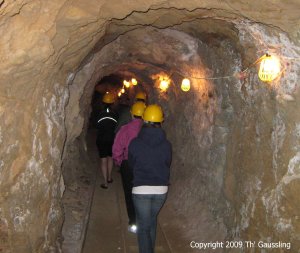
1000 Ft down into the Mollie Kathleen Mine

1000 Ft down into the Mollie Kathleen Mine

The tour guide was a young ex-miner from Montana who explained mining practices and demonstrated the numerous pneumatic tools used by hard rock miners.  In part 2, we will look at some of the mine workings and other features of the Mollie Kathleen Mine.

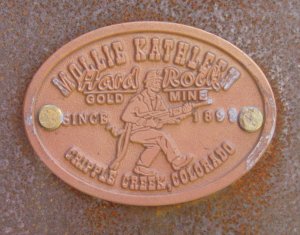
Hard Rock Placard. Photo Copyright 2009 Th' Gaussling.

Hard Rock Placard. Photo Copyright 2009 Th' Gaussling.

Cresson Gold Mine, Part 3.

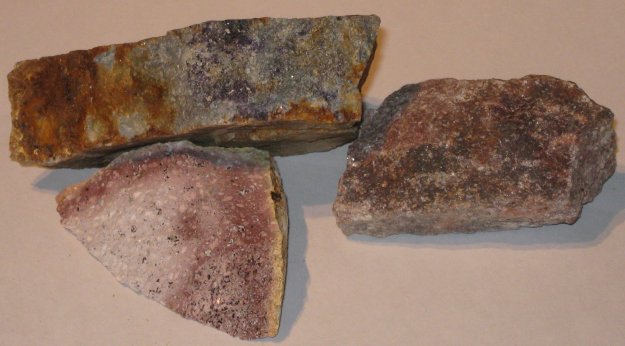
The Cresson Mine in Cripple Creek contains a good deal of fluorite. I was able to casually collect a few samples just lying in the road bed. In the photo below, the rock on the top has the most pronounced blue/purple color indicating CaF2 (fluorite). These specimens are not collectors pieces and are entirely unremarkable other than as indications of fluorite.

Cripple Creek Fluorite Indications (Cresson Mine). Copyright 2009 Gaussling.

Cripple Creek Fluorite Indications (Cresson Mine). Copyright 2009 Gaussling.

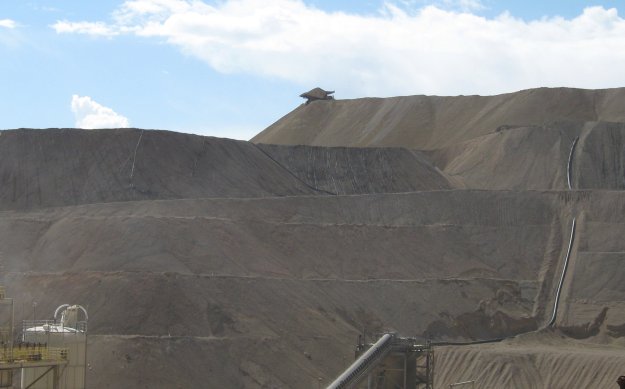
The mine business model requires heap leaching as a means of extracting the gold value out of the ore. Given that the ore is peculiar in that it contains gold in the form of gold telluride which cannot be leached out by cyanide, approximately 40 % of the gold remains in the host rock. The cost per toz of gold produced must be kept as low as possible and the way you do that is economy of scale.

The heap sits atop multiple layers of clay barriers and the 14,500 gal per minute of extract that flows out of the heap 24/7 is passed through coconut husk charcoal to trap the gold cyanide and the raffinate is recharged to the desired 100 ppm titer of aq NaCN and pumped back onto the pile. pH adjustment is a constant chore. The crushed rock is mixed with calcuim oxide prior to being dumped on the heap to maintain a high pH.

Building the Heap. Cripple Creek Cresson Mine. Copyright 2009 Gaussling.

Building the Heap. Cripple Creek Cresson Mine. Copyright 2009 Gaussling.

Cresson Gold Mine, Part 2.

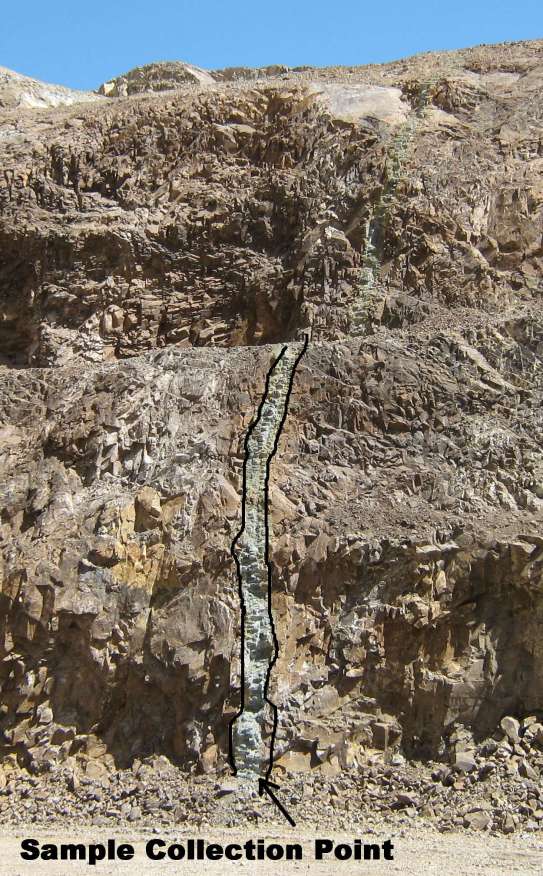
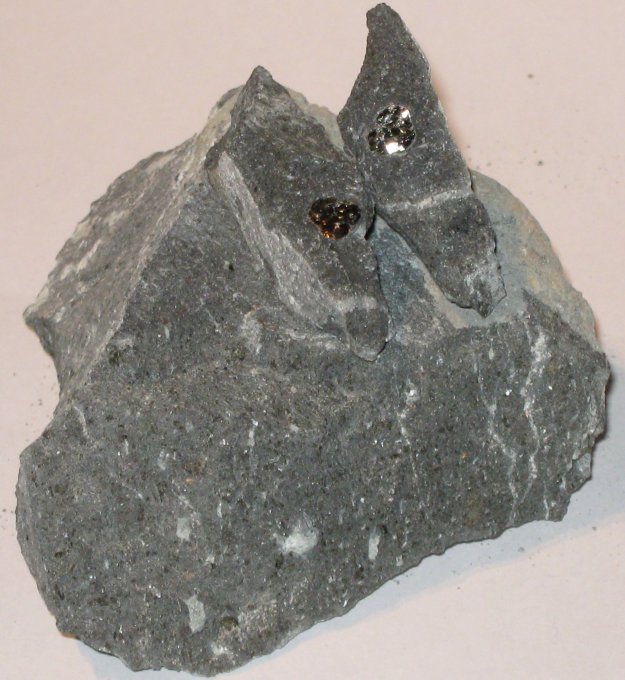
We collected samples of the lamprophyre in the bottom of the pit. The formation appeared whitish green in on the weathered surface owing to oxidation. However, if a fresh surface was exposed, the rock was composed of sugary dark xtals with the occasional biotite phenocryst.

Outlined Lamprophyre at bottom of Cresson open pit mine

Outlined Lamprophyre at bottom of Cresson open pit mine. Copyright 2009 Gaussling.

Cresson Mine Lamprophyre Close-up

Cresson Mine Lamprophyre Close-up. Copyright 2009 Gaussling.

Mafic or ultramafic rocks are low in silicates and enriched in Fe and Mg oxides. The lamprophyre above is mafic in composition with a sugary xtal matrix with biotite and other phenocrysts.

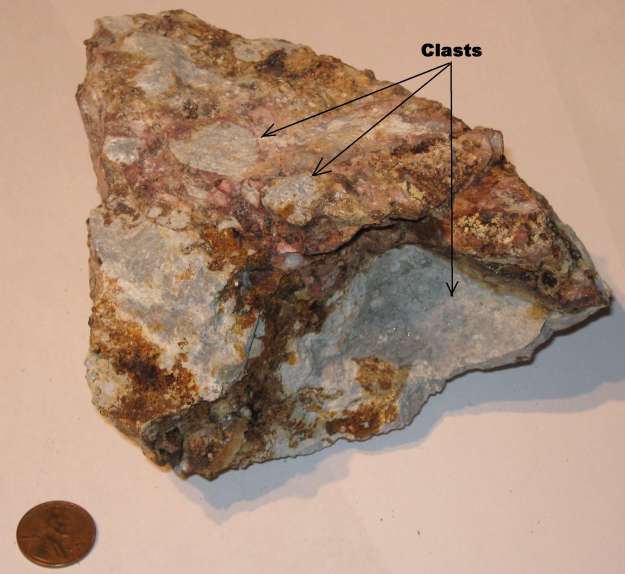
Breccia from Cripple Creek Diatreme

Breccia from Cripple Creek Diatreme. Copyright 2009 Gaussling.

The breccia above is characteristic of the Cripple Creek diatreme. Relatively rounded clasts populate the mass of the aggregate, indicating that the clasts were rounded by some process prior to deposition.

The gold is generally too dispersed to see, however, you can see pyrite with a hand lense in many of the samples. Pyrite often accompanies gold.

Cresson Gold Mine, Part 1.

Early saturday morning 50 intrepid geotouristas packed into vans and drove to the CC&V mine in the Cripple Creek district of Colorado. Most of the group were professional geologists- professors, teachers, and geological survey folks. There were only a few interlopers like myself who were interested but untrained in geology. Not surprisingly, a background in chemistry is nearly useless when the discussion turns to stratigraphy and rock morphology.

The Cripple Creek gold district consists of an extinct volcanic structure called a diatreme. A diatreme is characterized by the presence of a volcanic pipe structure filled with brecciated rock. It is thought that the combination of shallow hot rock and ground water lead to violent explosions that resulted in fractured rock. Cripple Creek breccia has rounded clasts, indicating the rock fragments were exposed to rough, erosive treatment leading to attrition and rounding of the clasts prior to consolidation of the breccia.

In the past, gold mining at Cripple Creek was a underground activity. The district contains an extensive network of remnant subsurface works of drifts and shafts. Today, CC&V’s mining activity is limited to high throughput open pit excavation supplying pulverized rock to a cyanide heap leach field. A constant flow of ca 100 ppm aqueous sodium cyanide solution is leached from the top down through as much as 800 vertical ft of gold bearing rubble.

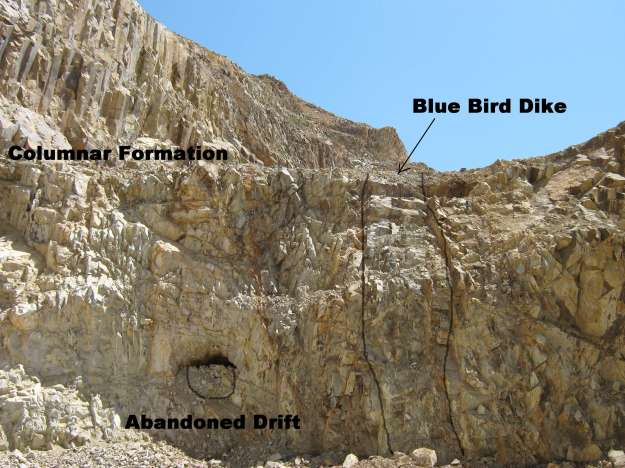
Abandoned Drift and Blue Bird Dike

Abandoned Drift and Blue Bird Dike

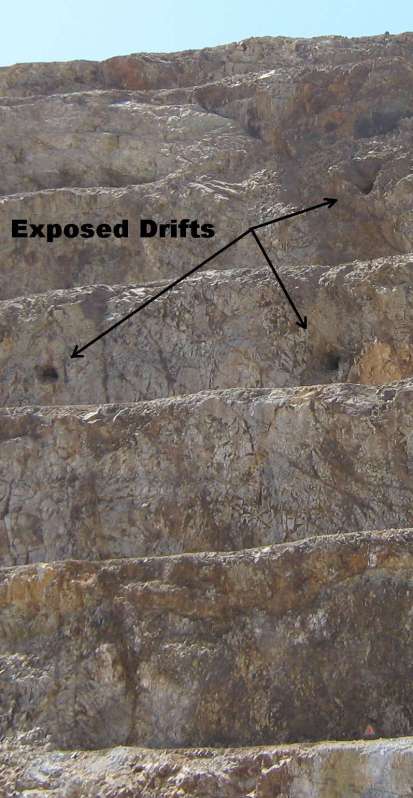
Columnar formations can be seen in certain locations of the mine (See photo: some features are enhanced with lines to show the margins). As the pit expands, drifts and shafts are exposed as seen in the photo above. The Blue Bird dike is an igneous intrusion into the surrounding formation. It is no coincidence that the drift in the photo is near the dike. It is common to see disturbed zones along the intrusion where gold can be found in higher abundance. The goal of the drift miner was to follow the enriched rock for more efficient reclamation of value.
Exposed Drifts During Pit Operations

Exposed Drifts During Pit Operations

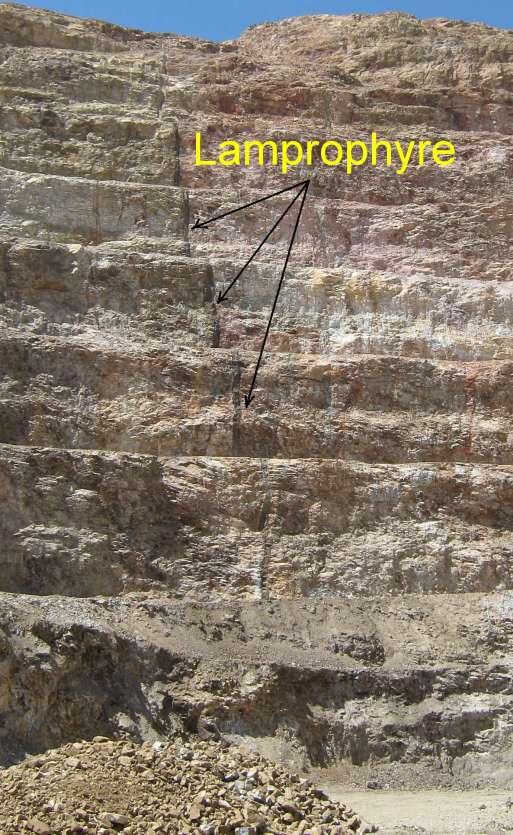
A feature seen in the pit is a Lamprophyre, or igneous dike comprised of ultramafic, silica-poor, magnesium-rich rock. Biotite phenocrysts can be seen in samples. This is regarded as an unusual feature.

Lamprophyre formation in Cresson Mine

Lamprophyre formation in Cresson Mine

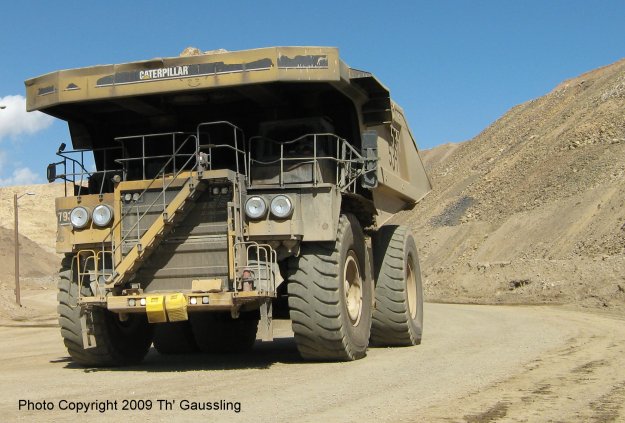
 The big haul trucks carry 300 tons of rock from the mine to the crusher. The crusher is actually a series of crushers that reduce the ore to pieces roughly 3/4 inch in diameter.

Haul Truck Carrying Rock from Blasting Site to Crusher

Haul truck carrying rock from blasting site to crusher The crushed rock is blended with lime and then driven to the leach pile for extraction. Another load for the leach heap.


A Massive Au/AuTe Deposit

Th’ Gaussling attended a geology seminar thursday evening at the Colorado School of Mines. It was given by the chief geologist at the Cripple Creek & Victor gold mine (now AngloGold Ashanti) and was concerned with 3-D modeling of the volcanic formation that forms the center of the deposit.

What is unusual about the CC&V mine is the extent to which tellurium is present. There are a dozen or more tellurium minerals and many of them are present in the ore body. The CC&V load was discovered relatively late- about 1891. Due to the extensive fraction of AuTe and AuAgTe minerals, the presence of the ore body was not detected by placer prospecting. 

Prospectors panning for gold in local streams had no way of knowing that extensive gold was present because AuTe(Ag) minerals do not have a gold-like appearance.  Legend has it that it was discovered by a drunken cowboy who noticed some native gold in an outcropping in the area and took a sample down for assay. As I have mentioned before, the Cripple Creek district has produced about half of all the g0ld to come out of Colorado.

What is key to the formation is the fact that it has zones of extensively altered volcanic rock disturbed both mechanically in the form of fractures and faulting, and chemically in the form of its potassic-alkali nature. The formation has strongly brecciated zones and is desribed as “vuggy”, meaning that there are extensive voids. Native gold and gold telluride mineralization can be found on the surfaces of the vugs. The mineralization was deposited by hydrothermal streams extracting Au and Te from unknown source rock.

Presently the operation is surface mining which feeds to a cyanide leach field for gold extraction. The surface pit mine is working downward, digging through the extensive network of mineshafts. In the early days at Cripple Creek the mining was limited to underground activity. Miners would follow the extensive subsurface network of gold-rich veins in whatever direction they might go. The result is a very complex and extensive matrix of tunnels and shafts that extend downward to as low as 3000 ft. In the early days, the economics of subsurface vein mining were attractive enough to sustain the operation. Today, the economy of scale dominates and pit mining with heap leaching of the lower grade ore is what sustains the operation.

The gold is recovered by a cyanide leach field that is 800 ft thick in places. This method produces ca 300,000 toz/yr. The process does not recover Au from AuTe. It is left untouched in the leach heap and constitutes ca 1/3 of the total gold present.

Curiously, during the many eruption cycles in the distant past (~32 ma), debris from the surface has washed back deep into the formation. Bits of woody debris have been recovered within cementitious rock hundreds of feet below the surface. The CC&V geologist showed a core sample with a wood fragment imbedded within it. For a time reference, the current episode of Rocky Mountains (the Laramide Orogeny) began ~65 ma.

Chemist Gaussling will blend in with a group of geologists tomorrow morning and take an extensive geology tour of the mine site. Hopefully, there will be pictures to share. We’ll be going up to ~10,000 ft, so it will be chilly.

A Nevada Cinder Cone

Whilst doing a survey of Lithium mining in North America, I blundered into a small cinder cone. It is found in the Clayton Valley of western Nevada south and west of Tonopah.

A link from the University of Nevada, Reno, gives some details on this cone as well as some interesting photographs.

Just to the south of this cinder cone is the Chemetall Foote Corporation Silver Peak brine facility. Lithium rich brines are pumped into evaporation ponds for concentration of the lithium salts. US 7390466 says that the Silver Peak brines contain 0.02 wt % Li.  The richest Li brine can be found in the Salar de Atacama brines in Chile. The Atacama brines contain from 0.15 to 0.193 wt % Li.

Gold Refining with Borax

According to the GEUS, the Geological Survey Office of Denmark and Greenland, it is possible to concentrate and isolate gold from the ore using borax and charcoal. This method has the immediate benefit of making mercury “redundant” in gold isolation.

Extraction of gold by amalgamation with mercury is a simple means of producing metallic gold in the field.  After contact with gold enriched ore, mercury is evaporated into the air by direct application of a torch flame to the puddle of metal leaving purified gold metal.

It is thought that there are millions of miners who scratch out a subsistance living working a small patch of ground for gold. It’s called small scale mining. In the course of this activity, environmental contamination can accrue to the immediate area as well as the watershed at large. Sadly, the toxicological insult to the miners from exposure to mercury vapor can be severe.

This method is an inexpensive and simple alternative to the mercury process. Perhaps the chemistry community has something to contribute by way of education or improved methods of extraction.

8/25/10  Update.  I have revisited this post and am compelled to comment further.  While I am unable to offer a good chemical explanation for the effect of borax on gold ore, I can say that the use of borax as a flux  for smelting goes back to the 19th century during the American gold rush period.  The process described in the link appears to be a smelting process for enriched ore containing elemental gold, as opposed to sulfide, or sulphuretted ore. The function of a flux is to modify the flow and phase separation properties of host rock so as to partition away from the gold phase or layer.  In other words, a flux modifieds the slag to help the gold to separate cleanly from the rock.

Weighty Cogitations on Borohydride

I have been making a conscious effort to find ways to use borohydride compounds rather than just default to the mighty gray sledge hammer- LAH. There are numerous reports of diverse and wonderful means of activating borohydride to reduce the more refractory functional groups. Recently I prepared and used Zn(BH4)2 on a new substrate. Initially, it appears to work poorly. The grey wall cake seems to contain metallic zinc. If preferences mattered, I’d prefer see electrons reducing my substrate rather than Zn (II) to Zn.

You can’t always get what you want.     M. Jagger