
Early saturday morning 50 intrepid geotouristas packed into vans and drove to the CC&V mine in the Cripple Creek district of Colorado. Most of the group were professional geologists- professors, teachers, and geological survey folks. There were only a few interlopers like myself who were interested but untrained in geology. Not surprisingly, a background in chemistry is nearly useless when the discussion turns to stratigraphy and rock morphology.
The Cripple Creek gold district consists of an extinct volcanic structure called a diatreme. A diatreme is characterized by the presence of a volcanic pipe structure filled with brecciated rock. It is thought that the combination of shallow hot rock and ground water lead to violent explosions that resulted in fractured rock. Cripple Creek breccia has rounded clasts, indicating the rock fragments were exposed to rough, erosive treatment leading to attrition and rounding of the clasts prior to consolidation of the breccia.
In the past, gold mining at Cripple Creek was a underground activity. The district contains an extensive network of remnant subsurface works of drifts and shafts. Today, CC&V’s mining activity is limited to high throughput open pit excavation supplying pulverized rock to a cyanide heap leach field. A constant flow of ca 100 ppm aqueous sodium cyanide solution is leached from the top down through as much as 800 vertical ft of gold bearing rubble.
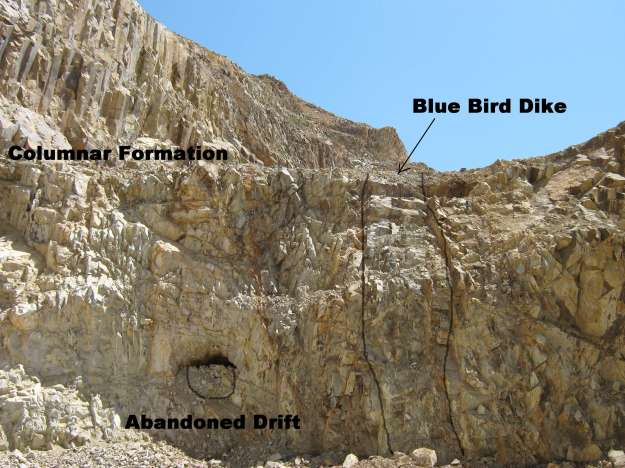
Abandoned Drift and Blue Bird Dike
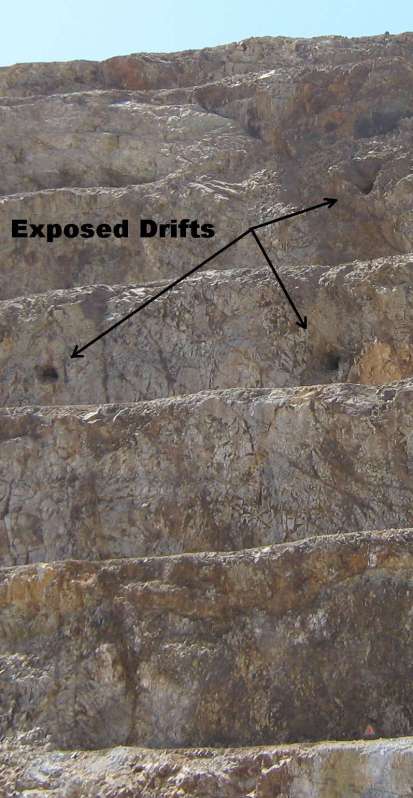
Exposed Drifts During Pit Operations
A feature seen in the pit is a Lamprophyre, or igneous dike comprised of ultramafic, silica-poor, magnesium-rich rock. Biotite phenocrysts can be seen in samples. This is regarded as an unusual feature.
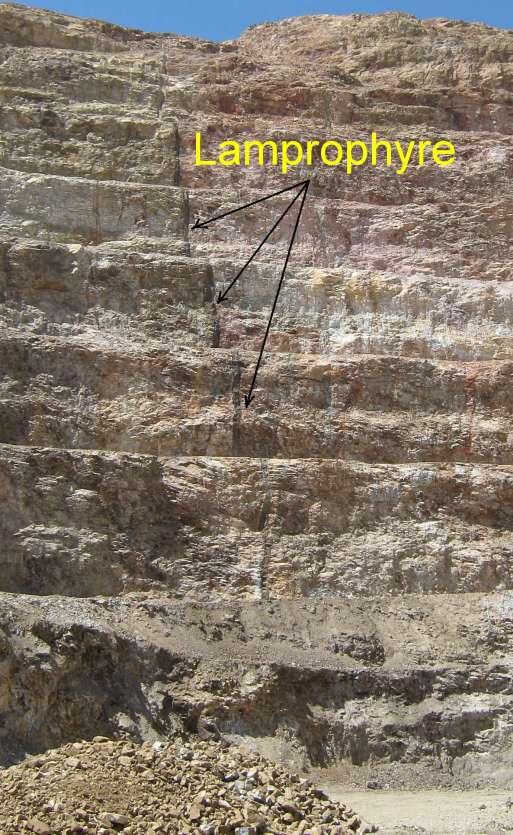
Lamprophyre formation in Cresson Mine
The big haul trucks carry 300 tons of rock from the mine to the crusher. The crusher is actually a series of crushers that reduce the ore to pieces roughly 3/4 inch in diameter.
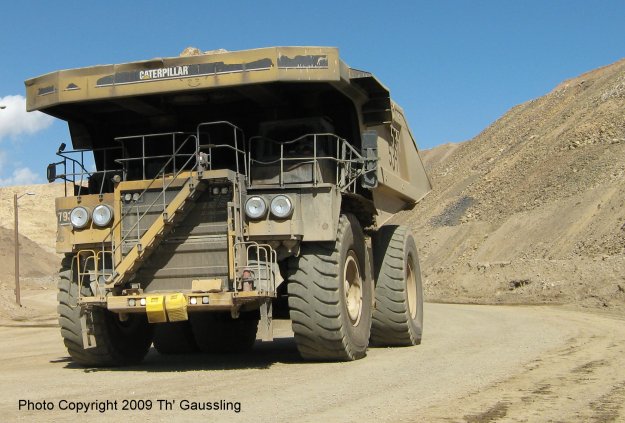
Haul truck carrying rock from blasting site to crusher The crushed rock is blended with lime and then driven to the leach pile for extraction. Another load for the leach heap.
 Lamentations on Chemistry