Category Archives: Nature

The US Strategic Petroleum Reserve (SPR)

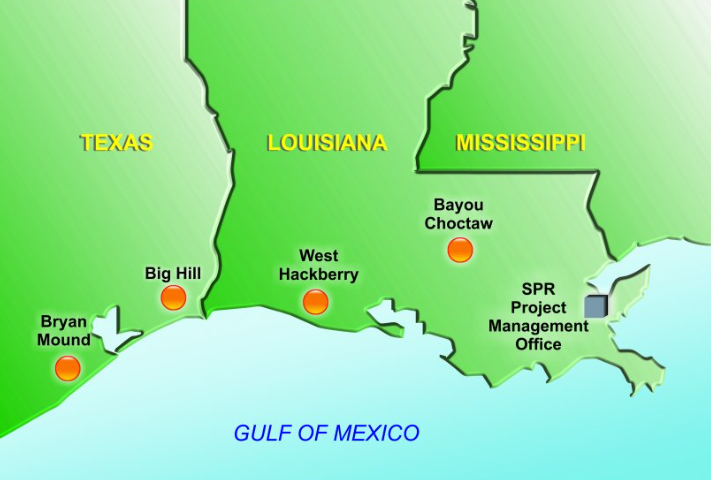
Many countries including the US have underground strategic gas & oil reserves. At present the US has 4 salt dome petroleum storage sites in Texas and Louisiana along the Gulf coast. Salt domes are convenient and inexpensive for underground storage of crude oil and gas. Salt mining has been done from underground workings of drifts and shafts employing underground miners. It has also been accomplished by hot water injection into the formation and retrieval of NaCl brine. Sometimes the salt dome is capped with a layer of elemental sulfur which is recoverable.

The dome formations, called ‘diapirs‘, are usually 1/2 to 5 miles across and rise to 500 ft to 6000 ft below the surface. The discovery of these salt formations coincides with the discovery of oil at Spindletop Hill near Beaumont, TX, in 1900. The current inventory in the SPR as of March 29, 2024, is 363.6 million barrels.

Source: Energy.gov. The 4 SPR sites in the US. The 4 sites have a combined 62 individual salt caverns.

The US acquired the sites in 1977 after the 1973 oil crisis hoping to buffer large disturbances in the crude oil supply. In October of 1973, the Organization of Arab Petroleum Exporting Countries (AOPEC or OPEC) embargoed any country that supported Israel in the 4th Arab-Israeli War. The US was embargoed after Richard Nixon requested 2.2 $ billion for support of Israel’s war effort. At about the same time, after the US had disconnected the dollar from gold, OPEC Ministers found that with the free-floating dollar, their income was lagging because they did not have institutional mechanisms to raise prices with fluctuations in the market price.

Oil storage is all very interesting but what’s the deal with salt domes themselves? What do they look like and where are they found? Why do they form domes?

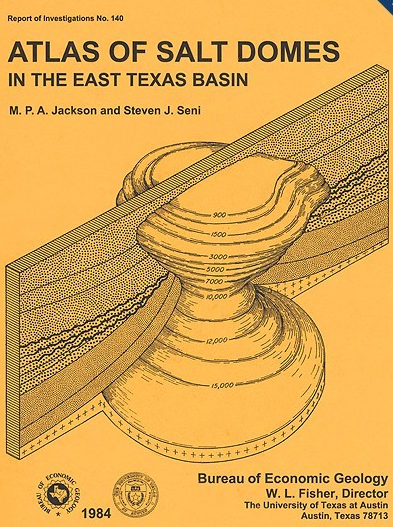
Source: Book cover from Jackson, M. P. A., The Atlas of Salt Domes in the East Texas Basin, 1984, doi.org/10.26153/tsw/4747. The Bureau of Economic Geology Store, UTexas.

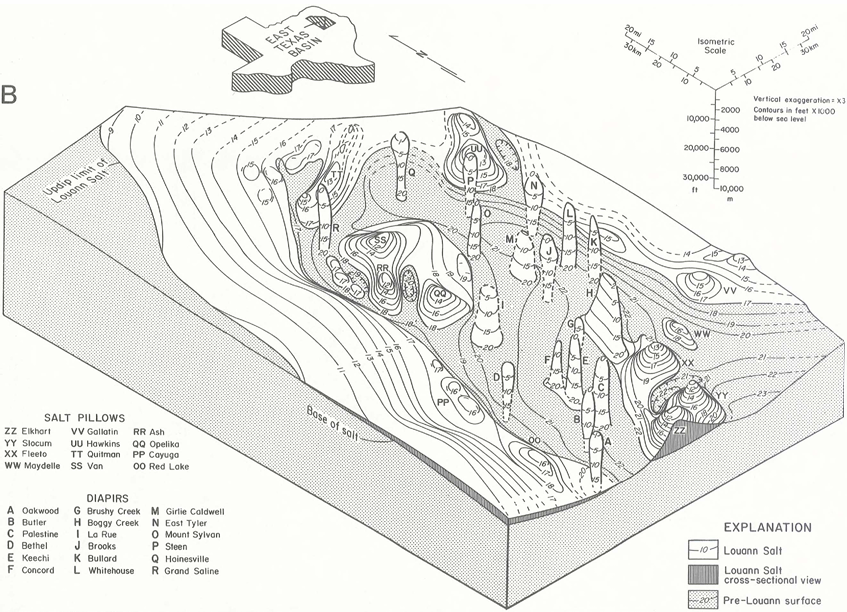
The graphic above is from a 1984 Atlas of Salt Domes produced at UT Austin. It shows the intrusive nature of an idealized salt dome. Salt strata are able to deform upwards due to the weight of the formation on the lower density and lower strength salt (halite) layer. The term “salt tectonics” has been used.

Source: ibid.

The collision of supercontinents Laurentia and Gondwana lead to compressional folding of strata and the formation of anticlines and synclines in the areas now lying in eastern Utah and western Colorado.

There are several types of diapirs: Magma, Salt and Mud. Salt diapirs start out as layers of salt sediment deposited. Here ‘salt’ refers to a number of ionic solids previously precipitated from an inland ocean. Changing sea levels and evaporation of shallow marine waters lead to the deposition of dissolved and suspended solids forming shales, dolomite, anhydrite, sodium and potassium salts, and black shale.

These salt strata do not consist purely of halite, NaCl, but rather contain other evaporites like hydrated gypsum, CaSO4 .2 H2O, and anhydrous gypsum or anhydrite, CaSO4. naturally, there may be layers of silt or sandstone included in the salt formation. If the salt strata form an anticline, oil, gas and water (or brine) may accumulate in the diapir.

Salt is less dense, has greater ductility and is more buoyant than the surrounding country rock. Under great pressure from the surrounding rock, salt can begin ductile flow in the direction of lower pressure which may be upwards. The salt formation has greater ductility than the surrounding rock, so the salt is extruded into faults and sediment layers above. This has been called ‘salt tectonics’.

Salt diapirs are more common than most of us realize. On the Gulf Coast they are found on both sides of the coastline and further inland. Sometimes they are associated with oil and gas deposits. Salt strata are found in Utah below Arches National Park and further south in the Moab valley and southeast into the Paradox Valley in western Colorado. The salt strata can be thousands of feet thick originating from marine transgressions of the Jurassic Sundance Sea. This is not to be confused with the later Cretaceous Western Interior Seaway.

The Sundance Sea moved in and out 5 times with a hiatus of erosion between transgressions.

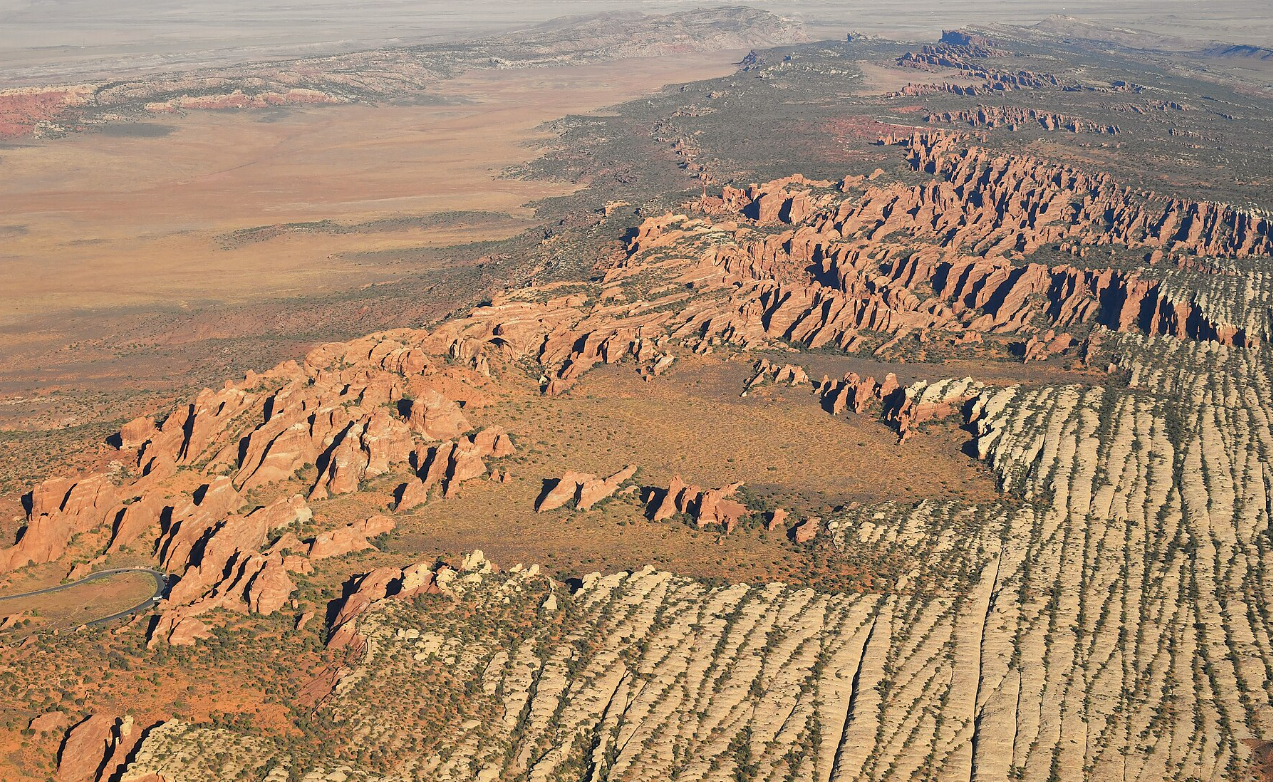
At Arches National Park, over time the ground beneath the area had been rising, fracturing the sandstone above and producing the fin formations at the surface. The exposed rock, called the Entrada sandstone, is part of the Pennsylvanian Paradox Formation. The fins are comprised of many layers of sandstone. If the broad face of the sandstone fins erode enough, a hole can be formed giving the namesake arches. An aerial photograph shows parallel fin formations over a wide area.

Source Image- Wikipedia. Fin formation.

If the reader has never explored Utah, by all means do so. It’s just gorgeous.

Sustainability? Can We Reinforce the House of Cards that Civilization has Become?

Ask yourself this- will your descendants in the year 2125 share in the creature comforts coming from the extravagant consumption of resources that we presently enjoy? Shouldn’t the concept of “sustainability” include the needs of 4-5 generations down the line?

The word ‘sustainability’ is used in several contexts and in contemporary use remains a fuzzy concept with few sharp edges. In this post I will refer to the sustainability of raw materials, fully recognizing that it covers numerous aspects of civilization.

There are wants and there are needs. For the lucky among us in 21st century developed nations, our needs are more than satisfied leaving surplus income to satisfy many of our wants. Will our descendants a century from now even have enough resources to meet their needs after our historical wanton and extravagant consumption of resources dating to the beginning of the industrial age? Our technology stemming from the earth’s economically attainable resources has done much to soften the jagged edges of nature’s continual attempts to kill us. After each wave of nature’s threats to life itself, survivors get back up only to face yet more natural disasters, starvation and disease. This is where someone usually offers the phrase “survival of the fittest”, though I would add ” … and the luckiest”.

What will descendants in 100 or 200 years require to fend off the harshness of nature and our fellow man? Pharmaceuticals? Medical science? Fuels for heat and transportation? Will citizens in the 22nd century have enough helium for the operation of magnetic resonance imagers or quantum computers? Will there be enough economic raw materials for batteries? Will there be operable infrastructure for electric power generation and distribution? Lots of questions that are easy to ask but hard to answer because it requires predicting the future.

Come to think about it, does anyone worry this far in advance? The tiny piece of the future called “next year” is as much as most of us can manage.

Humans would do well to remember that a great many of the articles that we rely on are manufactured goods, such as: automobiles, aerospace-anything, pharmaceuticals, oil & gas, metals, glass, synthetic polymers (i.e., polyethylene, polypropylene, PVC, polystyrene etc.), medical technology and electrical devices of all sorts. Each of these categories split off into subcategories all the way back to a farm or a mine. And let’s remember that both mining and farming are both reliant on big, expensive machinery and lots of water.

Each of the contributing technologies holding up any given apex technology were new and wondrous at one time. Think of a modern multicore microprocessor chip. Follow the chip’s raw materials back to the mines and oil & gas wells where the raw materials originated. Once you’ve done that, consider all of the people and inputs necessary in each step getting from the mine to the assembly of a working microprocessor. Each device, intermediate component or refined substance is at or near the apex of some other technology pyramid. To keep moving forward, people need to connect each apex technology input in a way to get to their own apex endpoint.

We mustn’t forget all of the machinery and components, energy to power them, transportation and trained personnel needed to manufacture any given widget. Skilled hands must be found to make everything work.

A given technology using manufactured goods is a house of cards kept upright by constant attention, maintenance, quality control and assurance, continuous improvement and hard work by sometimes educated and trained people. Then, there is a stable society with institutions, regulations and a justice system that must support the population. The technology driving our lifestyles does not derive from sole proprietor workshops in a corrugated iron Quonset building along the rail spur east of town. The highly advanced technology that is driving economic growth and the comfortable lives we enjoy comes from investors and factories and international commerce. A great many products we are dependent on like cell phones are affordable only because of the economies of large-scale production.

So, what is the point of this? Sustainability must also include some level of throttle back in consumption without upsetting the apple cart.

A plug for climate change

For a moment, let’s step away from the notion that the atmosphere is so vast that we cannot possibly budge it into a runaway warming trend. The atmosphere covers the entire surface of the planet with all of its nooks and crannies, but its depth is not correspondingly large. In fact, the earth’s atmosphere is rather thin.

At 18,000 feet the atmospheric pressure drops to half that at sea level. The 500 millibar level varies a bit but is generally near this altitude. This means that half of the molecules in the atmosphere are at or below 18,000 feet. This altitude, the 500 millibar line, isn’t so far away from the surface. From the summits if the 58 Fourteeners in Colorado, it is only 4000 ft up. That is less than a mile. The Andes and the Himalayan mountains easily pierce the 500 millibar line.

Our breathable, inhabitable atmosphere is actually quite thin. The Earth’s atmosphere tapers off into the vacuum of space over say 100 km, the Kármán line. Kármán calculated that 100 km is the altitude at which an aircraft could no longer achieve enough lift to remain flying. While this is more of an aerodynamics based altitude than a physical boundary between the atmosphere and space, the bulk of the atmosphere is well below this altitude. With the shallow depth of the atmosphere in mind, perhaps it seems more plausible that humans could adversely affect the atmosphere.

The lowest distinct layer of the atmosphere is the troposphere beginning as the planetary boundary layer. This is where most weather happens. In the lower troposphere, the atmospheric temperature begins to drop by 9.8 °C per kilometer or 5.8 oF per 1000 ft of altitude. This is called the dry adiabatic lapse rate. (With increasing altitude the temperature gradient decreases to about 2 oC per kilometer at ~30,000 ft in the mid-latitudes where the tropopause is found. The tropopause is where the lapse rate reaches a minimum then the temperature remains relatively constant with altitude. This is the stratosphere.)

Over the last 200 years in some parts of the world, advances in medicine, electrical devices, motor vehicles, aerospace, nuclear energy, agriculture and warfare have contributed to what we both enjoy and despise in contemporary civilization. The evolving mastery of energy, chemistry and machines has replaced a great deal of sudden death, suffering and drudgery that was “normal” affording a longer, healthier lives free of many of the harmful and selective pressures of nature. Let’s be clear though, continuous progress relieving people of drudgery can also mean that they may be involuntarily removed from their livelihoods.

It is quintessentially American to sing high praises to capitalism. It is even regarded as an essential element of patriotism by many. On the interwebs capitalism is defined as below-

As I began this post I was going to cynically suggest that capitalism is like a penis- has no brain. It only knows that it wants more. Well, wanting and acquiring more are brain functions, after all. Many questions stand out, but I’m asking this one today. How fully should essential resources be subject to raw capital markets? It has been said half in jest that capitalism is the worst economic system around, except for all of the others.

I begin with the assumption that it is wise that certain resources should be conserved. Should it necessarily be that a laissez faire approach be the highest and only path available? Must it necessarily be that, for the greater good, access to essential resources be controlled by those with the greatest wealth? And, who says that “the greater good” is everybody’s problem? People are naturally acquisitive- some much more than others. People naturally seek control of what they perceive as valuable. These attributes are part of what makes up greed.

Obvious stuff, right?

The narrow point I’d like to suggest is that laissez faire may not be fundamentally equipped to plan for the conservation and wise allocation of certain resources, at least as it is currently practiced in the US. Businesses can conserve scarce resources if they want by choosing and staying with high prices, thereby reducing demand and consumption. However, conservation is not in the DNA of business leaders in general. The long-held metrics of good business leadership rest on the pillars of growth in market share and margins. Profitable growth is an important indicator of successful management and a key performance indicator for management.

First, a broader adoption of resource conservation ideals is necessary. Previous generations have indeed practiced it, with the U.S. national park system serving as a notable example. However, the scarcity of elements like Helium, Neodymium, Dysprosium, Antimony and Indium, which are vital to industry and modern life, this raises concerns. The reliance of Magnetic Resonance Imaging (MRI) operations on liquid helium for their superconducting magnets poses the question of whether such critical resources should be subject to the whims of unregulated laissez-faire capitalism. While some MRI operators utilize helium recovery systems, not all do, leading to further debate on whether the use of helium for frivolity should continue, given its wasteful nature.

Ever since the European settlement of North America began, settlers have been staking off claims for all sorts of natural resources. Crop farmland, minerals, land for grazing, rights to water, oil and gas, patents, etc. Farmers in America as a rule care about conserving the viability of their topsoil and have in the past acted to stabilize it. But, agribusiness keeps making products available to maximize crop yields, forcing farmers to walk a narrower line with soil conservation. Soil amendments can be precisely formulated with micronutrients, nitrogen and phosphate fertilizers to reconstitute the soil to provide for higher yields. Herbicides and pesticides are designed to control a wide variety of weeds, insect and nematode pests. Equipment manufacturers have pitched in with efficient, though expensive, machinery to help extract the last possible dollars’ worth of yield. Still other improvements are in the form of genetically modified organism (GMO) crops that have desirable traits allowing them to withstand herbicides (e.g., Roundup), drought or a variety of insect, bacterial, or fungal blights. The wrench in the gears here is that the merits of GMO crops have not been universally accepted.

Livestock production is an advanced technology using detailed knowledge of animal biology. It includes animal husbandry, nutrition, medicines, meat production, wool, dairy, gelatin, fats and oils, and pet food production. There has been no small amount of pushback on GMO-based foods in these areas, though. I don’t follow this in detail, so I won’t comment on GMO.

The point of the above paragraphs is to highlight a particular trait of modern humans- we are demons for maximizing profits. It comes to us as naturally as falling down. And maximizing profits usually means that we maximize throughput and sales with ever greater economies of scale. Industry not only scales to meet current demand, but scales to meet projected future demand.

Essentially everyone will likely have descendants living 100 years from now. Won’t they want the rich spread of comforts and consumer goods that we enjoy today? Today we are producing consumer goods that are not made for efficient economic resource recovery. Batteries of all sorts are complex in their construction and composition. Spent batteries may have residual energy left in them and have chemically hazardous components like lithium metal. New sources of lithium are opening up in various places in the world, but it is still a nonrenewable and scarce resource. This applies to cobalt as well.

Helium is another nonrenewable and scarce resource that in the US comes from a select few enriched natural gas wells. At present we have an ever-increasing volume of liquid helium consumption in superconducting magnets across the country that need to remain topped off. This helium is used in all of the many superconducting magnetic resonance imagers (MRI) and nuclear magnetic resonance (NMR) spectrometers in operation worldwide. Quantum computing will also consume considerable liquid helium as it scales up since temperatures below the helium boiling point of 4.22 Kelvin are required.

As suggested above, today’s MR imagers can be equipped with helium boil off recovery devices that recondense helium venting out of the cryostat and direct it back into a reservoir. One company claims that their cold head condensers are so efficient that users do not even have to top off with helium for 7-10 years. That seems a bit fantastic, but that has been claimed. Helium recovery is a good thing. Hopefully it is affordable for most consumers of MRI liquid helium.

In the history of mining in the US and elsewhere, it has been the practice of mine owners to maximize the “recovery” of run-of-mill product when prices are high. Recovery always proceeds to the exhaustion of the economical ore or the exhaustion of financial backing of the mining company. Uneconomical ore will remain in the ground, possibly for recovery when prices are more favorable. It is much the same for oil and gas. As with everything, investors want to get in and get out quickly with the maximum return and minimum risk. They don’t want their investment dollars to sit in the ground waiting for the distant future in order to satisfy some pointy headed futurist and their concern for future generations.

What is needed in today’s world is the ability to conserve resources for our descendants. It requires caring for the future along with a good deal of self-control. Conservation means recycling and reduced consumption of goods. But it also means tempering expectations for extreme wealth generation, especially for those who aim for large scale production. While large scale production yields the economies of scale, it nevertheless means large scale consumption as well. In reality, this is contrary to the way most capitalism is currently practiced around the world.

Sustainability

The libertarian ideal of applying market control to everything is alleged to be sustainable because in appealing to everyone’s self-interest, future economic security is in everyone’s interest. If high consumption of scarce resources is not in our long-term self-interest, then will the market find a way to prolong it? As prices rise in response to scarcity, consumption should drop. ECON-101 right? Well, what isn’t mentioned is that it’s today’s self-interest. What about the availability of scarce resources for future generations? Will the market provide for that?

Is the goal of energy sustainability to maintain the present cost of consumption but through alternative means? Reduced consumption will occur when prices get high enough. As the cost of necessities rises, the cash available for the discretionary articles will dry up. How much of the economy is built on non-essential, discretionary goods and services? The question is, does diminished consumption have to be an economic hard landing or can it be softened a bit?

Where does technological triumphalism take us?

The generation and mastery of electric current has been one of the most consequential triumphs of human ingenuity of all time. It is hard to find manufactured goods that have not been touched by electric power somewhere in the long path from raw materials to finished article. As of the date of this writing, we are already down the timeline by many decades as far as the R&D into alternative electrification. What we are faced with is the need to continue rapid and large scaling-up of renewable electric power generation, transmission and storage for the anticipated growth in renewable electric power consumption for electric vehicles.

Our technological triumphalism has taken us to where we are today. The conveniences of contemporary life are noticed by every succeeding generation who, naturally, want it to continue. This necessitates that the whole production and transportation apparatus for goods and services already in place must continue. We have both efficient and inefficient processes in operation, so there is still room for more triumph. But eventually resources will become thin and scarcity of strategic minerals becomes rate limiting. Economies may or may not shift to bypass all scarcity of particular articles.

Perhaps a transition from technological triumphalism to minimalist triumphalism could take place. The main barrier there is to figure out how to make reduced consumption profitable. Yes, operate by a low volume, high margin business model. That already works for Rolls Royce, but what about cell phones and sofas?

Something else that stymies attempts at reduced consumption is price elasticity. This is where an increase in price fails to result in a drop in demand. Necessary or highly desirable goods and services may not drop in demand if the price increases at least to some level. As with the price of gasoline, people will grumble endlessly about gas prices as they stand there filling their tanks with expensive gasoline or diesel. Conservation of resources has to overcome the phenomenon of price elasticity in order to make a dent without shortages.

A meaningful and greater conservation of resources will require that people be satisfied with lesser quantities of many things. In history, people have faced a greatly diminished supply of many things, but not by choice. Economic depression, war and famine have imposed reduced consumption on whole populations and often for decades. When the restriction is released, people naturally return to consumption as high as they can afford.

The technological triumph reflex of civilization has allowed us to paint ourselves into a resource scarcity corner.

I’d like to believe that humanity could stave off the enviable conflict that would spark from numerous critical resource shortages, but I doubt the people and nations of the world can do it.

Helium and the “Howling Gasser”

Global demand for helium is expected to double by 2035. Helium is a critical, non-renewable resource used across the world. It is found in natural gas deposits in limited number of gas wells. Helium is the second most abundant element in the universe behind hydrogen. But this is averaged across the universe. Any helium the earth’s early atmosphere may have had has long ago diffused into space. At present, helium from terrestrial sources is derived from radioactive decay of uranium, thorium and daughter products within the Earth over eons of time. Underground structures suitable for the accumulation of natural gas may also accumulate helium.

Helium is useful in science and industry for many reasons, but mostly for its extreme chemical inertness and ultra-low boiling point. A gas with a very low boiling point, and if you manage to condense it, finds use as a low temperature coolant. Helium serves as an inert atmosphere in many applications including nuclear power, semiconductor manufacturing, welding and for pressurizing rocket propellant tanks. In liquid form, it boils at the low absolute temperature of 4.2 Kelvin (-261.1°C) and is indispensable as a cryogen for many applications from medical Magnetic Resonance Imaging (MRI) and quantum computing to other superconductor applications. Those of us who make great use of nuclear magnetic resonance spectroscopy (NMR) are highly dependent on it as an analytical tool. NMR has made identification and quality control possible in many kinds of chemical manufacture.

According to one source a single MRI unit can contain up to 2000 Liters of liquid helium and consume 10,000 Liters over its 12.8-year lifespan. If you condensed the helium gas into liquid from the balloons at the Macy’s Thanksgiving Day Parade, there would be enough liquid helium to keep two MRIs running for their lifetimes. The US presently has approximately 12,000 MRI units across the country. The good news is that helium recycling equipment can be fitted on to an MRI machine to greatly extend the life of a helium charge. Usually, a liquid helium dewar is immersed in a liquid nitrogen filled dewar which is inside a vacuum insulated container. The liquid nitrogen bath helps with the helium boil-off somewhat, even though the bp of nitrogen is considerably higher than that of helium, yet much lower than room temperature.

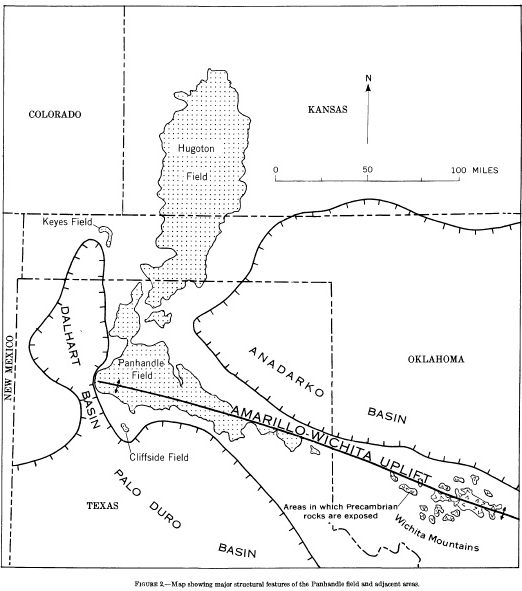
Source: Wikipedia. The Hugoton and Panhandle gas fields rich in helium. There are many other helium-rich gas fields in the US, but none as large as the Hugoton and Panhandle gas fields.
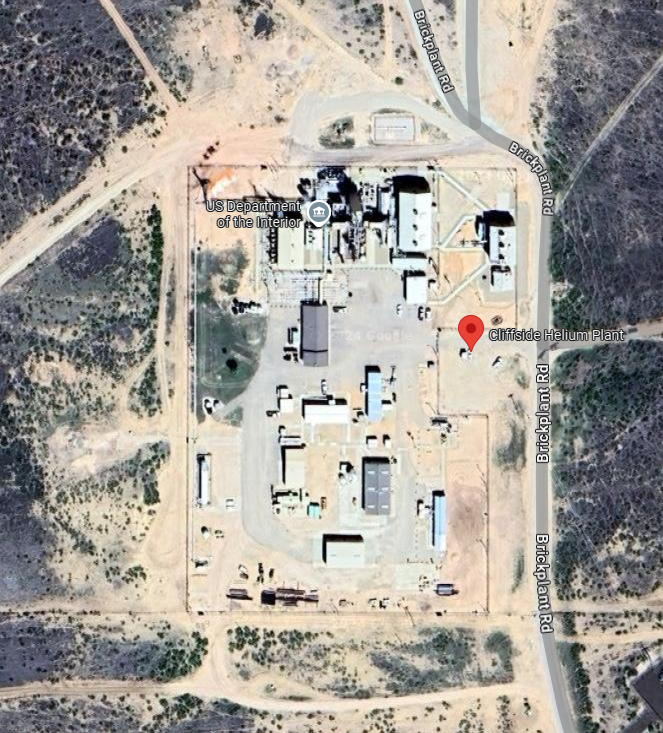
Source: Google Maps. Aerial view of the Cliffside Helium Plant. If there are actual cliffs near Cliffside then the panhandle folks are calibrated differently from me as to what constitutes a cliff.
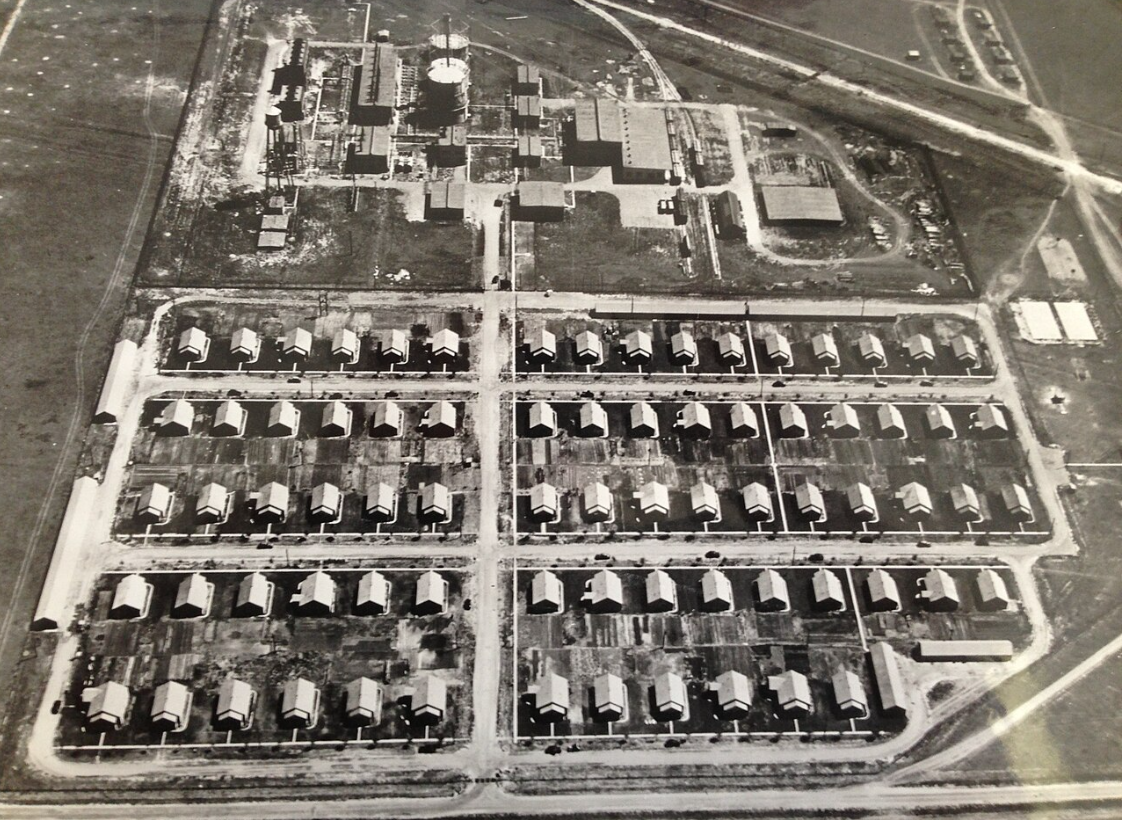
Source: Wikipedia. The Excell helium plant, ca 1945. Note the company housing.

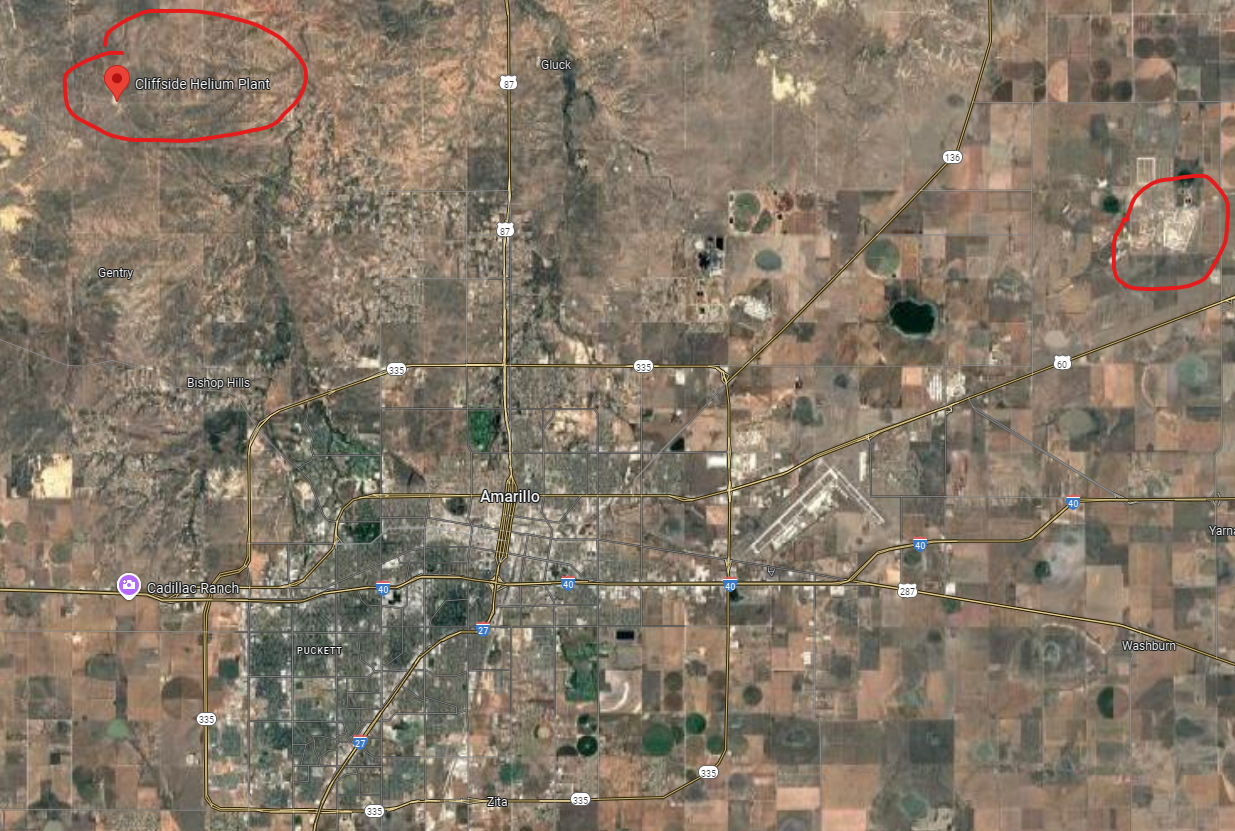
Helium is isolated from natural gas. According to the American Chemical Society, the US, Algeria and Qatar have the major the helium reserves while the US, Russia and Algeria are the top suppliers of helium. The majority of US reserves are in the Texas & Oklahoma panhandles and Kansas. The Cliffside helium plant is located a 15 miles NNW of Amarillo, TX, over the Cliffside dome. It is in the red circle on the upper left in the photo.

The Amarillo Helium Plant got its start in 1929 when the federal government bought 50,000 acres NNW of Amarillo for a helium extraction plant. The motivation was to accumulate helium for lighter than air aircraft like balloons and blimps.

Source: Google Maps. Cliffside Helium Plant, Amarillo, and Pantex.

It is interesting to note that the Pantex nuclear weapons plant is about the same distance but to the NE of Amarillo, TX. It is circled in red in the upper right. It is the primary site in the US where nuclear weapons are assembled, disassembled or modified. Uranium, plutonium and tritium bearing components are stockpiled there. Weapons that use tritium in their booster gas have a shelf-life constraint due to tritium’s very short half-life, so the gas must be periodically upgraded.

The facility opened in 1942 for the manufacture of conventional bombs and was shut down shortly after the Japanese surrendered in 1945. The site was purchased in 1949 by what is now Texas Tech and used for research in cattle-feeding operations. In 1951 it was surrendered to the Atomic Energy Commission (now the National Nuclear Security Administration) under a recapture clause.

So, we might ask the question: Why was anyone looking for helium in natural gas at the time? The easy answer is that nobody was looking for it. In May of 1903 in Dexter, Kansas, a crowd had gathered at a natural gas well to celebrate this exciting economic find. A celebration had been planned and the towns folk were there to see it ignited. It was called “a howling gasser” and there was much anticipation of a spectacular fire. After much ballyhoo and speeches, a burning bale of hay was pushed up to it in anticipation of ignition of the gas jet, but the burning bale was extinguished. This was repeated several times, but no fire. The disappointed crowd wandered off. Later Erasmus Haworth, the State Geologist and geology faculty member at the University of Kansas, got word of this curious event and managed to get a steel cylinder of gas sent to the university.

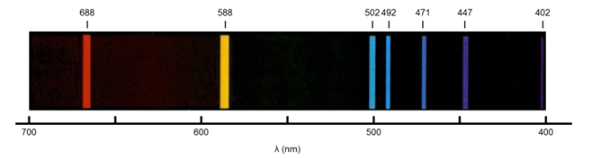
At the University Haworth and chemistry professor David F. McFarland determined that the composition of the Dexter gas was 72 % nitrogen, 15 % methane and 12 % of an “inert residue.” Soon, McFarland and chemistry department colleague Hamilton P. Cady began “removing the nitrogen from the gas sample by applying a spark discharge with oxygen over an alkaline solution.” This tedious procedure was soon replaced by using a glass bulb of coconut charcoal immersed in liquid air. This method had been shown to adsorb all atmospheric gases except helium, hydrogen, and neon at the temperature of boiling liquid air” (-310° F). The unabsorbed gas was collected in a glass tube and examined by emission spectroscopy. The spectrum showed all of the optical lines of helium. This discovery by McFarland and Cady showed that sizeable quantities of helium did exist on the Earth. The total amount of helium in the Dexter gas was 1.84 %.

Graphic: Atomic emission lines of helium. Source: chem.libretexts.org

The nagging question I have is how did the nitrogen content in the Dexter sample come to be? The thinking is that N2 gas found in natural gas derives from chemical alteration of organic ammonium compounds deep in the natural gas forming strata. To a chemist “ammonium” has a specific meaning. To a geologist it may just mean “amine”: hard to tell. N2 molecules are in a deep thermodynamic well, meaning that once formed, the nitrogen is very stable and not readily altered without large energy inputs. So, the formation equilibrium of N2 could favor its formation rather than returning to a precursor.

The removal of nitrogen, called nitrogen rejection, is a normal part of natural gas processing. The incentive for its removal is that it lowers the BTU content and thus the value of the gas. According to one source, the Midland gas field in the Permian formation of Texas is unusually high in nitrogen, from 1 % to 5 %. Given that the usual specification for nitrogen content is 3 %, excessive nitrogen must either be reduced by dilution or removed.

The problem of nitrogen becomes especially acute for gas that is condensed to LNG (Liquified Natural Gas). Natural gas that has too much nitrogen in it has a higher partial pressure of nitrogen and as a result it occupies space in a pipeline or LNG carrier that could be occupied by a gas that pays- natural gas. Non-combustible gas in the liquefaction train at the LNG terminal wastes its processing capacity. The specification mentioned above becomes more problematic when it is realized that the N2 content of natural gas may vary considerably from one wellhead to the next, adding to the overhead cost of quality control of the output gas.

Back to the Howling Gasser, the fact that the natural gas screaming out of the wellhead wouldn’t ignite was an extreme example of the effect of nitrogen in the formation. What saved the day was the high enrichment in helium. But, you would have to know to look for it. That a curious geologist and two chemists were able to isolate the helium and perform emission spectroscopy on it without a clue as to what it was stands as an excellent example of what curious, knowledgeable folks can do when given the resources. The state of Kansas is to be congratulated as well for providing the research facilities at the University of Kansas in Lawrence, KS.

Cells Count on Earth

Wow. A study was published calculating the number of living cells currently present on Earth and the number that have ever lived. The paper, titled “The geologic history of primary productivity,” was published in Current Biology, October 11, 2023. Sadly, the full article rests behind a paywall. But the abstract is open access so I will reproduce it here.

The lead author, Peter Crockford, is a geologist at Carleton University.

Source: Peter W. Crockford 67 , Yinon M. Bar On, Luce M. Ward, Ron Milo, Itay Halevy, Current Biology, October 11, 2023, DOI: https://doi.org/10.1016/j.cub.2023.09.040.

An article by Elizabeth Pennisi was published in Science which is a decent summary of the paper. The Science review reports that the number of cells alive today amounts to 1030 cells with most of them cyanobacteria. The total number of cells to ever have lived is estimated to be between 1039 and 1040. The article goes further and says that the resources on Earth cannot support more than 1041 cells.

Black Hole Imagery

An image of Sagittarius A*, the black hole in the center of the Milky Way galaxy, has just been published. This is only the second such feat. The first image was of the central black hole of the galaxy M87. The images were captured through the collaboration of 8 synchronized radio telescopes around the world called The Event Horizon Telescope. It is an impressive technical problem to solve. Seeing something the apparent size of the M87 black hole as viewed from earth is said to be like trying to see a bagel on the surface of the moon. And they did it with sub-millimeter radio waves.

The color of the objects is interesting. I wonder how many folks out there think that radio telescopes can record the visual color of an object?

Ionospheric Bow Waves Caused by August, 2017, Eclipse

A recent paper (free) in Geophysical Research Letters reports the discovery of long anticipated ionospheric disturbances caused by the passing of the moon’s shadow over the earth during an eclipse. The paper, submitted by the MIT’s Haystack Observatory, reports the occurrence of ionospheric bow waves associated with the shadow ground-track of the August, 2017, North American eclipse.  The online source, MIT News, summarized the discovery.


Grimsvötn Eruption

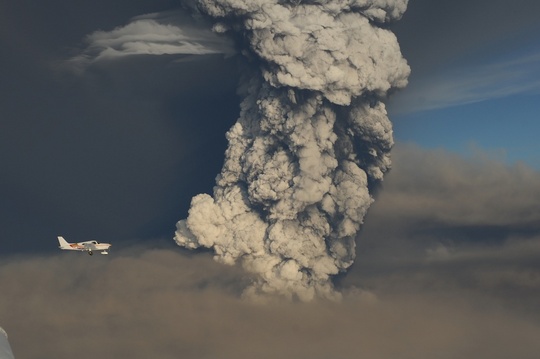
The Grimsvötn eruption in Iceland began its eruption on May 21, 2011 with the injection of considerable ash into the navigable airspace to the east. Excellent photographs can be found at the Icelandic Met Office.  Grimsvötn is a very prolific basaltic volcano located on the southeast part of Iceland. Grimsvötn is the most frequently erupting volcano in Iceland, with the most recent eruption in 2004.

Grimsvötn Eruption in Iceland. (Photo credit- Sigurjónsson, Icelandic Met Office)

According to one source in Iceland, the eruptions have presently subsided to steam venting, though no one is prepared to say that the eruption is over. The safe distance for viewing is said to be 2 km.

Inverse Midas Touch

I seem to have contracted a case of the inverse Midas touch. Everything I touch turns to crap. I mean everything. Chemistry, friendships, a pot of chili, volunteer work, you name it.  What gets me is that it seems statistically unlikely that I would uncover so many large magnitude failure modes (??) in such a tight temporal cluster.  A flock of black swans landed in my back yard.  A monkey sat at my typewriter and typed “screw you” 500 times.  A simple reaction making a simple product  is fraught with unforseen complications. Son of a …

Okay, the monkey thing didn’t happen.

One thing I’ll get out of this is to be more reticent to volunteer for projects that seem simple in concept. Nothing is simple. Every single thing has degrees of freedom you can’t see and local minima to sink into on the way to the prize. It’s a dangerous world out there and in ways you can’t imagine.

Morning Vulture Encounter

This is the week for wildlife encounters. While cycling yesterday we watched a hawk swoop down and grab its prey. Moments later the hawk flew away with a smallish (ca 12-14 “) snake in its talons and making its shrill cry. It landed on a nearby rooftop where it enjoyed its catch. I’m sure this kind of thing warms the heart of any homeowner lucky enough to host  the feast.

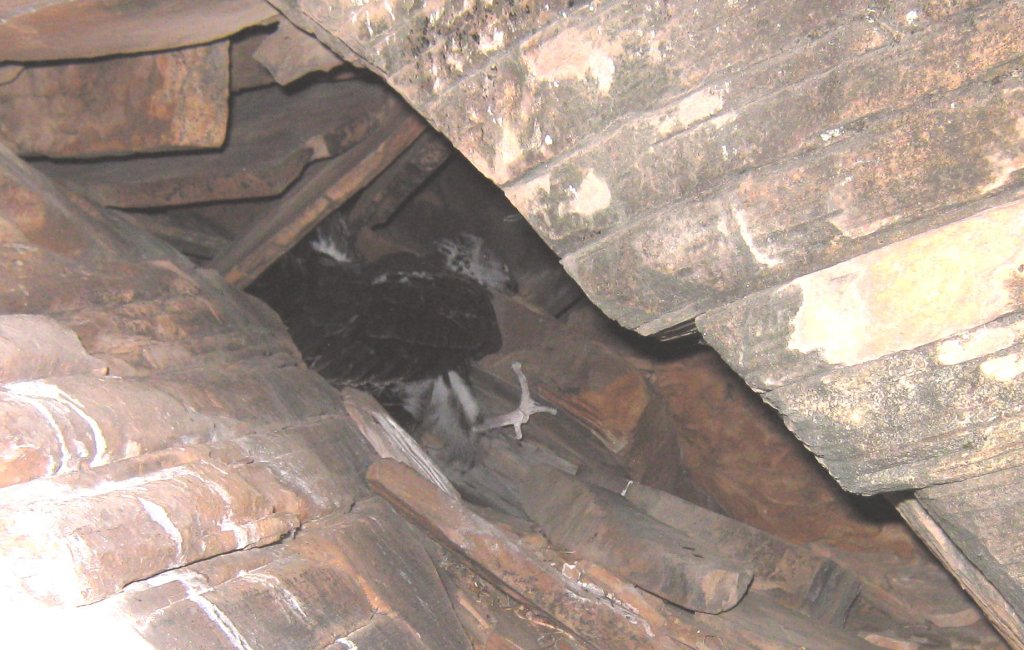
Fledgeling Vulture in Cave (Copyright 2009 all rights reserved)

Fledgeling Vulture in Cave (Copyright 2009 all rights reserved)

This morning we climbed to a cave along a cliff face (on private land) to see a vulture nesting site.  The cave was in the Fountain sandstone formation and was situated a good 4-500 ft above the roadway. The mother vulture was not present, but the two fledglings were in the cave. I say fledgeling, but I doubt that these young ones have flown yet.  According to the land owner who has been carefully and quietly observing their progress, the youngsters have not yet flown.

Not seeing the young birds from a distance, we slowly climbed toward the cave entrance long enough to grab some snapshots.

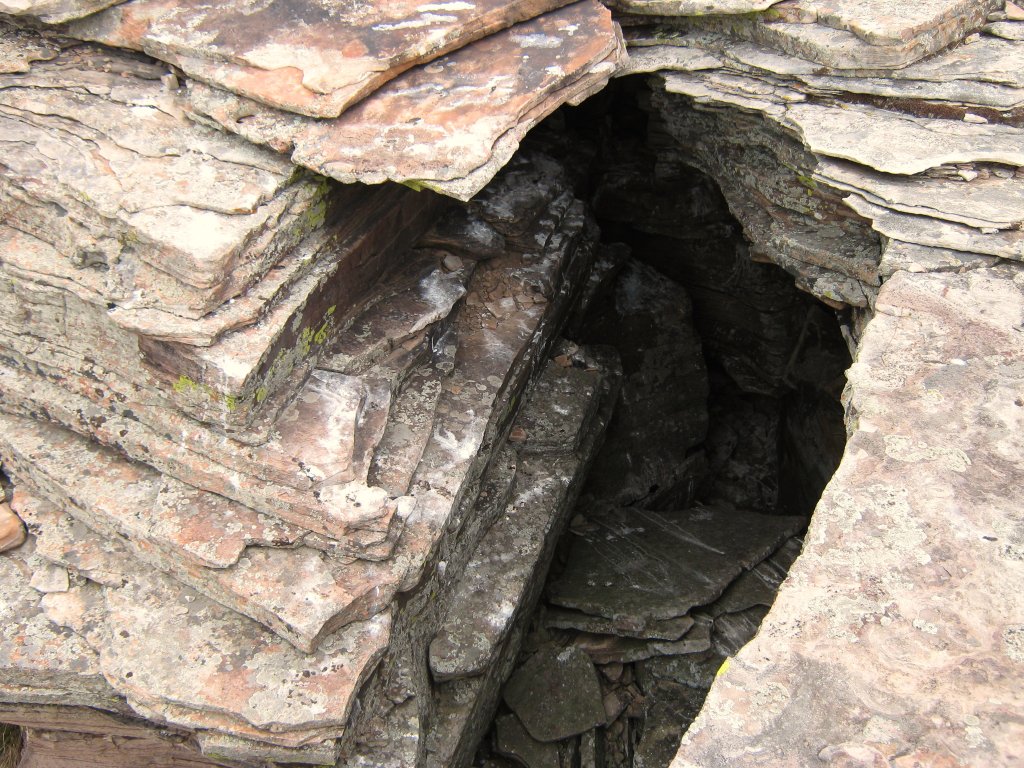
The cave is actually a covered crevice that derives from a dislocated sandstone slab which quickly narrows to a very small cross section. With the camera flash, a photo of the young birds was captured in the dark recesses. This is rattlesnake country so we were not eager to venture too deep or linger in this crevice. The property owner mentioned finding a ball of rattlers under a rock partway down the hill. We had no interest in uncovering our own ball of rattlesnakes.

The young birds still had some of their down. This top photo was taken from ca 3 meters distance. Shortly after this photo the bird scrambled into the deeper recesses and out of sight. They make a curious hissing noise which is surely a sign of distress.

Buzzard Cave Entrance near Loveland, Colorado

Buzzard Cave Entrance near Loveland, Colorado


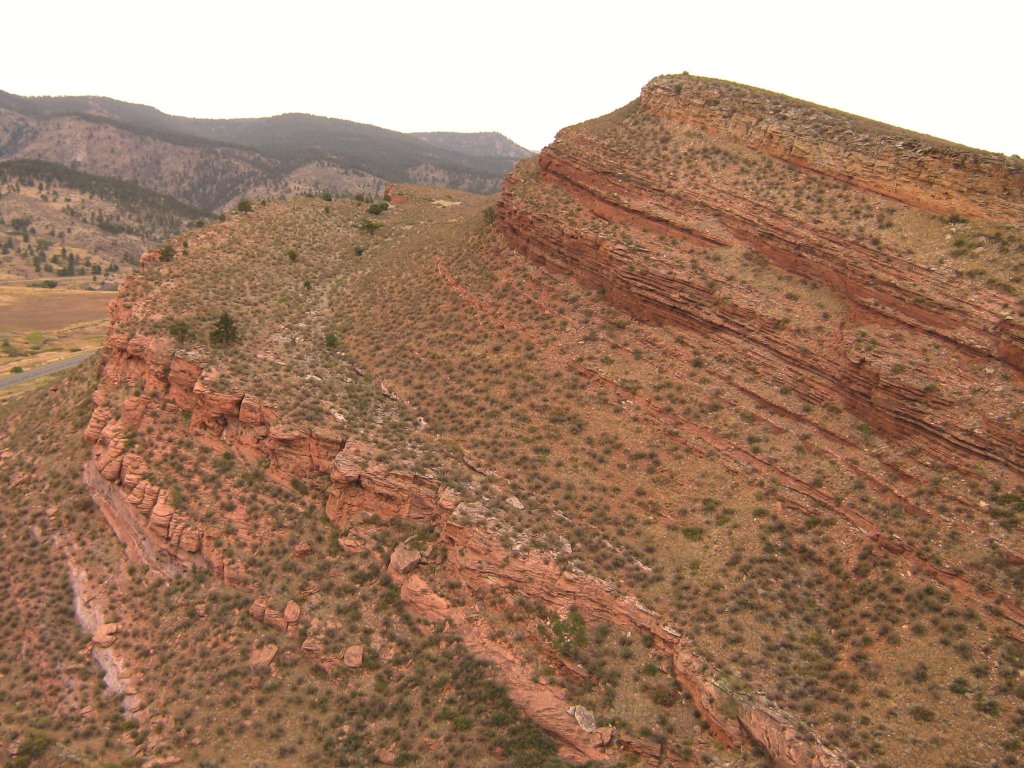
Fountain Formation near Loveland

Fountain Formation near Loveland

The buzzard cave was found in the red sandstone of the Fountain formation, west of Loveland, Colorado. The Fountain Formation is the deepest of the sedimentary formations along the Colorado Front Range. It is seen only along the western margin of the Great Plains here owing to the uplifting effect of mountain building. In fact, this sandstone formation consists of the eroded debris of a previous iteration of the Colorado Rocky Mountains. The present iteration is often referred to as the Laramide Orogeny.

The photo above shows both the sandstone of the Fountain Formation in the foreground and in the upper left, in the background, the uplifted plutonic rock formation consisting of gneiss and schist.

Nuclear Chemistry Article in Daily Kos

For those of use who carry around an interest in nuclear science, there is a short but interesting article in the Daily Kos written by a chemist on the topic of the Hanford site in Washington.  Of particular interest is the link describing a radiological assay of a chemist who died at age 76 of cardiovascular disease.  At the time of death they found 540 kBq of activity in his body- 90 % in his skeleton. The gentleman had been involved in a glovebox explosion involving exposure to 241-Am at age 64.

What do you do with a radioactive corpse? One option is to donate your body to science. The WSU College of Pharmacy maintains a registry of data culled from uranium and plutonium workers. A recent description of donated bodies is found in this pdf. One donation is from a plutonium worker who was present in the 1965 fire at Rocky Flats. He retained an estimated 6.8 kBq of lung burden. They did not specify how this was determined.  Rocky Flats did have state of the art whole-body monitoring and a substantial health physics department.

Pu detection is a little tricky because one of the important markers for Pu contamination is 241-Am, an alpha and gamma emitter (Pu is a bad actor mostly because of internal alpha exposure).  Residual and highly active 241-Pu (104 Ci/g) beta decays to the highly active 241-Am.  Unfortunately, not all Pu isotopes decay into Americium. This Am isotope allows for gamma ray spectra to be gathered so an estimate of Pu exposure can be calculated. The ever popular 239-Pu isotope alpha decays to 235-U without much gamma emission. So, the calculation of Pu exposure and dose depends on knowing the purity of the Pu at issue.