Recently we flew into Albuquerque, NM, and then took I-40 to the Barringer Meteor Crater southwest of Winslow, AZ, and 5 1/2 miles south of I-40. This was a bucket list trip for me but maybe not so much for my long-suffering spouse. I’ll spare the reader of all of the obligatory selfies.
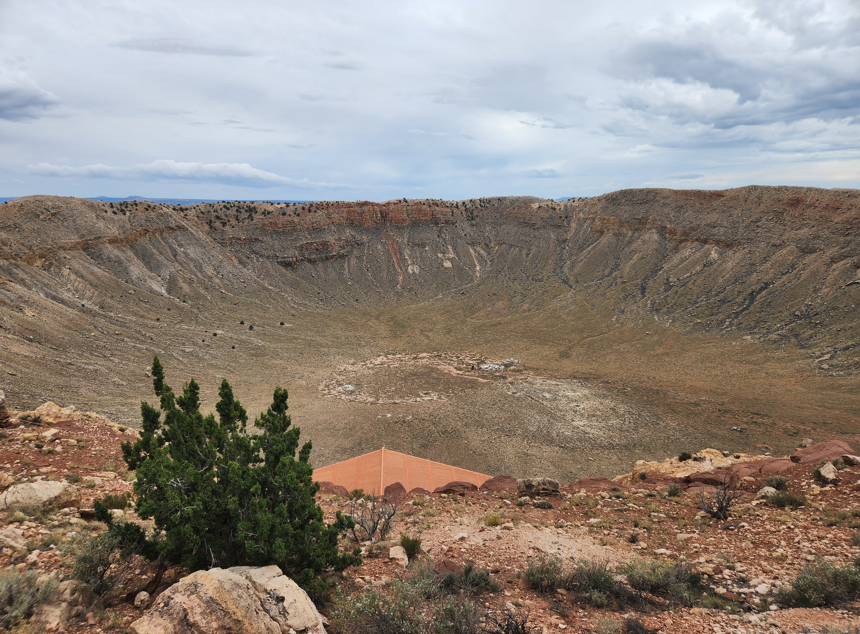
View of the Barringer Meteor Crater from the northern observation area. The brown roof in the foreground is a shelter with seating and with plaques commemorating those who own or have cared for the crater. Photo by Arnold Ziffel.
The meteor hit the AZ location 50,000 years ago and blasted a crater out of the local sandstone. The fellow who first bought the site, Barringer, believed that iron remnants of the meteor were buried within the crater, so he obtained the site by filing mining claims in 1903 that included the crater. He dug a 200 ft mineshaft into the center and drilled exploratory holes hoping to strike a rich lode of iron. Sadly for him, he found only sandstone. In fact, the fragmented remains of the meteor are scattered over the surrounding landscape. Daniel M. Barringer, a mining engineer and businessman, who bought the mining claims believed the crater was due to a meteor impact. It was many years later that professional opinions agreed that the crater was meteoric in origin. The Crater has been in in the hands of the Barringer family from the beginning.
Photo by Arnold Ziffel.
I thought this was amusing at first glance, seemingly warning that the Meteor Crater was out of order, but it was just for the water fountain. The visitor’s center has a large gift shop and an auditorium for a short video of the site and its history. The only path to the crater is through the visitor’s center. It is all private property.
The second big hole in Arizona is a whopper located north of Flagstaff. It is the Grand Canyon, of course. I had scheduled a helicopter tour of the canyon with Maverick Helicopter. at the Grand Canyon National Park Airport. They have 5 gleaming Airbus H130 helicopters that can carry 6 passengers each. Everyone gets headphones to speak in the noisy choppers.
View of the Grand Canyon looking northwest from the south rim. Photo by Arnold Ziffel.
Everybody has seen countless photos with all of the breathless descriptions of the canyon, and yes, it is definitely Grand. We took a ground tour with Pink Jeep Tours in one of their custom pink Jeeps. This was in the fall shoulder season for tourism so the crowds were manageable. Gawping at it from the rim was nice but to have a real canyon experience I think you have to go into the canyon.
Note: Some of the VLA pictures are duplicated from a recent post.
Once we completed our tour of Arizona’s two gaping holes, we pointed the car east and drove to the Very Large Array (VLA) near Magdalena, NM. They put on an open house for the public on Oct. 11, so I was obligated to grab another bucket list trip. Again, the spouse unit was luke-warm but I was impressed.
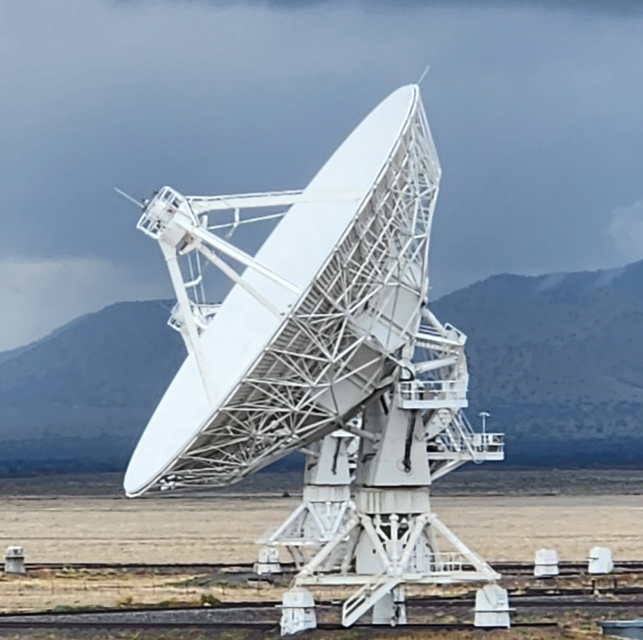
One of the 26 operating dishes at the VLA in New Mexico. Photo by Arnold Ziffel.
One of the 27 dishes is in the shop and 26 are in the field.
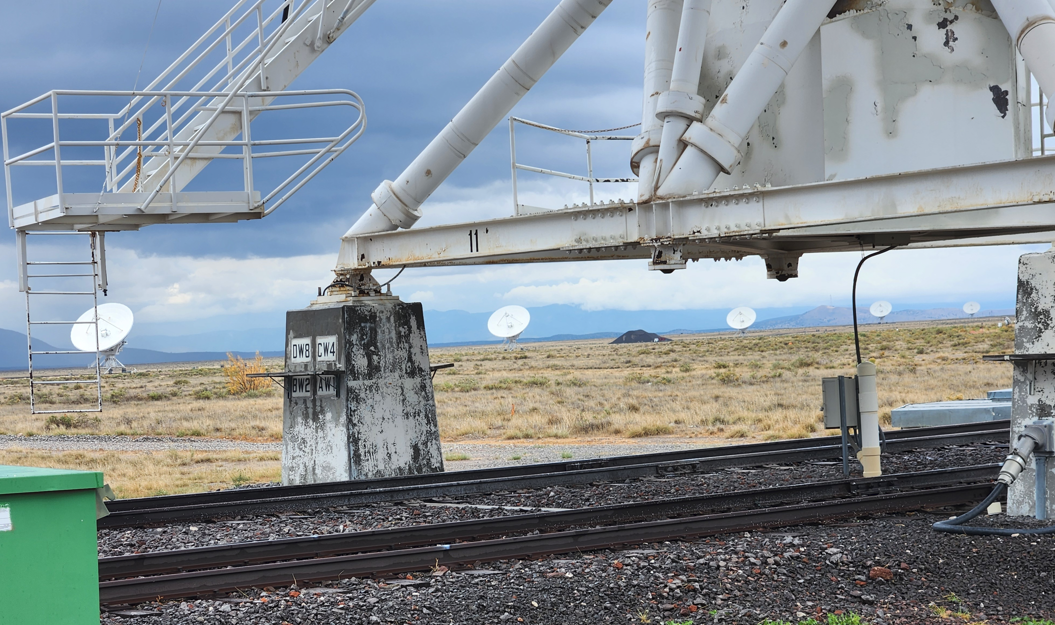
A view from under one of the dishes towards 5 more. Photo by Arnold Ziffel.
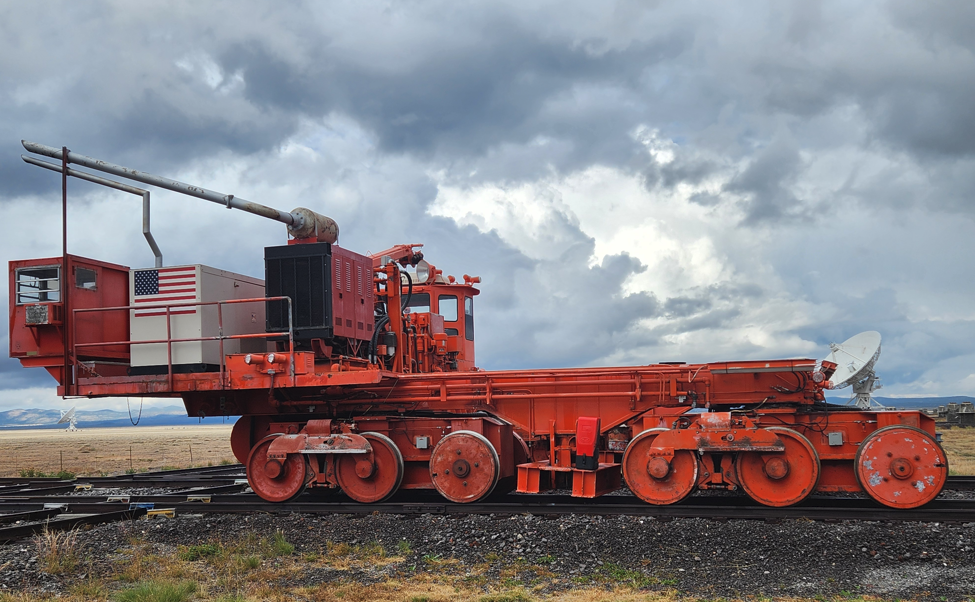
This is the machine they use at VLA to haul around the dishes when they need to be moved. When loaded it moves at 2 mph. Photo by Arnold Ziffel.
It takes the dish transport machine two weeks to reposition all 26 VLA dishes. The rails were installed to be rated for highspeed rail operations. This rating evidently ensures that dish transport is as smooth as possible.
One of the side effects of my 5 years of community theater experience on top of my beta-blocker high blood pressure meds has been that I tend not to get stage fright. I am likely to say things thar ordinarily I might not say. Beta-blockers have been successfully used to suppress the anxiety of stage fright. It works. The young radio astronomer tour guide kept referring to black holes in his spiel. Tired of this patronizing whizbang black hoIe talk, I asked him if it was possible for an astronomer to not mention black holes while speaking. He said he didn’t know. The younger VLA astronomers in the group were greatly amused by this blunt question.
When asked about the sensitivity of the VLA radio telescope system, the guide said that if you were out at the orbit of Pluto and used your cell phone, you would be the brightest radio object in the sky. Yikes.
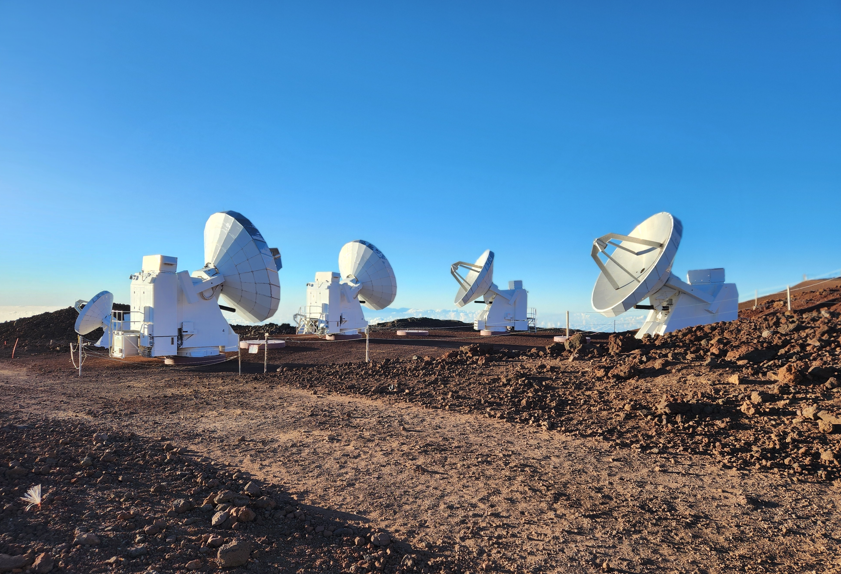
A year ago atop Mauna Kea on the Island of Hawai’i we saw these radio telescopes. The photo does not show the howling, frigid wind. It was dang cold.
Radio telescopes just below the very summit of Mauna Kea on Hawai’i Island. Photo by Ginger Rogers.
After VLA we left for Albuquerque 2 hours to the north. The next day while waiting for our flight, we visited the National Museum of Nuclear Science & History. There was a similar museum in Las Vegas, but a bit smaller. This museum was packed with artifacts from the early nuclear age.
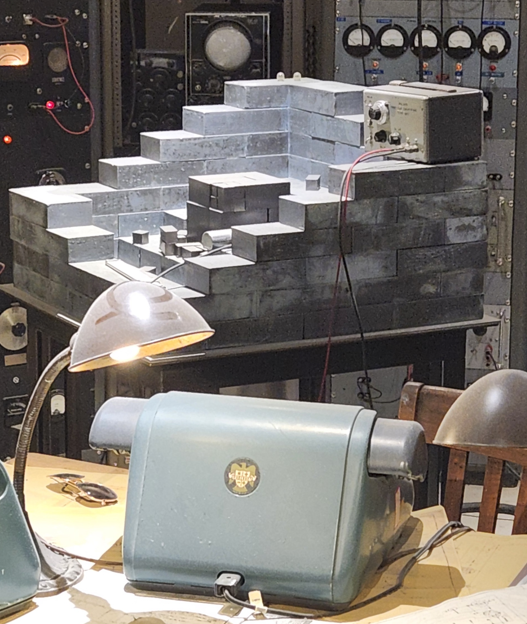
A mockup of an atomic pile used for Dragon’s Tail experiments aimed at finding the critical mass of the explosive pit. Lead bricks were piled up around a stack of what I believe are uranium cubes surrounding the fissile material. Some kind of radiation detector lies next to the pile.
At the time of the Manhattan Project, not much was known about the range of hazards of radiation exposure and dosing. And this may have been especially true for neutron exposure. Neutron activation was known, but the physiological consequences were poorly understood. Large doses of radiation correlates well with physiological effects, but in the low dose range, it begins to be sketchy. Radiation dosing tends to be stochastic in its effects.
Outside of the Nuclear Museum were numerous rockets and aircraft on display. Notably a model of the tower that held the Trinity gadget. On the lower end of the tower the gadget can be seen being hoisted up into the tower.
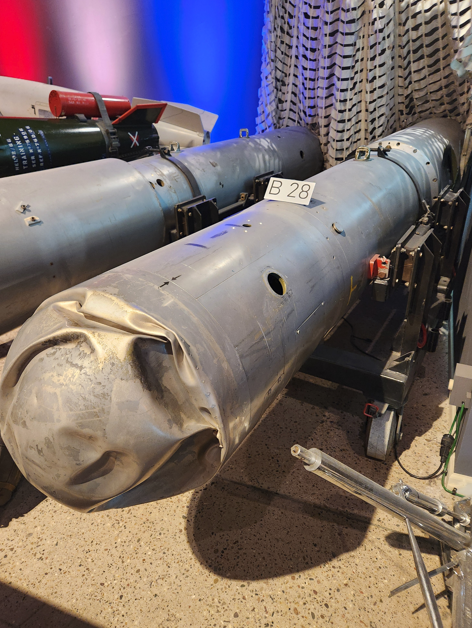
What a thermonuclear weapon looks like after it is dropped from a bomber by accident.
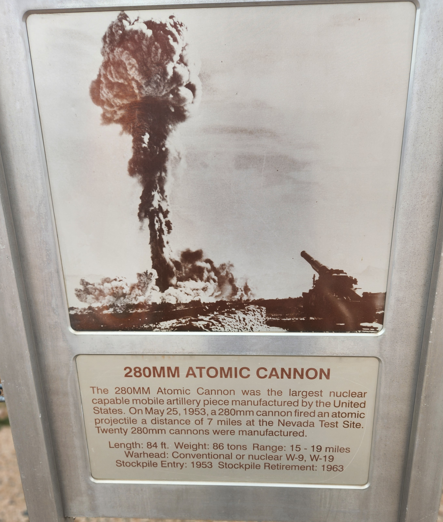
The actual cannon that fired a nuclear cannon shell and seen in film.
A photo after the nuclear cannon shell detonated.
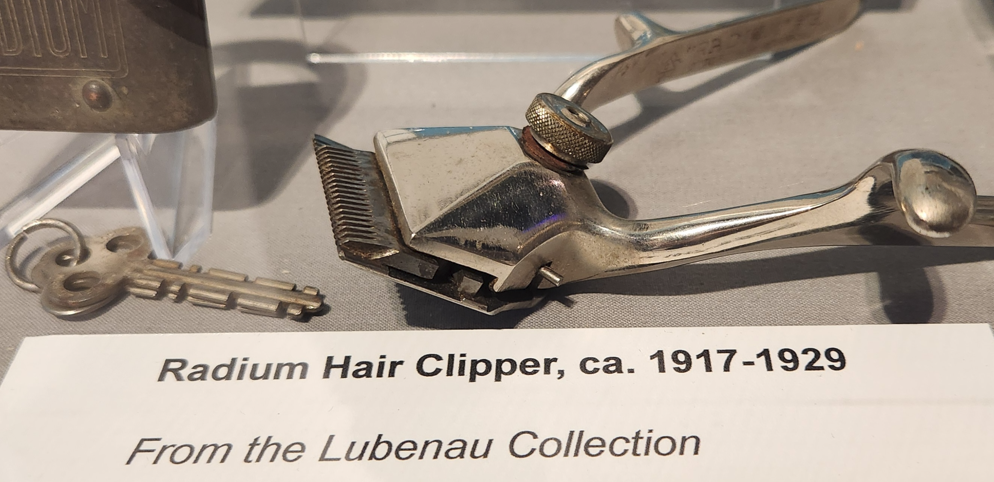
Why a radium hair clipper? Because there is a sucker born every minute.
Early atomic age children’s literature.
On my 50th birthday I actually went uranium prospecting near Idaho Springs, CO. I had a tip that pitchblende had been spotted nearby. All I managed to do was contaminate the Geiger counter with natural radioactive material that spoiled the calibration of the counter. Pisser.
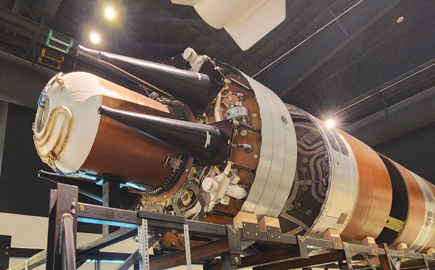
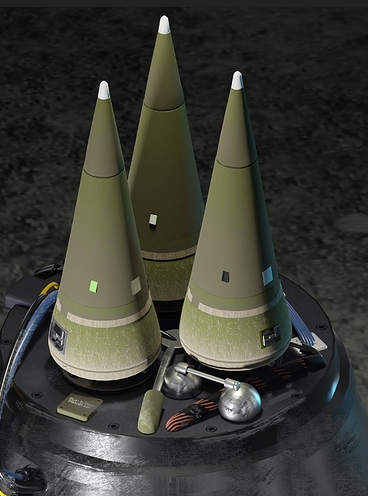
The top end of an ICBM with numerous MIRVs (the black conical objects).
A mockup of the top end of an ICBM with numerous MIRVs, Multiple Independently-targetable Reentry Vehicles.
Alert!! I spotted a Radio Shack store driving through Socorro. Driving by I could see shelves inside- it looked open for business. It was like spotting a wooly mammoth or a Dodo bird. I spent a lot of money at Radio Shack while in high school in the ’70s.
The story of PET, Positron Emission Tomography, has evolved over decades of advancement. To begin, tomography, detectors and computers had to be invented. Separately, positron emission as a medically viable radiation source had to be identified and validated. Positron decay occurs when a neutron deficient nucleus emits a positron and a neutrino to convert a proton to a neutron. This brings the p/n ratio to a more stable state.
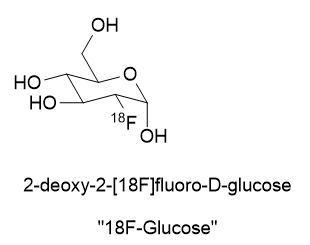
A substance for delivering a dose of isotope must be found. In the case of 18Fluorine, it is prepared as an inorganic salt like K18F or elaborated as an organic molecule like 2-deoxy-2-[18F]fluoro-D-glucose.
How did it come about that the 18Fluorine in the position where it is? I’ve not found mention of this in the literature so far. Looking through Chem Abstracts I have noticed there are numerous synthetic pathways leading to fluorine at that position. Could it have been placed there because research found that it was most biochemically similar to glucose? Or was it the more mundane reason that fluorination at position 2 gave the best yields and purity or was the cheapest and easiest to make?
18F has replaced the oxygen (OH) group at position 2 of glucose, thus the prefix “2-deoxy-2-[18F]fluoro-“
There are recent radioligand compounds that are used as PET (Positron Emission Tomography) diagnostic agents which selectively bind to the prostate specific membrane antigen receptor where they can undergo positron emission revealing the site of prostate cancer cells. 18F-glucose was first synthesized in 1967 in Czechoslovakia at Charles University by Dr. Josef Pacák and was first tried as a radiotracer by Abass Alavi in 1976 at the University of Pennsylvania on volunteers. PET scanning came along later. Cancer cells consume glucose a bit faster than normal cells so the 18F-glucose will tend to accumulate to a slightly greater extent and reveal their position by positron annihilation. This yields two 511 keV x-rays 180o apart and is identified by a ring coincidence detector. A single detection event is discarded.
Today, 18F-glucose is being superseded by many 18F PET preparations that are designed to interact with specific receptors. This interaction is called “conjugation”. In the case of Prostate Cancer there is PSMA, Prostate Specific Membrane Antigen, targeted by Pylarify (piflufolastat F 18) which is designed to bind with fatty acid binding protein 3 (FABP3). I just received a 6 millicurie (222,000 Becquerel) intravenous dose of this positron emitter just today for a PET/CT scan.
Synthetic Strategies Affording 18F-glucose
First, I have to say that the name 18F-glucose is a bit of a misnomer in that it is not glucose nor did it ever even start out as glucose. It is a 2-deoxy-2-18fluoro analog of D-glucose. It originates from D-Mannose whose OH groups were specially protected from side reaction by capping 4 of them with acetyl (Ac) groups and carrying away the hydrogens. The OH at position 2 of the D-Mannose precursor is converted to a triflate (OTf).
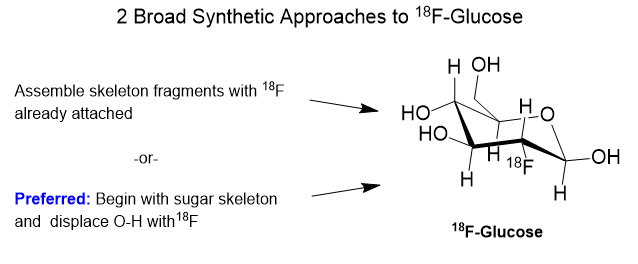
In chemical synthesis there is usually more than one possible strategy for getting to a target molecule. In the case of 18F-glucose, whatever pathway we choose must be rapid and efficient owing to the very short half-life of the 18F. The preparation must be done in as few half-lives as possible.
When it comes to a great many sugar derivatives, synthesizing them from scratch is just crazy. They are structurally and stereochemically complex. They have numerous hydroxyl groups in chemically different locations on the molecule and selective modification of one and not another can be quite involved. The world is awash in sugars (e.g., sucrose, starch and cellulose) from natural sources and many varieties are commercially available for developmental use. Better to adapt available sugars for modification than starting from earth, air, fire and water.
Source: Gaussling.
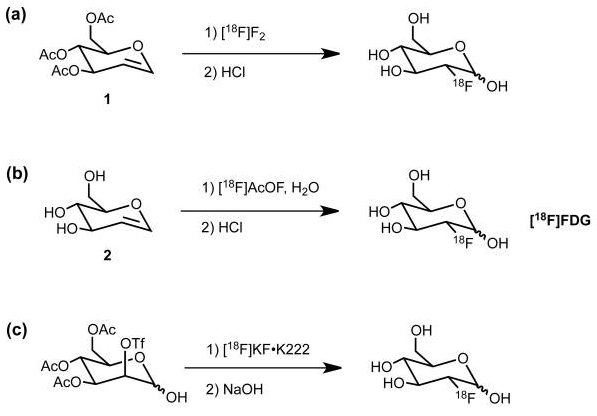
Getting 18F attached to a sugar can go along on one of two basic strategies- electrophilic addition of fluorine or nucleophilic addition. The first is called “electrophilic” addition where electrophile means “electron loving”. In electrophilic addition, the 18F reagent must be electron deficient requiring that the intended carbon skeleton is relatively electron rich. Electron rich means that there are oxygen or nitrogen atoms present with their lone-pair electrons, or pi-bonds present with their off-axis pi-electrons. Equations (a) and (b) below show two examples of electrophilic addition of 18F to a sugar analog.
The fluorinating reagents are (a) 18F enriched F2 and (b) acetyl hypofluorite, [18F]AcOF. Both fluorinating reagents feature fluorine atoms that are electron deficient and therefore electrophilic. Atomic and molecular fluorine are by nature quite electrophilic, but negatively charged fluoride is nucleophilic.
Source: Cole EL, Stewart MN, Littich R, Hoareau R, Scott PJ. Radiosyntheses using fluorine-18: the art and science of late stage fluorination. Curr Top Med Chem. 2014;14(7):875-900. doi: 10.2174/1568026614666140202205035. PMID: 24484425; PMCID: PMC4140448.
Nucleophilic addition of 18Fluoride is shown in reaction (c) wherein the OTf group is installed specifically to be displaced from the back side by 18F anion. A “nucleophile” is an attacking species that is able to bond directly with a carbon nucleus by virtue of having a lone pair of electrons available for bond making. A nucleophile is frequently negatively charged but can also be neutral in some cases.
The general strategy for the nucleophilic substitution synthesis of 18F-glucose is this: Protect all of the hydroxyl groups of D-Mannopyranose as an acetate except for one which serves as a “leaving group“. This leaving group is called a trifluoromethanesulfonate, or just “triflate“. This triflate is then displaced by 18Fluoride anion by an SN2 substitution. In plain English, 18Fluoride anion forms a C-F bond as the triflate anion is breaking its C-O bond in a process called nucleophilic substitution.
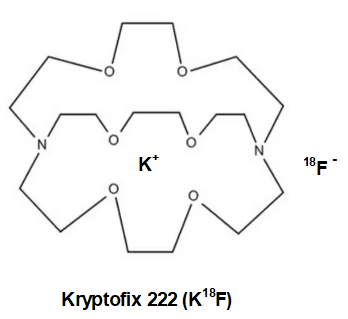
Oh, one more thing. The 18fluoride anion(-) must be made more reactive by keeping the inhibiting potassium cation (K+) in a “cage” so it can lose some of its electrostatic attraction to the negatively charged 18fluoride. Strong electrostatic attraction of K+ to 18F– will impede fluoride’s aptitude for triflate displacement. See below for Kryptofix 222. K+ wrapped in neutral Kryptofix 222 is called a “weakly coordinating ion”.
Ok, so there are some funny things you ought to know about this substitution business on a 6-member ring. Hydrogen atoms are not drawn because it is a pain. First, carbon always wants to have 4 bonds to it and oxygen just two bonds. Second, a 6-carbon ring with all single bonds can be twisted into several shapes or conformations. One of them is favored by virtue of having the least “strain” in it. That would be the “chair” conformation. It looks vaguely like a lawn chair.
Source: Gaussling. Shapes that cyclic, 6-carbon rings can take. In reality, the rings flip back and forth across the different conformations, but they tend to spend the most time in the lowest ring strain shape which is the chair.
Selective chemical synthesis happens only because some reaction pathways are fast while others are slow. Some possible reaction pathways are so slow that effectively they do not happen.
Making 18F
The 18F isotope does not exist in nature due to its 1.83 hour half-life. It decays by positron and neutrino emission to stable 18O. 18F must be prepared by slamming a suitable precursor nucleus with a nuclear particle like a proton or a deuteron with a cyclotron or linear accelerator. Yes, commercial cyclotrons are available for purchase.
Some Sugar Facts
What helps when thinking about sugars is to detach them from the matter of sweetness. Sugars are far too diverse and important to get hung up on sweetness.
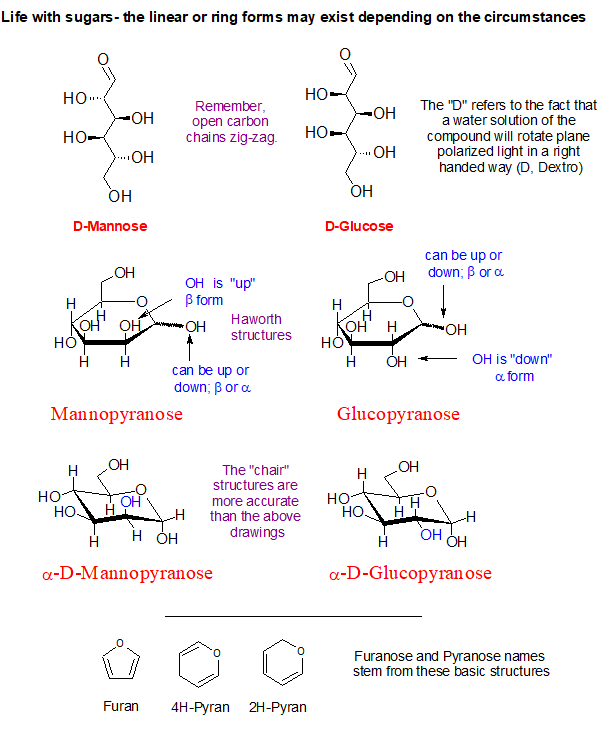
Look at the blue O-H groups on the α-D-Mannopyranose and compare it to the α-D-Glucopyranose shown above. See how they are hanging on the ring? One is directed up and the other is pointing outward and down a bit. This simple inversion in orientation produces the chemical difference between the two sugars making them distinctly different chemical substances.
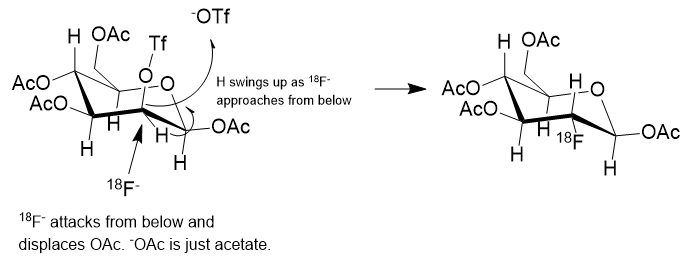
Source: Gaussling. How the 18-Fluorine gets attached to a sugar. D-Mannose is first derivatized by capping off 4 of the hydroxyl groups as acetates, OAc, and one as a triflate, OTf. 18-Fluoride backside attack will displace the triflate, –OTf. Of the –OTf and the –OAc, the –OTf is displaced much faster. The faster pathway dominates. The Ac groups are removed from their oxygens by base hydrolysis leaving OH groups on the ring behind. This results in the 18Fluorinated glucose.
In the reaction scheme above the 18F– is shown displacing the –OTf group from below, establishing a C-18F bond and causing the C-H to flip to the upper side like an inverting umbrella. The scheme is only partially correct. What isn’t shown is the positive counterion to the 18F– anion. The fluoride must be charge balanced by a positive ion which could be just a theoretical bare-naked ion or solvated potassium ion, K+.
In solution, ions or dipolar molecules interact with solvent molecules by Van der Waals forces or stronger dipolar influence. Going down the Group 1 elements on the periodic table from Lithium to Francium, all form 1+ cations, but also the radius of the ion increases. If you think of the ionic radius as being the distance from the nucleus to the distance that a solvent molecule can bump into, the Van der Waals radius, then as we drop down Group 1, a square picometer of “surface” of the ion carries less and less of the cationic charge at any given moment. This means that attractive or repulsive forces with that square picometer diminish as we go down the group, thus lowering the attractive forces. Very often potassium cation is acceptable, but it can be helped along.
While much of the time K+ is sufficiently non-interfering, but as happens occasionally the fluoride anion tends to bind to the potassium cation a bit too tightly. This can substantially slow the rate of transfer of 18F anion to the carbon of the sugar ring. To get around this, either the potassium must be replaced with another more charge diffuse cation like tetrabutylammonium+ or cesium+, the K+ can be “wrapped” in a protective organic “jacket or shield” that will prevent the K+ and the 18F– ions from getting too close to one another and bound too tightly. We would call the protected K+ a non-interfering or charge diffuse cation.
The cyclic amino polyether “ligand” that is used in this case in Kryptofix [2.2.2]. The single positive charge of the K+ is somewhat spread over the surface of the much larger Kryptofix [2.2.2]-potassium complex and diffuses the positive charge. This has the effect of “separating or loosening” an otherwise tight ion pair (K+F–) in solution. Once detached from potassium, the 18F– ion is able to react much faster to form the 18F-Glucose.
18F-Glucose must be synthesized in a radiopharmacy, also called a nuclear pharmacy, nearby the point of administration to the patient given its very short half-life. The 18F is produced in a commercially available cyclotron or linear accelerator either by proton bombardment of stable but scarce 18O enriched water or by deuteron bombardment of the stable isotope 20Neon.
18F-glucose is a sugar and undergoes metabolic trapping by phosphorylation with hexokinase inside the cell, giving it a phosphate group with a negative charge, inhibiting its transport to outside the cell. This allows the phosphorylated 18F-glucose to accumulate inside the cell, concentrating 18F to release more positron decays from the cell.
Prologue: What follows is a look at the use of 68Gallium as part of a positron emitting radioligand from an organometallic chemist’s point of view. I’m not from nuclear medicine nor am I a radiation oncologist.
It had to happen … the other shoe has dropped. My stage-4 prostate cancer has come charging back for round 2 after 9 years. Again, I’ve taken a personal interest in radiation oncology. Recently, my PSA shot up steeply through the 4.0 ng/dL threshold triggering an appointment with my radiation oncologist who has ordered a PET/CT scan. Back in 2015 I finished 18 months of hormone ablation (chemical castration) and got the PSA from 29 down to 0.01 with Lupron injections and earlier, a large cumulative dose of x-radiation in the lower abdomen. I have to say that while I experienced no discomfort at all in this round of treatment, I did lose body hair and muscle mass.
PET/CT scanning is an important tool in locating prostate cancer cells. Riding the platform in and out of the scanner is expensive but important. Unfortunately for me, the CT contrast agent is a potent emetic so the scanner becomes an expensive vomitorium ride.
The story of PET, Positron Emission Tomography, has evolved over decades of advancement. To begin, tomography, detectors and computers had to be invented. Separately, positron emission as a medically viable radiation source had to be identified and validated. A substrate for selective delivery of the isotope must be found. In the case of 18Fluorine, it is available as an organofluorine molecule like 18F-Glucose. It turns out that the 18F-Glucose concentrates in clinically useful places and K18F does not.
Positron Emitters
Atomic nuclei that are deficient in neutrons can have an instability leading to emission of a positron (anti-electron with a + charge), also called a β+ decay, which lessens the neutron deficiency by ejecting a positive charge from the nucleus. When a positron is ejected from the nucleus it finds itself immediately swarmed by the electron clouds of surrounding atoms and molecules and doesn’t travel very far. When a positron encounters a negatron (regular electron, β−), they annihilate one another and emit two gamma photons of 511 keV energy at 180 degrees apart. This is a mass to energy conversion. Loss of one positive charge from the nucleus gives rise to a transmutation of the atom causing a one-unit drop in atomic number, that is it goes from n+ to (n – 1)+, but retains most of its atomic weight. In this case, 6831Gallium undergoes positron decay to 6830Zinc.
Positron emitters include 11Carbon (T1⁄2 = 20.4 min), 13nitrogen (T1⁄2 = 10 min), 15oxygen (T1⁄2 = 2 min), 18fluorine (T1⁄2 = 110 min), 64copper, 68gallium, 78bromine, 82rubidium, 86yttrium, 89zirconium, 22sodium, 26aluminium, 40potassium, 83strontium, and 124iodine. This a list given by Wikipedia, but there are many more in more comprehensive tables.
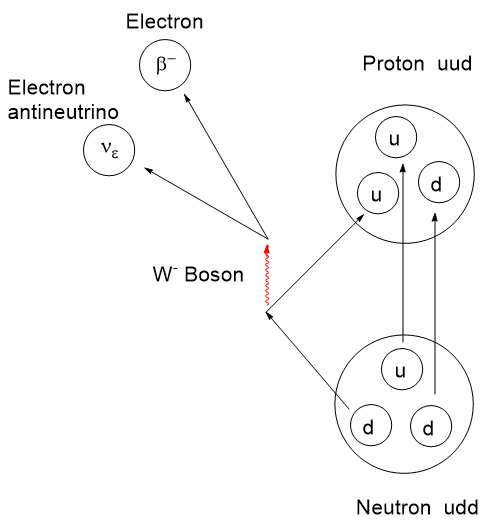
The actual mechanism of β-type emission requires a venture into fundamental particles called quarks. Protons and neutrons are composite particles called hadrons, not fundamental particles. Protons and neutrons are each comprised of 3 quarks, but with a different combination of “up and down flavors” where flavor refers to the species of quark. There are 6 flavors of quarks: up, down, charm, strange, top, and bottom. Interconversion between protons and neutrons can occur if one of the 3 top or bottom quarks changes flavor. By all means, if this interests you, take a dive into it. I shall stop here.
Beta emission diagram at quark level.
Positron emitters tend to have a short radioactive half-life as well as a limited chemical half-life in the body before they are cleared out through the kidneys or other routes. Ideally, the goal is to deliver a high radiation dose selectively to a target tissue as fast as is safe then disappear. Prolonged irradiation to surrounding tissue is undesirable. The optimal radiopharmaceutical will be highly target selective and have a short half-life. A selective radiopharmaceutical is one that will accumulate in a desired cell type or organ. Accumulation can be aided through simple solubility, the ability to undergo transport through a cell wall, affinity to a specific receptor and the ability to function fast enough to resist the various clearance mechanisms.
A short half-life means that the radioactivity per gram of radioisotope, specific activity in Becquerels per gram, will be at its maximum after activation. Though the radioactivity may be intense, the radiation dose can be controlled by the amount of mass administered. With radioisotopes, there are two kinds of purity to consider: Chemical purity referring to the atoms and molecules present; Radiological purity referring to the presence or absence of other radioactive isotopes. To provide maximum safety and effectiveness, the specific radioisotope with the desired decay mode should be the only source present. If your desired source is an alpha emitter, you don’t need spurious quantities of a gamma emitter present because of inadequate purification.
Economical methods of preparing positron emitters had to be addressed. To fully exploit PET for any given situation, tissue selectivity of radioligands had to be determined and selective positron radiopharmaceuticals developed. Due to the short half-life of these radioisotopes, rapid and safe methodologies to produce them by efficient nuclear transformations, isotope isolation followed by chemical synthesis had to be developed. It is important that isotope generation, isolation and attachment to a ligand be done nearby the hospital for the proper activity to reach the patient.
Positron emitter production involves a nuclear reactor for neutron activation or a cyclotron accelerating protons or deuterons in the preparation. Because both of these sources are highly destructive to organic molecules, an inorganic radioisotope is produced separately and chemically modified to produce an inorganic species that can be chelated or otherwise attached to a radiopharmaceutical. This technique evolved from simple radiography in the 1930’s to a large array of techniques and applications today. The reader is invited to take a dive into this topic.
Since my cancer experience began, a few new radiotherapies and imaging agents have landed in oncology space for prostate cancer. Recently I posted on Pluvicto PSMA (Prostate Specific Membrane Antigen) which was before I knew about my current prostate situation. PSMA is a transmembrane protein present in prostatic cells. Pluvicto uses a chelated177Lutetium beta emitter as the destructive warhead and a peptidomimetic fragment for binding to the PSMA receptor.
A Brief Interlude into Quality Factor
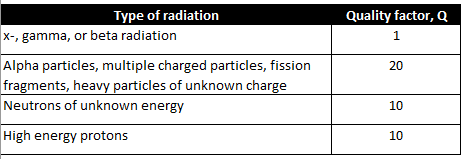
It should be noted that the various forms of particle (alpha, beta, or neutron) or electromagnetic radiation (x-ray or gamma) have differing abilities to penetrate and cause ionization of within matter. There is a factor for this which is used to refine dosage calculations. It is called the Quality factor, Q.
The destructive effects of radiation stem from its ability to ionize matter along its path. Ionization is a disruptive effect that may result in fragmentation of molecules or crystal lattices into reactive positive or negative ions. Single electron radical species may be formed as well. It is possible for some fraction of the disrupted molecules to recombine if the fragments haven’t already diffused away or gone on to further transformations.
The deleterious effects of radiation on living tissue stems from the amount of disruptive energy transferred to tissues along the path of each particle. Charged particles like electrons, protons and alpha particles tend to dump their energy into matter rapidly and along a short path making them less penetrating than neutrons or electromagnetic rays in general.
Quality factor, Q, is a dimensionless coefficient that is multiplied by an absorbed dose to give a more realistic estimation of radiation energy absorption. Interestingly, the Q for neutrons varies with energy and rises to a maximum around 0.5 to 1 MeV of energy and falls off at higher energies.
The larger the Q factor, the larger the corrected radiation effect. X-, gamma, and beta radiation have a Q factor lower than the others by a factor of 10 to 20. The x- and gamma rays will tend to pass through matter leaving a small amount of their energy to disruption. In radiation therapy this is compensated for by just increasing the fluence or the exposure time.
For clarity, x-rays are generated from the electron cloud around an atom via electron transitions. For instance, if an electron is dislodged from an inner, low energy orbital, another electron can occupy that vacancy by the emission of an x-ray. Gamma rays originate from nuclear energy transitions. Often a nuclear decay might result in a new nucleus that is not at its ground state and would be categorized as metastable. This metastable state, which has its own half-life, can collapse to its ground state by the emission of a gamma ray matching the loss of energy by the nucleus.
Neutrons
Free neutrons are special. They undergo beta decay with a short half-life outside the nucleus having t1/2 = ~ 10-15 minutes, depending on the information source. Not having a charge, they tend to be more penetrating than other particles. However, effective shielding can be had with a hydrocarbon like paraffin or water by virtue of the high concentration of hydrogen nuclei present in these substances. Neutrons are not affected by charge repulsion from an atomic nucleus and therefore can collide and interact with the hydrogen nucleus (a proton). They can scatter from hydrogen nuclei, leaving behind some of their kinetic energy with each collision (see “Neutron Lethargy“). This scattering is the basis for using water to moderate the neutrons in a nuclear reactor. Neutrons are cooled by repeated collisions with hydrogens in water to the point where their kinetic energy of 0.025 eV, which from the Maxwell-Boltzmann distribution corresponds to a temperature of 17 oC, thus the term “thermal neutrons“.
Many elements absorb neutrons, increasing the atomic weight and very often altering the stability of the nucleus leading to a radioactive decay cascade. This is what is happening in neutron activation. In the case of water, the ability of free neutrons to collide with hydrogen nuclei allows them to dislodge hydrogen ions or free radicals from organic and biomolecules resulting in ionization and makes them quite hazardous to living things.
Radioligands
Drugs like Pluvicto are referred to as a radioligand. There is a radioisotope connected to an organic “ligand” for selective binding to a specific protein receptor. A radioligand is injected and diffuses its way a particular receptor where it binds. As it turns out, due to the gamma radiation also emitted by 177Lu, Pluvicto is a radioligand that can also be located in the body by the gamma radiation it emits. In general, a radioligand can be used for two endpoints: To find and signal the location of a particular cell type; and to find and vigorously irradiate a particular cell type.
There are recent radioligand compounds that are used as PET (Positron Emission Tomography) diagnostic agents which selectively bind to the PSMA receptor where they can undergo positron emission revealing the site of prostate cancer cells by tomography. 18F-glucose was first synthesized in 1967 in Czechoslovakia at Charles University by Dr. Josef Pacák and was first tested as a radiotracer by Abass Alavi in 1976 at the University of Pennsylvania on volunteers. Positron tomography came along later. Cancer cells consume glucose faster than normal cells so the 18F will tend to accumulate to a slightly greater extent and reveal their position by positron annihilation. The two 511 keV x-rays simultaneously detected at 180o apart are identified by a ring coincidence detector. A single detection event is discarded.
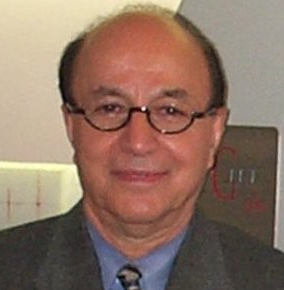
Dr. Abass Alavi, University of Pennsylvania. First use of 18F-Glucose on humans.
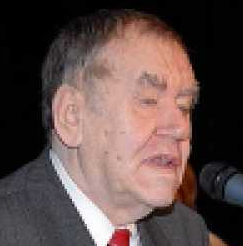
Dr. Josef Pacák (1927-2010), of Charles University in Czechoslovakia. First to prepare 18F-Glucose.
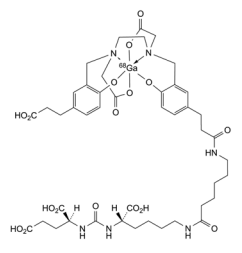
A radioligand that received FDA approval the same day as Pluvicto was Locametz or Gallium (68Ga) gozetotide. This gallium radioligand targets PSMA as does Pluvicto but is only a PET diagnostic agent.
Locametz or Gallium (68Ga) gozetotide. Source: Pharmeuropa.
Locametz has 4 carboxylic acid groups, a urea group and two amide groups aiding water solubility and numerous sites for hydrogen bonding of this radioligand to the receptor. The organic portion of the Locametz is called gozetotide, named “acyclic radiometal chelator N,N’-bis [2-hydroxy-5-(carboxyethyl)-benzyl] ethylenediamine-N,N’-diacetic acid (HBED-CC).” The 68Ga (3+) cation is shown within an octahedral complex with a single hexadentate ligand wrapping around it. The short 68 minute half-life of 68Ga requires that a nuclear pharmacy be nearby to prepare it. The short half-life of 68Ga or other positron emitters as well as the possibility of destructive radiolysis to the ligand prevents preparing a large batch and stocking it. Locametz must be synthesized and transported prior to use. This rules out remote or rural hospitals.
Nuclear Chemistry
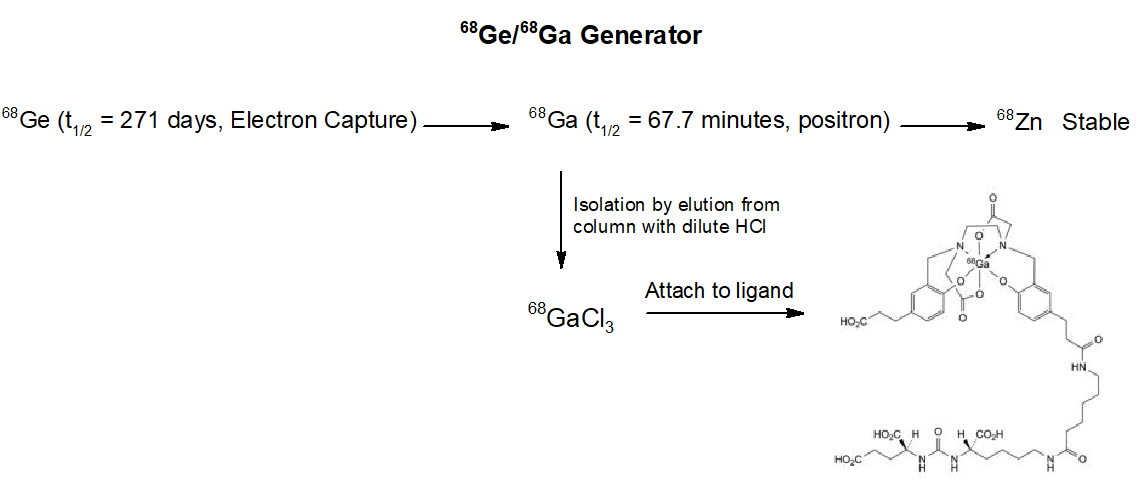
So, where does one obtain 68Gallium? Well, there are several methods out there. 68Ge/68Ga generators are produced commercially. One company is GeGantTM who offers 1-4 GBq of 68Ga. (Note: 1 GBq is 1,000,000,000 disintegrations per second).
Diagram courtesy of Gaussling.
From the scheme above we see the workings of a 68Ga generator. The ligand attachment is performed exterior to the generator. Atomic nuclei that are neutron deficient like 68Germanium can transform a proton to a neutron. There are two ways this can happen. In Electron Capture (EC) an inner “s” electron can be absorbed by a proton converting it to a neutron and emitting a neutrino by the weak nuclear force. This lowers the atomic number by 1, in this case 6832Germanium becomes 6831Gallium. The other mechanism is for the nucleus to emit a positron (anti-electron) and eject 1 positive charge as a positron (and an antineutrino) from the nucleus, resulting in a new neutron. The atomic weight remains constant, but the atomic number drops by one. If available energy in the nucleus is less than about 1 MeV, an electron capture is more favorable than positron emission.
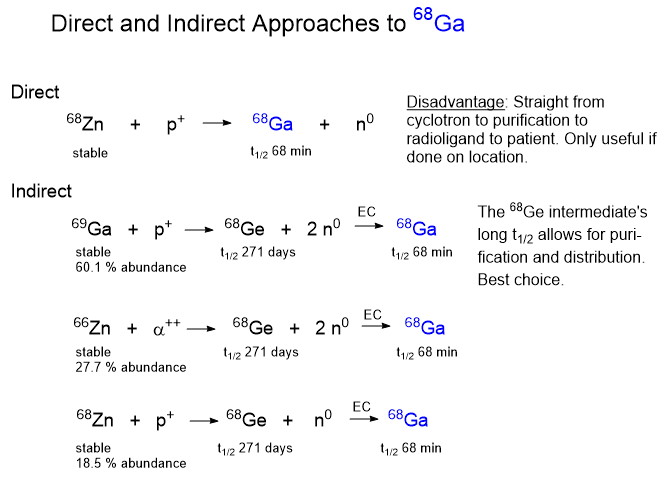
Once you know about the 68Ge electron capture reaction leading to the 68Ga isotope you have to ask, where does the 68Germanium come from? There are a few different ways to make and concentrate 68Ge and the method you use depends on the equipment available to you. One way is to accelerate protons to a high energy in a cyclotron and slam them into atoms heavier than germanium, such as rubidium or molybdenum. The collision with break the target nuclei into pieces by a process called “spallation“.
Diagram courtesy of Gaussling.
Cyclotrons
The first cyclotron was independently invented by Ernest Lawrence 1929-1930 at UC Berkeley. It was the first cyclic particle accelerator built. The idea of the cyclic accelerator was first conceived by German physicist Max Steenbeck in 1927. In 1928-1929 Hungarian physicist Leo Szilard filed patent applications for a linear accelerator, cyclotron, and the betatron for accelerating electrons. Unfortunately for both Steenbeck and Szilard, their ideas were never published or patented so word of the ideas were never made public.
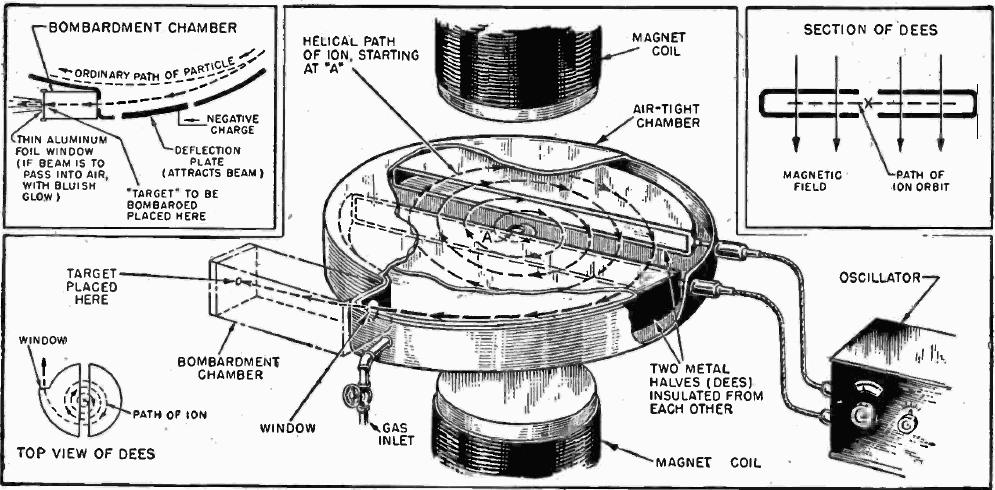
Where does one go to get a cyclotron? One company is Best Cyclotron Systems. If you are not sure of how a cyclotron works, check out the image below from Wikipedia. Note: A cyclotron can only accelerate charged particles like protons, electrons, deuterons and alpha particles which are introduced into the middle of the machine. A key component is the “D” or Dee, so-called because of their D-shape. The cyclotron has two hollow, coplanar Dees which are each connected to a high voltage radiofrequency generator. The Dees are open chamber-shaped electrodes that alternately cycle through positive and negative high voltage attracting and repelling charged particles under the influence of a powerful magnet. Because charged particles change their trajectory under the influence of a magnetic field, the particles follow a curved path of increasing diameter, accelerating until they exit the Dees and careen into the target.
[Note: This is an updated post from the original posted one year ago.]
March 22, 2022. Swiss drugmaker Novartis has released Pluvicto, “the first FDA-approved targeted radioligand therapy (RLT) for eligible patients with mCRPC that combines a targeting compound (ligand) with a therapeutic radioisotope (a radioactive particle). Pluvicto is expected to be available to physicians and patients within weeks.“
Pluvicto features a chelated 177Lutetium ion (half-life 6.7 days) which is the source of the molecule’s radioactivity. Lutetium is the heaviest of the lanthanide elements and the name comes from the Latin Lutetia Parisiorum which was the predecessor to the city of Paris, France.
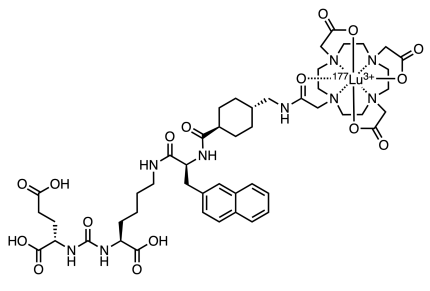
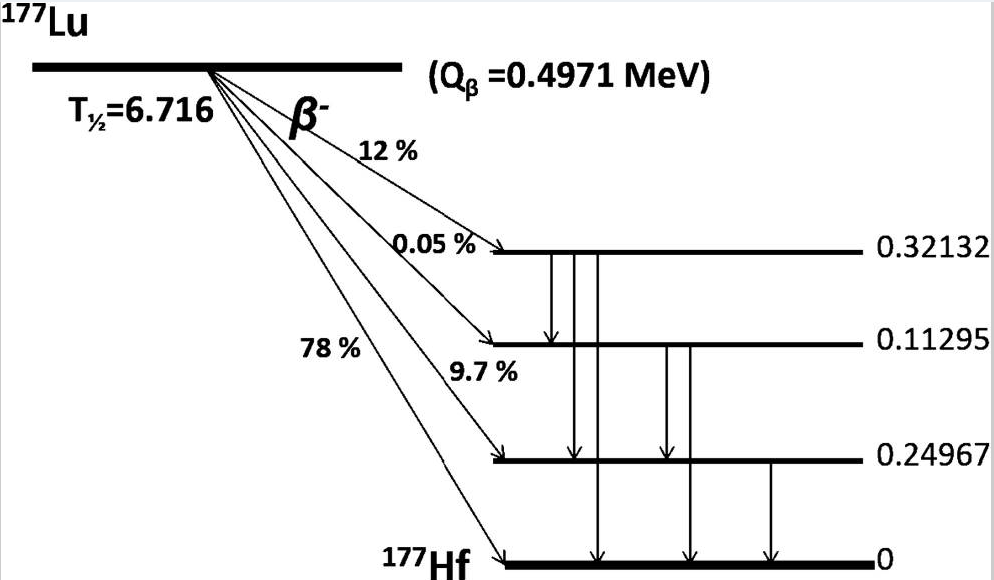
Pluvicto has been approved in the US for the treatment of metastatic prostate cancer. Several things are notable about the Pluvicto molecule. The molecule contains a PSMA-specific peptidomimetic feature with an attached therapeutic radionuclide, where PSMA stands for Prostate Specific Membrane Antigen. Peptidomimetic refers to a small chain that resembles a stretch of protein forming amino acids. This peptidomimetic fragment, which interestingly contains a urea linker, is designed as the tumor targeting piece of the drug. Connected to it is a chelated radioactive 177Lutetium cation (below, upper right). The tumor targeting fragment binds to the cancer cell. While bound to the cell, the short-lived radioisotope undergoes two modes of decay. The 177Lu has two decay modes. One emits a medium energy beta particle (Eβmax = 0.497 MeV) which is limited to a maximum of 0.670 millimeters of travel. This is the kill shot that will damage the attached and nearby target cells. The short path length of the beta ray in vivo limits the extent of surrounding damage by any given decay. Once the 177Lu emits a beta particle it becomes 177Hafnium.
Source: Ashutosh, et al. 177Lu decays to ground state 177hafnium 78 % of the time. In the three other beta decays to three hafnium excited states, each collapses to ground state by 6 possible gamma emissions.
The other mode of 177Lu decay is gamma emission by 177mLu, a nuclear isomer or metastable form of 177Lu. Gamma radiation is much more penetrating than beta radiation. The gammas can be detected from the outside of the patient allowing monitoring of dose and location of the drug. Even though gamma rays are more penetrating than beta rays, they produce many fewer ion pairs per centimeter as they traverse the tissue making them less effective per photon in tissue destruction compared to alpha and beta particles. For instance, alpha particles from therapeutic radionuclides like 223Radium used to treat prostate cancer are much more destructive because they produce many ion pairs per centimeter.
A Small Side-Track into Radon Decay
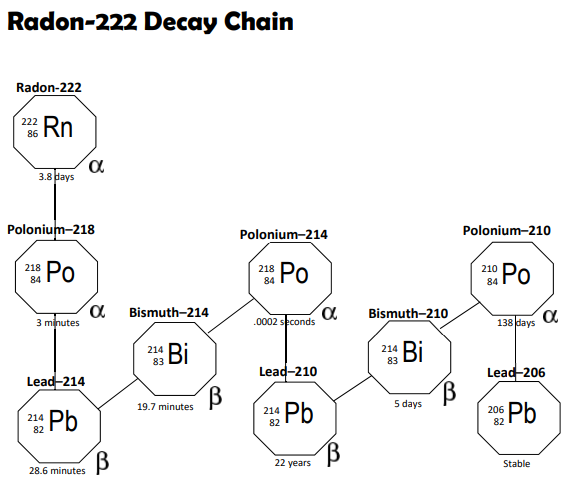
Not all radioactive isotopes are alike. Some, like 177Lu, offer only a single decay event while others are part of a domino series of decays. The decay of naturally occurring 222Radon begins a series of decay events (Radon’s daughters), with some decays being quite rapid, multiplying the radiological effect per initiating atom. Inhaling an alpha emitter like 222Radon is a gamble. Until the 222Rn decays, it is just an inert noble gas. But when it alpha decays in your lungs, it is converted to the 218Polonium which alpha decays to 214Lead which beta decays to 214Bismuth which beta decays to 214 Polonium which alpha decays to 210Lead which beta decays to 210Bismuth which beta decays to 210Polonium which alpha decays to stable 206Lead where the chain stops. Each of the daughter products is a reactive, nonvolatile metal.
Each 222Radon atom gives rise to 8 successive radiation emissions, 4 of which are alpha emissions. These new radioactive elements are called “Radon’s daughters”. This makes radon especially insidious. Note the half-lives in the graphic. Source: EPA.
Neutron Activation of 176Lutetium
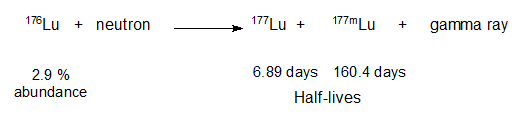
How does one obtain 177Lu? There are two pathways of nuclear chemistry that can be used, each with plus and minus attributes. The easiest pathway to execute would be the absorption of a thermal neutron by the lighter lutetium isotope 176Lu followed by a gamma emission from the new 177Lu. Gamma emissions result from metastable coproduct 177mLu that is in an excited state. It can de-excite by losing the excited state energy by the release of a gamma photon.
Where does one get thermal neutrons and what is “thermal” about them? Thermal neutrons are produced in a water-cooled nuclear reactor. It turns out that nature has bestowed a wonderful gift on 176Lu. It has a very large neutron capture cross section of 2090 barns for producing 177Lu. The metastable 177mLu isomer has a cross section of only 2.8 barns.
The unit “barn” is the unit of the effective target area of a nucleus and is equivalent to 10-28 m2, or 100 square femtometers. The capture cross section of a nucleus is dependent on the energy (or temperature) of a neutron and is proportional to the probability of a collision. Here is a brief reference on nuclear cross sections. The colorful etymology of the term “barn” is recalled here.
For comparison, the capture cross section of 239Plutonium is on the order of 750 barns with 0.025 electron volt neutrons. We can see that the capture cross section of the 176Lu is much larger than that of 239Pu. The word “thermal” comes from the kinetic energy corresponding to the most probable speed of a free neutron at a temperature of 290 K (17 °C or 62 °F).
The transmutation [176Lu + 0n —> 177Lu + 177mLu] is clean and direct with no other chemical elements to interfere. With its large capture cross section,176Lu is well suited to absorb a neutron. The down side is that the isotopic abundance of 176Lu is only 2.8 %. The other 97.2 % of Lu can also undergo neutron activation leading to chemical and radiological contamination of the desired 177Lu. Isotopic separation of 176Lu from the other Lu isotopes is difficult and not very scalable. By the way, the lutetium is neutron activated as the refractory oxide, Lu2O3. These lanthanide oxides are simple to prepare and can be dissolved in acid afterwards to produce Lu3+ cation for further chemistry.
Neutron Activation of 176Ytterbium
The other major channel to 177Lutetium is from neutron activation of 176Ytterbium, 176Yb. Generally speaking, the heavy lanthanides like Yb and Lu are less abundant than the light lanthanides on the left side of the series. All of the lanthanides have a 3+ oxidation state and similar ionic radii making them difficult to chemically separate, where “difficult” means that numerous steps are needed in purification often resulting in low yields. A few of the lanthanides have oxidation states other than +3. It turns out that Yb3+ can be selectively reduced by chemistry to Yb2+ in the presence of Lu3+ using sodium amalgam as the reductant. This happy fact allows for plausible chemical separation of Lu from Yb. Furthermore, Yb will amalgamate while Lu does not.
A Google search of Pluvicto or 177Lutetium will produce many good links of a technical and non-technical nature.
Pluvicto, PSMA-targeted radiotherapy (lutetium 177Lu vipivotide tetraxetan) for PSMA-positive prostate cancer 7.4 GBq (200 mCi) IV Q6W up to 6 doses
Some vocabulary from bad old days of the Cold War has come back to haunt us. Russia has announced that it has deployed its RS-28 Sarmat intercontinental ballistic missile (ICBM) in Belarus. The 112 ft long, 211 ton missile is said to carry 15 Multiple Independent Reentry Vehicles (MIRVs). As new and scary as this sounds, the US first conceived of the MIRV in the early 1960’s and deployed its first MIRV’d ICBM (Minuteman III) in 1970 and the first MIRV’d SLBM (Poseiden Sea Launched Ballistic Missile) in 1971. The USSR followed suit in 1975 and 1978, respectively.
In the early 1960’s it was believed in the US that it was behind the USSR in what was called the “Missile Gap”. It turns out this was incorrect and that, in fact, the US had a large advantage in the number of ICBM strategic delivery vehicles. For a long while we in NATO thought the Soviets were 10 feet tall and that turned out to be an exaggeration. From their performance in conventional battle, they have diminished in stature just a bit. However, their nuclear triad is to be respected.
The initial purpose of the MIRV concept was to compensate for inaccurate delivery. It has evolved to include decoys and multiple target delivery. There is a good deal of non-classified information on MIRV systems on the interwebs.
Putin’s threat of a new MIRV’d missile is just more nuclear bluster to frighten NATO citizens. For the present time his nuclear weapons are more valuable in storage as they have been all along with the Mutual Assured Destruction policy. That said, they have a policy of using nukes if the security of the state itself is under threat. I would guess that Putin sees himself as the state.
I wonder if it has dawned on the Russians that nobody in their right mind would actually make a preemptive attack on Russia or its former Soviet satellites. Who actually wants the place? What benefit is there in trying to subdue 140 million angry Russians and their huge frozen taiga? That’s nuts.
It has been announced that Dow and X-Energy will be building a nuclear power plant to feed Dow’s 4700 acre Seadrift, TX, manufacturing facility. The plant will be comprised of a 4 pack of Xe-100 80 Megawatt (electric) High Temperature Gas Cooled Reactor (HTGR) pebble bed reactors. The reactors are spec’d to each produce 200 MW thermal and 80 MW electric. The design is referred to as a small modular reactor facility and is part of the U.S. Department of Energy’s (DOE’s) Advanced Reactor Demonstration Program (ARDP).
According to Wikipedia, the history of pebble bed reactor operation is checkered by design and operational problems, many of which relate to the tennis ball sized graphite pebbles themselves. During operation of the pebble bed, radioactive graphite dust is generated leading to eventual contamination problems. Pebbles getting stuck within the equipment are difficult to dislodge and can lead to fracturing in doing so. The reactor needs fire protection because the hot pebbles are combustible when exposed to air.
The HTGR pebble bed design has many features that are very positive. The spaces between the pebbles duct the cooling gas, avoiding the need for coolant piping in the reactor. The absence of water prevents the formation of hydrogen by neutron collisions with the water. Hydrogen generated in a reactor will migrate into metal components and cause embrittlement leading to possible component failure. Overall, the design of a HTGR pebble bed reactor is considered to be much less complex than a water moderated reactor due to the lack of an elaborate water cooling system.
Despite the happy talk about their technology the maker of the system, X-Energy, will have to show how past problems with the pebble bed design have been overcome. Their website gives no clues about overcoming problems encountered in the past. The Nuclear Regulatory Commission is a tough crowd and both Dow and X-Energy will have to provide a strong case for safe operation.
According to Reuters, a 6 mm diameter by 8 mm long capsule of radioactive Cesium-137 was lost along the 1400 km road between a storage facility in suburban Perth and Rio Tinto’s Gudai-Darri iron mine in the Kimberley region of western Australia. The source was lost sometime between January 12 and the 25th, 2023. The capsule had been attached to a piece of equipment in a crate but evidently vibrated loose in transport from a road train– a multi-trailer vehicle- and fell off. While the activity was not disclosed the source was described as one that “emits radiation equal to 10 X-rays per hour”.
On February 1, 2023, the source was reportedly located after a week-long search along the 1400 km road. It was discovered by a vehicle moving at 70 kph with special detection equipment.
March 22, 2022. Swiss drugmaker Novartis has released Pluvicto, “the first FDA-approved targeted radioligand therapy (RLT) for eligible patients with mCRPC that combines a targeting compound (ligand) with a therapeutic radioisotope (a radioactive particle). Pluvicto is expected to be available to physicians and patients within weeks.“
Pluvicto features a chelated Lutetium-177 ion (half-life 6.7 days) which is the source of the molecule’s radioactivity. Lutetium is the heaviest of the lanthanide elements and the name comes from the Latin Lutetia Parisiorum which was the predecessor to the city of Paris, France.
The drug has been approved in the US for the treatment of metastatic prostate cancer. Several things are notable about the Pluvicto molecule. The molecule contains a PSMA-specific peptidomimetic feature with an attached therapeutic radionuclide, where PSMA stands for Prostate Specific Membrane Antigen. Peptidomimetic refers to a small chain that resembles a stretch of protein forming amino acids. This peptidomimetic fragment, which interestingly contains a urea linker, is designed as the tumor targeting piece of the drug. Connected to it is a radioactive Lutetium-177 cation (below, upper right). The tumor targeting fragment binds to the cancer cell. While bound to the cell, the short-lived radioisotope undergoes two modes of decay. The Lu-177 emits a medium energy beta particle (Eβmax = 0.497 MeV) which is limited to a maximum of 2 millimeters of travel. This is the kill shot that will damage the attached target cell. The short path length of the beta ray in vivo limits the extent of surrounding damage by any given decay.
The other mode of decay is gamma emission by Lu-177. Gamma rays are much more penetrating than beta particles. They can be detected from the exterior allowing monitoring of dose and location of the drug. Even though gamma rays are more penetrating than beta rays, they produce many fewer ion pairs per centimeter as they traverse the tissue making them less effective in tissue destruction compared to alpha and beta particles. For instance alpha particles from therapeutic radionuclides like Radium-223 use to treat prostate cancer are much more destructive because they produce many ion pairs per centimeter. This is why getting alpha emitters like radon inside you is not a good thing.
A Google search of Pluvicto or Lutetium-177 will produce many good links of a technical and non-technical nature.
Pluvicto, PSMA-targeted radiotherapy (lutetium 177Lu vipivotide tetraxetan) for PSMA-positive prostate cancer 7.4 GBq (200 mCi) IV Q6W up to 6 doses
Novartis PluvictoTM (lutetium Lu 177 vipivotide tetraxetan)
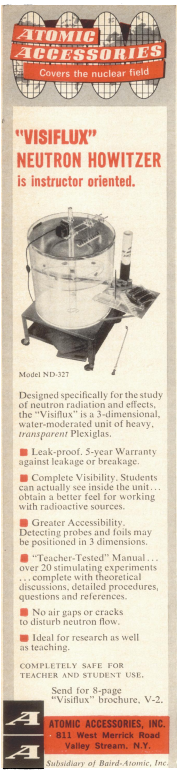
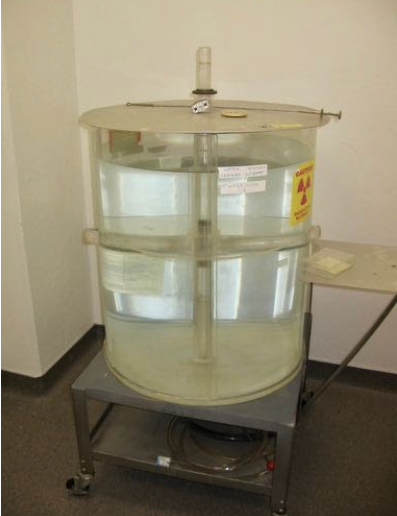
At my undergraduate institution, lo these many years ago, our physics department had a neutron howitzer. The school was a medium sized state land grant institution mostly known for producing teachers and nurses. But it also had a decent chemistry department from which I spring-boarded my chemistry career. This device was an education and research tool from the post WWII atomic age. Recall that it was a period that promised nuclear electric energy too cheap to meter.
I would hazard a guess that the word “howitzer” was used because it’s application involves bombardment of atomic nuclei. In the center of a water tank, a source comprised of one of several highly active alpha emitters like Plutonium, Americium, Radium, or Polonium is exposed to beryllium which produces a neutron. The alpha source activity was typically 1 to 3 Curies in contact with beryllium and located within a small diameter tube penetrating the water tank, producing a “beam” of neutron flux passing through the tube. Materials to be activated are exposed to this flux for a set period of time.
Our neutron howitzer was used for a freshman chemistry lab to measure the half-life of an indium radioisotope. A piece of indium foil would be neutron activated by a timed exposure to a neutron flux and then placed in a radiation counter to collect counts over time from radioactive decay in the indium sample. Indium-115 in the sample would be activated by the absorption of a neutron to form a small amount of Indium-116m1 which emits gammas with a half-life of 54.2 minutes according to this source. This short half-life was ideal for a freshman lab period.
I’m quite sure that the school got rid of the neutron howitzer long ago. Nuclear radiation of any kind scares the beejeebers out of school administrators and assorted folks mucking about on campus. The principle of CYA is always at work in our institutions. CYA refers to Cover Your Actions, wink wink, nod nod.
The nuclear chemistry of neutron production and absorption-
The neutrons generated can impact an Indium-115 nucleus and be absorbed, producing a metastable Indium-116m1 nucleus. Nuclear reactions often produce nuclei in an excited energy state. An excited nucleus can “de-excite” by the release of a gamma photon through an isomeric transition (IT), not unlike atomic fluorescence.
It is interesting to note that the large capture cross section of indium-115 for thermal neutrons has been exploited for the survey of high-energy neutron fluxes. Indium foil is encased in paraffin and placed in a cadmium container. High-energy neutrons entering this composition are cooled to produce thermal neutrons which are then captured by the indium. The thermal neutron flux is proportional to the high-energy flux and the system can be used for the instantaneous detection and counting of neutrons.
In one lab for a class I took in grad school called “Radioisotope Techniques”, we had a cloud chamber up and running. The professor brought in a neutron source on the end of an 8 foot pole. He swung it over by the cloud chamber and there was a sudden burst of trails in the ethanol vapor. Neutrons were colliding with protons in the ethanol vapor creating ion pairs, leading to condensation vapor trails zipping around in the chamber. The neutron source had 1 Curie of plutonium in it. This was in the radiation biology department. The department had a 7,000 Curie cesium-137 gamma source we got to use as well. It turns out that if you expose tomato plants to intense Cs-137 gamma radiation even briefly, it stunts their ability to uptake phosphorus-32 phosphate. Yeah, imagine that.
This is a guest post written by a good friend and colleague who retired as an executive from the specialty chemical industry. He is an author and editor of a respected book on Grignard chemistry. It is an honor for me to post his recollections on this site with his permission.
========================================
The TOXCO Story – Part I
I suppose this story begins during the Cold War. The US had developed a triad of defense capabilities to deter Soviet aggression. We had the Air Force B-52 bombers armed with atomic weapons, the submarine based Trident missiles, and the land based ICBMs–first the liquid fuel Atlas rockets and later the solid fuel Minuteman missiles hidden is silos in North Dakota and elsewhere.
Then came 1989, the destruction of the Berlin Wall, the subsequent collapse of the Soviet Union and, suddenly, the Russians were no longer the dreaded foes whom we once feared. Maybe it was time to “stand down” our hair-trigger defense posture.
Those solid fuel Minuteman rockets were designed to be launched on short notice. Firing them required a significant amount of electricity. This was to come from the electric power grid. But our military, recognizing that this source of power could be compromised in the tense times leading up to a nuclear confrontation, needed a backup. As a result, each missile silo was equipped with a diesel powered electric generator, just in case.
But things could go wrong. The diesel fuel might be contaminated, or sabotaged by Russian saboteurs, or any of a number of other problems. So, in an overabundance of precaution, the military insisted on a “backup to the backup”. And what could be better or more reliable as a source of electricity, than a battery. To be sure, these would have to be BIG batteries, bigger and more powerful than any produced thus far, but they would be certain.
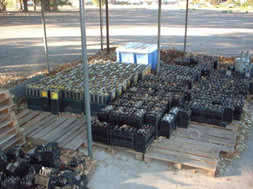
And so, the Defense Department commissioned the production of the world’s largest and most powerful batteries. These were based on lithium-thionyl chloride chemistry[1]. Each primary cell contained sheets of elemental lithium, surrounded by gallons of thionyl chloride, a reactive liquid which on contact with water produces a mixture of sulfuric acid and hydrochloric acid—really nasty stuff. These primary cells were each about the size of a coffin and it took three, ganged together to generate the power needed to initiate a missile launch. The government contracted for thousands of them and Union Carbide supplied them.
Apparently, at some point, there was a fatal incident involving a 10,000 amp Minuteman battery being drained and replaced[2] and this contributed to a decision in the early-mid 1990s to dispose of these hazardous items. The DOD issued a Request for Proposals (RFP) which caught the attention of a group of businessmen and entrepreneurs in southern California.
Operating in Orange County, California, headquartered in Anaheim, near Disneyland, were three affiliated companies. Adams Steel was in the ferrous metal recycling business-old washing machines, refrigerators, scrapped cars. Before you scrap a car, you remove the lead-acid battery and the catalytic converter. The battery, containing lead metal, lead salts and sulfuric acid is a hazardous waste and its disposal is regulated by the EPA. The catalytic converter contains precious metals such as platinum, rhodium and iridium. These two items (batteries and catalytic converters) were handled by Kinsbursky Brothers. Non-ferrous metals (common ones such as copper and aluminum and non-common ones like tantalum and gallium from electronic devices) were processed by Alpert & Alpert. The companies had worked together for a number of years.
Principals at Adams Steel and Kinsbursky decided to form a joint venture to bid on the lithium battery disposal opportunity. They created TOXCO for this purpose. It was headed by Terry Adams (the youngest sibling in the Adams family) and Steve Kinsbursky. And they won the bid. The government would pay TOXCO millions of dollars to dispose of these batteries that the government had paid millions of dollars to manufacture some years earlier. Your tax dollars at work.
So, how do you dispose of a lithium-thionyl chloride cell weighing hundreds of pound and filled with dangerous and explosive ingredients? Well, if you are a mechanical engineer, trained at USC (as Terry Adams was), you take a mechanical engineering approach the problem. You have to neutralize the thionyl chloride and the lithium by reaction with water. And reactions take place more slowly (and more safely) at lower temperatures. So, the answer is to chill the cell in liquid nitrogen down to 77°K, put it in a large container filled with water and chop it apart with big mechanical knives (like you chop an automobile into small pieces for scrap). This actually works. Provided you’re certain that the cells have been fully discharged first. But don’t take the military’s word for it. If you do, there may be an embarrassing incident, as there was in 2000, during the disposal process.[3]
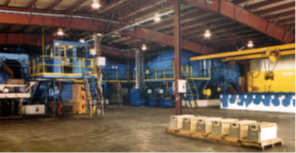
Next question. Where do you do this disposal? The TOXCO team discovered that there was an underused industrial site in Trail, British Columbia, on the Canadian side of the Idaho border. It had been part of the Cominco Smelter operations and was one of the most heavily polluted sites in North America[4]. What better place to site a hazardous battery disposal plant? If something went wrong, who would notice?
And so, TOXCO went into business, disposing of lithium batteries, successfully (except for a few incidents like the one incident alluded to above).
One of the by-products of this process was a stream of aqueous lithium salts. These had value and could be recovered and that put TOXCO into the lithium chemicals business. But that’s part II of this story.
The TOXCO Story – Part II (the Lithchem Story)
This story also begins in the Cold War. Even as the atomic bomb (the uranium and the plutonium fission bomb) was being engineered into reality at Los Alamos in the mid 1940s, plans were being made for the next generation weapon—a fusion bomb.
The first H-bomb, based on the concept of fusing light nuclei, was tested at Eniwetok in the South Pacific in 1953. Improvements in the initial “clunky” design quickly followed. One way to boost the power of the explosion was to surround the core of the bomb with a layer of lithium deuteride, LiD. Lithium is, well, the element lithium, atomic number 3 in the Periodic Chart. And deuterium is the name for “heavy hydrogen”, an atom of hydrogen, atomic number 1, but also containing an uncharged neutron[5]. Provided that the lithium used was of atomic weight 6, the fusion of the lithium(6) and the deuterium(2) would produce two nuclei of helium(4), plus lots of energy.
This would only work if you used lithium-6. Unfortunately, the lithium available to us on this planet in mineral form, deposited around the globe, is a mixture of lithium-6 and lithium-7 (the same element, but with one extra neutron). And God, in His infinite wisdom, chose to endow the earth with mostly lithium-7. Of the naturally occurring deposits of lithium, 93% is lithium-7.
So, if you need to use just Li-6, you have to separate it out from the more abundant, naturally occurring Li-7. And the US government proceeded to do just that. Starting in the 1950s, they processed millions of pounds of lithium containing minerals to extract the less abundant isotope that was required for its military purpose. For every hundred pounds of lithium salt they processed, they got, at most, 6 pounds of lithium-6 salt[6].
And what do you do with the “leftover” 94+ pounds. Well, you can’t just turn it back into the lithium chemicals marketplace. For one thing, it’s “depleted” lithium (missing its naturally occurring share of Li-6.) This would be easily noticed by someone using the lithium for routine chemical purposes. The extent of “depletion”, that is, of extraction of the Li-6 would be measureable, and that information was a secret[7]. Moreover, if the quantity of depleted Li were ever realized, that number could be used to infer the number of LiD containing bombs, and that too was a secret.
So, for more than five decades, for more than half a century, the US government simply stockpiled the “by-product” depleted lithium in a warehouse, in the form of the simple salt, lithium hydroxide monohydrate, LiOH•H2O. Millions of pounds of it. Packaged in poly lined, 55 gallon fiber drums.
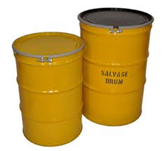
In later years, the cardboard drums began to deteriorate. Some of them were damaged during handling and relocation. Sometime in the 1980s the decision was made to repack the inventory in bright yellow steel “overpack” drums.
Now comes the early 1990s. The Cold War is over. Our nuclear secrets, at least those from the 1950s, are far less precious. And the Clinton administration is looking through Fibber McGee’s closet[8] to see what can be disposed of, and maybe generate a revenue stream for the government in the process.
What they discover is 100,000,000 pounds of “depleted” lithium hydroxide monohydrate, with a potential market value approaching $1 per pound. And so, it goes out for bids.
The terms of the sealed bid auction were that the final sale would be split 70-30 between the highest bidder (who would get 70% of the inventory) and the second highest bidder (who would get 30%, but at the high bid price).
This was a perfect set up. At that time there were only two lithium companies operating in the US who could handle this quantity of inventory—Lithium Corporation of America[9] and Foote Mineral Company[10]. And both of them knew that there was no incentive for overbidding since even the loser would get 30% of the supply.
And that’s where Lithchem appeared on the scene. The TOXCO team was already in the “recovered lithium” business. All they had to do was bid one penny more per pound than the other two majors and they would be awarded the lion’s share of the inventory. They incorporated Lithchem for that purpose. I’m told that LCA and Foote each bid the same number, somewhere in the 20+ cents per pound range, and Lithchem bid one cent more. As a result, Lithchem became the proud owner of 70,000,000 pounds of depleted lithium hydroxide monohydrate.
Now what? The principal use of LiOH is in the manufacture of high performance lithium greases, used in heavy industrial applications-heavy trucks, railroads, etc. Much of the market for lithium greases is in the third world and quality is less of a concern than price.
Still, to be sold on the open market, the LiOH from the government stockpile had to meet certain specifications. Some of the yellow drums contained beautiful white crystalline powder. Others contained dead cats and cigarette butts. It was “government quality” inventory.
One condition of the bid was that the winning bidder had to remove the inventory from its location in a government warehouse (in southeast Ohio[11]) within 12 months of the successful bid. I had the occasion to visit that warehouse, before the stock was removed and it was a memorable sight.
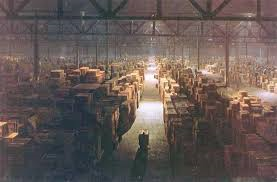
If you recall the final scene in the movie “Raiders of the Lost Ark”, the Ark of the Covenant is being stored in a gigantic government warehouse, filled floor to ceiling with identical gray boxes. A warehouse stretching far into the next county. Now replace those gray boxes with yellow overpack drums, stacked 6 or 8 high, stretching far into the next county. That’s what it was like. That’s what 70,000,000 pounds of LiOH hydrate looked like.
[1] The lithium – thionyl chloride primary cell has a high voltage (3.5 V) and a high current density.
[2]Battery Hazards and Accident Prevention, By S.C. Levy, P. Bro
[3] In November 2009 a fire broke out at the Trail BC facility in a storage shed containing lithium batteries slated for disposal. It was their sixth fire in fifteen years. Prior to that, a major fire in 1995 destroyed 40,000 kg of batteries at the facility. Three fires occurred in 2000, including one caused by some lithium batteries. This was during the summer when negotiations were underway between Toxco and Atochem for the acquisition of the Ozark business. http://www.cbc.ca/news/canada/british-columbia/trail-battery-recycling-fire-leaves-questions-1.805780
[5] Elements with the same atomic number but different weights are called isotopes. Heavy hydrogen (with an atomic weight 2) is an isotope of hydrogen (atomic number 1). Another example is carbon-14, useful for radiocarbon dating. It’s a heavier version of the more common version of carbon, C-12.
[6] Actually less than 6 pounds. The extraction process was less than perfectly efficient. The actual yield of Li-6 was a closely guarded national secret.
[7] In depleted lithium (with the Li-6 removed), the relative abundance of lithium-6 can be reduced to as little as 20 percent of its normal value, giving the measured atomic mass ranging from 6.94 Da to 7.00 Da.








 Lamentations on Chemistry