
Category Archives: Nuclear

Tsar Putin and the Bomb

Vlad Putin has been ominously reminding us that he will not rule out the use of nuclear weapons if the Russian state is under existential threat, whatever that means. Maybe now is a good time to review just a few basics of nuclear weapons and what they do.

There are a large number of internet sites that go into great detail about the dark art and history of nuclear weapons. No need to duplicate that here. I’ll just give my take on a few points.

Remember the Morse curve from freshman chemistry? It describes the potential energy versus distance of two atoms at the scale of chemical bonds. The left side of the blue curve shows how steeply the repulsive energy potential rises (exponentially) with diminishing internuclear distance. By contrast, the attractive potential on the right of the blue curve flattens out with increasing interatomic distances. Keep this in mind.
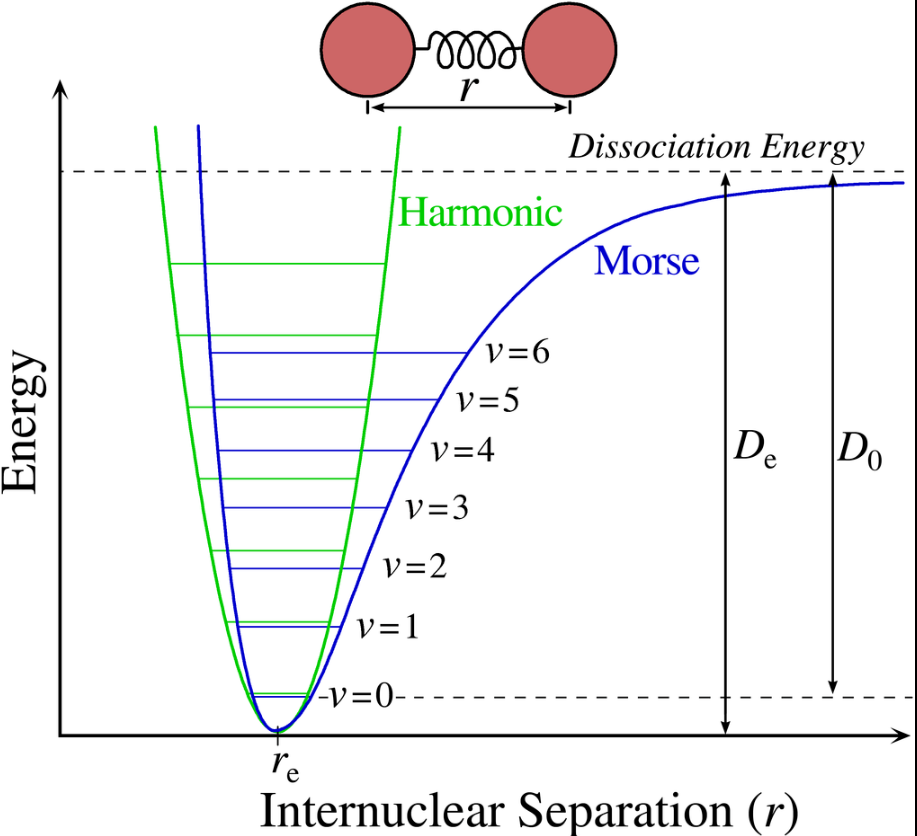
From Wikipedia

When a fissile uranium-235 nucleus absorbs a neutron, the nucleus momentarily becomes unstable uranium-236. A stable nucleus has repulsive Coulomb forces between nucleons that are balanced at close proximity by the attractive strong nuclear force. The liquid drop model is useful for visualizing a nucleus as it fissions. On absorption of a neutron the uranium nucleus will distort to an elongated dumbbell shape leading to an imbalance of attractive and repulsive forces between nucleons. This can take the nucleus past the distance where the strong nuclear force attraction can hold it together. The strong nuclear force holding together nuclear particles (nucleons) falls off much faster with distance than does the Coulombic repulsion of protons. At the instant the nucleus separates into adjacent fragments, the two highly positively charged nuclei find themselves in very close proximity and are now only subject to net repulsive force. From the left side of the Morse Curve we can see that the repulsive force is exceedingly high in this moment. The highly repulsive potential energy is converted to kinetic energy at the moment the nucleus splits. The nuclear fragments fly apart at high velocity along with neutrons and dump thermal energy into the surrounding bulk material. But the kinetic energy of the fragments is not the only source of energy output.

Nuclear fission fragments are released in a highly excited state. Apart from their kinetic energy, nuclei have different energy levels with differing stabilities. A nucleus can undergo energy transitions from one state to another. These higher energy levels are called nuclear isomers and their stability can be expressed in terms of half-life. As fission fragments are formed they shed energy in the form of alpha, beta, gamma, and neutron emissions. Neutrinos are left out of this discussion for simplicity. As nuclei decay, they get closer to a stable ground state. Unstable nuclear fission products will decay in their characteristic ways, contributing to the overall energy release.

One challenge to weapons designers is to cause as many nuclei as possible to fission before the weapon undergoes “hydrodynamic disassembly” over the first 1 microsecond or less. After ignition the rapidly expanding plasma of the bomb core increases in volume and the probability of neutron collisions with nuclei diminishes rapidly. When a uranium or plutonium nucleus fissions, 2 or 3 neutrons are emitted which go on to strike other nuclei and induce fission in them. The cascading generations result in an avalanche of fissions. One of the ways to ensure that enough generations of fissions occur with enough neutrons flying about inside the supercritical assembly is to surround the core with neutron reflecting material. Ways of doing this can be found elsewhere.

One more thing about the strong nuclear force. This quote is from the Wikipedia entry for the strong interaction

The residual strong force is thus a minor residuum of the strong force that binds quarks together into protons and neutrons. This same force is much weaker between neutrons and protons, because it is mostly neutralized within them, in the same way that electromagnetic forces between neutral atoms (van der Waals forces) are much weaker than the electromagnetic forces that hold electrons in association with the nucleus, forming the atoms.

A nuclear weapon produces a near instantaneous point source of energy release. These bombs can be detonated at or below ground or water level, or they can be set off in the atmosphere or space. The choice of where to do it depends on the intended effects. Subsurface bursts consume much of the explosive energy in moving soil or water which provides some radiation shielding to the surrounding area. Furthermore, bursts in contact with soil or water, especially when the fireball contacts the soil, tend to produce more fallout than air bursts. Air bursts deliver EMP, radiation and blast effects to a wider area, where “radiation” refers to neutrons, gamma and longer wavelengths of electromagnetic radiation. Thermal and blast effects produce considerable prompt destruction in the area surrounding the blast. As an approximate point source of energy, the intensity of the radiant energy falls off as some inverse square law. On an encouraging note, this means that radiation exposure falls off rapidly with distance. Distance is your friend.

There are numerous variations on the nuclear weapons theme. In the early cold war days, so called A-Bombs and H-Bombs were in the news. H-Bombs are also referred to as “hydrogen bombs or thermonuclear weapons.” An A-bomb, A for Atomic, was a basic implosion-type fission explosive and it was the typically the least powerful of the two. The H-Bomb was a nuclear fusion explosive that was triggered by a fission “primary.” That is, a fission trigger would be used to generate x-rays that would be “focused” onto fusion fuel, the “secondary,” which would initiate a runaway nuclear fusion explosion. The explosive yield of these bombs is much higher and can deliver a devastating blast to a larger area. Over time, the efficiency and compactness of these bombs has been greatly optimized.

The fusion explosive element was lithium-6 deuteride. The lithium atom would absorb a neutron, become unstable and decay into a helium-4 nucleus and a tritium (helium-3) nucleus. On a side note, in grad school I attended a seminar by Dieter Seebach from ETH, Zurich, who was talking about mechanistic work they’d done with lithium enolate complexes. He mentioned in passing that at that time, the mid-80’s, they had to be careful with stoichiometry because the commercial lithium that was available was often depleted of lithium-6 which was accumulated by the government for diversion to weapons. It was an unexpected brush with the cold war.

The main deleterious effect of radiation on human tissue lies in the formation of ions and radical pairs along the path of the penetrating radiation. The molecules of life are dissociated into ion pairs or radicals which may or may not collapse back to the original molecules. Given the amount of energy transferred into molecular dissociation along with random diffusion, the molecular destruction cannot be reversed. Heavy radiation particles like alpha particles produce a great many ions per centimeter of tissue penetrated. Penetrating, energetic photons like gamma rays produce relatively few.

There are 6 forms of hazardous radiation commonly considered- alpha, beta, gamma, x-ray, ultraviolet and neutrons. Of these 6, alpha, beta, gamma and neutrons are of nuclear origin. X-ray and ultraviolet are “electronic” in origin, that is they arise from electron transitions outside of the nucleus. The matter of the origin of x-rays is often confused in the literature with some authors implying that x-rays are from the nucleus. I prefer to define x-rays as resulting from electron transitions at the atomic level.

Of the 4 nuclear radiation types mentioned above, alpha, beta, and neutrons are particles. Gamma rays are photons. The atomic nucleus is comprised of so-called nucleons which are protons and neutrons. Nucleons are composite particles comprised of quarks and can bind by the strong nuclear force. Alpha particles are helium-4 nuclei and neutrons are neutral particles with approximately the same mass as a proton or about 1 atomic mass unit. Neutrons are not stable outside of the nucleus and have a half-life of about 15 minutes. Free neutrons will undergo radioactive decay into a proton, an electron, and an electron antineutrino.

Like gamma rays, neutrons are neutral in charge and have great penetrating ability. However, neutrons are effectively scattered by collisions with the hydrogen atoms of biomolecules and water. As a result neutrons can be very destructive to living tissue. As a side note, paraffin wax and water are effective shielding materials for neutrons due to the high concentration of hydrogen atoms. The collisions with hydrogen atoms in living tissues is a means of dumping neutron kinetic energy into the bulk matter, resulting in dissociation of biomolecules.

The so-called “neutron bomb” was an explosive that was designed to produce an abundance of neutrons at the expense of explosive yield. During the early Reagan years in the US there was much public handwringing about these bombs and their ability to kill people but leave buildings standing. People seemed indignant that somehow this reduced the value of human life below that of material things in the grand calculation of destruction.
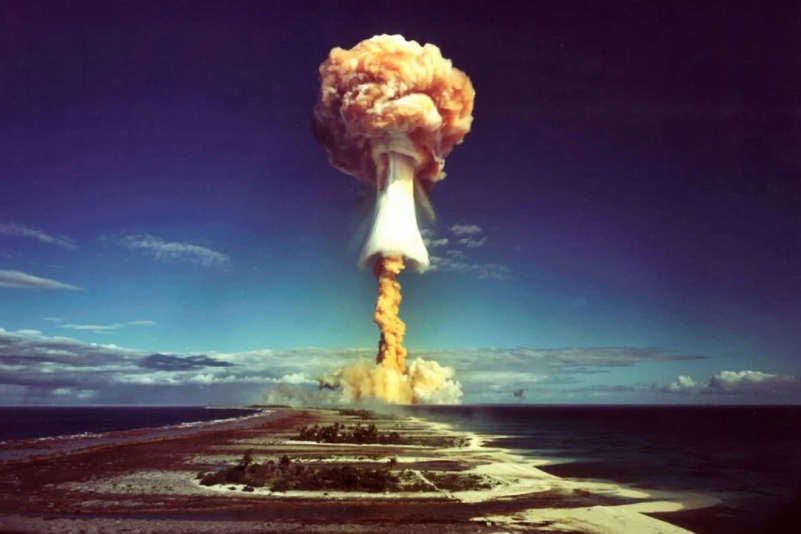
The characteristic mushroom shape rising to the sky after a nuclear air burst is just the result of a rapid release of energy and bomb debris in the air, but close enough to the ground to suck up soil. The “cap” of the mushroom results from the convectively rising point-source expansion of incandescent, debris-filled air from the point of energy release. The “stem” of the mushroom is a column of air that has rushed in to replace the rapidly rising fireball, picking up soil as it does so. There is nothing intrinsically nuclear about a mushroom cloud. Chemical explosives can do this as well.

Initially the fireball produces a strong pulse of thermal radiation. As this fireball develops, there is a momentary drop in radiant thermal energy due to the increasing opacity of the fireball. With further expansion the opacity of the fireball decreases and the thermal output increases. The shock wave and out-rush of air is obviously destructive, but the radiant thermal effects are not to be underestimated.

Another major effect of a nuclear blast is nuclear fallout. A nuclear blast unavoidably produces radioactive substances from the fission process and from neutron activation. A low altitude air burst is particularly troublesome because ground debris is sucked up into the air and contaminated with radionuclides. This material does what all suspended solids do, namely it is carried by the wind and falls back to earth gradually, contaminating a wide swath of ground. The finest particles remain suspended and are transported long distances, eventually falling out with rain or snow.

Finally, there are psychological effects associated with “the bomb.” It inevitably produces dread fear in people. This fear buttresses the idea of Mutually Assured Destruction or MAD.

Now that we are in a nuclear state of mind, let’s turn to what Putin intends to do with his nuclear arsenal. The Russians are not suicidal. Putin is neither crazy nor stupid. Russians have long understood where a nuclear confrontation with the West can go. They know escalation of nuclear war to full-scale would lead to mutual destruction of Russia and the West. The Russians know that the West has a policy of no first use with nuclear weapons and that we are extremely reluctant to use them. For the West, there is a firebreak between conventional and nuclear weapons. For the Russians, it is more of a continuum. They know that sabre rattling with their nuclear arsenal creates a good deal of anxiety in the rest of the world and Putin has been pushing this threat envelope to new levels and will keep doing so. Once a KGB guy, always a KGB guy. Putin obviously understands the pragmatics of coercion and the influential value of torture.

What nobody knows for sure is what happens when a Russian nuclear war shot is released. What does the West do? Respond in kind quickly or play the long game and see what happens next. How much planning has gone into nuclear conflict between two states outside of NATO? When would NATO step in? NATO is presently taking the side of Ukraine in terms of supplying money and arms but is studiously avoiding direct conflict with Russia. On the positive side, at least right now we aren’t bogged down with an endless middle east whack-a-mole exercise.

The best use of nuclear arms has always been and remains the threat of their use. Russia has been using this threat aggressively, even going so far as to blame Ukraine for planning a false flag operation with a “dirty bomb.”

Putin wants to see the alliance of the US and Europe disintegrate. He wants to see the American hegemony in place since WW II collapse. He wants to see the dominance of US culture, military reach, the influential dollar and prevalence of the default English language peel away. He wants to see Novorossiya rise from the ashes of the fallen USSR. But his vision requires the conquest of territory and cultural domination. The armed extinction project for Ukraine in process now will be followed by rebuilding the captured land with Russian infrastructure, political leaders and culture.

Russia, in its constant state of paranoia, wrings its hands about the “threat” of NATO at its border. The cruel irony is that it is hard to imagine that the West would find the conquest Russia possible or even desirable. The US-lead coalition was unable to get the medieval opium poppy kingdom of Afganistan under control with conventional weapons. How is it possible that we could even consider a preemptive invasion of Russia? Russia’s historical paranoia seems entirely self-serving for its authoritarian leaders.

One way to tear apart western alliances is to help them along with the demise of liberal democracy. Quietly support the internal cultural rot of individual nations by encouraging radical nationalism, white supremacy and political disharmony. It is happening all around us and especially here in the US. As badly as I’d love to entirely blame #45, I have to admit that he has only prodded a sleeping dragon. The MAGA and QAnon crowds were already out there. #45 has rallied them and validated their seething anger and indignation.

Today we have many people of great influence like Tucker Carlson, Alex Jones, Sean Hannity, nationalistic religious broadcasters, a stable of fringe political figures, and a mass of MAGA foot soldiers winning down-ticket elections moving their nationalistic and religious conservative agenda forward. Post-war baby boomers are being replaced with crowds and leaders who reject America’s present liberal democratic culture and leadership role in the world. There is growing open admiration for strongman authoritarian leadership. America’s experiment with fascism has already begun. Surprisingly, many Americans have expressed support for Putin.

Putin’s vicious attack on Ukraine, the rise of Trumpism with American fascism and a viral pandemic have overlapped within a narrow window of time- any one of which is a big problem by itself. It seems doubtful that MAGA right-wing crowds will have a change of heart in their vision for America. They will live out their lives within the same closed ideological space they are in presently. A political depolarization of America seems unlikely in the near term.

In this depressing global political climate it is more important than ever for the US to maintain its role as a thriving democratic culture and defender of those seeking democracy. Our leadership role in NATO must not waver against Russian aggression and expansionism. Russian expansionism will not end with Ukraine.

What will Putin do if he sees his internal political power structure collapsing? Will he ramp up the war to distract his opponents and rally the country? The present situation in Russia seems to suggest that rallying the population is more difficult than he anticipated.

It is hard to believe that Putin and his inner circle will change their ways in their lifetimes. They’ve painted themselves into a corner with their aggression and, like a trapped animal, will fight to the death. The cruel and murderous Joseph Stalin died in power. There is no reason to believe that Putin will be any different.

The Dirty Bomb Threat

Russia sent a letter to the United Nations accusing Ukraine of preparing to use a ‘dirty bomb’ in their battle with Russia. Western countries have claimed that this is nothing but a transparent attempt by Russia to provide a pretext for their own use of a dirty bomb or some other offensive action.

This issue resembles the matter of Weapons of Mass Destruction (WMD) that the Bush administration in the US contrived as a pretext for taking down Saddam Hussein. A great many innocent people died and we damaged our moral authority in the world by that and other wars. It was an obvious lie to a great many Americans and allies yet the Bush administration went forward with the invasion. No WMDs were found.

According to Wikipedia, a dirty bomb is a conventional explosive packed with radioactive material that, on detonation, disperses the dangerous material in the target area. Such a thing could be made portable or assembled on site. It is not to be confused with a nuclear bomb. A dirty bomb blast would be a radiological calamity wherever it is set off as well as downwind of the explosion. Being non-nuclear, dispersion by a conventional explosive would be extremely limited in range in terms of blast effects, but intensely radioactive. As with any sudden generation of dust and smoke, there would be a plume of radioactive material (RAM) extending downwind from the release. Water soluble radioactive materials would pollute the watershed and possibly groundwater. Contaminated soil would exclude the area from farming for many decades if not longer. Great harm would befall the biosphere.

Construction of a dirty bomb could be quite problematic for its builders. Assuming the builders of the bomb are not suicidal, collecting RAM, assembling and delivering the bomb could be tricky. On one end of the scale, spent nuclear fuel could be used as the source of RAM. Assembly could be as simple as packing explosives around a container of RAM. To prevent serious exposure to the workers, there would have to be some kind of shielding present during the handling of the RAM. On the lower end, a small RAM source from a medical device could be used. Whatever the case, the containment must be fragile enough to rupture in the explosion but dense enough to provide some level of shielding for the handlers.

The harmful effects of a dirty bomb would be both radiological and psychological. On the psychological end, it is sure to cause dread fear in the general population and sway public sentiment toward one side or the other. Importantly, its use would be releasing the nuclear weapons genie from its bottle. It would lower the threshold and allow war planners everywhere to reconsider their own use of nuclear strategy and tactics because a precedent has been set. Once the genie is out, there is no putting it back, or so the saying goes.

In all of the war gaming and planning NATO has done over the decades, I wonder how much attention has been given to responding to nuclear conflict between non-NATO states? What should the NATO countries do if other actors engage in nuclear conflict? As always, it depends on the circumstances.

==========================

I have chosen to avoid using the term “explosive device” because I feel it has a certain sanitizing effect. A thing that is meant to cause death and destruction by the explosive release of energy is just a f*cking bomb with all of the meaning and negative connotation associated with the word. Even grudging admiration for someone’s cleverness should not be awarded for putting together a “device.”

Radiant Pastures

“The AEC is my shepherd: I shall not live. (AEC- the Atomic Energy Commission)
It maketh me to lie down in radiant pastures; it leadeth
me beside deathly waters.
It destroyeth my bones; it leadeth me in the path of
frightfulness for its name’s sake.
Yet, though I walk through the valley of the shadow of
death, I will hear no evil; for thou art with me; thy
bomb and thy SAC, they comfort me.
Thou preparest a fable before me in the presence of mine
enemies; thou anointest thy words with oil; my cup
runneth over.
Surely, strontium and fallout shall follow me all the days
of my life; and I will dwell in the house of the
AEC–but hardly forever.”

by Lester Del Rey

Can be found in “A Stress Analysis of a Strapless Evening Gown: Essays for a Scientific Age“, edited by Robert A. Baker

On the Russian Occupation of the Zaporizhia Power Plant

In an escalation of his bloody war, the mass murderer Vladimir Putin allowed his troops to occupy the large Zaporizhia 6-reactor nuclear power plant along the Dnieper River in southern Ukraine in March of 2022. In doing so he brought the front line to a uniquely dangerous location. The world has expressed its concern and outrage, but characteristically, Putin is unmoved.

According to one source, El Pais, “On July 20, the Ukrainians launched a kamikaze drone against Russian units positioned near the nuclear power plant. The DiXi Group, a Kyiv think tank focused on the Ukrainian energy sector, confirmed the “precision [drone] attack.” According to Energoatom, the Ukrainian state-owned company that still manages the Zaporizhzhia plant, the Russians countered by storing “14 pieces of heavy weaponry, ammunition, and explosives,” inside the turbine room of one of the reactors.”

By way of background, the nuclear reactors at Zaporizhia are of the VVER variety and are water-cooled, water-moderated pressurized water reactors. They are not of the same design as the Chernobyl reactors. Chernobyl had RMBK-1000 graphite moderated reactors.

On Thursday, 8/25/22, a fire at a nearby non-nuclear plant shut down external power to Zaporizhia plant. Previously, three other power lines had been shut down. It may seem odd, but a nuclear power plant needs an outside feed of electrical power to assure that the coolant pumps to remain in operation. As a last layer of protection, the cooling pumps can be powered by diesel generators on site while the outside power is restored. The nuclear disaster at Fukushima, Japan, in 2011 is an example of what happens when a nuclear power plant loses it’s cooling pumps.

Reportedly, power was restored to the plant later that day. Whether or not the fire and the power trip was war-related or not is unclear.

There should be no mistake in realizing that the terroristic Putin knows precisely what he is doing and will wring out from the occupation of the plant his greatest advantage. He advances his pawns by relying on international dread fear of a large scale radiation release- a truly frightening prospect.

In Update 88, the IAEA, the International Atomic Energy Agency, listed the pillars of indispensable nuclear safety and security-

  • Pillar 1 (Physical integrity): Any military activity – such as shelling – within, or in the vicinity of, a nuclear facility has the potential to cause an Unacceptable Radiological Consequence.
  • Pillar 2 (All safety and security systems and equipment must be functional at all times): As a result of the shelling, emergency protection was activated at one of the  units, diesel generators were set in operation, and the nitrogen-oxygen station and an auxiliary building were damaged.
  • Pillar 3 (Operating Staff): This recent activity further increases the stress of the operational team.
  • Pillar 4 (Power supply): This has been compromised as a result of damage to the external power supply system.
  • Pillar 6 (Radiation monitoring and Emergency Preparedness and Response arrangements): In the current status of the site, this recent shelling further jeopardizes the already compromised EPR arrangements and capabilities to respond. However, the radiation monitoring system is still operational.

At some point in the future, the Putin war will be over. How it ends will largely be up to Putin or whoever surfaces after him. Eventually the Russian people, absent the malignant and unredeemable Putin, will have to be invited back as friends and neighbors onto the international stage as citizens of the civilized world. I hope that the strategic planners everywhere are thinking about this.

Putin Rattles the World with Upgraded ICBM

An article by Bloomberg and reposted by MSN reports the launch of Russia’s new Sarmat intercontinental ballistic missile (ICBM) from the Plesetsk cosmodrome in the northern Arkhangelsk Oblast. Putin is quoted in the Bloomberg piece as saying-

“this unique weapon will strengthen the military potential of our armed forces, will reliably guarantee Russia’s security against outside threats and force those, who in the heat of frenzied aggressive rhetoric try to threaten our country, to think again.”

Can we take it that the stated uniqueness of this weapon is related to it’s ability to evade whatever antiballistic missile capability the west may have? Or perhaps Sarmat may have greater range or more numerous and more accurate MIRVs? Whatever the case may be, Putin is ratcheting up the tension and uncertainty with regard to his dedication to the doctrine of Mutual Assured Destruction (MAD), making us wonder about his unleashing a pre-emptive nuclear strike.

There has been much speculation on what could trigger Putin’s use of tactical nuclear weapons. Informed opinion can be found in The Congressional Research Office document, updated in March of 2022, titled “Russia’s Nuclear Weapons: Doctrine, Forces, and Modernization.”

This document states that in a 2018 speech to the Federal Assembly, Putin said-

“I should note that our military doctrine says Russia reserves the right to use nuclear weapons solely in response to a nuclear attack, or an attack with other weapons of mass destruction against the country or its allies, or an act of aggression against us with the use of conventional weapons that threaten the very existence of the state. This all is very clear and specific. As such, I see it is my duty to announce the following. Any use of nuclear weapons against Russia or its allies, weapons of short, medium or any range at all, will be considered as a nuclear attack on this country. Retaliation will be immediate, with all the attendant consequences. There should be no doubt about this whatsoever.”

“There is no provision for a preventive strike in our nuclear weapons doctrine. Our concept is based on a retaliatory reciprocal counter strike. This means that we are prepared and will use nuclear weapons only when we know for certain that some potential aggressor is attacking Russia, our territory [with nuclear weapons]…. Only when we know for certain—and this takes a few seconds to understand—that Russia is being attacked will we deliver a counterstrike…. Of course, this amounts to a global catastrophe, but I would like to repeat that we cannot be the initiators of such a catastrophe because we have no provision for a preventive strike.”

While Putin says that Russia cannot be the initiators of a catastrophe, which could be taken as a nuclear exchange, Russia does reserve the right to a nuclear response to the use of conventional weapons that threaten the existence of the state. This suggests that a first use of nuclear weapons is possible by Russia. So, what circumstance would Russia have to be presented with to view a threat as existential? The death of Putin or the collapse of his government? A NATO invasion rolling onto Russian soil? Moscow surrounded by NATO tanks? Or just a moment of panic by Putin? One thing seems certain- Putin will be the judge of what is existential.

Elsewhere in the report it is stated that “… several [US] analysts have argued that Russia has adopted an “escalate to de-escalate” nuclear doctrine. They contend that when faced with the likelihood of defeat in a military conflict with NATO, Russia might threaten to use nuclear weapons in an effort to coerce NATO members to withdraw from the battlefield.”

This escalate to de-escalate idea from 2018 looks familiar. Maybe this is what Putin is doing now.

A summary of the 2018 Nuclear Posture Review: John R. Harvey, Franklin C. Miller, Keith B. Payne, and Bradley H. Roberts, “Continuity and Change U.S. Nuclear Policy,” RealClear Defense, February 7, 2018. https://www.realcleardefense.com/articles/2018/02/07/continuity_and_change_in_us_nuclear_policy_113025.html

[‘

Assorted Thoughts on our New Nuclear Age

If you search Google News for ‘nuclear war’, you’ll find links to articles from a large variety of sources. Putin’s invasion and belligerent behavior has resulted in a great deal of media buzz which is rightfully spooking the world. Better relations with Russia began with the fall of the Soviet Union and has lasted to some degree up to now- about 30 years duration.

Along with the invasion of Ukraine, Putin has been making threats suggesting to some that we may be heading back to a world of nuclear brinksmanship. Nuclear sabre rattling largely disappeared sometime after the fall of the Soviet Union. For the past 30 years the world has carried on as though nuclear weapons don’t exist anymore. Everyone knows that the major powers have nuclear weapons and understands the rationale for Mutual Assured Destruction (MAD). This has been in the background. Yes, there are outliers like North Korea and Iran.

Ronald Reagan took exception to the logic of MAD and in 1983 announced the Strategic Defense Initiative (SDI), sometimes derided by the name “Star Wars”. Reagan promoted the plan by asserting that orbiting SDI platforms would make nuclear weapons obsolete, at least with strategic weapons like the ICBM. It was a grand plan to make the world safer. It certainly made the world safer for defense contractors. Many of us think that the program was really meant cause the Soviets to go bankrupt in trying to keep up with the west in SDI technology. After the Soviet Union collapsed, enthusiasm for SDI in its original form faded away. You can read about it in the SDI link.

With Putin, steel must be met with steel. He only respects strength. For this reason it may have been a mistake to announce that there would not be a no-fly zone enacted over Ukraine. Handing over certainty to Putin only emboldens him. We should have said that it is on the table and left him guessing.

The big question is what to do if, in desperation, Putin uses a tactical nuclear weapon in Ukraine? How should NATO respond? Whatever it is, there must be an unambiguous response. The choice for Putin to use a tactical nuclear weapon will only be difficult the first time it is used.

On the lighter side, if you don’t already know, now may be a good time to familiarize yourselves with nuclear weapons effects and how the bombs work. If you’re in Vegas, stop by the National Atomic Testing museum. Get familiar with mankind’s fastest and most spectacular expressway to the collapse of civilization! Remember, nuclear explosions are effectively point sources of heat and pressure. The effects fall off as an inverse square law with distance. Distance is your friend.

On the personal level, try to come to terms with the stochastic nature of radiation damage and the existence and effects of background radiation. The dose/response curve to radiation gets quite fuzzy at the lower dose levels. Remember, exposure and dose are not the same.

The tragic effects of this invasion on the Ukrainian people is horrible. But I have Russian friends and have been to Russia. I grieve for the Russian people who are unwittingly on this dreadful misadventure of Putin’s. During the last 30 years of relative peace Russians have known a much improved quality of life. It is awful to see this ripped away from them. Russia just can’t shake itself free of despotic leadership.

David Brooks has an insightful article on Putin’s view of the world and Russia’s place in it. An excellent interview can be found in Der Spiegel describing Putin’s character by Ivan Krastev from the Institute for Human Sciences in Vienna.

Will Russian Sanctions Work?

It remains to be seen if the economic sanctions imposed on Russia by the west will have even a smidgen of effect on Putin. Western sanctions on the USSR had substantial effect on the Soviet people back in the cold war days, but the leadership of the USSR lasted for a very long time in this condition. It is naive of us to think that it will be any different with the Putin regime. Look at Iran and North Korea. They have lived under extreme sanctions for a very long time while under the tight control of their leadership and even have developed or will develop nuclear weapons.

One difference today in Russia is the relatively large middle class. They are accustomed to a lifestyle where goods and services are abundant. The smack down of the Russian economy will adversely affect them. But will it make a difference in Putin’s autocratic behavior? In the past, Putin’s response to dissent has been to crack down using the police and security services to enforce draconian law. Putin does not report to the Russian people. Like the old story of boiling the frog, he has cannily built a tight power structure around himself over time.

Will pinching the finances of the oligarchs make the difference? There is already talk of them turning to block chain schemes to park their money. Sanctions mean that money will begin to flow elsewhere. It seems doubtful that Putin would have allowed this kind of Achilles Heel of a powerful class to exist. Some think that the oligarchs report to Putin and not the other way around.

One beneficiary of this situation is thought to be China. It surely hasn’t gone unnoticed in China that the disconnection of western business will provide a great many business opportunities in Russia as well as an expansion of their sphere of influence. All we can do is to watch it unfold.

Putin’s invasion of Ukraine will bring negatives to his regime. Whether it will bring him down seems unlikely. Historical precedence does not give much hope to the idea that Putin will have a ‘come to Jesus’ moment and cause him to relent.

Russia’s status as a nuclear power worries everyone, of course. Adherence to the strategic doctrine of Mutual Assured Destruction (MAD) between nuclear states has limited warfare to the use of conventional arms for generations. It has been the doctrine of the US to incorporate a fire break between the use of conventional and nuclear arms. Whether this is true for Russia is unclear. They may see nuclear arms as part of a normal escalation in force. This would be most unfortunate if true. How the west would respond to the release of nuclear weapons in Ukraine or against other states of the former Soviet Union is also unclear, but there are surely contingency plans for this eventuality somewhere in the pentagon. I hope.

The unifying affect on the west in responding to Putin’s aggression is encouraging but it may not be enough to stop Putin from further invasions. Let us hope that this madman can be contained.

Operation Teapot – Turk 28112

The short video above is of LLNL atmospheric test shot Turk in Operation Teapot in 1955 at the Nevada Test Site. The test was of the primary for the XW-27D thermonuclear weapon, giving a 43 kt yield.

What struck me about the footage was that it captured detail of the expanding fireball as it contacted the ground. Turk was a tower shot with the explosive sitting at 150 m above the ground. As the roughly spherical fireball expanded, jets of roiling material protrude radially from the growing incandescent ball. In particular a conical extension of incandescent material protrudes from and is overtaken by the expanding fireball.

A commenter below offered what seems to me a quite plausible explanation of the conical “jet” observed in the footage. It is a cable from the tower caught in the act of cooking off into plasma from the much faster radiant energy.

Addendum 6/28/17. Thanks to a link supplied by commenter K, we find there is a name for this phenomenon- it is called the “rope trick”. See this link for more information.

The Amateur Scientist by C.L. Stong: A Remembrance.

Of the 1332 posts I have polluted cyberspace with, the most frequently visited is a post on the topic of neutron lethargy written in May of 2008. The post is titled Neutron Lethargy- This Weeks Obscure Dimensionless Quantity. My intent was to write about some of the obscure yet interesting factoids and concepts that I run into in my daily travails.

I’ve been drawn to nuclear topics since junior high school. Sometime in 8th grade I began to to build several scientific projects as described in the Scientific American column The Amateur Scientist written by C.L. Stong. Stong published a collection of articles in a book titled The Scientific American Book of Projects for the Amateur Scientist, 1960, Simon and Shuster. This book was (is) a treasure trove of information on how to assemble equipment for scientific investigation.

In jr high I spent some time trying to assemble an “Atom Smasher” (p 344). It was an evacuated glass tube with filament electron source a meter away from the positively charged target. The target was a 3 x 1/4 inch disk of aluminum with many perforations over which aluminum foil would serve to seal in the vacuum. The aluminum foil was to serve as a window through which electrons could collide with a sample on the exterior. Sadly the project eventually ended due to the lack of access to a McLeod gauge, bulk mercury, and a diffusion pump. The required Van de Graff generator was available for a few hundred dollars. The failure was perhaps fortuitous because even if I had managed to assemble the thing, I might have been exposed to x-rays during the accelerator’s operation.

Turning my attention to more feasible projects I did manage to do some biology experiments. The most interesting was growing protozoans from an infusion of grass and soil in standing water. After several days the water would turn cloudy and fetid. Using a decent Christmas microscope we were able to view a magical world of microorganisms scooting around in their herky-jerky manner. It was mesmerizing.

A glove box project afforded a place for growing microorganisms with petri dishes purchased at a hobby shop. I was able to grow mold and some blend of bacteria on Jello in the petri dishes, but the microscope didn’t have the resolution for bacteria. Since I had no interest in pathogens, the glove box was not really needed. But it looked cool.

By 10th grade I did manage to successfully build the cloud chamber project (p 307). Unfortunately I only witnessed stray cosmic rays and background radiation. As it turned out, the polonium 210 alpha source loaned to me by a physics teacher had long since decayed to inactivity. Building the chamber was a tremendous learning experience made possible through the use of the metal shop at school. It was of sheet metal construction with a dry ice and methanol coolant chamber built in. The actual chamber was made from  the bottom quarter of a Folgers coffee can cut and fitted with a glass viewing port and Plexiglass illumination ports. As I recall, the most problematic aspect of the construction was finding an adhesive that would not detach at dry ice temperature.

An electromagnet was built in an attempt to bend the path of the particles by a magnetic field, but was wholly inadequate for the job. Learned another lesson there too.

The book by Stong was something that lit up my curiosity and put a fire in the belly to explore. This was the beginning of what turned out to be life-long career in science. Strangely, the total lack of interest by the adults around me only strengthened my resolve to build and learn.

Solvay and AREVA Make Deal to Develop Thorium Technology

I have been an advocate of thorium based nuclear power for a long time. There are certain advantages that thorium based nuclear technology has over uranium and plutonium systems that make it appealing, as long as the nuclear genie is out of the bottle anyway. Others have written about this and there is no point in my wasting bandwidth on it here.  Fort St. Vrain Generating Station, one of the very few HTGR Thorium plants ever operated in the US sat a half hour from here from 1979 to 1989. As prototypical operations go, the plant had a history of upsets and unforeseen complications and was decommissioned after a decade of sub-commercial output. Eventually the plant was converted to a natural gas turbine plant and runs to this day in that capacity.

So it was of interest to learn that the venerable European company Solvay has teamed up with AREVA to develop thorium technology. Uranium and rare earth processing, as well as other minerals produce side streams enriched in thorium.  According to the link, both players have been accumulating inventories of thorium.  Hmmm. What could they be up to…?