Any questions?
Wherein Th’ Gaussling Elaborates on PET scans
2 Replies

Any questions?
This video was produced at Pultroon Studios in Smoldering Forest, Colorado.
The subject had received 15.7 mCi of 18F-glucose 6 hours prior to filming. His current whereabouts are unknown.
It is a crying shame that we (the rest of the world) did not think to encourage Iran and other states to develop thorium-based nuclear power many years ago. The thorium fuel cycle provides nuclear-powered steam generation, but is largely absent the use of fissile isotopes in the cycle which may be used for nuclear proliferation. Thorium-232 is more abundant that uranium-(235 + 238) isotopes and does not require isotopic separation as uranium does.
The great exploration boom in progress with rare earth elements would facilitate thorium supply. Thorium and uranium are commonly found in rare earth ores and, to the dismay of extractive metallurgists since the Manhattan Project, these elements tend follow along in rare earth extraction process. The isolation of thorium was developed long ago. Point is, since so many rare earth element extraction process streams are either in operation or are pending, now is the time to accumulate thorium.
At present however, thorium is a troublesome and undesired radioactive metal whose isolation and disposal can be quite problematic. The best process schemes partition thorium away from the value stream as early in the process as possible and channel it into the raffinate stream for treatment and disposal in the evaporation pond.
The specific activity of natural thorium is 2.2 x 10^-7 curies per gram (an alpha emitter). The specific activity of natural uranium is 7.1 x 10^-7 curies per gram. Alpha emitters pose special hazards in their handling. Dusts are a serious problem and workers must be protected especially from inhalation or ingestion. While alpha’s are not difficult to shield from, their low penetration through ordinary materials or even air makes them a bit more challenging to detect and quantitate relative to beta’s and gamma’s. In spite of the mild radioactivity of thorium, managing the occupational health of workers is known technology in practice in the nuclear industry.
Regrettably, most of the world’s nuclear power infrastructure is geared to uranium and plutonium streams. Thorium, the red-headed stepchild of the actinides, is thoughtlessly discharged to the evaporation ponds or to the rad waste repository- wherever that is- to accumulate fruitlessly. If we’re digging the stuff up anyway, why not put it to use? It is a shame and a waste to squander it.
The matter of medical x-radiation dosing is surfacing again. I wrote a post about this in 2009.
Let’s get to the core of the matter. Physicians need to take charge of this since only they have any real control. It’s a pretty goddamned simple concept. Doc’s who are calling for x-ray’s need to begin recording calculated dosing from this hazardous energy. If it is too troublesome for them, then the x-ray techs should record the information.
CT scanning seems to be problematic. There is no business incentive to hold back on CT use in for-profit settings. I suppose that documentation would only reveal the extent and magnitude of x-ray use. It would be fodder for malpractice law firms.
I can just see the billboards- Have you or a loved one ever gotten a tan from x-rays? If you have, call Dooleysquat, Schwartz and Schmuck for a free consultation. Do it Now!
According to an article in Mineweb, the remaining cold war era uranium will be consumed in the next few years, leaving the nuclear industry with inadequate supply streams from mining. Thomas Drolet of Drolet & Associates Energy Services, said that in 2010 mining produced 118 million pounds of uranium against a demand of 190 million pounds. Obviously, the balance was made up from decomissioned nuclear weapons stockpiles. The article did not say whether the numbers represented lbs of U or of U3O8. The oxide is commonly cited in relation to uranium mine production.
Drolet suggests that Japan will have to restart ca 30 of its 50 or so reactors in order to meet power demand.
It is my sense that the Fukushima disaster will not be the stake in the heart of nuclear power. The location of the Fukushima plant and a list of easily identifiable design features allowed the initiation and propagation of the incident. While the future of reactor operation in Japan may be stunted, most reactors elsewhere in the world are not located in tsunami flood zones. Regrettably, some are located in fault zones. But the insatiable demand for kilowatt hours will override everything. Commercial fission will continue into the indefinite future.
If one studies the economic geology of Rare Earth Elements (REE), it becomes clear that REE’s are frequently (usually?) found in deposits rich in other elements. Deposits of zirconium, tantalum and niobium, for instance, are frequently co-located with REE’s.
The REE’s are found in ore bodies that are naturally enriched in either heavies (yttric or HREE’s) or lights, (ceric or LREE’s). The LREE’s seem to be the most common spread of the REE’s. Molycorp’s Mountain Pass bastnasite deposit is a good example of this.
What is not so widely known is that thorium and/or uranium are nearly always found in these deposits. This might be regarded as a good thing except that companies in the REE business seem to be less interested in actinides than lanthanides. The actinide business is fraught with complications related to the natural radioactivity of Th and U. If one is interested in rare metal production, the matter of radioactivity is unwelcome.
However, there is opportunity here if certain institutional thinking is allowed to expand. I refer to the global preference for uranium and plutonium in the nuclear fuel cycle. Nearly the entire world’s nuclear materials infrastructure was directed to the production of yellowcake and separation of U235 from U238 post WWII. While there has been some experimentation with thorium 232 in the US, and there are some limited initiatives in motion, it has been largely neglected in reactor design and the fuel cycle in favor of uranium and plutonium.
Rare earth element mining and processing naturally produces thorium and uranium. At present, those practicing REE extractive metallurgy have every incentive to avoid concentrating the actinide components owing to the radioactivity. However, if there were a coherent program for the development of an efficient thorium fuel program, this natural resource could be efficiently taken from the REE product streams now or in the future.
Our reliance on energy will trend substantially towards electricity. The greater absolute abundance of Th over U, as well as the ability to use 100 % of the predominant isotope makes thorium a good candidate for energy exploitation. The recent boom in REE exploration has uncovered new sources of thorium. The nuclear genie was let out of the bottle nearly 70 years ago. By now we should be a little smarter about how we use it.
The IEEE article “24 Hours at Fukushima” is a detailed account of the events that rapidly unfolded during the earthquake induced nuclear disaster at the TEPCO Fukushima nuclear plant on the Pacific coast of Japan. It is well worth a look.
An alert was declared on June 7th, 2011, at the Fort Calhoun nuclear generating plant north of Omaha, NE. The plant is next to the Missouri River which has been at some level of flood stage recently. According to the NRC, a fire ocurred briefly affecting some electrical equipment necessary for safe operation of the plant. Within a few hours the plant operators exited the alert when the necessary access to equipment was regained.
For a short time the plant lost its ability to cool the spent fuel pool cooling water. While the incident did not result in any unsafe temperature rise in the pool, the licensee was obligated to declare the alert. The plant remained safely shut down during the event, though afterward the plant remained under an Unusual Event Declaration due to the condition of the Missouri River. The FAA issued a temporary flight restriction within two nautical miles of the plant.
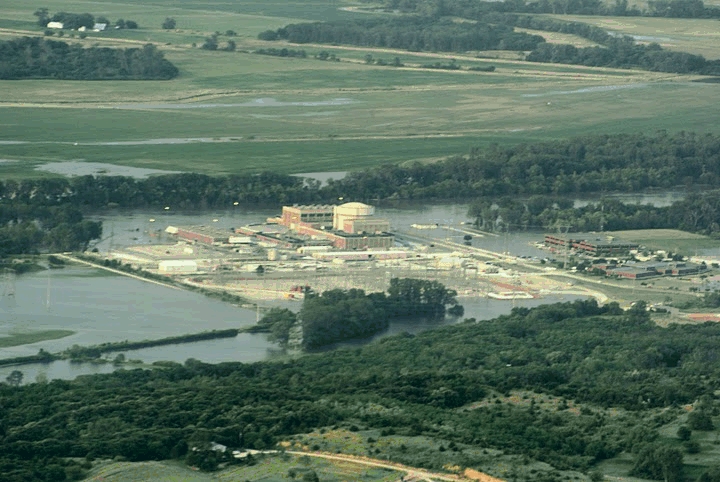
Ft Calhoun Nuclear Plant in the Missouri River
Another good site for well informed updates on the unfolding Fukushima Daiichi nuclear disaster can be found at MIT NSE Nuclear Information Hub.
Thanks to Les for the heads up.
Everyone is rightfully concerned about Japan and what is to become of the region around the Fukushima Dai’ichi generating station. The quality of information by the various broadcast outlets is improving somewhat in my estimation. What the rest of the world should take note of is the stoic and highly admirable manner in which the Japanese have responded to the earthquake*tsunami*nuclear-disaster trifecta that has fallen upon them. In a US city there’d be looting and widespread felonious mischief as local criminal entrepreneurs rose to the occasion.
Another thing that I hope is noticed is the manner in which the failures initiated and propagated at the power station. The unfortunate low elevation of the emergency generators is the obvious one. But there is something else that is dramatically affecting how the incident propagates. If you look at the cutaway diagrams of the plant you will see the highly compact nature of the facility. The footprint of the buildings are quite small given the amount of equipment and processing that occurs there. In particular, the location of the cooling pools for the spent fuel assemblies is at the upper level of the structure, above the reactor spaces.
The upper level with the cooling pools has an overhead crane that can move along the length of the facility. The fuel elements can be pulled up and out of the reactor and moved laterally into the pool. The General Electric design is quite efficient in the use of acreage. But in the event of a major upset with fire, explosions, major radioactive material release, and structural damage, the compactness of the facility and the elevation of the spent fuel cooling pools works for prolonged incident propagation and against termination.
The very altitude of the cooling pool spaces presents a major hurdle to taking control of the situation. Having this problem at ground level where you could directly apply resources to the event would be bad enough. But to have it many stories above ground places huge constraints on the responders. Designers of power plants should be thinking about where hazardous energy can be released and how responders will deal with it. Problem- all facilities design projects are constrained by severe cost considerations. Designers prefer to think about the most efficient designs, not how their brain child is going to fail.
 Lamentations on Chemistry