Category Archives: Nuclear

Credible Information on Fukushima

It is difficult to find truly informed opinion on the Fukushima reactor disaster in Japan.  The Daily Kos Community site by Richard Blair seems very credible from what I can discern.  The writer claims to be a Nuclear Power Operations-certified systems engineer in GE Boiling Water Reactors (BWRs). I have no reason to disbelieve it.

Actually, Rachel Maddow (and writers) did a very even handed presentation this evening of the basics of reactors, radiation, and nuclear power generation on her show. 

Blair (writing under the pseudonym Richard Cranium) shares some interesting insights on the Fukushima boiling water reactors. It’s worth a look.  It is part of a larger effort at information aggregation called the Japan Nuclear Disaster: Mothership.

China Syndrome in Japan

The China Syndrome is a fanciful “theory” that postulates that when a nuclear reactor undergoes a meltdown, the hot core material melts through the pressure vessel and through the concrete containment flooring below into the ground. All the way to China. 

Well, this really can”t happen because the core, hot as it is and dense as it is, could only go to whatever depth matches it’s density. I don’t think many people really understand what happens to core material when it breaches the containment and encounters the subsurface. Further, it’s hard to say if the core material will remain intact as a single unit long enough to retain a critical condition as it spills outside of the reactor vessel assembly. 

The fuel elements are, I believe, ceramic in nature, making them refractory. Refractory materials have quite high melting points. A reaction mass that has some fluidity might well split off isolated blebs which could then take the whole mass away from a critical condition.  This would tend to dampen the reaction rate and allow the reaction mass to cool below the melting point of the mass.  

Quite apart from the dispersion of the core material is the loss of moderator around the reaction mass.  This would occur as the primary coolant water flashes to steam as the pressure vessel is breached. Loss of moderator reduces the number of neutrons in the resonant range and the power should drop accordingly.  The decay heat from the fission products should be fierce.

As a molten parcel of reactor core heats up the surface material below it, the molten flooring, soil, or bedrock must be fluid enough to allow the core to displace it downward. It could be that the blob gets elongated and increases the surface to volume ratio enough to allow the loss of neutron flux to cause the blob to cool below the melting point of the ground.   How a self-heating blob of core material behaves under the pull of gravity in a variable and possibly refractory rocky matrix is not an easy problem.

Ground water would be problematic for the neighborhood because eruptions of contaminated steam would be expected to issue from the crater.

I hope these poor fellows are able to get their reactors under control before the area gets too hot.  If the reactor spaces and control rooms get too hot it is going to complicate the remediation.

It is worth reading the updates from NISA.

Nuclear Emergency in Japan

The recent earthquake in Japan has triggered an actual nuclear emergency at the Fukushima Daini nuclear power plant. According to IAEA, the explosion earlier today originated in the Unit 1 reactor building and was not the result of explosive breach of the primary containment. One character interviewed on CNN called it a six sigma event.

If memory serves, water dissociates at ~2300 C. The cracking of coolant water by overheated fuel elements would result in the generation of noncondensable gases (H2 and possibly O2) that would add to the pressure excursion. Venting is the only option at that point. This was an issue at TMI. The explosive concentration range of hydrogen is very wide.

IAEA goes on to say that Units 1,2,and 4 are experiencing increased pressure, but Unit 3 is in a safe cold shutdown condition.  Tokyo Electric Power Company received permission to inject boronated seawater into the Unit 1 reactor.

This is very ominous news. Plainly, if the cooling loops were dumping enough energy out of the reactor they would not inject corrosive sea water into it.

There is a lot of talk about a meltdown.  As of this post, nothing has been disclosed about the actual state of the Unit 1 reactor core.  There has been no word on the state of the fuel elements or the state of the coolant loops.  I assume that the reactor design has a negative reactivity coefficient that will attenuate the reactivity with water coolant loss or void space formation.  The link on reactivity coefficients delves into a number of interesting and perhaps not-so-intuitive effects on reactivity during an upset condition.

Plutonium Mining

The WordPress blog website comes with a feature on the dashboard that lets you know what key words people are using to find your site. I just got two hits from people looking for “Plutonium Mining”.  Some folks out there are really confused.

My dear fellow: one does not mine plutonium. One mines uranium and breeds it into plutonium.  Plutonium may be had from two successive neutron absorption and beta decay events starting with U-238. Plutonium has two more protons than uranium, so two beta decay events have to occur to increase the proton count by two in the nucleus. And making certain actinide nuclei even more rich in neutrons is one way to encourage beta decay.

The age of the solar system is just too great for the heavy actinides to be left over from regional supernovae atomic weight building events. But imagine if plutonium was found in abundance in ore bodies. No doubt museum shelves would be full of artifacts fashioned from plutoniferous minerals. Glazed pots and fertility fetishes made from the pretty rock.  Perhaps the Egyptians might have had glow-in-the-dark burial artifacts and a hieroglyph for radiation burn or sudden hair loss.

Antimatter Storage

We had an ACS local section meeting recently in the clubhouse of the Air Force Academy golf course.  The featured speaker, a DoD chemist, gave an interesting talk on his work on some of the basic issues relating to the storage of positrons or anti-electrons. In the interest of fairness, since I am writing under a pseudonym, I’ll not wave his name about.

The speakers background is P-Chem and in particular, spectroscopy of isolated species in cryogenic matrices. He pointed out that an atom or molecule or cluster in an inert cryogenic matrix is in a dissipative environment and thus isolated from solvent interactions that might otherwise mask other kinds of phenomena.  So it is possible to spectroscopically examine the solid phase environment of the cryo matrix. In other words, an imbedded subject  molecule might find itself in an isotropic or ansiotropic environment, depending on the matrix. Infrared spectroscopy could give clues as to the symmetry of the local environment.

It turns out that ortho-hydrogen is an interesting matrix in which to study an important aspect of antimatter storage technology.  In order to collect positrons, one has to first find a source of them. While they can be supplied by some kind of nucleosynthesis, an easier route experimentally is to find a radioisotope that emits positrons.

It does not take too long for the would-be keeper of antimatter to move to the problem of storage. If you’re going to have anti-matter, you must think carefully about where you’re going to store it.  But there is another issue.  The challenge in collecting positrons from nuclear decay begins with slowing them down. As they are emitted they are travelling at relativistic velocities. Positrons, like “regular” beta particles are emitted in a fairly broad band of energies, so slowing them down via some kind of electromagnetic trap would result in very high losses. Instead, a moderator is envisioned to bleed off speed.

Positrons do not automatically annhilate with the first electron cloud they encounter. In fact, positrons were observed early on by the tracks of ionization they left in bubble and cloud chambers. So positrons can move through matter some distance without annhilation.

Electrons and positrons can pair up to give a transient neutral form of matter called positronium. There are two forms of positronium- singlet and triplet- with the difference being the relative alignment of their spins in either a parallel (triplet) or an antiparallel (singlet) arrangement.  Singlet positronium has the shortest lifetime at 125 picoseconds and triplet at a relatively long lived 145 nanoseconds.

Back to ortho-hydrogen. Positrons can interact with lattice defects in a solid, resulting in early annhilation losses. It turns out that ortho-hydrogen at 2.3 K can be warmed to 5 K and be annealed to a single crystal structure, largely free of defects. Therefore it is possible to prepare a solid moderator free of positron quenching defects.

This is where the speakers research stands at present. The have uncovered a potential positron moderator that would be part of a collection and storage system.  The speaker freely admitted that practical antimatter storage in a container is 100 years in the future. But given the high energy densities available from antimatter, the Air Force is committing modest funds to exploring the issues.

There is work being done to study the positronium Bose-Einstein condensate. It is complicated by the short lifetime of positronium. But fortunately there are ways of storing positrons in storage rings. The annhilation of positronium as a BE condensate would afford coherent 511 keV gamma rays. This would be the basis of a gamma ray laser.

Thorium

A short drive from my office is the Fort St Vrain power plant. The present electrical generating facility is powered by natural gas. But a generation ago it was a nuclear plant powered by a high temperature gas cooled reactor (HTGR). What’s more, the reactor used fissile uranium with fertile thorium.  The output of the plant was ca 330 MW electric and it operated from 1976 to 1989.

The utility eventually decommissioned the helium cooled reactor and converted to natural gas. Today, as before, the plant looks like a planetary humidifier, billowing great clouds of steam condensate into the thin dessicated air of the high plains. The link above outlines the trials and tribulations the utility experienced with some of the auxillary hardware. They had to learn the principle of KISS the hard way.

A thorium-based nuclear reactor uses a fissile element like U-235 to provide a source of neutron flux from which to jumpstart in-situ breeding of U-233. The absorption of a neutron by Th-232 gives Th-233 which beta decays to Pa-233 which decays again to U-233.  Remember, beta decay causes the atomic number to increase by one, but the atomic weight stays the same.  The resulting U-233 is fissile and serves as a fuel.

Thorium as a fuel has pluses and minuses. On the plus side, thorium is more abundant than uranium. And Th-232, the predominant isotope, is the desired fertile material. This is in contrast to natural uranium which offers less than 1 % abundance of fissile isotope U-235. A large part of our nuclear infrastructure involves separation of this isotope to a more concentrated form. After isotopic separation the uranium must then be converted to a suitable chemical form.

The refractory nature of thorium oxide reportedly makes fuel element manufacture somewhat problematic. Interestingly, it is the refractory nature of thorium oxide that makes it valuable for use in thoria lantern mantles. The high melting point of thoria allows a gossamer web of glowing thoria (and ceria) to sit in place in the lantern burner and radiate bright white light.

On the minus side, there is no established fuel supply infrastructure to provide thorium oxide to industry. In fact, there is virtually no thorium trade in the United States today, with the latest annual US sales volume amounting to a paultry $350,000 according to the USGS. Some of the nuclear chemistry is of the thorium cycle is problematic as well.

The natural history of thorium mineral placement is rather different than that of uranium. Uranium migrates fairly readily, depending on its oxidation state and pH of mobilized hydrothermal fluids. As a result, uranium can be found in porous or fractured formations that have a history of water migration.  From what I can tell in the geological literature, thorium concentration results largely from magmatic differentiation in the distant past. There is considerable diversity in the details of each occurrence of thorium, so one should be careful of generalizations.

There is a notable monazite (a common thorium mineral) placer district across the central North and South Carolina border region. These monazite placer deposits sit in ancient stream channels and are the result of alluvial dispersion.

Colorado has two notable thorium mineral deposits. The Wet Mountains SW of Canon City and the Powderhorn district near Gunnison have substantial deposits of thorium as well as lanthanide elements. In fact, rare earths are commonly associated in monazite. Monazite is a phosphate mineral with a variety of thorium and lanthanide cations present. It is useful to recall that the rare earth elements include Sc, Y, the lanthanides, and the actinides. In Colorado, the significant uranium deposits are not coincident with thorium deposits. Uranium is found in sedimentary deposits of the Colorado Plateau, in the tuffaceous sediments of the Thirty-Nine Mile volcanic field, and in vein lodes along parts of the Colorado mineral belt.

There is considerable variability in the elemental associations found in rare earth deposits. Monazite seems to be fairly consistant in regard to the presence of Th and lanthanides. Scandium, however, is often absent or quite scarce in monazites from the assays I have seen in the literature. 

Perhaps the richest thorium district in the lower 48 states is in the Lemhi Pass district along the lower Idaho-Montana border. A company called Thorium Energy reportedly holds substantial claims of thorium rich deposits at Lemhi.

CT scan abuses. Who is actually in charge of the use of X-rays?

The latest news  about CT scan abuse and the subsequent excessive radiation exposure to the public is very disturbing. A recent issue of the Archives of Internal Medicine features 2 articles describing their findings in regard to the use and possible misuse of CT x-rays. There is no point in my regurgitating the details of the two articles. The reader can study the articles without my noisy input.

What I would like to point out is that this is a case of faulty administrative control over the exposure of patients to hazardous energy. Who is the gatekeeper for access to a CT scan-  the primary care doc or a consulting radiologist? If it is the primary care doc, is he/she up to speed on the exposure/dose details? Does the primary care doc know the dose and variability in radiation exposure for a given workup? Does the dose vary with the model of CT scanner? How much resolution is really necessary, anyway? Does half the dose give half the resolution, or is there some other law relating transmitted energy to resolution?

Maybe the gatekeeper should be the radiologist. The radiologist should be able to calculate a radiation dose and speak knowledgeably about the details of the risk. But should the radiologist be in a position to second guess the primary care doc? Does anybody provide feedback to the primary care doc as to the wisdom of a given CT scan? Doesn’t sound like that would work very well.

So, who is really the gatekeeper in regard to the merits of any given CT scan given to the patient? But more importantly, how the hell can it transpire that radiation exposures are far higher than anybody apparently realized??? Radiation technology and radiation biology are mature sciences now. And presumably, radiologists are trained to pay attention to these kinds of details.

Where the HELL were the radiologists when these instances of excessive exposure were accumulating?? Isn’t that why we train them … to provide expertise in the use of ionizing radiation in medicine??  Were they busy? Did they have something else to do besides monitoring the use of radiation on actual patients?

Could it be that people in the CT business are more captivated by the industrial light and magic of imagery and special effects rather than the grubby details of dosimetry?

Uranium roll fronts

As a kind of hobby Th’ Gaussling has been surveying the literature on uranium occurrences in North America. Uranium is found in many interesting locations and as a result of several distinct kinds of ore forming processes.

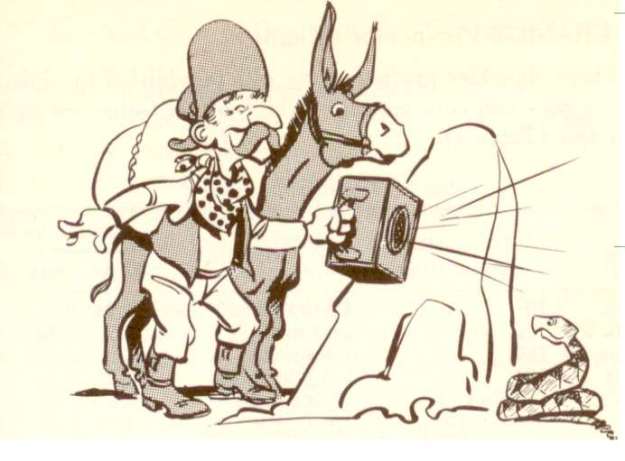
Prospector with Geiger Counter

From Ballard &Conklin, Uranium Prospectors Guide, 1955 Harper & Brothers

For the most part, uranium ore body formation is the result of aqueous transport and deposition.  Uranium is found as a lode in vein formations in precambrian  igneous/metamorphic structures as in the case of the Schwartzwalder mine near Denver. In fact, there are many lode occurrences that contain a variety of uranium minerals in the Colorado mineral belt.

What seemed counterintuitive to me was the extent to which uranium is found in sandstone. Evidently I had developed a bias for connecting heavy metal occurrences with igneous/metamorphic formations.

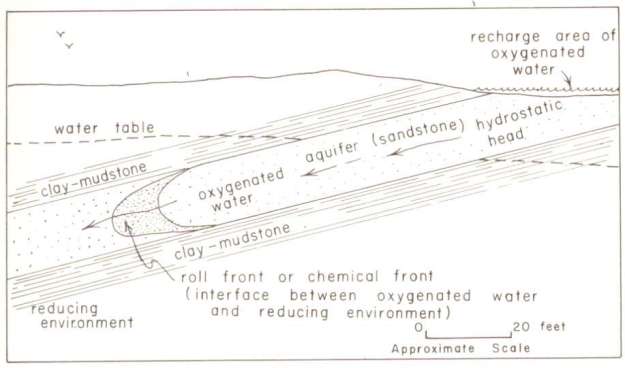
Uranium occurrences in sandstone take on certain characteristics as a result of ore forming processes. Uranium is often found in concentrated bodies called “roll fronts” or “ore rolls”. A roll front is a body of concentrated mineral with a lenticular cross section and is found in confined strata sandwiched between impermeable clays, shales, or mudstones.

Roll Front Cross Section

Adler & Sharp, Guidebook to the Geology of Utah, No. 21, Utah Geological Society, 1967, p. 59.

The action of oxygenated meteoric water (i.e., rain and surface water) migrating through a porous sandstone stratum will selectively mobilize mineral species that are soluble. In the case of uranium, the relatively insoluble U4+ compounds are oxidized to more soluble U6+ species which are then mobilized and flow in the formation.

Eventually, as the water flow encounters reducing conditions, U6+ gets reduced to U4+ and deposition occurs. Sandstone with organic material may be a net reducing environment and provide the necessary carbonaceous reductants to do the deed.

As the U6+ enriched aqueous flows encounter reducing conditions, deposition of U4+ insolubles occurs in a manner determined by fluid mechanical forces. The result is an elongated and tapered ore body confined to a narrow stratum.

Uranium roll fronts are common in many uranium districts. The Uravan uranium belt in the Colorado Plateau is a good example. Uranium is found concentrated in tuffaceous formations as well. An example of this is the uranium occurrence found in the 39 Mile Volcanic Field in the central Colorado mountains.

What is interesting to ponder is the geological effect of plant metabolic byproducts like oxygen. Oxygen directly contributes to a natural process that lead to the concentration of a scarce element like uranium. Plant life facilitating nuclear power. Hmmm.

Mantle of Insanity

Recently I went to a local outfitter of camping gear to look for Coleman Lantern Mantles. As I was scanning the shelves a cherubic faced clerk came up to me and asked if I needed help. I said I was looking for lantern mantles.

When we arrived to the endcap where they were hanging, I asked him if they were still making radioactive mantles. He looked at me as though I were a bit of a loon. When I pressed the question, he balked and summoned his manager.

The manager, another youngster who was much more of an alpha male, scoffed at my question and tried to assure me that such a thing was absurd. Why in the world would mantles be radioactive? I tried to assure the youngster that, yes indeed, mantles were radioactive at one time because they contained thorium. At this point the manager was becoming visibly annoyed at his time lost addressing the questions of an obvious crackpot.

I recognized the patronizing tone he took and turned and left the store. As a child of cold war science, I have witnessed mantles sitting in a cloud chamber with ionized cloud streamers zipping every whichway from the innocent looking woven bag. Today, schools are terrified of chemicals and radiation science. Mr Manager missed out on a real experience by being born into the post-cold war world of bland science education.

So, my GM counter sits in my office clicking from the occasional background radiation piercing the GM tube. Eventually I’ll find a source to give it something more interesting to detect.

A hot little number

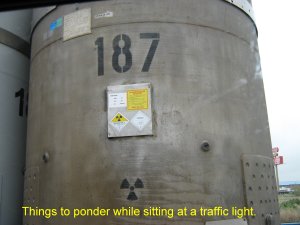
hot-load-on-the-interstate1

I see these shipping casks on the highway at least once a month.  This time I had a Canon with me (Powershot A470, you know, a camera). While sitting at the off-ramp stop light next to this container I began to wonder how much activity shines through the shielding. I began to daydream … if I could see in the gamma spectrum, would this thing be bright or dim?

Then, in the blink of an eye the spell was broken. The light turned green and I parted company with this hot little number.