
Category Archives: Nuclear

Reactivity and Risk. Gaussling’s 10th Epistle to the Bohemians.

A chemical plant performing synthesis is a place where the materials in use are purposely selected for certain attributes of instability. Chemical stability refers to the tendancy of a substance to remain unchanged when exposed to some kind of stimulus. That stimulus may be exposure to heat energy, mechanical shock, or a more precise chemical attack on particular functional groups. Unstable substances have a low threshold to change. Stable substances require more stimulus to cause a change in composition.

Substances that are extremely stable are often not very useful in near-ambient temperature chemical synthesis, i.e., saturated hydrocarbons, metal sulfates, silica, etc.  The lack of lower temperature reactivity (say, up to 200 C) can be compensated for by application of high temperatures. Petroleum refineries take full advantage of high temperature reaction chemistry to alter the composition of otherwise stable hydrocarbons.

We choose stable substances for duty as solvents, diluents, carriers, etc., precisely because of their non-changeability or stability. “Inert” solvents allow chemists to bring molecules into solution for selective transformations. Of course, we all know that most solvents have some influence on the course of a transformation, the point is that we can transform solute materials without the fuss of altering the solvent too.

Chemical synthesis requires the manipulation of reactivity (and therefore stability) to perform useful transformations. Without well placed instability on a molecule, there cannot be efficient, directed synthesis. It is the job of the synthesis chemist to apply the knowledge of reactivity.

Because of the inherent instability of reactive and flammable materials, chemical plants must require that certain behaviors, procedures, and knowledge be set into a formal structure. Actions and conditions must give predictable consequences. This structure is comprised of a set of standard- operating procedures, equipment, test methods, and safety requirements.

It seems silly to go to the trouble of detailing the merits of running a safe plant, but it is worth pointing out the layers of requirements on an operating plant. 

  1. Preservation of life, health, and the environment
  2. Compliance with federal, state, and local regulations
  3. To provide for the uninterrupted flow of goods and services in the conduct of business
  4. To qualify for affordable business insurance
  5. To be a good neighbor and stable source of gainful employment for all concerned

A company in the business of manufacture is exposed to many kinds of liability. A chemical manufacturing plant is subject to modes of failure and liability that set it apart somewhat. 

One result of chemical manufacture that sets it apart from other forms of industry is the combination of unknown risk and dread fear. For communities in the vicinity of chemical operations, fear comes from the combination of the unknown as new risks, unknown effects, or delayed effects with the dreaded possibility of catastrophic or fatal consequences, inequitable consequences, involuntary effects, and high risk to future generations (see: Perilous Progress: Managing the Hazards of Technology, Edited by Kates, Hohenemser, and Kasperson, 1985, Westview Press, Boulder, Colorado, p 108. ISBN 0-8133-7025-6).

While the neighbors of a furniture factory may be annoyed by the presence of a nearby woodworking shop, it is unlikely that the neighbors will be stirred into existential dread by its presence. The hazards of a woodworking plant are easy to imagine and therefore, easier to rank into the grand list of life’s dangers.

Chemical and nuclear risk perception score at the extreme ranges of risk perception. Both domains involve an agent of potential harm that is poorly understood by most people. Ionizing radiation is inherently destructive to tissues, but the exact relationship between quality and dose to risk is fuzzy at low level exposure. And because it cannot be sensed directly, fear of it’s presence can induce disturbing excursions of imagination and dread.

Fear of chemicals is widespread in the industrialized world. The downside to chemical operations has been immortalized by numerous well known industrial calamities like Love Canal (Hooker Chemical), Bhopal, numerous dioxin fiascos, PCB’s, or occupational exposure to asbestos or chromium (VI). There are a great many chemical items of commerce that are unavoidably hazardous to health.

Because of the risks associated with toxicity or exposure to hazardous energy from machines, chemicals, radiation, heat, noise, gravity, sharp implements, etc., the many layers of government have established agencies and a regulatory structure to diminish risk exposure to workers specifically and citizens generally.

The purpose of the chemical industry is to produce goods and services for people who want or need the value of it’s output. Like the ad says- “We don’t make the surfboard, we make it better”. Well, making the surfboard better inevitably requires that certain kinds of hazards be unleashed and managed. The expectation that hazardous materials can be eliminated in manufacturing is a fantasy. The manipulation of instability is inherent to chemical transformation. Zeroing out hazards has to come from the demand side of the market.
Fissile Molten Salt Reactors

Like it or not, the world is fitted with a web of nuclear power infrastructure. And, like it or not, we have inherited the chore of managing nuclear materials and industries from preceding generations. The question that begs to be answered is, how should we go forward with this legacy of nuclear power technology? Do we plod along maintaining  the status quo? Do we replace aging nuclear plants with non-nuclear facilities? Or, do we ramp up with more nuclear plants?

On the pro-nuclear side, alternative reactor schemes are surfacing.  Reactor designs that have been proposed for years are showing up on the internet and into the daylight.

One intriguing design utilizes a fissile molten salt that is circulated through a moderator assembly and cycled through a heat exchanger. In this scheme, the fuel is also a working heat transfer fluid. It is called a liquid fluoride reactor.  Many kinds of molten salt compositions are possible, but one is composed of (72 LiF, 16 BeF2, 12 ThF4, 0.3 UF4).  The designs I’ve seen use continuous fuel processing to keep an optimal fuel composition in use. The reactor described in the previous reference has a negative temperature coefficient, meaning that the fuel becomes less reactive as the temperature rises. This is an important safety attribute.

There is no point in a recital of the technical details here. The reader can follow the links if interested.

Russian Nuclear Lighthouse

Here is an obscure topic- the Nuclear Lighthouse. Seems the Russians set up lighthouses in remote coastal locations in the north. These stations would beam light generated by a power source utilizing decay heat from a radioactive source.  As you can see from the photographs, the facility has seen better days. There was no mention by the writer of any measures taken to monitor their exposure during the visit to this nuclear hellhole.  Crimony.

Self-Regulating Nuclear Power Reactor

Hyperion Power Generation (HPG) company has announced the commercial development of their Hyperion Power Module.  While there are numerous reports on the internet, it is more useful for curious and tech savvy folk to read the patent application (US 20040062340) for a detailed description of the device. While the idea has been knocking around for 50 years, it took the inventor, Dr. Otis G. Peterson, to work out the control issues for a safe, self regulating system.

The reactor uses the hydride of a fissile actinide like U-235 (as UH3 powder) at ~5% enrichment in U-238 to serve as a self-moderating nuclear pile. The marvels of chemistry, namely chemical equilibrium, play a large role here because the hydrogen content (as hydride) varies as a function of temperature. An increase in temperature of the UH3 leads to loss of hydrogen from the U to another hydrogen storing metal. Loss of hydrogen moderator leads to loss of reactivity and a downturn in heat generation. But the downturn in heat generation favors the return of hydrogen (as H2) to the uranium to make hydride. This causes the reactivity of the system to increase, so the rate of fission and heat generation rises as a result.

The system eventually reaches a steady state temperature where the rates of hydrogen gain and loss from uranium become equal and the rate of heat evolution reaches a steady output.

According to Table 1 of the appln, at 5 MW thermal the U-235 critical mass is 30 kg and at 50 MW thermal it is 215 kg. The table also discloses that at a loading of 30 kg U-235 the energy content is 78 MW years and at a loading of 215 kg U-235 the energy content is 540 MW years.

Of course, this is a patent and not a peer reviewed publication. But it was developed at Los Alamos so one would suppose it should have some credibility. The patent suggests that the reactor would be buried underground while in service. It is unclear if that is for shielding or security, or both.

Atomic Testing Museum

Th’ Gaussling took a quick trip to the Atomic Testing Museum this week. It is located on Flamingo Rd a few blocks east of the Las Vegas strip. Before entering I was dubious, wrongly thinking that it would be a thin gruel of well worn nuke photos and a few trinkets. I was wrong.

The museum is meant to chronicle the activity of the Nevada Test Site just a few miles to the north. There are numerous video units showing various shots.

They have a substantial collection of diverse equipment used in nuclear weapons testing as well as models of a few actual nuclear weapons, notably the Davy Crockett miniature nuclear bomb. There is very little in the way of bomb design detail, but there is considerable detail in regard to radiation sampling from the burst, drilling equipment, dosimeters, GM counters, a mushroom-cloud sampling rocket, slide rules, nuclear rocket motors, down-hole test rigs, etc.

The museum has a modest theater with special sound and wind effects to simulate being in close proximity of a test shot. They do a decent job. If the wind was hot, though, it would be more realistic. But in general, the application of museum science is well done.

If you are in the Las Vegas area, I would recommend a visit. The nuclear legacy is a part of our national history.  The Nuclear Genie is out of the bottle, but the people who write policies and devise programs need pushback from an educated populace in regard to the stewardship of the nuclear inventory and its expanded use.

CERN to Light Up Large Hadron Collider

CERN has announced that the first injection of particles into the Large Hadron Collider (LHC) will occur between 9:00 and 10:00 Wednesday, September 10th, 2008.  Fears of spurious black hole formation have been discounted. The final synchronization was a success. Safety has been reiterated.

This is big time science, man. While in Geneva you won’t be able to spit without hitting a particle physicist.

How do they keep the superconducting magnets chilled? Air Liquide was selected to provide the liquid helium supply to maintain the 1.8 K operating temperature of the magnets over the 27 km length of the LHC.

According to CERN, the cool down phase of LHC preparation required 10,000 tonnes of liquid nitrogen and 130 tonnes of liquid helium to fill the 8 magnet sectors.

The peak beam parameters are quite interesting. Check out this link to PhD Comics.

Hanford B Reactor Designated a National Landmark

August 25, 2008.  The Department of the Interior along with the Department of Energy has announced that the Hanford B Reactor has been designated as a National Historic Landmark.

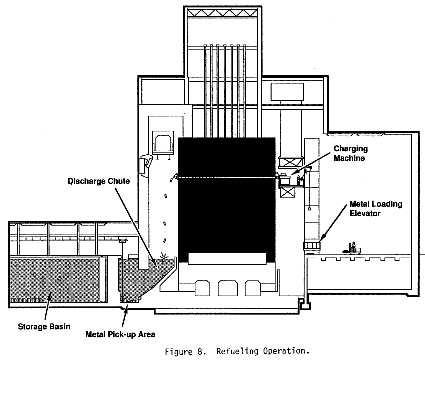
A pdf download details the history of area 100-B.  In this document there is a figure that shows how new fuel elements were pushed in one side and how the spent elements came out the other side into a water basin with the aid of the local (and free) gravitational field.

This seems very clever. I fear that a modern solution would involve 10 years of studies and would result in a half billion dollar high tech solution. Contractors would lock on to the DOE tit and hang there for decades with service contracts and spec’d in consumables.

 Hanford Refueling Process

Lead Couture

In case any of my dear colleagues in the blogosphere are in the market for a lead brasserie or heavy metal codpiece, there is one supplier of goods meant to protect those delicate regions from radiation. By way of style, I’d put the design in the 19th century Amish or Mormon settler category. But, that is beside the point.  This habillement de mode de plumbum [thanks BabelFish!] is meant to protect the more tender regions from ionization.

Nuclear Chemistry Article in Daily Kos

For those of use who carry around an interest in nuclear science, there is a short but interesting article in the Daily Kos written by a chemist on the topic of the Hanford site in Washington.  Of particular interest is the link describing a radiological assay of a chemist who died at age 76 of cardiovascular disease.  At the time of death they found 540 kBq of activity in his body- 90 % in his skeleton. The gentleman had been involved in a glovebox explosion involving exposure to 241-Am at age 64.

What do you do with a radioactive corpse? One option is to donate your body to science. The WSU College of Pharmacy maintains a registry of data culled from uranium and plutonium workers. A recent description of donated bodies is found in this pdf. One donation is from a plutonium worker who was present in the 1965 fire at Rocky Flats. He retained an estimated 6.8 kBq of lung burden. They did not specify how this was determined.  Rocky Flats did have state of the art whole-body monitoring and a substantial health physics department.

Pu detection is a little tricky because one of the important markers for Pu contamination is 241-Am, an alpha and gamma emitter (Pu is a bad actor mostly because of internal alpha exposure).  Residual and highly active 241-Pu (104 Ci/g) beta decays to the highly active 241-Am.  Unfortunately, not all Pu isotopes decay into Americium. This Am isotope allows for gamma ray spectra to be gathered so an estimate of Pu exposure can be calculated. The ever popular 239-Pu isotope alpha decays to 235-U without much gamma emission. So, the calculation of Pu exposure and dose depends on knowing the purity of the Pu at issue.