
Category Archives: Patents

Junior RFK and Thimerosal

My, my, my. Rober F. Kennedy Jr. really screwed the pooch with his comments on ethnically targeted COVID-19. Reportedly, he said “there is an argument that (COVID-19) is ethnically targeted”, adding “Covid-19 is targeted to attack Caucasians and Black people. The people who are most immune are Ashkenazi Jews and Chinese …. we don’t know whether it’s deliberately targeted or not.” If this quote is correct, he did not actually say that COVID-19 was ethnically targeted, but rather that “there is an argument …”. It is much like saying “is Bob still beating his wife? I just don’t know …” Whether he endorses the targeting theory or not isn’t clear, but he was willing to trot out this provocative statement to make his point. There was much blowback. Given the racial undertones, it was a large blunder.

RFK Jr. is well known as an advocate for conspiracy theories, some of which are whoppers. The online news magazine Slate has an article that compiles them. I find that his portfolio of mania is exhausting. The thought of pushing back against such seems like a fool’s errand. It reminds of a line in the movie True Grit: “What have you done when you have bested a fool?” What is the point in debating him?

RFK Jr. is a Harvard grad and went the University of Virginia School of Law to get his JD degree. He had a few slip ups early in his career but recovered. He spent most of his career as an environmental lawyer and has fought many laudable battles for environmental justice. Somewhere along the line he went off the rails and landed in the crackpot ferry to conspiracy land. RFK Jr. is a penetrating anti-vaccine voice who can draw large crowds if for no other reason just to see him.

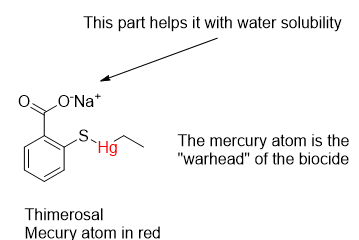
The substance of concern behind much of the anti-vaccine Sturm und Drang is Thimerosal. It is a synthetic organomercurial compound that is effective against bacteria and fungi. Its biocidal properties have been known since the around 1930. Mercurials have been used since the time of the Swiss alchemist Paracelsus (Philippus Aureolus Theophrastus Bombastus von Hohenheim) in the 1500’s. Paracelsus is known for the pronouncement that “only the dose makes the poison.” This remains a fundamental principle of toxicology.

The early mercurial medicaments used by Paracelsus were simple inorganic salts of mercury(II) like mercuric chloride, HgCl2, or mercury(I) like mercurous chloride, Hg2Cl2, also known as the mineral calomel. Mercuric chloride is prepared by treating liquid mercury with sulfuric acid followed by addition of sodium chloride for anion exchange. Mercurous chloride is prepared by heating mercuric chloride with mercury to do the reduction of Hg++ to Hg+.

Thimerosal is sometimes wrongly compared to methylmercury, a known and tragically toxic compound with the formula CH3Hg+X. The X anion can be chloride, hydroxide or a thiol, depending on the source. It is an easy comparison to make because of the similarity of methyl (CH3) to the ethyl (CH3CH2) hydrocarbon group in Thimerosal, but research has proven it to be a poor comparison. Methylmercury compounds can be produced by aquatic microorganisms in water bodies in the presence of inorganic mercury. The methylation of natural biomolecules is a well-known process.

Like many metals, mercury has an affinity for sulfur, occurring naturally as mercury (II) sulfide, HgS, as deposits of Cinnabar or as a minor constituent with other minerals. It also has an affinity for sulfur-containing amino acids such as methionine, cysteine and homocysteine found in proteins. In the bloodstream mercury binds with proteins like albumin to the extent of 95-99 %. While in the body and exposed to water it decomposes to thiosalicylate and ethylmercury. Ethylmercury cation (CH3CH2Hg+) disperses widely and can cross the blood-brain and placental barriers.
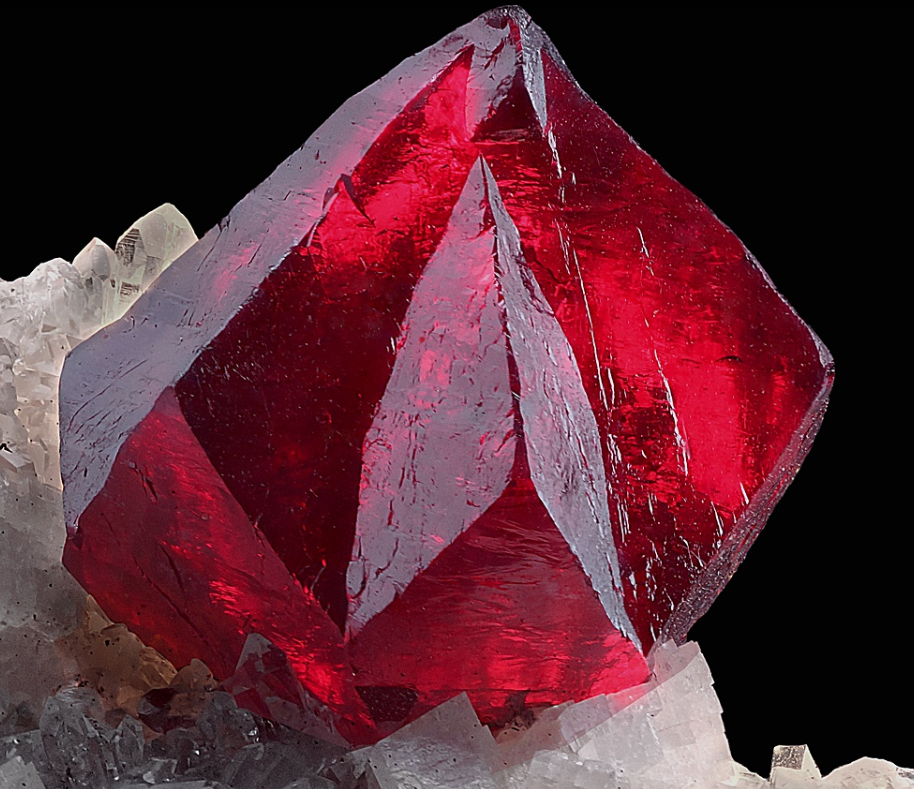
Cinnabar crystal, HgS. Source: Mindat.org

According to Doria, Farina, and Rocha (2015) in Applied Toxicology, a comparison of effects between methylmercury and ethylmercury gave essentially the same outcomes in vitro for cardiovascular, neural and immune cells. Under in vivo conditions, however, there was evidence of different toxicokinetic profiles. Ethylmercury showed a shorter half-life, compartmental distribution and elimination compared to methylmercury. Methylmercury and ethylmercury toxicity profiles show different exposure and toxicity risks.

For many years, Thimerosal was sold as an antiseptic under the name Merthiolate as a tincture (an ethanol solution) by Eli Lilly and Co. Like most households in the 1960’s, we had it in the medicine cabinet or its cousin Mercurochrome. They were used for topical application to burns, cuts and scratches. Thimerosal has been used as a preservative in many health-related preparations such as vaccines, eye drops and contact lens disinfecting solutions. While the CDC has cleared it of doing harm, anti-vaccine mania hit the fan well before COVID-19 and RFK Jr. put his credibility and name recognition behind it.

Thimerosal was first prepared by chemist Morris Kharasch at the University of Maryland in 1927. An interesting technical summary of the substance can be found on Drugbank Online.
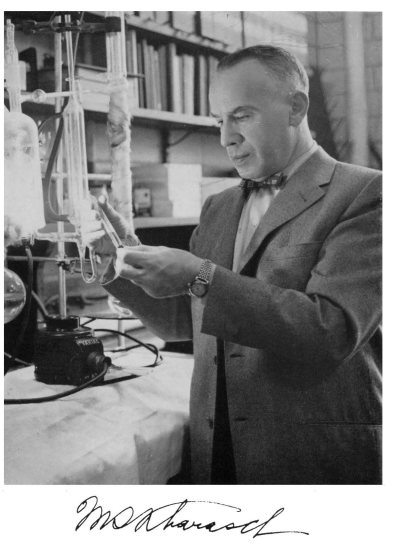
Morris Selig Kharasch. Photo credit: National Academy of Sciences, 1960.

Kharasch is known for his pioneering work in free radical chemistry in the 1930’s at the University of Chicago but before that began his work with organomercury chemistry during the 1920’s while at the University of Maryland. His development of Thimerosal was a result of his organomercury work. He is also credited with opening the door to organic free radical chemistry leading to improvements in rubber polymer chemistry and manufacture. His work led to the use of peroxides to reliably induce the so-called anti-Markovnikov addition of a protic acid (HX) to olefins. The presence of trace peroxides was behind the unexpected “reverse” Markovnikov addition of seen in work with the addition of hydrogen bromide to bromopropene.

Kharasch’s early work in organomercury chemistry led to the invention (and patenting) of what became known as Merthiolate (thimerosal). Kharasch later worked as a successful consultant for Eli Lilly, the Du Pont Company, US Rubber, the US Army and others. In many cases these companies were the assignees of the patents.

Little mention is made of Morris Kharasch as a prolific and wide-ranging inventor with, by my count, 117 US patents with him as the inventor. So, why did Kharasch bother to patent Thimerosal? Did he anticipate its biocidal and preservative properties?

Kharasch references make mention of a 1931 patent regarding Thimerosal. That patent is STABILIZED BACTERICIDE AND PROCESS OF STABILIZING IT, US 1862896, appln. filed August 22, 1931, assignee: no party disclosed. The patent claims a process for and claims of water-soluble solution compositions. Numerous additives include antioxidants, alkyl amines, ethanolamine and borax. Claim 19 is telling. It claims the composition of sodium ethyl mercurithiosalicylate (Thimerosal), monoethanolamine, borax as a buffer and enough sodium chloride to make the composition sufficiently isotonic with the body fluids. In this patent the Thimerosal composition itself is not claimed, but as a component of a stabilized water solution. Claim 14 claims a water solution composition of sodium ethyl mercurithiosalicylate and an antioxidant which tends to “inhibit the acquisition” (odd choice of words) of burning properties by the solution. This plus the claim of an isotonic composition strongly suggests anticipated medicinal applications.

STABILIZED ORGANO-MERCUR-SULFUR COMPOUNDS, US 2012820, appln. Feb 17, 1934, assignee: Eli Lilly and Company. Claims a stabilized solution of alkyl mercuric sulfur compounds in water with aliphatic 1,2-diamines. Also claims Ethylenediamine ethylmercurithiosalicylate composition. This is similar to the ‘896 patent but specified ethylenediamines.

As mentioned above, the biocidal nature of inorganic mercurials had been known for a long time. There was actually limited success in the treatment of syphilis. But they were long known for being very harsh on the patient and grew out of favor when better treatments came along.

The antiseptic properties of Mercurochrome were discovered in 1918 at Johns Hopkins Hospital by urologist Hugh H. Young. Mercurochrome is essentially a dye molecule with an attached mercury warhead. There are three groups on the organic structure that aid in its solubility in water- NaO, CO2Na, and HgOH. Water solubility is often an important attribute in medicinal substances.
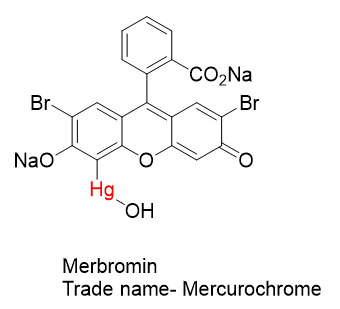
Source: Wikipedia.

Given that antiseptic properties of organomercurials were known, it is perhaps not surprising that an enterprising Ukrainian immigrant with an interest in organomercurials like Morris Kharasch might want to patent his invention.

USPTO to open new regional offices

Attention inventors!  I just received this from a friend who is a patent examiner. The USPTO is expanding to 4 new locations around the country.

================================

USPTO to Open Four Regional Patent Offices The Commerce Department and USPTO announced plans today to open regional USPTO offices in or around Dallas, Denver, and Silicon Valley, in addition to the already-announced first satellite office to open July 13 in Detroit. The four offices will function as hubs of innovation and creativity, helping protect and foster American innovation in the global marketplace. They will also help the agency attract talented IP experts throughout the country who will work closely with entrepreneurs to process patent applications, reduce the backlog of unexamined patents, and speed up the overall process, allowing businesses to move their innovation to market more quickly and to create new jobs.

Selection of the four sites was based upon a comprehensive analysis of criteria including geographical diversity, regional economic impact, ability to recruit and retain employees, and the ability to engage the intellectual property community. The Leahy-Smith America Invents Act of 2011 (AIA), signed into law by President Obama in September, requires the USPTO to establish regional satellite locations as part of a larger effort to modernize the U.S. patent system over the next three years.

Since the passage of the AIA, the USPTO and the Department of Commerce have been committed to an open, robust, and fair site selection process based on extensive public input. In addition to reviewing more than 600 public comments in response to a public Federal Register Notice, USPTO officials met with hundreds of state and local officials, congressional delegations, and policy leaders. The selection team developed a model to evaluate more than 50 Metropolitan Statistical Areas based on the previously stated criteria to assess operational cost and feasibility, ability to improve patent quality, and ability to employ U.S. veterans.

The USPTO will develop concepts of operations and best practices for the three newly-announced locations based on lessons learned from the Elijah J. McCoy Detroit Office over the coming months and years. While the Detroit office will employ approximately 120 individuals in its first year of operations, including patent examiners and administrative law judges, the USPTO is working to develop specific hiring plans for the other sites.

The agency will also seek to identify and maximize the unique regional strengths of all four offices to further reduce the backlog of patent applications and appeals.

“By expanding our operation outside of the Washington metropolitan area for the first time in our agency’s 200-plus year history, we are taking unprecedented steps to recruit a diverse range of talented technical experts, creating new opportunities across the American workforce,” said USPTO Director David Kappos. “These efforts, in conjunction with our ongoing implementation of the America Invents Act, are improving the effectiveness of our IP system, and breathing new life into the innovation ecosystem.”

Patent links

The blog Patently-O is a worthwhile site to visit periodically.  That is if you’re interested in the arcane cosm of patents like I am. The fellow who writes the blog is Dennis Crouch, Asst Prof. at the University of Missouri School of Law. The post on USPTO guidelines on obviousness is particularly interesting.  I find this to be the most vexing part of patent law. 

EDTexweblog documents patent litigation in the East Texas district. I especially like the litigation haiku.  Reference and comparison is made to Vogon poetry.

Anything Under the Sun, by Russ Krajek, is another useful site to visit if you want to glean useful tidbits on patent practice.  These sites are maintained by people interested in their field and are happy to share insights with others.

Cyanide-Based Legislative Voting Machine

The US patent literature is full of wondrous inventions and its easy access by computer-machine over the internets is a real boon to historians and hacks like myself.  In the course of my studies into 19th century gold metallurgy, I stumbled across US 7,521, issued July 22, 1850. This patent was issued to Albert N. Henderson of Buffalo, NY.  Mr. Henderson’s invention is entitled IMPROVEMENT IN THE APPLICATION OF ELECTRO-CHEMICAL PRINTING IN COLORS FOR TAKING AYES AND NOES. 

Henderson describes an apparatus for taking the ayes and noes by galvanic electricity and specifically proposed it for use in legislative assemblies. The concept was that at each desk in the assembly would be two keys (switches, as we now call them) for voting either Aye of No. The member would press one of the keys when called to vote, with the result of an electric current passing to a central apparatus with specially treated paper pressed between electrodes. The action of the current in the damp treated paper would be that a vote would be registered as a mark on the paper, recording the vote of the member.  In the end, the only gold connection in the patent related to gold electrodes as a preferred embodiment.

Claim 1.  This patent claims a mode of imprinting words, letters, & figures, etc, upon paper or other fibrous substances between two surfaces of a metal which is not acted upon by the substances employed, on one of which the letters or figures are raised by passing a current of galvanic electricity through the prepared material, substantially as above described.

Claim 2. Passing the electric current between metallic surfaces, as above described, through damp paper otherwise unprepared, and afterward applying a chemical solution, by which the effect of the electricity becomes visible whenever it has passed through the paper, for the purposes above described- telegraphing, etc.

Substances which may be used as part of the solution for the preparation of the paper- Copper sulfate (gives black impression), Potassium cyanide which may be acidified with H2SO4 or HNO3 (!!) to impart a green color with the galvanic current.  A strong solution of KCN with Ag chloride gives a green impression. All above leave white paper until acted upon by electricity.  A weak soln of potassium ferrocyanide (prussiate of potassia) colors the paper slightly and leaves a deep blue impression by the electricity. Henderson prefers to use electrodes of gold or platinum.

This invention has a kind of steampunk aspect that I find very appealing. On the other hand, it is hard to know what knowledge the inventor had with regard to the hazards of KCN or acidified solutions thereof. The patent is silent with regard to the chemical safety questions arising from the use of KCN treated paper.

Reading, searching, researching, and writing. My life as a chemist.

It turns out that I like Russian fiction. On a lark I picked up a collection of short stories by Nikolai Gogol on Amazon (ISBN 978-0-14-044907-5). It was worthwhile. 

Actually, it wasn’t such a lark. I was looking for a copy of Diary of a Madman.  The idea was to find a cutting for an audition, in case such an opportunity arose.  Gogol’s Diary of a Madman and The Government Inspector have been performed for generations and, as usual, I’m the last of my age cohort to read it.

I spend my days supervising chemical research, doing reactive hazard studies and IP analysis. From the job description point of view, I’m a walking, jabbering freak. How the hell am I going to get a job elsewhere with a resume like that? HR will look at it and, failing to find an exact match in their organization, toss it into the discard folder.  I don’t fear chemicals, but I do fear HR.  HR is the bane of our profession.

Back to the day job, these areas are basically writing activities and occur at a desk. It has occured to me that working at a desk is more dangerous than working with chemicals.  You soon get fat(ter) and stressed. It’s not good. 

It is funny how job descriptions differ. Many colleagues have jobs where they execute some task by bringing something into a predetermined structure. By that I mean, an analyst performs a standard procedure or the QA manager documents data for a product cert. An accountant performs procedures in the general ledger according to rules. Their work is reasonably well defined and they know when they are done.

Not a single thing I do is amenable to this kind of structured performance.  The chemistry stuff is experimental and involves sorting out what the hell happened. That’s just the nature of applied scientific investigation.

The IP work involves searching for information. If you find a relevant patent, well, you might be near the endpoint. Lucky day. But if you don’t find claims on a composition or a process, it’s a negative result. You have to ask if your search strategy was adequate. Anyone who has used a search engine knows what I mean. Sometimes, you don’t pick the best search terms and you come up with junk. Eventually you blunder into the right term and find the mother lode.

Sometimes an information search becomes dendritic. You find yourself bobbing along in the brackish waters of the “merely interesting”. So, you back up and revise the search terms.  Doing an IP search for an exact composition in CAS is very straightforward. A structure search or a CASRN search is very reliable and fast.

Much time can be wasted with patents that use compositions or processes but do not claim them. In particular I mean patents that mention compounds in the description (or specification) but do not claim them in the claim section.  A great many patents may be served up in the list of hits in this way. How you deal with this depends on what you want and what kind of search tool you’re using.

If you are interested in a class of compositions or the range of technology that might be out there, this is a kind of search that is more dendritic and subject to stranding in cul de sacs. If you do not use Chemical Abstracts Service in some way, your options become restricted.  There are many IP services that tap the various patent offices around the world. Some seem to have their own databases. Many seem to focus solely on searching the patent data through clever use of search terms or the patent classification system. For prior art searching, this is inadequate. For the most part, only CAS can provide reliable hits if a compound was reported in Acta Retracta by Professor van Wingenheuk in 1907.

After a day of reading abstracts and patents, it’s nice to read something well written and get lost in it for a little while. Patents are not written to be easily understood. They are often masterful in their obfuscation. I often admire the conciseness with which many are written. But in the end, they are all disclosures written grudgingly and with the intent to obscure.

Th’ Gaussling’s Epistle to the Phosita’s. PTO is Hiring

Got an email from a  friend who is a patent examiner. I thought I’d pass the rumor that the US Patent and Trademark Office is planning to hire 1000 more examiners in the coming months, 100 of which will be in the chemical field.  The USPTO website seems rather perky as well.  I can’t verify the accuracy of the number of hires planned- it’s just what my examiner friend said.

The good news is that it is a job with benefits. The bad news is that you have to live in the DC area, study patent applications all day, and haggle with endothermic patent attorneys.  For an interesting view of life as an examiner, read the blog Just a Patent Examiner.  Remember, Einstein was a patent examiner. Hmmm …. I wonder if he understood novelty?

My friend said that the goal is to fill the slots before the hoard of angry Tea Party Pissants take over the house next year.  (Well, ok. He said republicans. I made up the part about Tea Party Pissants)

I can’t bring myself to apply.

I wonder if an examiner must have more than ordinary skill in the art? An Über-Phosita.

Patent-isms

Odd descriptions of matter and the peculiar turn of phrase abound in the chemical patent literature. Here are just a few of my favorites (italics mine)-

  • “… wherein the substituents have the following significations:”
  • ionic layered compositions  (translation- clay)
  • Donor solvents (translation- certainly an ether, perhaps an ester)
  • A non-coordinating dispersant (translation- a hydrocarbon solvent)

The deal with the devil that you make in getting a patent is this- in exchange for a 20 year monopoly, you must disclose to the public enough enabling information that a confused citizen could determine if he/she is infringing on the patent and reasonably avoid infringement. But this does not stop the use of opaque vocabulary and unusual juxtapositions because, after all, one skilled in the art should be able to decode the many obfuscations applied to their area of specialty. Shouldn’t they…? Or, perhaps the obtuse vocabulary is meant to daze and confuse the judge and jury. Hmmm.

Chemical Art in the Public Domain

For the last few years I have been attempting to work with a full professor of chemistry who holds a named chair. He is fast approaching emeritus status and in addition to the other maladies of aging, he tends toward spontaneously bureaucratic demands and is rather hard of listening. His secretary types his correspondence which is written in the officious, pseudo-legalese tone remniscent of a 19th century divorce decree.

Recently, while discussing chemistry with the “judge” by email, I suggested that he look at the patent literature for clues to synthetic procedure. Procedures found in patents may have a general utility and are not automatically claimed. Minimally, a dip in the patent literature broadens ones knowledge of the prior art. Certainly, art found in expired patents has a high likelihood of being up for grabs.

My clumsy and sophomoric attempt at helpfulness sparked a multiparagraph recitation in reply on the anticipatory nature of content in patents and how “such material” is unacceptable for “we in academe”.

Suit yourself, says I. But like any prospector knows, gold is where you find it. And this brings me to a point.

Every week some number of US patents expire or lapse. This continuous stream of expiration represents a situation much like the periodic deposit of placer gold after the spring runoff.  Gold veins in the walls of the canyon spall and fracture allowing gold nuggets and dust to tumble into the creek.  Prospectors who know what to look for can pick up the occasional nugget of art that has fallen into the public domain.

Granted, expired art may be 17 years out of date, but many kinds of compositions and transformations in chemistry are not subject to the expiration of utility. Many kinds of oxidations, reductions, alkylations, halogenations, functional group transformations, etc., remain quite useful over time. What changes over time are the economic and regulatory compliance issues. It is possible to make C-C bonds without a platinum group metal, triflate, and boron.

The value of expired patent art is well known by the pharmaceutical industry. Pharma companies will fight like wounded bears to get extra days added to their patents or otherwise attempt to extend claimed art as far into the future as possible with formulation or other schemes. They know that the day after a cash cow drug goes off patent, there will be generic versions on sale by opportunistic producers.

Prior to June 8, 1995, utility and plant patents were allowed for a period of 17 years with the 17 year clock starting from the application date and the period of enforceability beginning on the issuance date. From June 8, 1995 onward, utility and plant patents are valid for 20 years.

It is in the nature of scientifically minded folk to be forward looking and lavish extra attention on the latest techniques.  In our enthusiasm for the new and exciting, we may forget the vast storehouse of knowledge accumulated over the last 100 years of chemical research.

There is an ever increasing store of public domain art at the patent office waiting to be extracted by those who have the interest to do so. If you do decide to adopt some expired art, it is worth paying attorneys fees to make sure your judgement is sound and to look for related patents that may be problematic. Due diligence is money well spent.

It is true that patents are written by lawyers with little interest in providing too much enablement to the public. But these lawyers also know that playing games with enablement is contrary to the intent of the sworn statements in the application and may ultimately weaken a patent during litigation. A patent isn’t a peer reviewed paper. But, to Phosita, it can be a rich source of clues on how to perform some particular expired art that may serve as the basis of a product or process.

Meat and Cheese Explosives

So, I’m blundering through the literature on a snipe hunt when I run into this ICI patent- US 5,456,729. In the description, they teach a method of preparing an explosive composition using “lactic casein”. Having been in the dairy business long ago, and specifically having worked in a cottage cheese plant, I recognized this component as … cheese. Well, mostly. Example 5 discloses a composition comprising 25 % ammonium nitrate and 3 % lactic casein.

Unless you have lactose intolerance, cheese is not ordinarily an explosive. In the patent, the lactic casein is one of many examples of a foam stabilizer. Other stabilizers include animal and fish proteins as well as collagens. A collection of other chemical additives rounds off the list.

If they had specified gluten, they could have claimed the use of a pastrami and cheese on rye sandwich as stabilizer feedstock for their explosive composition.

Law Review Issue on Nonobviousness

The summer 2008 issue of the Lewis & Clark (Vol 12, No. 2) Law Review is dedicated to the matter of nonobviousness in patent law- Business Law Forum: Nonobviousness — The Shape of Things to Come.

The papers are scholarly articles and are very densely written (sorta like some posts in this blog!!). But if you can tolerate that style or are an insomniac, some of the work seems to be worth plowing through.

Nonobviousness is one of the most vexing aspects of patent law. I find that my natural inclinations about what constitutes obviousness are completely inapplicable to patents. Perhaps one day I’ll get it.