According to Argus there are problems with the processing of Permian West Texas Intermediate (WTI) crude oil. Natural gas liquids, NGL, and additives are being blended upstream into WTI in an effort to boost profits in the face of low prices for crude oil. This is causing processing problems downstream. The problematic NGL component is butane.
The purpose behind adding NGLs is to lighten the WTI into a higher grade. Refineries not accustomed to receiving WTI that has been lightened with NGL are having problems with excessive light fractions that the refinery was not designed for. Crude enhanced with NGLs produce a higher output of light end yields, leading to production bottle necks. Further, the NGL enhanced crude is less dense and occupy more space in pipeline than does typical crude. As of the time of the report by Argus, is was unclear where the NGLs are coming from. NGLs are naturally found in crude oil.
Mercaptans are increasingly problematic, especially for export to countries with more stringent requirements for sulfur. Sulfur compounds are destructive to refinery operations and are subject to regulatory restrictions in some fuels like diesel and jet fuel.
Offshore US Gulf medium sour Mars refers to oil produced by a platform in the Gulf of Mexico and it serves as a benchmark for quality. Recently zinc contamination has been found in Mars crude stream. This has led to supply chain interruptions and refinery problems.
The next president of the US, # 47, was heard to proclaim very recently the slogan ‘Drill Baby Drill‘. This slogan was first used by Lieutenant Governor Michael Steele of Maryland at the 2008 Republican National Convention. It was quickly picked up and made famous by Sarah Palin at the 2008 vice-presidential debate with Joe Biden. The slogan was used frequently by former president DJ Trump in his 2024 presidential campaign.
As slogans go, Drill Baby Drill successfully hit a nerve with Trump’s constituency if for no other reason than as a shout-in-your-face taunt. There was and is conservative consternation with liberal push-back on the practice of hydraulic fracturing (‘fracking’). It is not just fracking either. Opening public land to oil exploration was met with howls of dismay by Democrats over the plan to open up ANWR and other public lands to oil exploration, drilling and pipelines.
Many seem to believe, MAGAs in particular, that increased drilling and fracking will automatically decrease gas and diesel prices at the pump. From 50,000 feet up, that might seem to be true. More supply, lower prices or so the thinking goes. But economics learned in the back yard drinking beer while playing corn hole or from TikTok only takes you so far. There are many details that have their origins national and global politics as well as the many particulars of how the oil & gas supply chain actually works.
An excellent source of data on the global oil & gas situation is the International Energy Agency, IEA. They offer an excellent pdf report of the global oil picture extending to 2030. Here are the highlights from the IEA November 2024 Oil Market Report:
Consider
World oil demand is forecast to expand by 920 kb/d this year and just shy of 1 mb/d in 2025, to 102.8 mb/d 2024 and 103.8 mb/d 2025, respectively. The slowdown in growth from recent years reflect the end of the post-pandemic release of pent-up demand and below-par underlying global economic conditions, as well as clean energy technology deployment. (kb/d = kilobarrels per day; mb/d = million barrels per day)
Global oil supply rose by 290 kb/d in October to 102.9 mb/d, as the return of Libyan oil to the market more than offset lower Kazakh and Iranian supplies. OPEC+ delayed the unwinding of extra voluntary production cuts to January, at the earliest. Non-OPEC+ producers will boost supply by roughly 1.5 mb/d in both 2024 and 2025.
Refinery margins improved in October as seasonal maintenance and economic run cuts supported product cracks. Global refinery runs hit a seasonal low in October before starting to recover in November and will average 82.8 mb/d this year and 83.4 mb/d in 2025. Annual growth of roughly 600 kb/d is driven largely by OECD Americas (+360 kb/d) this year and by non-OECD regions in 2025.
Global oil inventories plunged by 47.5 mb in September, to their lowest level since January, led by a sharp draw in OECD oil products and non-OECD crude oil stocks. OECD industry stocks fell by 36.4 mb to 27.99 mb, 95.3 mb below the five-year average. Provisional data suggest total global stocks decreased for a fifth consecutive month in October.
‘Global oil markets face a surplus of more than 1 million barrels a day next year as Chinese demand continues to falter, cushioning prices against turmoil in the Middle East and beyond, the International Energy Agency said.’
As you may know, lately China has been having a rough go of it economically with their construction and real estate crises. Bloomberg reports that-
‘Oil consumption in China — the powerhouse of world markets for the past two decades — has contracted for six straight months through September and will grow this year at just 10% of the rate seen in 2023, the IEA said in a monthly report on Thursday. The global glut would be even bigger if OPEC+ decides to press on with plans to revive halted production when it gathers next month, according to the agency.’
The linked Bloomberg article paints a picture of static global demand for oil and weak prices extending into 2025 and possibly longer. So, this leads us to the question- How anxious does this picture make oil executives who are always looking for a reason to increase oil & gas exploration and drilling? Obviously, their planning goes well past 2025. Lower wholesale prices of gasoline and diesel out of the refinery do not automatically translate into proportionally lower retail prices at the pump. What would be the reason that a gas station owner would lower the retail price just because his wholesale fuel costs have dropped? Why would they forfeit profit margin to offer lower pump prices when they could keep prices as high as the market allows?
Do you think that a MAGA gas station owner with a red hat would offer reduced margins and prices to MAGA customers in red hats just … because he/she is generous? I don’t think so.
The reality has always been that fuel prices are based on what the customer is willing to pay. A president or candidate promising lower fuel prices in the USA should be viewed with serious skepticism. The entire supply chain from drillers to gas station owners struggle to maximize their profit margins and sales volumes 24/7. Do we really believe that the supply chain would bend to the price promises of some politico? Perhaps in Venezuela but look at what price fuel price meddling has done to that country.
Drill-Baby-Drill is a shallow chant used to polarize voters into opposing Democrats by lumping them into a contrived basket of anti-American fools. The trouble is that it works.
An effect of the internet and social media is that it brings the entire bell curve of voters to the table where many believe that all opinions are of equal merit. On the macroscopic scale, all citizens in the broader bell curve have a right to express their opinions. But just like at the microscopic scale of business, home and institutions, arguments and opinions without merit can be cast aside. Facts and solid logic should prevail over hand waving opinions.
9/11/24. At present numerous oil production platforms in the Gulf of Mexico have been evacuated because of Hurricane Francine. One of them is the “Who Dat” O&G field. The Who Dat field produces O&G with low wax content and no asphaltene flocculation. The origin of the phrase “Who Dat” comes from the Acadiana region of Louisiana. There are numerous claims to the origin of the phrase and there have been legal spats as to the trademark ownership of the phrase. The NFL in particular has thrown its ponderous weight around in the matter. The reader is encouraged dive into ‘controversy’ for themselves.
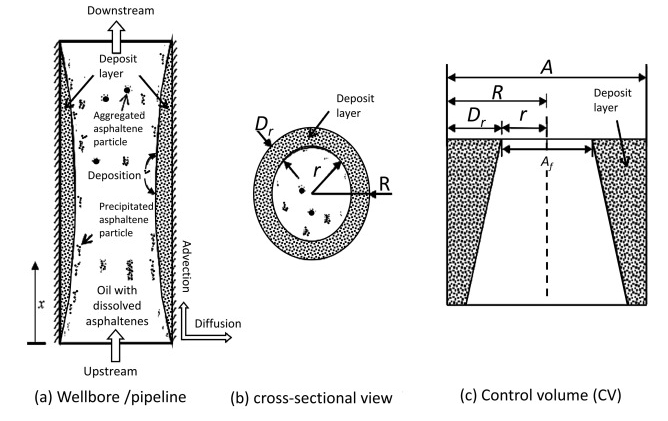
The low asphaltene-flocculation of the Who Dat field is fortuitous since asphaltenes can accumulate and choke the well bore or downstream piping, interfering with recovery. The graphic below is borrowed from a book chapter by Abdullah Hussein, Essentials of Flow Assurance Solids in Oil and Gas Operation, published by ScienceDirect in 2023. Fouling by asphaltenes can be removed by dissolution in aromatic hydrocarbons or detergents.
As asphaltene-bearing oil rises in the wellbore, it will begin to depressurize and cool causing the asphaltenes to precipitate out of solution and aggregate, resulting in flocculation and fouling of the wellbore, downstream equipment and pipelines.
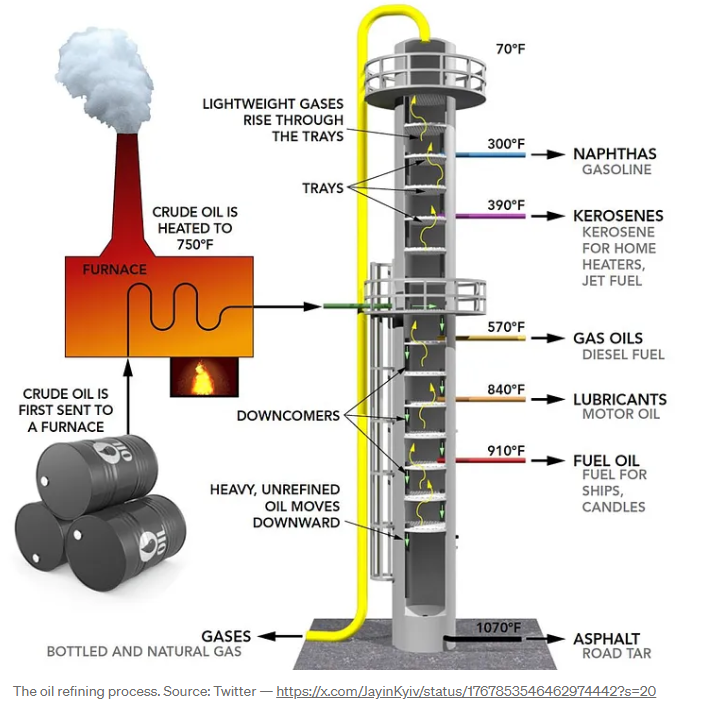
Graphic: Note that the higher the boiling point (heavies), the lower on the column a fraction is drawn from. In particular the asphalt fraction must remain quite hot to assure that it can flow away. The low boiling point fractions (lights) are vented off and sent elsewhere for processing. The graphic is sourced from here under the Fair Use Doctrine.
The simplified cartoon of a distillation column above shows that used in petroleum refining to isolate hydrocarbon components (fractions) in broad groupings by boiling point. These columns are quite tall and can be spotted easily as you drive by a refinery. Crude oil has suspended solids that are removed by water extraction which is then vaporized in a separate furnace under pressure. This hot, crude vapor is then pumped into the bottom of the distillation tower. For the non-industrial chemists out there who are accustomed to heating a reaction or distillation vessel directly nested in a heating mantle, this offset heat exchange approach is quite common. The fuel for the furnace can be several in-house sources.
Crude oil is a highly complex mixture of hydrocarbons and NSOs (nitrogen, sulfur, oxygen and heavy metals) with a broad range of structures and boiling points. These petroleum hydrocarbons contain a bit of nitrogen, sulfur and oxygen, produced water, natural gas, and inorganics. The hydrocarbons are further divided into linear, branched, aromatic/nonaromatic and cyclic carbon skeletons in which each can be subdivided again into differing molecular formulas and degrees of unsaturation. At this point the reader may need to take a cool refreshing dip into the pool of chemical bonding and the covalent bond in particular because this has a direct bearing on degrees of unsaturation.
A swerve into the weeds of chemical bonding
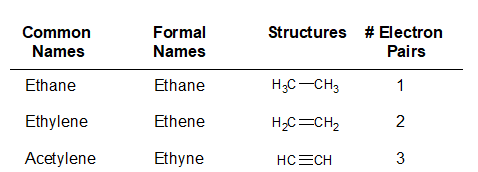
Here is the long and short of how the different types of chemical bonds affect the formula and structure of a molecule. Carbon atoms make up the skeleton of a molecule and are connected through the sharing of electron pairs. The shared electrons in a bond spend some fraction of their time in orbit between the two carbon nuclei and as such continue to screen out some of the mutual repulsion of the two nuclei. But that is not all. It turns out that this is where quantum mechanics rises from the murky depths of reality. The two bonding electrons are each able to occupy more space than what is available in the individual atoms and so drop in overall energy just a bit. This energy drop is manifested as heat which diffuses into the local environment. The amount of energy lost consists of a discrete quantity of electron orbital energy and occurs in a stepwise manner. This discrete step change is a “quantum jump”. [Note: a ‘quantum jump’ is often portrayed in the popular media as some type of Disneyesque dramatic and abrupt big shift in something or other. In reality it refers to a discrete step change in energy at the sub-nanometer scale.]
Graphics by Fred Ziffel. Each line between the Carbon atoms represents one pair of bonding electrons.
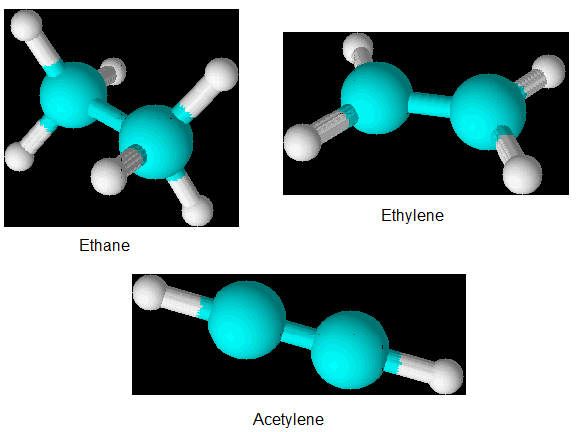
The number of bonds between the carbon atoms has consequences in the 3D shape of the molecule. In the 3 ball and stick representations below, only skeletal single bonds are shown (for reasons known only to ChemSketch).
Graphics by Arnold Ziffel. Bonds number 2 and 3 are omitted in Ethylene and Acetylene to emphasize the shapes. Note the flat planar shape of Ethylene compared to Ethane.
But what do you mean by ‘aromatic’?
The aromatic feature of a molecule is very special. It has a unique type of pi-bonding involving ‘special’ numbers of bonding electrons arranged in a ring and limited by the formula (4n + 2), where n is a counting integer. For n = 0, 1 2, etc., the numbers of electrons involved will be 2, 6 and 10 bonding electrons alternating in a ring. The most frequent ‘special’ number of electrons is 6, as in 3 alternating pairs of 2 electrons. Here, aromatic does not refer to fragrance, although many aromatic compounds like vanillin do have a fragrance. A cyclic group of 3 alternating bonding pairs of electrons will spontaneously ‘delocalize’ and occupy a lower energy level- a much-favored situation. That is, they will circulate around in a continuous ring and occupy a space above and below the ring atoms in a ‘sandwich’ fashion. Okay, we’re drifting a little too far into the weeds.
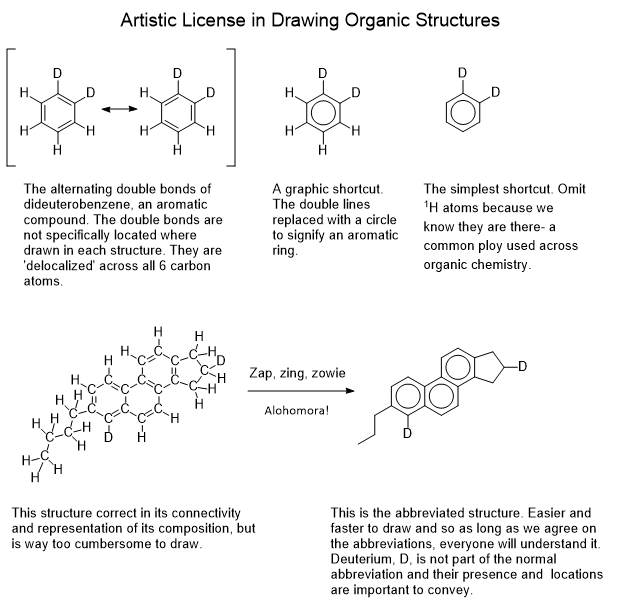
Graphics by Arnold Ziffel. Organic chemists draw a lot of chemical structures and, frankly, it can become tedious. To make life easier, certain graphical norms have arisen to stem the tedium.
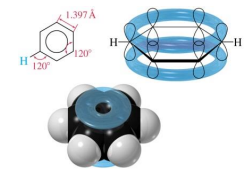
Knowing full well that I am presenting a highly truncated explanation of aromaticity, I have borrowed 3 representations below of the aromatic compound benzene. Given that single C-C bonds are longer than double C=C bonds, one might expect to find that with both C-C and C=C bonds present, 3 bonds would be longer than the other 3. But this isn’t what’s observed. Measurements show that all 6 CC bonds are of the same length, 1.397 Angstroms. And the CC bond angles are all 120 degrees, again different from C-C bond angles. These observations tell us that all 6 CC bonds are equivalent yet different from isolated CC bonds. Note in the upper right structure the 2 blue rings situated above and below the carbon skeleton. These rings represent delocalized electrons that are off-axis to the C-C bonds. They sandwich the carbon skeleton of C-C bonds. The blue rings show the space where the 6 C=C bonding electrons may be found. The bottom structure is a space filling model showing approximately the space occupied by the electron cloud. Think of it as the location of where another molecule will collide with it.
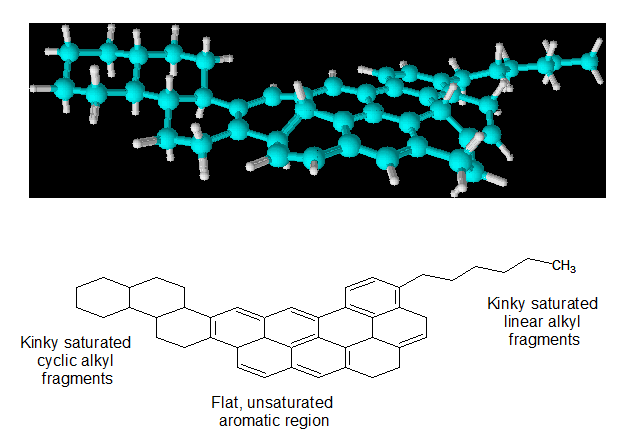
The imaginary large molecule shown below consists of a central region that is flat and two domains that are kinked and bristling with hydrogen atoms. The structure is shown stationary but in reality, it is vibrating vigorously, tumbling in solution, being battered by adjacent molecules and mashing its way through any liquid that may be around it. You know, the usual liquid scenario. The cyclic alkyl groups on the left are locked in space allowing only limited wagging motion, but the alkyl group on the right is free to rotate about all of the C-C bonds allowing the chain to writhe and snake around in its immediate 3D space.
Graphics by Sam Hill. 3D and 2D structures of an imaginary asphaltene. The aromatic section of the molecule is flat while the alkyl parts are kinked and bristly.
Above I referred to “… the sharing of a pair of electrons.” This is only just 1 part in a story of several kinds of chemical bonding. One carbon atom can bond to another carbon atom with 1, 2 or 3 pairs of electrons, producing 1, 2 or 3 chemical bonds. Carbon can also bond by sharing electrons (covalent bonding) with other atoms like nitrogen, oxygen and sulfur to form single or multiple covalent bonds. Atoms like hydrogen, boron, fluorine, chlorine, silicon, phosphorus, bromine and iodine bond well with carbon but with only a single bond. In general, as we move to the left and down on the periodic table the sharing of electron pairs becomes more and more one sided favoring the atom nearest to the upper right of the table. [Note to the purists: we are going to ignore carbanions, carbocations and carbenes in this post.]
Back to our regularly scheduled program
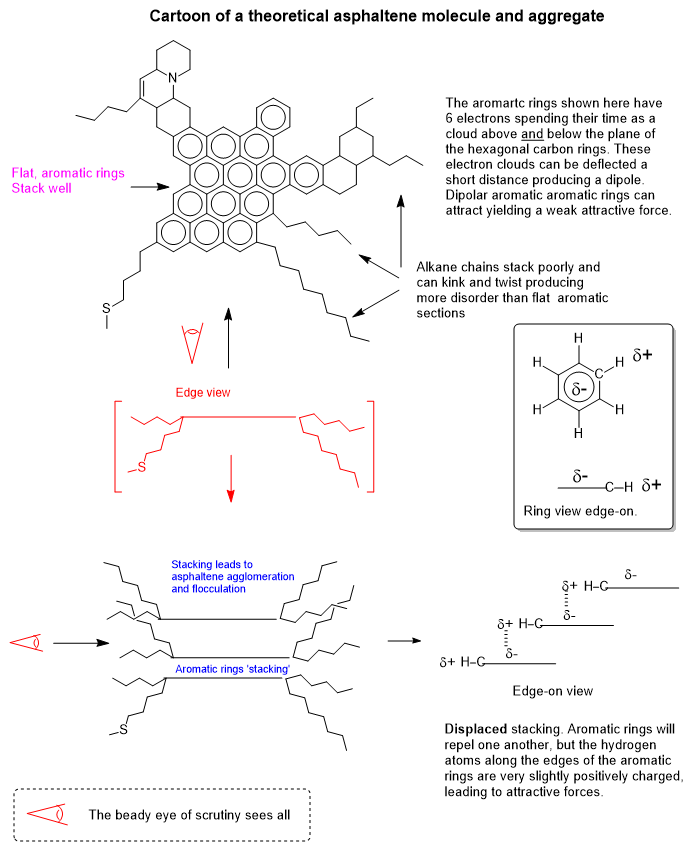
So what does all this bonding jazz have to do with asphaltenes? The type of chemical bond that makes aromatic rings flat, the pi-bond, is very abundant in asphaltenes. An aromatic ring of 6 carbon atoms has 3 alternating pi-bonds. Such compounds are commonly referred to ‘unsaturated’ meaning they have multiple bonds between carbon atoms rather than bonds with hydrogen- they are unsaturated with hydrogen atoms. These molecules consisting of hexagonal arrays, sharing edges like a thin honeycomb and are able to stack on one another- sometimes called pi-stacking.
Graphics by Arnold Ziffel. Agglomeration is when stacks of asphaltene begin to form. Flocculation is when groups of agglomerated asphaltenes mass together.
The asphaltene component of asphaltene (!?!) has been defined as that fraction which is soluble in aromatic solvents like benzene, toluene and xylene, etc., but not in alkane solvents. From this link, “Asphaltenes are referred to [as] the poly-dispersed distribution of the heaviest and most polarizable fraction of the crude oil.” This property derives from the large fraction of aromatic structures in the asphaltene.
Asphaltenes are a complex mixture of hydrocarbons containing variable amounts of nitrogen and sulfur atoms built into the structures. As a category, asphaltenes are substantially aromatic in nature with rather high molecular weights but may have cyclic and acyclic saturated hydrocarbon, or alkyl, fragments attached. These alkyl fragments lend solubility of individual asphaltene components in saturated hydrocarbon solvents (alkanes) and thus offer a means of semi-selective isolation. Maltenes are asphaltene components that are viscous liquids soluble in n-alkane solvents. Maltenes provide the adhesive qualities in asphalt. Asphaltene is divided into 2 fractions: Asphaltene and Maltene.
The words asphalt and bitumen are sometimes used interchangeably, both referring to the same material. Asphalt is the American English version. To help avoid confusion, the terms “liquid asphalt”, “asphalt binder” or “asphalt cement” are used in the U.S. to distinguish it from asphalt concrete. We recall that concrete is comprised of aggregate held together by cement.
Colloquially, various forms of bitumen are sometimes incorrectly referred to as “tar“. Asphalt or bitumen occurs naturally or can be manufactured. The roadbeds we drive on are “asphalt concrete” where stone aggregate is mixed with hot liquid asphalt as a binder that upon cooling forms a hard, durable surface. In common usage “asphalt concrete” is shortened to asphalt while the British call it tarmac.
Thus far, we have been talking about crude oil-based asphalt. Roughly similar materials like tar or coal tars are derived from sources other than petroleum. Generally, the words tar and pitch are used interchangeably but each can be considered specific to separate starting materials. Tar is a dark brown or black viscous liquid and is the result of the destructive distillation of a wide range of organic materials like wood, peat, coal. or petroleum. Pitch derives just from plant material.
In the early 1960’s, Dr. Fritz Rostler and coworkers of the Golden Bear Oil Company, now Tricor Refining LLC, discovered the cause of asphalt deterioration. He found that during the heat treatment used in asphalt processing and/or under prolonged exposure to sunlight in the presence of oxygen, the maltenes are degraded and their adhesive attribute is diminished, allowing the asphalt/aggregate components to crumble.
According to the online news source “Upstream“, what is at the time of writing the Category 2 Hurricane Francine spinning northeastward in the Gulf of Mexico has resulted in the shutdown of approximately 23.5 % of gulf oil and 26.6 % of gas production. Approximately 35 % of the 371 manned platforms in the gulf have been evacuated according to the US Bureau of Safety and Environmental Enforcement (BSEE).
Francine is projected to make landfall along the Louisiana coast Wednesday on 9/11/24 and move up through Mississippi. That is, unless Trump gets out his Sharpie marker and wills it in another direction ...
The “Who Dat Field” and more
Naturally, when investigating the gulf shutdown I saw mention of the “Who Dat Field“, I had to look into it. It is located in the Mississippi Canyon (MC) blocks 503 / 504 / 547 in the Gulf of Mexico (GOM) in water depths of 945m.
The Who Dat Field is made up of ten stacked reservoirs of the Pliocene and Upper Miocene age. Its reservoirs are located at a depth of 10,000ft-17,000ft, with pressures ranging between 6,000 psi and 12,500 psi.
The three wells drilled at the field encountered more than 700ft of net pay in the reservoirs. The wells flowed at the rate of 10,000 barrels a day of oil and 60 million cubic feet a day of non-associated gas. Source: “Who Dat Field“.
The origin of the phrase “Who Dat” comes from the Acadiana region of Louisiana. There are numerous claims to the origin of the phrase and there have been legal spats concerning the trademark ownership of the phrase. The NFL in particular has thrown its ponderous weight around in the matter. The reader is encouraged dive into controversy.
Most people have heard of fracking in the context of oil and gas (O&G) drilling and maybe a few of them know that this can be done in horizontal drilling at a distance from the surface well hole. Explosives or hydraulic pressure is used to fracture a section of rock formation surround the drill hole and then frac sand is forced into the fractures to prop them open. Sometimes the sand is referred to as a proppant. This increases the permeability of the formation and, hopefully, increases the productivity of the well.
The first directional drilling was performed in 1930 from shore at Huntington Beach, CA, into an offshore deposit of oilsands.
The fracking controversy stems from evidence that fracturing can lead to O&G migration into ground water and then into drinking water. This essay does not address this matter.
Within the O&G drilling world is the question of how far laterally a hole can be drilled and to what extent it pays. According to one source, in 1997 the lateral distance stood at about 500 ft to completion. At present it stands at 3 miles with 4 miles becoming more common. Greater length requires an upgrade in drilling equipment to handle the extra power demands.
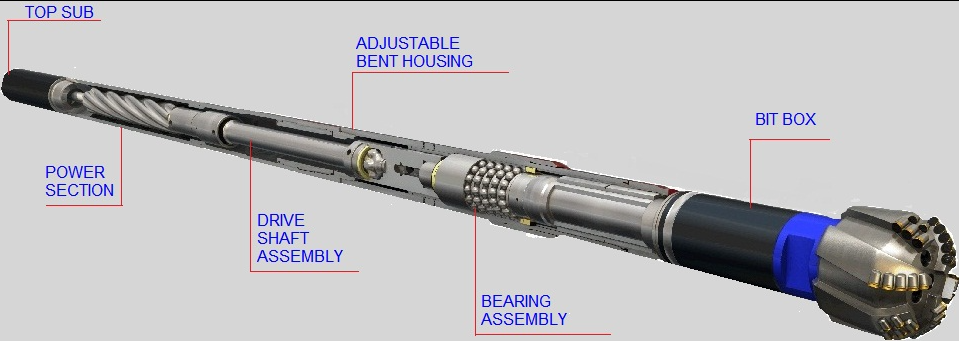
Today there are steerable down-hole mud motors that can rotate the drill bit independent of the drill string. Mud is pumped downhole at high pressure to rotate a rotor connected to the bit. The rotor fits in a stator near the end of the drill string. A steerable feature is able to bend ~3 to 4 degrees.
In the literature there is mention of the issues in vertical drilling through a steeply inclined fault. As the bit penetrates a steep fault surface it could slip and lead to damage of the drill string and casing. Better to penetrate a fault perpendicular to the fault plane with directional drilling.
There are many good reasons for a driller to use directional drilling.
A borehole that has gone off-course can be redirected to the desired direction from the same borehole.
From a single drilling site multiple boreholes can be drilled, each going to a different part of the formation.
During a well blow-out or fire, a new borehole can be drilled from a distance to intercept the blown-out borehole and pump material into it to control the blow-out.
A drilling site can be situated away from a settlement or body of water and still get to the oil reservoir by directional drilling.
Directional drilling can be performed in an existing well where equipment or debris is blocking the original bore hole.
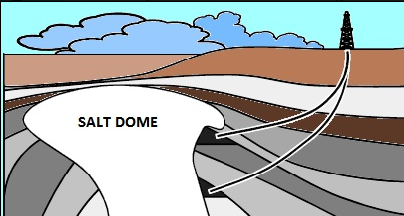
Drilling through a salt dome is problematic for several reasons. A soft formation like a salt dome can result in bit balling where the tricone bit packs with debris and the wheels quit turning. Wellbore erosion, salt creep, and excessive mud losses can occur as well.
Salt domes form from plastic deformation of an underlying low density and ductile salt layer (90 to 99 % halite) into a fault or fracture where it is subject to movement by lateral forces of the surrounding sediment layers. These lateral forces push the salt formation in the direction of weakest forces which is generally upwards. Irregular features in the salt dome can lead to collection of oil and gas pockets. Lateral drilling can be used to access the reservoirs, bypassing the salt formation.
Gasoline prices are expected to rise sharply over the next few weeks owing to low refinery utilization rates in the US. Refinery utilization rates in the US have remained below 87 % for 8 straight weeks. The number that the industry prefers is around 93-95 %. Gasoline stockpiles are below the 5-year seasonal average by 2 % and continue to fall. In the last few months refinery stoppages have been due to weather and maintenance.
The flow of petroleum in the world is comparatively tranquil until it gets to a refinery. There it is heated to several hundred oC, pressurized, passed through distillation columns and split into various streams, passed through different catalysts and cracked into fragments, contacted with hot acids, brutalized with superheated steam, converted into reformates, blended and then sent to a tank farm before heading out to your local gas station. All of this is done with hot, highly flammable hydrocarbons in a continuous flow system. Operators and computers monitor flow rates, temperatures, pressures and fill levels in vessels. Unusable vapors are sent to a flare tower for removal from the facility lest they accumulate and create an explosion hazard. That these places do not explode frequently is a wonderment and attests to the coordinated skill of a great many people.
First, the word is out. According to the EIA, the US was the world’s leading oil producer for the 6th straight year in 2023 producing 12.6 million barrels per day.
It is common for people to blame rising US gasoline and diesel prices only on restrictions in crude oil production and alleged government regulatory overreach. Indeed, pressure on the gas and oil supply side or even just the threat of it can lea to unstable retail gasoline and diesel prices. What is less appreciated is the role of petroleum refineries on prices. To be sure, there is always price speculation on both the wholesale and retail sides of gas and diesel pricing to consider no matter the throughput. Like everywhere else, sellers in the petroleum value chain seek to charge as much as they possibly can 24/7/365. Everyone is itching to charge more but are hindered by competition and risk.
Refineries are only one of several bottlenecks in the gasoline and diesel supply chain that can influence retail prices. In principle, more gas and oil can always be produced at the wellhead by increased exploration or increased imports. Even so, there are constraints on transporting crude to refineries. Pipelines have flow rate limitations and storage tank farms and ocean tanker fleets all have finite capacity. Another bottleneck today is access to both the Suez and Panama canals. Suez Canal traffic is threatened by Houthi missile strikes on commercial shipping in the Red Sea and the Panama Canal seems to be drying up. The result is increased shipping costs and delays for international transport which the consumer will have to bear.
What do refineries do?
Refineries are very special places. Within the refinery there is 24/7 continuous flow of large volumes of highly flammable liquids and gases that are subjected to extreme temperatures and pressures for distillation, cracking, alkylates, hydrogenations and reformates. The whole refinery is designed, built and operated to produce the fastest and highest output of the most valuable group of products- fuels. This group would include gasoline, diesel, aviation fuel, and heating oil.
Petrochemicals account for approximately 17 % or refinery output. These petrochemical streams account for pharmaceutical raw materials, polymer products, coatings and films, synthetic fibers, personal hygiene products, synthetic rubber, lubricating grease and oils, paint, cleaning products and more. Regardless of what we may think of plastics and other synthetic materials, the 17 % produced by refineries feeds a very large fraction of the global economy. If plastic bags went away overnight, the whole world would begin to search immediately for alternatives like wood, metal or cotton/wool/flax/hemp.
Occasionally technological challenges confront refineries. An early challenge was the production of high octane anti-knock gasoline. This was investigated thoroughly as early as the 1920’s as the demand for more powerful automotive and aircraft engines was rising. Luckily for the USA, UK, and Germany, the anti-knock problem was solved just prior to WWII. This breakthrough led to aircraft engines with substantially increased power per pound of engine weight.
Leaded Gas
The petroleum that goes into gasoline is naturally rich in a broad range of straight chain hydrocarbon molecules. Straight chain hydrocarbons were used in the early days of happy motoring, but the engine power remained low. While these straight chain hydrocarbons have valuable heat content for combustion, the problem with these molecules is that in a piston engine, they cannot withstand the pressures in the compression stroke that would give greater power. To get maximum power from a gasoline engine, it is desirable to have the piston move up and down as far as possible for maximum power delivery to the crankshaft. However, a long stroke length means greater compression and higher pressure near the top of the compression stroke. Straight chain hydrocarbons could not withstand the higher pressures coming from the compression stroke and would detonate prior to reaching top of the cycle. This effect results in knocking or destructive pre-detonation with power loss.
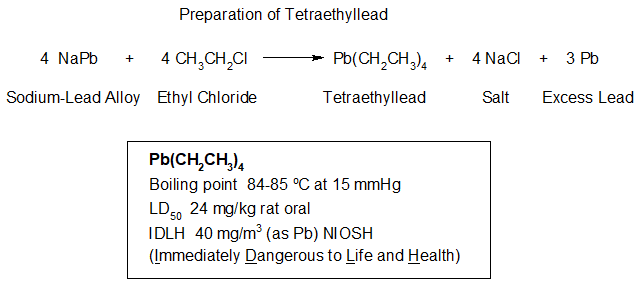
Tetraethyllead was invented in 1921 by Thomas Midgley, Jr, working at General Motors. After some deadly and dissatisfying work by DuPont, General Motors and Standard Oil Company of New Jersey started the Ethyl Gasoline Corporation in 1924, later called Ethyl Corporation, and began to produce and market tetraethyllead. Within months of startup, the new company was faced with cases of lead poisoning, hallucinations, insanity and fatalities.
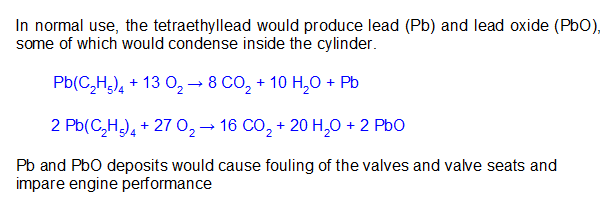
The first commercially successful fuel treatment to prevent this pre-detonation was tetraethyllead, (C2H5)4Pb, produced by Ethyl. This is the lead in “leaded” gasoline. The use of (C2H5)4Pb began before WWII and just in time to allow high compression aircraft engines to be built for the war. It allowed for higher powered aircraft engines and higher speeds for the allies which were applied successfully to aerial warfare. The downside of (C2H5)4Pb was the lead pollution it caused. Tetraethyllead is comprised of two chemical features- lead and 4 tetrahedrally arranged ethyl hydrocarbon groups. The purpose of the 4 ethyl groups (C2H5) on (C2H5)4Pb was their ability to give hydrocarbon solubility to a lead atom. It was the lead that was the active feature of (C2H5)4Pb that brought the octane boosting property. At relatively low temperature the ethyl groups would cleave from the lead leaving behind a lead radical, Pb., which would quench the combustion process just enough to allow the compression cycle to complete and the spark plug to ignite the mixture as desired.
While tetraethyllead was especially toxic to children, it was also quite hazardous to (C2H5)4Pb production workers. Its replacement was only a matter of time.
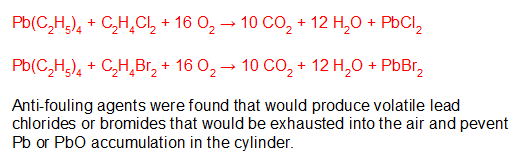
Fuel additives were found that would reduce engine fouling by scavenging the lead as PbCl2 or PbBr2 which would follow the exhaust out of the cylinder. While this was an engineering success, it released volatile lead products into the atmosphere.
Eventually it was found that branched hydrocarbons could effectively inhibit engine knock or pre-detonation and could replace (C2H5)4Pb … which it did. While lead additives have been banned for some time from automotive use, general aviation has been allowed to continue with leaded aviation gas (avgas) in light piston engine aircraft like 100 octane low lead (100LL). Only recently has leaded avgas become a matter of public concern.
A refinery not only engineers the production of fuel components, it must also formulate blends for their customers, the gas stations, to sell. The formulations will vary with the season and the location. Some gasolines have ethanol, other oxygenates like MTBE, octane boosters, detergents and more. One parameter is the volatility of the fuel. When injected into the cylinder, it must evaporate at some optimum rate for best fuel efficiency. This will depend on the vapor pressures of the components.
Back to Refineries
The production volumes of the individual fuel products will not match the contents of the crude oil input. Gasoline is the most valuable product, but more gasoline leaves the refinery than arrives in the crude. Any given grade of gasoline has many, many components and the bulk of them have somewhere around 8 carbon atoms in the hydrocarbon chain. Wouldn’t it be nice if longer hydrocarbon chains could be broken into smaller chains to be added into the gasoline mix? And guess what, that is done by a process called “cracking”. A piece of equipment called a “cat cracker” uses a solid ceramic catalyst through which hot hydrocarbon gases pass and get cut into smaller fragments.
But what about straight chain hydrocarbon molecules? Wouldn’t it be nice to “reform” them into better and higher octane automotive fuels? There is a process that uses a “reformer” to rearrange hydrocarbon fuels to give better performance. The products from this process are called reformates.
Reforming is a process that produces branched, higher-octane hydrocarbons for inclusion in gasoline product. Happily, it turns out that gasoline with branched hydrocarbons are able to resist pre-detonation and have come to replace tetraethyllead in automotive fuels entirely. Today we still refer to this lead free gasoline product as “unleaded”.
Octane and Cetane Ratings
Octane rating is a measure of resistance to pre-detonation and is determined quantitatively by a single-cylinder variable compression ratio test engine. Several octane rating systems are in use. RON, the Research Octane Number, is based on the comparison of a test fuel with a blend of standard hydrocarbons. The MON system, Motor Octane Number, covers a broader range of conditions than the RON method. It uses preheated fuel, variable ignition timing and higher engine rpm than RON.
Some gasoline is rated in the (R + M)/2 method which is the just average of the RON and MON values.
In both the RON and MON systems, the straight chain hydrocarbon standards are n-heptane which is given an octane rating of 0 and the branched hydrocarbon 2,2,4-trimethylpentane, or isooctane, which is given an octane rating of 100.
Tetraethyllead and branched hydrocarbons are octane boosters. Methyl tert-Butyl Ether (MTBE), ethyl tert-butyl ether, and aromatics like toluene are also used to boost octane values. Internal combustion engines are built to use a gasoline with a minimum octane rating for efficient operation. A rating of 85 or 87 are often the octane ratings of common “unleaded” gasoline. Higher compression ratio engines require higher octane fuel- premium grade -to avoid knocking.
For comparison, diesel has a RON rating of 15-25 octane so it is entirely unsuitable for gasoline engines. Diesel has its own system called the Cetane rating. The Cetane Number is an indicator of the combustion speed of the diesel and the compression needed for ignition. Diesel engines use compression for ignition unlike gasoline engines which use a spark. Cetane is n-hexadecane which is a 16-carbon straight chain with no branching. Cetane is given a Cetane Number (CN) of 100. Similar to the Octane rating, the branched 16-carbon hydrocarbon heptamethylnonane, or isocetane, is given a CN of 15. Included in the Cetane number.
Refineries must keep close tabs on seasonal demand for their various cetane and octane-rated products as well as the composition of the crude oil inputs which can vary. Each gasoline product stream has performance specifications for each grade. While gasoline is a refined product free from water, most sulfur and solid contaminants, it is not chemically pure. It is a product that contains a large variety of individual hydrocarbon components varying by chain length, branching, linear vs cyclic, saturated vs unsaturated members that together afford the desired properties.
Specific Energy Content
Absent ethanol, the combustion energy values of the various hydrocarbon grades are so similar as to be negligeable. The energy content of pure ethanol is about 33 % lower than gasoline. Any energy differences would be due to subtle differences in blending to achieve the desired octane rating or proprietary additives like detergents. A vehicle designed to run on 85 octane will not receive a significant boost in power with 95 octane unless it is designed to operate on higher octane fuel.
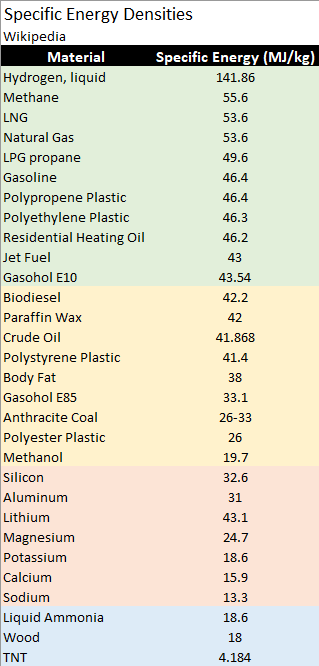
From the Table above and looking at the polypropylene (PP) and polyethylene (PE) entries then comparing to gasoline, we see that the specific energies are the same. The two polymers and gasoline are saturated, hydrocarbons so it is no wonder they have the same specific energies. Polystyrene is a bit lower in specific energy because the hydrogen content is lower, reducing the amount of exothermic H2O formation as it burns. The point is that by throwing away millions of tons of PP or PE every year, we are throwing away a whopping amount of potential fuel for combustion and electrical energy generation.
Petroleum based liquid fuels burn readily because of their high vapor pressure and low flash points. Polyolefins like PP and PE by contrast have virtually no vapor pressure at room temperature and consequently are difficult to ignite. In order to burn, polyolefins need to be thermally cracked to small volatile fragments in order to provide enough combustible vapor for sustained combustion. Plastic fires tend to have an awful smell and dark smoke because the flame does a poor job of energizing further decomposition to vapor.
Going from E10 to E85, the specific energy density drops considerably from 43.54 to 33.1 MegaJoules per kilogram (MJ/kg). Replacing a significant quantity of gasoline with the already partially oxidized ethanol lowers the potential energy. In the tan colored section, we can see the elements silicon to sodium. These elements are either very oxophilic or electropositive and release considerable heat when oxidizing. Some metals amount to a very compact source of readily oxidizable electrons.
Refinery Troubles
According to the US Energy Information Agency (EIA) US refinery output in the first quarter of 2024 has dropped overall by 11 % and has fallen as low as 81 % utilization. Decreasing inventories are causing rising retail prices. Still, average gasoline and diesel prices are currently below the same time period in 2023.
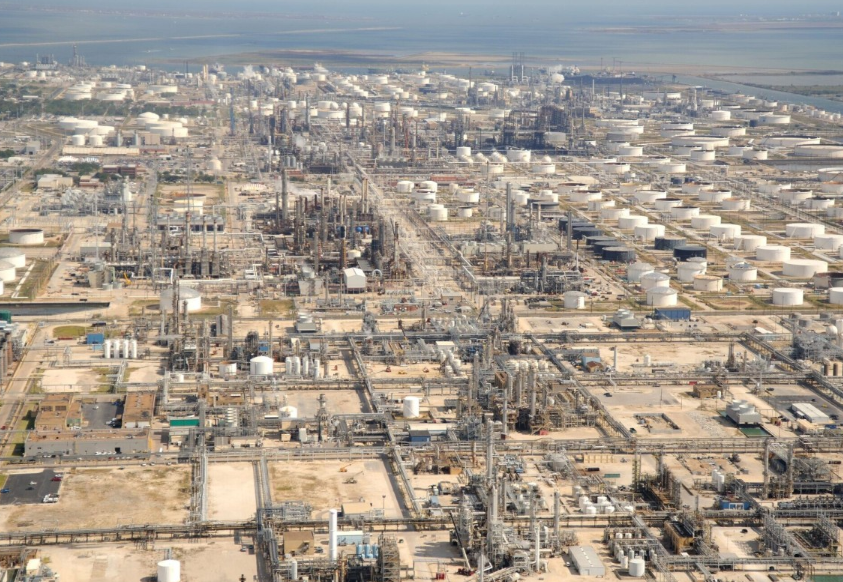
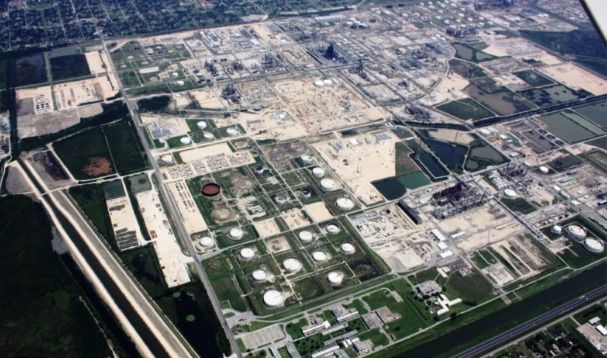
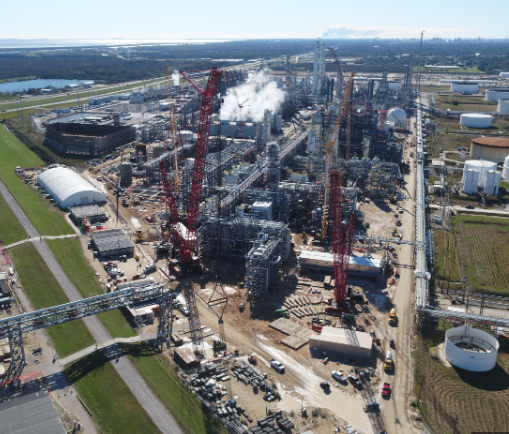
According to EIA, the US Gulf Coast has seen the largest 4-week average drop in refinery utilization at 14 % since January, 2024. This is attributed in part to the early start of maintenance shutdowns of Motiva Port Arthur and Marathon Galveston Bay refineries which account for 7 % of US capacity.
Galveston Marathon Refinery. Source: Google Images.
Motiva, Port Arthur, TX. Source: Google images.
Weather has factored-in this year as refinery production was halted in several locations in the US. A severe winter storm shut down the TotalEnergies’ 238,000 barrel-per-day refinery in Port Arthur, Texas.
TotalEnergies, Port Arthur, TX.
Oil production in North Dakota fell to half. Oil production was estimated to have fallen between 600,000 and 650,000 barrels per day.
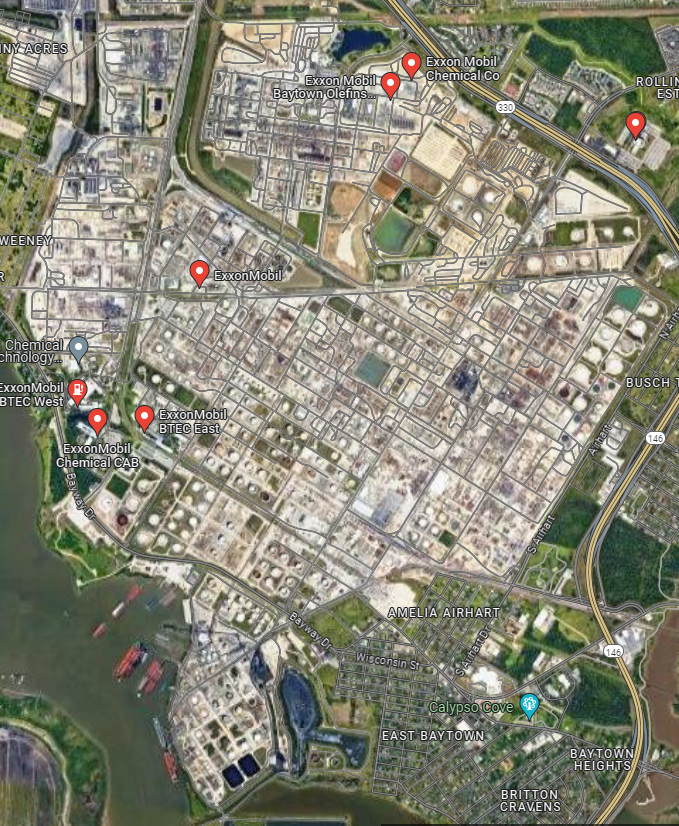
Exxon Mobil Corp returned a fluidic catalytic cracker and a coker to normal operation at its 564,440 barrel per day refinery in Baytown, Texas.
ExxonMobil Corp, Baytown, TX. Source: Google Maps.
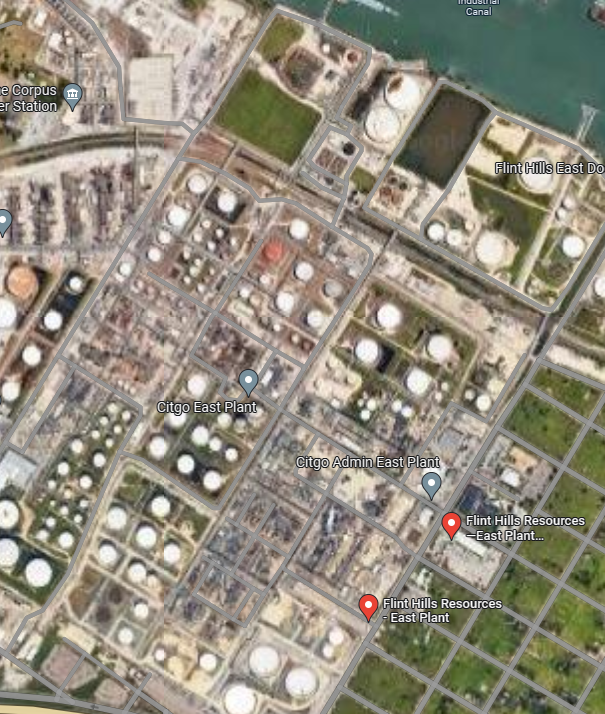
A Flint Hills Resources 343,000 barrel per day refinery in Corpus Christi, Texas, was significantly impacted by unseasonably cold weather including freezing rain.
Flint Hills Resources, Corpus Christi, TX. Source: Google Maps.
Flint Hills Resources East Plant, Corpus Christi, TX. Source: Google Maps.
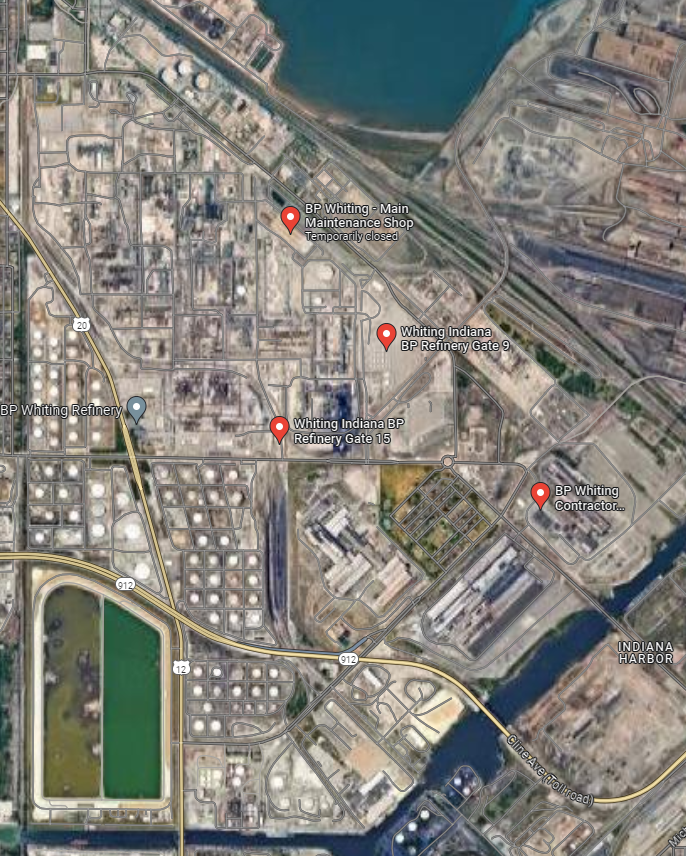
The largest refinery in the Midwest, BP’s 435,000 barrel per day refinery in Whiting, Indiana, was taken off-line by a power outage and forced a 10 % drop in refinery utilization in the Midwest the first week in January. Normally the Midwest region produces as much gasoline and diesel as it consumes. This rich local supply leads to somewhat lower prices in the region.
BP’s Whiting, IN, refinery along the southern shore of Lake Michigan, between Gary and South Chicago.
Much has been written about the gas & oil industry in the US. My aim only is to highlight the leaking, not actively producing, oil & gas wells.
Many states have a problem with orphaned and zombie wells. Big ole Texas has a problem with orphaned and “zombie” oil wells also. Over time, oil and gas companies have been abandoning uncapped oil and gas wells in their eternal haste to produce “Black Gold, Texas Tea.” Inactive or non-compliant wells with delinquent organizational reports (Form P-5) for more than 12 months are called “orphan” wells in Texas. The state of Texas does have procedures for the disposition of orphan wells. Wells may be abandoned because of low output or the owners going bankrupt. It is possible to take over an orphaned well, though why would someone takeover a depleted orphan well or a low output well?
What’s worse, even the capped wells have begun to leak because of the corrosion and decay of well casings and plug material. The leak may be far down the hole or near the surface. These abandoned wells that are now leaking are called “zombie” wells. The zombie wells push up brackish water along with hydrocarbon liquids and vapors into the atmosphere and the surface soil as well as underground into the water table. Some underground flows are large enough that sinkholes form and fill up with polluted water.
The Oil & Gas division of the Texas Railroad Commission is responsible for “Regulating the exploration, production, & transportation of oil and natural gas in Texas.”
In a September 14, 2022, article in the Houston Chronicle, James Osborne writes
Following up, Amanda Drane writes in her July 17, 2023, article in the Houston Chronicle
“The Railroad Commission plugged 1,068 wells during fiscal 2022 at a cost of $29.5 million, and added another 944 over the same period. During the second quarter, it said it plugged 363 wells at a cost of $11.7 million — 119 wells with state funds and 244 wells with money from the federal Infrastructure Investment and Jobs Act, which has promised Texas nearly $320 million in phased disbursements.”
“the oil and natural gas industry has paid hundreds of millions of dollars to have orphaned wells properly plugged… We welcome federal funding to enhance what industry has already contributed to address orphaned wells.”
As can be seen, the Texas Oil & Gas Association seems to feel that it has done its job with orphaned wells. The Teflon-coated Texas Oil & Gas trade association did what trade groups are supposed to do- shield their members from public blame and immense liability.
One component of crude oil & gas is hydrogen sulfide (H2S) which resides in both the liquid and vapor phases. This component is capable of both oxidation in the air to form a series of variously oxidized sulfur products as well as elemental sulfur itself. Hydrogen sulfide is extremely toxic and prone to cause olfactory fatigue in humans. The odor threshold is extremely low which could lead one to safely vacate the area, but the “nose numbing” effect on the sense of smell can lead to a false sense of security and continued exposure. Most cases of intoxication occur in confined spaces, however.
In a way, drilling for and striking oil & gas is like opening Pandora’s box. The well can produce valuable oil & gas, but along with it comes produced water with undesired dissolved minerals, petroleum and drilling residues. It seems clear that the State has a compelling interest in the final disposition of the well. The driller or party who owns the drilling rights to the well should be financially responsible for its clean shutdown. Bankruptcy should not absolve a company from responsibility for trouble the well brings.
Industry and people are like a gas- they expand to occupy the space available to them.
This post is limited to the issue in Texas but it can exist anywhere oil & gas drilling has occurred. Obviously, the oil & gas industry represents a massive amount of economic activity and consequently it has enjoyed a privileged position in American industry in terms of regulations. It is doubtful this will change but that doesn’t mean that the beady eye of scrutiny should blink.
Even if hydrocarbon vapors and other gaseous substances blowing out of wells were not greenhouse gases, can’t a case be made for capping-off wells just to prevent pollution? There is a mentality out there that holds that if some pollution action is not mandatory, then it is not necessary. Their response to a problem is often that they “met regulatory standards.” That is, they would have done less if they could have.
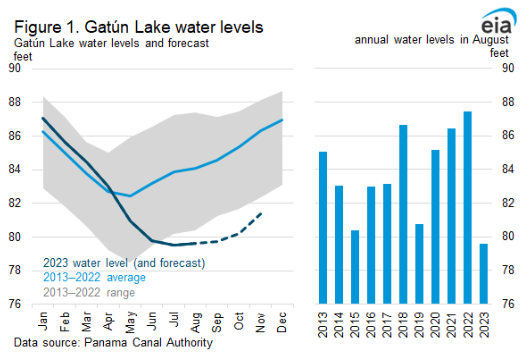
The continuing drought in Panama has caused the Panama Canal Authority to restrict traffic to smaller and smaller vessels. The critical variable is the draft of the ship. The water in Gatun Lake which feeds the locks is getting shallower with the drought. Traffic is down to 60 % of capacity at present and is expected to drop to 45 % by early next year.
The most affected US traffic are those going between the Gulf of Mexico and Asia-Pacific ports. This has also intensified the bidding war for smaller tankers able to make the Panama Canal transit, increasing transportation rates and lengthening shipping times.
Some companies are opting to send their ships through the more expensive Suez Canal. This adds 10 days to a voyage in some cases.
This transportation bottleneck is also negatively affecting US liquified petroleum gas (LPG) and natural gas liquids (NGL). According to the US Energy Information Agency (USEIA), Asia accounts for 53.8 % of US gas liquids shipments abroad this year at 2.6 million barrels per day. Compounding the problem, vessels carrying gas liquids have lower priority than larger vessels paying larger tolls. Ships can bid to cut in line but the prices are steep, up to $2.5 million for an LNG tanker and $100k to $500k for medium sized tankers.
The US Energy Information Agency, EIA, released a notice about low water levels from a historic drought in the Panama Canal region is slowing the passage of large ships. In particular, the Very Large Gas Carrier (VLGC) vessels are restricted which affects the transport and price of Liquified Petroleum Gas (LPG). According to the Panama Canal Authority (APC), water levels in the canal are at their lowest levels since 1995 and are expected to stay low if the drought is prolonged.
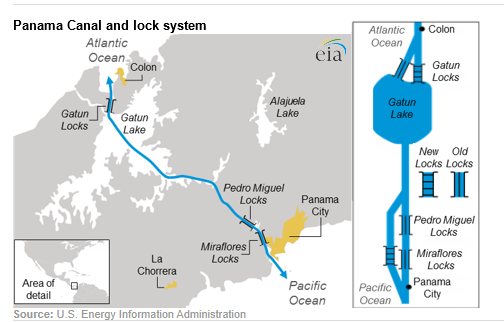
The core of the problem is low water levels at Gatun Lake. This lake is a key part of the system. It is an artificial reservoir that sits between the Atlantic and Pacific oceans providing water and power for the lock system. Due to a prolonged dry season and below normal precipitation, the APC has enacted water saving regulations.
The largest fraction of US-provided hydrocarbons carried through the canal by VLGC vessels is propane which is used for petrochemical applications and highly seasonal heating demand. Increased demand for US propane in East Asia has put pressure on the canal due to increased vessel demand.
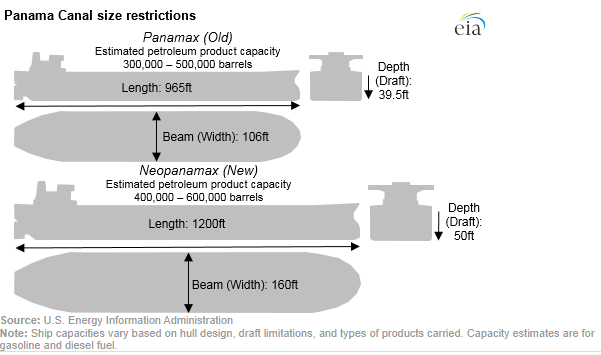
The canal has two types of locks- Panamax and Neopanamax. Ships are rated according to their size and draft as seen in the EIA graphic below.
The base cost of transit for Panamax VLGC vessels is $300,000. A smaller gas or chemical carrier using the Panamax locks has a base cost of $60.000. The low water problem has restricted the flow of traffic through the canal to just 32 transits per day- 10 for the Neopanamax and 22 for the Panamax. Other routes to Asia are around the Cape of Good Hope or through the Suez Canal.
Due to low water, restrictions have led to a waiting time of 13 to 17 days to transit the canal during August. According to Reuters 8/22/23, 125 booked and non-booked vessels were waiting to pass. As of this date, restrictions allow vessels with a maximum 44 foot draft. According to EIA a 6 foot decrease in draft can lead to a 40 % reduction in cargo.


 Lamentations on Chemistry