The US Energy Information Agency, EIA, has just released a new energy conversion relationship for the British thermal unit (Btu) and the kilowatt-hour (kWh). It is 3412 Btu/kWh.
On September 26, 2023, we released our primary report on recent and historical energy statistics, the Monthly Energy Review(MER). Beginning with the September 2023 MER, we have updated the way we calculate primary energy consumption of electricity generation from noncombustible renewable energy sources (solar, wind, hydroelectric, and geothermal). We will now calculate consumption of noncombustible renewable energy for electricity generation using the captured energy approach, which applies a constant conversion factor of 3,412 British thermal units per kilowatthour (Btu/kWh), the heat content of electricity. This approach is a change from our current methodology, called the fossil fuel equivalency approach. The captured energy approach is more consistent with international energy statistics standards than the fossil fuel equivalency approach.
I post this kind of petroleum-related information with the hope that more people will pay attention to large-scale energy in general and oil & gas in particular. It is fashionable to pooh-pooh the petroleum sector for several reasons but, like it or not, it is one of the pillars of civilization. If we are going to be steering it in some particular direction, we should know a bit more about it.
There is a great deal of fascinating technology in oil & gas extraction and refining. The funny thing is that when you learn more about a subject, the more level your viewpoint on it will become, to the plus or minus side.
An article by Kevin Crowley, Bloomberg News, 9/23/23, reports that ExxonMobil Corp. has already begun to adapt to the decline in demand for gasoline and diesel as the switch to electric vehicles and renewable energy progresses. ExxonMobil operates the largest oil refining network in the world with 13 refineries presently in operation. It sold 5 refineries in the last 4 years in order to focus on cost cutting and improvements in performance of the highest performing facilities. ExxonMobil’s interest in refining dates back to the early days of its progenitor, Standard Oil Company, founded by John D. Rockefeller.
The oil majors are not blind and deaf to the swing towards the replacement of gasoline and diesel powered vehicles. In the case of ExxonMobil, they are planning on switching to production of petrochemical feedstocks in their refineries. They expect that their high-performance chemicals will see 7 % growth per year. Exxon believes the key to its success will be in chemical products. These chemicals are used in manufacturing of industrial and consumer products, from lubricants to pharmaceutical raw materials. Many of the ingredients you see in consumer products have their beginning as crude oil flowing out of the ground somewhere.
Reuters has reported that the crack spread enjoyed by oil refiners is currently sitting around $37.50. The crack spread is the difference between the price of crude oil and the petroleum products coming from it. This number is an indicator of the profitability of refinery output.
Cracking is a major operation at oil refineries where heavy, long chain hydrocarbons are broken into shorter chain hydrocarbons. Crude oil naturally contains a limited amount of components suitable for modern engines. An important attribute is branching. The goal is to produce the most valuable products from otherwise longer chain, lower value hydrocarbons.
A Scratch in the Surface of Gas Chromatography
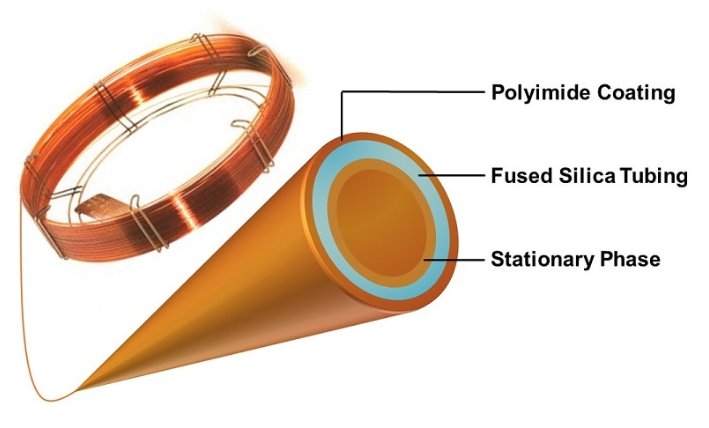
The analytical workhorse of the petroleum refinery is the gas chromatograph, or GC. The GC consists of a precisely controlled oven and within it is a coiled, small diameter hollow fiber many meters in length. It is called a capillary GC column. At one end of the column is an injection chamber with a silicone septum that samples are injected through via syringe. This chamber is hot enough to flash evaporate the sample but not so high that it decomposes. For instance, I have usually used a 250 oC injector temperature. A common volume of liquid to be injected is 1 microliter. The sample can be neat or a solution and must be scrupulously free of particles.
Inside the injector is the carrier gas input- helium is often used. A large amount of the vaporized sample is flushed out of the injector leaving only a small quantity of sample to be injected. Connected to the injector is the entrance of the capillary column. The goal is to inject a very narrow plug of sample into the capillary column all at once. After the injection, the detector is activated and the data collection begins. Progress can be followed in real time or not. Once the sample is on the column the GC run must be taken to completion. There is no reset for the column.
The inside surface of the long capillary column can be just fused silica or it can have a coating. In any case, the components of the sample each have a different affinity for the inner wall of the capillary. As the carrier gas pushes the vaporized sample components along, the components with the least affinity for the inner column surface advance through the column fastest and arrive at the detector earlier. Generally, the higher the molecular weight, the lower the volatility and the longer it takes to exit the column.
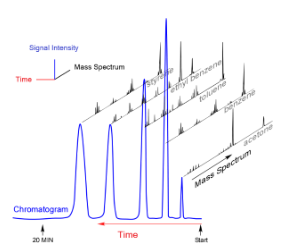
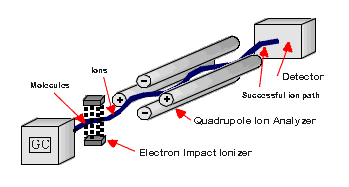
At the terminus of the capillary column is the detector. There are a variety of methods used to detect sample and send a signal to the plotter or computer. A particularly useful type of GC system uses a mass spectrometer as a detector. The flow of components enters an ionization chamber and positive ions are generated by electron impact and sent through the mass analyzer and on to the detector. This is occurring continuously as the sample components exit the column. As the components are detected, a regular chromatogram is collected and displayed. The difference with the mass spec detector is that along the timeline, mass spectra are also collected. It is possible to select any given peak in the chromatogram and display the mass spectrum.
A mass spectrum for every peak. Source: God I hope they don’t mind my using this graphic. American Chemical Society. I don’t need ACS goons banging on my door again!
Graphic from NASA showing schematic of the GC Mass Spec aboard the Huygens probe to Titan.
A mass spectrum detector offers the possibility of identifying the individual peaks from the molecular ion mass and the fragmentation pattern. That said, not all mass spectra are easily interpreted. Only cation fragments are visible. Neutral fragments must be inferred.
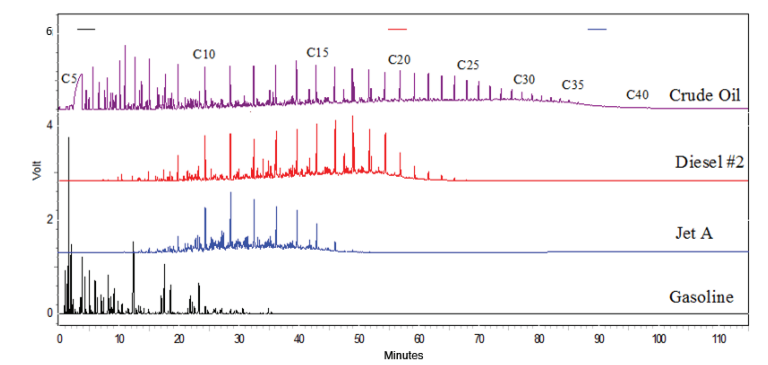
A stack of gas chromatograms showing the components of crude oil and several derived products below it. Each peak indicates a single component with the intensity along the y-axis and time in minutes along the x-axis. The area under each peak is proportional to the % composition in the sample. On the left side of the chromatogram are the components that are more volatile and exit the GC column earliest. The right side shows the components that exited the column after longer intervals. They are the longer chain molecules. Source: IRTC.
Back to the Crack
The most valuable refinery products are gasoline, fuel oil (including diesel), and aviation fuel. Within these three areas are subcategories that split into different product lines. These fuel product categories are defined by the number of carbon atoms in the blend of hydrocarbon molecules, saturation, and branching.
Refineries produce blended fuels affording certain properties according to their use. These properties include boiling point and vapor pressure specifications, octane or cetane numbers, viscosity, and pour point specifications. Between distillation, cracking, aromatization and reforming a wide variety of hydrocarbon substances are available from refining for formulation. A refinery is engineered to produce the largest volume of the most valuable hydrocarbons from continuous flow processes at the greatest profit.
Oh, I was just joking about the ACS goons. They don’t bang on your door.
The International Energy Agency (IEA) is predicting that growth in annual demand for crude oil will shrink from 2.8 million barrels per day to 0.4 million barrels per day by 2028. This is interpreted to be the result of the global shift to cleaner energy alternatives as well as high prices and security of supply issues. By 2028 IEA says that peak oil demand may be in sight.
IEA also predicts that the use of oil for transport fuels will go into decline by 2026. Many more insights into the global oil market are to be found in the link.
Note that this report is about oil, not natural gas.
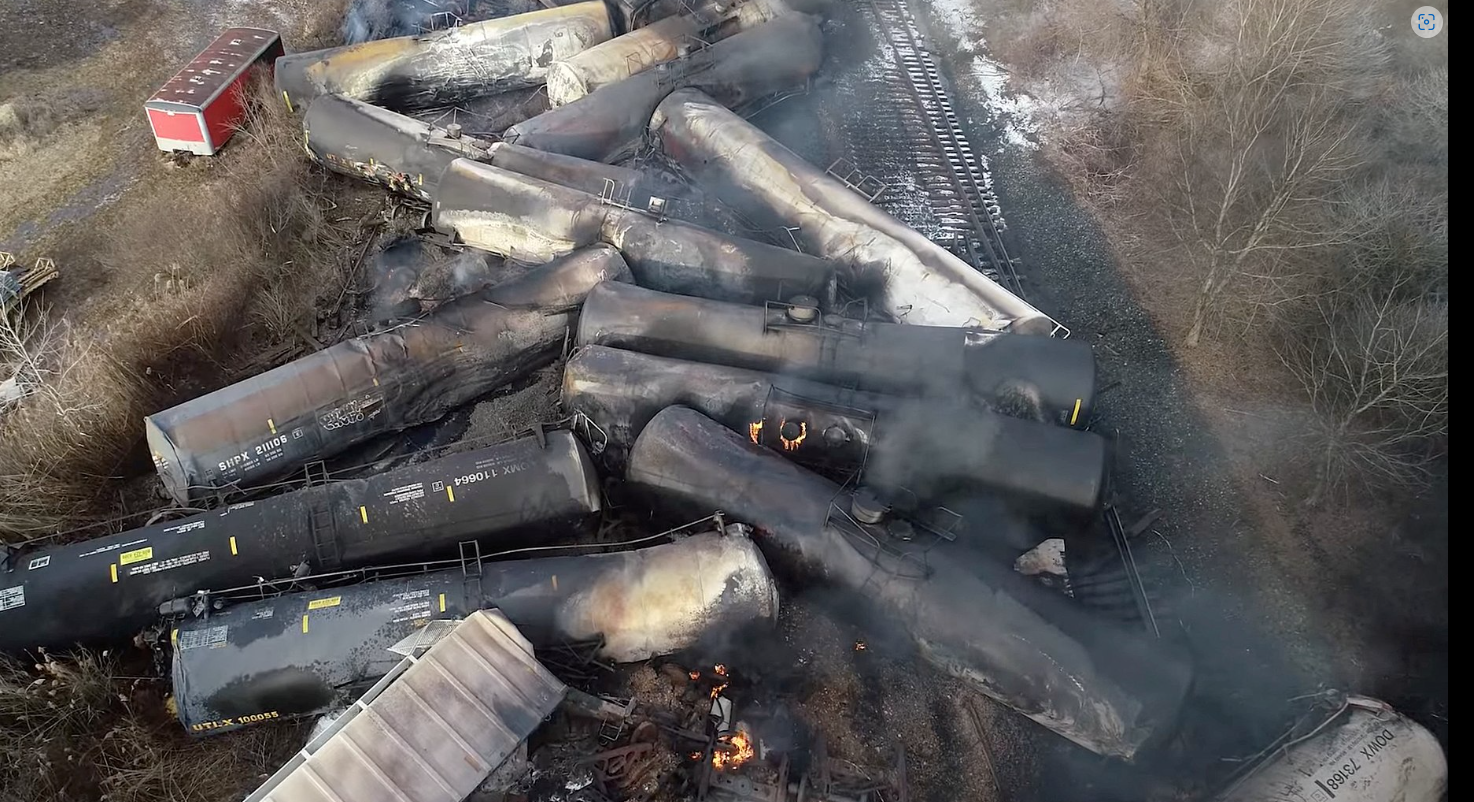
When I think “train wreck” I usually think of #45’s presidency. But here I refer to the actual Feb 3, 2023, Norfolk Southern train wreck in East Palestine, OH. A very long train carrying, among other things, tankers of hazardous chemicals had a derailment and fire near the small town of East Palestine, OH, along the southwest Pennsylvania border. It was a true calamity releasing hazardous chemicals, some of which caught fire and burned for days. It isn’t clear as yet as to what burned and what didn’t. The extent of pollution will eventually be released by authorities and monitored for years to come.
Early reports have claimed that the accident started with an overheated wheel bearing. It would be interesting learn how this could lead to a derailment. The root cause analysis will be interesting.
NTSB chair Jennifer Homendy explained that the train in this accident would not have been required to utilize the ECP braking system even if the FAST Act was not repealed, because the term high-hazard flammable train means a single train transporting 20 or more tank cars loaded with a Class 3 flammable liquid. As it had only three such placarded train cars, the derailed train did not meet the qualifications of a “high-hazard flammable” train.
ECP stands for Electronically Controlled Pneumatic brakes. The Wikipedia page describes the pathetic political kerfuffle over these brakes and how certain groups fought the requirements for them.
The Washington Post released a piece, dated Feb 18, 2023, about it showing some interesting pictures. One aerial shot captures the wreckage along with what the cars were carrying. A security camera caught the train moving along with a large fire blazing under one car minutes before entering town. The video has since been removed.
The burning vinyl chloride (and … ?) produced a toxic plume that by some accounts was also corrosive. I assume this to be due to the burning of an organic chloride releasing hydrochloric acid vapors. According to Wikipedia, of the 150 cars in the train some 38 train cars were derailed.
Substances in cars that were derailed according to the Washington Post-
Vinyl chloride
Polyethylene
Dipropylene and propylene alcohol
Semolina (a wheat flour)
Polyvinyl chloride (PVC)
Ethylhexyl acrylate
Petroleum lubricating oil
Diethylene glycol
Isobutylene
Butyl acrylate
Benzene
Much was made in the news about burning vinyl chloride and noxious fumes, but I haven’t heard an accounting of what actually burned. Any release of acrylate monomers is especially unfortunate since as a group, they can be nasty lachrymators. This will take years to get through the courts.
For the study the authors used 4 ions considered signatures of HF-related activity- chloride, bromide, barium and strontium. These ions were considered the likely mode of detection if and when surface waters were affected. They are usually found in high concentration in flowback and produced water from HF wells and are considered signatures.
Some vocabulary-
Environmental externalities– the negative consequences on nature and biodiversity that result from human activity. (Google)
Internalities– An internality at the organizational level (an “organizational internality”) is the product of organizational practice, which part or all of an organization engages in that produces a cost or benefit within the organization, which is not considered when engaging in that practice.
Produced water– Produced water is composed of formation water, hydrocarbons, and fluids introduced during drilling.
Some Key Findings-
“Significant improvements were found in water quality based on signature salts after mandates are introduced.”
“After disclosure mandates, operators pollute less per unit of production, use fewer toxic chemicals, and cause fewer spills and leaks of HF fluids and wastewater.”
They “… show that disclosure enables public pressure and that this pressure facilitates internalization“.
Barium is injected into oil and gas wells in the form of barite (BaSO4) to densify the drilling fluid although ilmenite (FeTiO3) has been used as well.
“Produced waters typically have large ionic strengths including large Sr concentrations compared to surface water and shallow groundwater. If the Sr isotopic compositions of produced waters differ substantially from surface water and groundwater, then the Sr ratios could be a valuable and sensitive indicator of small amounts of contamination from produced water.“
The strontium isotopic ratio (87Sr/86Sr) can be an indicator of produced water contamination in surface water.
An article in the Washington Post today reveals that state senator Jim Anderson who introduced the resolution to ban EV sales by 2035 in Wyoming is now saying that he doesn’t “actually” want EV sales phased out. He said that he has no problem with EVs at all. Instead, he and other legislators have a problem with California’s plan to ban gas-powered vehicles. Anderson said, his bill was “just a resolution saying, ‘We don’t like your bill that you did.’”
It is no secret that regulations made in California often spread to the rest of the country and this seems to be part of the issue for the tit-for-tat in the Wyoming statehouse. Plainly this is a real worry for some. But to fire up the legislative machinery and produce a resolution grumbling about another state’s switch to EVs seems to be a bit of impotent GOP grandstanding. I’m sure it plays well in the Cowboy State. No worries about this tempest in a teapot. EVs will share the road with gas and diesel pickup trucks in Wyoming and the US for a long time to come.
Since 2019, the US has lost over 1 million barrels per day of oil refining capacity, according to Energy Intelligence. On top of this, 2023 will see an additional loss of 268,000 barrels per day refining capacity with the closure of the LyondellBasell refinery in Houston, TX. Loss of oil refining capacity translates directly into greater scarcity of fuel distillates, which exerts upward pressure on retail fuel prices.
But, there is good news as well. In 2023 there will be a combined 505,000 barrel per day uptick in refinery capacity according to Energy Intelligence. ExxonMobil will see an increase in capacity at its Beaumont, TX, refinery. Valero Energy will be adding two coker and sulfur recovery trains to increase their heavy sour crude oil throughput to provide a 55,000 barrel per day increase in fuels output at their Port Arthur, TX, plant.
The controversial Limetree Bayrefinery in St. Croix in the US Virgin Islands, now owned by West Indies Petroleum Limited and Port Hamilton Refining and Transportation, LLLP, is scheduled to reopen, but information is scarce. Formerly the Hovensa facility, a joint venture of Hess Corp. and Petroleos de Venezuela SA, this refinery processed Libyan and Venezuelan crude and has supplied much of the US gulf coast. According to Energy Intelligence, the refinery is thought to be able to restart and produce 200,000 barrels per day. However, the former Hovensa facility has a recent history of losses, Clean Air Act violations and a bankruptcy sale. It doesn’t sound like the situation has fully played out yet.

 Lamentations on Chemistry