The US needs many things, but now in particular we need a government that will strongly support Ukraine’s efforts to defeat Putin. Containment of Russia’s latest brutal dictator is a must for continued liberal democracy in the west. The US/NATO partnership is the necessary bulwark from the world’s two giant, grasping autocracies- China and Russia. Both will continue to be a challenge to the very existence of liberal democracies around the world for many decades to come.
Both China and Russia are weary of US hegemony in the world and seek to knock the US down and replace it with their own hegemony. The widespread use of English as the “lingua franca” of the world, US popular culture as well as the preeminence of the US dollar in world trade grates on their national pride. To coexist with US hegemony is to give consent. Both nations want to be masters of the realm. Simple human nature.
Perhaps Russia will emerge on the world stage one day as a guiding influence for decent civilization. But, that event will happen only after Russian citizens steer away from their long tolerance of autocratic and brutal leadership. It is up to the Russian citizenry to fix the Putin problem. Putin will not peacefully die in retirement. He’ll die in power like most of the former leaders of the Soviet Union from Lenin onwards did. Gorbachev had the grace to step down peaceably after he dissolved the Soviet Union. Somehow the pillars of support Putin has constructed over the years will have to crumble away. However, there is no guarantee that his successor will be much different.
The US had to be shaken from its isolationist trance to join in with WWI and WWII. Today, president #45 and others were showing a definite trend towards isolationism in the years prior to the onslaught of Putin’s savage war in Ukraine. #45’s tolerance and admiration of Putin was peculiar and very suspicious looking. Treating Putin like buddy is the wrong tack. George W. Bush said he peered into Putin’s eyes and saw his soul. Bush later said he regretted having said that.
It is not in the interest of the US or Europe to stand back as Putin goes on a land grab along the Russian frontier. So far Putin’s war has not devolved into a WWIII. The NATO countries have wisely avoided actions that would trigger a direct shooting war with Russia while at the same time sending resources to Ukraine. Yes, it is a proxy war. This support is expensive but it must continue.
With China showing interest in supporting Putin, we may find ourselves in a proxy war with them as well. However, China has much to lose in as much as the US is one of it’s biggest customers. Whatever the case, we’re on the way with Cold War II.
Henry Kissinger (HK) made waves at the Davos Conference in May of 2022 when he suggested that Ukraine and Russia return to the status quo ante. In a July 2, 2022 interview with HK in The Spectator, interviewer Andrew Roberts reports-
“If Russia stays where it is now, it will have conquered 20 per cent of Ukraine and most of the Donbas, the industrial and agricultural main area, and a strip of land along the Black Sea. If it stays there, it will be a victory, despite all the setbacks they suffered in the beginning. And the role of NATO will not have been as decisive as earlier thought.
The other outcome is an attempt made to drive Russia out of the territory it acquired before this war, including Crimea, and then the issue of a war with Russia itself will arise if the war continues.
The third outcome, which I sketched in Davos, and which, in my impression, Zelensky has now accepted, is if the Free People can keep Russia from achieving any military conquests and if the battleline returns to the position where the war started, then the current aggression will have been visibly defeated. Ukraine will be reconstituted in the shape it was when the war started: the post-2014 battleline. It will be rearmed and closely connected to NATO, if not part of it. The remaining issues could be left to a negotiation. It would be a situation which is frozen for a while. But as we’ve seen in the reunification of Europe, over a period of time, they can be achieved.”
HK supports the “equilibrium” of status of quo ante to the pre-February 24, 2022, borders rather than an attempt to defeat Russia. I think Ukraine would only agree to this if things were looking bad for them. As Putin has demonstrated, he lies all of the time. He is in no way dependable in a peace agreement.
Whatever it is that Putin responds to, we have to assume that overwhelming and superior firepower are high on the list. The US and NATO must present an iron fist in reply to Russian aggression. Putin has established himself as one of the major bad actors in modern times. The man’s ambition and swaggering macho is and will remain a threat to democratic states.
Modern Russian leadership has a pattern of oppression and intelligence gathering along with institutions to apply it everywhere they can. They are masters of propaganda and the psychology of intimidation. America is outclassed in the propaganda field.
American notions of social order were influenced by the British. The oppression of monarchy on the American colonies served as a negative example of how to govern. But, the British have the Magna Carta of 1215 in their history which was an agreement between a group of barons and King John of England providing protection of certain rights. The original charter was quickly annulled but was reissued in 1216. Over the years the charter became a part of political life in England.
The point of this history lesson is to suggest that Russian history has no similar example of democratic leanings. What did happen in 1861 in Russia was the Emancipation Proclamation by Emperor Alexander II abolishing serfdom. This edict was one of many liberal reforms during his reign (1855 to 1881) and gave 23 million serfs their liberty. While not democratic, it was a positive step change in Russian society. Another step change for Russia came with the Bolshevik revolution if 1917. Unfortunately, this gave rise to the Union of Soviet Socialist Republics (USSR) and all of the subsequent Stalinist and cold war turmoil that followed. Russia needs another step change to shake loose the dictatorship/kleptocracy model that Putin has put in place. Whatever it is that serves the needs of a peaceful Russia, it needs to arrive soon.
Here we are, it’s 2023 and the US has an old opponent run by a strongman dictator with nuclear weapons who is fond of reminding us about his nuclear arsenal. There is nothing like the Central Committee of the USSR that Putin has to contend with. Putin is not only angry with the US about aiding Ukraine, but he clearly wants to punish the US because of our continuing hegemony and a series of historical slights. He very much wants the US to experience suffering on our own territory like Russia did in WWII. Putin has always been unhappy with the collapse of the USSR and with what happened in the country thereafter. Putin’s theory of the world places Russia at the top of the great empires in history. His would be an authoritarian empire.
There has been a lot of knowledgeable commentary on what Putin may have concluded about western countries leading up to the invasion. I’ll defer to my betters in this.
Much propaganda has been issued by Russian state organs over the Putin years heralding the moral corruption and a disintegrating political structure within the US. He sees a US that is an aging empire in decay. Despite his large intelligence apparatus, he overestimated the capacity of his conventional forces and underestimated the resolve of Ukrainians. He apparently guessed that his invasion would be met with an indecisive NATO dithering away and only able to muster small support for Ukraine. His mistakes have proved to the world that the Russians are not 10 feet tall after all.
My feeling is that the US and NATO must be extremely watchful through this period of history. Putin’s government is unlike any adversary we’ve had before. They have already put effort into sowing confusion in US media and continue to try to influence our elections. They are likely to have SLBM submarines lurking off our coasts in readiness. Even worse, there are many within the current US GOP that seem to be willing to support or tolerate authoritarian regimes.
For as much as Putin is making veiled threats of nuclear conflict, he surely knows that if there are nuclear missiles headed for the US, we will not allow our missile fleet to be destroyed sitting in their silos. Only the first nuclear weapon unleashed with be a difficult decision.
The world has much to lose if it allows a man like Putin to invade his neighbors. Such a Russian empire so established will exert its authoritarian influence around the world much like China is attempting to do presently. The democratic nations of the world must work together to keep a world order that encourages free trade, travel, cultural exchange, open communication and a devotion to the betterment of all mankind.
The US has long been practicing liberal democracy. It has been very successful in raising the standard of living for all Americans, very often in ways that are not fully appreciated. So there is no confusion, liberal democracy doesn’t mean “Democrat democracy”. It is a system of representative democracy operating as defined bv the US Constitution with a separation of powers and many checks and balances. The engine of the nation is a market economy with private property and respect for individual and civil rights.
Our democracy and economic engine has given the US and the world a great many benefits in science, engineering, consumer goods, and medicine. The US has had the most productive economic and scientific engines the world has ever seen. We also built and maintained the most powerful military in history based on discipline, rules and strong moral leadership. The US continues to lead the world in the critical area of aerospace.
Our Government-Industrial-University R&D complex has been the envy of the world since after WWII. Scientific and industrial R&D is a powerful combination for sustaining prosperity. It is this that I most worry about when government comes under the current brand of GOP leaders. This is the goose that layed the golden egg.
A recent report by Reuters says that global oil supply will exceed demand until mid-2023 when a steep rise in demand is expected, exceeding supply. The IEA’s Oil Market Report, January 2023, predicts record high demand for oil at 101.7 million bpd, an increase of 1.9 million bpd. Almost half of the demand growth for oil will result from China relaxing its regulations on COVID. Jet fuel will be the largest source of growth.
According to IEA, while Russian oil exports to the EU decreased, their diesel exports to EU surged-
Russian oil exports fell by 200 kb/d m-o-m in December to 7.8 mb/d, as crude shipments to the EU declined after the EU crude embargo and G7 price cap came into effect. Russian diesel exports surged to a multi-year high of 1.2 mb/d, of which 720 kb/d was destined for the EU.
From 50,000 ft it appears that the embargo of Russian crude oil into western refineries is somewhat offset by increased Russian diesel exports to EU. The EU is competing with increased imports of Russian diesel.
In following the savage Putin war against Ukraine I have become partial to watching short video’s on TVP’s Military Mind via YouTube. TVP is Polish public television. They have unique and up to date war footage and coverage every episode. The war footage they get is mostly drone or smart phone in origin and is pretty rough but it gives a sense of what it is like on the ground. If you are expecting politically balanced war reporting, this is not the place to get it. This Polish station is clearly wary of Russia, or Putin at least, and it’s geopolitical intentions.
Recently there was a particularly disturbing clip on TVP taken from a Russian television show called The Evening With Vladimir Solovyov. Solovyov is a state television mouthpiece for Putin. The format has guests standing at widely separated podiums and taking turns venting their sometimes murderous outrage. In it was a guest named Yevgeny Satanovsky who is President of the Institute of the Middle East who gave a very calm and matter-of-fact opinion on how to deal with their true enemies, the Americans. Russian TV has been startingly vocal about their perception of the “American threat” and what we deserve for standing up against them. From the Daily Beast article–
“First of all, our main enemy is certainly the United States. What does the U.S. react to? They react to two things: the threat of physical annihilation and the liquidation of a certain number of military personnel. What we know based on wars in Vietnam and Korea is that several tens of thousands of annihilated American servicemen will cause the public opinion in the U.S. to be severely strained. I will repeat: not several thousand, like in Afghanistan or Iraq, but a certain number of tens of thousands. Who will liquidate them, where they will be liquidated and in what way is completely irrelevant, but this is one of the objectives if we want to influence the American leadership. We have absolutely nothing to lose.”
Satanovsky concluded that based on how the Americans fought in Korea and Viet Nam, America could be counted on to limit it’s involvement up to a maximum of several “tens of thousands” of US casualties. They feign awareness of our dirty little secret of squeamishness about the body count in foreign engagements. Satanovsky said several times that Russia must “liquidate” several tens of thousands of Americans in order to stop America’s support of Ukraine. This is the key to American disengagement he says.
Resorting to grotesque threats in the same program, Andrey Kartapolov, head of the Russian State Duma Defense Committee, addressed the West with a line from an old Soviet movie: “Don’t worry, it won’t hurt when we cut your throat. We’ll slice just once and you’re in heaven… Our victory will take place wherever the Russian soldier will stop—and wherever he stops, from there he will never leave.”
Americanist Dmitry Drobnitsky commented: “In our country, we embraced one American we wouldn’t want to kill: that would be Tucker Carlson.” This is pathetic beyond words.
All of this is content generated by the host and his guests. But, their sentiments clearly are in line with the Kremlin’s interest in popular support for Putin’s war and antagonism towards the west. Much public sentiment seems to be tied up in national loss of face from the Russian military’s poor performance in the war but not so much in the actual need for the war. If you watch a few of these episodes you’ll see guests venting their white hot rage at America for it’s support of Ukraine peppered with references to WWIII and nuclear war with the west.
Propaganda, /ˌpräpəˈɡandə/, noun: information, especially of a biased or misleading nature, used to promote or publicize a particular political cause or point of view.
Americans should view some of this Russian television content to get an idea of the anti-American, anti-western bile being spewed continuously by the Russian propaganda apparatus. The Kremlin has been a master of propaganda for many years. They know the value of repeating big lies over and over. Unfortunately, certain Americans have been using this technique on our own population as well.
Hegemony, /həˈjemənē,ˈhejəˌmōnē/, noun: leadership or dominance, especially by one country or social group over others. “Germany was united under Prussian hegemony after 1871”
At present, Russia is publicly stamping their feet in outrage over western interference in their dirty little invasion, making every threat they can imagine. At the same time, actors for the state continue to conduct wave after wave of attacks on the west over the internet. Others are covertly interfering with our politics by trying to destabilize democracy. The overall goal the Russian’s share with China is to deflate American hegemony in the world and replace it with their own. You know, just your basic quest for world domination. It never ends.
The internet magazine Spiegel International, January 5, 2023, has an enlightening interview piece with the independent Russian opinion pollster and sociologist Lev Gudkov. His organization is the Levada Center which is described as the only independently operating opinion research institute in Russia.
Let’s cut to the chase. The tone of the interview is quite depressing in a near term if peaceful resolution of the Putin war is your hope. In case you were harboring the view that a groundswell of popular Russian sentiment against their country’s hostilities in Ukraine might lead to a change in policy in the Kremlin anytime soon, you will be disappointed because that is not what the polling suggests.
The polling also suggests that public sympathy for the plight of the Ukrainians is near zero. The idea of Ukraine as a sovereign state is not popular among the public.
When asked about public skepticism of the war effort-
DER SPIEGEL: What reasons do people give for their skepticism?
Gudkov: They say the operation is taking too long, that no progress has been made. People worry almost exclusively about their own country’s military defeat, the chaos in the army, the incompetence of the leadership. For years, they were told that the Russian army was the strongest and had miracle weapons, but that myth has evaporated.
DER SPIEGEL: The war itself isn’t being questioned.
Gudkov: No, the attacks on Ukraine and the massacres play no role. The Russians have little compassion for the Ukrainians. Almost no one here talks about the fact that people are being killed in Ukraine.
When asked about popular response to the war-
DER SPIEGEL: So they avoid it.
Gudkov: The war has exposed mechanisms in society that have existed since Soviet times. Out of habit, people identify with the state and adopt its rhetoric about their fatherland’s struggle against fascism and Nazism, just like they did in Soviet times, to justify the situation. It’s all been present in people’s minds for quite some time, and propaganda has activated these patterns. They block out any compassion and empathy for what is happening in Ukraine. Those feelings only apply their own dead and wounded soldiers, “our men.”
Other points made by Gudkov-
The potential for substantial public civil unrest was low in Soviet times and it remains so today.
Sanctions mostly affect the 20 % urban middle class.
Mobilization lead to decreased support for the war.
Mobilization was seen as a sign of defeat.
People are unwilling to protest because of the police and repression.
Fear of nuclear war has built up since the annexation of Crimea. “Soviet stereotypes were serviced, such as the complex of Russians supposedly living in a besieged fortress, being victims and not being liked by anyone.”
Gudkov says “In my opinion, the “Putinian” person is a continuation of the Soviet person, but the former is deeply cynical, confused and disoriented. The Soviet person knew that life was not rich, that there was a constant lack of something, be it goods or variety. But they believed that things would get better with time“
Russian trust in Ukraine collapsed with the loss of President Viktor Yanukovych who was loyal to the Kremlin.
Television broadcaster Margarita Simonyan famously said that if Russia loses “we will all end up in court in The Hague, from the janitor right up to the leaders.” It sounds laughable but who knows how much hyperbole people will absorb?
Russian state control of the media has been very successful in controlling the views of the population as has isolation from outside media. The challenge a belligerent Kremlin poses to the west and to democracy will be with us for a long time. Capitulating to Putin’s Kremlin would be a very regrettable mistake.
I believe that we in the US must understand that Russia has a history and perspectives that are very different from our own. We have very different languages, alphabets, traditions, folklore and lessons from history. Russia’s land was invaded in WWII by a very capable and violent enemy. Russians suffered and died in great numbers under the dictatorship of Joseph Stalin. Russian civilian and military losses during WWII have been estimated to be as high as 40 million dead. Russians continued to suffer in the suffocating grip of Soviet socialism until the collapse of the USSR. These dreadful experiences are layered over a long history that has never been exposed to the liberal democracy or free market capitalism that Americans have benefitted from immensely and take for granted.
It has been my habit to be circumspect about Russia. I studied a bit of Russian language in college, have a handful of Russian colleagues and have been to Russia on business. I enjoy 18th and 19th century Russian literature. I’m certainly no Russia scholar but I am sympathetic towards ordinary Russians who suffer under government repression and subsistence living, especially outside of Moscow or Saint Petersburg. Repression and poverty have been with Russia throughout history. Russia was an absolute monarchy up to the Bolshevik revolution in 1905-1917. It was a feudal society operating under a manorial system. Serfdom was common in Tsarist Russia from as early as the 12th century until 1861 when it was abolished. The Bolshevik revolution put an end to Tsarist rule with the abdication of Tsar Nicholas II in 1917 and murder of the Tsar and his family in 1918.
Today, President Vladimir Putin and his political machine have fabricated reasons to justify a violent military invasion in order to fulfill his dream of the unification of a greater Russian empire. Putin knows he won’t be stopped by a political uprising in his country. He seems quite confident that he can unleash brutal violence on the Ukrainian people without worry of a significant backlash at home. The people who fled Russia during the recent conscription are not present to protest against the war effort.
It is easy to believe that if anyone is the first to release a nuclear weapon, it is likely to be Putin or a successor. Release of a nuclear weapon will only be a difficult decision the first time. Once unleashed somewhere, reluctance for use will drop across the world.
The mountain of sanctions on Russia has had the side effect of bolstering Putin’s case that Russia is suffering from oppression from its western enemies. Putin’s response has only been to ratchet up the shelling of Ukraine. He will weaponize everything within his grasp and bring his hammer down as powerfully as he can.
My point today is that the EU, USA, and NATO must be extremely cautious with Russia in the present period of conflict yet maintain vigorous support for Ukraine and other border countries. Ukraine must be supplied with as much firepower as possible without direct conflict between NATO and Russia. Fortunately, that seems to be what is happening so far. While there are two opposing uniformed armies, Putin is using civilian collateral damage in Ukraine as a strategy to terrorize the population into submission.
My concern is the uncertainty of long-term political stability in US policy towards Russia, Ukraine and support for NATO. The US must maintain a firm opposition to Putin’s expansionism. Putin (and Xi for that matter) is clearly aiming to topple US hegemony in the world and would like nothing more than to see the US recede in influence. If you are not from the US, maybe this doesn’t sound so bad. But someone will aim for global hegemony and get it. Who is the least unfortunate choice?
Unfortunately, the disastrous presidency of Trump in the US gave the world in general, and Russia and China in particular, the impression that the US was in cultural decline due to moral corruption. We were perceived as a tired superpower rotting from within. A power vacuum will always be filled by some nation either abruptly or a centimeter at a time.
The political situation for Lukashenko in Belarus seems very precarious. It is hard to believe that he is a complete patsy for Putin. Knuckling under to Russia has to chafe at least a little bit. Russia has amassed firepower along the border joining Belarus and Ukraine and seems poised for action. Putin is also threatening Moldova over the safety of Russian troops in Transnistria. Any European state sharing a border with Russia has much cause for alarm. I’m guessing that Poland is worried about Russia capturing land to join the Kaliningrad Oblast to the rest of the country.
Putin will stop his aggression only when he is dead. Even then, a successor like Medvedev would likely continue the autocratic trend begun by Putin. Autocracies are notably difficult to take down. This war can play out in any number of ways.
The Energy Information Administration (EIA) is a primary source of data relating to global petroleum and distillate use. It follows production, transport and prices. In addition to supplying data, they provide some interpretation of the global picture. There is so much BS circulating about fuel costs that a credible source of information is welcome.
Oil tankers come in two varieties- clean and dirty. A clean tanker hauls low-sulfur distillates. A dirty tanker hauls crude oil. Since the invasion of Ukraine, tanker shipments from Russia to the west have fallen off and longer voyage shipments have increased. This has increased the cost of transport and floating storage of petroleum and distillates. In the time between February 2022 and November 2022, Very Large Crude Carrier (VLCC) rates from the Middle East to the US Gulf Coast (USGC) have more than tripled. The rates from USGC to Rotterdam have increased from $8.00 to more than $27.00 per metric ton. Rates of shipments on Suezmax ships have also tripled. Dirty tanker rates from Russian ports in the Baltic and Black Sea have gone up due to increased insurance rates. Also, add to all of this the increased cost of bunker fuel for longer voyages.
Shipments of LPG (propane) have been delayed by long waiting times for passage through the Panama Canal. Congestion at the Neopanamax locks has led to increased scarcity of Very Large Gas Carriers (VLGC). Propane is both a fuel and an industrial feedstock. Propane is dehydrogenated to propylene and used for the production of polypropylene. Propane is also a fuel whose demand is highly seasonal with greatest demand in the winter months. VLGCs in the Middle East are drawn out of the area by better rates in the US, creating scarcity there.
Vlad Putin has been ominously reminding us that he will not rule out the use of nuclear weapons if the Russian state is under existential threat, whatever that means. Maybe now is a good time to review just a few basics of nuclear weapons and what they do.
There are a large number of internet sites that go into great detail about the dark art and history of nuclear weapons. No need to duplicate that here. I’ll just give my take on a few points.
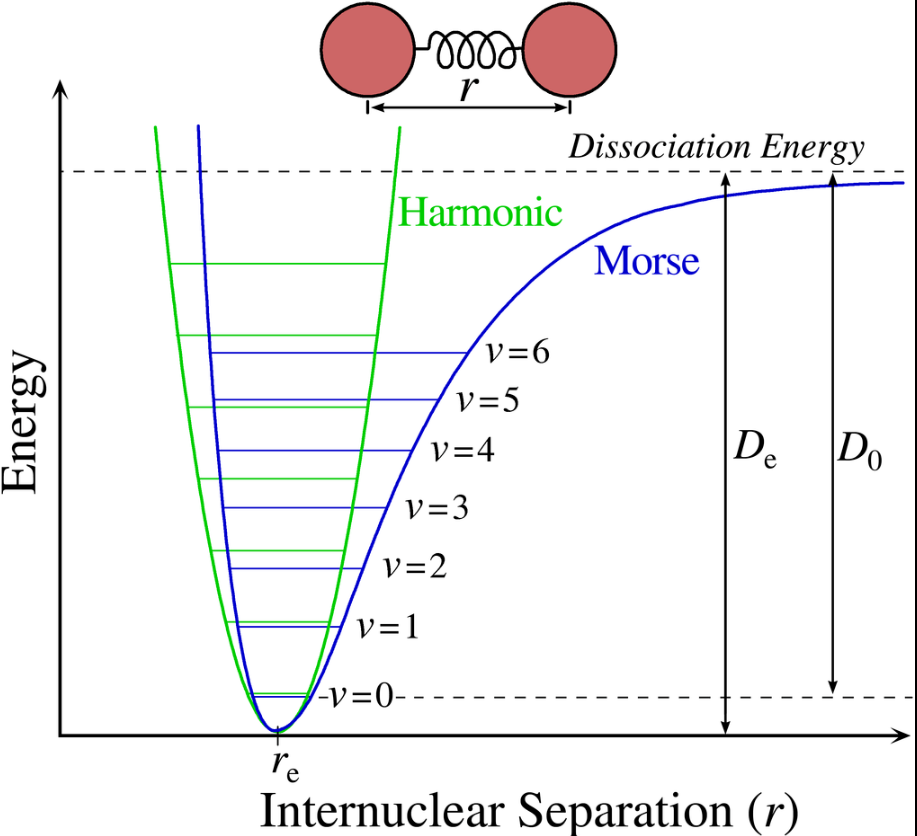
Remember the Morse curve from freshman chemistry? It describes the potential energy versus distance of two atoms at the scale of chemical bonds. The left side of the blue curve shows how steeply the repulsive energy potential rises (exponentially) with diminishing internuclear distance. By contrast, the attractive potential on the right of the blue curve flattens out with increasing interatomic distances. Keep this in mind.
When a fissile uranium-235 nucleus absorbs a neutron, the nucleus momentarily becomes unstable uranium-236. A stable nucleus has repulsive Coulomb forces between nucleons that are balanced at close proximity by the attractive strong nuclear force. The liquid drop model is useful for visualizing a nucleus as it fissions. On absorption of a neutron the uranium nucleus will distort to an elongated dumbbell shape leading to an imbalance of attractive and repulsive forces between nucleons. This can take the nucleus past the distance where the strong nuclear force attraction can hold it together. The strong nuclear force holding together nuclear particles (nucleons) falls off much faster with distance than does the Coulombic repulsion of protons. At the instant the nucleus separates into adjacent fragments, the two highly positively charged nuclei find themselves in very close proximity and are now only subject to net repulsive force. From the left side of the Morse Curve we can see that the repulsive force is exceedingly high in this moment. The highly repulsive potential energy is converted to kinetic energy at the moment the nucleus splits. The nuclear fragments fly apart at high velocity along with neutrons and dump thermal energy into the surrounding bulk material. But the kinetic energy of the fragments is not the only source of energy output.
Nuclear fission fragments are released in a highly excited state. Apart from their kinetic energy, nuclei have different energy levels with differing stabilities. A nucleus can undergo energy transitions from one state to another. These higher energy levels are called nuclear isomers and their stability can be expressed in terms of half-life. As fission fragments are formed they shed energy in the form of alpha, beta, gamma, and neutron emissions. Neutrinos are left out of this discussion for simplicity. As nuclei decay, they get closer to a stable ground state. Unstable nuclear fission products will decay in their characteristic ways, contributing to the overall energy release.
One challenge to weapons designers is to cause as many nuclei as possible to fission before the weapon undergoes “hydrodynamic disassembly” over the first 1 microsecond or less. After ignition the rapidly expanding plasma of the bomb core increases in volume and the probability of neutron collisions with nuclei diminishes rapidly. When a uranium or plutonium nucleus fissions, 2 or 3 neutrons are emitted which go on to strike other nuclei and induce fission in them. The cascading generations result in an avalanche of fissions. One of the ways to ensure that enough generations of fissions occur with enough neutrons flying about inside the supercritical assembly is to surround the core with neutron reflecting material. Ways of doing this can be found elsewhere.
One more thing about the strong nuclear force. This quote is from the Wikipedia entry for the strong interaction–
“The residual strong force is thus a minor residuum of the strong force that binds quarks together into protons and neutrons. This same force is much weaker between neutrons and protons, because it is mostly neutralized within them, in the same way that electromagnetic forces between neutral atoms (van der Waals forces) are much weaker than the electromagnetic forces that hold electrons in association with the nucleus, forming the atoms.“
A nuclear weapon produces a near instantaneous point source of energy release. These bombs can be detonated at or below ground or water level, or they can be set off in the atmosphere or space. The choice of where to do it depends on the intended effects. Subsurface bursts consume much of the explosive energy in moving soil or water which provides some radiation shielding to the surrounding area. Furthermore, bursts in contact with soil or water, especially when the fireball contacts the soil, tend to produce more fallout than air bursts. Air bursts deliver EMP, radiation and blast effects to a wider area, where “radiation” refers to neutrons, gamma and longer wavelengths of electromagnetic radiation. Thermal and blast effects produce considerable prompt destruction in the area surrounding the blast. As an approximate point source of energy, the intensity of the radiant energy falls off as some inverse square law. On an encouraging note, this means that radiation exposure falls off rapidly with distance. Distance is your friend.
There are numerous variations on the nuclear weapons theme. In the early cold war days, so called A-Bombs and H-Bombs were in the news. H-Bombs are also referred to as “hydrogen bombs or thermonuclear weapons.” An A-bomb, A for Atomic, was a basic implosion-type fission explosive and it was the typically the least powerful of the two. The H-Bomb was a nuclear fusion explosive that was triggered by a fission “primary.” That is, a fission trigger would be used to generate x-rays that would be “focused” onto fusion fuel, the “secondary,” which would initiate a runaway nuclear fusion explosion. The explosive yield of these bombs is much higher and can deliver a devastating blast to a larger area. Over time, the efficiency and compactness of these bombs has been greatly optimized.
The fusion explosive element was lithium-6 deuteride. The lithium atom would absorb a neutron, become unstable and decay into a helium-4 nucleus and a tritium (helium-3) nucleus. On a side note, in grad school I attended a seminar by Dieter Seebach from ETH, Zurich, who was talking about mechanistic work they’d done with lithium enolate complexes. He mentioned in passing that at that time, the mid-80’s, they had to be careful with stoichiometry because the commercial lithium that was available was often depleted of lithium-6 which was accumulated by the government for diversion to weapons. It was an unexpected brush with the cold war.
The main deleterious effect of radiation on human tissue lies in the formation of ions and radical pairs along the path of the penetrating radiation. The molecules of life are dissociated into ion pairs or radicals which may or may not collapse back to the original molecules. Given the amount of energy transferred into molecular dissociation along with random diffusion, the molecular destruction cannot be reversed. Heavy radiation particles like alpha particles produce a great many ions per centimeter of tissue penetrated. Penetrating, energetic photons like gamma rays produce relatively few.
There are 6 forms of hazardous radiation commonly considered- alpha, beta, gamma, x-ray, ultraviolet and neutrons. Of these 6, alpha, beta, gamma and neutrons are of nuclear origin. X-ray and ultraviolet are “electronic” in origin, that is they arise from electron transitions outside of the nucleus. The matter of the origin of x-rays is often confused in the literature with some authors implying that x-rays are from the nucleus. I prefer to define x-rays as resulting from electron transitions at the atomic level.
Of the 4 nuclear radiation types mentioned above, alpha, beta, and neutrons are particles. Gamma rays are photons. The atomic nucleus is comprised of so-called nucleons which are protons and neutrons. Nucleons are composite particles comprised of quarks and can bind by the strong nuclear force. Alpha particles are helium-4 nuclei and neutrons are neutral particles with approximately the same mass as a proton or about 1 atomic mass unit. Neutrons are not stable outside of the nucleus and have a half-life of about 15 minutes. Free neutrons will undergo radioactive decay into a proton, an electron, and an electron antineutrino.
Like gamma rays, neutrons are neutral in charge and have great penetrating ability. However, neutrons are effectively scattered by collisions with the hydrogen atoms of biomolecules and water. As a result neutrons can be very destructive to living tissue. As a side note, paraffin wax and water are effective shielding materials for neutrons due to the high concentration of hydrogen atoms. The collisions with hydrogen atoms in living tissues is a means of dumping neutron kinetic energy into the bulk matter, resulting in dissociation of biomolecules.
The so-called “neutron bomb” was an explosive that was designed to produce an abundance of neutrons at the expense of explosive yield. During the early Reagan years in the US there was much public handwringing about these bombs and their ability to kill people but leave buildings standing. People seemed indignant that somehow this reduced the value of human life below that of material things in the grand calculation of destruction.
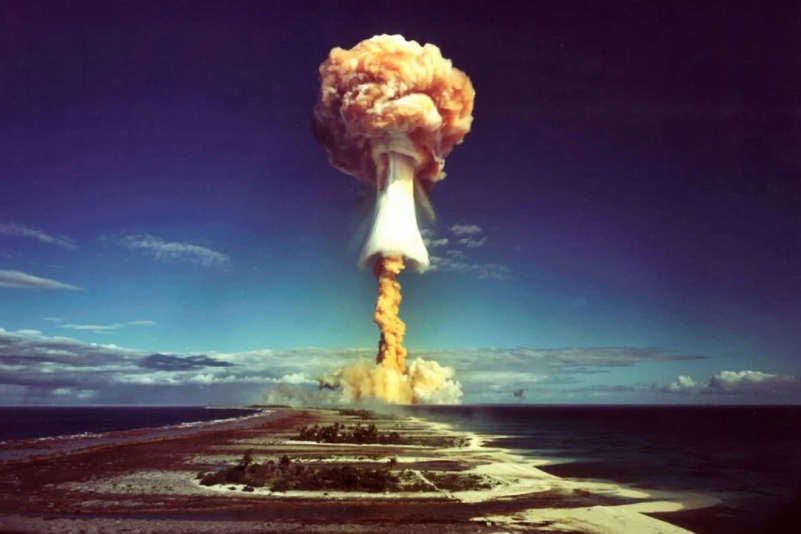
The characteristic mushroom shape rising to the sky after a nuclear air burst is just the result of a rapid release of energy and bomb debris in the air, but close enough to the ground to suck up soil. The “cap” of the mushroom results from the convectively rising point-source expansion of incandescent, debris-filled air from the point of energy release. The “stem” of the mushroom is a column of air that has rushed in to replace the rapidly rising fireball, picking up soil as it does so. There is nothing intrinsically nuclear about a mushroom cloud. Chemical explosives can do this as well.
Initially the fireball produces a strong pulse of thermal radiation. As this fireball develops, there is a momentary drop in radiant thermal energy due to the increasing opacity of the fireball. With further expansion the opacity of the fireball decreases and the thermal output increases. The shock wave and out-rush of air is obviously destructive, but the radiant thermal effects are not to be underestimated.
Another major effect of a nuclear blast is nuclear fallout. A nuclear blast unavoidably produces radioactive substances from the fission process and from neutron activation. A low altitude air burst is particularly troublesome because ground debris is sucked up into the air and contaminated with radionuclides. This material does what all suspended solids do, namely it is carried by the wind and falls back to earth gradually, contaminating a wide swath of ground. The finest particles remain suspended and are transported long distances, eventually falling out with rain or snow.
Finally, there are psychological effects associated with “the bomb.” It inevitably produces dread fear in people. This fear buttresses the idea of Mutually Assured Destruction or MAD.
Now that we are in a nuclear state of mind, let’s turn to what Putin intends to do with his nuclear arsenal. The Russians are not suicidal. Putin is neither crazy nor stupid. Russians have long understood where a nuclear confrontation with the West can go. They know escalation of nuclear war to full-scale would lead to mutual destruction of Russia and the West. The Russians know that the West has a policy of no first use with nuclear weapons and that we are extremely reluctant to use them. For the West, there is a firebreak between conventional and nuclear weapons. For the Russians, it is more of a continuum. They know that sabre rattling with their nuclear arsenal creates a good deal of anxiety in the rest of the world and Putin has been pushing this threat envelope to new levels and will keep doing so. Once a KGB guy, always a KGB guy. Putin obviously understands the pragmatics of coercion and the influential value of torture.
What nobody knows for sure is what happens when a Russian nuclear war shot is released. What does the West do? Respond in kind quickly or play the long game and see what happens next. How much planning has gone into nuclear conflict between two states outside of NATO? When would NATO step in? NATO is presently taking the side of Ukraine in terms of supplying money and arms but is studiously avoiding direct conflict with Russia. On the positive side, at least right now we aren’t bogged down with an endless middle east whack-a-mole exercise.
The best use of nuclear arms has always been and remains the threat of their use. Russia has been using this threat aggressively, even going so far as to blame Ukraine for planning a false flag operation with a “dirty bomb.”
Putin wants to see the alliance of the US and Europe disintegrate. He wants to see the American hegemony in place since WW II collapse. He wants to see the dominance of US culture, military reach, the influential dollar and prevalence of the default English language peel away. He wants to see Novorossiya rise from the ashes of the fallen USSR. But his vision requires the conquest of territory and cultural domination. The armed extinction project for Ukraine in process now will be followed by rebuilding the captured land with Russian infrastructure, political leaders and culture.
Russia, in its constant state of paranoia, wrings its hands about the “threat” of NATO at its border. The cruel irony is that it is hard to imagine that the West would find the conquest Russia possible or even desirable. The US-lead coalition was unable to get the medieval opium poppy kingdom of Afganistan under control with conventional weapons. How is it possible that we could even consider a preemptive invasion of Russia? Russia’s historical paranoia seems entirely self-serving for its authoritarian leaders.
One way to tear apart western alliances is to help them along with the demise of liberal democracy. Quietly support the internal cultural rot of individual nations by encouraging radical nationalism, white supremacy and political disharmony. It is happening all around us and especially here in the US. As badly as I’d love to entirely blame #45, I have to admit that he has only prodded a sleeping dragon. The MAGA and QAnon crowds were already out there. #45 has rallied them and validated their seething anger and indignation.
Today we have many people of great influence like Tucker Carlson, Alex Jones, Sean Hannity, nationalistic religious broadcasters, a stable of fringe political figures, and a mass of MAGA foot soldiers winning down-ticket elections moving their nationalistic and religious conservative agenda forward. Post-war baby boomers are being replaced with crowds and leaders who reject America’s present liberal democratic culture and leadership role in the world. There is growing open admiration for strongman authoritarian leadership. America’s experiment with fascism has already begun. Surprisingly, many Americans have expressed support for Putin.
Putin’s vicious attack on Ukraine, the rise of Trumpism with American fascism and a viral pandemic have overlapped within a narrow window of time- any one of which is a big problem by itself. It seems doubtful that MAGA right-wing crowds will have a change of heart in their vision for America. They will live out their lives within the same closed ideological space they are in presently. A political depolarization of America seems unlikely in the near term.
In this depressing global political climate it is more important than ever for the US to maintain its role as a thriving democratic culture and defender of those seeking democracy. Our leadership role in NATO must not waver against Russian aggression and expansionism. Russian expansionism will not end with Ukraine.
What will Putin do if he sees his internal political power structure collapsing? Will he ramp up the war to distract his opponents and rally the country? The present situation in Russia seems to suggest that rallying the population is more difficult than he anticipated.
It is hard to believe that Putin and his inner circle will change their ways in their lifetimes. They’ve painted themselves into a corner with their aggression and, like a trapped animal, will fight to the death. The cruel and murderous Joseph Stalin died in power. There is no reason to believe that Putin will be any different.
In an escalation of his bloody war, the mass murderer Vladimir Putin allowed his troops to occupy the large Zaporizhia 6-reactor nuclear power plant along the Dnieper River in southern Ukraine in March of 2022. In doing so he brought the front line to a uniquely dangerous location. The world has expressed its concern and outrage, but characteristically, Putin is unmoved.
According to one source, El Pais, “On July 20, the Ukrainians launched a kamikaze drone against Russian units positioned near the nuclear power plant. The DiXi Group, a Kyiv think tank focused on the Ukrainian energy sector, confirmed the “precision [drone] attack.” According to Energoatom, the Ukrainian state-owned company that still manages the Zaporizhzhia plant, the Russians countered by storing “14 pieces of heavy weaponry, ammunition, and explosives,” inside the turbine room of one of the reactors.”
By way of background, the nuclear reactors at Zaporizhia are of the VVER variety and are water-cooled, water-moderated pressurized water reactors. They are not of the same design as the Chernobyl reactors. Chernobyl had RMBK-1000 graphite moderated reactors.
On Thursday, 8/25/22, a fire at a nearby non-nuclear plant shut down external power to Zaporizhia plant. Previously, three other power lines had been shut down. It may seem odd, but a nuclear power plant needs an outside feed of electrical power to assure that the coolant pumps to remain in operation. As a last layer of protection, the cooling pumps can be powered by diesel generators on site while the outside power is restored. The nuclear disaster at Fukushima, Japan, in 2011 is an example of what happens when a nuclear power plant loses it’s cooling pumps.
Reportedly, power was restored to the plant later that day. Whether or not the fire and the power trip was war-related or not is unclear.
There should be no mistake in realizing that the terroristic Putin knows precisely what he is doing and will wring out from the occupation of the plant his greatest advantage. He advances his pawns by relying on international dread fear of a large scale radiation release- a truly frightening prospect.
In Update 88, the IAEA, the International Atomic Energy Agency, listed the pillars of indispensable nuclear safety and security-
Pillar 1 (Physical integrity): Any military activity – such as shelling – within, or in the vicinity of, a nuclear facility has the potential to cause an Unacceptable Radiological Consequence.
Pillar 2 (All safety and security systems and equipment must be functional at all times): As a result of the shelling, emergency protection was activated at one of the units, diesel generators were set in operation, and the nitrogen-oxygen station and an auxiliary building were damaged.
Pillar 3 (Operating Staff): This recent activity further increases the stress of the operational team.
Pillar 4 (Power supply): This has been compromised as a result of damage to the external power supply system.
Pillar 6 (Radiation monitoring and Emergency Preparedness and Response arrangements): In the current status of the site, this recent shelling further jeopardizes the already compromised EPR arrangements and capabilities to respond. However, the radiation monitoring system is still operational.
At some point in the future, the Putin war will be over. How it ends will largely be up to Putin or whoever surfaces after him. Eventually the Russian people, absent the malignant and unredeemable Putin, will have to be invited back as friends and neighbors onto the international stage as citizens of the civilized world. I hope that the strategic planners everywhere are thinking about this.
If you search Google News for ‘nuclear war’, you’ll find links to articles from a large variety of sources. Putin’s invasion and belligerent behavior has resulted in a great deal of media buzz which is rightfully spooking the world. Better relations with Russia began with the fall of the Soviet Union and has lasted to some degree up to now- about 30 years duration.
Along with the invasion of Ukraine, Putin has been making threats suggesting to some that we may be heading back to a world of nuclear brinksmanship. Nuclear sabre rattling largely disappeared sometime after the fall of the Soviet Union. For the past 30 years the world has carried on as though nuclear weapons don’t exist anymore. Everyone knows that the major powers have nuclear weapons and understands the rationale for Mutual Assured Destruction (MAD). This has been in the background. Yes, there are outliers like North Korea and Iran.
Ronald Reagan took exception to the logic of MAD and in 1983 announced the Strategic Defense Initiative (SDI), sometimes derided by the name “Star Wars”. Reagan promoted the plan by asserting that orbiting SDI platforms would make nuclear weapons obsolete, at least with strategic weapons like the ICBM. It was a grand plan to make the world safer. It certainly made the world safer for defense contractors. Many of us think that the program was really meant cause the Soviets to go bankrupt in trying to keep up with the west in SDI technology. After the Soviet Union collapsed, enthusiasm for SDI in its original form faded away. You can read about it in the SDI link.
With Putin, steel must be met with steel. He only respects strength. For this reason it may have been a mistake to announce that there would not be a no-fly zone enacted over Ukraine. Handing over certainty to Putin only emboldens him. We should have said that it is on the table and left him guessing.
The big question is what to do if, in desperation, Putin uses a tactical nuclear weapon in Ukraine? How should NATO respond? Whatever it is, there must be an unambiguous response. The choice for Putin to use a tactical nuclear weapon will only be difficult the first time it is used.
On the lighter side, if you don’t already know, now may be a good time to familiarize yourselves with nuclear weapons effects and how the bombs work. If you’re in Vegas, stop by the National Atomic Testing museum. Get familiar with mankind’s fastest and most spectacular expressway to the collapse of civilization! Remember, nuclear explosions are effectively point sources of heat and pressure. The effects fall off as an inverse square law with distance. Distance is your friend.
On the personal level, try to come to terms with the stochastic nature of radiation damage and the existence and effects of background radiation. The dose/response curve to radiation gets quite fuzzy at the lower dose levels. Remember, exposure and dose are not the same.
The tragic effects of this invasion on the Ukrainian people is horrible. But I have Russian friends and have been to Russia. I grieve for the Russian people who are unwittingly on this dreadful misadventure of Putin’s. During the last 30 years of relative peace Russians have known a much improved quality of life. It is awful to see this ripped away from them. Russia just can’t shake itself free of despotic leadership.
David Brooks has an insightful article on Putin’s view of the world and Russia’s place in it. An excellent interview can be found in Der Spiegel describing Putin’s character by Ivan Krastev from the Institute for Human Sciences in Vienna.

 Lamentations on Chemistry