Category Archives: Politics

The Three Pillars of Conservatism: Fear, Greed, and Anger

Every election cycle, we get to have a lingering look up the skirts of conservative dancers who tease the audience with alternating glimpses of their puritan knickers and their pasty white backsides. It is at once revolting yet fascinating in a sick kind of way.  Where are those dollar bills I brought …

Conservative Americans have made a virtue of fear, greed, and anger. This is one of the pure, crystalline forces of history. The Three Pillars of Conservatism.

Liberals fail in politics because they inherently misunderstand power and how it works. Conservatives have an innate grasp of power and suffer little from its wanton and extravagant use.  One never hears conservatives praising the ideals of the Greek thinkers. Conservatives are much more like Romans. The Romans made a show of conquest and of alignment to the doctrine and virtue of empire. Romans understood the value of bread and circuses. And that is what we get today every election cycle. A circus.

The Innate Appeal of Fear

I wrote a post a few years ago about a form of social reconstructionism that I recognized as a rebirth or perhaps, a reinvigoration, of the John Birch Society philosophy in American politics. I have noticed of late that others are making this connection as well. 

With the ascendancy of the confederate vaudevillians Glenn Beck and Sarah Palin as well as the Tea Party, Bircher political philosophy is being rediscovered.  Only, I’m certain that few of its new adherents have realized it has a name and is a 50’s cold war relic.  With scholars like Glenn Beck delivering lectures from his Fox TV lecture hall, the Tea Bag side is busily manufacturing consent by doing what preachers have done for a long time. By preaching that our society is in collapse and that the only way out of the impending disaster is to follow their recommendation.  This might be manifested as a more rigid adherence to teaching, or as has happened since the 1980’s, greater assertion of influence in political and social reconstruction. 

The Sky is Falling!!  -C. Little

There is a certain innate appeal to Bircher Philosophy that satisfies the inner fascist in all of us.  It is a manner of thought that feeds directly and almost unfiltered from the fear cortex of the brainstem. When uncertain, be afraid. No need for thoughtful analysis, just reject the unfamiliar. Distrust everything.  If it ain’t ‘Merican, then it ain’t no damned good. Study these principles devotionally, not analytically.

Bircher doctine serves as a political glove over the hand of protestant Christian evangelical fundamentalists who seek to de-secularize American culture, which includes government and the public arena.  They see our country as an errant Christian state taken off-track and into a condition of fallen righteousness by elitist liberal intellectuals bent on some kind of social buggery.  Listening to these folks, it would seem that they are engaged in a great battle between the forces of Heaven and the liberal leather-winged angels of darkness.  I think they have been watching too many Cecil B. DeMille movies.

Running a secular democratic state like the USA is hard to do. At least some citizens will demand an explanation for any given decision.  And they’ll want to argue. But a state run according to some religious conservative principles, well, that’s different.  Iron age justice is swift and harsh.  And how do the leaders know what to do? God came to them and expressed His conservative wishes. See, isn’t that so much easier? None of this ambiguity. It’s all so easy to understand.

I do agree with the conservative side in one way. The federal government is just too large and over reaching. But killing it while the citizens sleep is not the answer.  Neither is replacing it with market-style dynamics or reverting into a Confederate States of America.  The American experiment does not reduce to just a market phenomenon and was not kept running exclusively by righteous church-going people.  It does not reduce to a mere extension of the principles of the founding fathers either. It is all of that and much more.

It is the result of hundreds of millions of hard working, clever people who were born or naturalized into an enabled society without having to adopt narrow doctrines on how to think or without impermeable social strata. The American phenomenon is an artifact of the bell curve. It is the expression of a statistical distribution of individuals making a contribution to the betterment of our society by improving their own lot.  All citizens have the right to think as they please and we do not need conservative clowns to rally the dark side in all of us so that they can achieve their personal needs.

Obstreperous Theocracy

So it appears that the US is quietly building up military forces within striking distance of Iran. The island of Diego Garcia (UK) has served as a staging area for standoff weapons. The military-political establishment has been busy with threat analysis and is evidently staging forces to some extent based on their conclusions and evolving policy.

I think there are many credible arguments that rightly assert that Iran is an active threat to what passes for stability in that region. Or at least at the first-order level of political analysis. Iran is plainly an obstreperous theocracy with a particular zeal for the export of its orthodoxy.

As always, the drums begin to beat for war and the business of manufacturing public consent begins in earnest. I’ll go out on a limb and make a gross generalization. All human populations seem to have a fraction, say 1/4 , who are particularly fearful by nature. These are the folks who susbscribe to concrete notions of nationalism, righteousness, and the associated keenness for adherence to orthodox doctrine. These were key proclivities of the US/Soviet cold war era. It is part of a collective consciousness that is especially adept at finding patterns that validate its fundamental fear.

It would seem that we may be in yet another run up to the projection of force on the far side of the world. A good question would be this: Are we addressing the fundamental cause of World-vs-Iran conflict? At minimum we trying to shore up the result of a century of bad western foreign policy.  This region is at the overlap of profound social forces associated with abrupt infusions of petrodollars, reflexive militarism, ethnic antipathy, and religious orthodoxy.

I think that Chomsky has some valid points about the origin of these conflicts. Iran and other groups have used the Israeli-Palestinian conflict as a bully pulpit for their own regional ambitions. Obviously there is sincere religious and ethnic outrage over the the Palestinian issue. But a state like Iran is sure to use this conflict to their own political advantage to exercise the projection of power.

The US and other western states have chronically miscalculated the magnitude and direction of regional conflicts.  For instance, would a military strike against Iran be viewed as just an attack on the government of Iran, or as an attack by infidels on Shi ‘ism? Are we prepared for what would follow? I think I can guess the answer.

Russia being Russia

It was reported that the Russian Parliament has approved a draft of a law to increase the powers of its FSB, or the remnant of its Soviet era KGB.

The final version is somewhat weakened from its earlier form, which prescribed punishment for individuals who ignored such warnings from the F.S.B. In remarks posted on his party’s Web site this week, Vladimir Vasiliyev, the chairman of the State Duma’s Committee on Security, described the new power as “a preventive conversation” with “someone who is beginning to move toward committing a crime.” (New York Times, July 16, 2010)

Imagine that. A Future Crimes Division.

When asked about the bill by a German reporter during a meeting with German Chancellor Angela Merkel on Thursday, President Dmitri A. Medvedev said, “what is going on now is the result of my direct instructions,” and that foreign commentators should not concern themselves with it. (New York Times, July 16, 2010)

The police state is back. The Russian gov’t is moving (back) towards policing perceived intent. What a sad day for Russian civilization and the world.  Queen to E5, check.

BP oil spill. What are the merits of using dispersants?

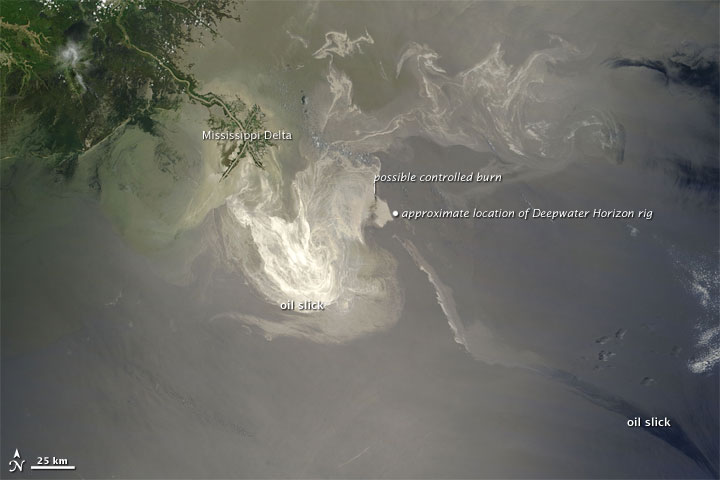
BP Oil Spill Image, May 4, 2010 (NASA Earth Observatory)

Oil Spill near Mississippi delta. Vegetation, red; Oil, silver. MA 24, 2010. (NASA Earth Observatory photo)

Eventually, BP will find a way to block the discharge of petroleum into the Gulf of Mexico.  And, eventually, the effectiveness of how the relevant parties responded to the incident will be analyzed and findings posted.

I hope that some effort will be put into an analysis of the merits of using dispersants in general and Corexit in particular. What sparks my comment is the finding that considerable subsurface petroleum has been found. This material is evidently close to neutral buoyancy and is drifting with the currents.

Question 1: Is there a connection between the dispersant use and the presence of this subsurface body of petroleum?  

Question 2: What is the desired outcome of dispersant use?  Where did the planners think the petroleum would go?

Question 3: Is there any advantage in encouraging petroleum to remain below the surface, if that is even possible?

At some point, a decision was made to use dispersants on this massive discharge. Is there a scientifically supported rationale for this, or was it palliative treatment intended to mask the surface effects of the release?

Does Corexit really correct it?

According to news sources, BP is allegedly using a dispersant called Corexit EC9527A.  According to the EPA this formulation contains water, propylene glycol, and 2-butoxyethanol, as well as an unspecified confidential additive.

I guess the question is, what purpose does this treatment serve? By dispersing the petroleum, I assume that the effect is to spread a given mass of petroleum into a larger volume of sea water by virtue of producing dispersed globules of oil-phase material. Does the increased surface area result in off-gassing of volatiles and subsequent submergence of the now denser oil phase? Or, will the dispersed petroleum simply drift into larger patches of oily water? If it enables an increased dispersion so that the currents can chaotically distribute the petroleum to a greater range of shorelines, is this treatment of any real benefit? Perhaps it is better in the long run to have a heavier coating on fewer beaches? Less acreage to scrape.

EPA is making noise about BP’s choice of Corexit. Seems to me that butyl cellosolve has been in the market for quite some time. There should be some information on its fate in the watershed. Judging from the map, the oil spill is near the dead zone around the mouth of the Mississippi River. So, until somebody gets some survey data, it’ll be hard to estimate the magnitude of the environmental insult of this event to the open ocean.

I do not understand what government officials were trying to do by saying that they might take over control of this spill. What is the government going to do to a petroleum discharge a mile below the surface? Call the Navy? Or Boots & Coots? As good as these guys may be, they’re land lubbers. 

Let the folks at BP finish the job.

NASA Earth Observatory Photo, May 24, 2010.

Rand, Ron, and Ludwig

Disclaimer: I’m neither an expert on or an enthusiast of orthodox libertarianism. I think it is yet one more narrow utopian social philosophy that a band of economic puritans want to impose on society. To their credit, it is a scholarly economic theory. But it seeks to validate and legitimize the most selfish and materialistic impulses of our primate sensibilities.

I have a comment on the recent public flare up on comments by candidate Rand Paul of Kentucky.

Randal Paul, son of Ron Paul, seems to be very much influenced in his thinking by his father and by Ludwig von Mises. I would characterize father and son as ultra-orthodox libertarians (if only by virtue of their scholarship) along the lines of the Austrian school but lacking the John Birch Society fascist and theocratic elements. I sincerely acknowledge their understanding of economics and history. However, I must differ in regard to their understanding of the non-mathematical aspects of civilization. 

Rand Paul’s recent expression of his views on the civil rights act comes straight from the Austrian view on statism. It is right out of the textbook. The man is not a racist. He just does not approve of the intervention of the state into the affairs of a property owner. I think he would prefer to see market forces solve the problem in the domain of private property.

The problem is that market forces have a substantial element of greed. And greed is what greed does. Social justice is orthogonal to greed forces. American slavery did not end because the market found a way out of it. The slave states were deeply dependent on the economic advantages in labor overhead that slavery provided. The nonmarket forces- government- that are inevitable in civilization intervened and put an end to it.

The impulse to accumulate power is expressed in the market and in government. Power is the ability to allocate resources. The domains of both government and business need to be watched closely because both are subject to the corruption of greed. Both socialism and libertarianism are utopian in their conception. Both tend to fail because adherents must rely on the adoption of their tenets by diverse groups. Both require a kind of homogeneity in thinking that is inherently unstable over large populations. Neither seems willing to accomodate a bell curve of views and behaviors. 

Just read history. You can’t even get large populations to agree on how to enable or even what is meant by the meaning of life, liberty, and the pursuit of happiness.

I fail to understand how people who do not trust big government can somehow trust a business system which can fund methods to override the checks and balances of a natural market. The notion that consumers actually have power through the allocation of their dispersed resources is perhaps partially valid in a village market. It fails in contemporary society because businesses are focused and populations tend to be defocused. 

Advertising works. Consumers are subject to suggestion by advertising influence. Consumers are not perfect, rational economic units. In some ways, we are fish in a barrel.  Businesses can obtain patents or assemble local monopoly and dominate a market in a way that consumers are powerless to respond. Look at how big box stores can move into a local market and dominate. They do provide lower prices, but they also offer a channel for foreign suppliers to cross the border and invade a market for the profit of corporate owners who live elsewhere. They apply instant globalization to local markets that are ill equipped to compete. Economic purists would say that local businesses are unfit in this circumstance.

The proclivity to trend into big-brother influence seems just as certain with business as with government. The purpose of civilization is to buffer the Darwinian forces of nature and make life less brutal and short. Government provides a way to accumulate resources and focus effort on large scale infrastructure and allow access to all. Access to infrastructure facilitates innovation and economic growth and diversity. If you don’t like infrastructure, move to Haiti or Somalia where you’ll be blissfully free of it.

Government can grow to the detriment of all. And, arguably, it is in such a position now. But to abandon this important element of our culture in favor of a more Darwinian approach to everything is a utopian dream that will not come to pass. Libertarians need to develop some pragmatism.


Manufacturing Consent

The Palin phenomenon is an exercise in manufacturing consent. It is happening before our eyes. The GOP media machine is tunneling under the democratic ramparts and allowing the gravity of doubt to bring the walls crashing down.

While the conservatives are beavering away underground in the muck, the eternally frenzied media is handing the conservatives exactly what they want- air time on the talking points of their choosing. Since media people view the world as an everlasting stream of dramatic sequences, they are naturally drawn to the Palin freakshow like flies to a steaming road apple.

An electorate that put GW Bush in office twice is certainly an electorate that could be moved to put Palin in office. A President Palin wouldn’t be the end of the world, 2012 allusions aside, but it would definitely be emblematic of US culture. And that’s an emblem I would rather not wear.

Republican swine riled over Obama Nobel Prize.

It is embarrassing to watch Republicans lift the soggy, fetid moss they’re hiding under long enough to stage a mini pageant of mock righteous indignation on President Obama’s Nobel Peace Prize. What a bunch of knuckle heads. They’re always angry about something. 

Is the Prize Committee trying to encourage the cause of peace? Sure they are. Is it premature? Yep, but it is done. Let’s take it and make it work for peace.  Somebody needs to try promote peace without the use of mechanized infantry or drones packing hellfire missiles or cluster bombs. Modern warfare is a form of pornography that gratifies the deepest and darkest of bloodlusts. We need to recalculate the guns vs butter equation.

Afghan Talibanistan

Afghanistan is a country that spontaneously generates Taliban like the USA generates bowling leagues. Afghanistan is a country that produces most of the worlds opium (morphine) and depends heavily upon this form of produce. In case you’ve forgotten, heroin is acylated morphine. 

Afghanistan is a tribal confederation. The country has a very complex history of bloody invasion and occupation. Afghanistan is still gripped by fundamentalist religion and fierce tribalism- a fulminate and gunpowder combination. 

The USA exists as a democratic state today only as the result of a lengthy and self-imposed European evolution from medieval monarchy to democratic constitutional government over, say, 7-800 years from the signing of the Magna Carta to the US constitution. This is one metric. 

Afghanistan has not produced what the rest of the world would recognize as modern institutions and democratic ideals. Afghanistan did not produce a Magna Carta nor an intellectual renaissance producing steam power, electricity, metallurgy, or modern concepts of economics. In fact, much of Afghanistan outside of Kabul shows precious little interest in modernism of any sort.

So, the question is this- What do we hope to accomplish by our invasion of Afghanistan? Exterminate Al Qaeda? At its core, Al Qaeda is an idea. You cannot redirect intrenched ideas with an army.

Other than whack-a-mole military operations fighting insurgents who are armed by powers hostile to the US, we are left with trying to instill a sense of national identity by the installation of basic democratic ideals and institutions in what is little more than a tribal confederation. Afghans have no discernable history of gladly adopting western ideals. And the Afghans adhere to a religion that is poorly compatible with western ideals as well. How do US troops know if the bullets flying by are from the Taliban or from Al Qaeda guns? Just like Viet Nam, much of the indigenous population supports the insurgents either naturally or by coercion.

So, realistically, what does minimally acceptable success in Afghanistan look like? Would we recognize it if we saw it? How much residual Talibanism is acceptable to the occupying powers?